STUDY PROGRAM “HOME ENVIRONMENT
AND INFORMATICS IN EDUCATION”
DEVELOPING OPPORTUNITIES
Natalia Vronskaya
Latvian university of Agriculture, Jelgava, Latvia E-mail: [email protected]
Abstract
The aim of the research is to clear up the necessity of the information and communication technologies (ICT) integration methodology, offered by author, in the household and home economic education. Studies with the ICT integration methodology, worked out by author, include: 1) possibilities of unassisted and intensive household, home economic and informatics mutual integration providing and development; 2) diversifying and improving of study methods; 3) extended application of ICT. Worked out ITC integration methodology was evaluated with analytic hierarchy process (AHP), by comparing defined criterions and sub-criterionscoupled together in relation to set aims. According to global priority summary of experts, it is possible to conclude, that the highest total rating have alternative studies with the global priority vector of ICT integration methodology – 0.393. As well as compliance with study content based on criterions (0.321) and the effectiveness of studying (0.248) the first place takes alternative studies with ICT integration methodology. It means, that worked out and offered by author ICT integration methodology is necessary in household and home economic studies.
Key words:ICT, household and home economic studies, alternative, integration methodology.
Introduction
the newest information and communication technologies (ict) take more important place in education. since process of society informatization is irreversible- young generation will have to live in environment of informatization, therefore usage of information technologies’ (it) methodology in education have to be improved.
it is necessary in education to promote innovation to make education and training more flexible and open as well as to develop more effective relationships between providers, employers and guidance services. more interaction will promote more skills–based qualifications and ensure continuing and lifelong education and training for all. it is necessary in education to promote the development of skills, to develop the right mix of skills. specific job related competences learned throughout education and training must be underpinned by interdisciplinary competences, especially ict competences (report by expert Group on new skills for new Jobs, 2010).
b. Zwaneveld and t. bastiaens consider that teachers should have following competences when they want to integrate ict in education:
1. individual media-competencies – this includes the basic knowledge and skills the use of ict.
2. critical media-competencies – this includes the skills to select critically the media in the teaching process of students.
of education in the 21st century Volume 38, 2011 123 4. educational-design competencies – this competence includes developing in a right way the
necessary learning materials en didactical activities by means of ict and new media. b. Zwaneveld and t. bastiaens argue that until now too little time is spent on didactical formations to teach teachers to use ict (Zwaneveld & bastiaens, 2007).
in the netherlands some articles have been published about the use of ict in teaching including a description of the ict competences of teachers, for example p. Kirschner, i. Wopereis and p. Van den dool (2003) and p. hogenbirk (2006).
p. Kirschner, i. Wopereis and p. Van den dool made an overview of the professional competences of a teacher. With respect to ict they formulated:
• personal ict competences: teachers in training should have basic skills in office applications and applying these skills in communication;
• ict as mind tool: teachers should be able to use applications to support meaningful thinking and working;
• ict as pedagogical tool: teachers should enhance their knowledge, skills and experience in resource based learning and collaboration in digital environments;
• ict as teaching tool: teachers should know the educational possibilities and impossibilities of ict;
• social aspects of the use of ict: teachers should not only be aware of ict, but also deliberately use ict (Kirschner et.al, 2003).
a teacher is ict competent in his professional development when he can plan and perform activities with the help of ict, which aim at the development of his teaching in general and at the welfare of his student in particular.
currently big importance is attached to ability to integrate ict in education therefore prospective teacher of household and home economics has to be able to know ict and freely orient in world’s informative environment: to search, understand and classify information; to select and pick out necessary and useful from huge array of information and after that use it in practice, share with pupils to create new knowledge and skills.
the investigated problem is development possibilities of study program Home environment and informatics in education (HE&IIE) at use of ict.
Educational Alternatives of the Study Program HE&IIE
the professional highest education bachelor study program HE&IIE was formed on the basis of academic study program supplementing with practical handicraft classes and field methodological practices in the end of each study year. on this study program he&iie study on this study program he&iie study the prospective teacher of household and home economics.prospective teacher of household and home economics.
analysing this study program is concluded, that the courses relevant to household and home economic as well as informatics are included in sufficient amount.
for four academic study years total of contact hours at informatics study courses (for example: computer basics, application software, computer Graphics, classrooms computer networks, it in education, data bases) is same as well as at household and home economic study courses (for example: composition and colour studies, interior design, embroidery, Knitting, crochet, Weaving, Wood and metal processing, modelling). it means that the prospective teacher of household and home economics well enough know computer science.
program HE&IIE, by offering the worked out ict integration methodology.
Educational Alternative – Studies with ICT Integration �ethodology – Studies with ICT Integration �ethodologyStudies with ICT Integration �ethodology
directions to improve the quality of studies are:
• unassisted and intensive household, home economic and informatics mutual integration providing and development in studies;
• diversifying and improving of study methods;
• extended application of ict (the carrying out necessary calculations for choice product to make, visualization and shaping of household product using the special household and home economic computer programs, current and final achievement control organizing in the household sphere etc.).
today it is necessary to work with such up to date technologies as videoconference, interactive blackboard and digital document camera, because the lecturer by using possibilities of these new interactive ict will be able to attract attention of the audience and communicate in the highest level of communication, due to the interactivity of audio-visual possibilities of ict.
it is considered that it is possible to improve the effectiveness of the lesson in study course household and home economic by using interactive blackboard, for example, in the planning of family finances or for conforming the clothing to corresponding style, or for shaping the design composition of room, that is possible to make in groups and to make comparison, or for composing of menu virtually in groups, when, for example, one group thinks out the menu, the second group virtually lays the table. after the completing of task, each student individually evaluates the corresponding of lying to offered menu, by using interactive response system.
With the digital document camera, for example, using zoom it is possible clearly demonstrate how to tune the size of knitting needle to appropriate diameter of wool, or to show, how it is possible to embroider, for example, drawn-thread work or cross-stitch, as well as by dividing the screen in two parts, it is possible to make draft, leaving the draft in one side of screen and in the second side showing, how the actual final shape of draft develops. by help of the digital document camera or video camera, during household and home economic lessons it is possible to make video records how the product is coming formatted in specific theme, for example, in the batik lesson, dividing in three groups (tie, hot and silk batik).
by help of different computer programs it is possible to show the content of household and home economics in dynamic format, by mutual combining of text, graphic, diagrams (�S PowerPoint), video and sound effects (�ovie �aker), making interactive control tasks of achievements (Hot Potatoes), drawing drafts and making compositions (Adobe Photoshop, Corel Draw, Gimp) as well as using different special household and home economic computer programs (Stitch Art Easy, Calling Knitting, �yCrochet, WeavePoint, Pattern CAD), that is provided for facilitation and acceleration of household product preparing works technological process.
the ict integration methodology was created, evaluated and compared with two other development possibilities of study programs: 1) studies with current methodology, 2) e-studies.
Educational Alternative – Studies with Current �ethodology – Studies with Current �ethodologyStudies with Current �ethodology
radical changes in the professional highest education bachelor study program during studies of nascent household and home economic teachers are not foreseeable.
of education in the 21st century Volume 38, 2011 125 competence during studies, and after that creative to use it in their pedagogical practice. students have possibility to use study aids and study materials in e-format prepared by lecturers as well as to submit self-contained works to lecturers in e-mail format and get consultations, if it is necessary.
for evaluation of study achievements different evaluating forms and methods are used according to aims, set in study course (seminars, tutorials, essay, self-contained works, tests, reflections). the lecturers use multimedia in study process.the lecturers use multimedia in study process.
the study work is purposefully promoted to stimulate, promote and support the activity of student, self-dependence and cognition interest. lecturer year by year ever realizable takes the role of consultant, organizer of discussion, and organizer of studies.
Educational Alternative – E-Studies – E-StudiesE-Studies
this environment exists on server and the users can reach system via internet browser. the lecturer by locating teaching materials in e-study environment, allows for students in due time introduce with them, in that way more time remains for discussions and talking about another similar problems. therefore it is possibility to acquire the study theme deeper (latvijas Lauksaimniecības universitātes e-studijas, 2011).
e-study environment offers different tools to make the acquirement of study course more affectively. in e-study environment the lecturers have possibility to upload and publish the study materials that is necessary to study work or simply to store them, students can download different study materials as well as submit their self-contained works, it is possible to apply time limit, the deadline for submitting of these works. lecturer can evaluate the work by looking it in e-study environment, create online tests or questionnaires for students that are possible to evaluate by mark. student can see results in mark book in e- study environment. it is possible to communicate with lecturer, to clear up the thing that he don’t understand or to discuss learnable theme, in that way the feedback is developing between student and lecturer. lecturer in his turn can make analysis after some testing and see in what questions students have been more mistaken as well as average mark or success level of the students of the given year. the location of study materials in e-study environment saves finances that are required for multiplying a distribution of study materials.
the aim of research – to found out the necessity and importance for ict integration methodology in household and home economic education as a whole and in study program HE&IIE in particular.
Methodology of Research
the improving of study program HE&IIE learning methodology with ict integration methodology worked out by author was evaluated using ahp. 10 experts took part in research (the lecturers from latvia university of agriculture, faculty of engineering, institute of education and home economics as well as students - nascent teachers of household and home economics.)
at first experts was introduced with ict integration methodology improvement offered by author and three possible alternatives: studies with existing methodology, studies with ict integration methodology and e-studies. after that experts, using relative relevance scale (saaty, 2000), mutually compare defined 5 criterions and 16 sub-criterions in pairs in relation to total aim, i.e. development possibilities of study program HE&IIE.
to perform ahp have been developed following five criterions:
of time to work out study materials, training of lecturers, and control of learning achievements;
compliance with study content with four defined sub-criterions – the international cooperation between education institutions, the stimulation of lifelong learning and deeper learning of students, development of professional, and social and methodological competences;
effectiveness of studying with three defined sub-criterions –development and improving of knowledge, skills and professional competitiveness, and stimulation of internal growth;
psych-emotional convenience of study program acquiring with three defined sub-criterions – the development of student personality, nonverbal and verbal communication with lecturer, and ergonomic of learning environment.
further in accordance to relevant expressions from ahp (saaty, 2000), there was worked out calculations of priority vectors as well as definition of coherence index, to evaluate how the activities of expert corresponds to given method when he composed the table necessary to research.
the processing of all evaluations data of experts was carried out using ms excel software, by calculating the average value of corresponding priority vector and showing it in graphic.
Results of Research
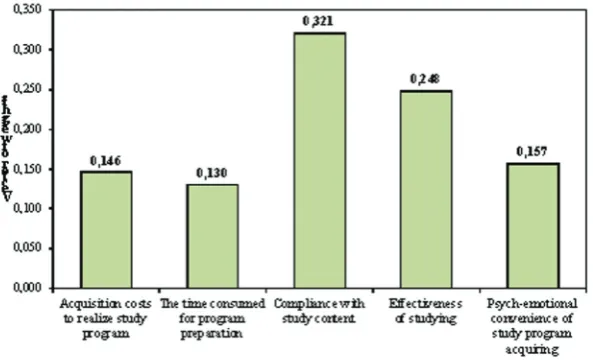
initially the data analysis was carried out for each criterion by mutual comparison, and clarified for comparisons asking two questions: �Which is more important with respect to thecomparisons asking two questions: �Which is more important with respect to the criterion?” and �how strongly?” the evaluations of five criterions of experts are summarizedthe evaluations of five criterions of experts are summarized in the figure 1.
Figure 1: The evaluation of experts after mutual comparison of criterions.
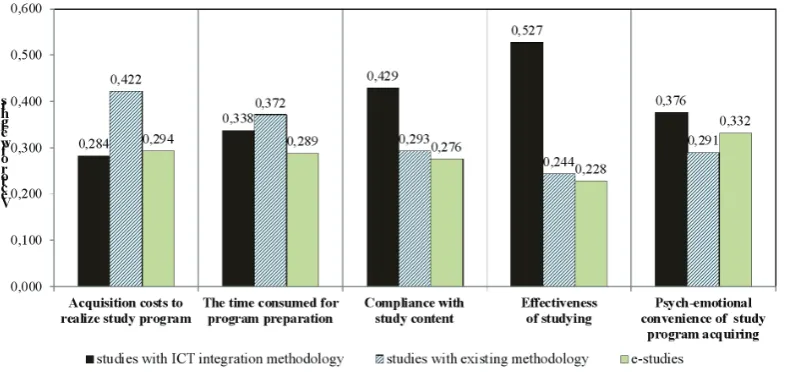
of education in the 21st century Volume 38, 2011 127 the following analysis of data is the expert’s evaluation about development possibilities of study program HE&IIE. each offered alternative (studies with existing methodology, studies with ICT integration methodology and e-studies) was evaluated according all sixteen sub-criterions (figure 2).
Figure 2: The evaluation of development possibilities of study program by ex-perts.
according to criterion acquisition costs to realize the study program the highest evaluation received alternative studies with existing methodology with vector of weights – 0.422. in the second place there are alternative e-studies – 0.294, after that follows studies with ICT integration methodology – 0.284. it is possible to explain such distribution by the fact, that for studies with existing methodology all necessary aids are delivered and acquisition costs for program realizing are not essentially. also for e-studies it is not necessary to consume lot of resources; therefore this alternative is evaluated as the second. in return for studies with ict integration methodology there is necessary to consume a lot of finances – both for purchasing of special household computer programs, and improving of lecturer qualification.
according to criterion the time consumed for program preparation the highest evaluation again received alternative studies with existing methodology with vector of weights – 0.372. in the second place there is an alternative studies with ICT integration methodology – 0.338, after that follows alternative e-studies – 0.289. it is possible to explain such distribution by fact, that for studies with existing methodology learning and achievement controls materials are already worked out end in the case of necessity, there get improved. for studies with ict integration methodology and e-studies there is necessary time for both learning and achievement control materials preparation, and lecturers training. in e-studies environment learning and achievement control materials will take more time than in studies with ict integration methodology. in return more time will be consumed to prepare lecturers in special household and home economic computer programs that are provided in ict integration methodology.
according to criterion compliance with studies content the highest rate this time takes alternative studies with ict integration methodology with the value of global priority vector – 0.429. in the second place there are studies with existing methodology – 0.293 and then follows e-studies – 0.276. such distribution is because stimulation of students’ lifelong learning and deeper learning is going on with the ict, because using of ict comes more necessary and real more and more.
- 0.527. in the second place there are studies with existing methodology – 0.244 and in the third place there are e-studies – 0.228. such distribution is because the development and improvement of knowledge, skills as well as development of professional competitiveness currently have been popularized by the possibilities offered by ict.
according to criterion psych-emotional convenience of study program acquiring the
highest evaluation received alternative studies with ICT integration methodology with the value of global priority vector - 0.376. after that follows alternative e-studies – 0.332 and then studies with existing methodology – 0.291.
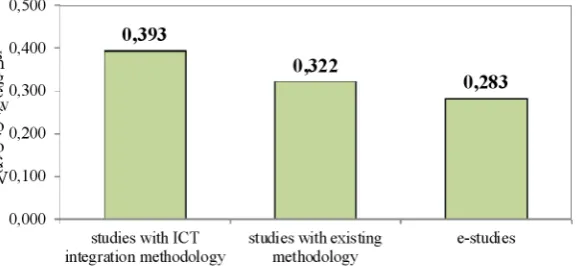
as the last one, the summary value of global priority vector was calculated, where the average values of corresponding priority vectors are showed (figure 3).
Figure 3: The summary of experts’ global priorities about development possibilities of study program HE&IIE.
the highest total rate after all sixteen sub-criterions have alternative studies with ICT integration methodology with the value of global priority vector - 0.393, then follows alternative studies with existing methodology with the value of global priority vector - 0.322 and the third place based on experts evaluation takes alternative e-studies – 0.283.
for criterions acquisition costs to realize study program and the time consumed for program preparation more preferable alternative is studies with existing methodology, because there is not necessary to spend time for preparing as well as financial resources to formation. in return, according to criterion compliance with studies content and effectiveness of studying in the first place comes the alternative studies with ICT integration methodology. it is possible to see in fig.1 that by making mutual evaluation of criterions, experts give the highest rate to criterions compliance with studies content and effectiveness of studying.
it means that the worked out and offered by author ict integration methodology is necessary in household and home economic studies.
Discussion
d. Wagner, r. Kozma, K. hepp, s. hinostroza, m. laval, f. rehbein, W. pelgrum, n. law are convinced that ict, if properly integrated, have the potential to enhance the teaching and learning process (Wagner&Kozma, 2005; hepp et.al, 2004; unesco, 2003; pelgrum &law, 2003).
When ict was introduced in educational institutions, teachers often got formations oneducational institutions, teachers often got formations ons, teachers often got formations on how to use technology. still today these kinds of formations are successful.
of education in the 21st century Volume 38, 2011 129 the advantages to increase communication among students. seven bases for ict education were suggested:
1) a better cooperation between students; 2) active learning;
3) direct feedback;
4) better and more contact with teachers; 5) possibilities to learn in different ways; 6) contextual learning;
7) a larger spread in different ways of teaching and learning (baars, 2006).
r. Kozma consider that ict can be used to improve student understanding, increase the quality of education, and thereby increase the impact of education on the economy, also knowledge creation, technology, technological innovativeness, and knowledge sharing can contribute to the transformation of the education system and to sustained economic growth and social development (Kozma, 2005).
the realization of self-education principle is especially important nowadays, because due to science and technique fast developing, knowledge acquired in education establishments quickly becomes out-of-date, and therefore it is necessary for non-stop updating and making them richer. to realize life demand, during study process lecturer must persistently stimulate students to self-contained work to acquire knowledge, to teach using of catalogues, internet searchers, home pages and other reference objects (albrehta, 2001).
the student is in the centre of education process, he is prepared to any task acquiring and memorizing that is interesting for him. concentrating to student and his ability, lecturer approach to study process from the viewpoint of humanistic approach and organizes educational process, by using approach oriented to student (bazens, 2008).
each student must acquire certain knowledge and skills and must be motivated to realize sustainable development during all life – in the family, school, high school and work by developing lifetime education (Zeltiņa, Glikasa and Karule, 2009).
Conclusions
technology is part of the formation, but ict competencies for teachers requires much more. teachers are part of school-live. if ict competencies have to be developed and shown in teaching process, the management have to develop a climate that encourages the high-tech-use in educational institutions, also students have to be encouraged to learn using high-tech.
education with ict promotes a thematic and integrative approach to teaching. this approach eliminates the artificial separation between the different disciplines and between theory and practice that characterizes the traditional approach.
it is necessary that teachers develop students’ ability of applying ict in household and home economic studies and elevate students’ competitiveness in the digital era through high-grade diverse information about ict using in education.
usage of ict promotes individualization of study process which depends on qualification level, skills, individual peculiarities of acquiring learning material, students’ interests and needs; as well as it promotes students’ character of cognitive activity change to higher self-dependency, investigative activity and aspiration to independent self- improvement and self-education.
Acknowledgements
albrehta, d. (2001). Didaktika. Rīga: RaKa.
baars, G. J. a., Wieland, a., Van de Ven, m. J. J. m., Jager, K. m. (2006). Leren (en) doceren met digitale leermiddelen in het hoger onderwijs. nederland: lemma, den haag.
bazens, t. (2008). Efektīvas mācīšanās rokasgrāmata. Rīga: Jāņa Rozes apgāds.
hepp, K. p., hinostroza, s. e., laval, m. e., rehbein, l. f. (2004). Technology in Schools: Education, ICT and the Knowledge Society. Retrieved 03/11/2011, from http:// siteresources.worldbank.org/EDUCATION/Resources/278200-1099079877269/5476 64-1099079947580/ICT_report_oct04a.pdf
hogenbirk, p. (2006). Leraren: Klikt ’t Professionaliseren voor een ict-praktijk. utrecht: inspectie van het onderwijs.
Kirschner, p. a., Wopereis, i. G. J. h., Van den dool, p. c. (2002). ICT3: Information and communication technology for teacher training: Pedagogic benchmarks for teacher education. utrecht: the netherlands: inspectie van het onderwijs.
Kozma, r. (2005). national policies that connect ict-based education reform to economic and social development. Human Technology. Vol. 1(2), p. 117-156. retrieved 03/11/2011, from http://www.humantechnology.jyu.fi/archives/search.php?search=Kozma &x=0&y=0
Latvijas Lauksaimniecības universitātes e-studijas. Retrieved 01/11/2011, from http://www.estudijas.llu. lv/
Mājas vide un informātika izglītībā studiju plāns. Retrieved 15/07/2011, from https://irma.cs.llu.lv/pls/pub/ stal.prg_s2?l=1&cl=0&n1=154&o1=1&t0=G0403&t3=FO0031&p1=
-pelgrum, W. J., law, n. (2003). ICT in Education around the World: Trends, Problems and Prospects. paris: unesco.
Report by Expert Group on New Skills for New Jobs. Retrieved 01/11/2011, fromRetrieved 01/11/2011, from http://ec.europa.eu/ social/main.jsp?catId=568&langId=en&eventsId=232&furtherEvents=yes
saaty, t. l. (2000). Fundamentals of the Analytic Hierarchy Process. pittsburgh.
unesco (2003). Developing and Using Indicators of ICT Use in Education. retrieved 03/11/2011, from http://portal.unesco.org/ci/en/ev.php-URL_ID=12438&URL_DO= DO_TOPIC&URL_SECTION=201.html
Wagner, d., Kozma, r. (2005). New Technologies for Literacy and Adult Education: A Global Perspective. UNESCO. Retrieved 03/11/2011, from http://www.literacy.org/sites/literacy.org/files/publications/Wagner_ Lit-ICT_UNESCO_05.pdf
Zeltiņa, M., Glikasa, O., Karule, L. (2009). Izglītība ilgtspējīgai attīstībai. Skolotājs. Vol. 1 (73), 14.-16. lpp.
Zwaneveld, b., bastiaens, t. (2007). Specifieke ICT competenties van docenten. nederland: open universiteit.
Advised by Ludis Peks, Latvia University of Agriculture, LatviaLatvia University of Agriculture, Latvia
received: August 31, 2011 accepted: November 04, 2011
Natalia Vronskaya Lecturer, Latvia University of Agriculture, Faculty of Information
Technologies, Liela street 2, Jelgava, Latvia. Phone: + 371 63022037.