MUTANTS I N HABROBRACON
P. W. WHITING
University of Pittsburgh, Pittsburgh, Pennsylvania
Received April 8, 1931
TABLE OF CONTENTS
PAGE
INTRODUCTION . . . 2
The mutant types. ... Defective, d1195 (venation). ... Reduced, r (wings and venation). . . Wrinkled, w (wings). . . Lethalnakedpupae ... . . . 3
Sooty, SII (mesosternum). ... . . . 3
Deficiency (antennae and posterior extremity). . . . . . 6
Cantaloup, c (eyes). . . . . . 7
Minnesota yellow, M , (base of antennae) . . . . . . 7
3 Orange, o (eyes), and its four allelomorphs. . . Maroon, ma (eyes). ... Yellow, Y (base of antennae). . . 12
. . . . . . 12
. . . 13
. . . Short, SI, (wings). . . . . . 13
Twisted, t , (legs). . . . . . 16
Wavy, "w, (wings). . . . . . . 16
Fused, f (antennae and . . . 17
Long, I , (antennae and wings). . . . . . 17
Semilong, si (antennae ... 18
Confluent, c~ (wing veins and antennalsegments). . . Constricted, C. (femora) . . . 16
Narrow, n (wings). . . 16
18 Truncate, t, (wing veins and antennal segments). . . 19
Unexpanded wings. . . Vestigial, t~ (wings). . . 19
. . . . . . Broad, b, (thorax). . . . . . 20
Notch, N o (wings). . . . . . . . 20
. . . 20
Kidney, k (eyes). . . 20
. . . 21
Discussion . . . . . . 21
Lethals. . . . . . 21
Mutation rate in pure an . . . 22
Stage a t which mutation occurs. . . . . . 23
Recurrences and reve
.
... 26Contrasted effects of ding structures. . . 1 . . . 26
SUMMARY. . . . . 28
LITERATURE CITED . . . . . . 29
2 P. W. WHITING
INTRODUCTION
The parasitic wasp, Habrobracon, is excellent material for studying the time of occurrence of mutations producing visible effects, since the haploid nature of the males prevents recessives from being carried over more than one generation before the mutant individuals appear. Recessive mutations occurring in the germ tract of the male will become evident in half the sons of the females arising from eggs fertilized by sperm bearing the mu- tant gene. Recessives occurring in the germ tract of the female will appear in her mutant sons. Should the mutated eggs be fertilized, her daughters developing from these eggs will produce sons of which fifty percent will show the new trait. Exceptions may, of course, appear, due to simultaneous occurrence of lethals or low viability reducing proportions of mutants be- low expectation, but even in this case count of a fair number of male off- spring should bring the mutation to light.
0
I
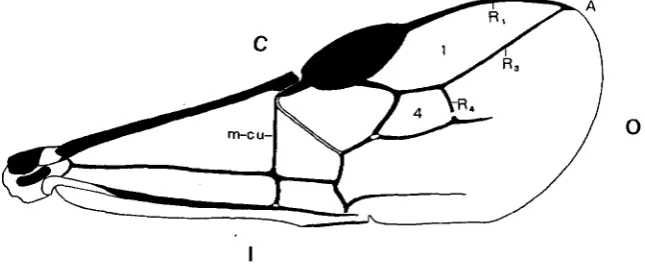
FIGURE 1-Right primary wing. C. Costal margin. 0. Outer margin. I. Inner margin. A. Apex.
RI, %, &. Fust, third and fourth branches of radius vein. m-cu. Medio-cubital cross-vein. 1,4.
First and fourth radial cells.
The purpose of the present paper is to put on record the salient points in regard to the occurrence of the mutants thus far found, together with a de- scription of their traits. Details of inheritance including linkage relations will not be considered here. All factors are inherited in sex-linkoid fashion as is to be expected in species producing males by haploid parthenogenesis
(arrenotoky).
THE MUTANT TYPES Defective, d w s (venation)
One of the commonest hereditary variations occurring in nature is a
MUTANTS I N HABROBRACON 3
perature influences the trait, the greater defect being correlated with higher temperature. A single gene occurring early in the work, possibly de- rived from wild stock (WHITING 1924), was isolated and found to give about 95 percent phenotypically defective under standard conditions, 30°C. Defective is of normal viability and fertility.
Wrinkled, w (wings)
A female from pedigree cultures carried a mutant factor causing diffi- culty in shedding pupal integument (WHITING 1926b). As a consequence irregular wrinkling of the wings results and portions of this integument are found adhering to the antennae which show a tendency to fragment. The fraternity segregating the mutants was small, consisting of males, type 6 ,
wrinkled
7,
and females, type4.
Failure of the character to appear among the mother's siblings indicates that the mutation arose late in spermato- genesis or in ovogenesis of one of the grandparents of the mutants or in the germ tract of the mother. Wrinkled is fertile in both sexes but is me- chanically hampered in eclosion and in other activities.Reduced, r (wings and venation)
ACHSA M. BEAN found in March, 1925 (WHITING 1926b), a single male
with small wings and irregular reduced venation (plate 1, figures 18-21). The character did not appear in any of the sibs and hence the mutation must have occurred late in ovogenesis. The trait is variable but always distinct from type. Reduced affects chiefly the middle area of the wings and usually causes disappearance of vein m-cu (figure 1). It is of good viability and fertility in both sexes,
Lethal naked pupae
A single female in pedigree culture proved heterozygous for a factor causing metamorphosis of larvae into small sized naEed pupae which at- tained approximately normal coloration before death. This factor (WHIT-
ING 1921b) proved to be linked with orange (19.5 percent crossovers).
Sooty, sII (mesosterrtum)
Variation in general body pigmentation is controlled largely by tempera- ture but the influence of hereditary factors is also obvious. When reared a t 30°C the wasps show differences in color of the mesosternum. A major factor for sooty, SII, was shown (WHITING 1926a) to be linked with dIIQ5,
but percentage of crossovers is uncertain due to overlaps. Minor factors for the same trait, independently segregating, were also found.
4 P. W. WHITING
LEGEND FOR PLATE 1
Wings of various mutant types. All shown from dorsal side except figure 17 which is viewed
FIGURE 1.-Semilong.
FIGURE 2.-Fused.
FIGURE 3.-Beaded.
FIGURE 4.-Unexpanded.
FIGURE 5.-Truncate with outline of secondary.
FIGURES Gll.-Notched, from four individuals. FIGURE 12.-Long.
FIGURE 13.-Miniature. FIGURES 14-17.-Wavy.
FIGURES 1&21.-Reduced, from one individual. F I G U R E S ; ~ ~ - ~ ~ . - T ~ ~ ~ . FIGURES 24-25.-Confluent.
FIGURES 2631.-Narrow, from three individuals.
FIGURES 32-42.-Shot.
6 P. W. WHITING
DeJficiency (antennae and posterior extremity)
Failure of normal development of structures a t anterior or a t posterior extremities sometimes occurs. Antennal segments may be irregularly fused. External genitalia may be small or lacking. Digestive tract may fail to open posteriorly. No definite factors were isolated for these deficiencies which were shown to be controlled by heredity and to be highly corre- lated with age of mothers (WHITING 1926~). Many of the genes cited in the present paper cause greater or less tendency toward antennal deficiency.
Orange, o (eye), and its four allelomorphs
A quadruple allelomorphic series of factors affecting eye color was re- ported (WHITING and BURTON 1926). The normal wild-type, jet black eyes and dark brown ocelli, mutated to orange, 0, in which the ocelli have
but a slight trace of pigment while the eyes are orange varying to pink and red. The first appearance of orange (WHITING 1921a) was in a fra- ternity of 254 males, a single mutant found March 27, 1920. The mother was less than seven days of age a t the time the egg was laid. A second orange mutant has been recorded (WHITING 1921a, p. 48) as a single male in a fraternity of type stock including also 115 type males and 83 type fe- males.
On June 24,1924, there appeared in a fraternity of orange stock 4 ivory,
d, eyed males. Eleven orange males and 22 orange females had been pro- duced in vial a. Vial b showed 12 orange males, 9 orange females of which 6 when tested produced only orange, and the 4 ivory mutants. There were therefore produced by the mother a t least 29 orange-bearing eggs besides the 4 ivory. The mutation probably occurred in ovogenesis previous to maturation. Ivory has colorless ocelli and compound eyes of a greenish white with occasionally a trace of pink. A second mutation to ivory is re- ported by EDWARD J. WENSTRUP. A female from orange stock (number 3) crossed with a type male (9B3) produced orange males 34, type females 113, and 1 orange female. This orange daughter produced 38 orange males and 34 ivory (checked by breeding). The mutation therefore took place in the sperm, changing the normal allelomorph directly to ivory.
MUTANTS I N WBROBRACON
7
the males. If males are reared a t low temperature i t is often difficult to dis- tinguish them from type. Light has been discarded.
A fifth allelomorph in the orange locus appeared December 1, 1929 (132.7b MMT). MAGNHILD M. TORVIK found from a cross of an ivory fe- male by a type male a single female with light ocelli and eyes very dark reddish brown. There were 11 type sisters and 7 ivory brothers in the same vial. There were 35 type sisters, one type brother (biparental) and 39 ivory brothers in the total fraternity. This mutant, called dahlia, od, proved compound for ivory indicating that the mutation had occurred in sperma- togenesis changing the normal allelomorph. Dahlia-ivory or dahlia-orange compound females are lighter in color than pure dahlia males or females. The locus orange appears to be especially unstable but there is certainly no striking increase of mutability correlated with X-ray treatment. As has been previously reported (WHITING 1928) there is a very high correlation between mosaicism and apparent mutation for this locus. New data on mutation and mosaicism will be reported elsewhere.
Cantaloup, c (eyes)
A female from orange stock was treated March, 1928 (filter,
3
mm a h - minum; peak voltage, 45 K. V.; milliamperes, 8; distance, 15 cm; dura- tion, 15 minutes; dosage, about 1100 R), by P. W. WHITING and produced (vial a) 5 orange males and 1 male with eyes resembling ivory. Crosses with ivory females resulted in 328 ivory males, 10 orange males (biparen- tal), and 193 orange females. By subsequent tests with type i t was shown that the mutant was a double recessive, orange cantaloup. Cantaloup varies considerably, ranging from creamy white a t eclosion through pale pink and light orange and finally deep red. I n mixed culture it may be con- fused with ivory or with orange.Maroon,
m a
(eyes)In January, 1931, L. H. BENKERT found a male with light ocelli and ma- roon eyes (199.18 LHB). There were but two other males in the fraternity, both type, so that the time of occurrence of mutation cannot be deter- mined. Maroon is deep reddish brown, somewhat resembling dahlia.
Minnesota yellow, M , (base of antennae)
8 P. W. WHITING
LEGEND FOR PLATE 2
Antennae of various mutant types. Antennae of males are shown as originating at left, of fe- FIGURES 4344.-Type.
FIGURES 4546.-Semilong. FIGURES 47-4K-Long. FIGURES 49-.51.-Confluent. FIGURES 52-55.-Fused. FIGURES 56-65.-Tapering. FIGURES 6671.-Beaded. FIGURES 72-73.-Miniature.
10 P W. WHITING
LEGEND FOR PLATE 3
Legs of various mutant types. Magnification 33fX.
FIGURES 75-77.-Prothoracic, mesothoracic, and metathoracic legs of type. FIGURES 7&80.-Long.
FIGURES 81-83,84-85,86-87.-Female heterozygous for stumpy.
FIGURES 88-91,92-95,96-99.--Stumpy male.
FIGURES lW102.-Fused.
FIGURES 103-105.-Beaded.
12 P. W. WHITING
be increased by selection. Minnesota yellow is of normal viability and may be regarded as dominant since heterozygous females show the trait under standard conditions.
Yellow, Y (base of antennae)
On February 17,1929, ANNA R. WHITING found two mutant males, one in vial b and one in vial c of a fraternity (10.6 ARW) containing 82 normal brothers. The mother had been treated (filter, 1 mm aluminum; peak volt- age, 50 K. V.; milliamperes, 8; distance, 15 cm; duration, 20 minutes; dos- age, 'about 1460 R) as a four day old larva. The mutants had the basal three segments of the antennae strikingly yellow. It is possible that sibs bearing the gene may have been present, but this is very unlikely as the culture was reared under standard conditions and all individuals were carefully examined. The yellow color is more definitely confined to the three basal segments in this type than is the case in Minnesota yellow, but lowering of temperature during development induces melanogenesis in both cases. Since heterozygous females show the trait, it may be called dominant. Yellow is fertile in both sexes but of less viability than type. Distal segments of antennae often appear pale and if temperature is but slightly increased over standard, yellow wasps become deformed and often die in cocoons. This is not the case with Minnesota yellow in which via- bility is normal. The linkage relations of the two types of yellow are also different.
Beaded, b (legs)
I n August, 1929, ANNA R. WHITING found a fraternity of males contain- ing a number of mutants with beaded legs (plate 3, figures 103-105). The mother was among a miscellaneous lot of larvae treated July 31 (filter, 1
mm aluminum; peak voltage, 50 K. V.; milliamperes, 8; distance, 15 cm; duration, 35 minutes; dosage, uncertain). Since she was set August 8, she had probably been in the embryo or young larval condition a t time of treatment. In vial a there was found but 1 wasp, beaded, and in vial b, 18 beaded to 8 normal sibs. The excess of mutants over equality expected if the entire gonad were heterozygous is not significant. The proportions of the various parts of the wing of beaded are very aberrant (plate 1, figure 3) and wings often fail to expand. Antennae are very likely to show fusion of segments and often more or less distal deficiency (plate 2, figures 66-71). A large and variable percentage of beaded fail to eclose. Males of beaded are fertile but viable females have not been found.
Stumpy, st (legs)
MUTANTS I N HABROBRACON 13
stumpy legs (223.1 g ARW) among 36 normal male sibs in vial g. There were 186 normal male sibs in the entire fraternity. The mother had been rayed as a one or two day old larva (filter,
3
mm aluminum; peak voltage, 60 K. V.; milliamperes, 5 ; distance, 15 cm; duration, 40 minutes; dosage 3250 R units). The most striking characteristic of stumpy is extreme reduction of tarsal segments (plate 3, figures 88-99). Appendages appear otherwise nor- mal. Stumpy may be called a recessive but a large proportion of heterozy- gous females bear a spur a t the tip of their prothoracic metatarsi (plate 3, figures 81-83). More or less irregularity obtains in tarsal segments of all legs (plate 3, figures 84-87) so that heterozygotes are not as sure footed as pure type. No metatarsal spur has ever been found on middle or hind legsof heterozygotes nor has a prothoracic metatarsal spur ever been found in type females. This spur closely resembles the spur normally occurring a t the end of the prothoracic tibia. It may be present on either or both front legs, but many heterozygotes fail to show it. Even in its absence i t is usually possible to identify heterozygotes by tarsal irregularity. Stumpy is of normal viability and fertility except that females have difficulty in feeding from caterpillars and consequently may die without producing eggs. Apparently they cannot brace themselves well enough to insert their sting for puncturing in order to feed.
MiBiature, m, (body)
A male of type stock (number 11) was treated in March 1928 (filter,
3
mm aluminum; peak voltage, 45 K. V.; milliamperes, 8; distance, 15 cm; duration, 40 minutes; dosage about 2950R), by P.W.
WHITING and mated on the same day and on five succeeding days. One of the daughters from the last mating produced 9 type males, 6 miniature males, and 44type females. Miniature is in general smaller than type. The primary wing (plate 1, figure 13) is less rounded on the costal margin. The antennae are shortened, both by shortening of the segments and by reduction of their number (plate 2, figures 72 and 73). There is also more irregularity in the way the segments are set together. No marked disproportion appears in the reduction of the size of the legs (plate 3, figures 106-108). Miniature is a semi-lethal. Many die as pupae. Adult males are of good fertility but adult females are almost sterile.
Short, S h (Wings)
14 P. W. WHITING
LEGEND FOR PLATE 4
FIGURES 109-120.-Magniiication 33)X; 121-131,13)X.
FIGURES 109-110, 111-112, 113-116.-Prothoracic, mesothoracic, and metathoracic legs of
twisted. Figures 115-116 are from one individual. FIGURES 117, 118, 119-120.--Same of constricted. FIGURE 121.-Dorsal view, thorax of type. FIGURE 122.-Dorsal view, thorax of broad.
FIG= 123.-Dorsal view, thorax and wing bases of broad showing reduplication of right
FIGURE 124.-Primary of a variant of broad showing tendency toward reduplication. FIG= 125.-Dorsal view, thorax of vestigial.
FIGURE 126.-Wing of vestigial unusually well developed for this type.
P. W. WHITING, MUTANTS IN HABROBRACON
I
PLATE 4
126
188 124
127 129 130 131
16 P. W. WHITING
whether it had been carried in the stock. Short is very susceptible to tem- perature, overlapping with normal to a considerable extent. It is impossible to distinguish a culture of short from type when reared a t room tempera- ture. Under standard conditions, 30°C, wings of short average much smaller, but even in this case there is more or less overlapping. No corre- lated differences have been found.
Twisted, t , (legs)
A male of type stock (number 11) was treated January 11, 1930 (filter,,
4
mm aluminum; peak voltage, 45 K. V.; milliamperes, 8 ; distance, 15 cm; duration, 40 minutes; dosage, 3560 R units) by R. ELIZABETH CHALMERS and mated to four females (number 11) (January 11, 12, 13, and 17). One of the daughters from the last mating produced 35 type males and 14 males with twisted legs. Legs of twisted show much malformation and irregular bending (plate 4, figures 109-116). Many individuals fail to eclose, proba- bly on account of mechanical difficulties. Males are of normal fertility. Fe- males are very weak.Constricted, C, (femora)
I n August, 1930, L. H. BENKERT found a single female with constricted femora (192.1813). There were 8 sisters in vial a, 9 in b including the mu- tant, 10 in c and 9 in d. Constricted is a dominant and apparently lethal in the male. It is very difficult to obtain offspring from constricted females and fraternities are small. The difficulty is probably mechanical and con- cerned with feeding from the caterpillars. The trait appears in all three. pairs of legs (plate 4, figures 117-120) but is most obvious in the meta- thoracic.
Narrow, n (wings)
A male of type stock (number 11) was treated April 25, 1930 (filter,
3
mm aluminum; peak voltage, 45 K. V.; milliamperes, 8 ; distance, 15 cm; duration, 25 minutes; dosage, 2100 R units) by R. ELIZABETH CHALMERS and mated to three females (number 11) (April 25, 28, 31). One of the daughters from the last mating produced 32 type males and 14 males with narrow wings. Narrow (plate 1, figures 26-31) is somewhat variable but does not overlap with type. It is of good viability and fertility in the male. Females are apparently sterile.W a v y , w, (wings)
MUTANTS I N HABROBRACON 17 mated to four females (number 11) (July
7,
10, 17, 24). Four daughters among 11 tested from this last mating produced type males and males with wavy wings as follows: type 6, wavy 7; type 14, wavy 11; type 7, wavy 6; type 8, wavy 5. The other seven daughters produced only type. Wings of wavy (plate 1, figures 14-17) are shortened, showing transverse waves which are especially noticeable near the distal part of the costal margin. Antennae are usually normal but in many cases one or both be- come markedly depigmented distally, the segments tending to drop off. Fertility and viability of males are good, but females are somewhat weak.Fused,
f
(antennae and tarsi)A single male was found by C. H. BOSTIAN in February, 1929, with an- tennal segments fused together and tarsal segments lacking (plate 2, fig- ures 52-55 and plate 3 , figures 100-102). The wing of fused has a very characteristic and constant indentation at the apex (plate 1, figure 2). Fused appears to be of good viability and fertility in the male. The female cannot reproduce on account of inability to feed from caterpillars. On February 8, 1931, there was found by P. W. WHITING a second fused mu- tant occurring in a fraternity (2004.5d) segregating males as follows: type 18, semilong 7, cantaloup 15, semilong cantaloup 23, semilong cantaloup fused 1. The mother was from cantaloup female by semilong male. Daughters of this mutant crossed with males of fused stock produced fused daughters as well as fused sons, showing that the mutated locus was iden- tical with that of the previous mutation. In February, 1931, there was also found by L. H. BENKERT a third fused mutation. An orange reduced fe- male crossed with a spread male produced daughters which were isolated for linkage tests. One of these segregated males (A20.05 LHB) as follows: type 4, orange 7, reduced 3, orange reduced 2, fused 4, orange fused 5, orange reduced fused 4. These two recurrences of fused in the same month are noteworthy. No fused was being bred a t the time except for some stock that was otherwise type. The two recurrences were moreover entirely in- dependent.
Long,
I
(antennae and wings)18 P. W. WHITING
duced 50 of the mutants to 46 non-long. Long males from vial a were crossed back to the heterozygous virgin mother and thus long females were obtained, 10 long to 3 non-long. Long had evidently been running in stock (number 17) as two or three long males were found dead early in the year in this stock. By lucky chance a female heterozygous for the mutant factor had been selected for the mating above mentioned, and a heterozygous daughter produced the 50 mutants. Males of long are of good viability and fertility but females are rather weak.
Semilong, sl (antennae and wings)
A male of type stock (number 11) was treated June 30,1930 (filter,
3
mm aluminum; peak voltage, 76 K. V.; milliamperes, 8; distance, 15 cm; dura- tion, 8 minutes; dosage, 2280R
units) by R. ELIZABETH CHALMERS and mated to three females (number 11) (July " , l o , 17). One of the daughters from the last mating produced 6 type males and 6 mutant males which have been called semilong because of similarity to long. Semilong males are of good fertility and viability. Females are also viable and fertile but rather weak. Antennal segments (plate 2, figures 45-46) are lengthened but are not as attenuated as are those of long (figures 47-48). Leg segments are also somewhat lengthened but heavier than corresponding segments of long. Distinction of semilong as of long from type is clear in antennae and to a great extent in legs, but overlapping between long and semilong ap- parently takes place especially in legs. The wing of semilong (plate 1, fig- ure 1) is to be compared with that of long (figure 12) on the one hand and with that of fused (figure 2) on the other. It is not, as in long, distally curved, but is quite flat. Distal shortening, however, takes place as is evi- denced by the form of the outer margin and especially by the abbrevia- tion of the first radial cell. A slight indentation is present a t the apex of the wing, not however as pronounced as in fused. It was a t first thought that semilong might be allelomorphic to long, but this proves not to be the case.Conjuent, cj (wing veins and antennal segments)
MUTANTS I N HABROBRACON 19 creased temperature many confluent die in cocoons and a t lower tempera- ture confluent overlaps with type.
Truncate,
t ,
(wing veins and antennal segments)On August
7,
1930, C. H. BOSTIAN found (260.4b ARW) a male with primary wings much shortened distally (plate 1, figure 5). The mother had been rayed (filter,+
mm aluminum; peak voltage, 60 R. V.; milliamperes, 5; distance, 15 cm; duration, 32 minutes; dosage, 2600 R units) as a three or four day larva on July 15. There were 71 male sibs. Truncate is very ir- regular in appearance apparently having a considerable overlap into type. Terminal antennal segments are very likely to be more or less fused and wings are often but slightly affected. The variation suggests confluent in certain respects. In combination with reduced i t is more easily recognized.Unexpanded wings
I n August, 1930, NEITA C. BOSTIAN found in vial b from a type stock female (number l), 12 type males and three with unexpanded wings (plate 1, figure 4). About 15 brothers were in vial a, all normal. Wasps with this mutant trait were bred for several generations, but were highly inviable, the majority dying in cocoons. Females were obtained but were inviable and the stock was discarded.
Vestigial, v (wings)
On August 4, 1930, NEITA C. BOSTIAN found (72.2d NCB) a culture vial containing wasps with vestigial wings (plate 4, figures 125-126). The mother was virgin producing males segregating other traits in a test for linkage. In vials a, b, and c there were found 50 non-vestigial. In vial d there occurred 12 vestigial and 12 non-vestigial. The seven wasps in vial e were non-vestigial. Vestigial is semi-lethal, many wasps dying before eclosion. Six of the mutants were dug out of cocoons. No other dead occurred except those in vial d. Hence the mutants were all produced when the mother was approximately 14-17 days old. Part, only, of the ovary was involved. Vestigial is of good fertility in the males that eclose, and many of them live a normal length of time.
Tapering,
t ,
(antennae)20 P. W. WHITING
of segments distally (plate 2, figures 56-65). Tapering does not overlap with type but reverse mutations have occurred (see Discussion).
Spread, s, (wings)
On May 18, 1930, MAGNHILD M. TORVIK found (134.1 MMT) from a male fraternity of orange stock (number 3), eight males with wings spread out to the sides. Further examination showed that these males had light areas on the mesopleura in the position of insertion of the directive wing muscles (plate 4, figures 128-131). Eight brothers occurred in the same fraternity. The mother, isolated from stock, was evidently heterozygous for the factor. Thus far it has been impossible to obtain offspring from fe- male spread. Males are of normal fertility. The wings are themselves nor- mal and the defect is probably muscular. The trait grades into type.
Broad, b, (thorax)
In August, 1930, L. H. BENKERT found a number of males with thorax abnormally broadened (plate 4, figures 122-124). There is more or less tendency toward reduplication in the wings as illustrated in the figures. The mutant type was first noticed in about 50 percent of the sons of two different sisters. The character is somewhat irregular and it cannot be stated with certainty that this represents the first appearance of the muta- tion. Broad may be called an irregular recessive but about 50 percent of the heterozygous females show the trait to a slight extent. Broad has good fer- tility and viability.
Notch, No (wings)
A female with notched wings was found by L. H. BENKERT, April, 1930, from a cross of stock number 3 female by tapering male. There were 16 type sisters 3 of which produced notch males. Notch does not breed true, and it is very likely that there are more factors than one involved. I n many cases the trait acts like a dominant lethal. There is much irregularity and asymmetry in expression (plate 1, figures 6-11).
Shot, s,, (wing veins)
In August, 1930, L. H. BENKERT found a number of wasps with irregu- lar venation. They were the offspring of different parents that had been subjected to high temperature accidentally. There is great irregularity in expression of the character (plate 1, figures 32-42). Fertility and viability are good.
Kidney, k (eyes)
MUTANTS I N HABROBRACON 21 side. Ocelli were of approximately normal size. The mother had been rayed (filter,
3
mm aluminum; peak voltage, 60 K. V. ; milliamperes, 5 ; distance, 15 cm; duration, 32 minutes; dosage, 2600 R units) as a five day larva on July 22. There were 18 male sibs in vial a and 18 in vial b including the mu- tant. The mutant was reared under standard condition, 30°C, but the Fz generation was bred at lower and variable temperatures. Eyes of mutant type in Fz were elongated dorso-ventrally, some of them kidney shaped. Kidney is highly lethal a t 30°C, many wasps dying as eyeless pupae. At lower temperatures, 25"C, for example, it is of excellent viability and fer- tility in both sexes. No lethal pupae were noted among the sibs of the mu- tant. It is therefore unlikely that the single mutant had more than one or two lethal kidney sibs a t most.Small head
A mated female from mixed stock was treated April, 1927 (filter,
+
mm aluminum; peak voltage, 40 K. V.; milliamperes, 25; distance, 15 cm; duration, 30 minutes), by P. W. WHITING (WHITING 1929, p. 273). She produced type males 7, type females 3. Her daughters were tested. Two produced only type. The third produced type females 28, type males 19, and 12 males with very small heads. Test of 11 of the sisters of the mutants showed 4 producing only type, 3 giving type and small head males, and 4 giving type and small head in both sexes, having evidently mated with their small head brothers. Small head was much more distinct in the homo- zygous females but showed considerable overlapping in the males. It was of good fertility and viability but was lost on account of interruption by other work.DISCUSSION
Lethals
As is now well known from the extensive work on Drosophila, mutation rate can best be measured by the occurrence of lethals whose frequency is many times that of visibles. No other form has yet been sufficiently ex- ploited genetically to make a study of rate of lethal production practicable. Habrobracon thus far is no exception to this rule. Sex ratio furnishing an excellent index of lethals in Drosophila is subject in Habrobracon to so
many diverse influences (temperature, quantity of sperm available, genet- ic stock of male and of female and particular combination involved) that only in extreme cases can it be utilized as evidence of lethals. Balanced lethals or several independently segregating lethals might be expected to
22 P. W. WHITING
loid nature of the males, either of these conditions would be rapidly elim- inated. A lethal may likewise be detected by linkage with a visible. Abun- dant evidence of lethals exists in Habrobracon, but for the most part these have not been analyzed genetically.
After certain preliminary tests it has been decided that, for the present a t least, i t is much better economy to confine attention to the “best” visible mutant types and to seek to determine by means of these what may be regarded as “normal” genetic relationships. Visibles, when obtained, are therefore bred to type stock and no attempt is made to study irregularities that may be due to raying. A genetic map must first be made.
Elimination of lethals must be very rapid in Hymenoptera and in other forms with haploid males. This does not of course presuppose that the germ-plasm of these types is any more stable, any less mutable. The more rapidly genetic degeneration is brought to the surface the more rapidly is i t eliminated.
Mutation rate in pure and mixed stock and in X-rayed material Mutation in the locus orange associated with heterozygous parentage will be deferred for consideration under Recurrences and Reversions, treated below.
Considering first the untreated material we find 6 mutations in the un- mixed Lancaster material, descended from a female taken in Lancaster, Pennsylvania, 1919. Of these mutations, 2 are to orange, 1 to light ocelli, 1 to lethal pupae, 1 to spread, and 1 to unexpanded. Possibly 300,000 wasps of this material have been passed under observation, most of them males. One mutation, tapering, was found in pure Minnesota stock, besides shot which occurred after peculiar conditions of high temperature. The amount of pure Minnesota material examined up to the present time is small relative to the Lancaster, but, on account of the type of work being done with it, i t has been very carefully studied.
MUTANTS I N HABROBRACON 23
X-ray mutations may be classified as follows according to the type of material treated: from Lancaster material, cantaloup; from Iowa City stock (number ll), beaded, twisted, narrow, wavy, semilong; from mixed material, small head, miniature, yellow, kidney, stumpy, truncate.
These mutations, like those from untreated material, are roughly dis- tributed in relative frequency according to the stocks used in the experi- ments.
Increase in mutation rate by X-ray treatment is obviously very great as the following considerations indicate.
1. The X-ray experiments involve small numbers relative to the numbers which have been and are being observed in the extensive genetic tests on linkage, male biparentalism, mosaicism, etc.
2. Only certain counts in the X-ray experiments are such as can be ex- pected to disclose mutations arising a t time of raying. Other counts ac- tually serve as controls and since a special point has been made of this fact, these “controls” have been as closely studied as the “experimental.” The “controls” in the experiments are, moreover, more numerous than the “ experimental.”
3. Six of the X-ray mutant types above mentioned, namely, small head, twisted, beaded, semilong, wavy, narrow, and miniature, occurred in such numbers (50 percent of the males in a fraternity) that they would have attracted attention in any count in the regular genetic work. This means that every fraternity of wasps counted serves as an additional control to these experiments. Among many thousands of fraternities of untreated ma- terial only ten mutations have been found with several mutants appearing in the fraternity. Among about 800 fraternities from treated parents there occurred the six mutants.
4. Four X-ray mutants, cantaloup, kidney, stumpy, and truncate, oc- curring as single individuals, are so strtking that they would not have been missed had they occurred among the hundreds of thousands of individuals in non-rayed material. Only 9 mutations (reduced, 2 orange, ivory, light, dahlia, 2 fused, confluent) have been picked up as single individuals in non-rayed material, 2 of these (light and dahlia) being less conspicuous than the 4 X-ray types mentioned.
Stage at which mutati0.n occurs
24 P. W. WHITING
have been confluent sibs unnoticed), cantaloup (in fraternity of 6,’ the mother X-rayed as adult), kidney (in fraternity of 36, the mother X-rayed as five day larva), truncate (in fraternity of 72, the mother X-rayed as three or four day larva; since truncate overlaps with normal there may have been truncate sibsunnoticed), stumpy (in fraternity of 187, the mother X-rayed as one or two day larva). In these 10 cases it is possible that the mutation occurred in but 1 ovocyte. If the mutation occurred a t time of raying we would expect, in the case of cantaloup, but one well developed egg to be involved. Ovogonial stages would be involved in the cases of truncate and stumpy and even of kidney, but it is altogether possible that only one ovum might be descended from the mutant cell, as the sister cells might form adjoining follicular and nurse tissue.
Cases in which more than one mutant male appeared will now be re- viewed. The first appearance of ivory showed 4 mutants in a fraternity in- cluding 29 individuals from orange bearing eggs. Distribution of sibs, more- over, gave evidence that the mother was not heterozygous but that the mutation involved only part of her ovary. In the case of unexpanded, data are not complete, but the occurrence of 3 mutants to 8 normal sibs in vial b and the fact that about 15 brothers were observed in vial a, all normal, indicate a situation comparable with that of ivory. The culture was not continued to vial c.
With reference to vestigial, conditions indicate that mutation took place before separation of the Artlagen of the two ovaries, but, nevertheless, after several ovogonial divisions. In other words the mutation involved a cross section of both ovaries or all four ovarioles. The 50 type of vials a, b, and c indicate that the ventral region was not involved. The 12 type to 12 vestigial of vial d indicate that the tissue functioning for 4 or 5 days was heterozygous. Each ovary in Habrobracon is made up of two elongate ovarioles. If tissue in only one ovariole were involved we would expect a ratio of 7 type to 1 mutant, while if tissue in both ovarioles of 1 ovary were involved we would expect 3 type to 1 mutant. Failure of mutants to appear among the 7 type of vial e indicates that non-mutant tissue oc- curred in dorsal end of ovary. Numbers are unfortunately small but the above suggested hypothesis is apparently the most plausible.
Only 2 X-rayed females gave rise to more than 1 mutant male. One of
these, a larva treated when 4 days old, developed into an adult producing
MUTANTS I N HABROBRACON 25
males and 19 beaded. The numbers, showing a non-significant departure in favor of mutants from the 1 to 1 expected from a heterozygote (lethal beaded pupae were counted), indicate that the whole functioning ovary consisted of mutated tissue. If mutation occurred a t time of raying, the mother must have been in the early embryonic stage or else part of the ovarian tissue was non-functional. If the mutation was not caused by ray- ing the gene may have been received from a parent, in which case the mother of the beaded mutants would be completely heterozygous.
In untreated material mutant male6 produced by mothers presumably heterozygous are wrinkled, lethal naked pupae, tapering, spread, broad, fused (LHB), and long. In the case of the first three named, evidence in- dicates that mutation occurred not earlier than gametogenesis of one of the maternal grandparents of the mutants. Spread, broad, and fused (LHB) may have been carried for some generations in the stock and pre- vious finding of dead males of long proves this point for that mutation.
Two dominant mutations, constricted and notch, appearing first in fe- males, probably occurred in gametogenesis of one of their parents.
Of mutations occurring in spermatogenesis 3 were first evidenced in single daughters. Light, dahlia, and ivory (E JW) of the orange locus each involved a mutation from the type allelomorph. Light with 34 type sisters and dahlia with 36 appeared each as a single compound with ivory. Ivory was recessive in the orange-ivory compound “mutant” female with 113 ex- pected type sisters.
Five mutations appearing from heterozygous mothers may be assumed to have occurred in spermatogenesis a t time of X-ray treatment. Minia- ture, twisted, and narrow were each from a single mother, whose father had been rayed 6 days previous, in each case, to the mating which pro- duced those mothers. Semilong was likewise from a single heterozygous mother whose father had been rayed 17 days previous to the mating pro- ducing her. Wavy appeared from 4 different females among 11 tested daughters of a single female which had been mated to a male treated 24 days previously. No other mutants were produced by daughters from his previous matings so that only a small part of testis material was affected. Each of these 5 treated males had been mated a few times previous to the mating resulting in the mothers of the mutants. Hence the treatment may be assumed to have affected spermatogonial tissue.
26 P. W. WHITING
it may have occurred either in the egg or in the sperm within the treated female.
Recurrences and reversions
With but two exceptions, both to fused, all recurrences have been in the locus for orange. One of these was from type to orange. Type has mutated once directly to ivory, while the original ivory mutation was from orange. Hundreds of thousands of wasps have been bred and recorded whose mothers were homozygous type, orange, or ivory, but no further recurrences have been reported.
The situation is very different when type and ivory stock are mixed. I n this case mutations or apparent mutations to orange are relatively fre- quent. Black-eyed females heterozygous for ivory occasionally produce, in addition to the expected black and ivory sons,an orange-eyed mutant male. Breeding tests show these to be identical with orange, 0. It is not known whether the ivory gene or its allelomorph has mutated in this case. Somewhat more frequently males appear with eyes mosaic for black and orange (WHITING 1928). Tests of these show that they breed as parental type would lead one to expect, namely, black or ivory, or mosaic black and ivory. They are apparent mosaic mutants but have never bred as orange. Their mosaicism is explained by egg binuclearity. Their mutation, real or apparent, is not explained, nor is that of the orange mutants from hetero- zygous, Ooi, mothers.
With the exception of these apparent reversions from ivory to orange in the mosaic males and the possible reversions in the orange mutant sons of heterozygous, Ooi, mothers, the only reversions thus far reported are in tapering. Tapering is clearly distinct from type, showing no overlaps. Five or six instances of type wasps appearing in tapering stock which had been carefully isolated (NCB, KAG, LHB) were at first attributed to contam- ination or to a mistake. Further work with pure stock gave an unques- tionable instance of reversion. KATHRYN A. GILMORE bred from an iso- lated virgin female from tapering stock, 34 tapering males and 1 type male. This male bred to a tapering female produced type daughters. The rever- sion was therefore genetic and occurred in ovogenesis. The evidence in- dicates that tapering reverts not infrequently and shows the original muta- tion to tapering to be not an irreparable genic “loss.”
Contrasted effects of different genes in corresponding structures
MUTANTS I N HABROBRACON 27
primary or secondary; the notches may be terminal or lateral. Truncate and confluent affect the margin distally, tending to cause coalescence of RI and
RB
distally. Narrow cuts off irregular slices of both wings on costal and inner margins. Miniature and beaded reduce the size, straighten the costal margin and elongate the tip of the primary (showing in form of the first radial cell). Secondary is also somewhat shortened. Beaded, moreover, enlarges fourth radial cell. Long and semilong shorten the wing distally (showing in form of first radial cell) and long causes a distal ventral curva- ture while semilong causes a very characteristic but slight indentation a t the apex. In fused this indentation is much more pronounced. Wavy pro- duces transverse waves especially in region of first radial cell affecting veins R I and R3 and general wing surface in adjoining region. A host of genes of greater or less potency cause breaks or disappearance of vein R,. The most effective of these that has been isolated we have called (EIIPS. Instability of this particular vein may be regarded as a “natural” phenomenon while other venation differences here noted are “artificial” being unable to sur- vive in nature. Shot causes irregular scattering of veins, especially in the region of the fourth radial cell. Reduced causes veinR4
to be missing in the majority of specimens but its particular incidence is in the region of vein m-cu where there is an irregular scattering of veins with m-cu usually, though not always, lacking; there is considerable shortening of wings prob- ably due to this extreme reduction of veins. Broad tends toward redupli- cation in wings or parts of wings. Short reduces size without affecting pro- portions. In certain types like broad and beaded the membranes of the wings may occasionally remain separate giving the wing an inflated ap- pearance.As regards antennae, long lengthens and attenuates segments without increasing number, while semilong has a somewhat similar effect but with- out such great attenuation. Miniature both shortens segments and reduces their number. Extreme reduction and fusion is to be noted in fused. Ter- minal deficiency frequently occurs in truncate and confluent and is ex- treme in tapering. I n beaded and some of the other mutants more or less antennal deficiency is often noted, and in wavy there is frequently distal depigmentation and fragmentation.
28 P. W. WHITING
are reduced proportionally or a t least there is no marked disproportion in the parts. The marked enlargement in diameter of the femora and distal part of the tibiae of beaded is very striking. In fused the legs are approxi- mately normal to tip of metatarsi to which the claws are apparently at- tached, the four tarsal segments being omitted. In stumpy there appear an extreme shortening and irregular crowding of tarsal segments, including the metatarsal. Claws are thus brought very close to the tips of the tibiae. Heterozygous females show a slight tendency in this direction, the tarsal segments being somewhat shortened and often irregularly set together. The prothoracic metatarsal spur, present in a large percentage, is a strik- ing and unexpected phenomenon. Irregular bending and malformation of the legs as in twisted is to some extent also present in constricted but in the latter there is to be observed a constriction in the femora, especially notice- able in the metathoracic legs.
SUMMARY
1. Discovery and brief description of 36 mutant types in Habrobracon are given, 24 being reported for the first time. Three were taken wild while 33 occurred in stock. Twenty-seven are classed as recessives, 5 irregular or intermediate, 3 partially dominant and 1 dominant.
2. Color, size, and form of many parts of the body are affected and several of the mutant genes have multiple effects.
3 . Three new mutations affecting eye color have occurred in stock. One
of these, dahlia, is allelomorphic with orange, making quintuple allelo- morphs in this series.
4. As regards orange locus, type (black) has mutated once to light, once
to dahlia, once to ivory, and twice to orange; orange has mutated once to ivory; and orange has appeared several times among sons of type mothers heterozygous for ivory. None of these changes have been associated with X-ray treatment except for a few of the last named group.
5 . Fused (antennae) has appeared three times by separate mutation.
Tapering (antennae) has reverted to type a few times.
6. No striking increase in mutation rate is attributable to mixture of stocks.
7. Twelve mutations were associated with X-ray treatment. Consider- ing relative numbers counted, this fact indicates a striking increase due to raying.
8. The allelomorphs to orange, light, and dahlia, and a recurrence to
MUTANTS I N HABROBRACON 29
5 recessive mutant types among sons of daughters of treated males indi- cate that genic change took place in spermatogenesis. One of these re- cessives, wavy (wings), appeared among the sons of 4 daughters of a treated male indicating mutation in spermatogonium a t time of treat- ment.
9. Ten mutations appeared as single males (besides several ivory to orange reversions) indicating mutation late in ovogenesis. I n the case of 5 others it is likely that mutation occurred early in the female germ tract. At least 14 mutant types appeared as sons of heterozygous mothers.
ACKNOWLEDGMENTS
I wish here to express my indebtedness to the Committee on Effects of Radiation on Living Organisms of the NATIONAL RESEARCH COUNCIL from which I have received support for technical assistance and special apparatus. The work was also aided by two grants from the AMERICAN ASSOCIATION FOR THE ADVANCEMENT OF SCIENCE received in 1928 and
1929. The radiation experiments were begun in 1927 under a grant from the Committee for Research in Problems of Sex (NATIONAL RESEARCH COUNCIL). Results of some of the experiments conducted a t that time are reported here. Facilities of the Zoological Laboratories of the UNIVERSITY
OF PITTSBURGH have been freely used and the Zoological Laboratories oi
the UNIVERSITY OF CHICAGO were kindly made available during the past
summer. During the summers of 1928 and 1929 the work was conducted a t the MARINE BIOLOGICAL LABORATORY, Woods Hole, Massachusetts.
I particularly wish to commend the excellent spirit of unselfish coopera- tion and enthusiasm of the group of graduate students and others working under my direction. Their names appear in connection with the mutants they have found, but I owe an especial debt to NEITA CORRIHER BOSTIAN and to LYSBETH HAMILTON BENKERT for their tireless work in connection with many of the technical details. The drawings have, for the most part, been made by KATHRYN A. GILMORE who has been most painstaking and conscientious in their execution. Figures 32,43,44,52-65,67-71 have been made by L. H. BENKERT.
LITERATURE CITED
WHITING, ANNA R., and BURTON, R. H., 1926 Quadruple allelomorphs affecting eye color in
Habrobracon. Amer. Nat. 60: 285-290.
WHITING, P. W., 1921a Studies on the parasitic wasp, Habrobracon brn’cornis (Wesmael). I.
30 P. W. WHITING
1921b Studies on the parasitic wasp, Habrobracon brevicornis (Wesmael). 11. A lethal factor
1924 Defective and freak venation in the parasitic wasp, Habrobracon juglertdis (Ashmead).
1926a Heredity of two variable characters in Habrobracon. Genetics 11: 303-304.
1926b Two wing mutations in Habrobracon and their method of inheritance. Amer. Nat. 60:
1926c Influence of age of mother on appearance of an hereditary variation in Habrobracon.
1928 Mosaicism and mutation in Habrobracon. Biol. Bull. 54 : 289-307.
1929 X-rays and parasitic wasps. J. Hered. 20: 268-276.
linked with orange. Biol. Bull. 41: 153-155.
University of Iowa Studies in Child Welfare 3: 11-18, 55-58.
443-454.