When GOF Design Patterns occur with God Class and Long
Method Bad Smells? - An Empirical Analysis
1B
RUNOL. SOUSA 1M
ARIZAA. S. BIGONHA 2K
ECIAA. M. FERREIRA
1UFMG - Federal University of Minas Gerais – Computer Science Department
Antônio Carlos Avenue, 6627, 31270-010 - Belo Horizonte (MG) - Brazil
2CEFET-MG - Federal Center for Technological Education of Minas Gerais – Department of Computing
Amazonas Avenue, 5253, 30421-169 – Belo Horizonte (MG) - Brazil
1
(bruno.luan.sousa,mariza)@dcc.ufmg.br 2
Abstract. Design patterns are general reusable solutions to common recurring problems in software projects. These solutions, when correctly applied, are supposed to enhance modular and flexible struc-tures in software. The aim of this work is to study the occurrences of God Class and Long Method bad smells in software systems developed with design patterns. To achieve this aim, we carried out an exploratory study with five Java systems to: (i) investigate if design patterns avoid bad smells; (ii) identify design patterns that may have co-occurrence with bad smells; and (iii) extract the main reasons that impact on such co-occurrence. We consider in our analysis eleven of the twenty-three GOF design patterns. We also consider the God Class and Long Method bad smells. The results obtained suggest that Composite and Factory Method have a low co-occurrence with these bad smells, and Template Method and Observer have a high co-occurrence with God Class and Long Method, respectively. In addition, we have identified that the misuse of design patterns and the scattering and crosscutting concerns has contributed to such co-occurrences.
Keywords:design pattern, bad smell, software metric, threshold.
(Received September 15th, 2017 / Accepted March 29th, 2018)
1 Introduction
Design pattern is a general solution to a recurring prob-lem in a given context in the software design [10]. Its main goal is to create flexible and extensible software systems, with a reusable structure and easy mainte-nance. They are recognized as good programming prac-tice. When applied correctly, they may help reducing bad smells in software, although they have not been pro-posed for this purpose [20].
Bad smells are symptoms existing in the source code of a program that possibly indicate a more seri-ous problem that requires code refactoring [9]. Code regions that exhibit these symptoms are not considered
errors, but they impair software quality and violate Soft-ware Engineering principles such as modularity, read-ability and reuse. Design patterns may be used to re-move bad smells [4, 14, 16, 17, 25]. On the other hand, there are studies that identify co-occurrence of design patterns and bad smells [3, 11, 12, 23]. Although de-sign patterns are intended to improve software quality, they do not necessarily avoid bad smells.
design patterns that may have co-occurrence with bad smells; and (iii) to extract the main reasons that impact on such co-occurrence.
To achieve these goals, we carry out a case study with five Java software systems. These systems are open source and they were extracted from Quali-tas.class Corpus [21]. In this case study, we investi-gate in our analysis the co-occurrences relationship of eleven design patterns described by Gamma et al. [10] with two bad smells: (i) God Class [13] and (ii) Long Method [9].
This paper is an extended version of our previous work [18]. In the current version, we manually in-spected source code in which bad smell and design pat-tern co-occurrence were detected. We present in details the architecture of two examples of such occurrence. From this analysis, we describe the lessons learned, dis-cussing the main reason that lead to design pattern and the bad smells co-occurrence considered.
2 Research Methodology
This study was carried out in six steps: (i) definition of research questions (ii) identification of bad smells detection strategies, (iii) definition of the data set that comprises the software systems considered in the study, (iv) data collection, (v) application of the association rules and (vi) method of the data analysis.
2.1 Rearch Questions
The research questions (RQn) investigated in this paper are the following:
• RQ1: Do the design patterns defined in the GOF catalog avoid the occurrence of God Class and Long Method bad smells in software?
• RQ2:Which design patterns of GOF catalog pre-sented co-occurrence with the God Class and Long Method bad smells?
• RQ3: What are the more common situations in which the God Class and Long Method bad smells appear in software systems that apply GOF design patterns?
2.2 Identification of Bad Smells Detection
Strategies
According to Marinescu [15], detection strategy is a for-mal rule that charatecterizes a specific bad smell. In ad-dition to detection strategies, software metric thresholds can be used to determinate the relationship of a metric with a bad smell and, thus, identify anomalous entities.
In this study, we consider the God Class and Long Method bad smells. God Class is a class that ex-ecutes too much work and delegate minor details to other classes [13]. Long Method is a method that per-forms too much work, having many lines, temporary variables and parameters [9]. We choose these bad smells because they are especially problematic to the software maintenance. Besides, they are related to a large amount of information that may turn the software comprehension hard and increase coupling among the methods and among the classes of the system.
The detection strategies used in this study were pro-posed by Filó et al. [8]. We choose these strategies be-cause they are composed of well known software met-rics. Besides that, they were previously evaluated by Filó [6], and no false negative was returned. False pos-itive may be returned, but with a low probability of occurrence. These results suggest that these detection strategies are effective in bad smells detection. The thresholds defined by Filó et al. [8] for a software met-ric is classified in three ranges: Good, Regular, and Bad. The authors indicated that the Good range is related to low occurrences of bad smells. Therefore, the detection strategies rely on the Regular and Bad ranges. Follow-ing, we describe the detection strategies of Filó et al. [8] for God Class and Long Method.
The God Class detection strategy, Figure 1, uses the metrics: Weighted Methods per Class (WMC), Number of Methods (NOM), Number of Attributes (NOF), and Lack of Cohesion of Methods (LCOM).
Figure 2 shows the detection strategy used for Long Method bad smell. It uses the following metrics: Method Lines of Code (MLOC), Nested Block Depth (NBD) and McCabe Cyclomatic Complexity (VG).
Figure 1:Detection strategy for God Class extracted from [8].
2.3 Data Set
Figure 2:Detection strategy for Long Method extracted from [8].
This data set was chosen because it has a large collec-tion of open source software developed in Java that are widely used in empirical studies of software artifacts.
As this study involves manual inspection, we con-sidered a sample of five software systems: Hibernate 4.2.0, JHotDraw 7.5.1, Kolmafia 17.3, Webmail 0.7.10 and Weka 3.6.9. All of them, except Kolmafia, are from Qualitas Corpus. The main criteria for the selection of these systems was based in two points: (i) they use de-sign patterns from GOF catalog; and (ii) they present the bad smells considered in this study. We decided to include Kolmafia 17.3 in this study because previous studies to point out metrics values considered problem-atic in this software [5], however, without any correla-tion of these values with bad smell or design patterns.
2.4 Data Collection
The third step involved the data collection to be ana-lyzed. Qualitas.class Corpus comprises files in XML format with the metrics of the software systems. As most of the software used in this study are from Qual-itas.class Corpus, we used these files. Since Kolmafia 17.3 data are not in this corpus. So, we downloaded its code and collected its metrics. We used the Eclipse 4.2 Juno IDE1and Metrics 1.3.6 plugin2for this purpose.
To verify the design patterns existence in the soft-ware, we used Design Pattern Detection using Similar-ity Scoring 4 (DPDSS) tool [22]. It models all aspects of design patterns by means of directed graphs, repre-sented by quadratic matrices, and applies an algorithm called Similarity Scoring. This algorithm receives as in-put the system and the graph of the design pattern, and then, calculates the similarity scores between the ver-tices of the graph. The main advantage of this approach is the ability to detect not only the patterns in their base form, which is normally found in the literature, but also the modified versions of it [22]. We previously tested DPDSS with three systems: JHotDraw 5.1, JRefactory 2.6.24 and JUnit 3.7, and no false positive occurrence of design patterns was returned. False negatives were
1http://www.eclipse.org/downloads/packages/
release/Juno/SR2
2http://metrics.sourceforge.net
returned only for two design patterns: Factory Method and State. The results presented by this tool were very satisfactory, showing that it is effective in identifying instances of design patterns.
Filó et al. [7] developed a tool, RAFTool, which performs the identification of methods, classes and packages with anomalous measurements of object-oriented software metrics. We used RAFTool with the purpose of implementing detection strategies. The tool receives as entry the XML file with software metrics of the target system and a detection strategy that is de-scribed by a logical expression in a given format. The tool reports the classes or the methods whose metric values fit to the detection strategy.
In RAFTool, the metrics’ thresholds that comprise the detection strategy are represented by the follow-ing keywords: COMMON, which corresponds to the Good/Frequent ranges of the metrics, CASUAL, which corresponds to the REGULAR/OCCASIONAL ranges of the metrics, and UNCOMMON, which corresponds the Bad/Rare ranges of the metrics. The God Class and Long Method logical expression are defined as follows.
Exp1 ( UNCOMMON[WMC] OR CASUAL[WMC] )
AND ( UNCOMMON[NOF] OR CASUAL[NOF] ) AND ( UNCOMMON[NOM] OR CASUAL[NOM] ) AND ( UNCOMMON[LCOM] OR CASUAL[LCOM] )
Exp2 ( UNCOMMON[MLOC] OR CASUAL[MLOC] )
AND ( UNCOMMON[NBD] OR CASUAL[NBD] ) AND ( UNCOMMON[VG] OR CASUAL[VG] )
The design patterns instances returned by DPDSS may be composed of one or more classes or methods. For instance, the returned instance to the Bridge de-sign pattern has a responsible class for representing the implementation part and a responsible class for repre-senting the abstraction part. To solve this problem, we developed the Design Pattern Smell3[19] to count the classes and methods in the design pattern instances, as well as to identify the components that have a given de-sign pattern and a given bad smell. This tool receives as entry (1) the XML files exported by DPDSS, con-taining the design patterns instances of a system, and (2) the CSV files generated by RafTool, containing the components with a given bad smell.
2.5 Application of Association Rules
To identify the design pattern and bad smells co-occurrences, we applied association rules, based on
3http://www2.dcc.ufmg.br/laboratorios/llp/
concepts of data mining [1, 2]. We decided to use the association rules because they combine items from a data set to extract knowledge about the data. Moreover, previous works in the same context of this one have ap-plied association rules [3, 23].
To apply the association rules, three metrics are used: Support [1], Confidence [1], and Conviction [2]. These metrics are based in the following main concepts:
Transaction, defined as a set of items; Antecedentthat is an item that appears on the left side of a association rule; andConsequent, an item that appears on the right side of a association rule. Therefore, a basic association rule has the following form:Antecedent⇒Consequent. Support (sup) on an association rule corresponds to the frequency that an item occurs in a transaction (Equation 1). For instance, let us consider a shopping base in a supermarket. Suppose that there is a data set with 1,000 transactions, which are the set of items that were purchased. In this data set, the itemspastaand
tomatoappear together in 100 records. So, Support for this relationship is 0.1, i.e., 10.0%.
sup(X ⇒Y) =P(X, Y) (1)
Confidence (conf) expresses the probability of a Consequent occurs since Antecedent has occurred (Equation 2).
conf(X ⇒Y) = sup(X ⇒Y)
sup(X) (2)
In the aforementioned example, let us consider that the itempastais found alone in 200 of 1,000 trans-actions of the data set. To compute the Confidence of thepasta⇒tomatoassociation rule, it is necessary to divide the Support of this rule, 0.1, by the Support of pasta– Antecedent in the association rule –, 0.2, resulting in a confidence of 0.5, i.e., 50.0%.
Brin et al. [2] proposed the metric Conviction. This metric uses the Support in both the Antecedent and the Consequent (Equation 3).
conv(X⇒Y) = sup(X)∗(1−sup(Y)) sup(X)−sup(X ⇒Y) (3)
In the given example, let us consider that the item
tomatois found alone in 300 of 1,000 transactions of the data set. Thus, the supporttomato,sup(tomato)
is 0.3 and the confidence conf(pasta ⇒ tomato) is 0.5. Applying these values in the Equation 3, the Conviction conv(pasta ⇒ tomato) is 1.4. When the value of Conviction is 1.0, it indicates that the an-tecedent and the consequent have no relation at all. When the value of Conviction value is less than 1.0,
it indicates that if the antecedent occurs, the consequent tends to not occur. When the value of the Conviction is greater than 1.0, it means that the antecedent and the consequent have relation; the greater the value of Con-viction, the greater the relation between the antecedent and the consequent. An infinite result indicates that the antecedent never appears in the transactions.
In this study, for the association rules application, we consider a transaction being each class in the ana-lyzed system; antecedent being a design pattern; con-sequent being a bad smell, in particular, the God Class and Long Method bad smells.
2.6 Method of the Data Analysis
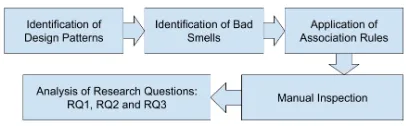
Figure 3 illustrates, via diagram, the method used to analyze the data obtained in the study.
Figure 3:Method of the data analysis.
This step is made in five parts. Initially, we identify the design patterns in the software systems. We used DPDSS tool to identify them and stored the results ob-tained in a table.
The second part aims to identify classes and meth-ods that have the God Class or Long Method bad smells. To find them, we applied the logical expressionsExp1 andExp2in RAFTool. After to identify the design pat-tern instances and God Class and Long Method bad smells, in sequel, we performed the pre-processing of these data by running the Design Pattern Smell tool.
In the third part, we apply the association rules on the data resulting from the pre-processing, and then, we identify the co-occurrences existing in the systems.
In the fourth part, we manually inspected the classes with co-occurrence to identify the situations that con-tributed the emergence of this relation in such classes.
Finally, we analyzed the data to answer the research questions proposed.
3 Results
This section presents the results followed by the dis-cussion of the presented study. We also answer, in this section, the proposed research questions.
Table 1:Amount of classes with God Class.
Software # Classes with
God Class # Classes
% Classes with God Class
Hibernate 527 7,711 6.83%
JHotDraw 122 1,061 11.50%
Kolmafia 385 3,225 11.94%
Webmail 15 129 11.63%
Weka 467 2,401 19.45%
Table 2:Amount of methods with Long Method.
Software # Methods with
Long Method # Methods
% Methods with Long Method Hibernate 2,883 48,234 5.98%
JhotDraw 995 7,633 13.04%
Kolmafia 5,400 2,8078 19.23%
Webmail 131 1,091 12.01%
Weka 3,822 20,871 18.31%
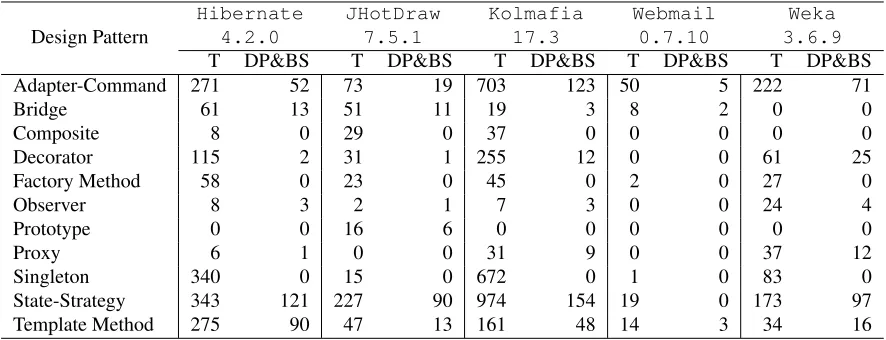
Tables 3 and 4 show the results after the data pre-processing. In both tables, the “T” column indicates the total number of classes or method that uses a design pattern, and the “DP&BS” column indicates the number of classes that have instances of some design pattern (DP) and occurrence of the respective bad smell (BS).
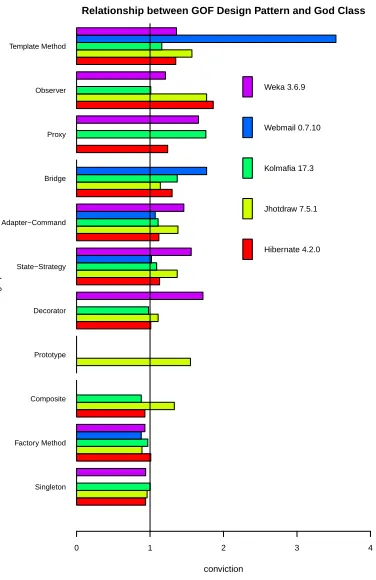
After the data pre-processing, we performed the association rule application to identify the co-occurrences. For this purpose, we calculated the met-rics described in Section 2.5 using the Tables 1, 2, 3, and 4 results. We used the Conviction metric result fol-lowing the thresholds shown in Section 2.5. Figure 4 exhibits the Conviction metric results for the God Class bad smell, considering theDesign Pattern⇒God Class
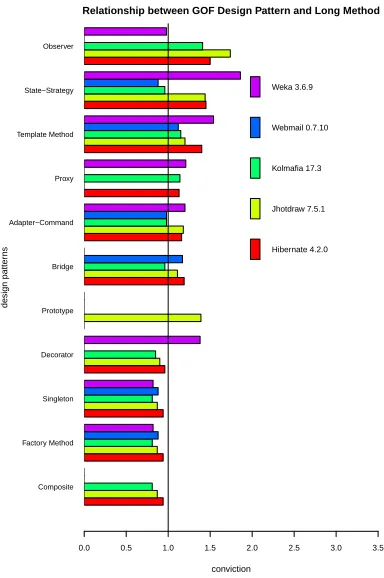
association rule. Figure 5 shows the results of the same metric for Long Method bad smell, according to the De-sign Pattern⇒Long Methodassociation rule.
3.1 Analysis of the Results
The classes with the God Class or Long Method bad smells were inspected manually to answer the research questions defined in this paper.
RQ1. Do the design patterns defined in the GOF cat-alog avoid the occurrence of God Class and Long Method bad smells in software?
The results reported in Table 3 indicate two design patterns with a low God Class occurrence: Compos-ite and Factory Method. The manual inspection reveals that they have a modular structure and divides the tasks between several classes. The idea of the Composite de-sign pattern is to build complex objects via simpler ob-jects. These simpler objects are defined in modules, in
Singleton Factory Method Composite Prototype Decorator State−Strategy Adapter−Command Bridge Proxy Observer Template Method
Weka 3.6.9
Webmail 0.7.10
Kolmafia 17.3
Jhotdraw 7.5.1
Hibernate 4.2.0
Relationship between GOF Design Pattern and God Class
conviction
0 1 2 3 4
design patter
ns
Figure 4: Results of the association ruleDesign Pattern⇒God Class.
such a way intelligence is divided between them, reduc-ing the complexity of the classes. The Factory Method design pattern simulates the idea of a factory in which there is an interface to create objects, but the object cre-ation itself occurs in the class that implements this in-terface. Thus, it is possible to create several modules, each one responsible for creating and managing the in-formation of a objects set, removing the workload from a single class. Therefore, both Composite and Factory Method are design patterns intrinsically modular.
We observed a similar behavior for the Long Method bad smell, as shown in Table 4. Most design patterns present a high amount of Long Method occur-rences, except Composite and Factory Method, which present just a few occurrences of this bad smell.
Table 3:Amount of classes that comprise each design pattern and amount of classes that contain both design pattern and the bad smell God Class.
Design Pattern
Hibernate 4.2.0
JHotDraw 7.5.1
Kolmafia 17.3
Webmail 0.7.10
Weka 3.6.9
T DP&BS T DP&BS T DP&BS T DP&BS T DP&BS
Adapter-Command 228 39 53 19 386 81 40 7 152 68
Bridge 56 16 40 9 14 5 6 3 0 0
Composite 12 0 12 4 8 0 0 0 0 0
Decorator 37 3 10 2 67 7 0 0 32 17
Factory Method 37 3 5 0 31 3 2 0 22 3
Observer 4 2 2 1 8 1 0 0 36 12
Prototype 0 0 21 9 0 0 0 0 0 0
Proxy 8 2 0 0 18 9 0 0 35 18
Singleton 232 3 13 1 77 9 1 1 34 5
State-Strategy 271 47 121 43 334 64 23 3 93 45
Template Method 87 27 16 7 54 13 4 3 22 9
Table 4:Amount of methods that comprise each design pattern and amount of methods that contain both design pattern and the bad smell Long Method.
Design Pattern
Hibernate 4.2.0
JHotDraw 7.5.1
Kolmafia 17.3
Webmail 0.7.10
Weka 3.6.9
T DP&BS T DP&BS T DP&BS T DP&BS T DP&BS
Adapter-Command 271 52 73 19 703 123 50 5 222 71
Bridge 61 13 51 11 19 3 8 2 0 0
Composite 8 0 29 0 37 0 0 0 0 0
Decorator 115 2 31 1 255 12 0 0 61 25
Factory Method 58 0 23 0 45 0 2 0 27 0
Observer 8 3 2 1 7 3 0 0 24 4
Prototype 0 0 16 6 0 0 0 0 0 0
Proxy 6 1 0 0 31 9 0 0 37 12
Singleton 340 0 15 0 672 0 1 0 83 0
State-Strategy 343 121 227 90 974 154 19 0 173 97
Template Method 275 90 47 13 161 48 14 3 34 16
Singleton were inspected, we identified methods with the Long Method bad smell inside them.
Summary.Although Factory Method and Compos-ite design patterns present few co-occurrences with the God Class and Long Method bad smells, the general conclusion of this analysis is that most of the design patterns studied in this paper are associated with this two bad smells. Therefore, the answer of RQ1 is “No, design patterns GOF not necessarily avoid occurrences of the God Class and Long Method bad smells.”
RQ2. Which design patterns of GOF catalog pre-sented co-occurrence with the God Class and Long Method bad smells?
To analyze the association between design patterns and bad smells, we considered the values of Convic-tion. The choice of this metric is due to the fact that
Conviction is able to establish a relationship between Support and Confidence metrics. Moreover, Conviction has a better sensitivity to the direction between the an-tecedent and the consequent. In order to define which design patterns and bad smells co-occurrences have the highest relation, we considered the Conviction thresh-olds, mentioned in Section 2.5.
The chart in Figure 4 indicates a strong relation-ship of several design patterns with the bad smell God Class. The design patterns with the highest Convic-tion values are: Template Method, Observer, and Proxy. We also observed that the results for those design pat-terns in four systems are very close: Hibernate 4.2.0, JHotdraw 7.5.1, Kolmafia 17.3, and Weka 3.6 .9. In Webmail 0.7.10, the association ruleTemplate Method
pre-Composite Factory Method Singleton Decorator Prototype Bridge Adapter−Command Proxy Template Method State−Strategy Observer
Weka 3.6.9
Webmail 0.7.10
Kolmafia 17.3
Jhotdraw 7.5.1
Hibernate 4.2.0
Relationship between GOF Design Pattern and Long Method
conviction
0.0 0.5 1.0 1.5 2.0 2.5 3.0 3.5
design patter
ns
Figure 5: Results of the association ruleDesign Pattern⇒Long Method.
sented more co-occurrences with God Class. These re-sults, then, indicate that Template Method, Observer, and Proxy presented more occurrences of the God Class bad smell than the other design patterns.
Long Method has a similar behavior. The chart in Figure 5 shows that many design patterns have a strong relation with Long Method. Three design patterns present a higher co-occurrence with Long Method: Ob-server, State-Strategy, and Template Method. Convic-tion is higher in 3 out of 5 systems: Hibernate 4.2.0, JHotDraw 7.5.1, and Kolmafia 17.3. The strongest as-sociation rule in these systems is Observer ⇒ Long Method. Webmail 0.7.10 does not present any Observer instance, therefore the Observer⇒ Long Method as-sociation rule was not found in this project. In Weka 3.6.9,Observer⇒Long Methodhas a low occurrence. In conclusion, the Observer⇒Long Method associa-tion rule, despite having a low occurrence in two cases, was the one that presented the strongest Conviction in this paper. Nevertheless, State-Strategy and Template Method also present a high Conviction value. Then, the results indicate that Observer, State-Strategy, and Tem-plate Method presented more occurrences of the Long Method bad smell than the other design patterns.
Summary.So, answering RQ2, we identified Tem-plate Method, Observer and Proxy as those which pre-sented the main co-occurrences with the God Class bad smell. Among them, Template Method design pattern was those which presented the highest co-occurrence with this bad smell. We also identified the Observer, State-Strategy and Template Method design patterns as those that presented the main co-occurrences with the Long Method bad smell. Nevertheless, Observer pre-sented the highest co-occurrence with Long Method.
RQ3. What are the more common situations in which the God Class and Long Method bad smells ap-pear in software systems that apply GOF design patterns?
The results indicate that God Class bad smell has more co-occurrences with the Template Method design pattern, and the Long Method bad smell has more co-occurrences with the Observer design pattern. To iden-tify the causes of such co-occurrences, we performed a manual inspection in the classes with theTemplate Method⇒God ClassandObserver⇒Long Method
co-occurrences. Tables 5 and 6 show the computed met-rics results for these two co-occurrences.
Table 5:Metrics results for theTemplate Method⇒God Class.
Software Support (%) Confidence (%) Conviction
Hibernate 0.35 31.03 1,35
JHotDraw 0.66 43.75 1,57
Komafia 0.40 24.07 1,16
Webmail 2.33 75.00 3,53
Weka 0.37 40.91 1,36
Table 6:Metrics results for theObserver⇒Long Method.
Software Support (%) Confidence (%) Conviction
Hibernate 0.01 37.50 1.50
JHotDraw 0.01 50.00 1.74
Komafia 0.01 42.86 1.41
Webmail 0.00 ∞ ∞
Weka 0.02 16.67 0.98
3.1.1 Template Method⇒God Class
object via polymorphism. The advantage of this imple-mentation is the reduction of complexity in the super class, since definitions via conditional structures such as if, else, and switches are replaced by polymorphism. However, using this pattern requires careful attention to avoid assigning many responsibilities to the templates and also to the super class.
The manual inspection in the classes that presented
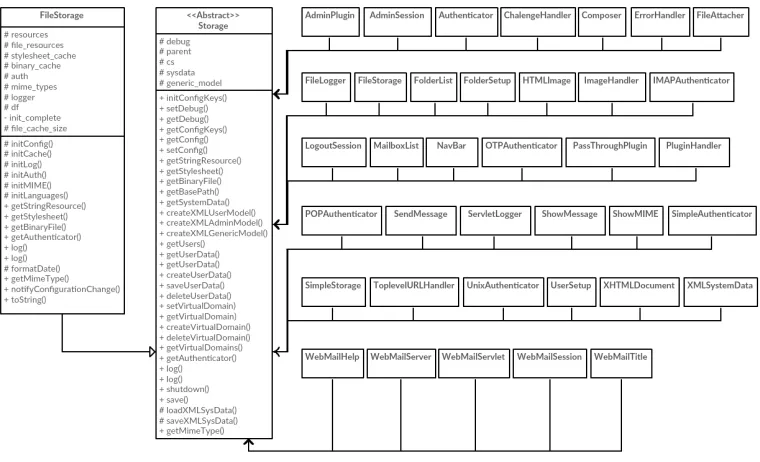
Template Method ⇒ God Class co-occurrence indi-cated that a great amount of responsibilities were as-signed to the classes containing the template method. We observed that the templates methods refer to the definition of the object behavior, implemented in the subclasses. In some classes, the behavior implementa-tion has a high complexity. This generates task over-load in the templates methods, contributing with the Long Method occurrence in some cases. In addition, a high number of dependencies has been observed in super classes that implements a Template Method. Sev-eral objects are instantiated in such implementations, elevating the coupling of these classes, and small tasks are passed to them. For instance, Figure 6 shows a class diagram of an Template Method instance identi-fied in the Webmail system. TheStorageclass plays the
AbstractClassrole on the design pattern and contains the template methods. The initConfigKeys(), setCon-fig(),getUserData(),setUserData(),deleteUserData(),
setVirtualDomain()andsave()methods are the template methods existing within theStorageclass.
Analyzing the diagram in Figure 6, we can observe the characteristics discussed above. TheStorageclass contains the template method of this Template Method instance. This class has an intense amount of getters and setters methods that make use of few attributes. In addition, we observe that this class has too much services provided for others classes with different con-cerns. It contains services regarding to user authentica-tion, log handling, data transport, among others. This task overloading at theStorageclass, besides centraliz-ing the intelligence of the system in a scentraliz-ingle component, impairs the maintainability of component and system.
Based on this analysis, we identify some reasons that contributed to theTemplate Method⇒God Class
co-occurrence emergence. The Template Method de-sign pattern allows the classes extension and the addi-tion of new features. However, poor planning and mis-application of this design pattern contributes to increase the amount of super-class responsibilities, concentrat-ing a large part of the system intelligence in the super-class, generating the God Class emergence. To elim-inate these co-occurrences, it is necessary to extract, from the overloaded classes, methods and attributes,
adding them to other classes to divide the amount of work and effort performed by the Template classes.
3.1.2 Observer⇒Long Method
Observer is a solution that establishes a one-to-many dependency between objects. Observer uses a structure where the subject class has a list of all observers classes that use its data. When some information is changed in the subject by one of its observers, the subject is trig-gered by changing the other observers. The aim of this design pattern is the synchronization of data and the up-dating of objects in real time. This update occurs via polymorphism, avoiding the increase of complexity that generally occurs with the use of conditional structures. However, when using this design pattern, it is important to implement the operation that notifies the observers in the subject properly, since a poor planning of this oper-ation can result in complex methods.
We manually inspected the methods involved in the
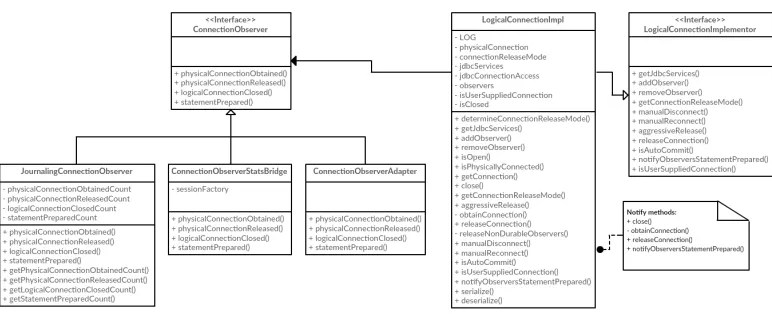
Observer ⇒ Long Method co-occurrence. Figure 7 shows a class diagram of an Observer instance identi-fied in the Hibernate system.
In the diagram, the ConnectionObserver class represents the Abstract Observer and the Connec-tionObserverAdapter,ConnectionObserverStatsBridge
and JournalingConnectionObserver classes represent the Concrete Observers which actually use the data maintained by the Subject. TheLogicalConnectionImpl
plays the Subject role and is primarily responsible for maintaining and managing data that is essential for the proper observers operation. When the existing data in the Subject is changed for some of observers, the others observers may be notified by one of following meth-ods: close(),obtainConnection(),releaseConnection()
andnotifyObserversStatementPrepared().
Analyzing the structure showed by the diagram in Figure 7, we observed that three of four notify meth-ods presented the Long Method bad smell:close(), ob-tainConnection()andreleaseConnection(). During the manual inspection we noticed that the methods imple-mented in the subject class, responsible for notifying observers, perform a lot of work. Such methods are big and complex, what make the code difficult to read and to understand. In some case, there is also scattering in the code, involving log records and observer update, among others, that influence the high complexity and the large size of these methods.
Figure 6:Class Diagram that represent theTemplate Method⇒God Classco-occurrence.
methods are the main situation we have found. Scatter-ing and crosscuttScatter-ing concerns also have appeared in the implementation of such methods. A concern is a part of a problem that one needs to deal with in a software system. The registration of the operation log is an ex-ample of concern. When concerns are not modularized in a program, it leads to scattering and to crosscutting concerns in the code. In the methods implemented in Observer, we have detected scattering and crosscutting concerns in subject classes, specially due to repetition of code that implements register of log, aiming to notify observers. To eliminate such co-occurrences, it is necessary to eliminate these code repetitions and to modularize them so that they are implemented in a single entity and can be reused by other entities. With respect to scattering and crosscutting concerns, in object-oriented programming, these occurrences are difficult to control. However, they can be mitigated through the Singleton design pattern. Developers could create a Singleton class, responsible for managing log concern for example, that would provide a specific method for logging, requesting only the information that should be written.
Summary. The main reason of co-occurrences of God Class bad smell with Template Method is the mis-use of object orientation, leading to concentration of re-sponsibilities in the classes that implements the Tem-plate Method. A similar situation was also found in the case of the co-occurrences of Long Method bad smell
with Observer; in this case, the misuse of object orien-tation leads to scattering and crosscutting concerns.
4 Lessons Learned
Design patterns are solutions with modular structure, so it is possible to infer think that their application avoid bad smells. Nevertheless, design patterns were not pro-posed specifically to this aim.
When applying design patterns in the construction of object-oriented software systems, it is important to ensure that object orientation and modularization are being properly applied. Design patterns are usu-ally applied in methods and classes to allow software more flexible and extensible. When design patterns are not implemented carefully, it may result in design deviances, such as concentration of responsibilities in classes and methods, scattering and crosscutting con-cerns. Such deviances may lead to the presence of bad smell in software systems, and make the code complex and difficult to understand.
Figure 7:Class Diagram that represent theObserver⇒Long Methodco-occurrence.
evolution could improve or keep the internal quality of the system, providing modularity, reducing the code complexity and improving the code readability.
Another important information found in this study is that most of the software systems analyzed presents both bad smells, God Class and Long Method in the implementation of the design pattern. The character-istics of these bad smells might be the reason of the co-occurrence of them with the design patterns. God Class is a class that performs a lot of work in a software system. To accomplish all the tasks a God Class has to do, there are two not excluding possibilities: the class has many methods and/or the methods of the class im-plement many tasks, i.e., some or all of them are Long Methods.
5 Threats to Validity
This section presents threats to validity according to the guidelines proposed by Wohlin et al. [24]. They are organized in external, internal and construct validity.
External Validity. We considered a sample com-posed of five systems. We mainly analyzed systems from a large data set, called Qualitas Corpus. The sam-ple has small, medium, and large systems. Neverthe-less, due to the small size of the sample, we are not able to generalize the results found in this study. Even though, the results found are still important because they show that the use of design patterns not necessarily avoid bad smells in object oriented software system.
Internal Validity. Our data collection was carried out by tools. The identification of design patterns was performed by DPDSS, and the identification of bad smells by RAFTool. We are not able to ensure that the results of those tools are totally right. However, we chose tools already used in previous work.
Construction Validity.To identify the main causes of the main co-occurrences of design pattern and the bad smells identified in this study, we performed a manual inspection in the classes and in the methods involved in such co-occurrences. This inspection was carried out by one of the authors of this work. Although the inspector has high level of knowledge of all the concepts involved in the analysis, the manual inspection might be error-prone. To overcome this threat, we decided to analyze a small quantity of software systems in this work.
6 Related Work
This section presents the main previous related work regarding the identification of co-occurrence between design patterns and bad smells.
Jaafar et al. [11] investigated the existence and the impact of the static relationship between anti-patterns and design patterns in software systems. They analyzed the behavior of these relationships during software evo-lution. In their work, a case study was performed with open source Java systems. The authors identified that design pattern have relationship with anti-patterns and that this relationship is in constant growth as the system evolves. In addition, the Command design pattern was identified as the one that presented the highest relation with the investigated anti-patterns.
the information of design patterns and bad smells in-stances, and through of association rules they found the co-occurrence between Command with God Class as well as Template Method with Duplicate Code.
Jaafar et al. [12] present a study on the impact of static and co-changes dependencies in classes with de-sign patterns and bad smells, and verify the relation of these dependencies to occurrences of software fail-ures. In their study, the authors observed the evolu-tion of three open-source Java software projects and concluded that classes having static dependencies with anti-patterns as well as classes having static and co-change dependencies with anti-patterns and design pat-terns tend to have more flaws.
Walter and Alkhaeir [23] investigated the relation-ship between design patterns and bad smells, and ex-amined how the presence of one interacts with the pres-ence of the other in a class. The authors carried out an empirical study with seven bad smells and nine design patterns, identified in two applications. They concluded that the presence of design patterns is linked with a small number of cases of bad smells.
In this paper, we identified other kind of co-occurrences to the God Class and Long Method bad smells and discussed these cases. In addition we iden-tified design patterns with low co-occurrence with the bad smells. Our study applied a different approach to detect bad smells. Our data rely in detection strategies to detect bad smells based in software metrics and their thresholds. These detection strategies were previously proposed and evaluated by Filó et al. [8].
7 Conclusion
In this paper we carried out an exploratory study with object-oriented systems that applies design patterns to (i) investigate if design patterns avoid the bad smells emergence in software; (ii) identify design patterns that may to present co-occurrence with bad smells; and (iii) extract the main reasons that impact on the co-occurrence emergence. The study considered a sample of five systems, of varying sizes. Our main contribution is that their findings may help the software engineering community in the comprehension of the internal struc-ture of the software systems that apply design patterns. To identify the bad smells in the software systems, we used detection strategies that are based in software metrics and that were previously proposed and evalu-ated in the literature. The detection strategies are based in metrics consistent with the characteristics of God Class and Long Method bad smells. Moreover, the thresholds of the metrics used in the strategies were also proposed and evaluated in previous work.
The results of this study show that the use of design patterns not necessarily avoid God Class and Long Method. We found that Composite and Factory Method are the design patterns less associated with the bad smells considered in this study. The main co-occurrences of design patterns and bad smells found in this paper areTemplate Method⇒God Classand Ob-server⇒Long Method. In the manual inspection of the artifacts that presented these relations, we found classes with many responsibilities, complex methods and code repetition. A better planning of the software design and its evolution could avoid the occurrences of bad smells in the implementation of design patterns. In particular, such problems would be avoided by a better planning of the software design, as well as by the application of refactoring techniques during the evolution of the soft-ware system.
Another important information found is that most of the analyzed systems presents both bad smells, God Class and Long Method, in the implementation of the design pattern. The characteristics of these bad smells might be the reason of the co-occurrence of them. God Class is a class that performs a lot of work in a software system, and to accomplish all the tasks there are two not excluding possibilities: the class has many methods and/or the methods of the class implement many tasks, i.e., some or all of them are Long Methods.
As future works, it is important (i) to extend this re-search to a greater amount of sample in order the results can be generalized; (ii) to investigate co-occurrences of design patterns with other bad smells; (iii) to conduct an analysis of a larger sample considering type and size of the software systems would be also of help to improve the comprehension of software systems that apply de-sign patterns.
Acknowledgments
We would like to thank CAPES that supported to con-duction of this work and the XIII Brazilian Symposium on Information Systems (SBSI 2017) where part of this study was published.
References
[1] Agrawal, R., Imieli´nski, T., and Swami, A. Min-ing association rules between sets of items in large databases. SIGMOD Rec., 22(2):207–216, June 1993.
[3] Cardoso, B. and Figueiredo, E. Co-occurrence of design patterns and bad smells in software sys-tems: An exploratory study. In Brazilian Sym-posium on Information Systems, pages 347–354, 2015.
[4] Christopoulou, A., Giakoumakis, E. A., Zafeiris, V. E., and Soukara, V. Automated refactoring to the strategy design pattern.Information and Soft-ware Technology, 54(11):1202–1214, 2012.
[5] Ferreira, K. A. M., Bigonha, M. A., Bigonha, R. S., Mendes, L. F. O., and Almeida, H. C. Identifying thresholds for object-oriented soft-ware metrics. The Journal of Systems and Soft-ware, 85:244–257, 2012.
[6] Filó, T. G. S. Identifying reference values for object-oriented software metrics. Master’s thesis, UFMG, Computer Science, 2014.
[7] Filó, T. G. S., Bigonha, M. A. S., and Ferreira, K. A. M. Raftool - filtering tools for methods, classes and packages with uncommon measurements of software metrics. InWAMPS, pages 1–6, 2014.
[8] Filó, T. G. S., Bigonha, M. A. S., and Ferreira, K. A. M. A catalogue of thresholds for object-oriented software metrics. InSOFTENG, pages 48–55, 2015.
[9] Fowler, M. and Beck, K. Refactoring: Improv-ing the Design of ExistImprov-ing Code. Addison-Wesley, 1999.
[10] Gamma, E., Helm, R., Johnson, R., and Vlissides, J.Design Patterns: Elements of Reusable Object-oriented Software. Addison-Wesley, 1994.
[11] Jaafar, F., Guéhéneuc, Y., Hamel, S., and Khomh, F. Analysing anti-patterns static relationships with design patterns.ECEASST, 59, 2013.
[12] Jaafar, F., Gueheneuc, Y.-G., Hamel, S., Khomh, F., and Zulkernine, M. Evaluating the impact of design pattern and anti-pattern dependencies on changes and faults.Empirical Software Engineer-ing, 21(3):896–931, 2016.
[13] Lanza, M. and Marinescu, R. Object-Oriented Metrics in Practice. Springer-Verlag, 2006.
[14] Liu, W., Hu, Z.-G. b., Liu, H.-T., and Yang, L. Au-tomated pattern-directed refactoring for complex conditional statements. Journal of Central South University, 21(5):1935–1945, 2014.
[15] Marinescu, R. Em Measurement and Quality in Object-Oriented Design. PhD thesis, University of Timisoara, 2002.
[16] Nahar, N. and Sakib, K. Automatic recommenda-tion of software design patterns using anti-patterns in the design phase: A case study on abstract fac-tory. InCEUR Workshop Proc., pages 9–16, 2015.
[17] Nahar, N. and Sakib, K. Acdpr: A recommen-dation system for the creational design patterns using anti-patterns. In IEEE 23rd International Conference on Software Analysis, Evolution, and Reengineering (SANER), vol. 4, pages 4–7, 2016.
[18] Sousa, B. L., Bigonha, M. A. S., and Ferreira, K. A. M. Evaluating co-occurrence of gof design pat-terns with god class and long method bad smells. In Proceedings of the XIII Brazilian Symposium on Information Systems, pages 396–403, 2017.
[19] Sousa, B. L., Bigonha, M. A. S., and Ferreira, K. A. M. A tool for detection of co-occurrences be-tween design patterns and bad smells. Technical report, Programming Language Lab (UFMG), llp 001-2017, 2017.
[20] Speicher, D. Code quality cultivation. Commu-nications in Computer and Information Science, 348:334–349, 2013.
[21] Terra, R., Miranda, L. F., Valente, M. T., and Bigonha, R. S. Qualitas. class corpus: A compiled version of the qualitas corpus. ACM SIGSOFT Software Engineering Notes, 38(5):1–4, 2013.
[22] Tsantalis, N., Chatzigeorgiou, A., Stephanides, G., and Halkidis, S. T. Design pattern detection using similarity scoring. Software Engineering, IEEE Transactions on, 32(11):896–909, 2006.
[23] Walter, B. and Alkhaeir, T. The relationship be-tween design patterns and code smells: An ex-ploratory study. Information and Software Tech-nology, 74:127–142, 2016.
[24] Wohlin, C., Runeson, P., Hst, M., Ohlsson, M. C., Regnell, B., and Wessln, A. Experimentation in Software Engineering. Springer, 2012.
![Figure 1: Detection strategy for God Class extracted from [8].](https://thumb-us.123doks.com/thumbv2/123dok_us/8363826.1672618/2.596.323.504.547.640/figure-detection-strategy-god-class-extracted.webp)
![Figure 2: Detection strategy for Long Method extracted from [8].](https://thumb-us.123doks.com/thumbv2/123dok_us/8363826.1672618/3.596.90.270.128.194/figure-detection-strategy-long-method-extracted.webp)