Sujatha et al. World Journal of Engineering Research and Technology
A NOVEL MEMS BASED MICROHEATER FOR GAS SENSING
APPLICATIONS USING COMSOL
L. Sujatha*, V. S. Selvakumar, S. Suganthi and C. V. Gayathri
Rajalakshmi Engineering College, Chennai – 602105.
Article Received on 17/01/2019 Article Revised on 07/02/2019 Article Accepted on 28/02/2019
ABSTRACT
Micro-Heaters have been the subject of great interest owing to their extensive applications in gas sensors, humidity sensors and other micro-systems. A micro-heater should have low power consumption, low thermal mass and better temperature uniformity. In this paper, we have looked for geometric optimization of the heater structure to achieve high temperature uniformity by performing analysis using COMSOL Multiphysics 4.2, a Finite Element Analysis (FEA) Package. We have presented four different patterns of micro-heater, namely Single Meander, double meander, fan shape and square shape of 500×500µm with their Electro-thermal simulated temperature profile. The Maximum Temperature of 642.75 K was obtained. For the same supply voltage applied, it was found that the Square shape structure gave the best result with 99.51% of the heater area having a temperature greater than 90 % of the maximum temperature attained with an average temperature of 642.75 K.
KEYWORDS: Micro-heater, COMSOL, Heater Geometries, Temperature Profile.
1. INTRODUCTION
Micro-Heaters are the key components in sub-miniature micro-sensors, especially in gas sensors. The metal oxide gas sensors utilize the properties of surface adsorption to detect changes in resistance as a function of varying concentration of different gases.[1] To detect the resistive changes, the heater temperature must be in the requisite temperature range over the heater area. Hence the sensitivity and response time of the sensor are dependent on the operating temperature of the micro-heater. So their proper design is of critical importance. In this paper, we report on the design and simulation of micro-heaters used in gas sensors with
World Journal of Engineering Research and Technology
WJERT
www.wjert.org
SJIF Impact Factor: 5.218*Corresponding Author
L. Sujatha
Rajalakshmi Engineering
the aim of improving their temperature uniformity.[2] The design has been supported using Electro-thermal Simulations using the COMSOL. There is a rapid increase in the number of application for MEMS-based micro heater, as they are an integral component in sub miniature micro-devices such as gas sensors, fuel cells & electron microscopes and in the preparation of thin films. Micro heaters are small is size and can offer temperatures in excess of 1000 ⁰C. Usually, the heating method for micro heaters involves conversion of electrical work to high-density heat.[3] The need for sensors with improved performances leads to continuous research efforts aiming at the optimization of the design of the device, the sensing material used as well as the mode of operation of the device. This leads us to the development of MEMS-based micro heaters. Nowadays, MEMS-based micro heaters are becoming increasingly important in portable electronics applications where low-voltage and low-power designs are required.[4] One such application is the micro gas sensors that consist of micro heaters and sensing electrodes on the membranes. They consume less power and have enhanced sensitivity. Metal oxide gas sensors predict the concentration of different gases by detecting the change in resistance.[5-7] To detect the resistive changes, the heater temperature must be in the requisite temperature range over the heater area. Hence, the sensitivity and response time of the sensor are dependent on the operating temperature of the micro-heater. The operating temperature and the sensing element decides the various parameters of a gas sensor.[8,9] Micro heaters provide the heat needed to attain the operating temperature as the gas chemical reaction in the sensing layer of a gas sensor takes places at high temperatures. For many gas sensitive materials the sensor performances are enhanced at relatively high temperatures. Optimization of the micro heaters to attain temperature uniformity leads to the ability of these sensors to detect selected target gases even at the ppb level in air.[10-14] High sensitivity and low cost are the main reasons that stimulate research efforts in this field. MEMS-based integrated gas sensors provide several advantages for applications such as array fabrication, small size, and unique thermal manipulation capabilities, uniform heating throughout the active area. Roy has in his paper has briefly discussed the significance of co-planar structure with micro heater by a single lithographic step on micro machined silicon substrates.[15]
temperature required for gas detection is a few milliseconds, the sensor will be active only for few seconds to detect the gas, after which it will stay inactive for most of the time. The DC values usually lie on the range between 30 and 150 mW. It is possible to optimize the micro heater geometry using computer simulations in order to achieve high temperature as well as uniformity.[20] The most often used micro heaters are the meander shaped micro heater and the double spiral micro heater. They provide an average temperature uniformity over the sensing areas but the active area temperature still lies as a hindrance to the performance of gas sensors.[21,22]
In order to solve these issues, in this paper, we design, simulate and analyses three different window-grill MEMS-based micro heaters that can be used in gas sensors with the aim of improving their temperature uniformity. We also discuss the effect of terminal placement on the heat produced as well as the current density. The optimization of the width of the terminals is also done, in order to improve the current density and the sensitivity. The design has been supported using Electro-thermal simulations using COMSOL Multiphysics. The uniform distribution of temperature over the heating plate through control of the heat distribution is also discussed. The heat produced and the average power dissipated is briefly discussed. All the proposed micro heaters were simulated in air atmosphere.
2. Mathematical Modeling
The electric field equals the negative of gradient of the potential V. The electric current density J is in turn proportional to the electric field. Due to this electric current, there is resistive heating which is shown to be proportional to the square of magnitude of the electric current density J. Hence the temperature increases. This is referred to as Joule heating.[1]
(1)
The proportionality constant is the electric resistivity ρ or the reciprocal of the temperature dependent electric conductivity. Combining these facts we have
(2)
(3)
Over a range of temperatures the electric conductivity varies with T, governed by the equation,
(5)
Where is the conductivity at the reference temperature T0. α is the temperature coefficient
of resistivity, which describes how the resistivity varies with temperature.
In the Electro- Thermal module available under COMSOL, the equation have been solved under Dirichlet Neumann, and mixed boundary conditions numerically. The temperature is kept fixed at the end wherein we apply the potential and the other ends are thermally insulated to achieve higher Joule’s heating profile. The material properties of the heater required to solve the mathematical equations are given in Table 1.
3. MATERIALS AND METHODS
Usually, to improve the resistance of a heating element, the length of the heating element is increased. In this way, the heat produced is increased, as it is directly proportional to the resistance of the heating element. However, here, we have optimized the area of the heater in order to increase the resistance.
For achieving geometric optimization, we have tried three geometries. This work aims to design a micro heater with good uniformity and higher average temperature throughout the structure when compared to existing heater structures. In order to improve the heating, we looked at increasing the number of connectors between inner squares and outer square to increase the current density all over the structure. The thermal insulation provides to achieve an improved temperature profile.
Above table shows temperature, current density, stress of different types of heater, we can observe that the average current density of type1 heater is lower as compared to all other types. The grill 1 heater provides better temperature uniformity with lower power consumption and there is no much change in stress distribution.
that 10µm terminal width with center terminal placement provides optimum current density as well as better temperature uniformity. So, grill 1 provides best uniformity and lower current density and hence lowers power consumption.
Table 1: Properties of the heater material (platinum Pt).
Property Value
Co efficient of thermal expansion 8.80e-6[1/K] Heat capacity at constant pressure 133[J/(kg8K)] Relative permittivity 38 Density 2320[kg/m^3] Thermal Conductivity 71.6[W/(m*K)] Young’s modulus 168e9[Pa] Poisson’s ratio 0.38
4. Heater Geometries
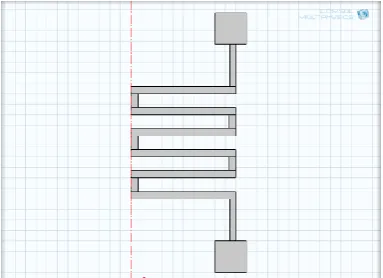
For achieving geometric optimization we have tried the following four geometries.
Figure 1: Single Meander Structure.
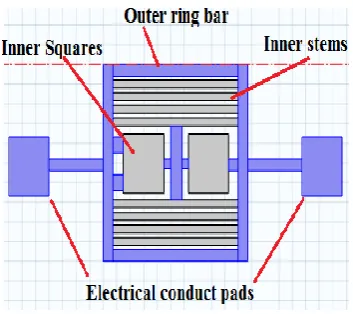
Figure 3: Grill grill 02 Microheater.
Figure 4: Grill grill 03 Microheater.
In our design, we wanted to improve the temperature uniformity of the micro-heater. Starting with the Single meander structure, we went on to make modifications to it to bring more area under heat and thus finally arriving at the square shape structure with an array of connectors.
In order to improve the heating, we looked at increasing the number of connectors between inner squares and outer square to increase the current density all over the structure. Thermal Insulation was provided to achieve an improved temperature profile.
5. Simulation With FEA
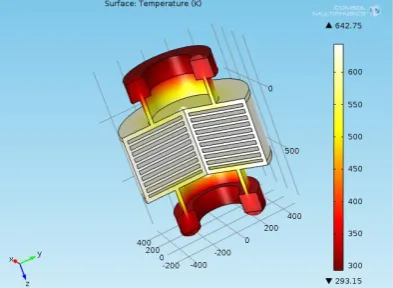
The geometries were analyzed by applying a potential of 0.1V.The end where potential is applied is maintained at 642.75 K.Their simulated temperature Profile are as shown below.
Figure 6: Single Meander.
Figure 7: Grill grill 01 microheater.
Figure 9: Grill grill 03 Microheater.
7. RESULTS AND DISCUSSION
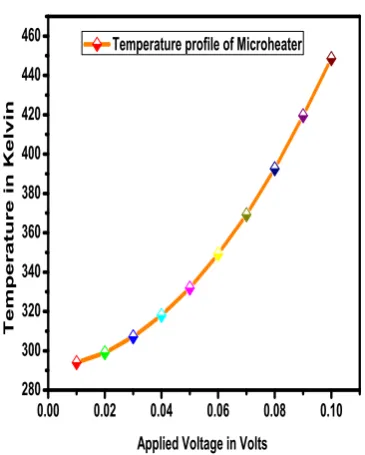
As the voltage is varied from 0.01 to 0.1 V in increments of 0.01 V the temperature increases exponentially. The same maximum temperature was obtained for all the structures; however there was a notable difference in temperature uniformity.
0.00 0.02 0.04 0.06 0.08 0.10 280
300 320 340 360 380 400 420 440 460
T
e
mp
e
r
a
tu
r
e
i
n
Ke
lvin
Applied Voltage in Volts Temperature profile of Microheater
Figure 10: Maximum Temperature Vs Applied Voltage curve for Micro Heater of area 100× 100 µm.
Table 2: Temperature profile of Various Structures.
Structure Type
Maximum Temperature
(K)
Average Temperature
(K)
Percentage of Area greater than 80% of maximum
Temperature
Single Meander 642.75 510.8 79.14
Grill type 01 642.75 640.2 99.5
Grill type 02 642.75 636.5 99
Grill type 03 642.75 638.25 99.2
The simulated result of microheaters shows that the Grill grill 02 structure provides better temperature profile when compared to other structures with an average temperature of 640.2 K.
8. CONCLUSION
A comprehensive thermal model of micro- heaters is designed and simulated using COMSOL 4.2. The results show the variation of temperature across the structure for the applied voltage. It was found that the Square shape structure gave the best result with 99.51% of the heater area having a temperature greater than 80% of the maximum temperature attained with an average temperature of 640.2 K. We have found many effective improvements in the temperature upgrade path while learning new features of the new COMSOL Multiphysics 4.2. As our work is in basic level, it is our future concern to fabricate a micro- heater on the basis of these simulation.
9. ACKNOWLEDGEMENTS
We acknowledge the NPMASS Program for the establishment of National MEMS Design Center (NMDC) at Rajalakshmi Engineering College. Also, we acknowledge Prof.S.Mohan. IISC, Bangalore who gave us sufficient knowledge on Electro-thermal-complaint microheaters.
10. REFERENCES
1. Velmathi. G, Ramshanker. N, and Mohan .S, 2D Simulations and Electro- Thermal Analysis of Micro-Heater Designs Using COMSOL for Gas sensor applications, Proceedings COMSOL conference, 2010.
3. Susmita Sinha, Sunipa Roy, C. K. Sarkar, Design & Electro-Themal analysis of Micro-heater for Low Temperature MEMS based Gas Sensor, Proceedings published by International Journal of Computer Applications, 2011.
4. B. Mondal, M. M. Mahanta, P. Phukan, C. Roychoudhury, H. Saha, Oxidized Macro Porous Silicon based Thermal Isolation in the Design of Microheater for MEMS based Gas, Proceedings published by International Journal of Computer Applications, 2011. 5. Woo- Jin Hwang, Kyu- Sik Shin, Ji- Hyoung Roh, Dae- Sung Lee and Sung- Hoon Choa,
Development of Micro- Heaters with optimized Temperature Compensation Design for Gas Sensors, Sensors, 2011.
6. S. J. Patil, D. S. Bodas, A. S. Nassiopoulou, A. Tserrepi, Sensors and Actuators B 95 78, 2003.
A. A. Darhuber, J. P. Valentino, S. M. Troian and S. Wagner, Thermocapillary actuation of droplets on chemically patterned surfaces by programmable microheater arrays, Journal of Microelectromechanical Systems, 2003; 12: 873-879. doi: 10.1109/JMEMS. 2003.820267.
7. Xuanhong Cheng, Yanbing Wang, Yael Hanein, Karl F. Böhringer and Buddy D. Ratner, Novel cell patterning using microheater‐controlled thermoresponsive plasma films, J. Biomed. Mater. Res., 2004; 159-168. doi: 10.1002/jbm.a.30053.
8. U. Drechsler, N. Bürer, M. Despont, U. Dürig, B. Gotsmann, F. Robin and P. Vettiger, Cantilevers with nano-heaters for thermomechanical storage application, Microelectronic Engineering, 2003; 67: 397-404. https://doi.org/10.1016/S0167-9317(03)00095-9.
9. Gwiy-Sang Chung and Jae-Min Jeong, Fabrication of micro heaters on polycrystalline 3C-SiC suspended membranes for gas sensors and their characteristics, Microelectronic Engineering, 2010; 87: 2348-2352. https://doi.org/10.1016/j.mee.2010.04.005.
10.A Delan, M Rennau, S.E Schulz and T Gessner, Thermal conductivity of ultra low-k dielectrics, Microelectronic Engineering, 2003; 70: 280-284. https://doi.org/10.1016/S0167-317(03)00417-9.
11.Carole Rossi, Pierre Temple-Boyer and Daniel Estève, Realization and performance of thin SiO2/SiNx membrane for microheater applications, Sensors and Actuators A: Physical, 1998; 64: 241-245. https://doi.org/10.1016/S0924-4247(97)01627-0.
13.Hongyu Ma, Wenjuan Wang, Enjie Ding, Xiaohu Zhao and Tingting Cheng, Cantilever-grill microheater fabricated with thick silicon, Microsystem Technologies, 2015; 21: 801-807. https://doi.org/10.1007/s00542-014-2288-3.
14.Carole Rossi, Emmanuel Scheid and Daniel Estève, Theoretical and experimental study of silicon micromachined microheater with dielectric stacked membranes, Sensors and Actuators A: Physical, 1997; 63: 183-189. https://doi.org/10.1016/S0924-4247(97)80503-1.
15.Ching-Liang Dai, A capacitive humidity sensor integrated with micro heater and ring oscillator circuit fabricated by CMOS–MEMS technique, Sensors and Actuators B: Chemical, 2007; 122: 375-380. https://doi.org/10.1016/j.snb.2006.05.042.
16.Z. Zhao, S. Glod and D. Poulikakos, Pressure and power generation during explosive vaporization on a thin-film microheater, International Journal of Heat and Mass Transfer, 2000; 43: 281-296. https://doi.org/10.1016/S0017-310(99)00129-5.
17.Seung-Chul Ha, Yong Shin Kim, Yoonseok Yang, Young Jun Kim, Seong-Mok Cho, Haesik Yang and Youn Tae Kim, Integrated and microheater embedded gas sensor array based on the polymer composites dispensed in micromachined wells, Sensors and Actuators B: Chemical, 2005; 105: 549-555. https://doi.org/10.1016/j.snb.2004.01.019. 18.Han Ji-song, T. Kadowaki, K. Sato and M. Shikida, Fabrication of thermal-isolation
structure for microheater elements applicable to fingerprint sensors, Sensors and Actuators A: Physical, 2002; 100: 114-122. https://doi.org/10.1016/S0924-247(02)00136-X.
19.Byeong-Ui Moon, Jeong-Min Lee, Chang-Hyun Shim, Myoung-Bok Lee, Jong-Hyun Lee, Duk-Dong Lee, Jong-Ho Lee, Silicon bridge grill micro-gas sensor array, Sensors and Actuators B: Chemical, 2005; 108: 271-277. https://doi.org/10.1016/j.snb. 2005.01.042.
20.Roy Sunipa, Majhi Tanusree, Kundu Avra, Sarkar and Saha, Design, Fabrication and Simulation of Coplanar Microheater Using Nickel Alloy for Low Temperature Gas Sensing Application, Sensor Letters, 2011; 9: 1382-1389. https://doi.org/10.1166/sl. 2011.1693.