Procedia - Social and Behavioral Sciences 197 ( 2015 ) 126 – 134 Available online at www.sciencedirect.com
1877-0428 © 2015 Published by Elsevier Ltd. This is an open access article under the CC BY-NC-ND license (http://creativecommons.org/licenses/by-nc-nd/4.0/).
Peer-review under responsibility of Academic World Education and Research Center. doi: 10.1016/j.sbspro.2015.07.068
ScienceDirect
7th World Conference on Educational Sciences, (WCES-2015), 05-07 February 2015, Novotel
Athens Convention Center, Athens, Greece
Use of a System Thinking Learning Force and Motion Concept in
Physics for Nurse Course
Prissana Rakbamrung
a*, Preeyanan Thepnuan
band Nattaphon Nujenjit
aaFaculty of Education, Suratthani Rajabhat University, Surat Thani, 84100 Thailand bPhetpadungweingchai School, Chai Ya, Surat Thani, 84110 Thailand
Abstract
This work was focused on students’ conceptual on Physics principles by conducting an integration of qualitative and quantitative study. The teaching intervention compose of three parts: training students on system thinking, use of a system thinking to teach on force and motion concept, and students’ practice on FMCE. The participants were the first year nursing students enrolled in Physics for Nurse Course. Student nurses’ often experience difficulty in understanding and conceptualizing abstract principles same as science students. Thus numerous studies have found that students struggled to grasp the underlying principles of force and motion. Owing to system thinking is an approach applied to understand how human think differently. This study, therefore, investigated the effectiveness of combine system thinking approach with teaching intervention on student understanding abstract concept of force and motion. This work was focused on how students conceptualized abstract principles by conducting a qualitative study. The teaching intervention compose of three parts: training students on system thinking, use of a system thinking to teach on force and motion concept, and students’ practice on FMCE. Results indicated that very few student groups describe in Newtonian way and there were some alternative concepts. However, about a half of student groups could identify cause and effect for purpose events. Hence, system thinking approach can be useful as formative assessment for learning Newtonian concept.
© 2015 The Authors. Published by Elsevier Ltd.
Peer-review under responsibility of Academic World Education and Research Center.
Keywords: Dynamic Concept; Force and Motion; Nursing Student; System Thinking
* Prissana Rakbamrung. Tel.:+66-822-695-848.
E-mail address: [email protected]
© 2015 Published by Elsevier Ltd. This is an open access article under the CC BY-NC-ND license (http://creativecommons.org/licenses/by-nc-nd/4.0/).
1.Introduction
In the education literature on Physics education, there is no doubt that students often experience difficulty in understanding and conceptualizing abstract principles (Kelly, 2011, Welsh, 2006 & Guidoni, Porro, & Sassi, 1995). Numerous research reveal that both teacher and students struggle to grasp the underlying principles of force and motion, Newtonian mechanics (Rakkapao et. al., 2014, Yvett, & Hise, 1988, Thornton, & Sokoloff, 1998, Hogg, & Zollman, 2002, Yuruk, Beeth, & Andersen, 2009, Peters, 1982, Halloun, & Hestenes, 1985, Clement, 1982). A number of papers dealing with making simple apparatus for inquiry based learning. More and more instructors focus on hands on experience. The use of these simple instruction models offer benefits to both teacher and students. However, students often tackle problems in scientific reasoning and making calculations as they often finding a solved example in their textbook and making minor changes to the resulting formulate to adapt it to their situation (Mungan, 2012). For coming across these problems, system thinking, an approach to generate knowledge and understand phenomena in terms of cause and effect is desired. System thinking is used to help student to understand phenomena in terms of cause and effect by examining the linkages and interactions between components as an array of interactions. It was drowned in several disciplines such as environment (Shaw, 2012), management (Stocklmayer, Rayner, & Gore, 2012), engineering (Feldman, 2011), education (Terzella et. al., 2008) and science education (Portillo-Velez et. al, 2013). Typically, the structure of system’s behavior in system thinking is a feedback loops which root causes are not individual. The reason is that phenomena are understood to be an emergent property of interrelated whole not by breaking them into parts. However, over 99% of the encounter problems can understand with the simple thinking approach called event oriented thinking. Therefore, the goal of this work is to investigate how students conceptualized abstract principles of force and motion by employed system thinking to learning instruction.
2.Learning Instruction
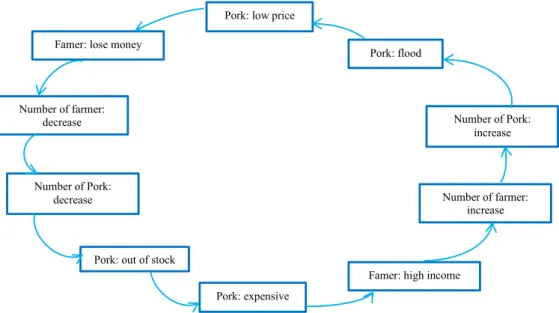
This study took place during the first semester of 2014. Participants were 99 freshman students in Nursing Program who enrolled in Physics for Nurse Course. As system thinking was unknown for students, training program for students to understand how to express their comprehension in term of cause and effect by examining the linkages and interactions between components as an array of interactions is necessary. The simple approach, therefore, event oriented thinking, was engaged to learn and assess students’ perception. The 8-hours contained three parts of teaching intervention; (1) training students on event oriented thinking and system thinking, (2) use of event oriented thinking and system thinking to teach on force and motion concept and (3) students’ practice on FMCE [6] (which was translated into Thai by the lecturers at Mahidol University) to examine students’ understanding of Force and Motion Concept including “Force Sled”, “Cart on Ramp”, Coin Toss and “Force Graph” questions. To ensure objectivity and reliability, integration of qualitative (students’ drawing, video recorder, interview and observation) and quantitative (FMCE multiple choice which focus on concept rather than on calculation) techniques was served. In order to train students on event oriented thinking and system thinking, five training steps were applied in a 3-hour live program. In the first step, the importance of thinking skill is understanding and identification of cause and effect. The simple real life event such moldy bread was merged for this training step [Fig. 1(a)]. Also, understanding that cause occurs when factors of cause are appropriate is necessary. The second step was implementation of multiple event oriented loops for deep understanding. Requirement of students’ awareness about influence of a cause on several effects and an effect results in causes was considered in the third step [Fig. 1(b)]. The fourth step was presenting feedback loop of non-individual root cause which is the nature of real world phenomena. This feedback loop is called system thinking. As an example of this process, the demand and supply of pig in market system, was applied (Fig. 2).The fifth step was writing article from system thinking and drawing system thinking from short news article.
For instructing force and motion concept, the participants were asked to read force and motion concept from textbook before the class begin. During class hour students were asked to work in group of eight for brainstorming and solving problems. The instructional steps are addressed sequentially as follows; (1) to present force sled event, (2) to present cart on ramp event and (3) to present coin toss event. Through more events, students were work through the questions “What parameters relate to the event?” and “How each parameter effect to each other” In
order to explore students’ conception of any situations, making of event oriented thinking or system thinking involve the following stages:
Stage 1: Students were asked to write the words (parameters) relate to an event.
Stage 2: Students were asked to choose the words (parameters) from a given list and add any words which relate to the event.
Stage 3: Students were asked to draw arrows for connecting the words from cause to effect. Stage 4: Students were asked to write the relationship among physics quantities in term of formula.
(a)
(b)
Fig. 1. Schematic of (a) simple event oriented thinking and (b) event oriented thinking about influence of a cause on several effects and an effect results in causes.
Factor of cause Food
Humidity
Temperature
Air
Fungus Moldy bread
Cause Effect
Urinate
Eat salty Exercise
Dehydration Thirsty Drinking water Eat less
Cause Effect Effect Effect Effect Effect Cause Cause Cause Cause Effect An effect from causes
Fig. 2. Schematic of system thinking
3.Students’ perception on force and motion
The result of training program indicated that integrating the scientific knowledge into the system thinking diagram is much more difficult than illustrating the scientific knowledge from the system thinking diagram into a word or assay, as students failed in the main goal of learning as they are hardly ever integrate their learning knowledge into real problems. Also the students’ score on FMCE pre-test was 6.3 r 1.8. It is obviously observed that students struggled to grasp force and motion concept, even if everybody studied force and motion concept in middle school course. Students asked to start working from stage 2 rather than stage 1 as they did not acquire any knowledge before class hour. Examples of students’ learning activity are shown in Figure 3.
(a) Cause
Gravitational force Sled weight Sled mass
Sled velocity Force apply on sled
Friction force between sled and ice land Effect
Pork: low price
Pork: flood
Number of farmer: increase
Famer: high income
Number of Pork: increase Famer: lose money
Number of farmer: decrease
Number of Pork: decrease
Pork: out of stock
(b)
(c)
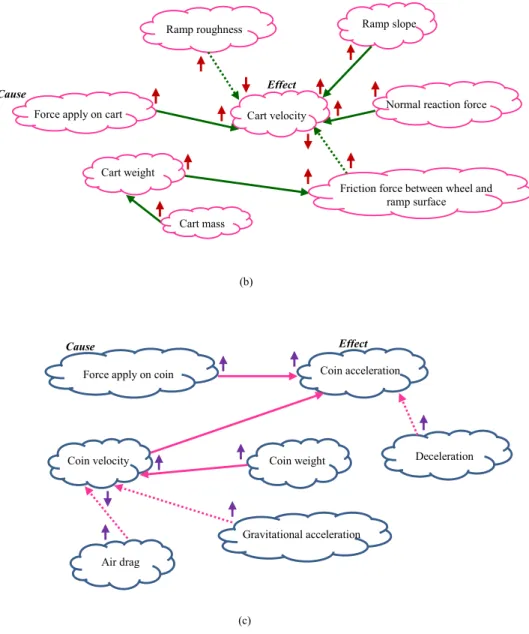
Fig. 3. Students’ drawing on (a) force sled (b) cart on ramp and (c) coin toss event
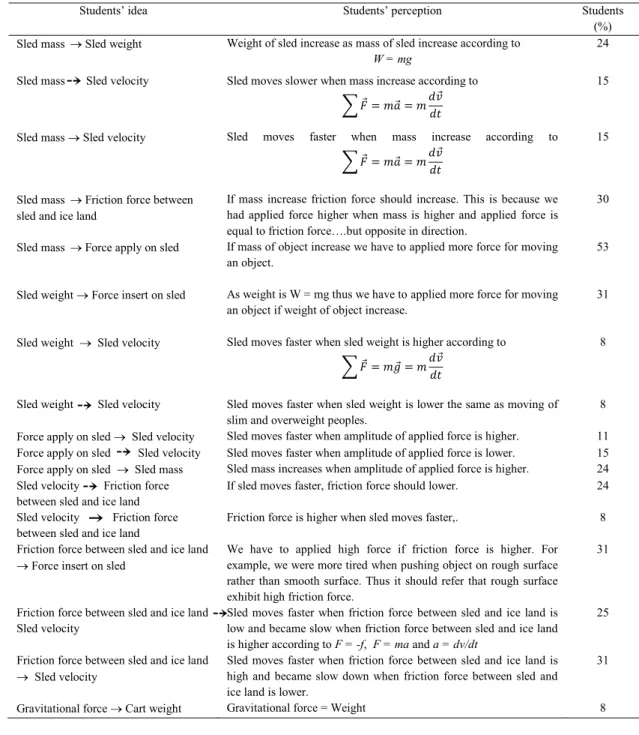
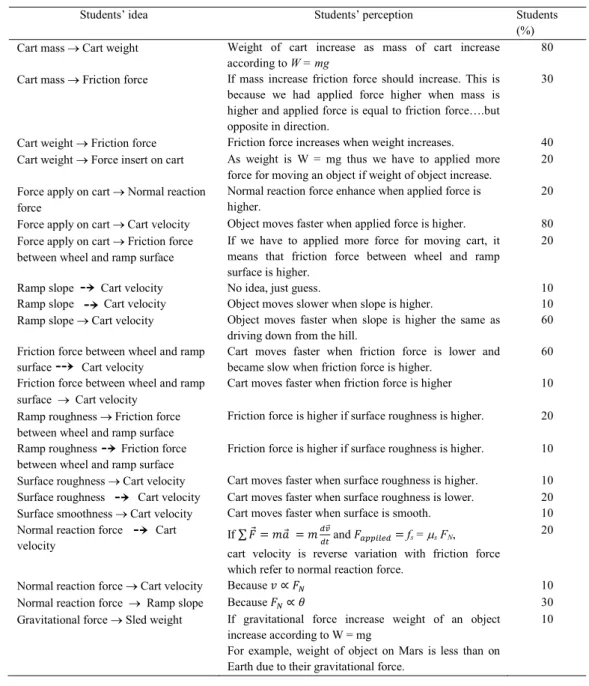
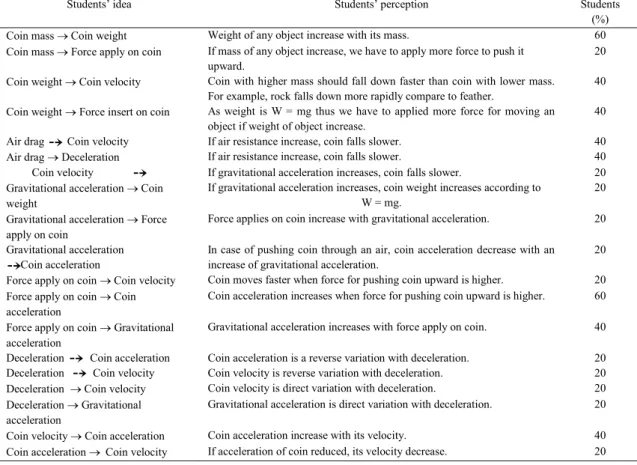
These studies respond to tworesearch question: What parameters relate to the event?” and “How each parameter effect to each other?” as display in Table 1-3.
Cause
Ramp roughness Ramp slope
Cart velocity Force apply on cart
Friction force between wheel and ramp surface Effect
Cart mass Cart weight
Normal reaction force
Force apply on coin
Gravitational acceleration
Deceleration Coin acceleration
Air drag
Coin velocity Coin weight
Table 1. Categories of students’ perception on physics concept relate to force sled event
Students’ idea Students’ perception Students
(%) Sled masso Sled weight Weight of sled increase as mass of sled increase according to
W = mg
24 Sled mass Sled velocity Sled moves slower when mass increase according to
ܨԦ ൌ ݉ܽԦ ൌ ݉݀ݒԦ ݀ݐ
15
Sled mass o Sled velocity Sled moves faster when mass increase according to ܨԦ ൌ ݉ܽԦ ൌ ݉݀ݒԦ
݀ݐ
15
Sled masso Friction force between sled and ice land
If mass increase friction force should increase. This is because we had applied force higher when mass is higher and applied force is equal to friction force….but opposite in direction.
30
Sled masso Force apply on sled If mass of object increase we have to applied more force for moving an object.
53
Sled weight o Force insert on sled As weight is W = mg thus we have to applied more force for moving an object if weight of object increase.
31
Sled weight o Sled velocity Sled moves faster when sled weight is higher according to ܨԦ ൌ ݉݃Ԧ ൌ ݉݀ݒԦ
݀ݐ
8
Sled weight Sled velocity Sled moves faster when sled weight is lower the same as moving of slim and overweight peoples.
8 Force apply on sled o Sled velocity Sled moves faster when amplitude of applied force is higher. 11 Force apply on sled Sled velocity Sled moves faster when amplitude of applied force is lower. 15 Force apply on sled o Sled mass Sled mass increases when amplitude of applied force is higher. 24 Sled velocity Friction force
between sled and ice land
If sled moves faster, friction force should lower. 24 Sled velocity Friction force
between sled and ice land
Friction force is higher when sled moves faster,. 8 Friction force between sled and ice land
o Force insert on sled
We have to applied high force if friction force is higher. For example, we were more tired when pushing object on rough surface rather than smooth surface. Thus it should refer that rough surface exhibit high friction force.
31
Friction force between sled and ice land Sled velocity
Sled moves faster when friction force between sled and ice land is low and became slow when friction force between sled and ice land is higher according to F = -f, F = ma and a = dv/dt
25
Friction force between sled and ice land
o Sled velocity
Sled moves faster when friction force between sled and ice land is high and became slow down when friction force between sled and ice land is lower.
31
Table 2. Categories of students’ perception on physics concept relate to cart on ramp event
Students’ idea Students’ perception Students
(%) Cart mass o Cart weight Weight of cart increase as mass of cart increase
according to W = mg
80 Cart mass o Friction force If mass increase friction force should increase. This is
because we had applied force higher when mass is higher and applied force is equal to friction force….but opposite in direction.
30
Cart weight o Friction force Friction force increases when weight increases. 40 Cart weight o Force insert on cart As weight is W = mg thus we have to applied more
force for moving an object if weight of object increase.
20 Force apply on cart o Normal reaction
force
Normal reaction force enhance when applied force is higher.
20 Force apply on cart o Cart velocity Object moves faster when applied force is higher. 80 Force apply on cart o Friction force
between wheel and ramp surface
If we have to applied more force for moving cart, it means that friction force between wheel and ramp surface is higher.
20
Ramp slope Cart velocity No idea, just guess. 10 Ramp slope Cart velocity Object moves slower when slope is higher. 10 Ramp slope o Cart velocity Object moves faster when slope is higher the same as
driving down from the hill.
60 Friction force between wheel and ramp
surface Cart velocity
Cart moves faster when friction force is lower and became slow when friction force is higher.
60 Friction force between wheel and ramp
surface o Cart velocity
Cart moves faster when friction force is higher 10 Ramp roughness o Friction force
between wheel and ramp surface
Friction force is higher if surface roughness is higher. 20 Ramp roughness Friction force
between wheel and ramp surface
Friction force is higher if surface roughness is higher. 10 Surface roughness o Cart velocity Cart moves faster when surface roughness is higher. 10 Surface roughness Cart velocity Cart moves faster when surface roughness is lower. 20 Surface smoothness o Cart velocity Cart moves faster when surface is smooth. 10 Normal reaction force Cart
velocity If σ ܨԦ ൌ ݉ܽԦ ൌ ݉
ௗ௩ሬԦ
ௗ௧ and ܨௗൌ fs = Ps FN, cart velocity is reverse variation with friction force which refer to normal reaction force.
20
Normal reaction force o Cart velocity Because ݒ ן ܨே 10 Normal reaction force o Ramp slope Because ܨேן ߠ 30 Gravitational force o Sled weight If gravitational force increase weight of an object
increase according to W = mg
For example, weight of object on Mars is less than on Earth due to their gravitational force.
10
These results show that about a half of students can indicate cause and affect correctly especially Newton’s second law. However, very few of them express their ideas as a physicist would. For instance, students description, sled moves faster when applied force is higher was justified from their experience without expression on Newton’s second law, σ ሬԦ ൌ ሬԦ ൌ ୢ୴ሬሬԦୢ୲ , and linear motion condition such as ଶൌ ଶ ʹ and ത ൌ୳ା୴
ଶ . Physicist should
describe that initial velocity (u) and average velocity (ݒҧ) are direct variations with external force. While mass and surface roughness is influenced on average velocity in oppose direction with external force. Therefore, it can be summarize that a force can cause a mass object to change its velocity. From sled and cart on ramp situation, it seems simple for students. The examples of alternative concepts are the following.
that object velocity is direct variation with mass according to.
2. Students believed that ୟ୮୮୧୪ୣୢൌ fs = Ps FN thus normal reaction force is a direct variation with
applied force
3. Students believed that friction force depends on external force.
4. Students believed that object velocity is a reverse variation with ramp slope. 5. Students believed that object velocity is direct variation with surface roughness.
After learning discussion of sled and cart on ramp, most students are aware that frictional force resists the relative motion of two solid objects in contact. The force of friction is always exerted in a direction that opposes movement (for kinetic friction) or potential movement (for static friction) between the two surfaces. As the weight of an object resting on a surface increases, it squeezes the two surfaces together and the actual area of contact increases. The actual contact area is believed to be proportional to the weight pushing the bodies together. Unexpectedly, coin toss question, a simple event, is quite complicated for most students as display in Table 3. They did not realized that the constant acceleration due to gravity which well-known as gravitational acceleration is always constant and pointing in the same direction for any case. External force applies on coin increase with gravitational acceleration and gravitational acceleration increases with force apply on coin are examples of alternative conception on gravitational acceleration of students. They are aware that distance in vertical direction of thrown object is greater if applied high amplitude of force. Unfortunately, they did not consider that gravitational force cause velocity of thrown object reduces at rate of 0.98 m/s. Therefore, force applies on object results only in initial velocity. Table 3, shows that air resistance as a cause of object velocity for free falling is dominant alternative concept exhibited by many students. After learning intervention, FMCE was used as the post-test. Statistical results found that mean score on post-test (5.6 r 1.9) was the same as pre-test (6.3 r 1.8).
Table 3. Categories of students’ perception on physics concept relate to coin toss event
Students’ idea Students’ perception Students
(%)
Coin mass o Coin weight Weight of any object increase with its mass. 60
Coin mass o Force apply on coin If mass of any object increase, we have to apply more force to push it upward.
20 Coin weight o Coin velocity Coin with higher mass should fall down faster than coin with lower mass.
For example, rock falls down more rapidly compare to feather.
40 Coin weight o Force insert on coin As weight is W = mg thus we have to applied more force for moving an
object if weight of object increase.
40 Air drag Coin velocity If air resistance increase, coin falls slower. 40
Air drag o Deceleration If air resistance increase, coin falls slower. 40
Coin velocity If gravitational acceleration increases, coin falls slower. 20 Gravitational acceleration o Coin
weight
If gravitational acceleration increases, coin weight increases according to W = mg.
20 Gravitational acceleration o Force
apply on coin
Force applies on coin increase with gravitational acceleration. 20 Gravitational acceleration
Coin acceleration
In case of pushing coin through an air, coin acceleration decrease with an increase of gravitational acceleration.
20 Force apply on coin o Coin velocity Coin moves faster when force for pushing coin upward is higher. 20 Force apply on coin o Coin
acceleration
Coin acceleration increases when force for pushing coin upward is higher. 60 Force apply on coin o Gravitational
acceleration
Gravitational acceleration increases with force apply on coin. 40 Deceleration Coin acceleration Coin acceleration is a reverse variation with deceleration. 20 Deceleration Coin velocity Coin velocity is reverse variation with deceleration. 20 Deceleration o Coin velocity Coin velocity is direct variation with deceleration. 20 Deceleration o Gravitational
acceleration
Gravitational acceleration is direct variation with deceleration. 20 Coin velocity o Coin acceleration Coin acceleration increase with its velocity. 40 Coin acceleration oCoin velocity If acceleration of coin reduced, its velocity decrease. 20
Coin mass Coin weight “” and “” means that two physics quantities are direct and reverse variation, respectively .
20
Coin weight Force apply on coin 20
Force apply on coin Coin velocity 20
Coin acceleration Force insert on coin 20
Air drag Coin velocity 20
Deceleration Coin velocity 20
Gravitational acceleration Coin velocity
20
4. Conclusion
Although, students’ perception on force and motion concept based on FMCE scores did not improve significantly after learning intervention, yet they could identify the cause and effect of some physics quantities correctly. However, the ability on identifying root of events did not mean that they could justify in Newtonian way as they use their experiences rather than scientific reasoning. These findings exhibited that most of their understanding be a sign of scientific conceptions rather than alternative conceptions. Based on findings, system thinking can be used an instructional implication and assessment from our point of view.
Acknowledgements
We would like to show our gratitude to RDG5740045 and Suratthani Rajabhat University for their support. We would also like to give our special thanks to Assoc. Prof. Dr.Suteera Prasertsan for the training instruments.
References
Clement, J. (1982). Students’ preconceptions in introductory mechanics. . American Journal of Physics, 50, 66-71. Feldman, G. (2011). Dramatic (and Simple!) Demonstrationof Newton’s Third Law. Physics Teacher, 49, 103-105.
Guidoni, P., Porro, A. & Sassi, E. (1995). Force-Motion Conceptions. In C. Bernardini, C. Tarsitani & M. Vicentini (Eds.), Thinking Physics for Teaching (pp.185-206). NewYork: Springer.
Halloun, I. A. & Hestenes, D. (1985). The initial knowledge state of college physics students. American Journal of Physics, 53, 1043-1055. Hogg, L. K. & Zollman, D. (2002). Model analysis of the structures of student models: An example with Newton’s third law. American Journal
of Physics, 70, 766-778.
Kelly, A. M. (2011). Teaching Newton’s Laws with the iPod Touch in Conceptual Physics. Physics Teacher, 49, 202-205.
Mungan, C. E. (2012). Conceptual and laboratory exercise to apply Newton’s second law to a system of many forces. Physics Education, 47(3), 274-287.
Peters, P. C. (1982). Even honors students have conceptual difficulties with physics. American Journal of Physics, 50, 501-508.
Portillo-Velez, R. de J., Cruz-Villar, C. A., Rodríguez-Angeles, A., Arteaga-Perez, M. A. (2013). Master/Slave.Robotic System for Teaching Motion-Force Manufacturing Tasks. Applied Mechanics and Materials, 307, 84-88.
Rakkapao, S., Pengpan, T., Srikeaw, S. & Prasitpong, S. (2014). Evaluation of POE and instructor-led problem-solving approaches integrated into force and motion lecture classes using a model analysis technique. European Journal of Physics, 35, 015016.
Shaw, M. (2012). I “Saw” Newton’s Three Laws. Physics Teacher, 50, 480-481
Stocklmayer, S., Rayner, J. P. & Gore, M. M. (2012). Changing the Order of Newton’s Laws–Why & How the Third Law Should be First.
Physics Teacher, 50, 406-409.
Terzella, T. Sundermier, J. Sinacore, J., Owen, C. & Takai, H. (2008). Measurement of g Using a Flashing LED. Physics Teacher, 46, 395-397. Thornton, R. K. & Sokoloff, D. R. (1998). Assessing student learning of Newton’s laws: The Force and MotionConceptual Evaluation and the
Evaluation of Active Learning Laboratory and Lecture Curricula. American Journal of Physics, 66(4), 338-352.
Welsh, H. L. C. (2006). The Use of History of Mechanics in Teaching Motion and Force Units’. Science & Education, 15(1), 55-89.
Yuruk, N., Beeth, M. E. & Andersen, C. (2009). Analyzing the Effect of Metaconceptual Teaching Practices on Students’ Understanding of Force and Motion Concepts. Research in Science Education, 39(4), 449-475.
Yvett, A. & Hise, V. (1988). Student Misconceptions in Mechanics: An International Problem?. Physics Teacher, 26(8), 499-502.