Language, literacy and technology: embodied peer-interaction
and collaborative writing in an ESOL classroom
Stephen Woulds MSc MA BA PGCE(FE)
Submitted in accordance with the requirements for the degree of Doctor of Philosophy
University of Leeds School of Education
The candidate confirms that the work submitted is his own and that appropriate credit has been given where reference has been made to the work of others.
This copy has been supplied on the understanding that it is copyright material and that no quotation from the thesis may be published without proper
acknowledgement.
Acknowledgements
Thank you
To my supervisors Dr James Simpson and Dr Aisha Walker.
To my wife and children: Carol, Stephanie, Jake, Emily and William. To Teresa and Reza for their translations.
To my ESOL colleagues at Leeds City College who continue to brave the coal-face of teaching in turbulent times.
To my parents William and Elaine, and sisters Angela and Melanie. Thank you dad for the years of wisdom and support.
Abstract
This study focuses on digital literacies, and real-time multimodal design, within the context of migrant adult learners in the UK. It seeks to understand the frameworks of peer-interaction when second-language learners are paired at a computer and how they negotiate second-language writing. In this research, pairs of students sharing the same language were tasked with an environmental project which included the digital design of an image, designing a four-page booklet using Publisher, a website and to produce all of these using English as a second language. The process was videoed across a three-hour classroom session with four pairs of learners: Kurdish, Polish, French and Arabic. New literacies, embodied peer-interaction and second-language writing are the primary fields informing this research.
The outcomes of the research are: (1) a methodology is developed for the collection and analysis of multimodal data when learners collaborate at a computer; (2) the field of new literacies is extended through an analysis of the design-process, as opposed to product-analysis; (3) a peer-interaction framework is presented which broadens our understanding of classroom interaction, including linguistic, paralinguistic and mediating resources when learners share technology; (4) the field of second-language writing is extended through an analysis of peer-writing with technology.
The research concludes with a peer-interaction framework comprised of learner alignment and misalignment across language, literacy and technology. Spoken and written language goes through an iterative cycle of transformation. The central finding from the research is the naming and defining of transmodal talk within a peer-interaction framework. The sequentiality of this process has common features across all the pairs of learners. Transmodal talk is presented to identify the fluid process of transposing off-screen dialogue to on-screen text. They both shape and mediate each other through temporal mapping and polyvocality.
Table of Contents
Abstract ... v
Table of Contents ...vi
List of tables ...ix
List of figures ... x
List of transcripts ... xii
List of multimodal extracts ... xiii
List of abbreviations ...xiv
1 Introduction ... 1
1.1 explaining the purpose ... 1
1.2 researcher context ... 2
1.3 learner context ... 3
1.4 research rationale... 5
1.5 structure of the thesis... 5
1.6 key terms ... 8
2 Literature review ... 10
2.1 introduction ... 10
2.2 the multimodal classroom ... 12
2.3 narrowing the focus ... 18
2.4 defining collaboration ... 20
2.5 peer-interaction and collaborative L2 writing ... 26
2.6 peer-interaction and multimodal interactional analysis ... 30
2.7 conclusion... 39
3 Methodology ... 41
3.1 introduction ... 41
3.2 the research participants and educational context ... 41
3.3 piloting phase ... 49
3.4 interviewing ... 54
3.5 ethnomethodological case study... 60
3.6 data collection ... 64
3.7 preparing the data pre-analysis ... 74
3.8 conclusion... 83
4 Analytical approach... 84
4.1 introduction ... 84
4.2 defining actions ... 84
4.3 scales of time ... 88
4.4 modes and modal configurations... 94
4.5 video analysis and transcription ... 97
4.5.1 modal density tables ... 98
4.5.2 multimodal extracts and sequence of stills ... 101
4.6 the focal events ... 104
5 Analysis 1 ... 108
5.1 introduction ... 108
5.2 understanding the task ... 110
5.3 composing sentence 1... 121 5.4 writing sentence 1... 128 5.5 writing sentence 2... 135 5.6 completing sentence 2 ... 142 5.7 conclusion... 152 6 Analysis 2 ... 154 6.1 introduction ... 154
6.2 understanding the task ... 157
6.3 typing the heading ... 162
6.4 writing sentence 1... 168
6.5 writing sentence 2... 180
6.6 contesting the design process ... 188
6.7 conclusion... 200 7 Cross-case analysis ... 201 7.1 introduction ... 201 7.2 transmodal talk ... 201 7.3 cognitive-orientation ... 202 7.4 off-screen drafting ... 208 7.5 on-screen writing ... 212
7.5.1 phoneme and syllable scaffolding in dyadic temporal mapping ... 217
7.5.2 lexeme and lexical chunk scaffolding in dyadic temporal mapping .... 220
7.6 noticing and correcting ... 224
7.6.1 noticing function ... 227
7.6.2 hypothesis testing function ... 228
7.6.3 metalinguistic awareness function ... 230
7.7 conclusion... 232
8.1 Discussion ... 233
8.2 research question 1 (the coordination of talk and text) ... 233
8.3 research question 2 (peer-interaction frameworks) ... 237
8.4 recap of purpose and findings ... 247
8.5 connections with previous research... 248
8.5.1 second-language collaborative writing ... 249
8.5.2 embodied peer-interaction within multimodal interactional analysis .. 250
8.5.3 new literacies within the context of digital technologies ... 251
8.6 limitations of research ... 251
8.7 problems arising during the research ... 253
8.8 implications of findings ... 255
8.9 recommendations ... 258
8.10 contributions to research ... 260
8.10.1 videography ... 260
8.10.2 multimodal literacies ... 261
8.10.3 embodied peer-interaction framework ... 261
8.10.4 second-language writing ... 262
List of references ... 264
Appendix A Transcription Notation Conventions ... 284
Appendix B Sakia & Gamda higher-level actions ... 285
Appendix C Darras and Shourok higher-level actions ... 286
Appendix D pre-task interview with Sakia ... 287
Appendix E pre-task interview with Gamda ... 289
Appendix F pre-task interview with Darras ... 291
Appendix G pre-task interview with Shourok ... 293
Appendix H post-task interview with Polish learners ... 295
Appendix I post-task interview with Kurdish learners ... 296
Appendix J classroom task instructions ... 297
List of tables
Table 1-1 (key terms and definitions)... 9
Table 3-1 (multimodal communicative competence) ... 51
Table 3-2 (pilot study data collection methods) ... 53
Table 3-3 (qualitative-quantitative dimensions) ... 62
Table 3-4 (problems and solutions with the first data collection) ... 68
Table 3-5 (transcript of before and after triangulation of audio channels) ... 80
Table 3-6 (before and after of transcribing from gesture) ... 82
Table 4-1 (narrative transcript of the Polish learners) ... 90
Table 4-2 (modal density 1)... 98
Table 4-3 (modal density 2)... 100
Table 5-1 (sentence 2) ... 150
Table 7-1 (modal density 3)... 204
Table 7-2 (modal density 4)... 205
Table 7-3 (modal density 5)... 210
Table 7-4 (modal density 6)... 211
Table 8-1 (transmodal talk features)………..236
List of figures
Figure 2-1 (research foci) ... 12
Figure 2-2 (multimodal intersection) ... 17
Figure 2-3 (Polish learners) ... 17
Figure 2-4 (embodiment papers in comparison to language, Nevile, 2015: 127) ... 33
Figure 2-5 (triangular layout) ... 35
Figure 3-1 (indices of deprivation, Harehills, Leeds) ... 42
Figure 3-2 (Multiliteracies diagram ... 48
Figure 3-3 (member-checking of interview data) ... 57
Figure 3-4 (first attempt at data collection) ... 67
Figure 3-5 (second attempt at data collection) ... 69
Figure 3-6 (macro level of visual data) ... 70
Figure 3-7 (micro level of visual data) ... 71
Figure 3-8 (meso level of visual data) ... 72
Figure 3-9 (Corel VideoStudio 12) ... 75
Figure 3-10 (synchronisation problems in Audacity) ... 77
Figure 3-11 (three audio tracks synchronised) ... 79
Figure 3-12 (using Transana in conjunction with Audacity) ... 81
Figure 4-1 (inverted pyramid showing actions across different scales of time) ... 92
Figure 4-2 (foreground-background continuum) ... 94
Figure 4-3 (two learners interact) ... 103
Figure 5-1 (learning outcome 2 - create a protest image) ... 110
Figure 5-2 (page four of recycling booklet) ... 111
Figure 5-3 (00:01 to 00:06) ... 114 Figure 5-4 (00:10 - 00:16) ... 117 Figure 5-5 (00:24 - 00:30) ... 121 Figure 5-6 (00:40 - 00:46) ... 124 Figure 5-7 (00:46 - 00:57) ... 125 Figure 5-8 (01.10 – 01.20) ... 128
Figure 5-9 (HLA 2.0 - create a protest image for page 1 of booklet; Appendix B) ... 135
Figure 5-10 (start point of second sentence) ... 138
Figure 5-11 (gesture combined with talk) ... 139
Figure 5-12 (Sakia uncertain if their text is correct) ... 140
Figure 5-14 (thinking what to write) ... 144
Figure 5-15 (choosing pollution) ... 149
Figure 5-16 (pollution in Wikipedia) ... 150
Figure 5-17 (Sakia, Gamda, typing) ... 151
Figure 6-1 (page four of recycling booklet and their previous image design) ... 155
Figure 6-2 (00:01 – 00:16)... 159
Figure 6-3 (00:38 – 00:42)... 160
Figure 6-4 (triangular layout) ... 161
Figure 6-5 (triangular layout 2) ... 161
Figure 6-6 (01:33 - 01:35) ... 167 Figure 6-7 (03:17 and 03:27) ... 170 Figure 6-8 (03:57 – 04:18)... 174 Figure 6-9 (05:13 – 05:25)... 179 Figure 6-10 (06:38 – 06:39)... 183 Figure 6-11 (07:09) ... 185
Figure 6-12 (LSA sitting behind the learners) ... 188
Figure 6-13 (01:00 – 01:26)... 191
Figure 6-14 (triangular layout 3) ... 192
Figure 6-15 (01:28 – 01:35)... 194 Figure 6-16 (greenpeace.htm)... 195 Figure 6-17 (01:35 – 01:36)... 196 Figure 6-18 (01:46 – 01:47)... 198 Figure 6-19 (02:16-02:17) ... 199 Figure 6-20 (02:40 – 02:47)... 199
Figure 7-1 (equal triangular layout) ... 207
Figure 7-2 (inequal triangular layout) ... 207
Figure 7-3 (waveform of ‘separately’ spoken by Gamda) ... 217
Figure 7-4 (waveform of ‘separately’ spoken by Sakia and Gamda) ... 218
Figure 7-5 (waveform of ‘electricity’ spoken by Shourok and Darras) ... 218
Figure 8-1 (transmodal talk diagram)……….………...235
List of transcripts
Transcript 4-1 (00:03 – 00:04)... 101
Transcript 5-1 (full transcript) ... 109
Transcript 5-2 (00:01 – 00:24)... 112 Transcript 5-3 (00:01 – 00:24)... 121 Transcript 5-4 (00:40 – 01:25)... 122 Transcript 5-5 (00:46 – 01:14)... 129 Transcript 5-6 (01:25 – 02:40)... 129 Transcript 5-7 (02:42 – 03:18)... 136 Transcript 5-8 (07:56 – 08:49)... 144
Transcript 6-1 (full transcript) ... 156
Transcript 6-2 (00:01 – 00:06)... 157 Transcript 6-3 (01:09 – 01:40)... 162 Transcript 6-4 (03:12 – 03:27)... 168 Transcript 6-5 (03:55 – 04:26)... 171 Transcript 6-6 (04:41 – 05:30)... 175 Transcript 6-7 (06:33 – 07:45)... 181 Transcript 6-8 (00:02 – 02:47)... 188 Transcript 6-9 (01:22 – 01:49)... 192 Transcript 6-10 (02:12 – 02:47)... 199 Transcript 7-1 (00:46 – 01:15)... 208
Transcript 7-2 (from section 5.5) ... 217
Transcript 7-3 (from section 6.4) ... 217
Transcript 7-4 (noticing function of language) ... 228
List of multimodal extracts
Extract 4-1 (00:01 – 00:06) ... 102 Extract 5-1 (00:01 – 00:09) ... 113 Extract 5-2 (00:09 – 00:18) ... 116 Extract 5-3 (00:23 - 00:32) ... 119 Extract 5-4 (00:40 - 00:49) ... 123 Extract 5-5 (00:57 – 01:06) ... 126 Extract 5-6 (01.10 – 01.17) ... 127 Extract 5-7 (01.19 – 01.27) ... 130 Extract 5-8 (02.05 – 02:18)... 130 Extract 5-9 (02.24 – 02:40)... 133 Extract 5-10 (02.42 – 03:00)... 137 Extract 5-11 (07:55 – 08:10) ... 146 Extract 5-12 (08:11 – 08:28) ... 146 Extract 5-13 (08:35 – 08:49) ... 148 Extract 6-1 (00:00 – 00:16) ... 158 Extract 6-2 (01:09 – 01:30) ... 164 Extract 6-3 (01:34 – 01:46) ... 166 Extract 6-4 (03:12 – 03:27) ... 169 Extract 6-5 (03:55 – 04:06) ... 172 Extract 6-6 (04:18 – 04:27) ... 173 Extract 6-7 (04:41 – 04:59) ... 176 Extract 6-8 (05:00 – 05:10) ... 177 Extract 6-9 (05:12 – 05:30) ... 178 Extract 6-10 (06:33 – 06:42) ... 182 Extract 6-11 (07:04 – 07:14) ... 184 Extract 6-12 (07:15 – 07:33) ... 186 Extract 6-13 (01:13 – 01:09) ... 190 Extract 6-14 (01:22 – 01:49) ... 193 Extract 6-15 repeated (01:22 – 01:49) ... 197Extract 7-1 (monadic temporal mapping of lexemes) ... 216
List of abbreviations
ACMC asynchronous computer-mediated communication
CEFR Common European Framework of Reference for Languages CMC computer-mediated communication
CW collaborative writing
DfEE Department for Education and Employment DfES Department for Education and Skills
ESOL English for Speakers of Other Languages
FELTAG Further Education Learning Technology Action Group F2FCCW face-to-face collaborative computer writing
HLA higher-level actions
IELTS International English Language Testing System
L1 first language
L2 second language
LLA lower-level actions
LLT Language, Literacy and Technology LRE language-related episodes
LSA
learning support assistant – this is someone employed by the organisation to support learners on a one-to-one basis as required, often circulating the classroom and verbally checking on learners
MDA multimodal discourse analysis
ROLSI Research on Language and Social Interaction SCMC synchronous computer-mediated communication SFA Skills Funding Agency
SLA second-language acquisition ZPD zone of proximal development
1
Introduction
1.1 explaining the purpose
This study explores embodied peer-interaction, and collaborative writing, within the context of migrant adult learners in the UK. It seeks to understand how second-language learners collaborate when paired at a computer and negotiate the production of multimodal texts. This is important to understand because ‘what constitutes English is not to be found in language alone, but exists in many modes, and in many tasks’ (Kress et al, 2005: 2). In this research, same-language learners were tasked with an environmental project which included the digital design of an image, designing a four-page booklet using Publisher, a website and to produce all of these collaboratively using English as a second language. The process was videoed across a three hour classroom session with four pairs of learners: Kurdish, Polish, French and Arabic. The research works towards an understanding of embodied peer-interaction within the context of face-to-face collaborative computer writing (F2FCCW).
Technology has enabled new pedagogies with a convergence of modes and a profusion of hybrid texts. It is widely acknowledged that there has been a paradigm shift from page to screen, from pen to keyboard, from words to visuals, from consumer to producer and more (Jewitt, 2006). One outcome of this paradigm shift in digitised, textual communication is the repositioning of literacy:
Conceptions of literacy as a singular canonical English that exclusively concerns linguistics or alphabetic print are no longer sufficient in an increasingly multimodal and digitally-mediated world of textual design. In particular, cultural differences and a proliferation of communication media provide impetus for a pedagogy of multiliteracies (Mills, 2006: 13).
Many theorists and educators have responded to this multimodal, digital landscape, including Warschauer (1999); Cope & Kalantzis (2000); Hawisher & Selfe (2000); Unsworth (2001); Snyder (2002); Martin (2006); Jewitt (2006); Kist (2005); Burn & Durran (2007); Baynham & Prinsloo (2009); Kress (2010); Goodfellow & Lea (2013). The tension between new literacy studies and learning technologies is considered by Gourlay, Hamilton & Lea (2013) who discuss the implications and future directions for researchers working in this field. This research seeks to understand how migrant learners of English collaborate at a computer to produce multimodal texts in real-time and what resources and modes they utilise to help them in the process. In this sense the
research belongs to what has been termed ‘third generation empirical work which is pushing the boundaries of literacy research in a number of key directions: from the local to the translocal, from print based literacies to electronic and multimedia literacies and from the verbal to the multimodal’ (Baynham & Prinsloo, 2009: 1). A research focus on second-language writing as an outcome of embodied peer-interaction also belongs to a body of work which Nevile (2015) calls the ‘embodied turn’ in multimodal research; discussed in detail in section 2.7.
1.2 researcher context
This research is situated in the Further Education (FE) sector and belongs to what could be termed practitioner-researcher, a branch of research in which the educator investigates their own teaching practice. Ecclesfield observes the paucity of FE based research compared to Higher Education (HE) and notes that ‘it seems essential to encourage and promote practitioner research both into the sector to support exploration and to change and find new ways of helping practitioners to turn their experiences into learning for themselves, their learners and their sector colleagues’ (2013: 10). Procter-Legg similarly identifies the insider benefits and ‘implicit knowledge that those working in FE can bring to research’ (2013: 11). At the same time, the FE sector seeks to professionalise the use of technology for teaching and learning. FELTAG (Further Education Learning Technology Action Group) for example makes a number of institutional and training recommendations to improve standards in the use of learning technologies. The FE workforce is at the core of this, calling for teachers’ ‘continuing professional development so that their ability to understand and optimise the use of learning technology can be enhanced and refreshed regularly’ (2013: 4). Grounded research in one’s own practice can generate emic ways of seeing and thinking about teaching and learning, including the use of digital technologies. Section 3.2 provides more contextual detail on the locality and demographics of this study as well as the ethnomethodological approach to practitioner research.
I have taught language and literacy in the FE sector, using technology, for twenty years. I have therefore experiential knowledge of how literacy has proliferated through digital media in the last two decades. I completed an MA in English language and later an MSc in educational technology. I was at the time teaching English for Speakers of Other Languages (ESOL) when the ratio of students to computers was rarely 1:1. Through these post-graduate qualifications I applied the research in these courses to my own
teaching practice. As researcher-practitioner I began to realise there were significant gaps in my understanding of how learners were collaborating using language and technology. I could also see my colleagues pairing learners at a computer. But in the real-time synchronicity of classroom learning it is impossible for a tutor to sit and observe the totality of learner-collaboration; even more so when there can be several pairings all happening at the same time.
As teachers we might use peer-collaboration (with or without a computer) in the best interests of the learners. It is a pedagogy assumed to be beneficial. Bruner (1996) discussed scaffolding to describe the process of an individual supporting another individual to achieve a learning goal; this could be the tutor but could equally be another student. Vygotsky talked in similar terms about the zone of proximal development to describe ‘the level of potential development as determined through problem solving under adult guidance, or in collaboration with more capable peers’ (Vygotsky, 1978: 86). I began to ask myself a range of questions: is peer-interaction as pedagogy always beneficial? How does scaffolding actually work in second-language contexts, if at all? What is an action in interaction? Are there inherited ways of thinking? What theories of learning are we taking for granted?
A PhD seemed ideal to formalise a research path to begin to answer some of these questions in relation to my own teaching practice, and beyond that, to other practitioners using the same pedagogy.This research journey was triggered because of two problems I was seeing in my own teaching: (1.) literacy was not a singular entity as I had been led to understand but multiple, digital and multimodal (2.) the participation frameworks for learner collaboration were far more complex than I realised because language was only one mode in a sophisticated repertoire of multimodal communication. Shortly after I began the PhD I became an ESOL Curriculum Manager at Leeds City College and then Head of Department. With 1200 learners and twenty-eight teachers I began to see on a daily basis the pedagogy of second-language collaboration and sometimes the use of computer-sharing in that pedagogy. Research into my own teaching practice could also have relevance to my peers.
1.3 learner context
ESOL is a term used to define a diverse collection of learners from different backgrounds and with different languages; typically, the learner is living in the country
of the dominant language and is in the minority. Based on the findings of the ESOL Effective Practice Project: ‘two thirds of ESOL students are women, half are under thirty, about one in seven cannot read or write in L1 while one in eight have a tertiary level education. And the vast majority are not currently working. Many migrants to English dominant countries do not already have competence in English when they arrive’ (Simpson, 2007: 2). The ESOL learners in the present research enrol on a thirty-five week Further Education (FE) college course, working towards ESOL and IT qualifications. This type of multicultural and multilingual classroom is increasing in the FE sector and mirrors a global pattern of migration and education: ‘globalisation and patterns of mass forced and voluntary migration have resulted … in large numbers of migrants coming to the UK’ (Simpson, 2007: 1). A fuller demographic and biographic discussion is provided at section 3.2.
The classroom in this study is an instance of literacy practice which is populated by multicultural, multilingual learners. Languages, literacies and technologies fuse at a local level within this classroom. That localised fusion is reflective of a more global pattern. Similar instance of new literacies are commonplace in the US, Canada and Australia, where dominant English competes with vernacular and digital literacies in traditional and virtual spaces for learning; Kist (2005); Mills (2006). A recent study is Bhatt’s (2014) PhD thesis. Also based in the FE sector and with ESOL learners in a digital context, Bhatt argues: ‘By understanding learner practices it is possible to better understand digital innovations in education, the extent to which learners embrace or avoid imposed technologies, and how such practices re-shape assignments as evolving pedagogic forms’ (2014: 4). This approach towards learner use of technology begins to answer recent concerns in the FE sector, that ‘research and conversations consistently referred to the under-exploitation of learners’ skills, devices and technical knowledge when it came to the use of learning technology’ (FELTAG, 2013: 5).
A classroom such as this in the UK is a place where teachers and students struggle to ‘survive and thrive in a world that increasingly puts emphasis on one’s ability to work in multiple forms of representation across a wide variety of spaces, all text-driven in one way or another’ (Kist, 2005:13). The classroom can put at the disposal of students a range of meaning-making resources, all text-mediated and often digitally-mediated. Multiple modes for communicating in and outside the classroom include traditional literacy repertoires (note-taking, essay writing, reading and producing different genres)
as well as newer types of multimodal literacies mediated by technology: web design, images and leaflet design. Such text-mediated resources (many of which include images) have been collectively named multiliteracies, discussed in chapter 3 (Cope & Kalantzis, 2000). It is the latter which is the focus of this research, how ESOL learners engage with the creation of digital literacies in the classroom.
1.4 research rationale
Central to this research is how to define, capture and analyse the sequential actions which collectively and accumulatively enable (and evidence) learning in real-time when using language, literacy and technology. By define I mean delineate interaction to arrive at a fuller understanding of what an action is, and how it is mediated by, different timescales of interaction, communicative modes and resources available to learners. This calls for a reassessment of classroom peer-interaction as part of the third generation approach to empirical research in literacy studies (Baynham & Prinsloo, 2009). By capture I mean how we might gather the multimodal video data we need to observe actions and interactions in real-time; including synchronous multiple streams of audio and video for analytical purposes. By analysis I mean how we might analyse and represent embodied peer-interaction, transposing observed phenomena into multimodal transcripts. Ultimately, the research seeks to explicate the participation frameworks of learning, language and interaction when learners collaborate in real-time using technology. Capturing and analysing these ‘real-time’ interactions to evidence learning is not without significant problems; discussed in chapters 3 and 4. The specific research questions are: (1.) How are off-screen talk and on-screen text coordinated? (2.) How are peer-interaction frameworks for learning structured? Chapter 2 will evidence the framing of these questions as contributions to the fields of multimodal interactional analysis and collaborative second-language writing.
1.5 structure of the thesis
Chapter 1 provides a rationale for the PhD and explains that the research grew out of classroom practice, driven by a desire to understand the real-time multimodal collaboration of second-language learners as they design digital texts. It was discussed that the current research will contribute to the capturing, looking at and thinking about such interaction.
In chapter 2 the relevant literature is reviewed. It begins with a consideration of how others have defined ‘literacy’ and finds competing views and ideologies. Theorists might favour one model, such as critical literacy (Freire 1986) or situated literacy (Street 1998) but these do not sit easily with the government funded functional literacy (DfEE 2001) and the similar focus on mechanical skills acquisition of autonomous literacy (Olson 1994). The chapter then moves on to consider more recent challenges to literacy from a technological perspective. Multimodality is problematised to clarify the focus in this research as one of multimodal interactional analysis rather that multimodal text analysis. Consideration is then given to what is meant by multimodal. The field of collaborative second-language writing is discussed.
Chapter 3 begins with the research methodology and identifies the research participants and the educational context. The research approach is identified as an ethnomethodological case study. A qualitative orientation is explained with video observation and interviewing as the primary methods of data-collection. The methods used to trial data collection in the piloting phase are considered and the epistemological and ontological changes that were an outcome of this experience. Audio-visual tools and methods were developed to collect the data from one classroom session and a rationalisation is provided to explain why the research needed extensively rich and detailed data. The videography (Knoblauch, 2011) of how to capture and manage video data is considered.
Chapter 4 describes the micro-analytical approach used to analyse the video data of the interaction, applied later in chapters 5 and 6. An ethnomethodological justification is given to the observation of videoed interaction; i.e. a grounded approach to understand the patterns and organisation of peer-interaction. A methodological framework for analysing the learners’ interaction (Norris, 2004) is discussed which involves considering scales of time and analysable units (Lemke, 2009). Consideration is given to what is meant by an action, where it starts, ends and bleeds into other actions. Analysing the moment-to-moment interaction of learners to understand the sequentiality of collaboration is one reason why the totality of the lesson was recorded and transcribed. The structuring of lower and higher-level actions in Norris’ methodological framework (2004) is used to enable this. Attention is then given to the preparation of multimodal data for transcription and analysis followed by a discussion on which focal events, and which participants, were chosen for detailed analysis.
Chapter 5 is the first analysis chapter. A ten-minute interaction of two female Polish learners is chosen as they write two sentences in Microsoft Publisher. Using detailed, second-by-second microanalysis, the research identifies the real-time modal coordination of screen-based, collaborative writing as the learners work together. Their interaction is positively structured with significant findings on the features of their multimodal collaboration and how off-screen dialogue is transposed to on-screen text. Chapter 6 is the second analysis chapter. A similar ten-minute interaction of two male Kurdish learners is chosen as they write three sentences in Microsoft Publisher. The same micro-analytical approach is used, combining multimodal and conversation analysis. Their interaction has a contested structure with features both similar and different to the Polish learners at chapter 5. The focal points chosen in both chapters provide a unique insight into the real-time design process of on-screen writing where language, literacy and technology come together. Using the similar focal event in both analysis chapters offers interesting contrast between the Kurdish learners and the Polish learners.
Chapter 7 summarises the findings from the previous two analysis chapters with comparisons and contrasts made between the two pairs of learners. The term transmodal talk is identified to explain the coordination of off-screen talk and on-screen text. There is a sequential pattern in how learners transpose talk to text. Spoken language between learners, as a drafting process prior to writing, undergoes significant mutation across phoneme, lexeme and lexical chunking as learners attempt to map speech to on-screen graphemes. The sequencing of that process is structured as cognitive orientation, off-screen drafting, on-off-screen writing, off-off-screen noticing, on-off-screen correcting; discussed further in section 8-2.
Chapter 8 is the conclusion chapter which offers a final summary of the key findings. The two research questions are answered. Section 8.2 collates the findings on transmodal talk and provides a diagram and terminology to answer the first research question on the coordination of talk and text. The identified features and terminology provided will support other educators and researchers wishing to explore face-to-face computer collaborative writing F2FCCW in similar contexts. 8.3 collates the findings on the peer-interaction framework (PiF) and provides a PiF diagram and terminology to
answer the second research question on how peer-interaction frameworks are structured. An inclusionary and exclusionary framework is identified and terminology provided for other educators and researchers wishing to explore PiF in similar contexts. The limitations of the study are considered, its implications for education and research, contributions and further areas for research.
1.6 key terms
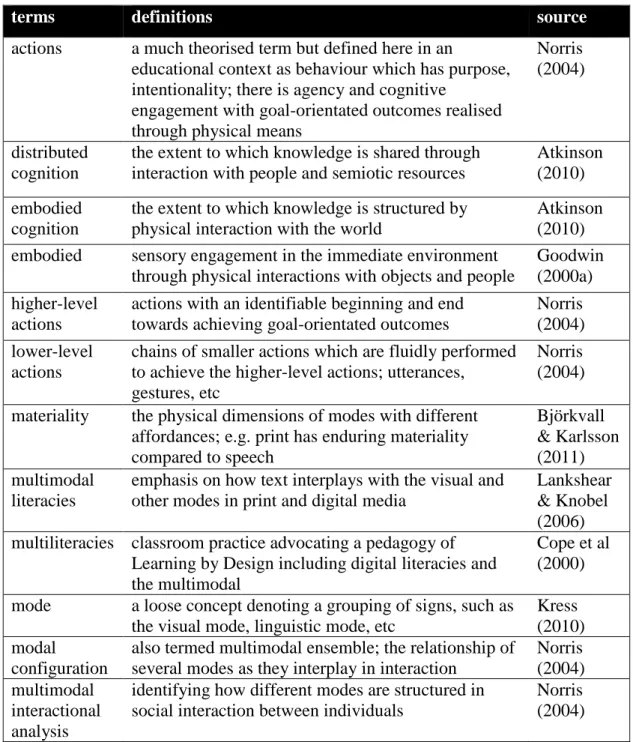
Table 1-1 lists and defines the key terms and ideas used in the thesis. This defining does simplify and hence is minimalist, however, problematic and additional terms are more fully explained as they appear in the thesis.
terms definitions source
actions a much theorised term but defined here in an
educational context as behaviour which has purpose, intentionality; there is agency and cognitive
engagement with goal-orientated outcomes realised through physical means
Norris (2004)
distributed cognition
the extent to which knowledge is shared through interaction with people and semiotic resources
Atkinson (2010) embodied
cognition
the extent to which knowledge is structured by physical interaction with the world
Atkinson (2010) embodied sensory engagement in the immediate environment
through physical interactions with objects and people
Goodwin (2000a) higher-level
actions
actions with an identifiable beginning and end towards achieving goal-orientated outcomes
Norris (2004) lower-level
actions
chains of smaller actions which are fluidly performed to achieve the higher-level actions; utterances,
gestures, etc
Norris (2004) materiality the physical dimensions of modes with different
affordances; e.g. print has enduring materiality compared to speech Björkvall & Karlsson (2011) multimodal literacies
emphasis on how text interplays with the visual and other modes in print and digital media
Lankshear & Knobel (2006) multiliteracies classroom practice advocating a pedagogy of
Learning by Design including digital literacies and the multimodal
Cope et al (2000) mode a loose concept denoting a grouping of signs, such as
the visual mode, linguistic mode, etc
Kress (2010) modal
configuration
also termed multimodal ensemble; the relationship of several modes as they interplay in interaction
Norris (2004) multimodal
interactional analysis
identifying how different modes are structured in social interaction between individuals
Norris (2004)
multimodal text analysis
identifying how different modes are structured in digital and printed media
Kress & van Leeuwen (2001) modal affordance
the potential benefits of a mode in representation and communication
Oliver (2005) modal
constraint
the limitations of a mode in representation and communication
Kress (2010) new literacies emphasis on literacy in digital media Kist (2005) scales of time the temporal duration between an action’s beginning
and ending
Lemke (2009) semiotic
resources
social, material and cultural resources to make meaning, including language, visuals, gesture, etc
Kress (2010) sociomaterial the interconnection of people and artefacts in
networks of activity
Fenwick et al (2011) transmodal moving the same meaning from one mode to another;
e.g. words as images and vice versa
Newfield (2013) Table 1-1 (key terms and definitions)
2
Literature review
2.1 introduction
This chapter will contextualise the research by considering literature across a number of related fields: new literacies, multimodality, second-language writing and peer-interaction. The discussion will move from the broad to the narrow, considering first the wider literature on literacy and technology, before narrowing the focus to the classroom research of this study: which is peer-interaction and writing as an embodied, cognitive activity within the context of second-language learners in a computer sharing setting. A research concern is with learner-related contexts and where to draw the boundaries of interest and relevance. A context-based framework for research seeks to place learners and learning at the centre of the focus because ‘it is impossible to understand how people work or learn without taking into account the people and artefacts that are part of the completion of their work or learning’ (Luckin, 2010: 3). A similar sociomaterial approach is taken here.
As practitioner-based research, the current study grew out of watching my own learners and my curiosity with the complexity of how they were collaborating at a computer to design multimodal texts. Understanding this requires close observation of ‘people and artefacts’ to identify how they are completing their learning. Therefore, the learners and their negotiation/coordination of learning and the role of the environment/artefacts are considered to be most central. In this research there is a resistance to shoehorning the students into an established field of discipline which might be a poor fit; for example, Human Computer Interaction (HCI); Computer Mediated Communication (CMC); Mediated Discourse Analysis (MDA); Activity Theory (AT). These are all feasible disciplines of study for this research and yet each of those might be considered a top-down approach which is not wholly relevant. Instead, the approach is to look at the learners and what is most relevant to understand how they are learning, and in a broadly ethnomethodological approach to identify social order, relate the literature where appropriate so that theory is grounded in the data. To this end, the literature review was significantly rewritten after a preliminary analysis of the data because it was then when the most relevant contexts became apparent.
Multiple contexts, however, run the risk of being too interdisciplinary and consequentially being ‘too thin’ when reviewing the literature in those fields, and in
addition, using established ideas and terms inappropriately. Luckin explains her similar dilemma at the start of her research endeavour. Each discipline ‘works within its own frame of reference with its associated and differing language, philosophy, concepts and methodologies. I also acknowledge that I run the risk of using these tools inappropriately as I blend them together in order to try and understand more …’ (2010: 4). She considers it a risk worth taking.
Returning to the idea of context and relevance, Luckin references Cole (1996) and suggests two concepts for identifying context: (1.) that which surrounds and (2.) that which weaves together. ‘Because what we call mind works through artifacts, it cannot be unconditionally bounded by the head or even the body, but must be seen as distributed in the artifacts which are woven together and which weave together individual human actions’ (Cole, 1996: 136; quoted in Luckin, 2010: 10). Thinking about two students sharing a computer and using English as a second language, there is a physical context (the classroom comprised of layout, computer screen, mouse, keyboard) and cognitive contexts (languages, literacies, technologies) which could be weaved together to make better sense of the learners’ embodied actions with each other and their environment. Another way of looking at this is to think of off-screen modes and on-screen modes and the coordinating actions of the learners between the two. A common approach is to use concentric circles to visually demonstrate contexts of relevance with the most important at the epicentre and radiating circles moving outwards in decreasing order of relevance. This can suggest separation. Here, overlapping circles are used to identify the contexts of relevance as they relate to the learners and the broader fields of literature.
p ed ago gy Theory Practice research context ESOL adults in FE
Figure 2-1 (research foci)
It is the intention of this research to work towards a theory of embodied peer-interaction and for those findings to inform the research context. The fields of theory informing this literature review and the research include: new literacies, multimodality, L2 writing and peer-interaction. The following sections will weave together the most relevant aspects in these fields as they relate contextually to the learners and their learning. This will require succinct discussion across the fields to prioritise what is most appropriate to the learners in their learning contexts. Like Luckin, I consider it a risk worth taking if the outcome is a more holistic understanding of the learners and their learning.
Section 2.2 offers a theoretical framework for the study, from the perspective of the students’ textual habitats, and positions literacy within the research as plural, multimodal and digital. 2.3 narrows the focus to locate the research from a technology perspective as one of collaboration at a computer, rather than through a computer; the latter being customary in the field of Computer-Mediated Communication (CMC). 2.4 problematises what is meant by collaboration, as a broad term used loosely in many learning contexts, and defines peer-interaction as most relevant to the present study. Participation frameworks are considered as an overarching structure within which peer-interaction unfolds. Section 2.5 considers peer-peer-interaction within second-language collaborative writing. Reviewing the literature reveals that this research can contribute towards the field of collaborative writing for lower level language learners, and especially when considering face-to-face computer collaborative writing (F2FCCW). 2.6 considers the fields of multimodality and embodied language to pinpoint the relevance to the current research. Multimodal interactional analysis is identified, compared to multimodal text analysis. Section 2.7 concludes the chapter and offers two research questions as an outcome of the literature review.
2.2 the multimodal classroom
In this section the discussion of literacy takes into consideration the increasing interest in the plurality of literacies and the multimodal dimension in new technological modes. Giving agency to the learners is a priority and one way of doing this is to position them as active designers of meaning. The discussion will contextualise the learners in this study from a digital literacy perspective as multimodal designers and consider what that
might look like and how, as a researcher, one might go about identifying the process of designing.
In their ‘textual habitat’ learners are surrounded by multimodal designs (Unsworth, 2001: 7). In their wider communicative landscape there is a plethora of literacies: websites, magazines, posters, emails, etc. This positions them as consumers of literacies. In the classroom they are similarly consumers of given designs, both tutor produced and existing realia. However, when learners are engaged in digital literacy events in class, producing their own designs, web-sites, writing, this is an opportunity to increase their textual habitat. Of interest is how they are problem-solving, negotiating, collaborating and writing, particularly in a second-language. Learners are ‘inheritors of patterns’ but they are also ‘active designers of meaning’ (Cope & Kalantzis, 2000: 7). To look for learner imitation and reproduction of existing designs is to simplify the literacy event. Transformed practice can evidence learning as can transduction of meaning across modes; in other words, where we find ‘much of what we regard as “creativity” happens’ (Kress, 2003: 36). An analysis of learner output following teaching activities is a feature of much multimodal analysis. It is a product-based approach to multimodality. Whilst this study is interested in the completed visual designs and writing of the learners it will not go into a detailed multimodal analysis of the completed products. How learners negotiate the design of new literacies, and transform practice in a process-based approach to multimodal texts, is of more interest than the completed texts themselves. There is a plethora of terms as researchers have tried to name literacy and technology:
electronic literacies (Warschauer, 1999)
global literacies (Hawisher & Selfe, 2000)
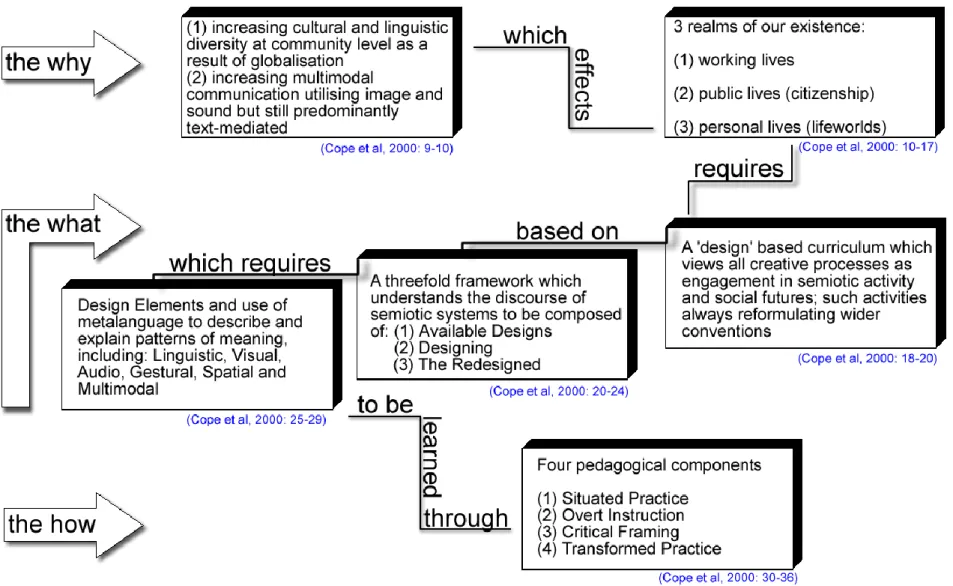
multiliteracies (Cope et al, 2000); (Unsworth, 2001)
multimodal literacy (Kress, 2001)
silicon literacies (Snyder, 2002)
new literacies (Kist, 2005)
digital literacies (Martin, 2006)
media literacy (Burn & Durran, 2007)
Each author addresses distinct aspects of technological literacy and yet each overlap in many respects. In particular, each draws varying levels of correlation between digital literacy and social literacy, that is, digital literacy as a socioculturally mediated practice no different to print literacy as defined by Street (1995) and Barton et al (2000) and
Papen (2005). The plasticity of the term literacy in technological contexts is taken up by Gourlay, Hamilton & Lea who ask if digital literacies is ‘ambiguous and infinitely elastic’ (2013: 7). If the pedagogical goals of classrooms are to enable a degree of mastery over numerous meaning-making resources, but the second-language of English is dominant across the multiple modes of communication, then a question might be asked about the ‘elasticity’ of literacy and technology in multimodal design collaboration. The classroom is a site where languages, literacies and technologies (LLT) converge. What participation frameworks are being constructed and contested and mediated by LLT? At a very dynamic level, in the day-to-day business of teaching and learning, there is language-switching, mode-switching, tool-switching and unexpected connections with numerous knowledge sources. For instance, learners design a website in the mode of paper and through first-language dialogue, utilising second-language translation products, but the completed design is transformed into a digital website with writing in the second-language of English and uploaded for public consumption on the internet. Here is evidence of transduction where modes work together to transform each other and transmute shared ideas into digitalised literacy artefacts. In the process of textual design, there may be scaffolding between learners to generate support and output in language, literacy and technology. For some, perhaps the ‘new’ requirement to become multiliterate is just too demanding, too great an ontological shift for those with a mind-set schooled in traditional literacy practices (Lankshear & Knobel, 2006: 29-62). This research seeks in particular to understand the sociomaterial process of interaction when individuals are paired according to their first-language and work collaboratively using a computer to design digital literacy products using English as a second language.
Pockets of languages often develop in ESOL classrooms where learners informally support each other. Sometimes a ‘community interpreter’ is found, such as an Arabic speaker with stronger digital or stronger literacy skills. Individuals thereby help each other, dependent and independent of the tutor, by switching languages from L2 English to a shared L1 and back again to support digital literacy processes such as using software or writing in a second language. This interpreter strategy, or use of a community scribe, is customary in multilingual settings. Baynham and others ‘point to the use of mediators of literacy as a typical strategy for the accomplishment of literacy tasks’ (Baynham, 1993: 296). In the instance of digital literacy practice described so far, the classroom is a place where the learners have reduced linguistic proficiency to
understand the dominant language of spoken English, are learning to use technology to express themselves, but have limited literacy skills to write in English and read instructions. In addition, the tutor as ‘master’ is circumnavigated by the different symbol uses of his students when they collaborate in their first language.In the pilot study, when asked about switching languages to L1 to support learning, there was an approximate 50% split across the respondents:
AM: It should be better but the problem is the people here in the class speak a different type of Arabic because we all have different backgrounds and accent. So Arabic is also a problem.
BC: Yes this might help.
JC: I don’t think this is going to help you. If you are here in England then you need to speak English. You have to work hard and use English. If you want to use Spanish go to Spain.
MT: No.
NM: Yes, definitely. Like my friend when she need help she always call me.
RN: Yes, it might help but I’m not interested in speaking Kurdish in the classroom. I need to speak English. I can already speak my own language.
These few responses show the attitudinal beliefs of the learners. In the classroom described so far, the learning environment is perceived as one with many potential semiotic resources and where many of the learners have limited linguistic skills to work with the dominant spoken language and limited literacy skills to work with writing. Bilingualism is a strategy for dealing with these at the intersection of language, literacy and technology and merits further investigation within this research.
An important consideration is the multimodal which integrates two or more semiotic resources and multiple modes. Multimodality is identified by Cope & Kalantzis (2000) in their multiliteracies framework. Kress asks ‘if the meaning of a message is realised, ‘spread across’, several modes, we need to know on what basis this spreading happens, what principles are at work’ (Kress, 2003: 35). However, a significant number of literacy models and multimodal models view individuals as consumers rather than producers. The term design has been suggested to emphasis the agency of individuals as producers of multimodal texts. The term design is intended to suggest that learners are ‘inheritors of patterns and conventions of meaning while at the same time active designers of meaning’ (Cope & Kalantzis, 2000: 7). These two differences (‘inheritors’
and ‘designers’) might also be polarised as product and process, and consumers and producers.
A trend in the literature is to position learners as consumers of products in an inheritance model of literacy. This research is interested in learners as producers of meaning in a designer model; this entails looking at the process of their visual and textual production. Pairing learners is commonplace in many language-learning contexts; a computer may configure in that process. The participation frameworks which learners establish when collaborating and designing are constituted on an ongoing flux of semiotic resources where off-screen activity and meaning is spread across action, language and the environment and the meaning-making is transposed across real-time into an on-screen product. Of interest is how those frameworks are structured, including both verbal and nonverbal modes. This study identifies the ESOL classroom as a multimodal learning environment where language, literacy and technology meet. Adult learners are dynamic meaning-makers who inherit knowledge from inside the classroom and outside its physical walls, as well as from each other and from the tutor, in a variety of languages and through traditional and technological modes. Increasingly, literacy studies focus on the sociomaterial aspects of digital practice. Gourlay, Hamilton & Lea discuss literacies alongside technological research interests to consider if ‘the concept of ‘literacies’ has lost its ethnographic and disruptive edge through its complex re-emergence and co-option in the messy term ‘digital literacies’’ (2013: 8). Considering classroom digital literacy as one which interconnects the multiple temporal and spatial practices of online and offline resources, Bhatt questions the where and when of a literacy event. The classroom is just one practice in a wider network of physical and digital practices; what Law calls material semiotics (2009) and Johri calls sociomaterial bricolage (2011). The potentially rich and multiple strands which weave together the tapestry of social phenomena, bridging the inside of the classroom with the outside of the learners’ lives, are not a central focus of this research because the network of associations under investigation is relatively small. The intention of this research is to understand how language interconnects with other modes in the immediate environment of the classroom rather than the learner’s complex interconnection with other practices outside the classroom. This requires detailed microanalysis of actions in the vein of Norris (2004) and Goodwin (2000, 2007a).
Of primary interest is how interaction is framed, actions sequenced and talk unfolded when learners collaborate on a single computer. ‘If language is no longer the only or even the central semiotic mode, then theories of language can at best offer explanations for one part of the communication landscape’ (Kress, 2000b: 153). The increasing forms of multimodal, digital literacies have led to a rethinking and re-naming of literacy processes, events and repertoires. As Kress states, language is central in this intersection of meaning-making, but it is not the only mode. There is always ‘choice’ and a coexistence of modes. The second-language classroom of today is a crucible of diverse languages mixed with traditional literacy practice(s) and emerging technologies. Plurality and polyvocality are central. In such instances it has become difficult to discuss literacy in the singular. There are a range of semiotic resources being used in classrooms. Individuals may have varying proficiency in, and reliance on, these resources. In pedagogical terms, to be multiliterate, one should ideally be able to consume and produce meanings across a range of semiotic resources which include linguistic, visual, spatial, etc: ‘It is important to raise students’ awareness of the variety of semiotic systems employed in texts and help them recognise that texts may be paper, electronic, and live’ (Anstèy & Bull, 2006: 27). Here there are three text types ‘and a range of semiotic systems, with which and through which, meanings are communicated in a classroom in a second language. There is then a crucial intersection where three text types merge. Figure 2.2 illustrates this intersection of modes as three overlapping triangles.
By ‘live’ the authors mean communication which is synchronous from person to person, typically spoken. By ‘portals’ they mean the different asynchronous media (traditional and modern) and individuals (peers, tutors, etc) which people may access. Portals are doorways to communication: ‘a portal is anything that gives access to the content and to ways of interacting with that content’ (Gee, 2004: 81). Of central concern to this research is what happens at this intersection when learners collaborate to design digital texts and write in a second language. At Figure 2.3, two adult Polish learners negotiate a screen-based form of literacy using technology, language(s) and the paper they are holding. They draw on each other’s existing knowledge, language(s), computer software, an electronic translator, the internet as well as the paper instructions provided by the tutor. Collaboratively, they ‘talk’ their way through multimodal designs (creating visuals and writing) on the computer, switching between English and Polish and paper and computer. For educational purposes, it is important to understand what learning constraints and what affordances are generated by this intersection. How is the multimodal design realised on-screen through off-screen negotiation and learner-collaboration? In such contexts we know very little about the ‘interactive organization of participation frameworks, including how they are structured and contested in the midst of moment-to-moment interaction’ (Goodwin, 2007a: 53). There is a need to understand the participation framework of technology and peer-collaboration at Figure 2-2 where digital designs are structured and contested in real-time. The sociomaterial configuration of space, modes and tools within the classroom are considered.
2.3 narrowing the focus
There are many language learning studies which justify technology as a tool for second-language acquisition (SLA). Sauro for example gives an overview of the last two decades to synthesise research findings on ‘the role of synchronous computer-mediated communication (SCMC) for second-language acquisition’ (2011, 369). More recently, but talking generally on the justification for using technology, Crawford-Thomas and Bloxham argue the case for learners, ‘If you’re not bringing digital into your teaching then it’s going to be really hard to meet their needs’ (2015). It has become common knowledge that technology is ‘good’ and the research on SLA mediated by technology is certainly rich (Chapelle, 2004; Sauro, 2011). This research will not consider traditional researched areas of collaborative writing with technology such as wikis, email exchanges, online forums, which generally fall under the field of asynchronous computer-mediated communication (ACMC). Nor will it consider SCMC such as text
chat, chat rooms, face-time videos, etc. Whilst this study may fall under the rubric of SCMC because the learners are synchronously working together using a computer, there is more interest in what happens off-screen as learners collaborate to produce a joint piece of writing which is written on-screen. It could be argued that this research is still positioned within CMC theory because ‘CMC can take place with the person seated at the computer next to you or with someone on the other side of world’ (Philp et al, 2013: 141). The contexts within which CMC occur are diverse so I want to briefly unpack this to narrow the scope and clarify the focus.
Prepositions of place can be helpful. Much of the literature on learner collaboration with ACMC and SCMC could be identified as collaboration through computers. The screen (be it computer, tablet, phone, TV) is a portal to wider communities through which communication and collaboration can take place. It is also possible to talk about learner collaboration with computers. Here the focus is on asymmetrical configurations through tutoring (or instructional) software where the programme contains the knowledge and the learner is positioned didactically in a top-down system where the computer ‘initiates, the student replies, the computer evaluates, the computer initiates again, and so on’ (Levin et al, 1990: 210). Computer-as-tutor is still prevalent in primary schools, for example, in literacy and numeracy programmes. Drill and practice with computers is not relevant here. Crook (1996) also discusses collaboration in relation to computers (chapter 5) and at computers (chapter 7).
One piece of research was found which is very comparable to the current research. Gardner & Levy (2010) analysed the collaborative interaction of two learners at a computer as they designed a webpage on recycling and the environment. The following quote is lengthy but is important to understand where there is understanding and where there are opportunities for enriching our understanding in collaborative computing research:
Collaborative computing is a significant and pervasive social phenomenon in education and the workplace, from early childhood to adulthood. Whether the communication is face-to-face or computer-mediated, it involves human-to-human collaboration and interaction. This interaction may take the form of synchronous face-to-face talk, as two individuals work together at the computer, or asynchronous forms of collaboration, for example in the joint construction of a document using the Track Changes option in a word processing application. A considerable body of work has emerged that focuses upon the ways in which participants remote from each other use specialised software to complete tasks: this is the kind of research that is reported under the rubric of computer
supported collaborative work. In contrast, much less consideration has been given to the impact of the IT tools – computer, keyboard, mouse, screen and software – on the participants’ manner of working and the sequences of talk that unfold at the computer. What seems to have been overlooked in the transition from pen and paper to the computer over the past three decades is our understanding of some of the key differences in the working environment that the computer imposes (Gardner & Levy, 2010: 1).
Bhatt & de Roock (2014) also use screen recording software to explore digital literacy practice, but without the collaborative element which is the focus here. In education it is common practice to pair learners around a computer to complete a shared task; Mercer et al (2004) for example discuss quantitative and qualitative approaches to collecting data from such pedagogy; though the focus is on children in school settings. Collaboration through computers is well documented, as is collaboration with software, but not so well documented is how learners collaborate at the computer. In L2 adult contexts the motivation for pairing learners is typically to ‘get’ learners to use English as a second language; both using English to talk together and to use English for reading and writing. Learner collaboration for the purpose of talk, be it dyadic or group, is a primary method used in teaching practice but is also backed by research as beneficial to language development; (Swain & Lapkin, 2002; Swain et al, 2009; Swain, 2010). Shehadeh for example reviewed the literature and summarised how it ‘has been argued that students’ collaborative dialogues mediate the construction of linguistic knowledge and that this process of joint accomplishment of a task contributes to L2 learning’ (2011: 2). Storch however draws attention to the fact that although ‘pair and group work are commonly used in language classrooms, very few studies have investigated the nature of such collaboration when students produce a jointly written text’ (2005: 153). Although there is now more research in the field since Storch wrote that a decade ago, the recent literature reveals uncertainty in our understanding of how students produce a joint text in real-time (Rouhshad, Wigglesworth, Storch, 2015). Understanding adult learners’ ‘manners of working’ with technology and the ‘sequences of talk that unfold’ (Gardner & Levy, 2010: 1) are two overlooked considerations when pairing learners at a computer. The continuing sections will discuss these issues in more detail.
2.4 defining collaboration
This section will unpack what is meant by collaboration in educational, second-language contexts. It will then consider collaboration in second-second-language writing. Scaffolding as a metaphor for knowledge and skills sharing, as a building process, was
first used by Wood, Bruner & Ross (1976) to explain how teachers helped children solve a block construction problem. The term is etymologically rooted in the idea that a more capable individual helps a less capable individual learner; typically teacher and pupil. This needs teasing out.
Essentially, in educational terms, collaboration makes reference to knowledge which is shared but we need to foreground that knowledge-sharing exists in a material world, not just inside people’s heads. Atkinson discusses shared knowledge acquisition to challenge cognitivist approaches: ‘For cognitivists, language learning is invisible … Yet if cognition occurs not just in but between people, and between people and their sociocognitive environments, then it is also in the world. People learn, from a sociocognitive approach, by participating in extended cognition’ (2010: 618). Co-cognition is at the core of what is meant by peer-interaction in an educational context; between two or more learners and less so the teacher. Although the tutor may have a significant role in establishing the grouping of learners and monitoring them (O’Donnell, 2006) he or she does not typically figure in collaboration research in education.
In this vein of sociocognitivism, common practice in the collaboration literature is to start with Vygotsky (1978) and the zone of proximal development (ZPD). Summarising the Vygotskian approach in relation to their research on the collaborative writing of college students, Ajmi & Ali contend that the ‘cognitive and linguistic development of children appears through social interaction as they obtain scaffolding from the older members of society’ and yet, the learners in their study are adults of symmetrical ability (2014: 2). A social constructivist approach to learning is important but noticeably the ZPD is an asymmetrical configuration and scaffolding is the process through which symmetry of knowledge is sought. There is a generalisation that older individuals and more competent individuals are best placed to enable the internalisation process of moving knowledge from what Vygotsky called the inter-mental social plane to the individual’s intra-mental plane i.e. distributed cognition. Bruner talks in similar terms of instructional scaffolding, which ‘refers to the steps taken to reduce the degrees of freedom in carrying out some task so that the child can concentrate on the difficult skill she is in the process of acquiring,' (Bruner, 1978: 19). Again it is an asymmetrical configuration in which an individual (i.e. a child) is identified as less able than another (i.e. a teacher or parent) and shared cognition is the goal. It could be argued that caution