Characterizing User Search Intent and Behavior for
Click Analysis in Sponsored Search
by
Azin Ashkan
A thesis
presented to the University of Waterloo in fulfillment of the
thesis requirement for the degree of Doctor of Philosophy
in
Computer Science
Waterloo, Ontario, Canada, 2013
c
I hereby declare that I am the sole author of this thesis. This is a true copy of the thesis, including any required final revisions, as accepted by my examiners.
I understand that my thesis may be made electronically available to the public.
Abstract
Interpreting user actions to better understand their needs provides an important tool for improving information access services. In the context of organic Web search, consid-erable effort has been made to model user behavior and infer query intent, with the goal of improving the overall user experience. Much less work has been done in the area of sponsored search, i.e., with respect to the advertisement links (ads) displayed on search result pages by many commercial search engines. This thesis develops and evaluates new models and methods required to interpret user browsing and click behavior and understand query intent in this very different context.
The concern of the initial part of the thesis is on extending the query categories for commercial search and on inferring query intent, with a focus on two major tasks: i) en-riching queries with contextual information obtained from search result pages returned for these queries, and ii) developing relatively simple methods for the reliable labeling of training data via crowdsourcing. A central idea of this thesis work is to study the impact of contextual factors (including query intent, ad placement, and page structure) on user behavior. Later, this information is incorporated into probabilistic models to evaluate the quality of advertisement links within the context that they are displayed in their history of appearance. In order to account for these factors, a number of query and location biases are proposed and formulated into a group of browsing and click models.
To explore user intent and behavior and to evaluate the performance of the proposed models and methods, logs of query and click information provided for research purposes are used. Overall, query intent is found to have substantial impact on predictions of user click behavior in sponsored search. Predictions are further improved by considering ads in the context of the other ads displayed on a result page. The parameters of the browsing and click models are learned using an expectation maximization technique applied to click signals recorded in the logs. The initial motivation of the user to browse the ad list and their browsing persistence are found to be related to query intent and browsing/click behavior. Accommodating these biases along with the location bias in user models appear as effective contextual signals, improving the performance of the existing models.
Acknowledgements
First of all, I would like to thank my advisor, Charles Clarke, from who I learned a lot throughout these years. His expertise, unique insights, continuous support, and positive at-titude have been extremely helpful to me. I am forever indebted to Charlie for his friendship and for providing by far the best research collaboration and experience of my career.
I would like to express my sincere gratitude to my examining committee, Charles Clarke, Gordon Cormack, Rosie Jones, Mark Smucker, and Olga Vechtomova for taking the time and the effort to participate in my committee and for their constructive feedback.
My sincere gratitude goes to Eugene Agichtein and Qi Guo for their valuable comments and collaborations in part of this work. I would also like to thank Gordon Cormack for his kind and encouraging attitude towards me, and for the insightful discussions.
Many thanks to my great colleagues in the IR / PLG group for providing such a friendly and wonderful environment in the lab. In particular, I would like to thank John Akinyemi, Jun Chen, Adriel Dean-Hall, Ashif Harji, Maheedhar Kolla, Bradley Lushman, Nomair Naeem, Adam Roegiest, Bahareh Sarrafzadeh, and Luchen Tan. I will never forget the fun we had together during our game nights, dinner events, and curling matches.
I hereby want to thank my beloved family for their unconditional love and care. In particular, my love and gratitude go to my Mom for always supporting me and helping me towards my dreams. Her insightful, caring, and strong personality has always been my inspiration in life. My love and respect go to my Dad for always believing in me and for passionately introducing me to the world of Mathematics and Physics. Many thanks to my friend to the spirit, Aida, for always being there for me.
My deepest appreciation goes to the love of my life, my husband, Ali. The best and sweetest part of this journey was having you beside me at all time. Our love, respect, and understanding for each other are the precious things I cherish the most in life.
At the end, I would like to acknowledge the Natural Sciences and Engineering Research Council of Canada for the NSERC Postgraduate Scholarship, the University of Waterloo for the President’s Graduate Scholarship, and the Cheriton School of Computer Science for the David R. Cheriton Graduate Scholarship.
Table of Contents
List of Tables xv
List of Figures xvii
1 Introduction 1
1.1 Background and Problem Statement . . . 2
1.2 Research Approach . . . 5 1.3 Data Set . . . 9 1.3.1 Setting #1 . . . 11 1.3.2 Setting #2 . . . 11 1.4 Bibliographical Notes . . . 12 1.5 Thesis Organization . . . 14
2 Background and Related Work 17 2.1 Query Intent Studies . . . 17
2.1.1 Traditional Query Intent . . . 19
2.1.2 Commercial Intent . . . 24
2.2.1 Ad Clickthrough . . . 30
2.2.2 Clickthrough Prediction . . . 32
2.3 Cascade Model of User Behavior . . . 38
3 Understanding and Inferring Query Intent 43 3.1 Manual Annotation . . . 44
3.2 Query Annotation via Crowdsourcing . . . 47
3.3 Evaluating Annotation Results . . . 50
3.4 Inferring Query Intent Categories . . . 52
3.4.1 Term Based Commercial Intent Analysis . . . 53
3.4.2 Features Set and Inference . . . 57
3.5 Discussion of Inference Results . . . 60
4 Characterizing Search Result Page Context 63 4.1 Impact of Ad Position on Clickthrough . . . 64
4.2 Impact of Ad Location on Clickthrough . . . 67
4.2.1 Clickthrough Estimation for Various Locations – The Primary Attempt 69 4.2.2 Clickthrough Estimation for Various Locations – Maximizing Entropy 72 4.3 Ad Clickthrough Behavior for Different Intents . . . 76
4.4 Context-Based Click Analysis . . . 83
4.4.1 Baseline Model . . . 85
4.4.2 Query Intent Model . . . 86
4.4.3 Evaluation Results . . . 88
5 Modeling User Browsing and Click Behavior 93 5.1 Motivational Points . . . 94 5.2 Location Bias . . . 95 5.3 Query Bias . . . 97 5.3.1 Initiation . . . 98 5.3.2 Persistence . . . 99 5.4 Parameter Inference . . . 102 5.5 Evaluation Results . . . 109 5.5.1 Click Models . . . 109 5.5.2 Click Prediction . . . 110 5.5.3 Evaluation Metrics . . . 111
5.5.4 Evaluating the Impact of Query Biases . . . 112
5.5.5 Evaluating the Impact of the Location Bias in Addition to Query Biases . . . 116
5.6 Summary . . . 120
6 Patterns Found in User Behavior 121 6.1 User Intent and Query Biases . . . 121
6.2 User Behavior and Location Bias . . . 126
7 Conclusions and Future Directions 129 7.1 Contributions . . . 130
7.1.1 User Intent Analyses . . . 130
7.1.2 Context-Based Click Analyses . . . 132
7.1.3 User Behavioral Analyses . . . 135
Appendix 141
A Parameter Estimation 143
A.1 Forward-Backward Variables . . . 143
A.2 Estimating Posterior Probabilities . . . 145
A.2.1 Transition Probability . . . 145
A.2.2 Satisfaction Probability . . . 147
List of Tables
1.1 Statistics of the data . . . 10
2.1 Synthesis of prior work on query intent analysis. . . 18
3.1 Percentage of HITs falling in different agreement states for different dimen-sions of intent. . . 50
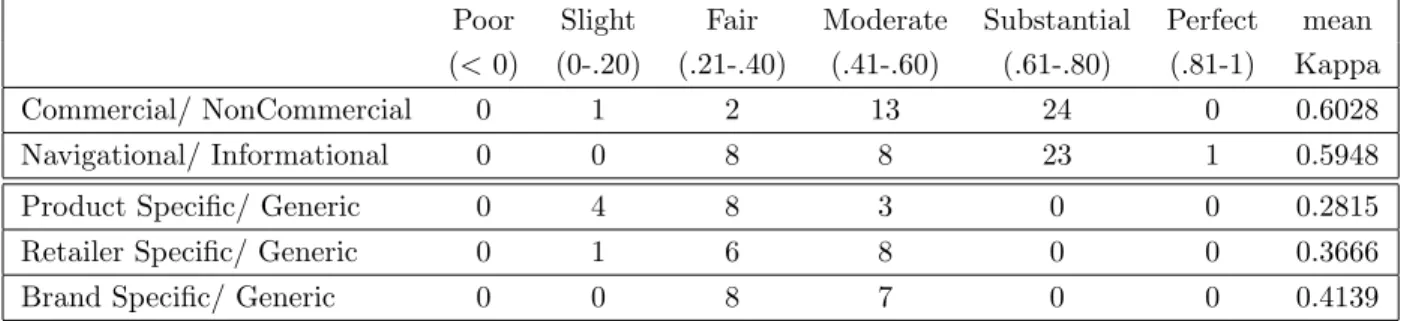
3.2 Measure of agreement among the annotators in terms of the number of batches falling in different margins of Kappa along with the mean Fleiss’ Kappa for each dimension. . . 52
3.3 List of most frequent terms in the data set . . . 53
3.4 Features set. . . 58
3.5 Precision, recall, and accuracy in percentage forms for Commercial/ Non-commercial classifier, Navigational/ Informational classifier, and the three classifiers corresponding to the sub-categories of commercial intent with re-spect to the SERP and query features combined or to the SERP features only. . . 61
4.1 Percentage of SERPs with particular number of ads on the top and at the side from the results obtained through an experiment on 43K queries. . . . 68
5.2 Runs across different settings of the query biases for the cascade model, DCM model, and DBN model. . . 113
5.3 The additional setting related to the location bias for the models under the experiment. . . 116
5.4 Runs across different settings of the query biases and the location bias for the cascade model, DCM Model, and DBN model. . . 117
List of Figures
2.1 Sample search engine result page for the query “airline tickets” that con-tains ad results (top-listed and side-listed) displayed along with the organic results. The three components of a sample ad are displayed. . . 29
2.2 The graphical presentation of ad clickthrough model (Becker et al., 2007). . 31
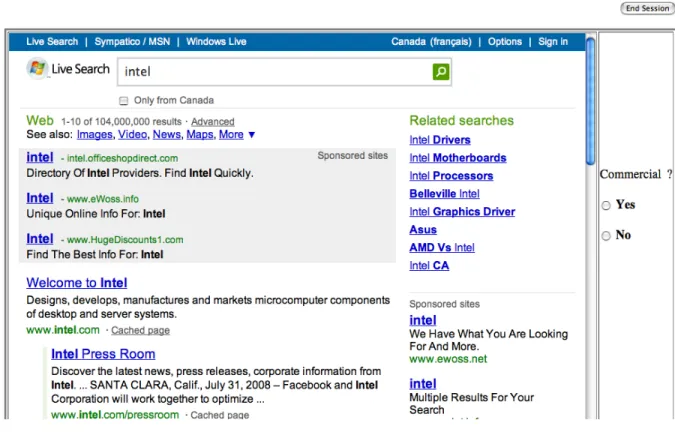
3.1 A snapshot of the Web application used for the manual annotation . . . . 45
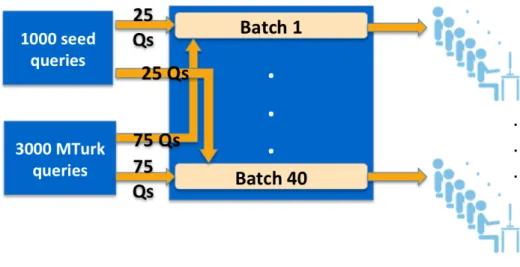
3.2 The labeling process through the Amazon Mechanical Turk. . . 48
3.3 ROC curve of prediction from on ad click data versus the prediction from on organic click data. . . 55
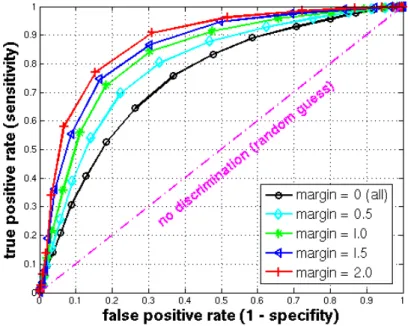
3.4 ROC curves for varying margin values. . . 56
4.1 Average CTR for SERPs with particular number of ads . . . 65
4.2 Average CTR at specific ranks for SERPs with particular number of ads. . 66
4.3 Approach 1 – Adjusted plots for average CTR for SERPs with a particular number of ads on top/ side of the page. . . 72
4.4 Approach 2 – Adjusted plots for average CTR for SERPs with a particular number of ads on top/ side of the page. . . 75
4.5 CTR for SERPs with particular number of ads and associated with various query types. . . 77
4.6 CTR for SERPs with particular number of ads and associated with major query types and associated with sub-categories of commercial intent: Spe-cific Product vs. Generic Product, SpeSpe-cific Retailer vs. Unknown Retailer, and Specific Brand vs. Unknown Brand. . . 78
4.7 Average CTR at specific ranks for SERPs with particular number of ads and corresponding to different categories of query intent. . . 80
4.8 Average CTR at specific ranks for SERPs with particular number of ads and corresponding to sub-categories of commercial intent. . . 81
4.9 Adjusted plots for average CTR for SERPs corresponding to different query intents and with a particular number of ads on top/ side of the page. . . . 82
4.10 Average CTR along with the adjusted plots for average CTR corresponding to a particular number of ads on top/ side of the page for Specific Product vs. Generic Product, Specific Retailer vs. Unknown Retailer, and Specific Brand vs. Unknown Brand. . . 84
4.11 Performance measures of the CTR estimation. . . 90
5.1 Relative click rate for different locations/positions of the result pages. . . . 96
5.2 The location- and query- aware browsing model. . . 100
5.3 The average log-likelihood for the 11 runs. . . 114
5.4 The average log-likelihood of studied click models with various settings of query biases and across different query frequencies. . . 115
5.5 The average log-likelihood for the 14 runs. . . 117
5.6 Impact of various biases on the studied click models. . . 119
6.1 Difference in the initiation probability for the commercial/non-commercial dimension. . . 122
6.2 Distinctions found in user behavioral parameters across the commercial in-tent sub-categories. . . 124
6.3 Difference in the persistence probability for the product dimension with respect to the brand information. . . 125
6.4 Difference in the initiation probability and the persistence probability for various locations of the result pages (t stands for top and s stands for side) and across the sample of queries from set B(2). . . 127
Chapter 1
Introduction
Traditional information retrieval methods do not explicitly consider goals, interests, and preferences of the user (Belkin, 1993). Accommodating these factors requires us to under-stand the intent of the user when issuing a query. In order to implement this requirement, user behavior must be captured and modeled, allowing us to make meaningful inferences regarding intent. These inferences, in turn, allow us to improve the user experience and satisfying their information need.
This thesis is specifically concerned withsponsored search: the selection and display of advertisement links (ads) by a commercial search engine (e.g., Bing or Google) in response to a user query. To explore and model user behavior, we work with a log of queries, result pages, and clicks provided by a commercial search engine for research purposes. Although this log is heavily anonymized, with substantial redaction, the impact of search context is demonstrated on user behavior. As part of this context, the nature of the query, the content of the organic (i.e., non-sponsored) results, the page structure, and the positioning of ads on the page are considered. By considering this context, improved models for user behavior and new methods for measuring ad quality are presented.
1.1
Background and Problem Statement
To study user intent, two major approaches have been employed in prior work. The first focuses on the manual examination of user queries to establish major categories of user intent (Bodoff, 2006; Carmelet al., 1992; Chooet al., 1998; Morrisonet al., 2001; Navarro-Prietoet al., 1999; O’Day and Jeffries, 1993; Sellen et al., 2002; Teevan et al., 2004). The second applies machine learning methods to automatically classify user intent (Ashkan and Clarke, 2013; Ashkan et al., 2009a; Baeza-Yates et al., 2006; Beitzel et al., 2005; Jansen et al., 2008; Leeet al., 2005; Li et al., 2008; Nettleton et al., 2007; Tan and Peng, 2008). Most early work was concerned only with user intent as it related to the organic search results (Broder, 2002; Kang and Kim, 2003; Rose and Levinson, 2004). More recent work has considered sponsored search, particularly the problem of predicting commercial intent (Ashkanet al., 2008; Dai et al., 2006; Huet al., 2008), i.e., the intent to purchase a product or service.
According to Rose and Levinson (2004), studying user goals in information access involves three primary tasks: i) creating a conceptual framework for user goals, ii) finding a way to associate user goals with queries, and iii) modifying engines to exploit user preferences via the goal information. The problem of inferring user search intent, as well its application to the improvement of Web search experiences, can be understood with respect to these three tasks. In what follows, the discussion is organized around these tasks.
The first task can be seen as understanding and modeling user search intent. With respect to this task, one direction of study could aim at extending the traditional cate-gories of query intent by considering different domains of Web search and by the manual examination of query/click logs.
Traditionally, user intent corresponded to any of the standard categories of Web query defined by Broder (2002): navigational, informational, and transactional. A navigational query is defined as a query through which the user has an immediate intent to reach a particular Webpage. The user intent behind an informational query is to acquire some information assumed to be present on one or more Webpages. The intent underlying a
transactional query is to perform some Web-mediated activity, such as buying a product or playing a game.
In the context of sponsored search, information providers may also wish to know whether a user has the intention to purchase or utilize a commercial service, or what is called online commercial intent (OCI) (Dai et al., 2006). In this respect, this thesis studies and extends the traditional categories of Web queries in the commercial domain, i.e sponsored search.
The second task, that ofinferring user intent, involves using the information obtained from any available source, such as a user search history, for the purpose of identifying the intention behind a query. A natural source of information for this purpose is the query itself. However, the query is short and it may not reveal much about the user (Broder et al., 2007). Therefore, additional sources of information may be used to enrich the query. Earlier work mostly infers intent by considering the anchor text associated with the links clicked by the user and the content of the pages reached from these links. This work approaches query intent detection using the information obtained from the combination of query itself and the relation between the query string and URLs presented on the page that the search engine returns as a result of the query. In addition, search result pages returned for queries are considered as representatives of the nature of the queries, and therefore the caption (Clarke et al., 2007) of search results displayed on these pages are used as means to identify the intent underlying queries.
The third task concerns the application of user intent studies to improve Web search. Understanding and inferring the intent underlying user queries can help search providers improve search personalization, and ideally increase user satisfaction. There has been a growing interest in employing query intent analysis to improve various Web search expe-riences, while there have been less efforts made in the sponsored search domain. This thesis considers the use of the contextual information, particularly the query intent, for the purpose of click analysis in the online advertising domain.
Sponsored search provides the major source of revenue for commercial search engines. In its simplest form, for a given query, a set of candidate advertisement links (a.k.a. ad(s))
are obtained through an ad retrieval algorithm that matches the query terms with the ads’ bid terms — keywords that are selected by the advertisers (Fain and Pedersen, 2006). These ads are then ranked in decreasing order based on the expected revenue estimated for each individual ad, a, typically as: REV(a) = ba×Qa where ba is the bid placed by
an advertiser, to be paid once the ad’s target page receives a click, and Qa is the quality
score of the ad as a notion of its performance predicted by the search engine.
A click on an ad is viewed as a potential purchase opportunity for the product or service that is offered by the advertiser. Hence, the expected ad clickthrough rate (CTR) is the classic measure of ad quality, determining the expected revenue for the search engine.
Information obtained from implicit feedback resources, such as query logs and the click history of ads recorded in the logs (Richardson, 2008), have been widely used to interpret and predict user’s future click behavior over these links. The existing models adopt the common assumption of atrust bias (Joachimset al., 2005) with respect to displayed results, which is the basis of the examination model (Richardsonet al., 2007). Under this model, it is assumed that click rate decreases towards the lower ranks on result pages due to the reduced visual attention from the user.
The link examination behavior of users appears to be similar to their click behavior, where most of the links examined by users are found to be the top-listed results on search result pages for both sponsored and non-sponsored links (Jansenet al., 2007). Hence, the main factors determining an ad click under the examination model are the relevance of each individual ad to the user’s need and the rank position of the ad on the page. This thesis, in part, investigates the result page contextual factors, such as the number of ads and the intent underlying the queries, as factors that could impact the ad’s click.
Further efforts in click models consider the influence of the co-appearance of ads with each other; a relatively strong ad appearing prior to a particular ad on a page may distract the user from the lower ads, while a weakly related ad appearing at a relatively high position may annoy the user into abandoning the list, regardless of the quality of the later ads. This idea is introduced by Ghosh and Mahdian (2008) as the externality effects of ads in advertising auctions, and it is based on the assumption that users visually scan the ad list from top to bottom. Once an ad is examined by the user, ad-specific factors will
determine the click decision and continuation probability. In contrast to the examination model, the probability of clicking on an ad is considered to be dependent on the other ads shown above it on the page as well as on its own quality factors.
The browsing and click behavior of users over the advertisement links are targeted in this thesis where the linear browsing behavior of users, the impact of their queries, and the structure of the result pages are among the factors that are taken into account.
1.2
Research Approach
This research work explores query intent characterization and user browsing and click behavior within the sponsored search domain. The contributions of the thesis can be summarized as follows:
• Extending the traditional categories of Web queries.
• Enriching queries with contextual information obtained from search result pages re-turned for these queries.
• Exploring simple methods for the reliable labeling of training data.
• Studying characteristics of commercial intent in sponsored search domain.
• Employing such contextual information as the query intent for click analysis in spon-sored search.
• Exploring user browsing behavior in sponsored search, eventually using the informa-tion for the better understanding of the click behavior in this domain.
• Analyzing patterns and common signals found in user browsing and click behavior with respect to various context.
We aim at extending the traditional categories of Web queries for commercial search. In the initial steps towards this goal, queries that exhibit commercial/ noncommercial and
navigational/ informational intent are studied. The commercial intent category is further extended to reference specific products, brands and retailers (Ashkan and Clarke, 2009), avoiding the more traditional topical categories, such as sport and news.
This work tackles the query intent inference using mostly the context in which a query appears. With respect to this approach, the content of search engine result pages (SERPs) returned for queries are considered as representatives of the nature of the queries, and they are used as means to identify the intent underlying queries.
A relatively easy and reliable approach is presented to label a set of queries through crowdsourcing (Doanet al., 2011) in order to be used for training purposes. The queries are consistently labeled by assessors in different dimensions, and the labels are fed to classifiers in order to identify different categories of query intent for a larger set of queries.
Feature sets are used to train five binary classifiers to recognize different dimensions of the commercial intent: i) commercial/ noncommercial, ii) navigational/ informational, iii) product oriented, iv) brand oriented, and v) retailer oriented. Classification accuracies confirm that distinctions among these categories are reasonably distinguishable, and also the query based features, along with the content of search engine result pages, are effective in detecting such categories.
Throughout this thesis, it is demonstrated that click behavior is consistent with the query intent categories identified and inferred earlier. While ad click analysis is primarily addressed in the literature by considering the content of ads and their associated bid terms, this work aims at tackling the problem through thecontext in which an ad appears. Consider an ad as it appears in the context of a search engine result page. This context may strongly influence whether or not the user will click on the ad, and includes the display location of the ad, the rank of the ad, the user’s query, the organic search results, and other ads displayed along with it.
A SERP represents a result page that the search engine returns as the result of a query. When a user clicks on an ad displayed on a SERP, they are transferred to the ad’s landing page, and the context and click information are typically stored in a log by the search engine. An ad impression represents a pair of ad and SERP where the ad appears on the
SERP as a result of a query. An ad’s impression number refers to the number of times the ad is displayed in its history of appearance in the log, whether it is clicked on or not. Commercial search engines generate and store this information as part of their normal operations. Historical clickthrough rate (CTR) for an ad can be computed directly from this log information as the ratio of the total number of clicks recorded for the ad to the ad’s impression number. One of the purposes of this thesis is to use the click log information to study the relationship between user ad click behavior and characteristics of queries and their corresponding sponsored links shown on search result pages.
In order to validate characteristics and differences of the query categories, the spon-sored search domain is employed due to two reasons: i) this domain has not been much addressed in previous query intent studies, and ii) this domain is more heavily targeted by the commercial intent of users. This step can also be seen among the primary efforts to address the third task introduced by Rose and Levinson (2004) as indicated previously; search engines can utilize the information obtained from user goals and preferences in order to improve the existing algorithms in Web search and information access.
Models for click behavior are presented in order to estimate ad clickthrough rate (CTR) with respect to the history of ads while the contextual information about the search result pages, such as the query intent category, forms the basis of these models. The aggregated click behavior of search result pages (i.e. context CTR), with respect to the number of displayed ads and rank position of ads, forms the basis of the proposed baseline model. In order to further study the influence of the query intent on ad CTR, the previously determined intents underlying the users’ queries are used to extend the baseline model, forming the proposed query intent model. These context-based ad click analyses suggest that contextual factors such as the intent behind user query have correlations with the performance of ads in sponsored search. Comparing the baseline model against the query intent model suggests that ad clickthrough prediction techniques could benefit from the query intent information and other contextual factors.
The above models consider only the aggregated click probability of an individual ad, whereas the list of ads appearing prior to a particular ad on the page and the user’s browsing behavior do not have any influence on the prediction. They are also limited
with respect to their need for explicit judgements of query intent. In a further attempt, a group of cascade-based click models, calledlocation– and query–aware models, are studied that aim at using variability of user behavior and differences found between user browsing behavior in dealing with sponsored links and organic links to better model click behavior in sponsored search. The main goal of these models is to gain insight into user browsing and click behavior in sponsored search, which in turn improves one’s ability to infer the probability of clicks on the advertisement links.
We augment context by adding biases that are based upon known properties of spon-sored search, and upon the differences that exist in user browsing behavior over advertise-ment links as opposed to organic links. According to Jansen and Resnick (2006), users exhibit a strong bias against ads, as opposed to organic links. Thus, users have a stronger tendency to consider organic links rather than ads. As for the ads themselves, users are known to pay more attention to the top-listed ads (i.e., those appearing above the organic results) as opposed to the side-listed ads (i.e. those appearing to the right of the organic results) (Jansen and Resnick, 2006). The nature of the query may also influence the prob-ability that the user will initiate browsing of the ad list, and continue browsing the ad list once they start. A user who issues a commercially oriented query may be assumed to have a greater tendency to purchase or utilize a commercial service, and thus they click on ads more frequently.
A notion of location bias is formally modeled in this work in order to account for top-listed and side-listed ads separately. Furthermore, query biases are introduced and parameterized in order to account for the probability that the user will initiate browsing of the ad list, and for their persistence (patience) in continuing to browse through the list. The initiation probability with respect to a particular query is defined as the chance that the user who issues this query will eventually initiate browsing the ad list. Thepersistence or transition probability with respect to a query is defined as the chance that the corre-sponding user who examined a particular ad at ranki will continue on to examine the ad at ranki+ 1. Both the initiation probability and the transition probability are determined separately for different display locations of ads on result pages.
The parameters of the location- and query- aware models and also their original settings are learned from the click signals recorded for the advertisement links appearing in a log of search result pages. To evaluate the performance of the models and to compare them with state-of-the-art performance, standard evaluation metrics, including log-likelihood and perplexity are applied. The evaluation results indicate that, through the incorpora-tion of query and locaincorpora-tion biases, significant improvements can be achieved in predicting browsing and click behavior in sponsored search.
In part of the experimental study, the extent to which these biases actually reflect varying behavioral patterns is explored, confirming that correlations exist between the biases and user search behavior. These sorts of observations are interesting and at the same time may be helpful in the sense that they are obtained from independent experiments. One group of experiments empirically calculates the bias parameters with respect to the click signals recorded in the search engine log. Another group of experiments matches these values against query types that have been obtained independently, and finds distinctive patterns of user behavior based on them. These patterns not only shed light on user behavior, they may also suggest the development of user dependent properties to be used as signals for ad click analysis in sponsored search.
1.3
Data Set
The empirical study described throughout this thesis work is based on a data set obtained from the Beyond Search program (Beyond Search Data, 2007) developed by Microsoft Re-search and Microsoft adCenter in 2007. This set of ad Re-search and click logs was sampled over the course of three months with personally identifying information removed. It in-cludes a sample of 101 million SERPs. A set of ad clicks (about 8 million) is also associated with the SERPs.
Each SERP and each click is described by a set of attributes. The list of attributes used from the SERP data is as follows: date and time of when the SERP was displayed, user query,number of ads displayed on the SERP,the list of ad ids displayed on the SERP,
Table 1.1: Statistics of the data
Original Setting #1 Setting #2
(Click≥4) (Frequency≥3, Click≥1)
Unique SERPs 98M 20M 41M
Unique ad impressions 360M 107M 206M
Unique queries 25M 135K 2.8M
user session ID, andSERP ID. The list of attributes used from the click data is as follows: date and time of the click, user query, rank of the clicked ad on the corresponding SERP, user session ID, and corresponding SERP ID.
We removed any extra white space at the beginning and the end of the queries, and between words of the queries for both SERP and click files. We then case-normalized the queries. SERPs with a duplicate combination of SERP id and user session id were removed in order to filter out repeated queries from the same user, resulting in approximately 98 million unique SERPs. We used the above attributes to create the set of ad impressions (about 360 million) from the SERPs. Remember an impression is represented by the pairs of ad and SERP where the ad appears on the SERP as a result of a query. Each impression obtains its unique id as the combination of <user session ID, SERP ID,ad id >, and it records all the information from the corresponding SERP. Each click instance was then associated with the appropriate ad impression in order to track the click status of each impression. A report of the statistics of the data is presented in Table 1.1.
There are various experiments conducted in this thesis in order to provide evidence for the proposed hypotheses or to empirically evaluate the performance of the proposed models and techniques. For these purposes, various subsets of the original data are required, which are prepared through different filtering settings. We categorize these subsets under two settings that will be explained next.
1.3.1
Setting #1
The first setting prepares subsets of the original data which will be used by those ex-periments exploring query intent categories. In order to prevent train-test contamination across those experiments, we randomly split the impression and click data into three equal-sized sets (setA(1), setB(1), and setC(1)) at the query level. All the impressions and click
data for a given query are put into the same set. This process is achieved by randomly assigning each query (with all its impression and click information) into one of the three sets.
Set A(1) is used to train classifiers for query intent detection; set B(1) is used to study characteristics of different categories of query intent; set C(1) is used to study ad
click-through with respect to various contexts of result pages. All three sets contain approxi-mately the same number of queries (about 800K) along with their SERP, impression, and click information.
There are many queries with a very small number of clicks (less than four). The upcoming analyses deal with empirical ad click rates, and estimating click rates from small numbers of clicks may lead to estimates that are wildly different from the true click rates for these queries, producing problems with the analysis. Following the approach of Richardson et al. (2007), the sets have been filtered to include only queries that have at least four ad clicks. After filtering, we ended up with 45032, 44941 and 44909 queries in setsA(1), B(1),
and C(1) respectively (134,882 queries in total).
In the remainder of the thesis, we will refer to the case/space/user normalized SERP data, impression data and their corresponding click information as the original data. Otherwise, by SERP data, impression data or click data from the setting #1, we mean one of the prepared sets (i.e. A(1), B(1), or C(1)) as described above.
1.3.2
Setting #2
The second setting prepares data for those experiments that involve modeling user browsing and click behavior in sponsored search. Two subsets of the data are prepared for this
purpose.
The first subset is referred to as set A(2) in the remaining of the thesis. There are approximately 206 million impressions (resulted from 41M SERPs) in this set which were sampled over three months. These impressions correspond to a sample of about 2.8M queries, all of which were required to appear at least 3 times and to have at least one ad click recorded in the log.
For another group of experiments, we will require access to the location of the ads on the SERPs. Since the precise location of the ads is not recorded in the original data set, we had to separately select a subset of the data for the second step such that the location of ads can be identified with certainty. This selection is possible due to the ad placement strategy of the search engine at the time, i.e. for each SERP, at most three ads were displayed on the top and a maximum of five ads were displayed at the side.
Given this constraint, and assuming that the ads displayed on the top are ranked higher than the ones displayed at the side, one can be assured that SERPs with eight ads belong to result pages with three top-listed ads and five side-listed ads. All such SERPs along with their impression and click information from the set A(2) have therefore been placed
into a second set, called B(2). Approximately 56 million impressions (resulted from 7M
SERPs) appear in the set B(2), which corresponds to a sample of about 712K queries.
For both sets A(2) and B(2) from the setting #2, we make sure that their SERP
data is sorted according to their time stamp. This is required due to the final set of the experiments that focuses on the online learning of ad click probabilities, and therefore the order in which the SERPs appear in the log matters.
1.4
Bibliographical Notes
Preliminary versions of the material presented in various parts of this thesis have appeared in the following publications:
on Clickthrough Behavior in Sponsored Search, Knowledge and Information Systems (KAIS) Journal, Volume 34, Issue 2, pp. 425-452, February 2013.
• Azin Ashkan and Charles L.A. Clarke, Modeling Browsing Behavior for Click Analysis in Sponsored Search, In Proceedings of the 21st ACM Conference on Information and Knowledge Management (CIKM), pp. 2015-2019, Maui, Hawaii, November 2012.
• Azin Ashkan and Charles L.A. Clarke, Characterizing Commercial Intent, In Pro-ceedings of the 18th ACM Conference on Information and Knowledge Management (CIKM), pp. 67-76, Hong Kong, China, November 2009.
• Azin Ashkan, Charles L.A. Clarke, Eugene Agichtein, and Qi Guo, Estimating Ad Clickthrough Rate through Query Intent Analysis, In Proceedings of the IEEE / WIC / ACM International Conference on Web Intelligence (WI), pp. 222-229, Milan, Italy, Sept. 2009.
• Azin Ashkan and Charles L.A. Clarke, Term-Based Commercial Intent Analysis, In Proceedings of the 32ndACM International Conference on Research and Development in Information Retrieval (SIGIR), pp. 800-801, Boston, USA, July 2009.
• Azin Ashkan, Charles L.A. Clarke, Eugene Agichtein, and Qi Guo, Classifying and Characterizing Query Intent, In Proceedings of the 31st European Conference on
Information Retrieval (ECIR), pp. 578-586, Toulouse, France, April 2009.
• Azin Ashkan, Charles L.A. Clarke, Eugene Agichtein, and Qi Guo, Characterizing Query Intent From Sponsored Search Clickthrough Data, In Proceedings of the SIGIR Workshop on Information Retrieval for Advertising (IRA), pp. 15-22, Singapore, July 2008.
Other related publications are as follows:
• Azin Ashkan and Charles L.A. Clarke, On the Informativeness of Cascade and Intent-Aware Effectiveness Measures, In Proceedings of the 20th International Conference
• Charles L.A. Clarke, Nick Craswell, Ian Soboroff, and Azin Ashkan, A Comparative Analysis of Cascade Measures for Novelty and Diversity, In Proceedings of the 4th ACM International Conference on Web Search and Data Mining (WSDM), pp. 75-84, Hong Kong, China, February 2011.
• Azin Ashkan, John S. Whissell, and Charles L.A. Clarke, Unsupervised Learning of Result Page Context for Clickthrough Analysis in Sponsored Search, In Proceedings of the 5th International Workshop on Data Mining and Audience Intelligence for
Advertising (ADKDD), pp. 44-52, San Diego, USA, August 2011.
• John S. Whissell, Charles L.A. Clarke, and Azin Ashkan, Clustering Web Queries, In Proceedings of the 18thACM Conference on Information and Knowledge Management (CIKM), pp.899-908, Hong Kong, China, November 2009.
• Qi Guo, Eugene Agichtein, Charles L.A. Clarke, and Azin Ashkan, In the Mood to Click? Towards Inferring Receptiveness to Search Advertising, In Proceedings of the IEEE / WIC / ACM International Conference on Web Intelligence (WI), pp. 319-324, Milan, Italy, September 2009.
• Charles L.A. Clarke, Maheedhar Kolla, Gordon V. Cormack, Olga Vechtomova, Azin Ashkan, Stefan B¨uttcher, and Ian MacKinnon, Novelty and Diversity in Information Retrieval Evaluation, In Proceedings of the 31st ACM International Conference on
Research and Development in Information Retrieval (SIGIR), pp. 659-666, Singa-pore, July 2008.
1.5
Thesis Organization
The remainder of this thesis is organized as follows:
In Chapter 2, a background review of the query intent analysis is provided with a focus on traditional query intent and the commercial intent categories. As well, concepts from the sponsored search domain are briefly discussed in this chapter. Various clickthrough
studies are reviewed where the main purpose is to address the lack of contextual information in this area. Towards the end of the chapter, an overview of the common cascade-based browsing and click behavior models is provided.
Details of query modeling techniques (manual annotation and crowdsourcing) are dis-cussed in Chapter 3. The evaluation results of the annotation process are also reported. The remainder of the chapter discusses the details of the query inference procedure within the five dimensions of query intent studied in this work. A preliminary study of the query intent is explained first which accounts for the click information of the query terms in order to determine the intent of the query. It is concluded that click information is costly and noisy, and therefore the rest of chapter focuses on developing a features set from the result page contextual information. The chapter ends by reporting the results of the classification of the query intent using the collected set of features.
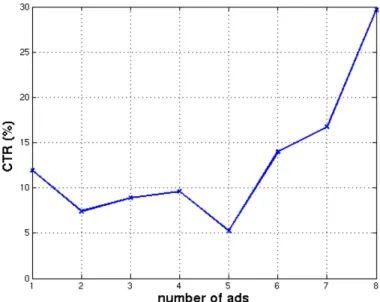
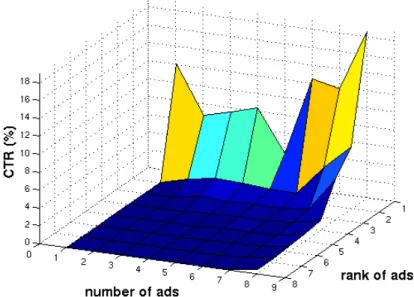
In Chapter 4, characteristics of search result pages are studied with respect to a group of factors: the position of ads, the location of ads, the number of displayed ads, and query intent. It is concluded that the placement of ads has a substantial impact on the number of clicks they receive. This impact is more obvious when the intent underlying the queries for which those ads are displayed is also taken into account. User’s click behavior in sponsored search is modeled in the remaining of the chapter. The models are based on aggregated click behavior over the ads displayed within different contexts on the result pages.
Another group of click models, called location– and query–aware models, are studied in Chapter 5. Rather than taking the individual performance of ads into account (like the models studied in Chapter 4), this group of models considers each ad in the context of the ones appearing prior to it on a result page. They also account for variability of user behavior and differences that exist between user browsing behavior in dealing with sponsored links and organic links to better model click behavior in sponsored search. The evaluation results of the models are presented ate the end along with an overall comparison of the performance of all models.
Chapter 6 further analyzes the results of the previous chapter and reports interesting patterns found in user browsing and click behavior in sponsored search.
Finally, a summary of the contributions of this thesis, along with findings, and future directions are provided in Chapter 7.
Chapter 2
Background and Related Work
Implicit feedback has been widely used to interpret and predict search behavior and user preferences (Agichteinet al., 2006; Joachimset al., 2005; Oard and Kim, 2001; Oardet al., 1998; Poblete and Baeza-Yates, 2008; Richardson, 2008; Teevanet al., 2008), including user intent. As Broderet al.(2007) point out, queries are often short. A query by itself may not reveal much about the user, and implicit feedback can enhance this information. Compared with explicit feedback, such as a user questionnaire, implicit feedback has the advantage that it can be collected at much lower cost, in much larger quantities, and without placing an unwanted burden on the user (Joachims et al., 2005). However, implicit feedback is more difficult to interpret than explicit feedback, is potentially noisy (Joachims et al., 2005), and is generally thought to be less accurate (Kelly and Teevan, 2003).
2.1
Query Intent Studies
While the earliest Web search engines were primarily based on document content and link structure (Broder, 2002), they now depend heavily on an understanding of user behavior, including user intent. A synthesis of prior work on query intent analysis is depicted in Table 2.1. Prior efforts reported in literature can be categorized from two perspectives:
i) the method of inference (manual or automatic), and ii) the query intent categories addressed (traditional or commercial).
Table 2.1: Synthesis of prior work on query intent analysis.
Manual Automatic
Limited training data is used Mostly the traditional categories,
such as navigational, informational, Low performance results
Traditional transactional, and resource, are addressed or trade-off between precision and recall are reported Much effort has been made in manual
examination and survey review Past click behavior and anchor text information are mostly used High level query categories (commercial and noncommercial) are mostly addressed
Limited study on the commercial There is lack of study on the
Commercial categories has been conducted relation of this newer dimension of query categories with the traditional categories
Characteristics of various query categories are not validated
Early work on query intent analysis includes a variety of controlled studies and manual examinations from various perspectives of user search, such as browsing (Carmel et al., 1992; Teevan et al., 2004), search strategies, tasks, tactics (Choo et al., 1998; Morrison et al., 2001; Navarro-Prieto et al., 1999; O’Day and Jeffries, 1993), and information seek-ing (Bodoff, 2006; Sellen et al., 2002). More recently, efforts have been made to tackle query intent modeling and detection through automatic approaches (Ashkan and Clarke, 2013; Ashkan et al., 2009a; Baeza-Yates et al., 2006; Beitzel et al., 2005; Jansen et al.,
2008; Leeet al., 2005; Li et al., 2008; Nettleton et al., 2007; Tan and Peng, 2008) mostly through the application of machine learning techniques. In what follows, we address a group of manual and automatic efforts in query intent analysis, for both the traditional and commercial categories of query intent.
2.1.1
Traditional Query Intent
A fundamental study of the traditional query categories was performed by Broder (2002), who proposed three broad user intent categories for Web queries: navigational, informa-tional, and transactional. A navigational query is defined as a query through which the user has an immediate intent to reach a particular Webpage. The user intent behind an informational query is to acquire some information assumed to be present on one or more Webpages. The intent underlying a transactional query is to perform some Web-mediated activity. Using survey results, Broder reports that approximately 26% of queries are nav-igational, nearly 73% are informational, and an estimated 36% are transactional. Based solely on the log analysis, Border reports that 48% of the queries are informational, 20% navigational and 30% transactional.
Broder discusses the evolution of search engines with respect to these categories of query intent. In the early stage, engines mostly supported the informational queries, and they used to be heavily based on classic IR techniques over text and formatting of documents. Later, search engines targeted both informational and navigational queries by employing information other than content of documents, such as link analysis, anchor text, and clickthrough information. Finally, the emerging generation of search engines supports informational, navigational, and transactional queries and seeks answer to “the need behind the query” by employing various sources of information, such as semantic and context analyses.
Kang and Kim (2003) define query classification schemes using heuristics to distinguish two types of queries: topic finding (i.e. informational intent) and homepage finding (i.e. navigational intent). They placed the documents acting as entry points for a particular homepage into a database calledDBHOM E, while the remaining documents from their
col-lection were assigned to a database calledDBT OP IC. From these databases, they extracted
various information, such as the frequency of appearance of an individual term and the mutual information of term pairs, and combined them linearly to formulate various query types. The best results obtained from their settings had a precision of 91.7%, while the recall was reported as 61.5%.
Rose and Levinson (2004) conducted an extensive study of user intent developing a hierarchy of query goals with three top-level categories: informational, navigational, and resource. Under their taxonomy, a transactional query as defined by Broder (2002) might fall under either of their three categories, depending on the details of the desired transac-tion. They repeatedly revise these goal categories and suggest that the goals naturally fall into a hierarchical structure:
• The definition of a navigational goal by Rose and Levinson (2004) follows that of Broder’s work (Broder, 2002). They consider a query to be navigational if the user has a single authoritative Webpage in mind when they issue the query. Hence, most queries consisting of names of companies, universities, or well-known organizations are considered to be navigational.
• Following Broder’s definition, they express the informational goal as: i) a directed question to learn something in particular about a topic, ii) an undirected question to learn anything/everything about a topic, iii) a request for advice, ideas, suggestions, or instructions, iv) a request to locate something in the real world, or v) a request to obtain a list of suggestions for further research. Most queries consisting of topics in science, medicine, history, or news qualify as undirected informational queries.
• The resource category represents the goal of obtaining some resource other than information. This category can be expressed as: i) a goal to download a resource to be used on the computer or on other device, ii) an entertainment intent to be satisfied by viewing items available on the result page, iii) a goal to interact with a resource using another program/service available on the Website the user finds, or iv) a goal to obtain a resource that does not require a computer to use (e.g. printing a document).
They manually judged a sample of 500 queries with respect to the above categories and by looking at four sources of information: the query itself, the results returned by the search engine, the results on which the user clicked, and further searches or other actions (e.g. query refinement) performed by the user. Their observations indicate that roughly 62% of queries are informational while nearly 13% and 25% of the queries are navigational and resource, respectively. A large fraction of the queries appeared to be attempts to locate a product or service rather than to learn about a subject. With respect to these queries, over 35% appeared to have general research goals (i.e. questions and undirected requests for information) for which traditional information retrieval systems were designed.
The approaches described above primarily determine intent category from manual clas-sification techniques, surveys, and other sources, using adhoc thresholds and parameters setting (Brenes et al., 2009). One of the first attempts at automatic query intent classifi-cation was conducted by Lee et al. (2005) in order to predict user query goals in terms of navigational and informational intents. Their approach is based on past user click behavior and anchor-link distribution. They studied the 50 most popular queries issued to Google from the UCLA (University of California, Los Angeles) Computer Science Department. They computed the click distribution for these queries using click log data. Their findings suggest that the click distribution for a navigational query is highly skewed towards one or just a few domains, while the distribution is relatively flat for an informational query. Their approach correctly identifies the intent underlying 90% of these queries.
Liu et al. (2006) addressed the task of separating navigational queries from informa-tional/ transactional ones. In part of their work, they studied the same features used by Lee et al. (2005): user-click behavior and anchor-link distribution. They extracted anchor text information from over 202 million crawled Chinese Webpages. Given a page and a query, if the page shares the same anchor text as the query, they consider it as an anchor match for the query. After filtering for spam, duplicate pages, and other noise, they calculated the percentage of queries matching a certain number of anchor texts. As a result of this study, they found that the percentage of matching queries does not vary with time, and that there are only 16.24% matching queries per day, on average. From a similar study, they found that as time goes by, the percentage of newly-appearing queries
drops to about 10%, implying that click data can be applied to about 90% of queries. Based on these experiments, they conclude that the past user click behavior can be seen as prior information for about 90% of queries, while anchor text evidence may be effective for a much smaller percentage of queries. Hence, their work mainly focuses on using click data sources. With respect to these sources, they incorporate two features (extracted from click data) into a decision tree based algorithm for identifying the intent underlying user queries: the n Clicks Satisfied (nCS) and the Top n Results Satisfied (nRS).
The nCS feature is the proportion of sessions containing a given query in which the user clicked on at most n results. The underlying assumption for this feature is that users issuing navigational queries click on fewer results than users submitting informational or transactional queries. Hence, when using a small value for n (e.g. 2 clicks) navigational queries would exhibit larger nCS values than informational/ transactional queries.
The nRS feature is based on the assumption that users submitting navigational queries tend to click on the top results. Thus, nRS is the proportion of sessions containing a given query in which the user clicked on, at most, the topn results. Navigational queries exhibit higher nRS values (e.g. for n= 5).
Liu et al. compare their work with that of Lee et al. (2005). Their test set con-sists of 81 informational/transactional queries and 152 navigational queries. The informa-tional/transactional queries were obtained from a Chinese search engine, while the nav-igational queries were obtained from a widely-used Chinese Web directory hao123.com. Their findings indicate that, although past user-click behavior is quite effective for query type identification, adding the new nCS and nRS features achieves improved performance. They report an average precision and recall of 81.5% on their classification. Moreover, their decision tree method was found to outperform that of Lee et al.(2005).
Jansen et al. (2008) develop a methodology to classify user search intent in terms of navigational, informational, and transactional categories. They consider user query intent with respect to the type of content specified by the query and other user expressions, and they operationalize these categories by defining characteristics for them. Examples of the characteristics for each query intent include: i) in navigational searches the query may contain domain suffixes, ii) in transactional searches the query may relate to image, audio,
or video collections, and iii) in information searches the query may contain question words, such as ways to, how to, what is, etc.
They implement these characteristics using a decision tree approach that automatically classifies Web search engine queries. For their experimental study, they use a transaction log fromDogpile.com. They selected a random sample of 400 queries from this transaction log and manually classified these queries. Their results indicate that more than 80% of Web queries are informational, with navigational and transactional queries each representing about 10% of Web queries. They relate the variation in reported percentage of navigational and transactional queries from the earlier work to the relatively small size of the samples used in prior studies. Their findings also suggest that about 70–80% of the queries can be classified into one category with a high degree of confidence, while the remaining queries appear to be more problematic and may represent multiple intents. By achieving an average accuracy of 74% in their approach, they conclude that automatic classification of user intent is achievable using data that is readily available to Web search engines.
Furthermore, machine learning techniques have been borrowed by researchers in this area in order to automatically infer the intent underlying user queries. For instance, Baeza-Yates et al. (2006) develop models applying supervised and unsupervised learning tech-niques for query identification, primarily using the content of landing pages. From the content of the queries, they establish three categories for the goals which motivate a user to initiate a search: informational, non-informational, and ambiguous. They further con-sider the topic category of queries, which is defined as the type of user information need. One group of their topics belong to the general categories from ODP (Open Directory Project)1 listed as: arts,games,kids and teens,reference,shopping,world,business,health,
News, society, computers, home, recreation, science and sports. They also consider three more topics: various, other, and sex. The various topical category contains the queries that can be placed into more than one category, while other refers to the queries that can be put into any category. Finally, the sex topic contains adult queries.
They employed a set of 6042 manually labeled queries, originally obtained from a Chilean search engine, for their experimental evaluation. In the user goal classification
task, their reported precision varies from 30% to 70%, while the recall for various goals falls between 20% to 90%. The informational goal is found to be the most distinguishable one among the three user goals. The precision is reported to be between 55% to 70% for the topic classification task, while the recall for this task falls in between 20% to 50%.
Various semi-supervised and supervised learning techniques (Beitzel et al., 2005; Li et al., 2008; Nettleton et al., 2007; Tan and Peng, 2008) for query intent detection have been applied mainly over click data (e.g click distribution and query session) and over anchor text information resources. While click data appears to be noisy and anchor text appears to cover a low percentage of the queries (Brenes et al., 2009), other sources of information such as the query string itself and the context in which the query appears are often not considered in the literature.
In part of their work,. Ashkan et al. (2008, 2009a) address query intent inference for the traditional categories of query intent, informational and navigational, using two groups of features: i) clickthrough features combined with query features and search engine result page (SERP) features, an ii) a combination of query and SERP features alone. They trained classifiers based on these two sets of features in order to automatically identify the intent underlying 1700 queries selected from the logs of a commercial search engine (and labeled manually). They report an average precision, recall, and accuracy of 89%, 88%, and 90%, respectively, using the first set of features; and an average precision, recall, and accuracy of 83%, 83%, and 84.5% using the second set of features. Their findings suggest that query and SERP features are effective in identifying the intent underlying users’ queries. Moreover, a classifier trained on query and SERP information plus the clickthrough features outperform one where only query and SERP features are used. Chapter 3 of this thesis is, in part, based on the preliminary results we reported in these earlier studies.
2.1.2
Commercial Intent
Most existing work focuses on query intent with respect to the traditional navigational, informational, and transactional categories defined by Broder (2002). More recently, there has been growing interest in commercial intent classification. Jansen (2007) employs a user
evaluation technique to manually organize commercial queries into five categories: intent to buy,product specific,location specific,company specific, and general. Most of the queries fall into the product specific category, while a very small percentage focus on companies and locations.
Dai et al. (2006) formalize the problem as a binary classification problem: deciding whether or not a search query is intended for commercial purposes, such as intending to buy a product or finding product information in a research stage. In their experimental setup, they picked a random sample of 1408 US English search queries from one day of MSN search log, and manually labeled these queries. They trained their commercial query detector using search result pages and the contents of the top ranking pages returned for the queries. They report 86% precision, 82%recall, and 84% accuracy.
Hu et al. (2008) improve the commercial intent detection method of Dai et al. (2006) through a skip-chain conditional random field model and a set of additional features. To detect the commercial intent of a query, their method considers two types of features. One contains the generalized OCI intention features of Dai et al. (2006), which are extracted from the content of the top result pages returned for the queries. The other consists of historical similarity features, which take past queries into consideration. These two feature sets are used in a conditional random field model which takes a sequence of queries (rather than a single query) issued by a particular user into consideration for personalized commercial intent detection.
Hu et al. (2008) limit their empirical evaluation to the search history of four users picked from the logs of a commercial search engine. These users had substantially more queries than other users (a total of nearly 28K non-unique queries in their log). They manually labeled the corresponding queries as commercial and noncommercial taking the clicked pages of the queries into consideration. Their experimental results indicate that their algorithm can improve the performance (in terms of F1 measure) of a baseline OCI detector (Dai et al., 2006) by an average of 8.7% across the four selected users.
Shen et al. (2009) take the product query classification into the consideration by clas-sifying Web queries into a predefined product taxonomy. They study the impact of query expansion and the size of training data in their work by comparing the classification
per-formance of different combinations of query representation and training data. There are two approaches used in their work for the enrichment of the Web queries. One approach uses search snippets for query enrichment, and the other expands queries by their similar queries automatically discovered from clickthrough log data.
They use three settings for training data. In the first setting, a set of labeled queries (as well as their enriched representations) is used to train classifier. In the second, the classifiers are built using labeled product names from MSN shopping. However, due to the difference of languages for Web queries and product names, classifiers trained over product names are much worse than those trained over queries. To remove the gap between product names and Web queries, they produce “pseudo” queries by translating product names to Web queries, to give their third setting. Then they train classifiers using the pseudo queries. Although these classifiers cannot beat those trained over labeled queries, they appear to be much better than the classifiers trained over product names directly.
On the other hand, using search snippets to represent Web queries achieves the best results compared to other methods. As retrieving search snippets is time consuming and it may be infeasible for a large scale query set, they minimize the dependency over search snippets by building a “hybrid” classifier that uses the original queries in order to clas-sify Web queries directly. Only when the classifier cannot clasclas-sify the queries with high confidence, it uses the snippet information. With this solution, they classify more than 70% queries directly without retrieving the search snippets, while maintaining the same accuracy as using search snippets for all Web queries.
Ashkan et al. (2009a) and Ashkan and Clarke (2009) address the commercial intent categorization in their work with respect to three goals: i) enriching the queries with contextual information, an issue that has been previously tackled in literature mostly through the click and anchor text information; ii) obtaining reliable training data through a relatively easy approach; and iii) studying characteristics of commercial intent in sponsored search domain. In order to enrich the queries, they employ the information from the query string combined with the features obtained from the content of search result pages returned for those queries. They also consider the relation among the string of the queries and the document URLs listed on the result pages (e.g. whether the query is the substring of any
URL listed among the results).
To extend a set of manually labeled training queries in a relatively easily and reli-ably way, they employ Amazon Mechanical Turk (2009). A set of 4000 labeled queries was obtained and validated through this process. Finally, they study the commercial in-tent category with respect to the impact of navigational and informational inin-tent of the queries. Their results indicate that the commercial-navigational queries receive more ad clicks than commercial-informational queries. In other words, the ads that reflect the intent of commercial-navigational queries seem to be more of a target for clicks than the ones that reflect the intent of commercial-informational queries. They further study the commercial category in terms of the specificity of brands, products, and retailers by characterizing these sub-categories with respect to their clickthrough behavior in sponsored search. Parts of Chapter 3 of this thesis is based on the results we reported in these earlier studies.
Understanding the intent underlying user queries can help search providers for search personalization and therefore improve user satisfaction. There has been a growing interest in employing query intent analysis to improve various search experiences such as: Web spam detection (Bencz´uret al., 2007), usability of interactive applications (Fourney et al., 2011), and general Web search experiences (Dai et al., 2011). Current research work considers the use of this technique for the purpose of clickthrough analysis in sponsored search, a direction that has not been previously addressed in literature.
2.2
Sponsored Search
In sponsored search, advertisers promote their commercial product or service once they are allocated slots on search engine result pages to show their advertisement links (a.k.a. ad(s)). In order to acquire a slot, an advertiser submits to the search engine their ad and a set of keywords describing the ad, calledbid termsor bid phrases (Benderskyet al., 2010; Fain and Pedersen, 2006; Ghose and Yang, 2008). They also submit a bid value for each of the keywords indicating the price they are willing to pay once their ad is shown on a result page for a query matching the bid term(s).
In its simplest form, for a given query a set of candidate ads are obtained through an ad retrieval algorithm (Bendersky et al., 2010). The search system uses an auction mechanism (Edelman et al., 2007) to find candidate ads that can maximize the expected revenue. These ads are ranked in decreasing order based on the expected revenue estimated for each individual ad.
A sample search result page containing the organic results (a.k.a. Web search results or non-sponsored results) and ad results (a.k.a. sponsored results) is depicted in Figure 2.1. As shown in the figure, ads may appear in two different locations on a result page: typically at the top (north) or the right (east) side of the organic results. An ad displayed in either of these locations is represented by three components: the title, the creative (the text describing the ad) and the URL of the ad. Once a user clicks on the ad, they will be directed to a page, called the landing page of the ad.
Once a set ofN ads are retrieved for a given queryqand ranked on theN slots [available at the top and/or side] of the search result page, the expected revenue of the sponsored results can be computed as follows (Hillardet al., 2010):
REV =
N
X
i=1
cost(q0, ai, i)×P(C = 1|q, ai)
wherecost(q0, ai, i) is the cost of a click for ad ai at position i, computed according to the
bid placed by the corresponding advertiser, to be paid once the ad’s URL receives a click for the phraseq0. In case of astandard match, q0 =q, in which the ad is shown for a query if the query finds an exact match among the ad’s bid phrases. Otherwise, q0 6= q which is referred to as an advanced match. For an advanced match, the query is found to be semantically related to the bid phrases, rather than exactly matching them.
Search engines typically rank the ads retrieved for a given query q according to the product of the estimated clickthrough rate, P(C = 1|q, ai), and the bid amount in an
attempt to maximize revenue for the search engine. Thiscost-per-click modelis among the most common revenue models, charging an advertiser per click according to their bids.
From the user’s point of view, a good quality ad should be trustworthy and relevant to their interests. From the search engine point of view, a click on an ad is viewed as a
Figure 2.1: Sample search engine result page for the query “airline tickets” that contains ad results (top-listed and side-listed) displayed along with the organic results. The three components of a sample ad are displayed.
potential purchase opportunity for the service or product offered by the advertiser. Hence, the expected ad clickthrough rate (CTR) is the classic measure of ad quality, determining the expected revenue for the search engine. Clickthrough rate is defined as the ratio of the total number of clicks recorded for an ad to the total number of impressions of the