
Spatio-Temporal Covariance Descriptors for Action and Gesture Recognition
Andres Sanin, Conrad Sanderson, Mehrtash T. Harandi, Brian C. Lovell
NICTA, PO Box 6020, St Lucia, QLD 4067, Australia
∗University of Queensland, School of ITEE, QLD 4072, Australia
Abstract
We propose a new action and gesture recognition method based on spatio-temporal covariance descriptors and a weighted Riemannian locality preserving projection ap-proach that takes into account the curved space formed by the descriptors. The weighted projection is then exploited during boosting to create a final multiclass classification algorithm that employs the most useful spatio-temporal re-gions. We also show how the descriptors can be computed quickly through the use of integral video representations. Experiments on the UCF sport, CK+ facial expression and Cambridge hand gesture datasets indicate superior perfor-mance of the proposed method compared to several recent state-of-the-art techniques. The proposed method is robust and does not require additional processing of the videos, such as foreground detection, interest-point detection or tracking.
1. Introduction
Video-based classification plays a key role in human motion analysis fields such as action and gesture recog-nition. Both fields have shown promising applications in many areas, including security and surveillance, content-based video analysis, human-computer interaction and ani-mation. According to a recent survey on recognition of hu-man activities [28], the focus has shifted to methods that do not rely on human body models, where the information is extracted directly from the images and hence being less de-pendent on reliable segmentation and tracking algorithms. Such image representation methods can be categorised into global and local based approaches [22].
Methods with global image representation encode visual information as a whole. Ali and Shah [1] extract a series of kinematic features based on optical flow. A group of kinematic modes is found using principal component anal-ysis. Guoet al. [6] encode the same kinematic features us-ing sparse representation of covariance matrices. Several methods first divide the region of interest into a fixed spatial or temporal grid, extract features inside each cell and then combine them into a global representation. For example,
∗Acknowledgements:NICTA is funded by the Australian Government
as represented by theDepartment of Broadband, Communications and the Digital Economyas well as the Australian Research Council through the
ICT Centre of Excellenceprogram.
this can be achieved using local binary patterns (LBP) [11], or histograms of oriented gradients (HOG) [27]. Global rep-resentations are sensitive to viewpoint, noise and occlusions which may lead to unreliable classification. Furthermore, global representations depend on reliable localisation of the region of interest [22].
Local representations are designed to deal with the abovementioned issues by describing the visual information as a collection of patches, usually at the cost of increased computation. Laptev and Lindeberg [14] extract interest points using a 3D Harris corner detector and use the points for modelling the actions. One of the major drawbacks is the low number of interest points that are able to remain stable across an image sequence. A common solution is to work with windowed data, extracting salient regions which can be represented using Gabor filtering [4].
Wanget al. [31] showed that dense sampling approaches tend to perform better compared to interest point based ap-proaches. Dense sampling is typically done for a set of patches inside the region of interest. Features are extracted from each patch to form a descriptor. These descriptor rep-resentations differ from grid-based global reprep-resentations in that they can have an arbitrary position and size, and that the patches are not combined to form a single representa-tion but form a set of multiple representarepresenta-tions. Examples are HOG and HOF (histogram of oriented flow) descrip-tors [15], SIFT descripdescrip-tors [17], and their respective spatio-temporal versions, HOG3D [31] and 3D SIFT [26]. Be-cause of the likely large number of descriptors and/or their high dimensionality, comparing sets of descriptors is often not straightforward. This has led to compressed represen-tations such as formulating sets of descriptors as bags-of-words [21].
In this paper we propose the use of spatio-temporal covariance descriptors for action and gesture recognition tasks. Flat region covariance descriptors were first pro-posed for the task of object detection and classification in images [29]. Each covariance descriptor represents the fea-tures inside an image region as a normalised covariance ma-trix. They have led to improved results over related descrip-tors such as HOG, in terms of detection performance as well as robustness to translation and scale [29]. Furthermore, co-variance matrices provide a low dimensional representation which enables efficient comparison between sets of covari-ance descriptors.
The proposed spatio-temporal descriptors, which we name Cov3D, belong to the group of symmetric positive definite matrices which do not form a vector space. They can be formulated as a connected Riemannian manifold, and taking into account the non-linear nature of the space of the descriptors may lead to improved classification results. The most common approach for classification on manifolds is to first map the points into an appropriate Euclidean rep-resentation [16] and then use traditional machine learning methods. A recent example of mapping is the Riemannian locality preserving projection (RLPP) technique [8].
The Cov3D descriptors are extracted from spatio-temporal windows inside sample videos, with the number of possible windows being very large. As such, we use a boosting approach to search the windows to find a sub-set which is the most useful for classification. We pro-pose to extend RLPP by weighting (WRLPP), in order to take into account the weights of the training samples. This weighted projection leads to a better representation of the neighbourhoods around the most critical training samples during each boosting iteration. The proposed Cov3D de-scriptors, in conjunction with the classification approach based on WRLPP boosting, lead to a state-of-the-art method for action and gesture recognition.
We continue the paper as follows. In Section 2 we de-scribe the spatio-temporal covariance descriptors, and use the concept of integral video to enable fast calculation in-side any spatio-temporal window. In Section 3, we first overview the concept of Riemannian manifolds formulated in the context of positive definite symmetric matrices, and then detail the proposed boosting classification approach based on weighted Riemannian locality preserving projec-tion. In Section 4, we compare the performance of the pro-posed method against several recent state-of-the-art meth-ods on three benchmark datasets. Concluding remarks and possible future directions are given in Section 5.
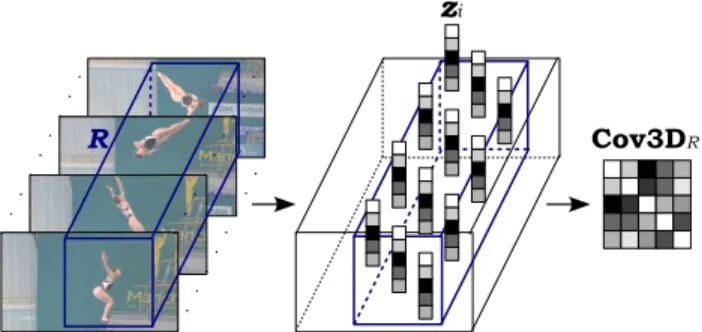
Figure 1.Conceptual demonstration for obtaining a Cov3D spatio-temporal covariance descriptor. A spatio-spatio-temporal windowRis defined inside the input video. For each pixel inRa feature vector
ziis calculated. The feature vectors are then used to compute the covariance matrixCov3DR.
2. Cov3D Descriptors
In this section we first present the general form of the proposed spatio-temporal covariance descriptors (Cov3D), an algorithm for their fast calculation, and finally how they can be specialised for action and gesture recognition. For convenience, we follow the notation in [29].
LetV be the sequence of images {It}Tt=1 andF be the
W×H×T×ddimensional feature video extracted fromV:
F(x, y, t) = Φ(V, x, y, t) (1)
where the function Φ can be any mapping such as inten-sity, colour, gradients, or optical flow. For a given spatio-temporal windowR⊂F, let{zi}S
i=1be thed-dimensional
feature vectors insideR. The regionRis represented with thed×dcovariance matrix of the feature vectors:
Cov3DR= 1 S−1 XS i=1(zi−µ)(zi−µ) T (2)
whereµis the mean of the points. Fig. 1 shows the con-struction of a covariance descriptor inside a spatio-temporal window. Examples of feature vectors specific for action and gesture recognition are given in Section 2.2.
Representing a spatio-temporal window with a covari-ance matrix has several advantages: (i) it is a low-dimensional representation which is independent on the size of the window,(ii)the impact of noisy samples is re-duced through the averaging during covariance computa-tion,(iii)it is a straightforward method of fusing correlated features.
2.1. Fast computation
Integral images are an intermediate image representation used for the fast calculation of region sums [30]. The con-cept has been extended to image sequences [10], where the integral images are stacked to form an integral video, and can be used to compute spatio-temporal region sums in con-stant time. For a videoV, its integral videoIV is defined as:
IV(x0, y0, t0) =X x≤x0 X y≤y0 X t≤t0V(x, y, t) (3)
Tuzelet al. [29] used the integral image representations for fast calculation of flat region covariances. Here we ex-tend the idea for fast calculation of covariance matrices in-side a spatio-temporal window using the integral video rep-resentation. The(i, j)-th element of the covariance matrix defined in (2) can be expressed as:
Cov3DR(i, j)= 1 S-1 " S X k=1 zk(i)zk(j)− 1 S S X k=1 zk(i) S X k=1 zk(j) # (4)
where zk(i) refers to the i-th element of thek-th vector.
To find the covariance in a given spatio-temporal window R, we have to compute the sum of each feature dimen-sion, z(i)d
i=1, as well as the sum of the multiplication of
any two feature dimensions, z(i)z(j)i,j=1...d. Withd
rep-resenting the number of dimensions, the covariance of any spatio-temporal window can be computed inO(d2)time, as
We need to compute a total ofd+d2integral videos. Let
P be theW×H×T×dtensor of the integral videos: P(x0, y0, t0, i) = X x≤x0 X y≤y0 X t≤t0 F(x, y, t)(i) (5)
whereF(x, y, t)(i) is thei-th element of vector F(x, y, t). Furthermore, letQbe theW×H×T ×d×dtensor of the second-order integral videos:
Q(x0, y0, t0, i, j) = X x≤x0 X y≤y0 X t≤t0 F(x, y, t)(i)·F(x, y, t)(j) (6)
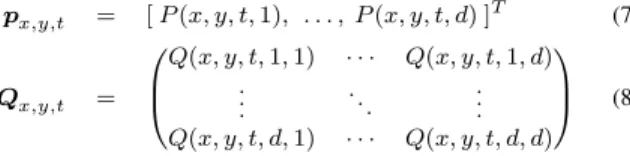
fori, j= 1, . . . , d. The complexity of calculating the tensors isO(d2W HT). Thed-dimensional feature vectorpx,y,tand
thed×ddimensional matrixQx,y,t can be obtained from
the above tensors using:
px,y,t = [P(x, y, t,1), . . . , P(x, y, t, d) ]T (7) Qx,y,t = 0 B @ Q(x, y, t,1,1) · · · Q(x, y, t,1, d) . . . . .. ... Q(x, y, t, d,1) · · · Q(x, y, t, d, d) 1 C A (8)
LetR(x1, y1, t1;x2, y2, t2)be the spatio-temporal window
of points {(x, y, t)|x1 ≤ x ≤ x2, y1 ≤ y ≤ y2, t1 ≤ t ≤ t2},
as shown in Fig. 2. The covariance of the spatio-temporal window bounded by(0,0,0)and(x, y, t)is:
Cov3DR(0,0,0;x,y,t)= 1 S−1 » Qx,y,t− 1 Spx,y,tp T x,y,t – (9)
whereS=x·y·t. Similarly, after a few rearrangements, the covariance of the regionR(x1, y1, t1;x2, y2, t2)can be
com-puted as: Cov3DR(x1,y1,t1;x2,y2,t2)= 1 S−1 h b Qx2,y2+Qbx1−1,y1−1−Qbx2,y1−1−Qbx1−1,y2 − 1 S ` b px2,y2+bpx1−1,y1−1−bpx2,y1−1−bpx1−1,y2 ´ ` b px2,y2+pbx1−1,y1−1−pbx2,y1−1−bpx1−1,y2 ´Ti (10) where b
px,y = px,y,t2−px,y,t1 (11)
b
Qx,y = Qx,y,t2−Qx,y,t1 (12)
andS= (x2−x1+ 1)·(y2−y1+ 1)·(t2−t1+ 1). (x1,y2,t2) (x1,y1,t2) (x2,y2,t2) (x2,y1,t2) (x1,y2,t1) (x1,y1,t1) (x2,y2,t1) (x2,y1,t1) R (0,0,0) (W,H,T)
Figure 2.Integral feature video. The spatio-temporal windowR
is bounded by(x1, y1, t1)and(x2, y2, t2). Each point inRis ad
dimensional vector, wheredis the number of features.
2.2. Features and regions
Commonly used features for action and gesture recogni-tion include intensity gradients and optical flow. Previous studies have shown the benefit of combining both types of features [4, 31]. We define the feature mappingΦ, present in (1), as the following combination of gradient and optical-flow based features, extracted from pixel location(x, y, t):
Φ(V, x, y, t) = [x y t g o]T (13) where g = » |Ix| |Iy| |Ixx| |Iyy| q I2 x+Iy2 arctan |Iy| |Ix| – (14) o = » u v ∂u ∂t ∂v ∂t „ ∂u ∂x+ ∂v ∂y « „ ∂v ∂x− ∂u ∂y « – (15)
The first four gradient based features in (14) represent the first and second order intensity gradients at pixel loca-tion(x, y). The last two gradient based features correspond to the gradient magnitude and gradient orientation. The optical-flow based features in (15) represent, in order: the horizontal and vertical components of the flow vector, the first order derivatives of the flow components with respect tot, and the spatial divergence and vorticity of the flow field as defined in [1]. Each descriptor is hence a15×15matrix,
asΦ(V, x, y, t)has15dimensions.
For reliable recognition, several regions (and hence sev-eral descriptors) are typically used. Fig. 3 shows the spatio-temporal windows of two descriptors which can be used for recognition of face expressions. With the defined mapping, the input videoV is mapped toF, a15-dimensional feature video. Since the cardinality of the set of spatio-temporal windows{R⊂F}is very large, we only consider windows of a minimum size and increment their location and size by a minimum interval value. Further specifics on the windows used in the experiments are given in Section 4.
Following [29], each covariance descriptorCov3DR, is
normalised with respect to the covariance descriptor of the region containing the full feature video, Cov3DF, to
im-prove the robustness against illumination variations: \
Cov3DR= diag(Cov3DF)
-1
2 Cov3DR diag(Cov3DF)-12 (16) wherediag(Cov3DF)is equal to Cov3DF at the diagonal
entries and the rest is set to zero.
Figure 3. Two examples of Cov3D windows that, together, can be useful for the recognition of face expressions.
3. Classification of Actions and Gestures
The Cov3D descriptors are symmetric positive definite matrices of sized×d, which can be formulated as a con-nected Riemannian manifold (Sym+d) [7]. In this section we first briefly overview Riemannian manifolds, followed by describing the proposed weighted Riemannian locality pre-serving projection (WRLPP) that allows mapping from Rie-mannian manifolds to Euclidean spaces. We then describe a classification algorithm that uses WRLPP.
3.1. Riemannian manifolds
A manifold can be considered as a continuous surface lying in a higher dimensional Euclidean space. Formally, a manifold is a topological space which is locally similar to an Euclidean space [29]. Intuitively, the tangent spaceTXis
the plane tangent to the surface of the manifold at pointX. A pointY on the manifold can be mapped to a vector in the tangent spaceTX using the logarithm map operator
logX. ForSym+d the logarithm map is defined as:
logX(Y) =X 1 2log “ X−12Y X−12 ” X12 (17) where log (·) is the matrix logarithm operator. Given the eigenvalue decomposition of a symmetric matrix, Σ=U DUT, the matrix logarithm can be computed via:
log(Σ) =Ulog(D)UT (18)
wherelog(D)is a diagonal matrix, with each diagonal el-ement equal to the logarithm of the corresponding elel-ement inD.
The minimum length curve connecting two points on the manifold is called the geodesic, and the distance between two points is given by the length of this curve. Geodesics are related to the tangents in the tangent space. ForSym+d, the distance between two points on the manifold can be found via:
d2(X,Y) = tracenlog2“X−12Y X−12
”o
(19)
3.2. Weighted RLPP
The usual approach for classification on manifolds is to first map the points into an appropriate Euclidean represen-tation [29] and then use traditional machine learning meth-ods. Points in the manifold can be mapped into a fixed tangent space (such as TI whereI is the identity matrix)
[6]. Since distances in the manifold are only locally pre-served in the tangent space, better results can be achieved by considering the tangent space at the Karcher mean, the point which minimises the distances among the samples, as shown in [29]. Improved results have been obtained by con-sidering multiple tangent spaces [19, 25]. A more complex approach involves using training data to create a mapping that tries to preserve the relations between points, such as the RLPP approach [8].
RLPP is based on Laplacian eigenmaps [2]. Given N training pointsX={X1,X2,· · ·,XN}from the underlying
Riemannian manifold M, the local geometrical structure of Mcan be modelled by building an adjacency graphG. The simplest form ofGis a binary graph obtained based on the nearest neighbour properties of Riemannian points: two nodes are connected by an edge if one node is among thek nearest neighbours of the other node. From the adjacency graphGwe can find the degree and Laplacian matrices, re-spectively:
D(i, i) = X
kG(i, k) (20)
L = D−G (21)
where the degree matrix D is a diagonal matrix of size N×N, with diagonal entries indicating the the number of edges of each node in the adjacency graph.
RLPP also uses a heat pseudo-kernel matrixK, with the
(i, j)-th element constructed via: K(i, j) =k(Xi,Xj) = exp −d(Xi,Xj) σ ff (22)
whered(·,·)is the geodesic distance defined in (19). The final mapping can be found through the following generalised eigenvalue problem [8]:
KLKTA=λKDKTA (23)
where the eigenvectors with thersmallest eigenvalues form the projection matrixA.
The number of possible Cov3D descriptors inside a sam-ple video is very large. As such, we elected to use boosting to search for a subset of the best descriptors for classifica-tion. We could use the original RLPP mapping approach to map the matrices as vectors at each boosting iteration. However, as shown in [29], the sample weights can be used to generate a mapping which is more appropriate for the critical training samples. Therefore, we propose a modified projection, specifically designed to be used during boosting, which uses sample weights to generate the final mapping. We refer to this approach as weighted Riemannian locality preserving projection (WRLPP).
In the modified projection, the adjacency graphGis re-placed with a weighted adjacency graphGb, defined as:
b
G=W GW (24)
where W is a diagonal matrix with diagonal values that correspond to the vector of sample weights[w1, w2, . . . , wN].
Using the weighted adjacency graph, edges involving crit-ical samples (ie. samples with higher weights) become more important and their geometrical structure is better preserved. The modified projection approach is detailed in Algorithm 1.
Once the the projection matrix Ahas been obtained, a given pointC (a Cov3D matrix) on the manifold can then be mapped to Euclidean space via:
WRLPP(C) =ATKC (25)
where KC= [k(X1,C), k(X2,C), · · ·, k(XN,C)]T, with
k(·,·)defined in (22), and{Xi}N
i=1representing the training
Algorithm 1 :obtaining weighted RLPP
Input:Training samples (covariance matrices), labels and weights {(Xi, yi, wi)}Ni=1,Xi∈ M
• Create Riemannian pseudo-kernel matrix:
K(i, j) = exp n −d(Xi,Xj) σ o using (19) asd(·,·)
• Construct weighted adjacency graph:
b G(i, j) =
8 < :
wi·wj ifyi=yjandXjis among the
knearest neighbours ofXiinK.
0 otherwise
• Obtain the weighted degreeN×Ndiagonal matrix: b
D(i, i) =P kGb(i, k)
• Calculate the weighted Laplacian matrix: b
L=Db −Gb
• The eigenvectors with thersmallest eigenvalues of the Rayleigh quotientKcDKT
KLbKT form the projection matrixA.
Output:Projection modelλ={A,{Xi}N i=1}
3.3. Classification
As mentioned in the preceding section, we have chosen to use boosting to find a subset of the best descriptors for classification, as the number of possible Cov3D descrip-tors inside a sample video is large. For simplicity, we used a combination of one-vs-one LogitBoost classifiers [5] to achieve multiclass classification.
We start with a brief description of binary LogitBoost classification, with class labelsyi∈ {0,1}. The probability
of samplexbelonging to class1is represented by:
p(x) = exp{F(x)}
exp{F(x)}+ exp{−F(x)} (26)
whereF(x) = 12PMm=1gm(x), withg(x)representing a weak
learner.
The LogitBoost algorithm learns a set ofMweak learn-ers by minimising the negative binomial log likelihood of the data. A weighted least squares regressiongm(x)of
train-ing pointsxi ∈Rdis fitted to response valueszi∈ R, with weightswi, where
wi=p(xi)(1−p(xi)) (27)
zi=
yi−p(xi)
p(xi)(1−p(xi)) (28)
As we are using Cov3D descriptors (covariance matri-ces) as input data, we adapt the weak learners gm(·) to
use the projected descriptors. In other words, gm(x)is
re-placed withgm(WRLPP(X)), withXrepresenting a
covari-ance matrix.
For every unique pair of classes, we train a one-vs-one LogitBoost classifier as follows. Only the samples belong-ing to the pair of classes are used for trainbelong-ing the binary classifier. One class is selected to be the positive class and the other as the negative class. For each boosting iteration, we search for the region whose Cov3D descriptor best sepa-rates positive from negative samples. The descriptor is cal-culated for all the training samples and mapped to vector
Algorithm 2 :Boosting with WRLPP
Input:Training videos with labels{(Vi, yi)}Ni=1belonging toNc classes
• For each unique pair of class labels< k, l >train the one-vs-one classifierC<k,l>
– Letkbe the positive class label and restrict the training set to {(Vj, yj)}j=1...N|yj∈{k,l}
– Let eitherkorlbe the positive labely<k,l>
– Create binary labelsy0
j←(yj=y<k,l>)
– Start withwj= 1/N,F(V) = 0,p(Vj) = 12,m= 1
– Repeat whilep(Vp)−p(Vn)< margin
∗ Compute the response values and weights
zj=
y0j−p(Vj)
p(Vj)(1−p(Vj)),wj=p(Vj)(1−p(Vj))
∗ For each spatio-temporal windowRs
· Construct the descriptorsXj,s=Cov\3Dj,Rs · From{(Xj,s, yj, wj)}Nj=1obtain the projection
modelW RLP Psusing Algorithm 1
· Map the data pointsxj,s=W RLP Ps(Xj,s) using (25)
· Fit functiongs(x)by weighted least-squares regression ofzjtoxj,susing weightswj
∗ UpdateF(V)←F(V) +12fm(V), wherefmis the best classifier among{fs}which minimises the negative binomial log-likelihood
−PNj=1[yj0log(p(xj)) + (1−yj0) log(1−p(xj))]
∗ Updatep(V)← eF(V) eF(V)+e−F(V)
∗ Sort positive and negative samples according to descending probabilities and find samples at the decision boundariesVp= (dr·Np)-thV+,Vn= (rr·Nn)-th
V−, wheredrandrrare the desired detection and false positive rejection rates
∗ m←m+ 1
– StoreC<k,l>={(Rm, W RLP Pm, gm)}Mm=1, threshold
τ<k,l>=F(Vn)and positive labely<k,l>
Output:A set ofNc(Nc−1)
2 one-vs-one classifiers
space with WRLPP, using the sample weights calculated for the current boosting iteration. Once in vector space, we fit a linear regression and use it as the weak LogitBoost classi-fier.
To prevent overfitting, the number of weak classifiers on each one-vs-one classifier is controlled by a probabil-ity margin between the last accepted positive and the last rejected negative. Both margin samples are determined by the target detection rate (dr) and the target false positive re-jection rate (rr). The final multiclass classifier is a set of one-vs-one classifiers. Each one-vs-one classifier C<k,l>,
wherekandlare the labels of its two classes, has a positive classy<k,l>and a thresholdτ<k,l>. The positive class is the
label of the class deemed to be positive and the threshold is found via boosting. Algorithm 2 summarises the training process.
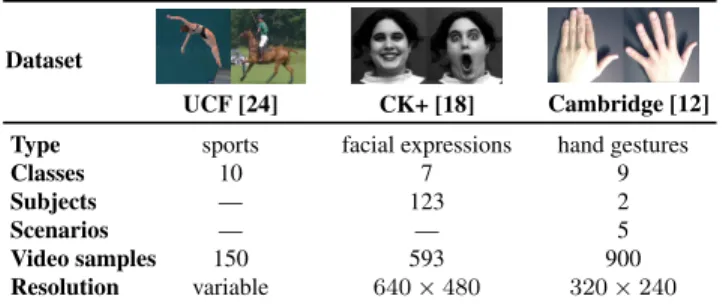
Dataset
UCF [24] CK+ [18] Cambridge [12] Type sports facial expressions hand gestures
Classes 10 7 9
Subjects — 123 2
Scenarios — — 5
Video samples 150 593 900
Resolution variable 640×480 320×240
Table 1.Overview of the datasets used in the experiments.
A sample videoV is classified as follows. Given a one-vs-one classifierC<k,l>, the probability of a sample video
V belonging to the positive classy<k,l>is evaluated using:
C<k,l>(V) = M X m=1 gm “ WRLPPm(Cov\3DRm) ” −τ<k,l> (29)
After evaluatingV with all the one-vs-one classifiers in the set, the sample is labelled as the class a which max-imises:
C(V) = arg max
a X
i6=aC<a,i>(V) signa(C<a,i>(V)) (30)
wheresigna(C<a,i>(V))issign(C<a,i>(V))ifais the positive
class y<a,i>, or 1−sign(C<a,i>(V))otherwise. In other
words, V is labelled as the class with greater probability sum, selecting all the one-vs-one classifiers that evaluate to that class.
4. Experiments
We compared the performance of the proposed algorithm against baseline approaches as well as several state-of-the-art methods. We used three benchmark datasets, with an overview of the datasets shown in Table 1.
In the following subsections, we first present an evalua-tion of several Riemannian to Euclidean space mapping ap-proaches, justifying the use of the weighted RLPP. We then follow with experiments showing the performance on sport actions, facial expressions and hand gestures.
Unless otherwise stated, no pre-processing was per-formed in the input sequences and all the recognition re-sults were obtained using 5-fold cross validation to divide the samples into training and testing sets.
In all cases we used the following parameters: 0.95 de-tection rate, 0.95 false positive rejection rate, 0.5 margin. Furthermore, since the search space of spatio-temporal win-dows is very large, we restricted the minimum size of the windows, as well as the minimum increment on location and size of the windows, to 1
8 of the frame size.
4.1. Comparison of mapping approaches
In Fig. 4, we compare the following six Riemannian to Euclidean space mapping (Sym+d 7→ R) approaches which can be used during boosting: (i)no mapping (ie., using a
0.02 0.04 0.1 0.2 0.4 1 0.002 0.004 0.01 0.02 0.04 0.1 0.2 0.4 1
false positives per window
miss rate Vector space Identity RLPP Weighted Mean 3−Tangent Spaces WRLPP
Figure 4.Performance comparison of variousSym+d 7→ R
map-ping approaches, used within the classifier framework described in Section 3.3.
vectorised representation of the upper-triangle of the co-variance matrix),(ii)projection to a fixed tangent space [6],
(iii) projection to the weighted Karcher mean of the sam-ples [29], (iv) projection using k-tangent spaces [25],
(v)mapping the points with the original RLPP method [8], and(vi)mapping the points with the proposed WRLPP ap-proach.
Since the mapping approach affects individual binary classifiers, we show results per classifier with detection er-ror trade-off curves. We chose the one-vs-one classifiers be-tween conflicting class pairs (where samples of one class are misclassified as the other class) on the Cambridge hand ges-ture recognition dataset (which is described in Section 4.4). Each point on the curve represents the average of all the chosen classifiers. The curves were obtained by varying the classification thresholdτin Algorithm 2.
With the exception of the original RLPP method, incre-mentally better results are obtained by using the mapping approaches in the mentioned order, as they provide increas-ingly better vector representations of the manifold space. Although RLPP is designed to provide a better representa-tion compared to tangent-based approaches, it appears not to be appropriate for boosting as it does not take into ac-count the sample weights of critical training points. The proposed WRLPP method addresses this problem, resulting in the best overall performance.
4.2. UCF sport dataset
The UCF sport action dataset [24] consists of ten cat-egories of human actions, containing videos with non-uniform backgrounds where both the camera and the subject might be moving. We use the regions of interest provided with the dataset.
We compared the Cov3D approach against the follow-ing methods: HOG3D [31], hierarchy of discriminative
Method Performance
HOG3D [31] 85.60% HDN [13] 87.27% AFMKL [32] 91.30%
Cov3D 93.91%
Table 2.Average recognition rate on the UCF dataset [24].
space-time neighbourhood features (HDN) [13], and aug-mented features in conjunction with multiple kernel
learn-ing (AFMKL) [32]. HOG3D is the extension of
his-togram of oriented gradient descriptor [15] to the spatio-temporal case. HDN learns shapes of space-time feature neighbourhoods that are most discriminative for a given action category. The idea is to form new features com-posed of the neighbourhoods around the interest points in a video. AFMKL exploits appearance distribution features and spatio-temporal context features in a learning scheme for action recognition. As shown in Table 2, the proposed Cov3D-based approach achieves the highest accuracy.
4.3. CK+ facial expression dataset
The extended Cohn-Kanade (CK+) facial expression database [18] contains 593 sequences from 123 subjects. We used the sequences with validated emotion labels, among 7 possible emotions. The image sequences vary in duration (i.e. 10 to 60 frames) and incorporate the onset (which is also the neutral frame) to peak formation of the facial expressions.
We compared the Cov3D approach against active appear-ance models (AAM), constrained local models (CLM) [3], and temporal modelling of shapes (TMS) [9]. AAM is the baseline approach included with the dataset. It uses ac-tive appearance models to track the faces and extract the features, and then uses support vector machines (SVM) to classify the facial expressions. The CLM approach is an improvement on AAM, designed for better generalisa-tion to unseen objects. The TMS approach uses latent-dynamic conditional random fields to model temporal vari-ations within shapes.
We show the performance per emotion in Table 3, in line with existing literature. The proposed Cov3D approach achieves the highest average recognition accuracy of92.3%
(averaged over the 7 classes). The next best method (TMS) obtained an average accuracy of87.92%.
4.4. Cambridge hand gesture dataset
The Cambridge hand-gesture dataset [12] consists of 900 image sequences of 9 gesture classes. Each class has 100 image sequences performed by 2 subjects, captured under 5 illuminations and 10 arbitrary motions. The 9 classes are defined by three primitive hand shapes and three primitive motions. Each sequence was recorded with a fixed
cam-Method angry contempt disgust fear happy sadness sur prise
AAM [18] 75.0 84.4 94.7 65.2 100 68.0 96.0 CLM [3] 70.1 52.4 92.5 72.1 94.2 45.9 93.6 TMS [9] 76.7 — 81.5 94.4 98.6 77.2 99.1
Cov3D 94.4 100 95.5 90.0 96.2 70.0 100
Table 3.Recognition rate (in %) on the CK+ dataset [18].
Method Set1 Set2 Set3 Set4 Overall
TCCA [12] 81% 81% 78% 86% 82% (±3.5) PM [20] 89% 86% 89% 87% 88% (±2.1) TB [19] 93% 88% 90% 91% 91% (±2.4)
Cov3D 92% 94% 94% 93% 93% (±1.1)
Table 4.Average recognition rate on the Cambridge dataset [12].
era having roughly isolated gestures in space and time. We followed the test protocol defined in [12]. Sequences with normal illumination were considered for training while tests were performed on the remaining sequences.
The proposed method was compared against tensor canonical correlation analysis (TCCA) [12], product mani-folds (PM) [20] and tangent bundles (TB) [19]. TCCA is the extension of canonical correlation analysis to multiway data arrays or tensors. Canonical correlation analysis and princi-pal angles are standard methods for measuring the similarity between subspaces. In the PM method a tensor is charac-terised as a point on a product manifold and classification is performed on this space. The product manifold is created by applying a modified high order singular value decompo-sition on the tensors and interpreting each factorised space as a Grassmann manifold. In the TB method, video data is represented as a third order tensor and factorised using high order singular value decomposition, where each factor is projected onto a tangent space and the intrinsic distance is computed from a tangent bundle for action classification. We report the recognition rates for the four test sets in Table 4, where the proposed Cov3D-based approach obtains the highest performance.
5. Conclusion
In this paper, we first extended the flat covariance scriptors proposed in [29] to spatio-temporal covariance de-scriptors termed Cov3D, and then showed how they can be computed quickly through the use of integral video repre-sentations.
The proposed Cov3D descriptors belong to the group of symmetric positive definite matrices, which can be formu-lated as a connected Riemannian manifold. Prior to classi-fication, points on a manifold are generally mapped to an Euclidean space, through a technique such as Riemannian locality preserving projection (RLPP) [8].
The Cov3D descriptors are extracted from spatio-temporal windows inside sample videos, with the number of possible windows being very large. We used a boosting ap-proach to find a subset which is the most useful for classifi-cation. In order to take into account the weights of the traing samples, we further proposed to extend RLPP by in-corporating weighting during the projection. The weighted projection (termed WRLPP) leads to a better representa-tion of the neighbourhoods around the most critical training samples during each boosting iteration.
Combining the proposed Cov3D descriptors with the classification approach based on WRLPP boosting leads to a state-of-the-art method for action and gesture recognition. The proposed Cov3D-based method performs better than several recent approaches on three benchmark datasets for action and gesture recognition. The method is robust and does not require additional processing of the videos, such as foreground detection, interest-point detection or track-ing. To our knowledge, this is the first approach proving to be equally suitable (ie.,> 90% recognition accuracy) for both action and gesture recognition.
Further avenues of research include adapting the method for related tasks, such as anomaly detection in surveillance videos [23], where there is often a shortage of positive ex-amples.
References
[1] S. Ali and M. Shah. Human action recognition in videos using kine-matic features and multiple instance learning. IEEE Trans. Pattern Analysis and Machine Intelligence, 32(2):288–303, 2010.
[2] M. Belkin and P. Niyogi. Laplacian eigenmaps for dimensionality reduction and data representation.Neural Computation, 15(6):1373– 1396, 2003.
[3] S. Chew, P. Lucey, S. Lucey, J. Saragih, J. Cohn, and S. Sridharan. Person-independent facial expression detection using constrained lo-cal models. InIEEE International Conference on Automatic Face Gesture Recognition and Workshops, pages 915–920, 2011. [4] P. Dollar, V. Rabaud, G. Cottrell, and S. Belongie. Behavior
recogni-tion via sparse spatio-temporal features. InIEEE International Work-shop on Visual Surveillance and Performance Evaluation of Tracking and Surveillance, pages 65–72, 2005.
[5] J. Friedman, T. Hastie, and R. Tibshirani. Additive logistic regres-sion: a statistical view of boosting.Annals of Statistics, 28(2):337– 407, 2000.
[6] K. Guo, P. Ishwar, and J. Konrad. Action recognition using sparse representation on covariance manifolds of optical flow. InIEEE Int. Conf. Advanced Video and Signal Based Surveillance (AVSS), pages 188–195, 2010.
[7] M. T. Harandi, C. Sanderson, R. Hartley, and B. C. Lovell. Sparse coding and dictionary learning for symmetric positive definite matrices: A kernel approach. In ECCV 2012, Lecture Notes in Computer Science (LNCS), Vol. 7573, pages 216–229, 2012. [8] M. T. Harandi, C. Sanderson, A. Wiliem, and B. C. Lovell. Kernel
analysis over Riemannian manifolds for visual recognition of actions, pedestrians and textures. InIEEE Workshop on the Applications of Computer Vision, pages 433–439, 2012.
[9] S. Jain, C. Hu, and J. Aggarwal. Facial expression recognition with temporal modeling of shapes. InIEEE Int. Conf. Computer Vision Workshops, pages 1642–1649, 2011.
[10] Y. Ke, R. Sukthankar, and M. Hebert. Efficient visual event detec-tion using volumetric features. InIEEE Int. Conf. Computer Vision, volume 1, pages 166–173, 2005.
[11] V. Kellokumpu, G. Zhao, and M. Pietikainen. Human activity recog-nition using a dynamic texture based method. InBritish Machine Vision Conference, 2008.
[12] T.-K. Kim and R. Cipolla. Canonical correlation analysis of video volume tensors for action categorization and detection.IEEE Trans. Pattern Analysis and Machine Intelligence, 31(8):1415–1428, 2009. [13] A. Kovashka and K. Grauman. Learning a hierarchy of discrimi-native space-time neighborhood features for human action recogni-tion. InIEEE Conf. Computer Vision and Pattern Recognition, pages 2046–2053, 2010.
[14] I. Laptev and T. Lindeberg. Space-time interest points. InIEEE Int. Conf. Computer Vision, volume 1, pages 432–439, 2003.
[15] I. Laptev, M. Marszalek, C. Schmid, and B. Rozenfeld. Learning realistic human actions from movies. InIEEE Conf. Computer Vision and Pattern Recognition, pages 1–8, 2008.
[16] T. Lin and H. Zha. Riemannian manifold learning. IEEE Trans. Pattern Analysis and Machine Intelligence, 30(5):796–809, 2008. [17] D. G. Lowe. Distinctive image features from scale-invariant
key-points.Int. J. Computer Vision, 60(2):91–110, 2004.
[18] P. Lucey, J. Cohn, T. Kanade, J. Saragih, Z. Ambadar, and I. Matthews. The extended Cohn-Kanade dataset (CK+): A com-plete dataset for action unit and emotion-specified expression. In
Computer Vision and Pattern Recognition Workshops, pages 94–101, 2010.
[19] Y. Lui. Tangent bundles on special manifolds for action recognition.
IEEE Trans. Circuits and Systems for Video Technology, 22(6):930– 942, 2012.
[20] Y. M. Lui, J. Beveridge, and M. Kirby. Action classification on prod-uct manifolds. InIEEE Conf. Computer Vision and Pattern Recogni-tion, pages 833–839, 2010.
[21] J. Niebles, H. Wang, and L. Fei-Fei. Unsupervised learning of hu-man action categories using spatial-temporal words.Int. J. Computer Vision, 79(3):299–318, 2008.
[22] R. Poppe. A survey on vision-based human action recognition.Image and Vision Computing, 28(6):976–990, 2010.
[23] V. Reddy, C. Sanderson, and B. C. Lovell. Improved anomaly detection in crowded scenes via cell-based analysis of foreground speed, size and texture. InComputer Vision and Pattern Recognition Workshops (CVPRW), pages 55–61, 2011.
[24] M. Rodriguez, J. Ahmed, and M. Shah. Action MACH a spatio-temporal maximum average correlation height filter for action recog-nition. InIEEE Conf. Computer Vision and Pattern Recognition, pages 1–8, 2008.
[25] A. Sanin, C. Sanderson, M. T. Harandi, and B. C. Lovell. K-tangent spaces on Riemannian manifolds for improved pedestrian detection. InIEEE Int. Conf. Image Procesing, 2012.
[26] P. Scovanner, S. Ali, and M. Shah. A 3-dimensional SIFT descriptor and its application to action recognition. InInternational Conference on Multimedia, pages 357–360, 2007.
[27] C. Thurau and V. Hlavac. Pose primitive based human action recog-nition in videos or still images. InIEEE Conf. Computer Vision and Pattern Recognition, pages 1–8, 2008.
[28] P. Turaga, R. Chellappa, V. Subrahmanian, and O. Udrea. Machine recognition of human activities: a survey.IEEE Trans. Circuits and Systems for Video Technology, 18(11):1473–1488, 2008.
[29] O. Tuzel, F. Porikli, and P. Meer. Pedestrian detection via classifi-cation on Riemannian manifolds.IEEE Trans. Pattern Analysis and Machine Intelligence, 30(10):1713–1727, 2008.
[30] P. Viola and M. Jones. Rapid object detection using a boosted cas-cade of simple features. InIEEE Conf. Computer Vision and Pattern Recognition, volume 1, pages 511–518, 2001.
[31] H. Wang, M. M. Ullah, A. Klaser, I. Laptev, and C. Schmid. Eval-uation of local spatio-temporal features for action recognition. In
British Machine Vision Conference, 2009.
[32] X. Wu, D. Xu, L. Duan, and J. Luo. Action recognition using context and appearance distribution features. InIEEE Conf. Computer Vision and Pattern Recognition, pages 489–496, 2011.
![Table 2. Average recognition rate on the UCF dataset [24].](https://thumb-us.123doks.com/thumbv2/123dok_us/9013846.2799212/7.918.464.825.111.230/table-average-recognition-rate-ucf-dataset.webp)
