R E S E A R C H A R T I C L E
Open Access
Polymers containing phosphorus groups and
polyethers: from synthesis to application
Smaranda Iliescu
1, Leire Zubizarreta
2, Nicoleta Plesu
1, Lavinia Macarie
1, Adriana Popa
1and Gheorghe Ilia
1*Abstract
Background:Phosphorus-containing high performance polymers have aroused wide interest, mainly due to good mechanical properties and their excellent fire resistance. The flexibility of synthetic polyphosphoesters allows the development of polymers in order to obtain solid polymer electrolytes for rechargeable lithium batteries based on solid films with superior fire resistance.
Results:Novel linear Phosphonate-PEG polymers were synthesized by solution polycondensation of
4-chlorophenyldichlorophosphonate as a linking agent and poly(ethylene glycol)s with different molecular weights in the presence of triethylamine or 1-methylimidazole as acid scavenger. The yields were between 54% and 88% and inherent viscosity between 0.18-0.48 dl/g. Molar masses, Mn were about 26300 g/mol for polyphosphonates with PEG 2000 and 4600 g/mol for polyphosphonates with PEG 200. The LOI values for these polymers and membranes are in the range of 26–29. The membranes based on polyphosphonate with PEG 200 and 2000 showed conductivity between 6 × 10⁻⁸S.cm-1and 6 × 10⁻⁷S.cm-1at room temperature and total ionic transference number between 0.87- 0.96. The evolution of conductivity vs. temperature is linear.
Conclusions:1-methylimidazole was found to be better HCl scavenger than triethylamine, and allowed higher yields and more eco-friendly synthesis of the Phosphonate-PEG polymers for SPE. These polymers and membranes based on these polymers showed good LOI values and indicate an improvement of the safety of lithium batteries. The membranes present conductivities around 6 × 10⁻⁷S.cm-1at room temperature and total ionic transference number is higher for membranes based on polymers with high EG unit content. Best results yield 88%, inherent viscosities 0.48 dl/g and Mn 26000 were obtained with 1-methylimidazole and PEG 2000. These membranes based on these polymers showed good LOI values (in the range 26-29%) and indicate an improvement of the safety of lithium batteries.
Keywords:Phosphonate-PEG polymers, 1-methylimidazole, Acid scavenger, Solid polymer electrolyte, Limiting oxygen index
Background
Polymers containing phosphorus in the backbone have been intensely studied during the last years. They have aroused wide interest, mainly due to their excellent fire resistance and good mechanical properties [1-3]. Poly-phosphoesters can also form another interesting class of phosphorus containing polymers which were developed as biomaterials [4].
The synthetic flexibility of polyphosphoesters allows the development of copolymers with poly(ethylene glycol),
poly (ethylene oxide), poly(propylene oxide) etc. in order to obtain solid polymer electrolytes. Interest in the devel-opment of rechargeable lithium batteries based on solid polymer films as electrolytes has increased in recent years. Lithium batteries are an important power source for small electronic technologies because of desirable characteristics including high-energy density, low weight, and excellent cycle performance [5,6].
The battery is constructed as: cathode, electrolyte and anode. There are three basic categories of electrolyte materials for lithium batteries: liquid, including organic solvent-based electrolytes; inorganic solvent-based electro-lytes; and molten salts (low temperature = ionic liquids); * Correspondence:[email protected]
1
Institute of Chemistry, Romanian Academy, 24 Mihai Viteazul Bvd, Timisoara 300223, Romania
Full list of author information is available at the end of the article
solid: solid polymer, ceramic, gel, and glassy electrolytes; composites [7].
Besides, Solid polymer electrolytes (SPE) are promising materials for electrochemical device applications, namely, high energy density rechargeable batteries, fuel cells, supercapacitors, electrochromic displays etc. [8].
Solid polymer electrolytes must exhibit high ionic con-ductivity of about 10-3Scm-1at ambient temperature and good mechanical strength. They should also possess wide electrochemical stability, typically between 0–4.5V for sin-gle cell and good compatibility with high voltage cathodes such as LiCoO2, LiNiO2, and low voltage anodes such as
lithium, Li-graphite, Li-Sn. For solid polymer electrolytes the main disadvantage, limiting their further development, is related to their very low conductivity at room (ambient) temperature - usually below 10-5S cm-1- and low lithium transference number (usually, in 0.2-0.3 range) [9].
Solid polymer electrolytes have been extensively stud-ied in the past three decades since the pioneering studies of materials based on the complexes of poly(ethylene oxide) (PEO) with alkali metal salts were reported by Peter V.Wright and M.B. Armand [10,11]. They have shown that poly(ethyleneoxide) (PEO) (CH2CH2O)n can
act as a host for sodium and potassium salts, thus produ-cing a solid electrical conductor polymer/salt complex.
An important class of solid polymer electrolytes is based on poly(alkyelne glycols). Poly(ethyleneglycol) (PEG) with the chemical formula H(−O––CH2–CH2)n–
OH, has the same monomeric unit as PEO but has an end hydroxyl group. Poly(ethylene glycol) has high sol-vating ability for inorganic salts and shows homogeneous solution mixing because of interactions with polar ether groups and coordination with dissociated cations. Solid polymer electrolytes consisting of PEG of molecular weight 2000 and LiClO4were prepared [12]. (PEG)xLiClO4shows
ionic conductivity of 7.27 × 10⁻⁷S.cm-1and a high value of ionic conductivity ~ 10–4S.cm-1at a temperature close to the melting point.
Several another polymers have been used for the purpose of designing new solid polymer electrolytes that include poly(siloxanes), poly(phosphazenes), poly(vinylpyrrolidine), poly(acrylates), poly(ethylenesuccinate), poly(vinylalcohol), poly(ethyleneimine), poly(alkylenesulphides) etc. [13].
Improvement of solid polymer electrolytes conductivity can be achieved by the modification of polymer architec-ture and by using additives. Flame retardancy in lithium batteries is also a major challenge for battery manufac-turers. Especially under abusive conditions, full size batter-ies may undergo thermal runaway that generates a sharp rise in temperature, with potential for explosion and/or fire. Fire-retardant polymer electrolytes are key materials for safer operation of lithium batteries. Solid polymer elec-trolytes systems with fire-retardant polymer matrixes have been investigated in only few cases. One critical approach
to improve the safety of lithium batteries is to enhance the thermal stability of materials for batteries. Organic phosphorus-based compounds are usually used as flame retarding components in electrolytes for lithium batteries. For example, alkyl phosphates such as trimethyl phosphate and triethyl phosphate; phosphazenes such as hexamethyl phosphazene; compounds with phosphorus substituents were used [14-17]. Novel safe and non-flammable phos-phorus-based electrolytes composed of phosphate as a linking agent with poly(ethylene glycol) were synthesized [18-21]. In our earlier papers we have reported the possibi-lity of obtaining phosphorus containing polymers, respect-ively polyphosphonates and polyphosphates by interfacial polycondensation in liquid-liquid system [22], gas–liquid system [23,24] and inverse phase transfer catalysis [25].
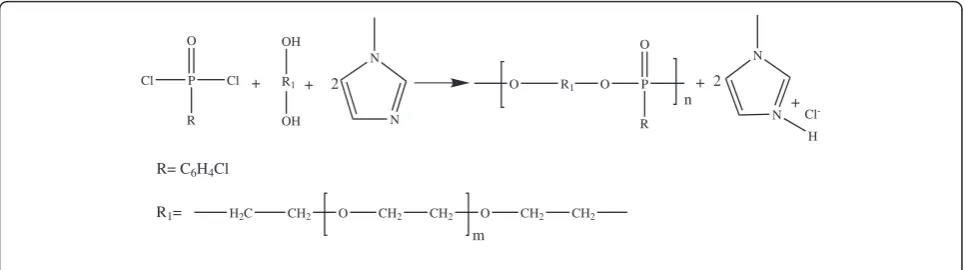
In this paper, novel linear Phosphonate-PEG polymers composed of phosphonate (4-chlorophenyldichloropho-sphonate) as a linking agent with poly(ethylene glycol) (PEG) with different molecular weights (MW of 200 and 2000) as soft segment increasing chain flexibility) were synthesized to increase segmental motion to aid the ion transport and ionic conductivity at ambient temperatures (Scheme 1).
In order to improve the parameters of process, in-crease the yield and reduce the corrosion during the synthesis of the Phosphonate-PEG polymers for SPE, 1-methylimidazole as an acid scavenger was used.
Recently, efforts have been made to perform reactions in greener or more environmentally acceptable media. For providing a minimum of mixing and heat transfer of the exothermal reaction, 1,3-dioxolane was added as green solvent in this synthesis [26].
Triethylamine (TEA) was usually used as scavenger of HCl [27]. Scavenging with a tertiary amine, a thick, non-stirrable slurry results, and low yields were obtained.
Recently, BASF developed an elegant process called BASIL (Biphasic Acid Scavenging using Ionic Liquids) using 1-methylimidazole as HCl scavenger [28,29].N -Me-thyl imidazole was used as a catalyst in the synthesis of aromatic polyphosphonates [30,31].
The polymers were characterized by IR, 1H and
31
P-NMR, and molecular weights were determined by gel permeation chromatography. The properties of the poly-mers such as thermal stability and flammability have also been investigated. The phosphonate-PEG polymers which were obtained as solid materials were complexed with lithium triflate and investigated if these copolymers can show potentially applications for electrochemical device. Ionic conductivity and transference number, flammability and elasticity tests for membranes were investigated.
Results and discussion
(MW of 200 and 2000) in the presence of TEA or 1-methylimidazole, as HCl scavenger (Scheme 1). HCl is formed during the synthesis of polymers. Hydrochloric acid has to be removed to prevent decomposition of the polymer product. Normally, tertiary amines such as triethylamine are used to scavenge the acids, but these bases form solid salts when they react with acids, and the reaction mixture becomes a suspension. They usually make the reaction mixture more viscous, leading to in-sufficient mixing of the reagents. These salts can be removed by using an aqueous extraction phase. The slurry causes poor mixing, which leads to poor heat transfer, i.e., hot spots, and difficulty controlling the reaction. The mentioned problems significantly lower the yield and capacity of the process. In order to provide a minimum of mixing and heat transfer of the exothermal reaction usually a solvent has to be added (1,3-dioxolane). 1,3- dioxolane has successfully green applications due to its strong solvency, low odor, superior toxicological profile, and improved safety in handling.
Using 1-methylimidazole as acid scavenger, an ionic liquid is formed:1-methyl-imidazolium chloride, which has a melting point of about 75°C (Scheme 2).
The products can be easily recovered by a simple layer separation, where the upper phase mainly contains the polymer product and the lower layer mostly consists of 1-methylimidazolium chloride (ionic liquid), which could
be converted to 1-methylimidazole by treating with NaOH aqueous solution at a room temperature.
Table 1 shows the effect of acid acceptor on the yield and inherent viscosity of the phosphonate-PEG polymers P1-P4.
The inherent viscosities of all polymers were in the range 0.18-0.48 dl/ g. The yield of the process decreases in the case of TEA and results indicate that the polycon-densation system requires 1-methylimidazole as acid scavenger instead of TEA.
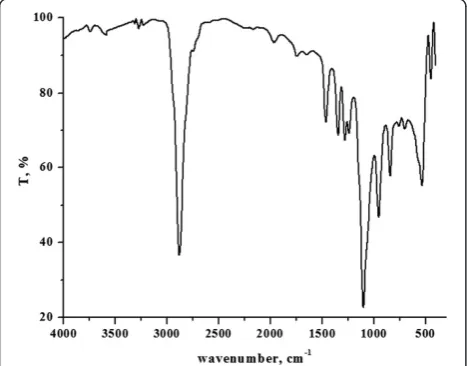
The chemical structure of polymers was authenticated by %P, IR and1H-NMR analysis. IR,1H-NMR, 31P-NMR, Molecular weight and distribution, thermogravimetric data for polymer P4 are shown in Figures 1, 2, 3, 4 and 5.
Polymeric structure was supported by P-O-Caliphpeaks
at 1090–1120 cm-1
and 840 cm-1, respectively. The dis-appearance of the phosphonate (P-OH) stretching band at 3500–3200 cm-1
indicates that the polymer is indeed a polyphosphonate. Absorptions arising from aliphatic C-H in PEG and P=O stretching of PPD (or CPPD) occur in the region of 2800 cm-1and 1240 cm-1, respectively. The resonance of the phenyl group falls in the range 7.0-7.9 ppm [32,33].Chemical shifts of the -CH2-O-CH2- group
were observed at the positions of 3.5-3.7 ppm [34,35]. The presence of phosphorus is confirmed by elemental analysis and31P-NMR spectrum. The %P content of the-ses polymers is in agreement with the calculated values.
P O
Cl Cl
R
OH
R1
OH
O R1 O P
O
R n
R= C6H4Cl
N N
N N
+ + +
H +
Cl
-2 2
R1= H2C CH2 O CH2 CH2 O CH2 CH2
m
Scheme 21-Methylimidazole as acid scavenger.
P
O
Cl Cl
Cl
+ HO
O
H P
O O
O P
O
O
Cl
Cl
n n
O
-HCl
The 31P-NMR spectra of all polymers present two sig-nals: one corresponds to the P in the repeat unit and other one to the P at the end chain, and confirm suc-cessful incorporation of phosphorus in the polymer backbone [36,37].
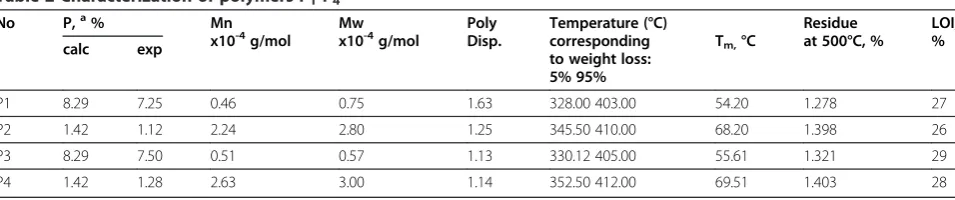
The thermal stability of the polymers P1-P4 was evalu-ated by the thermogravimetric analysis and flame retard-ancy by Limiting Oxigen Index (LOI) (Table 2).
From the TG data of PEG 2000, a rapid mass loss process beginning at about 345°C and completed at about 420°C can be noticed. This process corresponds to the cleavage of PEG backbone.
For polymers obtained from PEG 200, the rapid mass loss process begins at 328°C and is completed at about 403°C for P1 and for P3 begins at 330.12°C and is com-pleted at 405°C. For polymers obtained from PEG 2000, P2 and P4, the rapid mass loss process begins at 345.5°C and 352.50°C and is completed at about 410°C and 412°C. The mass loss was about 95% for all samples untill 420°C. The residual mass at 500°C was for all samples higher than for PEG 2000 (1.181%). The decrease of rapid mass loss process comparatively with PEG and an increase of resi-due at 500°C is an indication of polymer formation. The temperature corresponding to 5% weight loss indicates the temperature until polymer is considered to be stable.
These temperatures are higher in the case of polymers P2 and P4 than for P1 and respectively P3. An increase of (EG) units in polyphosphonate improves polymer thermal stability. A melting process was observed on DSC curves for all samples. The melting temperature (Tm) values for the synthesized polymers determined from DSC are higher than the PEG used (−38°C for PEG-200 and 49.52°C for PEG-2000, values available from Merck product data sheet).
The molecular weights and polydispersity for the poly-mers P1-P4 are presented in Table 2. Higher molecular weights were obtained for polymers synthesized by poly-condensation of CPPD with PEG 2000 (Figure 5). Also, it was noticed that using TEA as acid scavenger the polymers are obtained with an increase polydispersity, most likely due to the low heat transfer during polycondensation.
Synthesized compounds were tested as flame retar-dants using LOI method. These polymers show LOI values in the range 26–29, comparable with other poly-phosphonates and polyphosphates [38].
Based on the polymer P3 and P4 obtained by method b with MeI as acid scavenger, different membranes with variable lithium salts contents were prepared. The mem-branes with higher salt concentration (20%) are opaque, smoother but brittle on the margins. The membranes with lower salt concentration (5%) are transparent and harder. The membranes with middle salt concentration (10-15%) are semi-transparent and softer. These interest-ing tendencies in physical properties of the membranes are the consequence of the decrease in flexibility of chains due to an increase in intramolecular and intermo-lecular coordination between active sites of the polymer chains. The complexation of polymers with lithium salts allowed the ions to act as transitory cross links [39]. Also, the surface of the membrane containing high salt concentration is less smooth compared with the low and middle salt concentration membranes.
The thermal stability of the membranes based on the polymers P3 and P4, flame retardancy, conductivity and ion transference number were investigated. The obtained results are presented in Table 3.
The complexation of polymers with lithium salt affects the melting temperature, Tm, of the membrane. Com-paratively with parent polymers P3 and P4, lower lithium salt concentration in membranes induces a decrease of Tm with ~1-2°C and higher salt concentration induces a decrease with ~3°C- 7°C. This behavior is attributed to the process of the inhibition of crystallization by the presence of the salt (practically a reduction in crystalline fraction). Even at lower salt concentration a decrease of Tm takes place due to the intercalation of lithium ions and decrease in polymer–polymer interaction.
The LOI values for membrane lies in the range closely to the parent polymers P3 and P4. The presence of the
Table 1 Effect of acid acceptor on the preparation of polyphosphonates P1-P4
Polymera Acid acceptor Yield, %
ηinhb , dl/g
P1 TEA 54 0.18
P2 TEA 65 0.35
P3 MeI 75 0.24
P4 MeI 88 0.48
a.
P1-P4: see Procedure.
b
measured at a concentration of 0.5 g/dl in tetrachloroethane, at 30°C.
phosphonate group reduces flammability both of the parent polymers and membranes based on them.
In order to evaluate if the polymers P3 and P4 can be used as polymer electrolyte for SPE, the ionic conductiv-ity at different temperatures and ion transference num-ber were determined. The ionic conductivity (σ) value was calculated at room temperature according to Eq. (2), from the intercept of the curve with real axis and the total ionic transference number was calculated from plots of the polarization current versus time with the Eq. (3). The Bode plots for P4-10/Li at Open Circuit Potential (OCP), V, and the evolution of polarization current as a function of time, after the application of a direct current (DC) potential (1.5 V) across the SS/P4-10/Li /SS cell is presented in Figures 6 and 7.
The difference between the membranes lies in the structure of polymer (P3 or P4) and in the salt content. The data indicate that the polymer with a greater
amount of EG unit (P4) facilitates the ion transport showing higher ionic conductivity. At the same salt content, the highest conductivity was obtained for mem-brane based on P4. Also, the conductivity increases with the lithium salt content from 5 to 10% at room temperature and decreases with the increase of lithium salt content from 10 to 20%. The decrease of conductivity was attributed to the decrease of the available number of charge carriers due to ion aggregation. The P4-10/Li membrane presents the highest conductivity of 6.27 × 10⁻⁷ S.cm-1. This value is higher than the conductivity observed for pure PEG 2000, of 1.67 × 10⁻⁹S.cm-1 and close to 7.27 × 10⁻⁷S.cm-1 for (PEG)xLiClO4system [12].
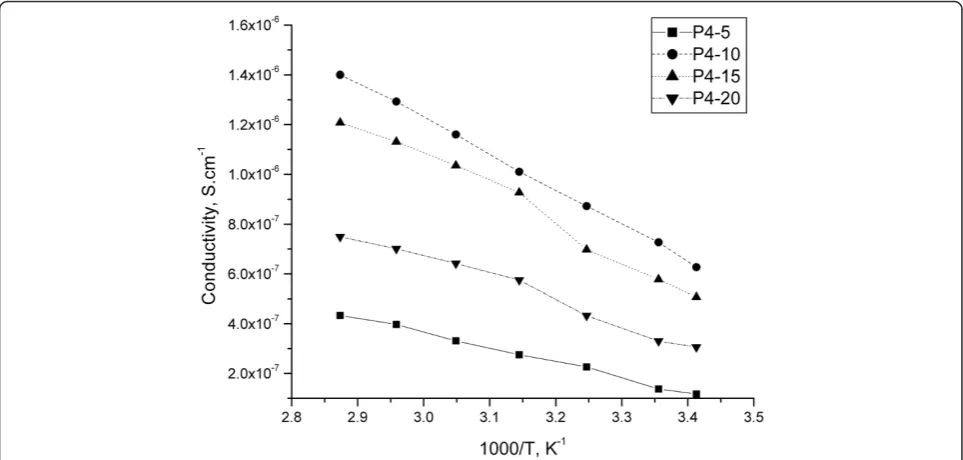
The conductivity of all membranes increases with the increase of the temperature. This tendency leads to the increase of ions and chains mobility. The polymer can expand easily when the temperature increases, the free volume increase and polymer segments can be without Figure 21H-NMR spectrum of polyphosphonate P4.
difficulty in motion. Practically, these enhance in mobility can compensate the retarding effect of the ion clouds.
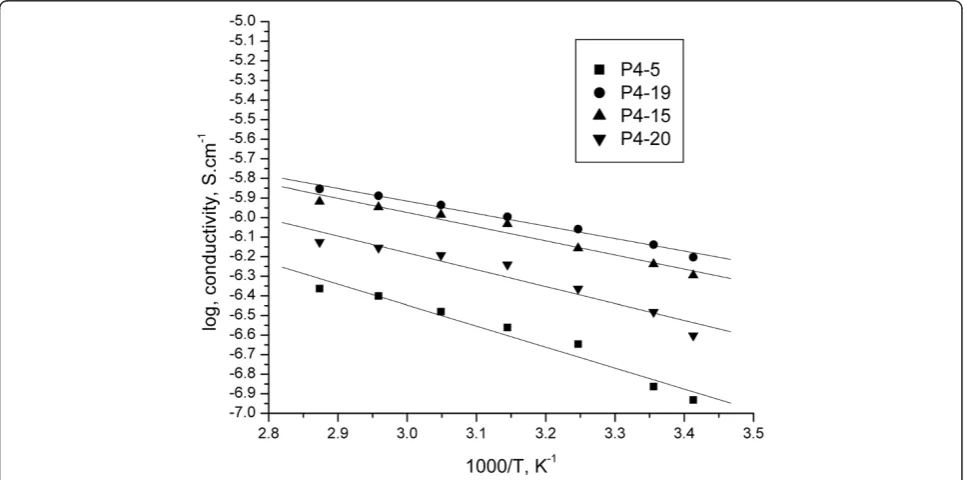
The variation of the conductivity vs. temperature islinear, which is characteristic for a thermally activated process (Figure 8 and 9). It was observed only a slightly modifica-tion of the slope around Tm for P3-5/Li and P4-15/Li, due the melting of the crystalline phase, which usually improves the dynamic properties of the polymer electrolytes with an enhancement in the ion conduction [19].
The activation energy Ea values were calculated from the linear segment of all plots using the equation (1):
σð Þ ¼T σ0exp kTEa
ð1Þ
Wereσ0represents the pre-exponential factor in S.cm-1; Ea is the activation energy in eV,; k is the Boltzmann constant.
The activation energy, Ea can be calculated from the slope and the pre-exponential factor can be obtained from the intercept with the vertical axis.
The conductivity plotted in Arrhenius coordinates is pre-sented in Figure 10 and 11 (log conductivity vs. 1000/T), all samples fits well the Arrhenius equation.
The pre-exponential factor and activation energy Ea calculated from the linear segment of all membranes are presented in Table 4.
The regression values R are close to unity and, therefore, the dependence of ionic conductivity on temperature, for all the complexes, obeys Arrhenius law (R2 lies between 0.965 and 0.993) indicating a thermally assisted conducti-vity mechanism.
The conductivity of polymer electrolytes is affected by the number of charge carriers and their mobility [40]. The low activation energy values were obtained for membranes with higher amount of EG unit (P4). The low activation energy value obtained for P4 membranes indicates that
Table 2 Characterization of polymers P1-P4
No P,a% Mn
x10-4g/mol
Mw x10-4g/mol
Poly Disp.
Temperature (°C) corresponding to weight loss: 5% 95%
Tm,°C
Residue at 500°C, %
LOI, %
calc exp
P1 8.29 7.25 0.46 0.75 1.63 328.00 403.00 54.20 1.278 27
P2 1.42 1.12 2.24 2.80 1.25 345.50 410.00 68.20 1.398 26
P3 8.29 7.50 0.51 0.57 1.13 330.12 405.00 55.61 1.321 29
P4 1.42 1.28 2.63 3.00 1.14 352.50 412.00 69.51 1.403 28
a
determined by Schöniger method.
the ion transport is possible by the lower energy barrier to the ions transport in this copolymer matrix.
The structure of the P4 polymer is capable to reduce the apparent activation energy for ion transport and also to increase the local free volume of the matrix. The acti-vation energy depends on salt content which is the source of charge carriers in the polymer electrolyte (the decrease activation energy is due to the increase number of charge carriers in the polymer electrolyte). It was observed a decrease of activation energy with the increase of salt content till 10% and at higher salt concentration an increase of activation energy. This is a consequence of two factors: the first is the number of charge carriers and second is the tendency to aggregate. Practically, the in-crease in number of charge carriers with the inin-crease of salt content can be overcome by the effect of the ion clouds.
At high salt concentration in membrane the salt exists as ion pairs or aggregated ions that could slow down ion transport resulting in a decrease of conductivity.
The σ0 values are highest for P4 membranes and lowest for all P3 membranes. The highest values explain
the increase of conductivity in this polymer as a result of the higher quantity of mobile charge carriers in the membranes. A greater amount of EG unit in the P4 matrix shows an improvement of polymer complexation.
The addition of an optimum content of salt 10% pro-vides the most suitable environment for ion transport and achieves the highest conductivity. Similar observa-tions are also reported by Jeon et al. [41].
The total ionic transference number was found to be in the range of 0.94–0.96 and suggests that the charge transport is predominantly due to ions. Also, the total ionic transference number is higher for membranes based on P4 and confirms the observation regarding the improvement of salt complexation due to the greater amount of EG unit in the P4.
The elasticity tests were performed by measurement the shear stress, and the elasticity modulus. The shear stress and the elasticity modulus were plotted versus angular frequency and time, respectively (Figures 12 and 13).
The membrane based on P4-10/Li showed elasticity modulus of G’= 5.74 × 10⁷Pa, the breaking appeared at frequency ofω= 75.95 rad/s.
Maximum conductivity at room temperature with good mechanical stability and total ionic transference number has been observed for P4-10/Li membrane from the various compositions studied. Higher conductivity and good thermal stability of this membrane could be attributed to the optimum composition, with a good balance between EG unit and salt content.
Experimental
Materials
Reagents (4-chlorophenyldichlorophosphonate (CPPD) and poly(ethylene glycol) (200 and 2000) from Aldrich, were used as received. 1-methylimidazole (MeI, Aldrich),
Table 3 Characterization of solid polymer electrolytes membranes based on P3 and P4
Membrane Tm,°C LOI, % Conductivity at 25°C, S.cm-1 T ion
P3-5/Li 55.12 28 6.08 × 10⁻⁸ 0.92
P3-10/Li 54.60 28 9.05 × 10⁻⁸ 0.89
P3-15/Li 53.12 29 1.34 × 10⁻⁷ 0.87
P3-20/Li 51.50 28 3.09 × 10⁻⁸ 0.88
P4-5/Li 67.80 29 1.17 × 10⁻⁷ 0.96
P4-10/Li 65.20 29 6.27 × 10⁻⁷ 0.96
P4-15/Li 63.00 28 5.07 × 10⁻⁷ 0.94
P4-20/Li 62.18 28 2.5 × 10⁻⁷ 0.92
Figure 6Bode plots at OCP potential, for the studied membrane P4-10/Li.
triethylamine (TEA, Aldrich), solvent (1,3-dioxolane Aldrich) were used without purification. Lithium tri-fluoromethanesulfonate (lithium triflate) from Aldrich was used after drying under reduced pressure at 120°C for 24h. Methanol (without purification, Aldrich) and ethylene carbonate (EC, without purification, Aldrich) were used for membrane formation.
Procedure
Synthesis of Phosphonate-PEG polymers, P1-P4, by solution polycondensation
Polyphosphonates were synthesized using two routes:
a. triethylamine (TEA) as an HCl scavenger (P1=CPPD +PEG200+TEA; P2=CPPD +PEG2000 +TEA)
Figure 8The evolution of conductivity as a function of the temperature for membranes based on P3.
b. 1-methylimidazole as an HCl scavenger (P3=CPPD +PEG200 +MeI; P4=CPPD +PEG2000 + MeI)
a. A solution of CPPD (1mmol) in 1,3-dioxolane (5 mL) was added dropwise over 1h to a stirring mixture of PEG (200 or 2000) (1mmol), triethylamine (2 mmol) and 1,3-dioxolane (5 mL) at 25°C.
The reaction mixture was stirred 6 h at 30°C under continuous stirring. After the reaction was completed, HCl.TEA side product was filtered 4–5 times. The 1,3-dioxolane was removed by the vacuum evaporation on a rotary evaporator. The products (P1) and (P2) were white solids. Polymers were dried under vacuum, at 50°C.
Figure 10The conductivity plotted in Arrhenius coordinates for membranes based on P3.
P1 IR (ATR, cm-1): 1241.30 (P=O), 1090.36; 844.52 (P-O-Caliph), 1461.24 (P-Carom); 2879.34 (aliph-CH2-);
3048.3;1343.18;1620.91; 755.95 (Ph); 1743.33 (Parom-Cl)
1H-NMR (400 MHz, CDCl
3, TMS) 7.2-7.8 (m,C6H5);
3.5-3.6 (m, -CH2-O-CH2-)
P2: IR (KBr, cm-1): 1240.80 (P=O), 1099.26;840.52 (P-O-Caliph), 1463.71(P-Carom); 2878.24(aliph-CH2-);
3048.3;1343.18; 1620.91;755.95 (Ph); 1742.25 (Parom-Cl)
1H-NMR (400 MHz, CDCl
3, TMS) 7.0-7.6 (m,C6H5);
3.4-3.7 (m, -CH2-O-CH2-)
31P-NMR (400 MHz, CDCl
3, TMS): 12.0(P at chain
end) and 15.7 (P in the repeat unit)
b. A solution of CPPD (1 mmol) in 1,3-dioxolane (5mL) was added dropwise over 1 h to a stirring mixture of PEG (200 or 2000) (1 mmol), 1-methylimidazole (2 mmol) and 1,3-dioxolane (5 mL) at 25°C.
The reaction mixture was stirred for 3h at 30°C, then the mixture was heated at 75°C. After the reaction is completed two clear liquid phases occurred that can be easily separated. The upper phase is the polymer solu-tion and the lower phase is the pure ionic liquid. The ionic liquid formed in the lower layer was separated, and then washed with sodium hydroxide to recycle the 1-methylimidazole. The 1,3-dioxolane solution was removed by vacuum evaporation on a rotary evaporator. The
products P3 and P4 were white solids. Polymers were dried under vacuum, at 50°C.
P3: IR (ATR, cm-1): 1242.61 (P=O), 1120.29;842.51 (P-O-Caliph), 1460.25 (P-Carom); 2878.24(aliph-CH2-)
3048.3;1343.18; 1620.91; 755.95 (Ph); 1746.23 (Parom-Cl)
1H-NMR (400 MHz, CDCl
3, TMS) 7.2-7.8 (m,C6H5);
3.5-3.7 (m, -CH2-O-CH2-)
P4: IR (KBr, cm-1): 1239.04 (P=O), 1100.19;841.77 (P-O-Caliph), 1462.74 (P-Carom); 2878.24(aliph-CH2-)
3048.3;1343.18; 1620.91; 755.95 (Ph); 1743.33 (Parom-Cl)
1H-NMR (400 MHz, CDCl
3, TMS) 7.3-7.9 (m,C6H5);
3.72 (s,-CH2-O-CH2-)
31P-NMR (400 MHz, CDCl
3, TMS): 16.7(P at chain
end) and 18.6 (P in the repeat unit)
Preparation of solid polymer electrolytes
Polymer electrolytes membranes were prepared based on P3 and P4 polymers obtained with MeI as acid sca-venger. Certain amount of lithium salts (i. e. lithium triflate), was added to the melted polymer and stirred until lithium salts is dissolved. Ethylene carbonate (2%) as a plasticizer was added to a phosphonate–polyether (P3 or P4) network to improve ionic conductivity at room temperature. Then the mixture was cast on a
Table 4 The pre-exponential factor and activation energy Ea
Lihium salt, % wt
σ0, S. cm -1
Ea, eV R
P3 P4 P3 P4 P3 P4
5 1.38266 3.23101 1.67421 1.07206 0.98262 0.97916
10 3.59694 3.9991 0.8934 0.63855 0.98808 0.99301
15 3.68579 3.80389 0.90964 0.72339 0.96845 0.98286
20 1.91187 3.59556 1.60686 0.86164 0.97328 0.96526
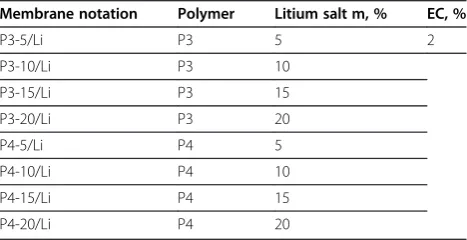
Teflon plate and dried in vacuum at 70°C for 24 h to form polymer electrolyte complex films. The membrane notation is P3-m/Li or P4-m/Li, were m represents the weight in % of lithium salt. The notation and compo-sition of prepared lithium polymers membranes were presented in Table 5.
Analysis
The IR spectra were recorded on a JASCO - FT/IR-4200 spectrophotometer and 1H-NMR and 31P-NMR spectra on a Bruker DRX 400 MHz spectrometer. All NMR spectra were recorded in CDCl3 using TMS as internal
standard, at 25°C. The polymer was characterized by vis-cosity, on an Ubbelohde suspended level viscometer, at 30°C and by gel permeation chromatography (GPC), on an Evaporative Light Scattering Detector, PL-EMD 950 (2x PL gel MIXEDC 300 × 7.5 mm columns; T=35°C; DMF as solvent; Flow 1 ml/min; calibration with KIT polystyrene as standard). The thermoanalytical curves TG, DTG and DTA (as heat flow) were drawn up by a TGA/SDTA 851-LF 1100-Mettler Toledo device, in
nitrogen atmosphere and heating rates of 10 degmin-1. Limiting oxygen (LOI) index was determinates by Limi-ting Oxygen Index Chamber 340AJH0038 for all poly-mers and membranes based on ASTM D2863–1997. The elasticity tests were performed using Anton Paar Rheometer.
Ionic conductivity of the membranes was determined by the AC impedance spectroscopy. The impedance tests were carried out in the frequency range from 0.1 Hz to 106Hz using an Autolab 302N potentiostat/galvanostat equipped with the FRA2 impedance module. The sinu-soidal potential amplitude was 10 mV. All electrochem-ical measurements were performed at room temperature (ambient condition). For each spectrum 60 points were collected, with a logarithmic distribution of 10 points per decade. The sample films were sandwiched between symmetrical cells containing blocking stainless steel (SS) electrodes. Analysis of the impedance spectra is based on the Bode diagrams. In this case, the overall imped-ance and the phase shift between applied voltage and answering current signal are both plotted against the frequency. At the point where the phase angle is zero (or close to zero), the impedance is pure ohmic and the resistance of the membrane can directly be determined and used for the ionic conductivity calculation, by the following equation (2):
σ¼L=Rb:A ð2Þ
where:
σ- ionic conductivity, S cm-1
Rb–the resistance corresponding to the angle closest to zero in the Bode diagram,Ω
Figure 13Dynamic mechanical analysis of polymeric membrane based on P4-10/Li; G', G" versus time.
Table 5 The notation and composition of prepared membranes
Membrane notation Polymer Litium salt m, % EC, %
P3-5/Li P3 5 2
P3-10/Li P3 10
P3-15/Li P3 15
P3-20/Li P3 20
P4-5/Li P4 5
P4-10/Li P4 10
P4-15/Li P4 15
L – the thickness of the membrane between the electrodes, cm
A –the cross-sectional contact area of the measured sample with the electrodes, cm2.
The study of conductivity vs temperature was per-formed in the temperature range of 25°C to 75°C.
Transference numbers were evaluated with Wagner’s polarization technique. The cation transference num-bers,t+in the electrolytes were determined by monitor-ing the current as a function of time on application of a fixed DC voltage (1.5 V) across the sample sandwiched between two SS electrodes [42]. The total ionic transference number was calculated from plots of the polarization current versus time with the equation (3):
tion¼1IfIi ð3Þ
WhereIiis the initial current andIfis the final residual
current.
Conclusions
In order to reduce the risk of fire in lithium-ion battery new polymers containing phosphorus groups and poly-ethers were developed. Polymers composed of phospho-nate as a linking agent and poly (ethylene glycol) s were synthesized in order to increase local segmental motion and improve ion transport. Polymer electrolytes were synthesized by solution polycondensation of 4-chlorophenyldichlorophosphonate as a linking agent and PEG with different molecular weights (MW of 200 and 2000). 1-methylimidazole as an acid scavenger and of 1,3-dioxolane as a green solvent were used. The advan-tages are: an ionic liquid is formed and the products can be easily recovered by a simple layer separation; the enhancing of polymer yield; reducing of the corrosion problem.
Best results (yield 88%, inherent viscosities 0.48 dl/g and Mn 26000) were obtained with 1-methylimidazole as an acid scavenger and PEG 2000. These polymers and mem-branes based on these polymers showed good LOI values (in the range 26-29%) and indicate an improvement of the safety of lithium batteries. The membrane based on P4-10/Li showed elasticity modulus of G’= 5.74 × 10⁷Pa, the breaking appeared at frequency of ω = 75.95 rad/s. The temperature - conductivity dependence of the copoly-mer exhibits Arrhenius behavior and the activation energy increases by increasing the content of EG unit. The con-ductivity increases initially with the lithium salt content until 10% and decrease with the increase salt content. This decrease in conductivity at higher salt concentration is due to the ion aggregation. The P4-10/Li membrane pre-sents the higher conductivity about 6.27 × 10⁻⁷S cm-1at room temperature. The total ionic transference number is
in the range of 0.92–0.96 and the charge transport is predominantly due to ions.
Competing interests
The authors declare that they have no competing interest.
Authors’contributions
SI, GI synthesized the polymers and prepared the manuscript, NP, LM contributed in obtaining and characterization of membranes, AP, GI , SI characterized polymers, LZ helped to draft the manuscript. All authors read and approved the final manuscript.
Acknowledgments
The research leading to these results has received funding from the European Community's SeventhFramework Programme (FP7/2007-2013) underGrant Agreementn° 266090 (SOMABAT) and also by the Romanian Ministry of Education, Research and Innovation Agency through PNCDI 2 Program(Romanian co-financing EU-7FP- SOMBAT - Module III - nr. 128 EU/ 2011, which are gratefully acknowledged.
Author details
1
Institute of Chemistry, Romanian Academy, 24 Mihai Viteazul Bvd, Timisoara 300223, Romania.2Instituto Tecnológico de la Energía, Av. Juan de la Cierva,
24 Parque Tecnológico de Valencia, Paterna, Valencia 46980, Spain.
Received: 1 October 2012 Accepted: 30 October 2012 Published: 8 November 2012
References
1. Ren H, Sun J, Wu B, Zhou Q:Synthesis and properties of a phosphorus-containing flame retardant epoxy resin based on bis-phenoxy (3-hydroxy) phenyl phosphine oxide.Polym Degrad Stab2007, 92(6):956–961.
2. Petreus O, Vlad-Bubulac T, Hamciuc C:Synthesis and characterization of new polyesters with enhanced phosphorus content.Eur Polym J2005, 41(11):2663–2670.
3. Chang Y-L, Wang Y-Z, Ban D-M, Yang B, Zhao G-M:A novel phosphorus-containing polymer as a highly effective flame retardant.Macromol Mater Eng2004,289(8):703–707.
4. Monge S, Canniccioni B, Graillot A, Robin J-J:Phosphorus-containing polymers: a great opportunity for the biomedical field.Biomacromolecules 2011,12(6):1973–1982.
5. Tarascon M, Armand M:Issues and challenges facing rechargeable lithium batteries.Nature2001,414:359–367.
6. Bruce PG, Scrosati B, Tarascon JM:Nanomaterials for rechargeable lithium batteries.Angew Chem-Int Edit2008,47(16):2930–2946.
7. Stephan AM:Review on polymer electrolytes for lithium batteries. Eur Polym J2006,42(1):21–42.
8. Gray FM:Solid polymer electrolytes-fundamentals and technological applications. New York: VCH; 1991.
9. Liang YPM, Wang B:Synthesis and Characterization of a Novel Polymer Electrolyte for Lithium-ion Battery.Chinese Chemical Letters2004, 15(2):234–237.
10. Wright PV:Electrical conductivity in ionic complexes of poly(ethylene oxide).Br Polm J1975,7(5):319–327.
11. Armand MB, Chabagno JM, Duclot M: InFast ion Transport in Solids. Electrodes and Electrolytes. Edited by Vashitshta P, Mundy JN. Amsterdam: North Holland Publishers; 1979.
12. Singh THJ, Bhat SV:Morphology and conductivity studies of a new solid polymer eelctrolyte: (PEG)xLiClO4.Bull Mater Sci2003,26(7):707–714.
13. Chandrasekhar V, Chandrasekhar V:Polymer solid electrolytes: Synthesis and structure.Block copolymer/polyelectrolytes biodegradation, Adv Polym Sci 1998,135:139–205.
14. Morford RV, Kellam EC, Hofmann MA, Baldwin R, Allcock HR:A fire-resistant organophosphorus gel polymer electrolyte additive for use in rechargeable lithium batteries.Solid State Ionics2000,133(3–4):171–177. 15. Wu L, Song Z, Liu L, Guo X, Kong L, Zhan H, Zhou Y, Li Z:A new
16. Allcock HR, Laredo WR, Morford RV:Polymer electrolytes derived from polynorbornenes with pendent cyclophosphazeens:poly(ethylene glycol) methyl ether (PEGME) derivatives.Solid State Ionics2001,139(1–2):27–36. 17. Shibutani R, Tsutsumi H:Fire-retardant solid polymer electrolyte films
prepared from oxetane derivative with dimethyl phosphate ester group. J Power Sources2012,202:369–373.
18. Kim SH, Kim JY, Kim HS, Cho HN:Ionic conductivity of polymer electrolytes based on phosphate and polyether copolymers.Solid State Ionics1999,116(1–2):63–71.
19. Kim SH, Kim JY:Ionic conduction of network polymer elctrolyets based on phosphate and polyether copolymers.Solid State Ionics1999, 124(1–2):91–99.
20. Morris SR, Dixon BG:A novel approach for development of improved polymer electrolytes for lithium batteries.J Power Sources2003, 119–121:487–491.
21. Dixon BG, Morris RS, Dallek S:Non-flammable polyphosphonate electrolytes.Journal of Power Sources2004,138(102):274–276. 22. Iliescu S, Avram E, Visa A, Plesu N, Popa A, Ilia G:New technique for the
synthesis of polyphosphoesters.Macromol Res2011,19(11):1186–1191. 23. Iliescu S, Plesu N, Popa A, Macarie L, Ilia G:Green synthesis of polymers
containing phosphorus in the main chain.C R Chim2011, 14(7–8):647–651.
24. Iliescu S, Ilia G, Plesu N, Popa A, Pascariu A:Solvent and catalyst-free synthesis of polyphosphates.Green Chem2006,8(8):727–732. 25. Iliescu S, Ilia G, Pascariu A:Novel synthesis of phosphorus containing
polymers under inverse phase transfer catalysis.Polymer2006, 47:6509–6512.
26. Novolyte tecnologies: http://www.novolyte.com/performance-materials/ high-performance solvents/green-solvents.aspx (accesed May,7, 2012). 27. Sato M, Yokoyama M:Preparation of phosphorus-containing
polymers-XVII. Preparation of polyamides containing phenoxaphosphine rings. Eur Polym J1979,15(8):733–736.
28. Maase M: InMultiphase Homogenous Catalysis. Edited by Cornils B, Herrmann WA, Horvath IT, Letner W. Weinheim: Wiley; 2005:560–566. 29. Schubert TJS:Ionische plussigkeiten- eine querschnittstechnologie.Nachr
Chem2005,53(12):1222–1226.
30. Shobha HK, Johnson H, Sankarapandian M, Kim YS, Rangarajan P, Baird D, McGrath JE:Synthesis of high refractive-index melt-stable aromatic polyphosphonates.J Polym Sci Part A: PolymChem2001,39(17):2904. 31. Shobha HK, Sekharipuram V, McGrath JE, Bhatnagar A:High refractive index
thermoplastic polyphosphonates.; 2001. U.S.Patent 6288210, Sep. 11. 32. Thomas LC:Interpretation of the infrared spectra of organophosphorus
compounds. London: Heydon; 1974.
33. Bellamy J:The Infrared Spectra of Complex Molecules, vol.2. 3rd edition. London: Chapman and Hall; 1980.
34. Levi GC, Lichter RI, Nelson GI:Nuclear Magnetic Resonance Spectroscopy. New York: John Wiley and Sons Inc; 1980.
35. Ewing GC:13C: Substituent effect in monosubstituted benzenes.Org Magn Resonance1979,12:499–524.
36. Van Wazer JR: InTopics in Phosphorus Chemistry. 5th edition. Edited by Grayson F, Griffin M. London: John Wiley; 1967.
37. Van Wazer JR, Callins CF, Shoolery JN, Jones RC:Principles of phosphorus chemistry. II.Nuclear magnetic resonance measurement.J Am Chem Soc 1956,78:5715–5726.
38. Annakutty S, Kishore K:A novel approach to structure—flammability correlation in polyphosphate esters.Polymer1988,29(7):1273–1276. 39. Le Nest JF, Gandini A, Cheradane H:Crosslinked polyethers as media for
ionic conduction.Br Polym J1988,20(3):253–268.
40. Every HA, Zhou F, Forsyth M, MacFarlane DR:Lithium ion mobility in poly (vinyl alcohol) based polymer electrolytes as determined by7Li NMR spectroscopy.Electrochim Acta1998,43(10–11):1465–1469.
41. Jeon JD, Kwak SY:Variable-Temperature7Li Solid-State NMR Investigation of Li-Ion mobility and its correlation with conductivity in pore-filling polymer electrolytes for secondary batteries.Macromolecules2006,39(23):8027–8034. 42. Wagner JB, Wagner CJ:Electrical conductivity majorements on cuprous
halides.J Chem Phys1957,26(6):1597–1601.
doi:10.1186/1752-153X-6-132
Cite this article as:Iliescuet al.:Polymers containing phosphorus groups and polyethers: from synthesis to application.Chemistry Central Journal 20126:132.
Open access provides opportunities to our colleagues in other parts of the globe, by allowing
anyone to view the content free of charge.
Publish with
Chemistry
Central and every
scientist can read your work free of charge
W. Jeffery Hurst, The Hershey Company.
available free of charge to the entire scientific community peer reviewed and published immediately upon acceptance cited in PubMed and archived on PubMed Central yours you keep the copyright
Submit your manuscript here: