Biochemistry 3G03 Test 1 September 21, 2012
Note: Please check your examination booklet to ensure all pages are there. There are 27
questions. Please mark your answers clearly on the examination answer sheet. You can
keep the examination booklet. There are several different versions of this test, therefore it's
important that you mark your version on the CLASSROOM ANSWER SHEET (scantron)
according to question 1 & 2.
Please also mark your seat number on the scantron in the space for RECORD (SEAT)
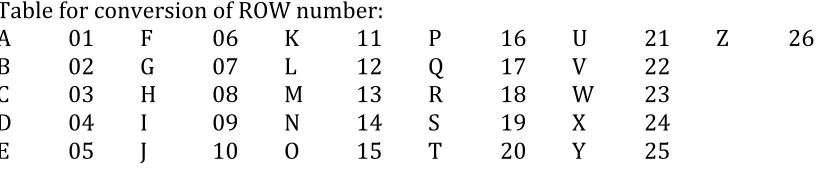
NUMBER according to the following table.
Failure to indicate your version number or seat number may result in 5% penalty.
Table for conversion of ROW number:
A
01
F
06
K
11
P
16
U
21
Z
26
B
02
G
07
L
12
Q
17
V
22
C
03
H
08
M
13
R
18
W
23
D
04
I
09
N
14
S
19
X
24
E
05
J
10
O
15
T
20
Y
25
First two numbers in RECORD (SEAT) NUMBER are used for letter (row) and the second
two numbers are for the seat number. For example: w20 is 2320.
1. Please mark question 1 c
2. Please mark question 2 a
3. A spontaneous process a) all of the rest
b) has a delta G < 0 c) none of the rest d) is exergonic
e) occurs without the addition of free energy
4. Amphiphilic molecules: a) are micelles
b) have both hydrophilic and hydrophobic groups
c) have chromophores in two different wavelength regions d) have both oxidizing and reducing groups
e) have both acidic and basic groups
5. To make an acetate buffer at pH 4.76 (pK = 4.76) starting with 500 mL of 0.1 M sodium acetate (pK = 4.76), you could add:
a) 0.1 moles of HCL
b) You can’t make a buffer by adding HCL or NaOH c) 0.1 moles of NaOH
[image:1.612.74.485.262.348.2]
6. Assuming you had a way to measure the amount of protein in a sample of food, which of the following elements would you measure in order to tell whether the food contained protein
a) potassium b) oxygen c) hydrogen d) carbon e) nitrogen
7. Given log (0.00001)=-5; log(0.0001)=-4; and log(0.001)=-3. If you added a drop (about 0.05 mL) of 1.0 M HCL to one liter of pure water (assume pH 7.), the pH would become:
a) 2.7
b) 7.0 (there would be no significant change) c) 9.7
d) 4.3 e) 5.0
8. To make a phosphate buffer at pH 6.82 starting with one liter of 10 mM phosphoric acid (H3PO4; pKs are of 2.15, 6.82, and 12.38), you could add
a) 15 millimoles of KOH b) 5 millimoles of HCL c) 25 millimoles of HCL d) 20 millimoles of K+
e) You can’t make a buffer by adding HCL or KOH
9. Phosphate, with a pK2 of 6.82, will be mostly in the HPO4(2-) form at pH 7.2. At pH 5.82 it is mostly in the _________________________ forms.
a) PO4(3-)
b) none of the rest c) H2PO4(1-)
d) HPO4(2-) e) H3PO4
10. The biological classification system categorizes organisms into the domains:
a) bacteria, eukarya, and vertebrate b) bacteria, eukarya, and archaea c) eukarya and bacteria
d) archaea and eukarya e) none of the rest
11. A phosphate buffer solution at a pH = pK1 = 2.15 would have equal amounts of phosphate in the ____________ form and the H2PO4(1-) form. a) HPO4(2-)
b) H3PO4
c) tetrahedral d) disordered e) H2PO4(1-)
b) van der Waal forces c) hydrogen bonds d) ionic interactions
e) London dispersion forces
13. Hydrophobic interactions between nonpolar molecules or groups: a) result from the tendency to maximize water’s contact with nonpolar molecules
b) require the presence of surrounding water molecules
c) depend on strong permanent dipoles in the nonpolar molecules d) are the result of strong attractions between nonpolar regions
e) are the result of strong repulsion between water and nonpolar regions
14. Hydrogen bonds within liquid water: a) are attractions between two hydrogen atoms
b) are attractions between the protons of the oxygen nuclei c) are dipole-dipole attraction
d) are ion-induced dipole attractions
e) are attractions between the H(+) and OH(-) ions of the liquid
15. A solution of buffer at a pH of 8.5 with a pK = 7.5 would have more capacity to buffer the addition of
a) base versus acid b) HPO4(2-) and PO4(3-) c) none of the rest d) acid versus base e) PO4(3-)
16. Which of the following statements concerning prokaryotes is false? a) Prokaryotes are one branch of the newer, more accurate phylogenic tree made up of prokarya, archaea and eukarya
b) None of the rest
c) Prokaryotes are made up of two major groupings: the eubacteria and the archaea, which are as different from each other as from the eukaryotes d) Prokaryotes are generally much smaller than the eukaryotic cells e) Prokaryotes do not have organelles
17. What is the final pH of a solution with 50 mL of a stock solution of 2.0 M K2HPO4 and 25 mL of a stock solution of 2.0 M KH2PO4; diluted to a final volume of 200 mL. (pK=6.82; log(1) = 0; log(2)=0.3; log(3)=0.48; log(5)=0.7).
a) 6.52 b) 7.3 c) 5.82 d) 7.12 e) 6.82
18. What is the ratio of citric acid (pK1=3.09) to monosodium citrate in a 1.0 M citric acid solution with a pH = 2.09?
19. Which of the following is a similarity between all prokaryotes and all eukaryotes?
a) Both contain certain of the same membrane bound cell organelles (like mitochondria, Golgi complexes etc)
b) Both contain DNA in a nucleus
c) All of the rest are similarities between prokaryotes and eukaryotes d) Both have a cytoskeleton
e) None of the rest are similarities between prokaryotes and eukaryotes
20. If gas molecules in an enclosed space are allowed to enter a second chamber, the resulting redistribution of gas molecules represents an increase in
a) entropy
b) all of the rest c) enthalpy
d) enthalpy and force e) force
21. The term used to indicate the degree of randomness within a system is
a) Delta G b) H-TS c) entropy d) q/T e) enthalpy
22. The Henderson-Hasselbalch equation, pH = pK + log {[A-] /[HA]} , indicates that when the _____ of a solution containing acid is equal to the _________ of that acid, then the acid is half deprotonated.
a) pH and pK b) base and OH-
c) log pH and log pOH d) log [A-] and pH e) H+ and pK
23. An increase in disorder
a) results in a decrease in entropy b) is found in every exergonic process
c) results in the factor T delta S being positive d) is required for a process to be spontaneous
e) is characteristic of a system increasing in enthalpy
24. In a hydrogen bond between a water molecule and another biomolecule: a) the partial charge on a hydrogen of the water interacts with the
partial charge on a hydrogen of the other molecule
b) a hydrogen on the water molecule forms a covalent bond to a hydrogen atom on the other molecule
c) a hydrogen ion on the water molecule forms an ionic bond with a hydride ion on the other molecule
d) the hydrogen bond will typically form between a hydrogen atom and either a nitrogen, sulfur, or oxygen atom
e) the hydrogen atom is located between an oxygen atom of the water and a carbon atom of the other molecule
25. Which of the following statements about water is incorrect?
a) Cations (e.g. Na+) are solvated by shells of water molecules oriented with their hydrogen atoms pointed toward the ions.
b) Water is an excellent solvent for polar molecules.
c) Amphiphilic detergents often form micelles with the polar groups on the outside exposed to the water (solvent) and the non-polar groups
sequestered in the interior.
d) Pure water has a concentration of approximately 55.5 M.
e) Non-polar molecules do not dissolve in water, but form a separate phase.
26. The free energy change for the reaction A => B at 25 degree C. Given enthalpy (kJ.mol-1) and entropy (J.K-1.mol-1) for A and B are: A enthalpy = 60; entropy = 22; B enthalpy = 75; entropy = 97. Zero degree C = 273 Kelvin. Delta G = Delta H – T Delta S.
a) 3.7 kJ.mol-1 b) 7.4 kJ.mol-1 c) -7.4 kJ.mol-1 d) -3.7 kJ.mol-1 e) none of the rest
27. A soccer coach keeps a couple of instant cold packs in her bag in case one of her players suffers a muscle injury. Instant cold packs are composed of a plastic bag containing a smaller water bag and solid
ammonium nitrate. In order to activate the fold pack, the bag is kneaded until the smaller water bag breaks, which allows the released water to dissolve the ammonium nitrate. Which of the following statements about the dissolution of ammonium nitrate in water is correct?
a) Delta T > 0 b) Delta H < 0
c) Delta H < Delta S d) Delta G > 0
e) Delta S > 0
THE END of QUESTIONS