A Refocus on Foci: A Multidimensional and
Multi-foci Examination of Commitment in Work
Contexts
This study extended previous commitment research by simultaneously assessing affective, normative and continuance components of commitment towards four distinct foci (organisation, supervisors, co-workers, occupation) and relationships with self-reported attitudes and work behaviour. The commitment structure was supported through confirmatory factor analysis in a sample of 145 employees from various NZ organisations. Regression analyses revealed that the components and foci have differential impacts on work attitudes and behaviour (self-reported in-role behaviour, organisational citizenship behaviour, supervisory trust, intention to leave the occupation and the organisation). Commitment foci that matched the foci of the work outcome variable typically emerged as best predictors. In order to understand the effect of commitment on work attitudes and behaviours, researchers need to study the appropriate foci of commitment.
Commitment has been recognised as an integral factor in understanding employee work behaviour (Mowday, Porter, & Steers, 1982). There is relative consensus that commitment is multidimensional (Meyer, Stanley, Herscovitch, & Topolnytsky, 2002; Blau & Holladay, 2006). Meyer and Allen (1991) used the terms affective, continuance and normative commitment to distinguish between the different components of commitment. Affective commitment, an emotional attachment to organisations, is characterized by a genuine want or desire to belong to the organisation (Meyer et al., 2002; Porter, Steers, Mowday, & Boulian, 1974). Second, continuance commitment is identified as the perceived costs associated from leaving one’s current organisation (Meyer et al., 2002; Kanter, 1968). Finally, normative commitment is viewed as a sense of obligation, or a feeling that one ought to remain with the organisation (Meyer et al., 2002; Meyer & Allen, 1991). These components of organisational commitment have
empirically distinct antecedents and consequences (Meyer et al., 2002). Affective commitment is the best understood form of commitment, with clearly established theoretical antecedents and consequences; in contrast, understanding of continuance and normative commitment is still lacking (Cohen, 2003; Meyer et al., 2002).
H i s t o r i c a l l y, c o m m i t m e n t research has focused on commitment to organisations, but there is now widespread recognition that there are different foci of commitment, that is the entities to which individuals can feel commitment (Cohen, 2003; Wasti, & Oender, 2009). Attempts have been made to explore commitment to other entities or foci (e.g., Becker, 1992; Becker, Billings, Eveleth, & Gilbert, 1996; Bentein, Stinglhamber, & Vandenberghe, 2002; Clugston, Howell, & Dorfman, 2000; Hunt & Morgan, 1994; Meyer, Allen, & Smith, 1993; Somers & Birnbaum, 2000; Redman & Snape, 2005; Vandenberghe & Bentein, 2009).
Despite consensus that commitment can be directed to different foci, there is little research that examines the three forms of commitment in relation to various foci simultaneously (Bergman, 2006, Mosadeghrad, Ferlie, & Rosenberg, 2007; Wegge, Schmidt, Parkes, & van Dick, 2007). The current study addressed this gap by examining the three forms of commitment with four different foci: the organisation, supervisors, co-workers, and occupation.
A second contribution of the study is an examination of a wider range of work attitudes and behaviours as criterion variables. Recent research has tended to only focus on single outcomes such as turnover or absenteeism (Vandenberghe & Bentein, 2009; Mosadeghrad et al., 2007; Wegge et al., 2007; Loi, Hang-yue, & Foley, 2006). This study tested the differential relationships between the three forms and four foci on organisational citizenship behaviours (voice and helping), self-reported work performance, supervisory trust and propensity to leave.
Foci of Commitment
Porter, Steers, Mowday and Boulian
(1974) defined affective organisational
commitment as (a) a strong belief in and acceptance of the goals and values of one’s organisation, (b) a willingness on the part of the employee to exert considerable effort on behalf of the organisation; and (c) a desire to maintain membership in one’s organisation. Challenging this exclusive focus on organisations, Reichers (1985) proposed
Shannon A. Veurink, Victoria University of Wellington
that individuals can be committed to their supervisors and peers in addition to their organisation. She used the term foci to refer to the distinct entities to which an employee may feel committed (Reichers, 1985). Subsequent research has demonstrated that employees can be committed to different foci simultaneously, including commitment to the occupation, management, supervisors and the work group (Becker & Billings, 1993; Becker, Randall, & Riegel, 1995; Lee, Carswell, & Allen, 2000).
The importance from a managerial perspective is that commitment to different foci relates differently to important organisational outcome variables such as intention to quit, satisfaction and work behaviour (Becker, 1992; Becker et al., 1996; Bentein et al., 2002; Clugston et al., 2000; Hunt & Morgan, 1994). Yet, to date most studies have only examined a few selected components and foci simultaneously. For example, examining all three forms of commitment, Meyer, Allen and Smith (1993) studied commitment to one’s occupation and the organisation; Hunt and Morgan (1994) examined top management, supervisors and workgroup foci; and Becker et al. (1996) studied commitment to the organisation and supervisors. The most comprehensive study was conducted by Clugston et al. (1992) who differentiated between all three forms of commitment (affective, continuance, and normative) and three foci (organisation, supervisor, and workgroup) of commitment. Recent studies continue to examine the three forms of organisational commitment without differentiating between foci (Mosadeghrad et al., 2007; Wegge et al., 2007), or differentiate more than one foci but study only one of the three forms (typically affective commitment; e.g., Bentein et al., 2002).
This study examined the forms of commitment in relation to four foci. The next section outlines the differential relationship between the forms, by foci, on outcome variables. Given the limited current research and theoretical development on the integrated set of forms by foci, especially related to less well-understood forms of commitment (continuance and normative commitment), theory-driven hypotheses
could not be offered regarding all forms and foci. This study contributes to further theory development by reporting empirical relationships across a wider range of forms and foci.
Commitment and Work Outcome Variables
Turnover is costly and a generally undesirable event for an organisation
(Meyer, Paunonen, Gellatly, Goffin, &
Jackson, 1989). Turnover intentions have been extensively studied in commitment research (Meyer et al., 2002) and can therefore provide a reference point for examining relationships across forms and foci. This study distinguished between both intentions to leave the organisation and intentions to leave the occupation. Trust has been shown to be an important organisational outcome variable (Mayer et al., 1995), with employee trust in supervisors being particularly important from a commitment perspective (Bentein et al., 2002; Cohen, 2003; Eisenberger, Stinglehamber, Vandenberghe, Suchariski, & Rhoades, 2002). Mowday et al. (1989) and Meyer et al. (2002) called for more commitment research on work performance. This study measured self-reported in-role work performance (that is work performance
specified in one’s job description) and
organisational citizenship behaviour
(OCB, behaviour that is beneficial for
the organisation but goes beyond formal
job role specifications).
Drawing upon attitude-behaviour research, the strongest correlations between commitment and other work attitudes and behaviours were expected to emerge when the focus of the commitment matched the focus of the attitude or behaviour (Fazio, 2007). Intentions to leave the organisation, in-role work performance and organisational citizenship behaviour (especially the voice or innovation related aspect; Van Dyne & LePine, 1998) are clearly organisation-focused attitudes and behaviours. In-role performance is also influenced by the ethical and moral codes of one’s occupation, therefore, may also be related to one’s occupation. Intention to leave the occupation is clearly focused on one’s occupation. Trust in supervisors is focused on the supervisor. Helping and altruism forms
of organisational citizenship behaviour (Van Dyne & LePine, 1998) are oriented towards one’s co-workers (Williams &
Anderson, 1991), while still benefiting
the organisation indirectly.
Matching the focus of the commitment to the focus of the attitude and behaviour suggested
what specific relationships would be
found. For example, commitment to the organisation should be related to intentions to leave the organisation (Hypothesis 1), whereas commitment to the occupation should be related to intentions to leave the occupation (Hypothesis 2). Organisational commitment should correlate with
voice OCB as this behaviour benefits the
organisation (Hypothesis 3). In contrast, helping OCB was expected to relate to commitment to co-workers (Hypothesis
4), as it benefits co-workers directly and only indirectly benefits the organisation
(Williams & Anderson, 1991). In-role work performance is related to both the organisation and the occupation (Williams & Anderson, 1991); therefore, correlations between in-role performance and both organisational and occupational commitment were expected (Hypothesis 5). Supervisory commitment should relate to trust in supervisors1 (Hypothesis 6).
Hypotheses 1 to 6 were concerned with the foci of commitment as this is the
major contribution of the study, however
they did not specify which form of commitment would be relevant. Meyer et al. (2002) found in their meta-analysis that affective commitment showed the strongest correlations, followed by normative commitment, whereas continuance commitment was mostly unrelated to outcome behaviours. More
recent research generally confirms these
patterns, with affective commitment consistently showing the strongest
i It should be noted that our data is
cross-sectional and our hypotheses do not imply causality. For example, the employee-supervisor trust relationship is probably reciprocal, (i.e. that supervisors who demonstrate trust in their employees may promote employees’ trust in their supervisor and employees trusting their supervisors developing stronger commitment). It is also plausible that high work performance
relationships (e.g., Blau & Holladay, 2006; Fischer & Mansell, 2009; Snape & Redman, 2003). Affective forms of commitment capture the intrinsic form of motivation, which is most predictive of attitudes and behaviours (Ryan & Deci, 2001). Normative components are also important as they capture social pressures (Fischer & Mansell, 2009; Wasti & Onders, 2009). Yet, affective and normative commitments are moderately to strongly correlated (Fischer & Mansell, 2009; Meyer et al., 2002) and it is necessary to include both affective and normative commitment to examine the unique effects of either form. Based on these past studies, the affective component was expected to be the stronger and most consistent predictor of work variables (hypothesis 7). As a consequence, Hypotheses 1 to
6 can be specified in terms of affective
commitment: Affective organisational commitment should be most related to intentions to leave the organisation (hypothesis 1); affective occupational commitment should be most related to intentions to leave the occupation (Hypothesis 2) and so on. Examining the three forms by four foci sought to a) clarify the relative importance of affective versus normative commitment and b) further address the inconsistent relationship between continuance commitment and work variables.
Method
Participants were recruited through local churches, Rotary Clubs, local sports teams, and at various public spaces in Wellington. Only individuals who were currently employed voluntarily participated in this study. Participants who returned the questionnaire via pre-paid postal envelopes were entered in a draw (5 x $50 shopping vouchers; every tenth respondent received a small complimentary token). A total of 500 surveys were distributed, of which 145 with suitable data (participant responses on at least 4 of the 6 dependent measures) were returned (response rate 29%). The small sample and response rate are noted as limitations of this research. The mean age was 37 years and 43% (N=62) of participants were male.
The majority of respondents (N=115; 79%) were of European ethnicity. Most individuals worked in private sector
organisations (N=78; 53.8%). The participants represented a wide variety of industries, with the largest numbers
being employed in finance (N=18; 12%), education (N=17; 12%) and wholesale/ retail (N=15; 10%). The largest number of respondents were process and clerical workers (N=39; 27%) and senior and middle managers (N=34; 24%). The
project received ethical approval by the
School of Psychology Ethics Committee at Victoria University of Wellington.
Instruments
Bases and Foci of Commitment. This research used an extended version of Clugston et al.’s (2000) measure of forms and foci of commitment. It
used five items for each commitment
component and each of the four foci (organisation, supervisor, co-worker, occupation), resulting a total number of 60 items (5 x 3 x 4). An example of affective commitment was, “I would be very happy to spend the rest of my career with this organisation”; an example of normative commitment was, “I feel or sense a moral obligation to my organisation”; and, an example of continuous commitment was, “I feel that I have too few options to consider leaving this organisation”. The focus of commitment was changed by substituting organisation with supervisor, co-worker and occupation, respectively. The same order described by Clugston et al.(2000) was used and occupational commitment was added at the end of each block of items. Participants responded on a 7-point scale indicating how strongly they agreed or disagreed with each statement (i.e., strongly disagree, disagree, somewhat disagree, neutral, somewhat agree, agree, strongly agree).
A confirmatory factor analysis was run to examine whether the three components across the four foci were empirically distinct. Item parcels (two two-item parcels and one single item per dimension, allocation of items to parcels was random) were used within Lisrel 8.50 to assess the structure of the questionnaire. A solution separating the four foci and three components provided acceptable fit: χ2 (528) =
901.27, RMSEA = .07; CFI = .95 and SRMR = .06. Values larger than .90 for CFI and smaller than .08 for RMSEA
and SRMR are acceptable. A second model was run where only the three components (but not the different foci) were specified. The fit was poor: χ2
(592) = 2347.51, RMSEA = .14; CFI
= .83 and SRMR = .14. A final model
was run where only the four foci were modeled (but not the components). The
fit was again not acceptable: χ2 (588) =
4450.71, RMSEA = .21; CFI = .79 and SRMR = .20. Consequently, the best model was the one separating the four foci and three components. Cronbach’s alpha ranged between .79 and .90 for all factors (see Table 1).
In-role behaviour, Voice, Helping. Van Dyne and LePine’s (1998) measures of in-role behaviour, voice and helping were used (using the same 7-point Likert scale described above). In-role behaviour included items such as, “I
fulfill the requirements of my specified job description”, and “I adequately
complete responsibilities”. Reliability
of the five item measure was .84. Voice
was measured using seven items such as, “I speak up and encourage others to get involved in issues that affect the company” and, “I get involved in issues that affect the quality of work life here”. The scale had an alpha of .89. The five items that assessed helping included statements such as “I help my co-workers with their work-responsibilities” and “I assist others
with their work for the benefit of the
organisation”. The resulting alpha was .89. An exploratory principal component analysis showed three clear factors with all items loading on their respective factor.
Trust. Podsakoff, MacKenzie, Moorman and Fetter’s (1990) measure of Trust in/Loyalty to the Leader was used. This measure was adapted by replacing the word “leader” with “supervisor”, and included six statements such as “I
feel quite confident that my supervisor
will always try to treat me fairly”, and “My supervisor would never try to gain an advantage by deceiving workers.” This scale had a reliability value of .84. A principal component analysis together with the in-role performance and OCB items showed a four-factor structure, clearly separating the trust items from the three behaviour factors.
Variable Mean SD 1 2 3 4 5 6 7 8 9 10 11 12 13 14 15 16 17 18
Organisation 1. Af
fective 4.37 1.52 (.88) 2. Normative 3.61 1.25 .43** (.79) 3. Continuance 3.71 1.37 .10 .23** (.80)
Supervisor 4. Af
fective 3.75 1.44 .48** .46** .10 (.84) 5. Normative 3.08 1.32 .25** .78** .20* .61** (.85) 6. Continuance 3.08 1.27 -.04 .20** .65** .36** .50** (.83) Co-W orker 7. Af fective 4.18 1.25 .32** .30** -.03 .34** .31** .09 (.83) 8. Normative 3.23 1.39 .15 .58** .15 .30** .66** .37** .47** (.85) 9. Continuance 3.08 1.47 -.02 .28** .52** .19* .38** .70** .28** .51** (.90) Occupation 10. Af fective 4.62 1.39 .72** .42** .12 .46** .36** .04 .41** .34** .05 (.88) 11. Normative 2.79 1.57 .20* .62** .27** .30** .61** .38** .28** .65** .39** .31** (.88) 12. Continuance 3.70 1.07 -.02 .19** .67** .09 .17 .54** .03 .23** .54** .17** .33** (.89) 13. V oice 5.27 1.07 .65** .25** .02 .17* .03 -.14 .22** -.01 -.15 .55** .06 -.04 (.89) 14. Trust 5.38 1.17 .42** .36** -.04 .66** .42** .08 .25** .07 -.05 .36** .08 -.09 .37* (.84) 15. In-Role 6.05 0.70 .15 .10 .10 .1 1 .04 -.04 .16 -.03 -.10 .30** .06 .10 .43** .28** (.84) 16. Helping 5.69 0.71 .34** .14 .07 .13 .10 -.07 .31** .08 -.05 .41** .04 .03 .57** .25** .52** (.85)
17. Leaving Occupation
2.62 1.21 -.52** -.43** -.15 -.33** -.24** -.04 -.16 -.07 .07 -.54** -.34* * -.19* -.30* * -.27** -.18 -.24* * (.87)
18. Leaving Organisation
2.61 1.30 -.59** -.45** -.16 -.37** -.21** -.06 -.15 -.04 .01 -.45** -.31* * -.16 -.29* * -.41** -.1 1 -.17* -.85** (.84) Table 1
. Descriptive Statistics,
Alpha Coefficients and Correlations of Commitment V
ariables and Job Consequences
Note
:
N
=143-145; *
p
<.005, **
P
on a 5-point scale to three items: how frequently they thought about leaving their current occupation to work in another, how likely it was that they would actually leave their occupation within the next six months, and how likely they were to explore another occupation altogether (Meyer, Allen ,& Smith, 1993). Respondents chose between the following options to indicate how frequently they thought about leaving: never, less than monthly, monthly, weekly, most days. The options assessing likelihood of leaving and exploring new occupations were: extremely unlikely, unlikely, possible, quite likely, likely. These three items had a reliability of .87.
Intention to leave organisation. As above, desire to leave the organisation was assessed by the first two items,
only using the word “organisation” in place of the word “occupation.” The two items assessing desire to leave the organisation had a reliability of .84. Although the two sets of intention items loaded on one factor in an exploratory principal component analysis, they were kept separate based on conceptual grounds (see Meyer et al., 1993 for similar treatment).
Results
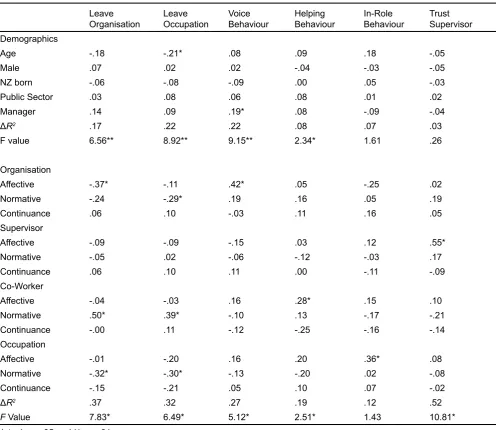
Table 1 shows descriptive statistics, correlations and alpha coefficients for all study variables. To test the hypotheses, the work outcome variables were regressed on all commitment variables simultaneously (see table 2). The CFA showed that the 12-factor commitment structure fit better than alternative models separating foci or
components, implying that these factors are empirically distinct. Some of the correlations were sizeable (but in line with previous research that treated them as independent predictors, see Clugston et al., 2000; Meyer et al., 2002). Bootstrap regression was used to avoid unstable regression weights due to potential multicollinearity of predictor variables. Bootstrapping was also advantageous because the sample was relatively small considering the number of independent variables. Standard criteria for estimating significance level may have been inappropriate and bootstrapping offered a simple method for estimating statistical
significance. A bootstrapped regression
was performed for each dependent variable, drawing 1,000 random samples
with replacements. The 95% confidence
Leave
Organisation Leave Occupation Voice Behaviour Helping Behaviour In-Role Behaviour Trust Supervisor Demographics
Age -.18 -.21* .08 .09 .18 -.05
Male .07 .02 .02 -.04 -.03 -.05
NZ born -.06 -.08 -.09 .00 .05 -.03
Public Sector .03 .08 .06 .08 .01 .02
Manager .14 .09 .19* .08 -.09 -.04
ΔR2 .17 .22 .22 .08 .07 .03
F value 6.56** 8.92** 9.15** 2.34* 1.61 .26
Organisation
Affective -.37* -.11 .42* .05 -.25 .02
Normative -.24 -.29* .19 .16 .05 .19
Continuance .06 .10 -.03 .11 .16 .05
Supervisor
Affective -.09 -.09 -.15 .03 .12 .55*
Normative -.05 .02 -.06 -.12 -.03 .17
Continuance .06 .10 .11 .00 -.11 -.09
Co-Worker
Affective -.04 -.03 .16 .28* .15 .10
Normative .50* .39* -.10 .13 -.17 -.21
Continuance -.00 .11 -.12 -.25 -.16 -.14
Occupation
Affective -.01 -.20 .16 .20 .36* .08
Normative -.32* -.30* -.13 -.20 .02 -.08
Continuance -.15 -.21 .05 .10 .07 -.02
ΔR2 .37 .32 .27 .19 .12 .52
[image:5.595.55.552.347.777.2]F Value 7.83* 6.49* 5.12* 2.51* 1.43 10.81*
Table 2. Bootstrap Regression analyses. The reported estimates are the median standardized regressions weights from 1,000 samples with random replacements.
intervals were then used for the 1,000
standardized regression weights to judge significance. If the confidence interval
included 0, the regression weight was
not significant. Age, gender, being a
manager, sector and being born in New Zealand (compared to overseas born) were also included in the regression as demographic control variables in step 1. All commitment variables were entered simultaneously in the next step. Table 2 reports the bootstrapped standardized regression weights from
the final model.
Hypothesis 1 was supported because affective organisational commitment
was significantly and negatively related
to intentions to leave the organisation. Additionally, a series of normative commitment factors were associated with intention to leave. Normative organisational commitment and normative occupational commitment were negatively associated with intention to leave, whereas normative co-worker commitment was positively associated.
Hypothesis 2 was not supported. Affective occupational commitment was negatively related to intention to leave the occupation (as predicted), but it did not reach traditional levels of significance using bootstrapping (p = .08). Normative organisational commitment and normative co-worker commitment were however, significantly related to intention to leave the occupation. Controlling for all other forms of commitment, greater normative commitment to co-workers was associated with more thoughts about leaving one’s occupation.
Hypothesis 3 predicted that affective organisational commitment would be positively related to voice OCB. This hypothesis was supported since affective organisational commitment was the only significant predictor for voice OCB. Hypothesis 4 was supported: affective commitment to colleagues was positively related to helping OCB. Hypothesis 5 was partially supported: affective occupational commitment was
significantly related to in-role behaviour
across 1,000 bootstrap regressions with random replacement; however organisational commitment was not significantly related. Hypothesis 6 was also supported: greater affective
commitment to one’s supervisor was associated with more supervisory trust.
The final hypothesis predicted that
across all criterion variables, affective commitment should show the strongest correlations, normative commitment somewhat weaker correlations and continuance commitment should have near-zero relationships. To test Hypothesis 7, meta-analytical procedures were used to average correlations across work outcomes and test the difference in mean correlations. Correlations averaged across voice OCB, helping OCB, trust and in-role were separated from correlations with intentions to leave (as the latter showed negative correlations overall). The mean affective commitment correlation across the
first set of outcome variables was .43,
the mean normative correlation was .15, and mean continuance correlation was .05. These average correlations
were significantly different from each
other: χ2 (3) = 12.49, p < .01. Across
intentions to leave outcomes, the mean affective commitment correlation was -.39, the mean correlation for normative commitment was -.26, and the mean continuance correlation was -.09. These
correlations were again significantly
different from each other: χ2 (3) = 7.10,
p < .05, supporting Hypothesis 7.
Discussion
This study demonstrated that employees distinguish between different components and foci of commitment, which in turn are differentially related to work outcome variables. The study also addressed calls for multi-dimensional examinations of commitment (e.g., Cohen, 2002; Meyer et al., 2002; Wasti & Oender, 2009). We used cross-sectional data in a relatively small sample, therefore, we can not make any causal claims or generalize
findings to the larger NZ work force. Nevertheless, the findings provide some
useful insights that can be explored further with more sophisticated designs in larger samples.
In line with research on attitude-behaviour relations (Fazio, 2007), matching foci of commitment and work outcomes showed the overall strongest correlations and typically emerged as significant predictors (controlling
for all other foci of commitment). Demonstrating this matching effect is an important contribution of the study. Past commitment researchers have
occasionally failed to find significant
relationships between organisational commitment and other variables
(Mathieu & Zajac, 1990; Mowday et
al. 1982). This research demonstrated that relationships depend on the target of commitment.
Second, this study found evidence that affective commitment across all foci is the most important component of commitment. It suggests that practitioners should direct their efforts towards maintaining high levels of affective commitment in their workforce. Continuance commitment seems to be only weakly related to most attitudes and behaviours, and may at times even produce counter-productive behaviours (e.g., Meyer et al., 1993). Nevertheless, it is important to note that the individual affective component measures were not consistently related to outcome variables.
Normative commitment was the second strongest predictor across all outcome variables, but showed more complex relationships. To date, normative commitment has received little attention (Meyer et al., 2002).
These findings show that it is important
et al., 2002).
Acknowlegements
This study formed part of the
honors dissertation of the first author.
We would like to thank the editors and three anonymous reviewers for their constructive feedback.
References
Becker, T.E. (1992). Foci and bases of commitment: are they distinctions worth
making? Academy of Management
Journal, 35, 232-244.
Becker, T. E., & Billings, R. S. (1993). Profiles of commitment: An empirical test. Journal of Organizational Behaviour, 14, 177-190.
Becker, T.E., Billings, R.S., Eveleth, D.M., & Gilbert, N.L. (1996). Foci and bases of employee commitment: implications
for job performance. Academy of
Management Journal, 39, 464-482. Becker, T.E., Randall, D.M., & Riegel, C.D.
(1995). The multidimensional view of commitment and theory of reasoned action: A comparative evaluation. Journal of Management, 21, 617-638.
Bentein, K, Stinglhamber, F., & Vandenberghe, C. (2002). Organization-, supervisor-, and workgroup-directed commitments and citizenship behaviours: A comparison of models. European Journal of Work and Organizational Psychology, 11, 341-362.
Bergman, M. E. (2006). The relationship between affective and normative commitment: review and research agenda. Journal of Organizational Behaviour, 27, 645-663.
Blau, G. & Holladay, E.B. (2006). Testing the discriminant validity of a four-dimensional occupational commitment measure. Journal of Occupational and Organizational Psychology, 79, 691-704.
Clugston, M., Howell, J.P., & Dorfman, P.W. (2000). Does cultural socialization predict multiple bases and foci of commitment? Journal of Management, 26, 5-30. Cohen, A. (2003). Multiple commitments in
the workplace: An integrative approach. New York: Lawrence.
Eisenberger, S., Stinglhamber, F., Vandenberghe, C., Sucharski, I. L., & Rhoades, L. (2002). Perceived supervisor support: Contributions to perceived organizational support and employee retention. Journal of Applied Psychology, 87, 565-573.
Fazio, R.H. (2007). Attitudes as object-evaluation assocations of varying
strength. Social Cognition, 25, 603-637. Fischer, R., & Mansell, A. (2009). Commitment across cultures: A meta-analytical approach. Journal of International Business Studies, 40, 1339-1358.
Hunt, S.D., & Morgan, R.M. (1994). Organizational commitment: One of many commitments or key mediating construct? Academy of Management Journal, 37, 1568-1587.
Kanter, R.M. (1968). Commitment and social organization: A study of commitment mechanisms in utopian communities. American Sociological Review, 33, 499-517.
Lee, K., Carswell, J. & Allen, N. (2000). A meta-analytic review of occupational commitment: Relations with person and work-related variables. Journal of Applied Psychology, 85, 799-811. Loi, R. Hang-yue, N. & Foley, S. (2006).
Linking employees’ justice perceptions to organizational commitment and intention to leave: The mediating role of perceived organizational support. Journal of Occupational and Organizational Psychology, 79, 101-120.
Mathieu, J.E., & Zajac, D.M. (1990). A review and meta-analysis of the antecedents, correlates, and consequences of organizational commitment. Psychological Bulletin, 108, 171-194. Mayer, R. C., Davis, J. H., & Schoorman,
F. D. (1995). An integrative model of organizational trust. Academy of Management Review, 20, 709-734. Meyer, J.P., & Allen, N.J. (1991). A
three-component conceptualization of
organizational commitment. Human
Resource Management Review, 1, 61– 89.
Meyer, J.P., & Allen, N.J., & Smith, C.A. (1993). Commitment to organizations and occupations: Extension and test of a three-component conceptualization. Journal of Applied Psychology, 78, 538-551.
Meyer, J.P., Paunonen, S.V., Gellatly, I.R., Goffin, R.D., & Jackson, D.N. (1989). Organizational commitment and job performance: It’s the nature of commitment that counts. Journal of Applied Psychology, 74, 152-156. Meyer, J.P., Stanley, D.J., Herscovitch,
L, Topolnytsky, L. (2002). Affective, continuance, and normative commitment to the organization: A meta-analysis of antecedents, correlates, and consequences. Journal of Vocational Behaviour, 61, 20-52.
Mosadeghrad, A.M., Ferlie, E. & Rosenberg, D. (2007). A study of the relationship
between job satisfaction, organizational commitment and turnover intention among hospital employees. Health Services Management Research, 21, 211-277.
Mowday, R.T., Porter, L.W., & Steers, R.M. (1982). Employee-organization linkages: the psychology of commitment, absenteeism, and turnover. New York: Academic Press.
Organ, D.W. (1990). The motivational basis of organizational citizenship behaviour. Research in Organizational Behaviour, 12, 43-72.
Podsakoff, P, M., MacKenzie, S.B., Moorman, R.H., & Fetter, R. (1990). Transformational leader behaviours and their effects on followers trust in leader, satisfaction, and organizational citizenship behaviours. Leadership Quarterly, 1, 107-142.
Porter, L.W., Steers, R.M., Mowday, R.T., & Boulian, P.V. (1974). Organizational commitment, job satisfaction, and turnover among psychiatric technicians. Journal of Applied Psychology, 59, 603-609.
Redman, T. & Snape, E. ( 2005). Unpacking commitment: multiple loyalties and
employee behaviour. Journal of
Management Studies 42, 301-328. Reichers, A.E. (1985). A review and
reconceptualization of organizational
commitment. Academy of Management
Review, 10, 465-476.
Ryan, R. M., & Deci, E. L. (2001). Self-dermination theory and the facilitation of intrinsic motivation, social development and well-being. American Psychologist, 55, 68-78.
Somers, M. & Birnbaum, D. (2000). Exploring the relationship between commitment profiles and work attitudes, employee
withdrawal, and job performance. Public
Personnel Management, 29, 353-364. Snape, E. & Redman, T. (2003). An
evaluation of a three-component model of occupational commitment: dimensionality and consequences among United Kingdom human resource management specialists. Journal of Applied Psychology, 88, 152-159. Vandenberghe, C. & Bentein, K. (2009). A
closer look at the relationship between affective commitment to supervisors and organizations and turnover. Journal of Occupational and Organizational Psychology, 82, 331-348.
VanDyne, L., & LePine, J.A. (1998). Helping and voice extra-role behaviours: Evidence of construct and predictive
validity. Academy of Management
Wasti, S. A., & Onder, C. (2009). Commitment across cultures: Progress, pitfalls and propositions. In H. J. Klein, T. E. Becker & J. P. Meyer (Eds), Commitment in organizations: Accumulated wisdom and new directions: 309–343. New York: Routledge Taylor and Francis Group. Wegge, J., Schmidt, K-H., Parkes, C. &
van Dick, R. (2007). ‘Taking a sickie’: Job satisfaction and job involvement as interactive predictors of absenteeism in a public organization. Journal of Occupational and Organizational Psychology, 80, 77-89.
Williams, L.J., & Anderson, S.E. (1991). Job satisfaction and organizational c o m m i t m e n t a s p r e d i c t o r s o f organizational citizenship and in-role behaviours. Journal of Management, 17,601–617.
Corresponding Author: Ronald Fischer
School of Psychology,
Victoria University of Wellington PO Box 600
Wellington New Zealand