ISSN 2324-805X E-ISSN 2324-8068 Published by Redfame Publishing URL: http://jets.redfame.com
How to Be a Serious Leisure Participant? (A Case Study)
Utku Isik
Correspondence: School of Physical Education and Sports, Recep Tayyip Erdogan University, Rize, Turkey.
Received: July 11, 2018 Accepted: August 5, 2018 Online Published: August 6, 2018 doi:10.11114/jets.v6i9.3453 URL: https://doi.org/10.11114/jets.v6i9.3453
Abstract
The benefits of serious leisure activities demonstrate the significance of serious leisure participation. This study is thought to contribute to literature on how leisure time participation can be generated and sustained. This research presents a case study analysis on how an individual can be a significant leisure participant. In line with the purpose of the study, an “Astro pitch” organization was done which was originally started by the researcher but later continued by participants themselves willingly without any intervention. This organization continued on Mondays and a total of 14 participants (7 in each team) participated in the activity for about 8 months. Semi-structured interview technique (a qualitative technique) was used during data collection. While the games continued (they are still going on), the participants were first informed about serious leisure activities and they were asked whether this organization was considered as a serious leisure activity by them. Later, the researcher prepared a theoretical framework to ask participants how the organization was born, how it continued non-stop with the same participants and the general benefits of this organization. The main ideas obtained by the researcher were analyzed in terms of content by using Maxqda program and codes, categories and themes were obtained. According to themes found in this study; a leader is required for the participants to be a serious leisure participants and to sustain the activity; the activity should include opportunities for the individual to stand out, there must be rapport in the group, and the activity should be enjoyed. Keywords: serious leisure, leisure participant, recreation, group activity
1. Introduction
Throughout history, scientists in many fields have been concerned about how mankind spends their leisure time. It is observed in human history that leisure activities are generally carried out to sustain life. Based on historical monuments, excavation sites, cave paintings and from the relics, Hamilton-Smith (1993) indicate that archeological findings in regards to leisure time date back to prehistoric cultures. According to McBrearty & Stringer (2007), people today demonstrate their social status and group identity with visual clues such as apparel, jewelry, cosmetics and hairstyle and these behaviors are similar to those of people who dyed their clothes and bodies with ochre 80,000 years ago in North and South Africa. Societies have changed over time and so have individuals’ concepts of work and leisure. Slyvester (1999) stated that leisure time belonged only to the elite during the classical Greek era. Aristotle regarded the concept of work as "rape of a good life". According to Aristotle, people can make their lives better only when they are protected from having to work for their vital needs. Moreover, leisure time, which meant “not working” in Ancient Greece, was a condition for a good life. Based on these; Aristotle stated that happiness depended on leisure. As a matter of fact, what today’s researchers defend in contemporary world is not that different than the opinions Aristotle presented thousands of years ago. The only difference is the change in the meaning of leisure time from one day to another; primarily based on advances in technology and life. While hunting and gathering were vital activities for the vast majority of the population to survive in the past; today hunting and gathering are areas where only a few people are involved in to make their living. Moreover, today, hunting is a popular leisure time activity for some people. While music, dance and sports activities are leisure activities for some, others take up these activities professionally and make money from them. However, it should be noted that individuals who take up these activities professionally also need leisure time and leisure time activities. As individuals begin to participate in leisure activities, they become so involved in them that these activities become a part of their personality and they may choose to become professionals in these areas. Godbout (1990) referred to this as the professionalization of leisure activities. The idea of professionalization of leisure activities has brought a fresh perspective to leisure studies: serious leisure perspective.
substantial, interesting, and fulfilling and where, in the typical case, participants find a career in acquiring and expressing a combination of its special skills, knowledge, and experience (Akyildiz, 2013; Flack, 2006; Stebbins, 1997; Stebbins, 2012a; Shen & Yarnal, 2010). However, when Stebbins defined serious leisure time, he stated that serious leisure did not fit into the definition of leisure time and that serious leisure participants participated in deeper contextual and recreational activities. Also in an another definition, serious leisure is defined as an amateur, hobby, or voluntary activity that requires specific knowledge, skill and experience and which is quite important, interesting and satisfactory in order to get a career” (Akyildiz, 2013; Flack, 2006; Stebbins, 1997; Stebbins, 2012a; Shen & Yarnal, 2010; Kim, Dattilo, & Heo, 2011; Barbieri & Sotomayor, 2013).
Stebbins (1980, 1993, 1997, 2012b) examined the nature of serious leisure with interdisciplinary comparative studies over 30 years. As a result of these studies, Stebbins identified six distinct characteristics that distinguished serious leisure participants from casual leisure participants. Accordingly, serious leisure participants;
- Persist in the activity carried out at leisure time (they are determined), - Make personal and worthwhile efforts,
- Want to obtain leisure time careers, - Get concrete and continuous benefits,
- Try to create a social world composed of authentic norms, beliefs or values and become members of this social community,
- Form strong bonds with the selected activity (Akyildiz, 2013; Flack, 2006; Stebbins, 1997; Stebbins, 2012a; Shen & Yarnal, 2010).
When these characteristics are examined; it can be argued that the serious leisure participants are committed to selected leisure activities to an extent that can influence their lives, they change their daily lives around these activities and place these activities in the center of their lives. If the person has the characteristics described above for a specific activity, it can be argued that he/she is now a serious leisure activity participant. Being a leisure time participant provides significant benefits to the individual in every sense (Patterson, 2000, 2001; Aitchison, 2003; Kleiber, 1999; Roker, Player, & Coleman, 1998, Patterson & Pegg; 2009). Stebbins (2009) advocated that serious leisure activities provide individuals with social interaction, feelings related to group success and feelings of contribution to the development of the group in addition to personal benefits such as personal empowerment, self-realization, self-expression, self-awareness, satisfaction, pleasure, enjoyment and financial return. Leisure activities have benefits to individuals in general but serious leisure activities provide more serious benefits and the underlying cause for this difference lies in the basic features that distinguish casual leisure time from serious leisure time.
As the benefits of serious leisure activities were better comprehended by researchers, more studies have been conducted to investigate the types of serious leisure activities and their benefits. Literature review points to studies on serious leisure activities in the field of tourism (Wearing, 2004; Harrison, 2001; Weiler & Hall, 1992), quality of life and well-being (Haworth, 1986; Mannell,1993), leisure education (Stebbins, 2001; Hutchinson & Kleiber, 2005), retirement and unemployment (Stebbins, 2005; Heuser, 2005; Roberson, 2005) and disabilites (Kleiber,1999; Patterson, 2000; Isik, 2017). However, these studies have focused on individuals with significant leisure time participation and they have not examined the process of involvement in serious leisure time activities. The factors affecting individuals’ involvement in serious leisure activities when these persons have had no previous experience of leisure time activity have not been examined much. The benefits of serious leisure activities demonstrate the significance of serious leisure participation. This study is thought to contribute to literature on how leisure time participation can be generated and sustained. This research presents a case study analysis on how an individual can be a significant leisure participant.
2. Method
2.1 Procedure
Throughout the games, the researcher observed the general behavior of the participants and was careful not to attend all the games so as not to attract attention. The role of the researcher was limited to observation and he did not intervene in any way. While there was no competitiveness during the first few games, the teams designed custom jerseys for the games without any intervention from the researcher. By time, the teams created social media profiles on Instagram and Facebook and evaluated the scores with the other team players after the games and sometimes made fun of the members of the opponent team. As time went by, they developed techniques and tactics and evaluated each game afterwards. By time, the teams tried to take the games rather seriously. They named their teams (The LosGalacticos and The Avangeres) and designed jerseys for their teams. Members of each team posted fun comments on social media after each game based on the score of that week’s game. In short, the games started to be a part of their lives and the members began to demonstrate the characteristics of serious leisure time participation. At this point, the study was redesigned by the researcher.
2.2 Participants
The participants were selected by the researcher from a group of 32 individuals who played amateur football. The formation of this group was not based on any criteria; the researcher knew the participants from the classes he taught. According to the observations of the researcher, all participants are respectful and provided efforts during classes in general. These qualities observed by the researcher were corroborated by the instructors of other courses (N=23) and a group of 25 individuals was selected based on these qualities. Each participant in the second group was asked whether they would participate in a game organization held in an astro pitch for two weeks without any cost and 12 volunteers were included in the study. 12 of the 14 participants were students (School of Physical Education and Sports) who were selected by this method and the other 2 were research assistants employed at the university with no prior information of this study. These 2 research assistants were also the team captains and selected the teams.
2.3 Data Collection and Analysis
Semi-structured interview technique (a qualitative technique) was used during data collection. While the games continued (they are still going on), the participants were first informed about serious leisure activities and they were asked whether this organization was considered as a serious leisure activity by them. Later, the researcher prepared a theoretical framework to ask participants how the organization was born, how it continued non-stop with the same participants and the general benefits of this organization. The main ideas obtained by the researcher were analyzed in terms of content by using Maxqda program and codes, categories and themes were obtained. In addition; Peer debriefing was used to increase the validity of the data. This strategy is achieved through the fact that experienced researchers in qualitative analysis and recreation issues a few interview texts and discusses the coding process to control the emerging themes and codes. Pseudonyms (Beckham, Zidane and Ronaldo for The LosGalacticos; Hulk, Thor and Iron Man for The Avangeres) used instead of coding names when referring to participants in the findings.
3. Findings
The code, category and themes obtained from the first question regarding whether they considered themselves as serious leisure participants in this activity are presented in Table 1.
Table 1. Findings on whether the participants were serious leisure participants
Descriptive Category Sub Category Codes Definition of the codes
Serious leisure time participation
*Characteristics
Creating a social world
Spending time with friends Feelings responsible towards
friends
Determination -Effort
Delays
Making it a priority Feelings of excitement Need to discuss games Making a career Developing technique-tactics
Conditioning
Bond Continuity
Part of the team *Limited
reasons
Ronaldo; «I agree because I feel responsibility towards my friends and instructor, all of us are parts of this team and if I am not there, there may be no games or the game can be lost because of me. I won’t do that to my friends».
According to participants; the benefits of serious leisure activities they observed can be grouped into two sub categories: social and personal benefits. While social benefit category was generally related to friendships and communication codes, the codes associated with personal benefits were pleasure, health and self-realization. Findings related to benefits are shown in Table 2
Table 2. Findings related to benefits of the activity
Descriptive Category Sub Category Codes Definition of the codes
Benefits
*Social
Friendship
Increase in number of friends Knowing friends more closely Group success
Communication
Learning new approaches Feelings of respect Patience
*Personal
Pleasure/enjoyment Satisfaction Fun/entertainment
Self-realization
Increase in skills Increase in competence Awareness
Feelings of achievement Health Increase in condition
Strength/Empowerment Some participant responses about the benefits of the activity are provided below:
Beckham; « When the games started, I and Hasan only said hello to each other, as the games continued, our friendship grew stronger and now we are roommates, all my teammates have become just like my brothers thanks to these games » Hulk; « I am very happy when we win, and when we lose I feel really depressed. Whether we win or lose, it definitely affects my normal life»
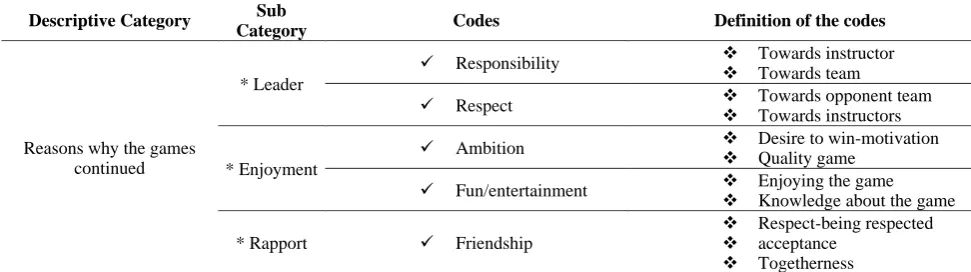
Finally, the participants were asked how they were able to participate in these activities without interruption and the basic reason why these activities became a part of their lives. In fact, the answer to this question also demonstrates how the participants became serious leisure participants for this activity. The responses of participants to this question are shown in Table 3. “Leader, enjoyment and rapport” emerge as the cub categories of the third question.
Table 3. How come do the activities continue this long? How have they become a part of your life?
Descriptive Category Sub
Category Codes Definition of the codes
Reasons why the games continued
* Leader
Responsibility Towards instructor Towards team
Respect Towards opponent team
Towards instructors
* Enjoyment
Ambition Desire to win-motivation Quality game
Fun/entertainment Enjoying the game Knowledge about the game
* Rapport Friendship
Respect-being respected acceptance
Togetherness Some of the responses provided by the participants are given below:
Zidane; «If we did not have an instructor with us, I may not have gone to the games this regularly. At first I went to the games so as not to offend the instructor but then there was no need for the instructor to push me (to go the games)»; Iron Man; «I really like my friends in my team and in the opponent team and o want to spend time with them; beyond the games; I like being with them».
4. Result
When the findings are examined in terms of serious leisure perspective; the characteristics of the participant group are similar to the distinctive characteristics of serious leisure participants (Stebbins, 2009; 2012a; 2007; Isik, 2017).
Galambos, Lee, Rahn, & Williams, 1994; Prescott, 1994; Pegg & Compton, 2003; Stumbo & Pegg, 2004).
Literature review shows that there are many reasons that affect the participation of individuals in leisure time (Ardahan, Turgut, & Kaplan Kalkan, 2016). These reasons can be listed as age, gender, income level, urbanization, time and people's desires and expectations. In this study, the reasons for participation in serious leisure should not be considered apart from the reasons that affect leisure time participation in literature. However, the fact that the activity becomes serious and continuous depends on the characteristics of the activity and the group participants.
5. Discussion
According to themes found in this study; a leader is required for the participants to be a serious leisure participants and to sustain the activity; the activity should include opportunities for the individual to stand out, there must be rapport in the group, and the activity should be enjoyed.
In terms of the general benefits of serious leisure participation, this study provides important clues as to how individuals can be serious leisure participants. Both social media and mass media tools and activities can be used to both create serious leisure participants and to sustain their participation. This study was designed by the researcher and the ethnographic aspects of the participants contributed to the continuity and realization of the research. By similar methods, further studies can investigate in detail how to be serious leisure participants.
References
Aitchison, C. (2003). From leisure and disability to disability leisure: Developing data, definition and discourses. Disability and Society 18:955-69. https://doi.org/10.1080/0968759032000127353
Akyildiz, M. (2013). Ciddi ve Kayıtsız Katılımcıların Kişilik Özellikleri ile Boş Zaman Tatmini ve Yaşam Tatmini Arasındaki İlişki. Doktora Tezi, Anadolu Üniversitesi Sağlık Bilimleri Enstitüsü, Eskişehir.
Ardahan, F., Turgut, T., & Kaplan, K. A. (2016). Her yönüyle rekreasyon. Detay Yayıncılık. Ankara.
Barbieri, C., & Sotomayor, S. (2013). Surf travel behavior and destination preferences: An application of the serious leisure inventory and measure. Tourism Management, 35, 111-121. https://doi.org/10.1016/j.tourman.2012.06.005 Dattilo, J., & Schleien, S. J. (1994). Understanding leisure services for individuals with mental retardation. Mental
Retardation, 32(1), 53-59.
Driver, B. L., Brown, P. J., & Peterson, G. L. (1991). Benefits of leisure. In Preliminary drafts of the chapters in this volume were presented at a workshop of the authors in Snowbird, Utah, May 1989. Venture Publishing.
Flack, W. F. (2006). Peripheral feedback effects of facial expressions, bodily postures, and vocal expressions on emotional feelings. Cognition and Emotion, 20, 177-195. https://doi.org/10.1080/02699930500359617
Galambos, L., Lee, R., Rahn, P., & Williams, B. (1994). The ADA: getting beyond the door. Parks & Recreation (Arlington), 29(4), 66-71.
Godbout, J. (1990). La Participation: Instrument de Professionnalisation des Loisirs. Loisir et Societe/Sciety and Leisure, 9, 33-40. https://doi.org/10.1080/07053436.1986.10715249
Hamilton-Smith, E. (1993). In the Australian bush: Some reflections on serious leisure. World Leisure & Recreation, 35(1), 10-13. https://doi.org/10.1080/10261133.1993.10559134
Harrison, D. (2001). Less developed countries and tourism: The overall pattern. Tourism and the less developed world: issues and case studies, 1-22. https://doi.org/10.1079/9780851994338.0001
Haworth, J. T. (1986). Meaningful activity and psychological models of non-employment. Leisure Studies, 5(3), 281-297. https://doi.org/10.1080/02614368600390211
Heuser, L. (2005). We’re not too old to play sports: The career of women lawn bowlers. Leisure studies, 24(1), 45-60. https://doi.org/10.1080/0201436042000250131
Hutchinson, S. L., & Kleiber, D. A. (2005). Gifts of the ordinary: Casual leisure's contributions to health and well-being. World Leisure Journal, 47(3), 2-16. https://doi.org/10.1080/04419057.2005.9674401
Isik, U. (2017). The Role of Serious Leisure Participation and Hearing Impairment in Recognising Different Emotions (With Dimensions of Personality and Emotional Intelligence). Dumlupinar University Graduate School of Health Sciences, Department of Physical Education and Sports, PhD Thesis, Kutahya.
Kim, J., Dattilo, J., & Heo, J. (2011). Taekwondo participation as serious leisure for life satisfaction and Health, Journal of Leisure Research, 43(4). https://doi.org/10.1080/00222216.2011.11950249
and flow activities.
McBrearty, S., & Stringer, C. (2007). Palaeoanthropology: The coast in colour. Nature, 449(7164), 793. https://doi.org/10.1038/449793a
Patterson, I. (2000). Developing a meaningful identity for people with disabilities through serious leisure activities. World Leisure Journal, 42(2), 41-51. https://doi.org/10.1080/04419057.2000.9674185
Patterson, I. (2001). Serious leisure as a positive contributor to social inclusion for people with intellectual disabilities. World Leisure Journals, 3, 16-24. https://doi.org/10.1080/04419057.2001.9674234
Patterson, I., & Pegg, S. (2009). Serious leisure and people with intellectual disabilities: Benefits and opportunities. Leisure Studies, 28(4), 387-402. https://doi.org/10.1080/02614360903071688
Pegg, S., & Compton, D. M. (2003). Creating opportunities and ensuring Access to leisure and recreation services though Inclusion in the Global Community. Leisure/Loisir, 28(1-2), 5-26.
https://doi.org/10.1080/14927713.2003.9649937
Prescott, G. E. (1994). Leisure as a vocational option for people with disabilities. Leisure Options: The Australian Journal of Leisure and Recreation, 4, 18-23.
Roberson Jr, D. N. (2005). Leisure and learning: An investigation of older adults and self‐directed learning. Leisure/Loisir, 29(2), 203-237. https://doi.org/10.1080/14927713.2005.9651330
Roker, D., Player, K., & Coleman, J. (1998). Challenging the image: The involvement of young people with disabilities in volunteering and campaigning. Disability & Society, 13(5), 725-741. https://doi.org/10.1080/09687599826489 Shen, X. S., Yarnal, C. (2010). Blowing open the serious leisure-casual leisure dichotomy: What’s in there?, Leisure
Sciences, (32), 162-179. https://doi.org/10.1080/01490400903547179
Stebbins, R. A. (1980). “Amateur” and “Hobbyist” as concepts for the study of leisure problems, Social Problems, 27(4), 413-417. https://doi.org/10.2307/800168
Stebbins, R. A. (1993). Social world, life-style, and serious leisure: Toward a mesostructural analysis. World Leisure and Recreation, 35(Spring), 23-26. https://doi.org/10.1080/10261133.1993.10559137
Stebbins, R. A. (1997). Casual leisure: A conceptual statement, Leisure Studies, 16, 17-25. https://doi.org/10.1080/026143697375485
Stebbins, R. A. (2001). The costs and benefits of hedonism: Some consequences of taking casual leisure seriously. Leisure studies, 20(4), 305-309. https://doi.org/10.1080/02614360110086561
Stebbins, R. A. (2005). Choice and Experiential Definitions of Leisure. Leisure Sciences, 27(4), 349-352. https://doi.org/10.1080/01490400590962470
Stebbins, R. A. (2007). Serious leisure: A perspective for our time (Vol. 95). Transaction Publishers.
Stebbins, R. A. (2009). Leisure and consumption: Common ground/separate worlds. Springer. https://doi.org/10.1057/9780230244863
Stebbins, R. A. (2012a). Comment on Scott: Recreation Specialization and the CL-SL Continuum. Leisure Sciences, 34(4), 372-374. https://doi.org/10.1080/01490400.2012.687646
Stebbins, R. A. (2012b).Unpaid Work of Love: Defining the Work-Leisure Axis of Volunteering, Leisure Studies, 1-7. Stumbo, N. J., & Pegg, S. (2004). Choices and challenges: Physical activity and people with disabilities. Annals of
Leisure Research, 7(2), 104-126. https://doi.org/10.1080/11745398.2004.10600945
Sylvester, C. (1999). The classical idea of leisure: Cultural ideal or class prejudice?. Leisure Sciences, 21(1), 3-16. https://doi.org/10.1080/014904099273255
Wearing, S. (2004). Examining best practice in volunteer tourism. Volunteering as leisure/leisure as volunteering: An international assessment, 209-224. https://doi.org/10.1079/9780851997506.0209
Weiler, B., & Hall, C. M. (1992). Special interest tourism: in search of an alternative. Special interest tourism: in search of an alternative, 199-204.
Copyrights
Copyright for this article is retained by the author(s), with first publication rights granted to the journal.