JIEM, 2010 – 3(1): 68-86 – Online ISSN: 2013-0953
Print ISSN: 2013-8423
Estimation of cellular manufacturing cost components using
simulation and activity-based costing
Paul Savory
5REHUW:LOOLDPV
University of Nebraska-Lincoln (USA)
UZLOOLDPV#XQOHGX
Received January 2010
Accepted June 2010
Abstract: It can be difficult estimating all of the cost components that are attributed to a
machined part. This problem is more pronounced when a factory uses group technology
manufacturing cells as opposed to a functional or process layout of a job shop. This paper
describes how activity-based costing (ABC) concepts can be integrated into a
discrete-event simulation model of a U-shaped manufacturing cell producing a part family with
four members. The simulation model generates detailed Bills of Activity for each part type
and includes specific information about the cost drivers and cost pools. The enhanced
model output can be used for cost estimation and analysis, manufacturing cell design, part
scheduling and other manufacturing decision processes that involve economic
considerations. Although the scope of this effort is restricted to a small scale
manufacturing cell, the costing concepts have general applicability to manufacturing
operations at all levels.
Keywords: simulation, activity-based accounting, cost estimation, cellular manufacturing,
group technology
1 Introduction
JIEM, 2010 – 3(1): 68-86 – Online ISSN: 2013-0953
Print ISSN: 2013-8423
are routed around the shop in small batches through a functional process layout. This type of layout and production system involves similar types of machines being grouped into physically separate areas of a facility.
One of the more effective methods for a traditional job shop to improve its manufacturing efficiency is through the application of group technology. Group technology is a manufacturing philosophy that takes advantage of the similarities in the design and manufacturing attributes of production parts (Groover, 1987). Similar parts are grouped together into part families. Efficiency is gained by arranging the production equipment into manufacturing cells to facilitate work flow and reduce the inherent inefficiencies of batch production (Groover, 1987; Dhavale, 1993). In a comparison of a traditional job shop to a manufacturing cell using group technology, Flynn and Jacobs (2007) found that the group technology design, on average, had shorter setup times, lower machine utilization, and shorter distances traveled.
However, the efficiency gained with cellular manufacturing may not be accurately reflected in the product costs if the company uses the traditional accounting practices of a typical job shop environment (Dhavale, 1992). Today’s manufacturing processes are much more automated and the direct labor percentage is therefore significantly reduced. Additionally, overhead costs have greatly increased. The traditional volume-based costing (VBC) methods are less meaningful with this increase in the relative amount of non-direct costs (Barth, Livet, & De Gui, 2008; Harrison and Sullivan, 1996). Moreover, an operator may tend to several machines at one time and may perform tasks such as inspection and maintenance that are considered indirect labor. This makes it difficult to account for all of an operator’s time and to partition the cost spent only on direct labor (Dhavale, 1992).
JIEM, 2010 – 3(1): 68-86 – Online ISSN: 2013-0953
Print ISSN: 2013-8423
various capacity, resource, and product mix scenarios. Discrete-event simulation is one of the best techniques to study and compare these scenarios. Usually simulation focuses on evaluating system performance variables such as resource utilization, inventory levels, and throughput time. A cost analysis is typically performed separately of the simulation model development. This research highlights the integration of the two.
There are three methods for incorporating cost estimation with simulation (Savory, Williams, & Rasmussen, 2001). The first involves incorporating costing extensions into the simulation language or package. An example of this would be the commercially-available simul8 simulation software. A disadvantage is that many times only superficial costing information is presented and the specific details of how the costs are determined are unknown to the modeler. The second approach involves developing costing estimates off-line during a post-processing step that uses the final system performance measures generated by the simulation. This is the most common approach in that a modeler takes the simulation results and converts them to costs. A disadvantage is that costing estimates are developed based on aggregate simulation data and often times does not account for the underlying randomness and variability of part processing and system interaction. A final approach incorporates costing routines directly into the simulation model and collects data on-line during the execution of the model. As this research will highlight, one of its key advantages is that non-allocated costs associated with idle time can be tracked.
JIEM, 2010 – 3(1): 68-86 – Online ISSN: 2013-0953
Print ISSN: 2013-8423
2 Uses of activity-based costing and simulation
John Deere & Company is credited with coining the term “activity-based costing” in 1984. A pilot study at their Component Works division showed that ABC resulted in more competitive bidding and transfer pricing, better process scheduling, and more efficient machine configuration (MacArthur, 1992). They also found that ABC provided more accurate costs of individual castings due to the overhead assignment based on manufacturing activities in comparison to their previous system of allocating overhead based on direct labor hours.
The concept of ABC is based on the realization that products require businesses to perform activities (work generating processes or procedures). Those activities in turn drive the business to incur associated costs. These costs fall into two general categories: (1) costs directly tied to a product flow, and (2) those costs not tied to a product flow. Costs that are traceable to a product flow are ultimately assigned to the product (Barth et al., 2008). The costs not associated with product flow are assigned to the activities that make the costs necessary (Williams, Savory, & Rasmussen, 1997; Hicks, 1992).
Harrison and Sullivan (1996) highlight the difference between ABC and the traditional VBC for a manufacturing system with four products. Their example shows that VBC undercosts three of the items and overcosts the fourth. The authors also found that as overhead increased, the cost methodology became more important. Absolute differences in unit product costs increased with higher overhead. Shields and McEwen (1996) surveyed over 140 companies regarding the objectives and results of implementing ABC. The majority of the respondents listed better cost information as their original objective. When asked about the future goals for their ABC system, product costing was the most common response.
JIEM, 2010 – 3(1): 68-86 – Online ISSN: 2013-0953
Print ISSN: 2013-8423
programming model which utilized ABC information to determine optimal product mix and product cost in a multi-product manufacturing environment. They found that their approach, which incorporated more specific information on indirect cost consumption, produced different results when compared to the traditional costing system.
3 Description of the manufacturing cell
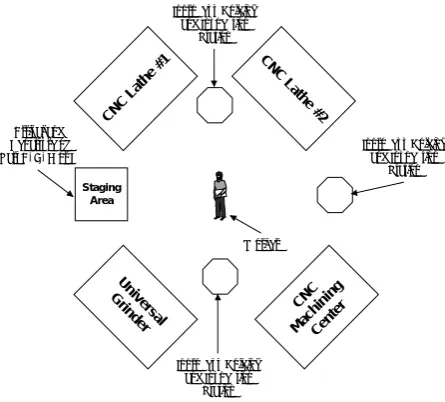
The manufacturing efficiency of a company that uses low volume batch production can be improved by rearranging the equipment into cells to facilitate work flow (Groover, 1987). A hypothetical manufacturing cell and part family were considered. The cell is abstracted from a real manufacturing system and contains issues significant in most production environments (e.g., breakdowns, part routings, preventive maintenance, batch processing). The cell is shown in Figure 1 and represents a typical U-shaped or loop layout. The cell consists of four machines: two identical computer numerically controlled (CNC) lathes, one CNC machining center, and one universal grinder. The first lathe contains all tooling and fixtures to machine one side of a rotational part, while the second lathe is used to machine the opposite side of the part.
Staging Area
Un iversa
l G
rin de
r
CNC Mac
hinin g
Cen ter CNC
L at
he # 2 CNC
Lat he #
1
Arrival and Departure of Part A, B, C or D
Inprocess Holding and Inspection
Station
Inprocess Holding and Inspection
Station Worker
Inprocess Holding and Inspection
Station
Figure 1. “U-shaped cell configuration”.
JIEM, 2010 – 3(1): 68-86 – Online ISSN: 2013-0953
Print ISSN: 2013-8423
for parts on all four machines. The operator processes requests on a in, first-out basis with no pre-emption. In such an implementation, there is the potential that production time on one machine is lost while the worker is completing a task on another machine.
Table 1 shows the purchase price, useful life, and other pertinent data of the four machines comprising the cell. In addition to the machine costs, direct and indirect labor rates were assumed to be $12 per hour with a 30 percent benefit rate. Hourly preventative and repair maintenance rates (including parts and labor) were assumed to be $50 and $200, respectively. All costs are in US dollars.
Machine Purchase
Cost Life In Years Consumption Power Utility Rate Consumables Rate CNC Lathe #1 $120,000 10 20 kilowatts $0.04/hour $2.00/hour CNC Lathe #2 $120,000 10 20 kilowatts $0.04/hour $2.00/hour CNC Machining Center $100,000 10 25 kilowatts $0.04/hour $2.50/hour Universal Grinder $ 80,000 10 15 kilowatts $0.04/hour $1.75/hour
Table 1. “Machine cost and usage information”.
The part family consists of four part types (A, B, C and D) each requiring different processing sequences. Part arrivals to the cell occur in homogeneous batches of a specific part type. Batch sizes for each part type and the sequence for processing are shown in Table 2. Batch arrivals occur based on an exponential distribution with a mean of four hours and forty minutes. Part type determination is based on production mix requirements of 30% type A, 20% type B, 40% type C, and 10% type D.
Production Sequence
Part Type Batch Size CNC Lathe #1 CNC Lathe #2 CNC Machining Universal Grinder
A 4 1 2 3 4
B 3 1 2 N/A 3
C 6 1 2 3 N/A
D 2 1 2 N/A N/A
Table 2. “Part family characteristics and sequence of stations for each part type”.
The cell operates for two consecutive eight-hour shifts over a six-day work week. Production scheduling is based on completing at least 1080 part type A’s, 720 part type B’s, 1440 part type C’s, and 360 part type D’s within 51 weeks of annual operation.
JIEM, 2010 – 3(1): 68-86 – Online ISSN: 2013-0953
Print ISSN: 2013-8423
same part type as the current batch, then a short setup is accomplished, otherwise a long setup is performed. The notion of the short setup takes advantage of the much fewer tooling changeovers required with similar part types. The probability distributions for the short and long setup times at each station are:
• CNC Lathe #1 and CNC Lathe #2 – Long: TRIANGULAR(30,60,90) minutes,
• CNC Lathe #1 and CNC Lathe #2 – Short: TRIANGULAR(30,60,90)/4 minutes,
• CNC Machining – Long: TRIANGULAR(30, 45, 60) minutes,
• CNC Machining – Short: TRIANGULAR(30, 45, 60)/4 minutes,
• Universal Grinder – Long: TRIANGULAR(20,40,60) minutes,
• Universal Grinder – Short: TRIANGULAR(20,40,60)/4 minutes.
All other times within the cell are based on actions involving individual parts rather than batches. After the batch setup is done, an individual part is selected, moved to the machine, loaded, processed, unloaded, moved to the in-process inspection station, and inspected. This cycle is accomplished at each station until all parts within the batch are complete. Distributions representing part loading, unloading and inspection times were common to all four station:
• Part Loading Time: NORMAL(3, 0.5) minutes,
• Part Unloading Time: NORMAL(2,0.25) minutes,
• Part Inspection Time: UNIFORM(1.5,2.0) minutes.
Part processing time distributions (the same for each part type) at each station are:
• CNC Lathe #1: TRIANGULAR(10, 15, 20) minutes,
• CNC Lathe #2: TRIANGULAR(10, 15, 20) minutes,
• CNC Machining: TRIANGULAR(10, 20, 30) minutes,
JIEM, 2010 – 3(1): 68-86 – Online ISSN: 2013-0953
Print ISSN: 2013-8423
Material handling or move times are based on distances between the various stations and the time for the respective operator to travel from one point to another. Because of the small distances, the material handling times, on the order of 15 to 20 seconds, are relatively small in comparison to other times considered within the cell.
4 Development of cost drivers and activity centers
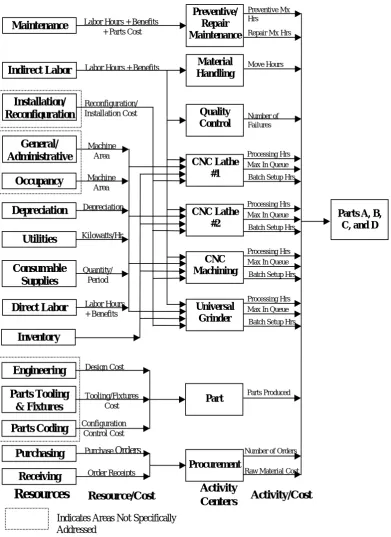
Since activities require resources to be consumed and products require activities to be performed, an ABC implementation is designed as a two-stage process. The first stage transfers costs associated with resource consumption and support to activities, while the second stage allocates activity costs to products. The mechanisms used to transfer costs at the first stage are called first-stage cost drivers or resource drivers. At the second stage, they are referred to as second-stage cost drivers or activity drivers. The production of parts, for example, requires raw materials, batch setups, material handling, and processing. Each of these require resources in terms of purchasing and receiving actions, indirect labor, direct labor, machine usage with associated depreciation costs, consumable supplies, and electrical power. As such, cost drivers are the metrics used to translate resource consumption, support, and activity into costs for allocation at the appropriate level (Williams et al., 1997).
JIEM, 2010 – 3(1): 68-86 – Online ISSN: 2013-0953
Print ISSN: 2013-8423
Indirect Labor
Activity
Centers
Activity/Cost
Resource/Cost
Resources
Receiving
Purchasing
Inventory
Direct Labor
Utilities
Depreciation
Occupancy
Installation/
Reconfiguration
Consumable
Supplies
General/
Administrative
Procurement Material Handling Quality Control CNC Lathe #1 CNC Lathe #2 CNC Machining Universal Grinder PartEngineering
Parts Coding
Parts Tooling
& Fixtures
Maintenance
Preventive/ Repair Maintenance Labor Hours + Benefits+ Parts Cost
Reconfiguration/ Installation Cost Labor Hours + Benefits
Machine Area Machine
Area
Order Receipts Purchase Orders
Configuration Control Cost Tooling/Fixtures Cost Design Cost Labor Hours + Benefits Quantity/ Period Kilowatts/Hr Depreciation
Parts A, B, C, and D
Indicates Areas Not Specifically Addressed
Repair Mx Hrs Preventive Mx Hrs
Raw Material Cost Number of Orders
Parts Produced Batch Setup Hrs Processing Hrs Number of Failures Move Hours
Max In Queue
Batch Setup Hrs Processing Hrs Max In Queue
Batch Setup Hrs Processing Hrs Max In Queue
Batch Setup Hrs Processing Hrs Max In Queue
Figure 2. “Activity-based costing representation for the manufacturing cell”.
JIEM, 2010 – 3(1): 68-86 – Online ISSN: 2013-0953
Print ISSN: 2013-8423
the effort had been developed for an existing manufacturing facility, this information would have been available and could easily be included.
A total of nine activity centers are specified. Each machine in the cell is designated as its own activity center. Other activity centers are designated for maintenance, material handling, quality control, part and procurement. These activity centers are required in order to provide detailed manufacturing cost estimates.
While Figure 2 provides an overview of how costs are transferred, an ABC implementation requires specific cost transfer mechanisms to be defined in terms of mathematical equations. Equations for cost terms include: (1) the accumulation of all costs to provide the per unit cost for part type i (A, B, C, or D); (2) the per unit development cost for part type i; (3) the per unit procurement cost for part type i; (4) the within-cell per unit material handling costs for part type i; (5) the per unit inspection/quality control cost for part type i; (6) the per unit maintenance cost based on part family; (7) the per unit production cost for part type i on machine j (CNC Lathe #1, CNC Lathe #2, CNC Milling Machine, Universal Grinder), and (8) the per unit inventory costs for machine j. The specific equations are:
( )
(
)
( )
( )
( )
(
)
( )
(
)
( )
(
)
(
)
[
]
( )
( )
8 7 * * * 1 6 * * 1 5 * * 1 4 * 1 3 * * 2 1 1 * , ∑ + + + + + + + + + = + = + = = + = + + = + + + + + = =∑
∑
∑
∑
∑
∑
∑
∑
i i a I j I j I j ij j j ij ij j j j j j j i ij j j j i i j ij j i i i ij j i i i i i i i i i i i i i j ij i i i i i su cs lsu dsu lp lp p cs p dp ir oc ga a p rm rm pm pm a mx p qc qc lqc a qc mh lmh a mh a q m o op m t c e lt dv p mx qc mh m dv pc N R N C T R R R T R T R R R R R R N C T R T R N C N R T R N C T R N C N N R N R C C C C N C C C C C C C C j
JIEM, 2010 – 3(1): 68-86 – Online ISSN: 2013-0953
Print ISSN: 2013-8423
A (cdvA), the per unit procurement costs of part type A (cmA), the per unit material handling cost of part type A (cmhA), the per unit inspection/quality control cost for part type A (cqcA), the per unit maintenance cost (cmx), and the per unit production cost for part type A on machines 1, 2, 3, and 4 (∑cpAj). As discussed in the next section, these cost components are collected and recorded during the execution of the simulation model.
5 Simulation model development
A discrete-event simulation model of the manufacturing cell was developed in the SIMAN simulation language. Parts (entities) arrive in batches to CNC Lathe #1 (according to Table 2). Upon a batches arrival, the operator and machine are occupied for a set-up time. Depending upon if the batch type is the same as the previous batch, a long or short set-up delay occurs (triangular distribution). After the machine is set-up, the operator loads an individual part on the machine (normal distribution) and the part is processed (triangular distribution). During the part processing, the operator is free to attend to other activities in the cell. After processing is complete and the operator is free, the part is unloaded (normal distribution) and inspected (uniform distribution). Once all the parts in a batch are processed, the batch can be moved to CNC Lathe #2. Each of the machining stations operates similar to this first one. The specific parameter values for the probability distributions are described in Section 2.
The stochastic or random components of the simulation model include: time between batch arrival, part type per batch, load time for a part on a machine, set-up time for a part on a machine, processing time for a part on a machine, unload time for a part at a machine, inspection time of a part, time to complete a preventive maintenance (partial and full), time between a machine failure, and time for a machine repair.
JIEM, 2010 – 3(1): 68-86 – Online ISSN: 2013-0953
Print ISSN: 2013-8423
time, and part movement time. When all processing is complete on a part (entity), the information is accumulated in a set of SIMAN variables by part type and machine in order to establish costs.
The simulation program also determines non-allocated costs. Examples would include operator idle-time costs and unused or excess capacity costs. Operator idle-time costs reflect the amount of time that the operator is not busy moving parts, loading or unloading the machines, performing setups, or inspecting parts. Unused capacity costs are based on machine depreciation and the difference between actual and scheduled production time. In a perfect scheduling environment there would be no unused capacity costs. However, anytime production is finished prior to the scheduled completion, there is a portion of the depreciation costs that are unallocated. This can be viewed as an opportunity since excess capacity can be used for processing other products or completing other tasks.
All data collection and cost estimation is performed using the constructs of the SIMAN simulation language. There is no user-written inserts or code linked into the simulation model. To achieve this, SIMAN blocks/variables such as MREP, NREP, WRITE, READ, and WHILE were used. The only SIMAN summary statistics used by the cost accounting procedure are related to preventive and repair maintenance actions. In these instances, frequency times and totals were used to establish the total time for each type of maintenance action.
A total of thirty replications were run for the simulation model of the manufacturing cell. Each replication of the model simulates 51 weeks of operation. After each replication is complete, the model writes the accumulated costing information to a data file. After the thirtieth replication, all of the information from the data file is read back into the simulation model and used to calculate estimates for the cost parameters. The simulation model next generates a Bill of Activity for the part family, for each part type, and for each major activity center.
6 Costing results and analysis
JIEM, 2010 – 3(1): 68-86 – Online ISSN: 2013-0953
Print ISSN: 2013-8423
simple cost estimates, the model only reports the mean cost for the 30 replications rather than generating and reporting confidence intervals. The average manufacturing cost per unit is $35.38. The average total and per unit costs are listed for each of the main activity centers of the cell. One key feature of this Bill of Activity is the estimated non-allocated cost associated with operator idle time. The average idle time cost for the operator for the simulated 51 weeks is $17,393.73.
Figure 3. “Part family bill of activity with non-allocated costs”.
Figure 4. “Bill of activity for part type A”
JIEM, 2010 – 3(1): 68-86 – Online ISSN: 2013-0953
Print ISSN: 2013-8423
manufacturing cost per unit for part A ($41.91) is significantly higher than the average cost per unit for the entire family ($35.38). This is due to the fact that part A’s processing sequence includes all of the four machines in the cell. The other part family members only require processing at two or three machines and have less cost. Similar bills are generated by the simulation for each of the other part types.
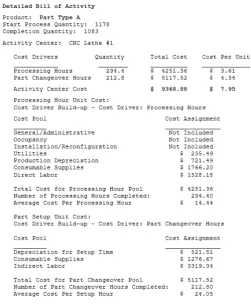
Figure 5. “Detailed bill of activity for part type a showing CNC lathe #1 activity center”.
JIEM, 2010 – 3(1): 68-86 – Online ISSN: 2013-0953
Print ISSN: 2013-8423
indirect labor. This type of detailed costing information is generated by the simulation model for each part type and each activity center.
7 Conclusion
The application of group technology part families and manufacturing cells is an effective method for improving manufacturing operations. However, the improved manufacturing efficiency may not be fully reflected with traditional volume-based costing (VBC) methods. This research demonstrates the positive integration of activity-based costing (ABC) with a discrete-event simulation model to provide more accurate estimates of manufacturing cost components. Key outcomes include: (1) reviewing how cost estimation and simulation can be combined, (2) integrating activity-based costing concepts into the discrete-event simulation model of a hypothetical U-shaped manufacturing cell, (3) having the simulation model produce detailed bills of activity that break down part manufacturing costs for each activity performed within the cell during the processing of the part family, and (4) developing estimates of the non-allocated costs such as operator idle-time costs and unused or excess capacity costs.
For an analysis technique to be useful, the output it produces must be understandable to all levels of an organization. Barth et al. (2008) comments, “The accurate evaluation of production costs has become absolutely essential for companies today.” While simulation models traditionally help in the estimation of production metrics such as machine utilization, processing time, and throughput times, the cost of a system/part is a universal performance characteristic. By integrating ABC concepts with simulation, the added costing information provides an economic assessment of the system being evaluated and allows better decisions to be made at all levels of an organization (O’Loughlin, Driskell, & Diehl 1990).
JIEM, 2010 – 3(1): 68-86 – Online ISSN: 2013-0953
Print ISSN: 2013-8423
simulation model can supplement traditional performance metrics with costing information for determining the best system configuration with the appropriate labor resource level.
Appendix - Nomenclature for Terms in Cost Equations
Time:
Tlp ij
Tp
Total labor time for production (load and unload) of part types i processed on machine j
ij
Tsu
Total machine time for production (load, process, and unload) of part types i processed on machine j
ij
Tqc
Total time for batch setup (change over) for part types i processed on machine j
ij
Tmh
Total time for quality control inspection for part types i completing processing on machine j
ij
Tpm
Total move time for part types i processed on machine j
j
Trm
Total time for preventive maintenance on machine j
j Total time for repair maintenance on machine j
Rates:
Rdp j
Rdsu
Depreciation/production hour for machine j
j
Rlp Labor rate for production activities (loading and unloading parts) Depreciation/setup hour for machine j
Rlsu Labor rate for batch setup activities Rlqc Labor rate for quality control inspections Rlmh Labor rate for material handling
Rcs j
Rga
Consumable supplies rate for machine j
j
Roc
General/Administrative cost/hour for machine j (based on scheduled hours)
j
Rir
Occupancy cost/hour for machine j (based on scheduled hours)
j
Rp
Installation/Reconfiguration cost for machine j
j
Rqc Inspection cost/inspection following machine j
Operating cost/hour for machine j
JIEM, 2010 – 3(1): 68-86 – Online ISSN: 2013-0953
Print ISSN: 2013-8423
Rm i
RI Inventory overhead rate per part
Raw material cost per batch for part type i
Quantities: Nq ij
Np
Number of batches of part i processed on machine j
ij
Na
Number of units of part i processed on machine j
i
No
Number of part type i to enter processing
i
Nlt
Number of orders for part i
i
NI
Estimated number of part type i to be produced over product life cycle
j Maximum number of parts waiting in the machine j queue
Costs: Cpc i
Cm
Per unit cost for part type i
i
Cp
Per unit procurement cost for part type i
ij
Cmh
Per unit production cost for part type i on machine j
i
Cmx
Per unit material handling cost for part type i
Cdv
Per unit maintenance cost
i
Cqc
Per unit development cost for part type i
i
Ce
Per unit inspection/quality control cost for part type i
i
Cc
Total cost for part family engineering development
i
Ct
Total cost for part family codification
i
CI
Total cost for part family tooling and fixtures
j
References
Per unit inventory overhead cost for machine j
Barth, M., Livet, A., & De Gui, R. (2008). Effective activity-based costing for manufacturing enterprises using a shop floor reference model. Journal
International Journal of Production Research, 46 (3), 621 – 646.
Dhavale, D.G. (1992). Activity-based costing in cellular manufacturing systems.
Industrial Engineering, 24, 44-46.
Dhavale, D.G. (1993). Activity-based costing in cellular manufacturing systems.
JIEM, 2010 – 3(1): 68-86 – Online ISSN: 2013-0953
Print ISSN: 2013-8423
Emblemsvag, J. (2003). Life-cycle costing: using activity-based costing and monte
carlo methods to manage future costs and risk. New York: John Wiley & Sons.
Flynn, B.B, & Jacobs, F.R. (2007) Applications and implementation: an experimental comparison of cellular (group technology) layout with process layout. Decision Sciences, 18(4), 562–580.
Groover, M. (1987). Automation, production systems, and computer integrated
manufacturing. New Jersey: Prentice-Hall.
Harrison, D.S., & Sullivan, W.G. (1996). Activity-based accounting for improved product costing. Engineering Valuation and Cost Analysis, 1, 55-64.
Helberg, C., Galletly, J.E., & Bicheno, J.R. (1994). Simulating activity-based costing. Industrial Management & Data Systems, 94(9), 3-8.
Hicks, D.T. (1992). Activity-based costing for small and mid-sized businesses: an
implementation guide. New York: John Wiley & Sons.
Lere, J.C., & Saraph, J.V. (2006). Activity-based costing for purchasing managers' cost and pricing determinations. Journal of Supply Chain Management. 31(4),
25-31.
MacArthur, J.B. (1992). Activity-based costing: how many drivers do you want?
Cost Management, Fall 1992, 37-41.
Malik, S.A., & Sullivan, W.G. (1995). Impact of abc information on product mix and costing decisions. IEEE Transactions on Engineering Management, 42, 171-176.
Mangan, T.N. (1995). Integrating an activity-based cost system. Cost Management, Winter 1995, 5-13.
Michalska, J., & Szewieczek, D. (2007). The improvement of the quality management by the activity-based costing. Journal of Achievements in Materials
JIEM, 2010 – 3(1): 68-86 – Online ISSN: 2013-0953
Print ISSN: 2013-8423
Özbayrak, M., Akgün, M., & Türker, A.K. (2004). Activity-based cost estimation in a push/pull advanced manufacturing system. International Journal of Production
Economics, 87(1), 49-65.
O'Loughlin, M.J., Driskell, M.K., & Diehl, G. (1990). Financial simulation: combining cost information in systems analysis. Proceedings of the 1990 Winter Simulation
Conference, 578-581.
Raab, C., Shoemaker, S., & Mayer, K.J. (2007). Activity-based costing: a more accurate way to estimate the costs for a restaurant menu. International Journal of
Hospitality & Tourism Administration, 8(3), 1-15.
Savory, P.A., Williams, R.E., & Rasmussen, R.R. (2001). Combining activity-based costing with the simulation of a cellular manufacturing system. Journal of Design
and Manufacturing Automation, 1(3), 221-229.
Shields, M.D., & McEwen, M.A. (1996). Implementing activity-based costing systems successfully. Cost Management, Winter 1996, 15-22.
Spedding, T.A., & Sun, G.Q. (1999). Application of discrete event simulation to the activity based costing of manufacturing systems. International Journal of
Production Economics, 58(3), 289-301.
Williams, R.E., Savory, P.A., & Rasmussen, R.R. (1997). An integrated approach to simulation and activity-based costing for evaluating alternative manufacturing cell designs. Transactions of the XXV North American Manufacturing Research
Institute of the Society of Manufacturing Engineers, 263-267.
©© Journal of Industrial Engineering and Management, 2010
Article's contents are provided on a Attribution-Non Commercial 3.0 Creative commons license. Readers are allowed to copy, distribute and communicate article's contents, provided the author's and Journal of Industrial Engineering and Management's names are included. It must not be used for commercial purposes. To see the complete