Journal of Applied Linguistics and Language Research Volume 4, Issue 2, 2017, pp. 106-114
Available online at www.jallr.com ISSN: 2376-760X
* Correspondence: Gholam Reza Ravand, Email: ghrravand47 gmail.com © 2017 Journal of Applied Linguistics and Language Research
The Effects of Project-oriented Tasks on Iranian Intermediate
EFL Learners’ Learning Motivation
Masoud Khalili Sabet
Assistant Professor, Department of English Language and Literature, University of Guilan, Rasht, Iran
Gholam Reza Ravand *
MA Student, Department of English Language and Literature, University of Guilan, Rasht, Iran
Abstract
This study sought to examine the effects of project-based learning (PBL) approach on the Intermediate EFL students’ learning motivation. To this end, a sample of 43 male students was selected from an English language institute in Rasht, Iran. Subjects were randomly assigned into one of the two groups: the experimental group and the control group. Using research instruments such as OPT, it was ensured that all subjects were at the same level of English proficiency. The experimental group received the PBL method; however, the control group was exposed to conventional teaching method. In order to figure out whether or not the motivation of the students underwent any considerable change during the course, a version of Gardner's Motivation Test Battery (MTB) questionnaire was given to the participants of the two groups, both at the beginning and at the end of the course. When compared with the first grades, the final grades of the experimental group proved to be a lot higher than those of the control group.
Keywords: learning motivation, project, project-based learning
INTRODUCTION
exist an approach to enhance their motivation to make them take further steps forward. Project-based Learning has proved to qualify for this purpose, and meet the goal fairly properly.
PBL focuses on applying the research process in teaching and learning activities developing learners' skills such as problem-solving and collaborative skills. Moreover, PBL can help learners improve their social skills, strive to become able to accept and handle the responsibility for their own learning which they keep within their control. The core idea of project-based learning is that as the students acquire and apply new knowledge in a problem-solving context, most of their interest is captured by real-world problems and provoked by serious thinking.
Although, in project-based learning, projects are intended to be the basic means to instruct, there are not any criteria that are commonly shared for the acceptable project constituents that differ a lot in exploring the depth of the questions, how clear the learning goals are, the content and structure of the activity, and the guidance that the students receive from their teacher. In the overall curriculum, the role of projects is left open to interpretation. Projects can direct the whole curriculum or simply comprise a few scattered hands-on activities. In elementary schools, projects might be multidisciplinary or single-subject (commonly science and math). Some projects are designed for the whole class, some others for small groups, and still some for individual students. Very seldom has project-based teaching been fully realized widespread in mainstream public schooling.
Being unaware of or unfamiliar with this approach on the part of most Iranian teachers has been giving persistent trouble to them as well as their students. Most of the teachers are unfamiliar with this approach and some are afraid of implementing it in their classes, while the students, on the other hand, do not have any motivation to study. It is worth mentioning that such a research has not been undertaken yet, and the researcher has had in mind to brighten new ways for the Iranian academic body to achieve success, and has put much effort in this paper for the sake of Iranian students’ progress.
RESEARCH QUESTION AND HYPOTHESIS
RQ: Can Iranian Intermediate EFL learners' learning motivation be enhanced by using a PBL approach?
H0: PBL does not have a significant effect on Iranian Intermediate EFL learners' learning motivation.
REVIEW OF THE RELATED LITERATURE
the material, not just pass tests? These are age-old, important questions of educators and continue to be the central issues in psychological researches. Motivational questions are often studied in isolation from questions of thinking and learning; however, the job of the teacher requires an integration of these two related, but often distinct, areas of study. If one of the important schooling goals is to foster the development of students’ minds by engaging them in sophisticated and substantial opportunities, for deep understanding of curricular content, then, educators must concern themselves with motivational questions that examine how students engage in and persist at such activities (Blumenfeld, Soloway, Marx, Krajcik, & Palincsar, 1991) It was mentioned above that the system of educating Iranian students lacks the appropriate method or approach, in the same vein, Zare-Behtash, Khoshsima, and Ahmadi (2016, p. 167) assert that “since the Iranian students are far from the native context and most of their learning happens in the classroom, application of an appropriate teaching method increases motivation, self-confidence, autonomy, and...”. They also emphasize that “the well-organized teaching method is necessary to enhance speaking skill by endorsing self-confidence, motivation, and …” (p. 168). Finally, they conclude that since the students were happy due to fun learning environment which decrease the learning-related anxiety, PBL increased motivation, self-confidence … (p. 174).
It is suggested that teachers should create a learning environment to inspire students’ learning motivation, and develop students’ critical thinking ability (Adi Yununto, 2015, p.4). Cited by Adi Yununto, Nassir (2015) asserts that Project-based learning strategy increases students' motivation to learning and raises the degree of competition among students.
Searching for organizing principles of instruction and curriculum that attend to critical relations between motivation and thinking, researchers have recurrently returned to the idea of projects, relatively long-term, problem-focused, and meaningful units of instruction that integrate the concepts from a number of disciplines, or fields of study. Projects do have the potential to help people learn, indicate factors that affect motivation and thought, examine difficulties that students and teachers may encounter with projects, and describe how technology can support students and teachers as they work on projects. (Blumenfeld, et al, 1991)
PBL students generate explanations that are more accurate, coherent and comprehensive than non PBL students. They transfer the reasoning strategies that they are taught and are more likely to use science concepts in their explanations. The effect is still much stronger for the first time PBL students. (Hmlo, 1998) However not all studies have found in favor of PBL.
In the same way, Dambrauskas (2012) holds that good PBL students should ensure that they:
have a knowledge of the PBL process;
have commitment to self/student directed learning;
have active participation in discussion and critical thinking while contributing to a friendly non-threatening environment;
possess kind of willingness to make constructive evaluation of self, group and tutor.
The discussion on motivation is so significant a key-issue that “it has been studied and defined by a number of learning scholars. As far as Keller (1983) is concerned, motivation "refers to the choice people make as to what experiences or goals they will approach or avoid and the degree of effort they will exert in that respect" (p. 389). In a similar vein, as fundamental to his social-psychological model, Gardener (1985) considers motivation the combination of three factors, namely the learners' efforts to learn, their desires to achieve this goal, and their favorable attitudes towards it. Chastain (1990) also defines motivation as "some incentive that causes the individual to participate in an activity leading towards a goal and to persevere until the goal is reached" (p. 172). He classifies it into three types, viz. cognitive drive, ego enhancement, and social affiliation. The first, in this framework, is the outcome of a desire to learn, the second is a means of enhancing self-concept, and the third is the result of a desire to integrate with the members of a speech community.” (Maftoon, Birjandi, & Ahmadi, 2013, p. 1631)
METHODOLOGY
The contemporary sedentary methods of ESL/EFL had better evoke the students to do something practical to enhance their various skills in the course of language learning. PBL offers this to those learners who have always hated getting stuck on a seat for one and a half hours in traditionally taught classes. PBL was improved for those learners who can volunteer to do some individual/ collaborative project by using their talents, physical abilities and mental capabilities. Needless to say that this method must soon find its way through the Iranian school/university curricula, and be popularized in academic levels since research has validated that during the school years, the Iranian students’ accomplishment in language learning has seldom-if never-been satisfactory enough. Therefore, the curriculum designers are strongly recommended to make use of this method, and put some projects in the syllabus of –at least-high school years to get the students involved in the language learning process so that they would modify their attitude and get motivated to take some steps towards the goals set for them depending on their present knowledge, and hoping to further their success and better their English.
Participants
experimental groups, and were soon divided into two groups of 23 (control group) and 20 (experimental group).
Instruments
To answer the research questions, the following instruments were made use of: First, an OPT (Oxford Placement Test): To see whether or not the students were all at the same level. Second, a Motivation Questionnaire: To measure how motivated the learners were in English.
OPT (Oxford Placement Test)
First of all, an OPT (Oxford Placement Test) containing 100 multiple choice questions ranging from below elementary to Advanced level was administered at the outset of the study. The levels were as follows: Below Elementary, Elementary, Pre-intermediate, Intermediate, Upper Intermediate, and Advanced.
A Motivation Questionnaire
A modified version of Gardner's Attitude/Motivation Test Battery (AMTB) questionnaire on a 5-point Likert scale from 'strongly disagree' to 'strongly agree' including 25 items was given to the participants in the first session, in order to measure their motivation. Since it was intended to measure and compare the learners' learning motivation, the attitude section of Gardner's Test Battery was removed from the test. In order to have a comparison between the learners’ learning motivation scores between the first and last sessions, the test was also administered in the last session.
Research Design
A mixed method approach was designed to help interpret and explain the results gained or changed in various stages of implementing PBL through the use of different research instruments. Based on the purpose of the research, the current study employed seceral quantitative and qualitative instruments to investigate the way in which PBL can enhance Iranian EFL learners' motivation.
Procedure
questionnaires which contained 25 questions. Having collected the data, the researcher reported it in percentage terms, tabulated and then analyzed them based on statistical figures. The comparison of opinions of the two groups (experimental and control) revealed notable points that are reflected in the relevant sections. The results were analyzed with the help of a statistician. The analyses revealed that most of the motivation scores in the experimental group had considerably increased, and were a lot higher than those of the learners in the control group.
Methods of Data Analysis
This paper reports on a one-cycle action research conducted at two intermediate classes at a private English institute in Rasht. The study aimed to find out whether PBL could have any positive effect on the intermediate language learners to improve their motivation.
RESULTS AND DISCUSSION
In order to compare the Motivation Data in the control and experimental groups, the Kolmogorov-Smirnov and Shapiro-Wilk Tests were reviewed to check the normality of the data, and in both cases the Normality Hypothesis was approved. Therefore, a T-Test was conducted to compare the data. First the Pre-Test data was compared using a T-Test, and there was not any significant difference between the Pre-Test means in the two groups, but when the Post-Tests in the two groups were compared using an independent T-Test, there happened to be a considerable difference between the control and experimental groups. The results indicate that the data mean of the Post-Test in experimental group is bigger than that of the control group. Meanwhile the mean difference of the Pre-Test and Post-Test in the two groups were compared, indicating that the mean difference in the experimental group was bigger as well.
Statistical Inference and Hypothesis Testing for Motivation Data
Examining the Normality of Motivation Data Using Kolmogorov-Smirnov and Shapiro-Wilk Tests
Table 1. Investigation of Normality of the Motivation Data
Group Motivation Score N Skewness Kurtosis
Statistic Std. Error Statistic Std. Error
Control First Score 23 .380 .481 -.884 .935
Last Score 23 .300 .481 -.444 .935
Experimental First Score 20 .502 .512 -.449 .992
Last Score 20 -.111 .512 -.690 .992
In the table above, Skewness and Kurtosis were calculated for motivation scores. Since Skewness and Kurtosis of investigated parameters are in the range (-2, 2), they will probably have a normal distribution.
Table 2. The Normality of the Motivation Data for the First and Last Scores
Group Kolmogorov-Smirnova Shapiro-Wilk
Statistic df Sig. Statistic df Sig.
First Score Control .114 23 .200* .943 23 .204
Experimental .128 20 .200* .944 20 .285
Last Score Control .158 23 .141 .965 23 .563
Experimental 140. 20 .200* .963 20 .595
The table above reviews the normality of the data for the first and last scores in the control and experimental groups. According to the values of the Sig. that are greater than zero the null hypothesis, i.e., the normal distribution of the data will not be rejected. Given the normal distribution of data, in order to compare motivation data, parametric tests could be used.
Paired T-Test Results for the Comparison of the mean of the First and the Last Score in the Experimental Group
Table 3. The Results of the Comparison of the Data for Motivation Using Paired T-Test
Mean N Std. Deviation Std. Error Mean
Pair1 First Score-Experimental 58.360 20 10.8501 2.4262
Last Score-Experimental 84.880 20 4.9920 1.1162
The Comparison of First Score in Experimental and Control Groups Using T-Test for Independent Groups
To check whether or not there is any difference between the First Score Data and the control and experimental groups, these means were compared by using a T-Test for independent groups.
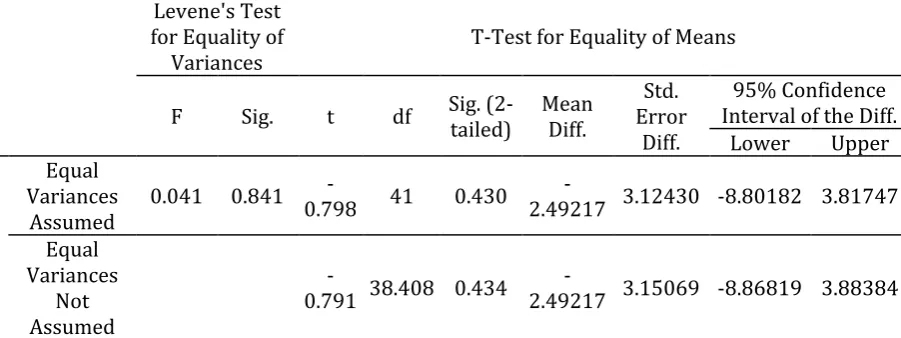
Table 4. Independent T-Test to Compare the First Score in Both Groups
The above table indicates the test results of the equality of the data means of the first score relating to the motivation score between the control and experimental groups. First, the equality of the variances of the first score data in the two groups was checked. The value of Sig. in the second column equals 0.841, which is greater than α=0.05.
The assumption of equality of the variances could not be rejected, as a result, we will take a look at the results in the first row, which assumes equal variances. In this row the value of the Sig (2-tailed) is equal to 0.430 which is greater than α = 0.05. Consequently, the assumption of the equality of the variances could not be rejected.
The two numbers shown in column (95% Confidence Interval of the Difference) contain zero, and this confirms the equality of means in the two groups. As seen here, the difference between the two groups is not significant.
CONCLUSION
The results of the T-Test indicate that both methods were effective in improving motivation scores, or pedagogically speaking, in motivating the students. The results of the first Independent T-Test on the learning motivation reveal that there has been no significant difference between the groups, but the mean of the final test scores in the experimental group was significantly greater than that of the control group. The comparison of the first and last motivation scores indicates that the students in the experimental group scored much higher than the students in the control group,
Levene's Test for Equality of
Variances
T-Test for Equality of Means
F Sig. t df Sig.
(2-tailed)
Mean Diff.
Std. Error
Diff.
95% Confidence Interval of the Diff.
Lower Upper
Equal Variances
Assumed
0.041 0.841
-0.798 41 0.430
-2.49217 3.12430 -8.80182 3.81747
Equal Variances
Not Assumed
-0.791 38.408 0.434
therefore it can be concluded that the method used in the experimental group has enhanced the motivation a lot more than the control group, which proves the effectiveness of the method used-PBL.
Pedagogical Implications
Although it has had its difficulties, working on a project can be a good opportunity for students to use English creatively, and to do something different. For mixed-ability class this approach can bring many advantages. In addition to developing social skills, reinforcing independence, and responsibility, mixed-ability class will definitely benefit from group work as well as positive atmosphere which will be established while doing the work. The learners may experience the true feeling of success and satisfaction when students can express themselves and all the contributions are valued.
PBL guarantees success of the independent, autonomous learners in improving the speaking skills and increasing their motivation in this regard to a great extent because it provides the learners the unique chances to interact, socialize, and get engaged with the problem/project with increased confidence and reliance. It offers the learners self-esteem, often leading them to this understanding that they are capable of dealing with the problems by themselves, and find as many solutions to it as possible. And this is what we expect education to do for a generation.
REFERENCES
Blumenfeld, Phyllis C; Soloway, E; Marx, Ronald W.; Krajcik, Joseph S., Guzdial, M., & Palincsar, A. (1991). Motivating Project-based Learning, Sustaining the doing, supporting the Learning. The University of Michigan, Educational psychologist,
26(3&4), 369-398.
Brophy, J. (1983) Conceptualizing Student Motivation. Educational Psychologist, 18, 200-215.
Dambrauskas, Zilvinas (2012). An introduction to Problem Based Learning http://www.powershow.com/view2a/51200d-YzhlN/Zilvinas_Dambrauskas Hmlo, C.E. (1998). Does Problem Based Learning Work? Teaching and Learning in
Medicine,10, 92-100 https://docs.lib.purdue.edu/ijpbl/vol3/iss1/4/
Maftoon, P., Birjandi, P., & Ahmadi, A. (2013). The Relationship between Project-based Instruction and Motivation: A Study of EFL Learners in Iran. Theory and Practice in
Language Studies, 3(9), 1630-1638.
Thomas, J.W. (2000). A review of research on project-based learning. San Rafael, CA: Autodesk. http://www.k12reform.org/foundation/pbl/research
Weinstein, C., & Mayer, R. (1986). The Teaching of Learning Strategies. In M. Whiteley, P. (2002). Motivation. United Kingdom: Capstone Publishing.
Yununto, A. (2015). The Effectiveness of Project Based Learning Model in Teaching
English to the Tenth Grade Students of SMAN I Kediri In Academic Year 2014-2015. Retrieved from: http://simki.unpkediri.ac.id
Zare-Behtash, E., Khoshsima, H., & Ahmadi, A. (2016). The Effect of Project Work on the Speaking Ability of Iranian EFL beginner Students. Journal of Applied Linguistics