V. R. Mohan, Ethnopharmacology Unit, Research Department of Botany, V.O. Chidambaram College, Tuticorin, Tamil Nadu. 628008. Tel +919487279902 E-mail: [email protected]
Address for correspondence
Access this article online www.japer.in
Total Phenolic, flavonoid contents and in vitro antioxidant
activity of leaf of Sesuvium portulacastrum. L (Aizoaceae)
INTRODUCTION
Free radicals are produced continually in
various metabolic processes and exist in biological
systems. They are important for maintaining normal
physiological function. Reaction oxygen species (ROS)
(eg. Superoxide anion, hydroxyl radical and hydrogen
peroxide) increases the possibility of a wide range of
common degenerative diseases. The free radical may
cause lipid peroxidation, aggregation of protein and
degradation of DNA, protein and polysaccharide,
which eventually destroys cell membranes and kills
cells. [1] Many plants often contain substantial
amounts of antioxidants including vitamin C and E,
carotenoids, flavonoids and tannins etc., and thus can
be utilized to scavenge the excess free radicals from
human body [2]
Sesuvium portulacastrum(Aizoaceae) is
commonly known as Sea Purslane. It is a frequent
pioneer species in the backshore zone of coastal
branches, where sand movement is influenced by
prevalent winds near the born coast. [3]
S.portulacastrum has a long history of use in folk
medicine where, in Zimbabwe and South Africa use
the plant to treat various infections and kidney
problems. [4] Kompferet al[5]stated a gram- staining
positive coccus, belonging to genus Salinicoccus, was
isolated from the rhizosphere of
Sesuviumportulacastrum. Michaelet al[6] used
hydrodistilationto extract the essential oil from the
fresh leaves of S.portulacastrum, and the essential oil
exhibited antibacterial, antifungal and antioxidant
activity.[6]Chandrasekaranet al[7] expressed the fatty
acid methyl esters (FAME extract) from S.
portulacastrum can be used in traditional medicine as
a potential antimicrobial agent. But, the studies
revealed with the in vitro antioxidant activities from
mangrove associated plants are two limited. Hence,
the present studies were made and attempt to
evaluate the in vitro antioxidant activities from
mangrove associated plants (Sesuvium
portulacastrum) using different models viz, DPPH,
Hydroxyl, Superoxide and ABTS. The present attempt
has been made to find out the in vitro antioxidant
efficacy of various extract from the leaf of Sesuvium
portulacastrum.
MATERIALS AND METHODS
The leaf of S. portulacastrum was collected
from Tuticorin coast, Gulf of Mannar, Tamil Nadu. The
collected samples were cut into small fragments and Research
Research Research
Research ArticleArticleArticleArticle
Antioxidant activity of the leaf of Sesuvium portulacastrum was studied for its free radical scavenging property on different in vitro models eg DPPH, hydroxyl, superoxide, ABTS radical cation scavenging and reducing power by using different solvents. Total phenolic and flavonoid contents were estimated. The methanol extract showed promising free radical scavenging activity in dose dependent manner. This antioxidant potency may be related to the presence of antioxidant phenolic and flavonoid compounds present in the extract. These results clearly indicate that S.portulacastrumleaf is effective against free radical mediated disease.
Keywords: Mangrove, Sesuviumportulacastrum, Methanol, DPPH, ABTS, Reducing power.
ABS ABS ABS
ABSTRACTTRACTTRACTTRACT K. Paulpriya, M. PackiaLincy, V.
R. Mohan*
Ethnopharmacology Unit, Research Department of Botany, V.O. Chidambaram College, Tuticorin 628 008, Tamil Nadu, India.
shade dried until the fracture is uniform and smooth.
The dried plant material was granulated or powdered
by using a blender, and sieved to get uniform particles
by using sieve No. 60. The final uniform powder was
used for the extraction of active constituents of the
plant material.
Preparation of Plant extract
Freshly collected leaf samples of S.
portulacastrum were dried in shade, and then coarsely
powdered separately in a wily mill. The coarse
powder (100g) was extracted successively with
petroleum ether, benzene, ethyl acetate, methanol and
ethanol, each 250 ml in a Soxhlet apparatus for 24 hrs.
All the extracts were filtered thoughWhatman No.41
filters paper. . All the extracts were concentrated in a
rotary evaporator. The concentrated extracts were
used for in vitro antioxidant activity. The methanol
extract was used for the estimation of total phenolics
and flavonoids.
Estimation of Total Phenolic content
Total phenolic content was estimated using
the Folin-Ciocalteu method.[8] Samples (100µL) were
mixed thoroughly with 2 ml of 2% Na2CO3. After 2
min. 100 µL of Folin-Ciocalteu reagent was added to
the mixture. The resulting mixture was allowed to
stand at room temperature for 30 min and the
absorbance was measured at 743 nm against a blank.
Total phenolic content was expressed as gram of gallic
equivalents per 100 gram of dry weight (g 100g-1DW)
of the plant samples.
Estimation of Flavonoids
The flavonoids content was determined
according to Eomet al[9]. An aliquot of 0.5ml of
sample (1mg/ml) was mixed with 0.1ml of 10%
aluminium chloride and 0.1ml of potassium acetate
(1M). In this mixture, 4.3ml of 80% methanol was
added to make 5ml volume. This mixture was
vortexed and the absorbance was measured
spectrophotometrically at 415nm. The value of optical
density was used to calculate the total flavonoid
content present in the sample.
DPPH radical scavenging activity
The DPPH is a stable free radical and is widely
used to assess the radical scavenging activity of
antioxidant component. This method is based on the
reduction of DPPH in methanol solution in the
presence of a hydrogen donating antioxidant due to
the formation of the non radical form DPPH-H[10]
The free radical scavenging activity of all the
extracts was evaluated by 1,
1-diphenyl-2-picryl-hydrazyl (DPPH) according to the previously reported
method. [10] Briefly, an 0.1mM solution of DPPH in
methanol was prepared, and 1ml of this solution was
added to 3 ml of the solution of various concentration
of extracts and the reference compound
(50,100,200,400 & 800μg/ml).The mixtures were
shaken vigorously and allowed to stand at room
temperature for 30 minutes. Then the absorbance was
measured at 517 nm using a UV-VIS
spectrophotometer (Genesys 10S UV: Thermo
electron corporation). Ascorbic acid was used as the
reference. Lower absorbance values of reaction
mixture indicate higher free radical scavenging
activity. The capability to scavenging the DPPH radical
was calculated by using the following formula.
DPPH scavenging effect (% inhibition) = {(A0 –
A1)/A0)*100}
Where, A0 is the absorbance of the control reaction,
and A1 is the absorbance in presence of all of the
extract samples and reference. All the tests were
performed in triplicates and the results were averaged
Hydroxyl radical scavenging activity
The scavenging capacity forhydroxyl radical
was measured according to the modified method of
Halliwellet al[11]. Stock solutions of EDTA (1mM),
FeCl3 (10mM), Ascorbic Acid (1mM), H2O2 (10mM)
and Deoxyribose (10 mM), were prepared in distilled
deionized water.
The assay was performed by adding 0.1ml
EDTA , 0.01ml of FeCl3,0.1ml H2O2, 0.36ml of
deoxyribose, 1.0ml of the extract of different
concentration (50,100,200,400 &800μg/ml)dissolved
in distilled water,0.33ml of phosphate buffer (50mM ,
mixture was then incubated at 370c for 1 hour. 1.0ml
portion of the incubated mixture was mixed with
1.0ml of 10%TCA and 1.0ml of 0.5% TBA (in 0.025M
NaOH containing 0.025% BHA) to develop the pink
chromogen measured at 532nm. The hydroxyl radical
scavenging activity of the extract is reported as %
inhibition of deoxyribose degradation is calculated by
using the following equation
Hydroxyl radical scavenging activity= {(A0 –
A1)/A0)*100}
Where, A0 is the absorbance of the control reaction,
and A1 is the absorbance in presence of all of the
extract samples and reference. All the tests were
performed in triplicates and the results were
averaged.
Superoxide radical scavenging activity
The superoxide anion scavenging activity was
measured as described by Srinivasanet al.[12]The
superoxide anion radicals were generated in 3.0 ml of
Tris – HCL buffer (16 mM, PH 8.0), containing 0.5 ml of
NBT (0.3mM), 0.5 ml NADH (0.936mM) solution, 1.0
ml extract of different concentration (50,100,200,400
& 800μg/ml), and 0.5 mlTris – HCl buffer (16mM, PH
8.0). The reaction was started by adding 0.5 ml PMS
solution (0.12mM) to the mixture, incubated at 25oC
for 5 min and the absorbance was measured at 560
nm against a blank sample, ascorbic acid. The
percentage inhibition was calculated by using the
following equation
Superoxide radical scavenging activity= {(A0 –
A1)/A0)*100}
Where, A0 is the absorbance of the control reaction,
and A1 is the absorbance in presence of all of the
extract samples and reference. The entire test was
performed in triplicates and the results were
averaged.
Antioxidant Activity by Radical Cation (ABTS. +).
ABTS assay was based on the slightly
modified method of Huang et al.[13] ABTS radical
cation (ABTS+) was produced by reacting 7mM ABTS
solution with 2.45 mM potassium persulphate and
allowing the mixture to stand in the dark at room
temperature for 12-16 h before use. The ABTS +
Solution were diluted with ethanol to an absorbance
of 0.70+0.02 at 734 nm. After addition of 100μL of
sample or trolox standard to 3.9 ml of diluted ABTS+
solution, absorbance was measured at 734 nm by
Genesys 10S UV-VIS (Thermo scientific) exactly after 6
minutes. Results were expressed as trolox equivalent
antioxidant capacity (TEAC).
ABTS radical cation activity = {(A0 –
A1)/A0)*100}
Where, A0 is the absorbance of the control reaction,
and A1 is the absorbance in presence of all of the
extract samples and reference. All the tests were
performed in triplicates and the results were
averaged.
Reducing Power
The reducing power of the extract was
determined by the method of Kumar and
Hemalatha,.[14] 1.0 ml of solution containing
50,100,200,400 &800μg/ml of extract was mixed with
sodium phosphate buffer (5.0 ml, 0.2 M, pH6.6) and
potassium ferricyanide (5.0 ml, 1.0%): The mixture
was incubated at 50oC for 20 minutes. Then 5ml of
10% trichloroacetic acid was added and centrifuged at
980 g (10 minutes at 5oC) in a refrigerator centrifuge.
The upper layer of the solution (5.0 ml) was diluted
with 5.0 ml of distilled water and ferric chloride and
absorbance read at 700 nm. The experiment was
performed thrice and results were averaged.
Statistical analysis
Antioxidant activities like DPPH radical
scavenging activity, hydroxyl radical scavenging
activity, superoxide radical activity, ABTS radical
cation scavenging activity and reducing powers were
estimated in triplicate determinations. Data were
analyzed using the statistical analysis system SPSS
(SPSS software for windows release 17.5; SPSS Inc.,
Chicago IL, USA) Estimates of mean, standard error for
aforesaid parameters were calculated.
RESULTS AND DISCUSSION
The total phenolic content and total flavonoid
content of the methanol extract of Sesuvium
portulacastrum leaf was found to the 0.89 g100g-1 and
0.15 g100g-1 respectively. Phenolics are secondary
metabolites that play a role in the maintenance of the
human body. The presence of phytoconstituents, such
as phenols, flavonoids and tannin in plants, indicates
the possibility of antioxidant activity and this activity
will helps in preventing a number of diseases through
free radical scavenging activity. Phenolic compounds
are commonly found in plants and have been reported
to have several biological activities including
antioxidant properties. Many studies focused on the
biological activities of phenolic compounds, which
have potential antioxidants and free radical scavenger.
[15]
Phenolic compounds are well known as
antioxidant and scavenging agents free radicals
associated with oxidative damage. Phenolic
compounds have attracted much interest recently
because in vitro studies suggest that they have a
variety of beneficial biological properties like
anti-inflammatory, antitumor and antimicrobial activities.
Studies have attributed that antioxidant properties
are due to the presence of phenols and
flavonoids.[16-17]
Antioxidant activity of phenolic compounds is
based on their ability to donate hydrogen atoms to
free radicals. In addition, they possess ideal structural
properties for free radical scavenging properties.
Flavonoids are important secondary metabolites of
plant modulating lipid peroxidation involved in
atherogenesis, thrombosis and carcinogenesis. It has
been confirmed that pharmacological effects of
flavonoids is correlating with their antioxidant
activities. [18]
DPPH radical scavenging activity:
Free radicals and other reactive species are
thought to play an important role in many human
diseases. Radical scavenging activities are very
important due to the deleterious role of free radicals
in biological systems. Many secondary metabolites
which include flavonoids, phenolic compounds etc,
serve as sources of antioxidants and do scavenging
activity. [19] In this study, it is evident that the extract
of the study species S.portulacastrum leaf possess
effective antioxidant activity. In vitro antioxidant
activity of the petroleum ether, benzene, ethyl acetate,
methanol and ethanol extracts of S.portulacastrum leaf
was investigated in the present study by DPPH,
hydroxyl, superoxide and ABTS radical cation
scavenging activities and their reducing ability. These
methods have proven the effectiveness of the extracts
in comparison to that of reference standard
antioxidant, ascorbic acid and trolox.
The radical scavenging activity of different
extracts was tested using the stable free radical DPPH.
Unlike laboratory generated free radical such as the
hydroxyl radical and superoxide anion, DPPH has the
advantage of being unaffected by certain side
reactions such as metal ion chelation and enzyme
inhibition brought about by various additives. A
freshly prepared DPPH solution exhibits a deep purple
colour generally fades/disappears when an
antioxidant present in the medium. Thus, antioxidant
molecule can quench DPPH free radicals and convert
them to a colourless product resulting in a decreasing
absorbance at the 517 nm.
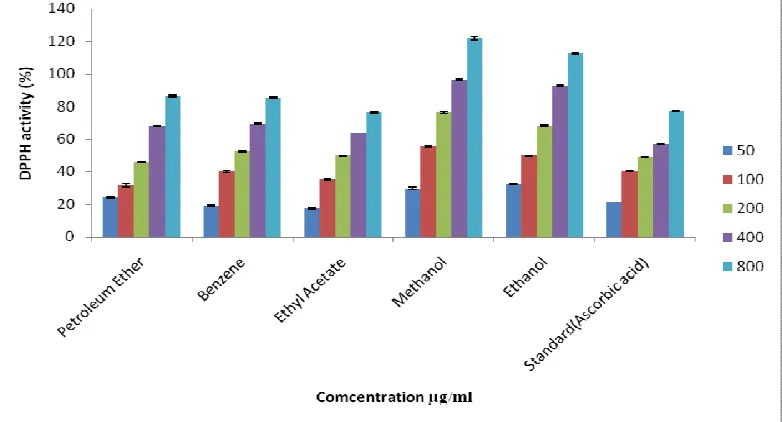
DPPH radical scavenging activity of
petroleum ether, benzene, ethyl acetate, methanol and
ethanol extracts of S.portulacastrum leaf was shown in
Fig 1. The scavenging effect increases with the
concentration of standard and samples. Among the
solvent tested, methanol extract exhibited highest
DPPH radical scavenging activity. At 800µg/ml
concentration, methanol extract of S.portulacastrum
possessed 121.63% scavenging activity on DPPH.
From the result, in the present study, the extracts have
shown about equivalent free radical scavenging
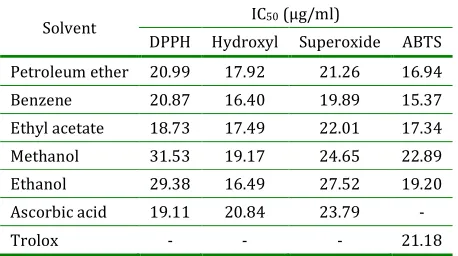
activity with dose dependent manner. The IC50 value
of ascorbic acid was 19.11µg/ml where as methanol
extract was found to be 31.53µg/ml.(Table 1)
Hydroxyl radical is highly reactive oxygen
centered, radical formed from the reaction of various
hydroperoxides transition metal ion. It attacks
protein, DNA, polyunsaturated fatty acids in
membranes and most biological molecule it contacts
and is known to the capable of abstracting hydrogen
atoms from membrane lipids and brings about
peroxidic reaction of lipids. [20] The present extract
exhibited concentration dependent scavenging
activity against hydroxyl radical generated in a Fenton
reaction system. Hydroxyl radical scavenging activity
ofpetroleum ether, benzene, ethyl acetate, methanol
and ethanol extracts of S.portulacastrumleaf was
shownin Fig 2. Methanol extract showed very potent
hydroxyl radical scavenging activity. At 800µg/ml
concentration methanol extract ofS.portulacastrum
possessed 72.74% scavenging activity on hydroxyl
radical.The scavenging activity may be due to the
presence of various phytochemicals including
polyphenols and flavonoids in S.portulacastrum leaf
extracts.The IC50 value of ascorbic acid was
20.84µg/ml where as methanol extract was found to
be 19.17µg/ml.
Superoxide radical scavenging activity:
Superoxide anions damage biomolecules
directly or indirectly by forming H2O2, OH, peroxy
nitrite or singlet oxygen during aging and pathological
events such as ischemic reperfusion injury.
Superoxide has also been observed to directly initiate
lipid peroxidation [21].The S.portulacastrum leaf
extracts were subjected to the superoxide scavenging
assay and the results were shown in Fig 3. It indicates
that ethanol extract of S.portulacastrum leaf
(800µg/mL) exhibited the maximum superoxide
scavenging activity of 98.11% which is higher than the
standard ascorbic acid whose scavenging effect is
98.11%.The IC50 value of ascorbic acid was
23.79µg/ml where as methanol extract was found to
be 27.52µg/ml.
ABTS radical cation scavenging activity:
ABTS radical scavenging activity is relatively
recent one, which involves a more drastic radical,
chemically produced and is often used for screening
complex antioxidant mixtures such as plant extracts,
beverages and biological fluids. The ability in both the
organic and aqueous media and the stability in a wide
pH range raised the interest in the use of ABTS for the
estimation of antioxidant activity. [13]
TheS.portulacastrum leaf extracts were subjected to
the ABTS radical cation scavenging activity and the
results were presented in Fig 4. The methanol extracts
exhibited potent ABTS radical cation scavenging
activity in concentration dependent manner. At
800µg/ml concentration of S.portulacastrum
possessed 94.70% scavenging activityon ABTS which
is higher than the standard Trolox whose scavenging
activity is 70.29%.The methanol extract showed
potent antioxidant activity in ABTS method, which is
higher than that of standard trolox. Here, the
S.portulacastrum leaf extracts radical scavenging
activity showed a direct role of its phenolic
compounds in free radical scavenging.The IC50 value
of ascorbic acid was 21.18µg/ml where as ethanol
extract was found to be 22.89µg/ml.
Reducing power:
The reducing properties of the plant extracts
are generally associated with the presence of
reductones, which have been shown to exert
antioxidant action by breaking the free radical chain
by donating a hydrogen atom. [22-24] Reductones are
also reported to react with certain precursors of
peroxide, thus preventing peroxide formation. The
data obtained in the present study suggest that it is
likely to contribute significantly towards the observed
antioxidant effects. Like the antioxidant activity, the
reducing power of the extract increase with increasing
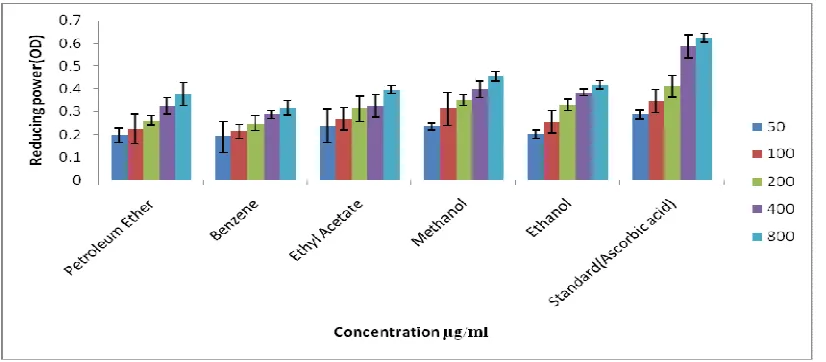
concentration. Figure 5 showed the reducing ability of
different solvent extracts of S.portulacastrum leaf
compared to ascorbic acid. Absorbance of the solution
was increased when the concentration increased. A
higher absorbance indicates a higher reducing power.
Among the solvent tested, methanol extract exhibited
CONCLUSION
The results from various free radicals
scavenging systems reveal that all the extracts of
S.portulacastrum leaf have significant antioxidant
activity. The extracts are found to have different levels
of antioxidant activity in all the methods tested. IC50
values obtained were comparable to that of the
standards used i.e, ascorbic acid and trolox. The
overall antioxidant activity of the S.portulacastrum
leaf extracts might be attributed to the presence of
phytochemical constituents. The findings of the
present study suggest that S.portulacastrum leaf could
be a potential source of natural antioxidant that could
have great importance as therapeutic agent in
preventing or slowing the oxidative stress related
degenerative diseases. Furthermore, the in vitro
antioxidant activity of this extract needs to be
assessed prior to clinical use.
ACKNOWLEDGEMENT
The authors are thankful to Dr.R. Sampathraj,
Honorary Director, Dr. Samsun Clinical Research
Laboratory, Thiruppur for providing necessary
facilities to carry out this work. The second author,
V.R.M. gratefully acknowledges and expresses his
sincere thanks to University Grants Commission, New
Delhi for providing financial assistance to this Major
Research Project (F39-429/2010 (HRP).
Fig 1: DPPH radical scavenging activity of different extracts of Sesuvium portulacastrum leaf.
Fig 3: Superoxide radical scavenging activity of different extracts of Sesuvium portulacastrum leaf.
Fig 4: ABTS radical cation scavenging activity of different extracts of Sesuvium portulacastrum leaf.
Table 1: IC50 values of different solvent extracts of Sesuviumportulacastrumleaf *
Solvent IC50 (µg/ml)
DPPH Hydroxyl Superoxide ABTS
Petroleum ether 20.99 17.92 21.26 16.94
Benzene 20.87 16.40 19.89 15.37
Ethyl acetate 18.73 17.49 22.01 17.34
Methanol 31.53 19.17 24.65 22.89
Ethanol 29.38 16.49 27.52 19.20
Ascorbic acid 19.11 20.84 23.79 -
Trolox - - - 21.18
All the values are mean by triplicate determines*
REFERENCES
1. Wang X.H., Dal J.T. A comparative study on antioxidant
activity of water and extracts of ten Chinese herbs. J.
Med plant Res. 2012; 6: 22210-2215.
2. Sathishkumar T., Shanmugam S., Palvarnan T.,
Bharathikumar V.M. Evaluation of antioxidant
properties of Canthium parviflorum lam. Leaves. Nat.
Prod. Rad. 2008; 7: 122-126.
3. Robert I.L., FrankW. The biological flora of costal and
Wetlands Sesuvium portulacastrum L. J. Coast
Res.1997; 13: 96-104.
4. Lokhande V.H., Srivastava S., Patade V.Y., Dwivedi S.,
Tripathi, R.D., Nikam, T.D. Investigation of arsenic
accumulation and tolerance potential of Sesuvium
portulacastrum (L.). Chemosphere. 2011; 4: 529-34.
5. Kampfer P., Arun A.B., Busse H.J., Young C.C., Lai W.A.,
Rekha P.D., et al. Salinicoccussesuvii sp. Nov., isolated
from the rhizosphere of Sesuvium portulacastrum. Int.
J. Syst. EvolMicrobiol. 2011;61: 2348-52.
6. Michael L.M., Mazuru G., Nyasha G., Godfred H.
Chemical composition and biological activities of
essential oil from the leaves of Sesuvium
portulacastrum . J. Ethanopharmacology. 2006; 103:
85-9.
7. Chandrasekaran M., Senthilkumar A., Venkatesalu V.
Antibacterial andantifungal efficacy of fatty acid
methyl esters from the leaves of Sesuvium
portulacastrum L. Eur. Rev.MedPharmcol Sci. 201;7:
775-80.
8. Lachman J., Hamouz K., Orsak M., Pivec V. Potato
tubers as a significant source of antioxidant human
nutrition. RostlVyr .2000;46:231-236.
9. Eom S.H., Cheng W.J., Hyoung J.P., Kim E.H., Chung M.I.,
Kim M.J., Yu C., Cho D.H. Far infra red ray irradiation
stimulates antioxidant activity in Vitis flexuosaThunb.
Berries. Kor. J. Med. Crop Sci. 2007;15: 319-323.
10.Shen Q., Zhang B., Xu R., Wang Y., Ding X., Li P.
Antioxidant activity in vitro of selenium-contained
protein from the se-enriched. Bifodobacterium
animalis01. Anaerobe. 2010; 16: 380-386.
11.Halliwell B., Gutteridge J.M.C., Aruoma O.I.The
deoxyribose method: a simple test to be assay for
determination of rate constants for reaction of
hydroxyl radicals. Ana. Biochem. 1987;165: 215-219.
12.Srinivasan R., Chandrasekar M.J.N., Nanjan M.J., Suresh
B. Antioxidant activity of Caesalpinia digyna root. J.
Ethnopharmacology. 2007;113: 284-291.
13.Huang M.H., Huang S.S., Wang B.S., Sheu M.J., Hou
W.C.Antioxidant and anti-inflammatory properties of
Cardiospermum halicacabumand its reference
compounds ex vivo and in vivo. J. Ethnopharmacology.
2011; 133:743-750.
14.Kumar R.S., Hemalatha S. In vitro antioxidant activity
of alcoholic leaf extract and subfractions of Alangium
lamarckiiThwaites. J. Chem and Pharm Res.
2011;3:259-267.
15.Meenakshi S., Umayaparvath S., Arumugam M.,
Balasubramanian T. In vitro antioxidant properties and
FTIR analysis of two seeweeds of Gulf of Mannar. Asian
Pac. J. Trop Biomed.2012; 2: S66-S70.
16.Turkoglu A., Duru M.F., Mercan N., Kivrak I., Gezer K.
Antioxidant and antimicrobial activities of Laetiporus
sulphureus (Bull.)Murill. Food Chem.2007; 101:
267-273.
17.Jose S.,Radhamany P.M. Identification and
determination of antioxidant constituents of
bioluminescent mushroom. Asian Pac J Trop Biomed.
18.Mbaebie B.O., Edeoga H.O., Afolayan A.J. Phytochemical
analysis and antioxidants activities of aqueous leaf bark extract of Schotia latifoliaJacq. Asian Pac J Trop
Biomed. 2012;2: 118-124.
19.Ghasemi K., Ghasemi Y., Ebrahimzadeh
M.A.Antioxidant activity, phenol and flavonoid
contents of 13 Citrus species peels and tissues. Pak. J.
Pharm. Sci, 2000; 22: 277-281.
20.Naranasamy K.,Ragavan B. In vitro antioxidant activity
of Zanthoxylum lutraspermum W.A. stems bark. Int. J.
EngSci Tech. 2012; 4: 155-162.
21.Nishanthini A., AgnelRuba A., and Mohan V.R. Total
phenolic, flavonoid contents and in vitro antioxidant
activity of leaf of Suaeda monoicaForssk ex. Gmel.
(Chenopodiaceae). Int. J. Adv Life Sci. 2012; 5: 34-43.
22.Oyedemi S.O., Afolayan A.J., Antibacterial and
antioxidant activities of hydroalcoholic leaf bark
extract of Schotialatifolia Jacq. Asian Pac J. Trop
Biomed. 2012; 4: 952-958.
23.Sajeesh T., Arunachalam K., Parimelazhagan T.
Antioxidant and antipyretic studies on Pothosscandens
L.Asian Pac J. Trop Med.2011; 4: 889-899. 24.Paul priyaK., and Mohan V. R. In vitro antioxidant
potential of methanol extract of Dioscorea oppositifolia.
Science Research Reporter. 2012;2(3): 239-245.
How to cite this article: K. Paulpriya, M. PackiaLincy, V. R. Mohan*; Total Phenolic, flavonoid contents and in vitro
antioxidant activity of leaf of Sesuvium portulacastrum. L (Aizoaceae); J. Adv. Pharm. Edu. & Res. 2013: 3(2): 67-75.