Aleksandra Pytel
1, Zdzisława Wrzosek
1, 2Estimation of Patient Knowledge
on Rheumatoid Arthritis in the Range
of Their Own Disease – Preliminary Study
Ocena stanu wiedzy pacjentów chorych na reumatoidalne
zapalenie stawów na temat własnej choroby – badania wstępne
1 Institute of Medical Rehabilitation, Wroclaw Medical University, Poland
2 Chair of Physiotherapy in Disfunctions of the Motorial Organ, University of Physical Education, Wrocław,
Poland
Abstract
Background. Knowledge is an essential element of treatment which allows patients to take care of themselves, to undertake every day activities and to make decisions essential from the point of view of health. A patient suffering from rheumatoid arthritis needs support, assistance from his family and from medical staff. It depends on him how much the disease will change his life and how he will cope with all the problems related to the psychological, physi-cal and social aspects of life. Each patient should know what his disease is. If he does not receive this information from the qualified staff, he will try to find some information from different sources and then the information may be incomplete and may provoke negative reactions which will make the process of treatment more difficult.
Objectives. Defining the source of the patient’s knowledge about his disease and the role and tasks of health educa-tion in transferring knowledge to the patient and in building his attitude to the treatment. Increasing participaeduca-tion of a therapeutic team in health education in order to propagate the awareness and need of prevention and physical effort for bringing back normal state of health.
Material and Methods. The subject of studies included 270 people with rheumatoid arthritis. The patients exam-ined were treated in the Clinic of Rheumatology and Internal Diseases of the University of Wrocław since 1st
February, 2010 till 15th February, 2011. A self-made questionnaire was used for studies, aimed at obtaining basic
information about patients with a diagnosed rheumatoid arthritis. Statistical calculations were made with package Statistica 9 PL. Tests on essentiality of differences were calculated with T-Student test for quantitative data and
c2 test for qualitative data. Abroad, the level of significance was a value of 0.05.
Results. The examined patients were divided into 2 groups according to gender. These groups were similar in respect of age, place of residence, professional activity, working time and co-existing diseases excluding osteopo-rosis which was more frequent in women. A higher level of education was represented by women who were single or widowed or suffered from rheumatoid arthritis for a longer time than men. In women there were more frequent cases of rheumatoid arthritis in the family. In the group of men there were more patients smoking cigarettes and among the smokers they smoked more than women. Women more often realized preventive procedures such as: regular taking medicines, gymnastics and healthy diet.
Conclusions. The condition of knowledge of women on their own disease is definitely higher and relatively high. It was revealed that the interest in obtaining information on the disease is higher in people with higher education both in women and men. Independently of the age, the main source of knowledge on the disease is a doctor, phys-iotherapist or a nurse. Educational deficiency in therapeutic teams was revealed, which indicates the necessity of developing information programmes and of running trainings, talks aiming at increasing knowledge on rheuma-toid arthritis among patients (Adv Clin Exp Med 2012, 21, 3, 343–351).
Key words: rheumatoid arthritis, health behaviours, health education.
Streszczenie
Wprowadzenie. Wiedza jest niezbędnym elementem leczenia, który pozwala chorym troszczyć się o siebie, podej-mując codzienne czynności i ważne z punktu widzenia ochrony zdrowia decyzje. Chory cierpiący na
reumatoidal-Adv Clin Exp Med 2012, 21, 3, 343–351 ISSN 1899–5276
ORIgINAL PAPERS
ne zapalenie stawów potrzebuje wsparcia, opieki ze strony osób najbliższych i personelu medycznego. To przede wszystkim od chorego zależy, jak bardzo pozwoli chorobie zmienić swoje życie i w jaki sposób upora się z pro-blemami w wymiarze psychicznym, fizycznym i społecznym, które niesie za sobą choroba. Każdy chory powinien wiedzieć, na czym polega jego schorzenie. Jeżeli nie otrzyma tych informacji od wykwalifikowanego personelu, to będzie usiłował ich poszukiwać u innych źródeł, a wówczas mogą być one niekompletne i wywoływać negatywne zachowania, które utrudnią proces leczenia.
Cel pracy. Określenie źródła wiedzy pacjentów na temat swojej choroby oraz roli i zadań edukacji zdrowotnej z zakresu przekazywania wiedzy i przekształcania postaw chorego wobec leczenia. Zwiększenie udziału zespołu terapeutycznego w wychowaniu zdrowotnym w celu uświadomienia potrzeby i znaczenia profilaktyki oraz wysiłku fizycznego w przywracaniu prawidłowego stanu zdrowia.
Materiał i metody. Przedmiot badań stanowił materiał obejmujący 270 osób, u których zdiagnozowano reumato-idalne zapalenie stawów. W tej grupie było 195 kobiet (77,22%) w wieku 20–90 lat i 75 mężczyzn (27,78%) wieku 23–85 lat. Badani byli leczeni w Klinice Reumatologii i Chorób Wewnętrznych Akademii Medycznej im. Piastów Śląskich we Wrocławiu w okresie od 1.02.2010 do 15.02.2011. Do przeprowadzenia badań, mających na celu uzy-skanie podstawowych informacji o pacjencie ze zdiagnozowanym reumatoidalnym zapaleniem stawów, jego pozio-mie wiedzy wykorzystano ankietę autorską. Obliczenia statystyczne zostały przeprowadzone za pomocą pakietu Statistica 9 PL. Testy istotności różnic zostały obliczone za pomocą testów T-Studenta dla danych ilościowych oraz testów c2 dla danych jakościowych. Za granicę poziomu istotności przyjęto wartość 0,05.
Wyniki. Osoby badane podzielono na 2 grupy w zależności od płci. grupy te były jednorodne pod względem wieku, miejsca zamieszkania, aktywności zawodowej, czasu pracy i chorób współistniejących z wyjątkiem oste-oporozy, którą częściej stwierdzano u kobiet. Wyższy poziom wykształcenia posiadały kobiety, częściej były stanu wolnego lub owdowiałe oraz dłużej chorowały na reumatoidalne zapalenie stawów niż mężczyźni. U kobiet czę-ściej występowało reumatoidalne zapalenie stawów w rodzinie. Kobiety częczę-ściej realizowały zabiegi profilaktyczne, m.in.: regularne przyjmowanie leków, gimnastyka oraz zdrowe odżywianie się.
Wnioski. Stan wiedzy kobiet na temat własnej chorobyjest zdecydowanie lepszy i utrzymuje się na poziomie wysokim. Wykazano, że zainteresowanie informacją dotyczącą choroby jest większe w grupie zarówno kobiet, jak i mężczyzn z wykształceniem wyższym. Niezależnie od wieku głównym źródłem wiedzy o schorzeniu jest lekarz, fizjoterapeuta oraz pielęgniarka. Wykazano deficyt edukacyjny ze strony zespołu terapeutycznego, co wskazuje na konieczność opracowywania programów informacyjnych oraz przeprowadzania szkoleń, pogadanek, których celem będzie podniesienie poziomu wiedzy wśród pacjentów na temat reumatoidalnego zapalenia stawów (Adv Clin Exp Med 2012, 21, 3, 343–351).
Słowa kluczowe: reumatoidalne zapalenie stawów, zachowania zdrowotne, edukacja zdrowotna.
In Poland nearly 400 thousand people are treated for rheumatoid arthritis and each year there are about 8 to 16 thousand new patients with this disease. Rheumatoid diseases constitute an enormous health problem which is, statistically, encountered by every third person of the popula-tion. With regard to the fact that etiopathology of most of these diseases has not been recognised this problem is a serious challenge to medicine. Rheu-matoid arthritis is a chronic, immunologically de-pendent, disease of the connective tissue, which is characterized by symmetrical inflammation in the joints, or the joints or out of joints bringing about complications in various organs. The course of the disease may vary, from mild forms, characterized by periods of remission of different length in time and slowly progressing joint destruction, to very acute forms, very aggressive and leading to perma-nent disability in a short time [1–4].
One of the main factors related to this disease, which has an essential influence on the develop-ment of the disability in rheumatoid arthritis is: pain activity of the disease, degree of joints and tis-sue around joints damages, changes out of joints and complications in other systems. Furthermore, there are some other factors, independent on the disease, which influence the disability, approach to
the situation of the illness, coping with emotions at the time when the disease progresses as well as expectations of the increase in severity after remis-sion. These are demographic and psycho-social factors such as age, sex, genetic conditions, social and economic status, level of education, coexisting diseases, environment and mental factors [6].
Taking into consideration the fact that the rheumatoid disease concerns numerous areas of functioning of the patient, it seems necessary to consider a possibility of a mental disease and the need of psychiatric aid both in relation to newly diagnosed as well as chronic patients. Indicating high risk groups allows us to begin a specialised therapy for patients with mental problems, which will enable the general improvement of their phys-ical fitness and the quality of life.
negative behaviour, making the process of treat-ment very difficult. Patient education brings a lot of advantages both in the clinical and the social aspect and helps the patient cope with his health problems. Furthermore, it has a good influence on his condition and the process of the recovery. For this reason it is considered to be an integral part of the high quality health care [7].
Material and Methods
The subject of studies included 270 people with rheumatoid arthritis. The patients examined were treated in the Clinic of Rheumatology and Internal Diseases of the Wroclaw Medical University from 1st February, 2010 to 15th February, 2011. A
self-made questionnaire was used for studies, aiming at obtaining basic information about patients with diagnosed rheumatoid arthritis. Statistical calcu-lations were made with package Statistica 9 PL. Tests on the essentiality of differences were calcu-lated with T-Student test for quantitative data and Chi 2 test for qualitative data. Abroad, the level of significance was a value of 0.05
The analysis of the impact of independent variables (covariates) on the level of knowledge about rheumatoid arthritis was conducted through multiple regression analysis. The model takes into account the level of knowledge of the following factors (explanatory variables): X1: age; X2: gender (1 – a woman, 0 – man); X3: place of residence (0 – village, 1 – city); X5: secondary education (0 – no, 1 yes); X6: higher education (0 – no, 1 – yes); X8: professional activity – pension (0 – no, 1 – yes); X11: duration of disease 1–3 years (0 – no, 1 – yes); X12: disease duration of 5–10 years (0 – no, 1 – yes); X14: disease in the family (0 – no, 1 – yes); X15: preventing procedures – regular medica-tion (0 – no, 1 – yes); X16: preventing procedures – gymnastics (0 – no, 1 – yes); X17: lack of pre-ventive procedures – smoking cigarettes (0 – no, 1 – yes); X20: medical consultation twice a year (0 – no, 1 – yes); X21: medical consultation more than twice a year (0 – no, 1 – yes); X23: stay in the hospital twice a year (0 – no, 1 – yes); X24: sources of knowledge – a doctor (0 – no, 1 – yes); X25: sources of knowledge – physician (0 – no, 1 – yes); X27: sources of knowledge – books (0 – no, 1 – yes); X30: sources of knowledge – television (0 – no, 1 – yes); X31: sources of knowledge – Internet (0 – no, 1 – yes); X33: subjective estimation of the level of knowledge (0–10); X34: difficulties in education – lack of time (0 – no, 1 – yes); X36: difficulties in education – lack of didactic means (0 – no, 1 – yes); X37: difficulties in education – lack of space (0 – no, 1 – yes); X40: subjective health condition
– not bad (0 – no, 1 – yes); X41: subjective estima-tion of health – bad (0 – no, 1 – yes).
β – factor of “importance” of the variable b – coefficient of the variable y = bx + c p – level of significance
R2 – talking about the relevance factor, eg 0.31 means that 31% of the data is explained by the regression.
The standard error of estimate – the value of c for the function y = bx ± c.
Author’s Questionnaire
The questionnaire consists of 3 parts. The first part of the questionnaire aims at obtaining basic information on the examined person and is about: gender, age of the patient, place of residence, marital status, education, duration of the disease, co-existing diseases and the applied preventive proceedings.
In the second part there are 19 questions. The patient may acquire maximum 19 points.
The sum of these points defines the level of patient’s knowledge on his disease: 19–17 points – very high level of knowledge; 16–14 points – high level of knowledge; 13–12 points – average level of knowledge; < 12 points – low level of knowledge.
Questions to this part were divided into 4 groups: from 1 to 4 – questions on the definition and etiology of the disease; from 5 to 9 – questions about the symptoms of the disease; from 10 to 15 – questions about rehabilitation and pharmacolog-ical treatment; from 16 to 19 – questions related to prevention of the disease and possible recreation after diagnosing the disease.
The third part consists of questions related to a subjective estimation of the knowledge of the ex-amined person and the sources of this knowledge.
Results
The examined patients were divided into 2 groups according to gender. These groups were similar in respect of age, place of residence, pro-fessional activity, working time and co-existing diseases excluding osteoporosis which was more frequent in women. A higher level of education was represented by women who were single or widowed or suffered from rheumatoid arthritis for a longer time than men. In women there were more frequent cases of rheumatoid arthritis in the family (Tab. 1).
tak-ing medicines, gymnastics and healthy diet. There were no differences when smoking was given up or limited. In this respects the groups were similar. Estimation of the level of knowledge was divided into 4 main domains and then general results were summed up. The level of knowledge was definitely higher with the exception of knowledge connected to prevention, where the groups were homoge-neous and revealed a high level of knowledge in this range. The examined groups were homoge-neous in respect to the other sources of knowledge and the frequency of hospitalization. Both women and men gave similar answers on factors making education difficult.
Women have a higher level of knowledge re-lated to the definition and etiology of the disease. This knowledge is influence by the following fac-tors: education, duration of the disease (the longer the disease, the higher knowledge), occurrence of the disease in the family, frequent medical consul-tations. Also, a lack of didactic means has a negative influence on this knowledge. People with weaker health have lower level of knowledge (Tab. 2).
A positive influence on the level of knowledge concerning the disease has got education, applica-tion of preventive procedures, medicaapplica-tion, limiting or giving up smoking and obtaining knowledge on the disease from a physician or from books. People
Table 1. Characteristics of the study group
Tabela 1. Charakterystyka grupy badanej
Characteristics of the study group (Charakterystyka
badanej grupy) p-value
all group woman man
No. of patients
(Liczba pacjentów) 270 (100%) 195 (77.22%) 75 (27.78%)
Age (Wiek): average
standard aberration SD median minimum maximum 56.9 15.2 58 20 90 57.6 15.5 59 20 90 55.11 14.45 57 23 85 Education (Wykształcenie): basic vocational secondary higher 28 (10.37%) 77 (28.52%) 107 (39.63%) 58 (21.48%) 20 (10.26%) 43 (22.05%) 84 (43.08%) 48 (24.62%) 8 (10.67%) 34 (45.33%) 23 (30.67%) 10 (13.33%) Professional activity (Aktywność zawodowa): work retirement pension pension benefit unemployed 66 (24.44%) 72 (26.67%) 115 (42.59%) 3 (1.11%) 14 (5.19%) 41 (21.03%) 48 (24.62%) 93 (47.69%) 2 (1.03%) 11 (5.64%) 25 (33.33%) 24 (32%) 22 (29.33%) 1 (1.33%) 3 (4%) Duration of the disease – years
(Czas trwania choroby – lata): 1–3 3–5 5–10 > 10 71 (26.3%) 43 (15.93%) 62 (22.96%) 94 (34.81%) 48 (24.62%) 23 (11.79%) 49 (25.13%) 75 (38.46%) 23 (30.67%) 20 (26.67%) 13 (17.33%) 19 (25.33%) Duration of the disease > 10 years
(Czas trwania choroby > 10 lat): average
standard aberration SD median minimum maximum 19.2 7 17 11 37 18.65 6.5 16 11 36 21.26 8.51 18 11 37 0.48
Disease in the family
who think that they have a high level of knowledge – really know better.
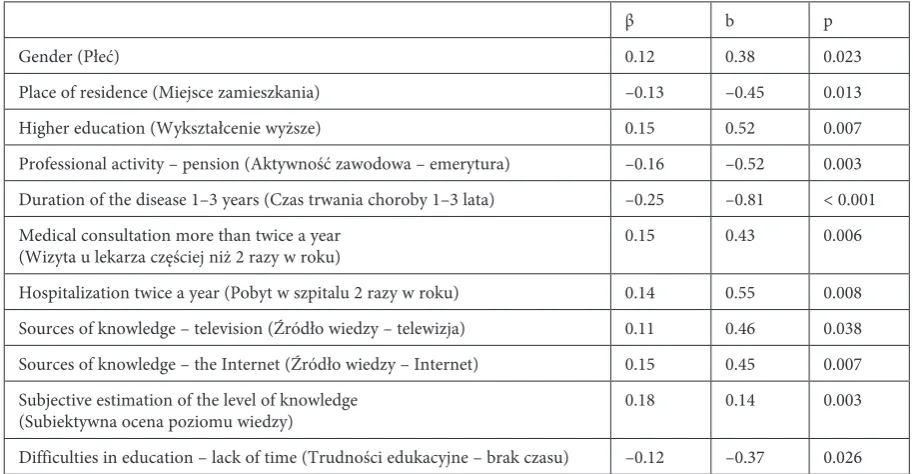
A short duration of the disease has a negative influence on the level of knowledge. Pensioners have got lower knowledge (Tab. 3).
The analysis revealed that women have a high-er level of knowledge on rehabilitation and medi-cation. A positive influence in this respect results from such factors as education, frequent medical consultations, hospitalizations and knowledge ob-tained from television, problems and the Internet. People who think they have good knowledge about the disease really have this type of knowledge. A negative influence comes from a short duration of the disease, living in a town and difficulties in ac-quiring education resulting from the lack of time of the medical staff when they are on duty. Pensioners have a lower knowledge. The analyses indicate that the examined patients like obtaining this knowledge from the medical staff or from visual aids (Tab. 4).
Age has got a positive influence on the level of knowledge related to prevention and recreation. People who think they have good knowledge in this range really have this knowledge. People with bad subjective health condition have got lower knowledge in this range. The data suggests that the older the examined patients are, the better knowledge in this range and patients with lower level of knowledge suffer worse health conditions (Tab. 5).
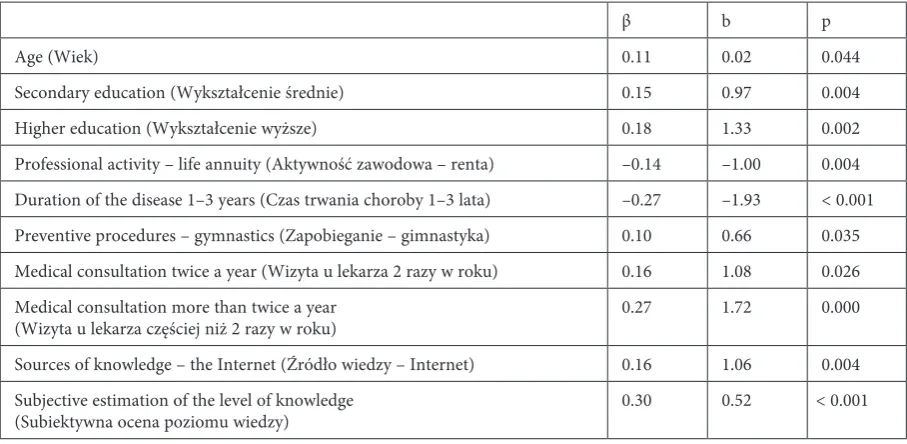
Age and education have a positive influence on the general level of knowledge. People who think they have good knowledge in this range really have this knowledge. People practicing gymnastics as preventive procedures and frequently consulting a physician have got better knowledge. The source of knowledge – the Internet – is a factor which helps to acquire better knowledge. Whereas peo-ple who are pensioners and have been ill for up to 3 years have got worse knowledge (Tab. 6).
Table 2. Summary of regression of the dependent variable for the level of knowledge of patients the definition and etiology of the disease
Tabela 2. Podsumowanie regresji zmiennej zależnej dla poziomu wiedzy pacjentów w zakresie definicji i etiologii choroby
β b p
gender (Płeć) 0.20 0.43 < 0.001
Secondary education (Wykształcenie średnie) 0.12 0.24 0.018
Duration of the disease 5–10 years (Czas trwania choroby 5–10 lat) 0.11 0.25 0.035
Disease in the family (Występowanie choroby w rodzinie) 0.12 0.23 0.021
Medical consultation more than twice a year
(Wizyta u lekarza częściej niż 2 razy w roku) 0.16 0.30 0.005
Subjective estimation of the level of knowledge
(Subiektywna ocean poziomu wiedzy) 0.32 0.17 < 0.001
Difficulties in education – lack of didactic means
(Trudności edukacyjne – brak środków dydaktycznych) –0.13 –0.26 0.009
Subjective health condition – not bad
(Subiektywna ocena stanu zdrowia – niezła) –0.14 –0.28 0.006
The designated method of least squares model of the knowledge about the definition and etiology of the disease takes the following form (Tab. 2):
definition and etiology (Tab. 2) = 1.09 + 0.43 * X2 + 0.24* X5 + 0.25* X12 + 0.23* X14 + 0.3* X21 + 0.17* X33
– 0.26* X36 – 0.28* X40 ± 0.8
R2 = 0.35
knowledge on the disease (Tab. 3) = 2.11 + 0.38 * X6 – 0.41* X8 – 0.54* X11 + 0.36* X15 + 0.5* X17 + 0.54* X24
+ 0.35* X27 + 0.11* X33 ± 1
R2 = 0.244
The designated method of least squares model of knowledge on rehabilitation and drug treatment takes the following form (Tab. 4):
Table 3. Summary of regression of the dependent variable on the level of knowledge of patients with symptoms of the disease
Tabela 3. Podsumowanie regresji zmiennej zależnej dotyczącej poziomu wiedzy pacjentów o objawach choroby
β b p
Higher education (Wykształcenie wyższe) 0.14 0.38 0.018
Professional activity – pension (Aktywność zawodowa – emerytura) –0.16 –0.41 0.005 Duration of the disease 1–3 years (Czas trwania choroby 1–3 lata) –0.21 –0.54 < 0.001 Preventing procedures – regular medication
(Zapobieganie – regularne stosowanie leków) 0.12 0.36 0.047
Lack of preventive procedures – tobacco smoking
(Brak profilaktyki – palenie tytoniu) 0.16 0.50 0.004
Sources of knowledge – doctor (Źródło wiedzy – lekarz specjalista) 0.13 0.54 0.020 Sources of knowledge – physician (Źródło wiedzy – lekarz pierwszego kontaktu) 0.14 0.35 0.017 Subjective estimation of the level of knowledge
(Subiektywna ocena poziomu wiedzy) 0.17 0.11 0.008
Table 4. Summary of regression of the dependent variable on the patients’ knowledge about rehabilitation and medication
Tabela 4. Podsumowanie regresji zmiennej zależnej dotyczącej poziomu wiedzy pacjentów o rehabilitacji i leczeniu farmako-logicznym
β b p
gender (Płeć) 0.12 0.38 0.023
Place of residence (Miejsce zamieszkania) –0.13 –0.45 0.013
Higher education (Wykształcenie wyższe) 0.15 0.52 0.007
Professional activity – pension (Aktywność zawodowa – emerytura) –0.16 –0.52 0.003 Duration of the disease 1–3 years (Czas trwania choroby 1–3 lata) –0.25 –0.81 < 0.001 Medical consultation more than twice a year
(Wizyta u lekarza częściej niż 2 razy w roku) 0.15 0.43 0.006
Hospitalization twice a year (Pobyt w szpitalu 2 razy w roku) 0.14 0.55 0.008
Sources of knowledge – television (Źródło wiedzy – telewizja) 0.11 0.46 0.038 Sources of knowledge – the Internet (Źródło wiedzy – Internet) 0.15 0.45 0.007 Subjective estimation of the level of knowledge
(Subiektywna ocena poziomu wiedzy) 0.18 0.14 0.003
Difficulties in education – lack of time (Trudności edukacyjne – brak czasu) –0.12 –0.37 0.026
rehabilitation and drug treatment (Tab. 4)= 3.3 + 0.12 * X2 – 0.45* X3 + 0.52* X6 – 0.52* X8 – 0.81* X11 +
0.43* X21 + 0.55* X23 + 0.46* X30 + 0.45* X31 + 0.14* X33 – 0.37* X34 + 0.45* X37 ± 1.15
The designated method of least squares model of knowledge about prevention and recreation takes the following form (Tab. 5):
Table 5. Summary of regression of the dependent variable for the level of knowledge of patients the prevention and recreation
Tabela 5. Podsumowanie regresji zmiennej zależnej dotyczącej poziomu wiedzy pacjentów o profilaktyce i rekreacji
β b p
Age (Wiek) 0.18 0.01 0.003
Subjective estimation of the level of knowledge
(Subiektywna ocena poziomu wiedzy) 0.32 0.16 < 0.001
Subjective estimation of health – bad (Subiektywna ocena stanu zdrowia – zła) –0.14 –0.25 0.017
prevention and recreation (Tab. 5) = 2.02 + 0.01 * X1 + 0.16* X33 – 0.25* X41 ± 0.81
R2 = 0.153
The designated method of least squares model the general level of knowledge takes the following form (Tab. 6):
The general level of knowledge (Tab. 6) = 7.53 + 0.02 * X1 + 0.97* X5 + 1.33* X6 – 1* X8 – 1.93* X11 +
0.66* X16 + 1.08* X20 + 1.72* X21 + 1.06* X31 + 0.52* X33 ± 2.33
R2 = 0.46
Table 6. Summary of regression of the dependent variable for the general level of knowledge of patients about the disease
Tabela 6. Podsumowanie regresji zmiennej zależnej dla ogólnego poziomu wiedzy pacjentów o chorobie
β b p
Age (Wiek) 0.11 0.02 0.044
Secondary education (Wykształcenie średnie) 0.15 0.97 0.004
Higher education (Wykształcenie wyższe) 0.18 1.33 0.002
Professional activity – life annuity (Aktywność zawodowa – renta) –0.14 –1.00 0.004 Duration of the disease 1–3 years (Czas trwania choroby 1–3 lata) –0.27 –1.93 < 0.001
Preventive procedures – gymnastics (Zapobieganie – gimnastyka) 0.10 0.66 0.035
Medical consultation twice a year (Wizyta u lekarza 2 razy w roku) 0.16 1.08 0.026 Medical consultation more than twice a year
(Wizyta u lekarza częściej niż 2 razy w roku) 0.27 1.72 0.000
Sources of knowledge – the Internet (Źródło wiedzy – Internet) 0.16 1.06 0.004 Subjective estimation of the level of knowledge
(Subiektywna ocena poziomu wiedzy) 0.30 0.52 < 0.001
Discussion
Rheumatoid arthritis is a chronic disease which happens to about 8 to 16 thousand people a year. Thus, rheumatoid diseases constitute a serious health problem to cope with not only by patients as well as a therapeutic team. It is a disease which leads to disability and limits functioning in physi-cal, emotional and social aspect. Low self-esteem,
changes. Displaying problems and deficiencies of knowledge on rheumatoid arthritis, or some other chronic disease may contribute to making the ed-ucator aware that extending the education of pa-tients in this range is very important [8–12].
In the bibliographies on this subject we can mainly find positions on the problems related to etiology of the disease, diagnostics, symptomatol-ogy, methods of treatment and rehabilitation, but there are few materials with results of studies on the estimation of the patients’ knowledge on their own disease in terms of mental and physical activities.
This knowledge constitutes an essential ele-ment of treatele-ment, which allows the patients to take care of themselves, to undertake everyday activities and decisions important for the patient. A person suffering from rheumatoid arthritis needs support, family care and medical care. It depends on the patient how much the disease will change his life and how he will cope with the problems re-lated to mental, physical and social aspects of life. The topic of estimating patient knowledge suffer-ing from rheumatoid arthritis, the role of health education in the process of treatment and signifi-cance of good relations between the therapeutic team and the patient is not often enough described in Polish and English papers in this branch. Thus, patient education is one of important challenges for each system of health, especially when they are trying to improve their efficiency [14–16].
Numerous studies [13, 17], including my stud-ies, reveal educational deficiency in therapeutic teams, which suggests the necessity of developing information programmes and running schoolings and trainings aiming at increasing the level of knowledge of patients on rheumatoid arthritis.
An increase of the knowledge on this disease, its perception and acceptance, as it is suggested by most scientists dealing with this problem [13, 17] may be achieved by effective education of chronic patients on the essence of the disease, its complica-tions, methods of therapeutic procedures, abilities of self-care, increasing motivation to change the lifestyle to a healthy one and minimizing harmful behaviour.
The authors concluded that the condition of knowledge of women on their own disease is defi-nitely higher and relatively high. It was revealed that the interest in obtaining information on the disease is higher in people with higher education both in women and men. Independently on the age the main source of knowledge on the disease is a doctor, physiotherapist or a nurse. Educational deficiency in therapeutic teams was revealed which indicates the necessity of developing information programmes and of running trainings, talks aim-ing at increasaim-ing knowledge of patients on rheu-matoid arthritis.
References
[1] Atzeni F, Sarzi-Puttini P: Anti-cytokine antibodies for rheumatic diseases. Curr Opin Invest Drugs 2009, 10, 11, 1204–1211.
[2] Bennemann M, Hönle W, Simank HG, Schuh A: Pathogenesis of knee osteoarthrist. MMW Fortschr Med 2007, 149, 25–26, 25–27.
[3] Scherer HU, Burmester GR: A clinical perspective of rheumatoid arthritis. Eur J Immunol 2009, 39, 8, 2044– 2048.
[4] Żuk B, Księżopolska-Orłowska K: Ochrona stawów w reumatoidalnym zapaleniu stawów. Zaopatrzenie ortope-dyczne. Reumatologia 2009, 47, 5, 241–248.
[5] 5. Żuk B, Księżopolska-Orłowska K: Ochrona stawów w reumatoidalnym zapaleniu stawów. Prawidłowe pozycje i sposoby ich zmiany. Reumatologia 2009, 47, 3, 116–122.
[6] Filipowicz-Sosnowska A, Rupiński R: Złożoność procesu niepełnosprawności u chorych na reumatoidalne za-palenie stawów. Reumatologia 2005, 43, 138–146.
[7] Mianowana V, Wąsik A, Fidecki W: Edukacja zdrowotna pacjentów hospitalizowanych. Pielęgniarstwo XXI Wieku 2007, 1, 18, 21–24.
[8] Żuk B, Księżopolska-Orłowska K: Ochrona stawów w reumatoidalnym zapaleniu stawów. Czynności dnia co-dziennego. Reumatologia 2009, 47, 4, 193–201.
[9] Rigby W, Ferraccioli G, Greenwald M, Zazueta-Montiel B: Effect of rituximab on physical function and quality of life in patients with rheumatoid arthritis previously untreated with methotrexate. Arthritis Care Res 2011, 63, 5, 711–720.
[10] Radner H, Smolen JS, Aletaha D: Comorbidity affects all domains of physical function and quality of life in pa-tients with rheumatoid arthritis. Rheumatology (Oxford) 2011, 50, 2, 381–388.
[11] Olewicz-Gawlik A, Hycaj P: Jakość życia chorych na reumatoidalne zapalenie stawów – badania własne i przegląd literatury. Reumatologia 2007, 45, 6, 346–349.
[12] Mäkeläinen P, Vehviläinen-Julkunen K, Pietilä AM: Rheumatoid arthritis patient education: RA patients’ experi-ence. J Clin Nurs 2009, 18, 14, 2058–2065.
[14] Bączyk G: Rozwój badań nad pomiarem stanu zdrowia i jakości życia w reumatologii. Reumatologia 2008, 46, 5, 284–289.
[15] Bączyk G: Przegląd badań nad jakością życia chorych na reumatoidalne zapalenie stawów. Reumatologia 2008, 46, 6, 372–379.
[16] Bączyk G: Pomiar jakości życia chorych z osteoporozą – przegląd skal ogólnych i specyficznych mierzących jakość życia. Reumatologia 2009, 47, 5, 300–306.
[17] Jennings F, Toffolo S, de Assis MR, Natour J: Brazil Patient Knowledge Questionnaire (PKQ) and evaluation of disease-specific knowledge in patients with rheumatoid arthritis. Clin Exp Rheumatol 2006, 24, 5, 521–528.
Address for correspondence:
Aleksandra Pytel
Institute of Medical Rehabilitation Wroclaw Medical University Borowska 213
50-556 Wrocław Poland
Tel.: +48 71 734 32 20 E-mail: [email protected]
Conflict of interest: None declared Received: 6.12.2011