World Maritime University
The Maritime Commons: Digital Repository of the World
Maritime University
World Maritime University Dissertations Dissertations
2000
An investigation into the system of managing
maritime safety [and] environment protection in
the United Republic of Tanzania
Musa H. Mandia
World Maritime University
Follow this and additional works at:http://commons.wmu.se/all_dissertations Part of theEnvironmental Studies Commons
This Dissertation is brought to you courtesy of Maritime Commons. Open Access items may be downloaded for non-commercial, fair use academic purposes. No items may be hosted on another server or web site without express written permission from the World Maritime University. For more
Recommended Citation
Mandia, Musa H., "An investigation into the system of managing maritime safety [and] environment protection in the United Republic of Tanzania" (2000).World Maritime University Dissertations. 97.
WORLD MARITIME UNIVERSITY
Malmö, SwedenAN INVESTIGATION INTO
THE SYSTEM OF MANAGING MARITIME
SAFETY AND MARINE ENVIRONMENT
PROTECTION IN THE UNITED REPUBLIC OF
TANZANIA
By
MUSSA H. MANDIA
United Republic of Tanzania
A dissertation submitted to the World Maritime University in partial fulfilment of the requirements for the award of the degree of
MASTER OF SCIENCE
in
MARITIME EDUCATION AND TRAINING (Nautical)
2000
Declaration
I certify that all the material in this dissertation that is not my own work has been identified, and that no material is included for which a degree has previously been conferred on me.
The contents of this dissertation reflect my own personal views, and are not necessarily endorsed by the University.
... (Signature)
... (Date)
Supervised by:
Captain Jan Horck Lecturer
World Maritime University
Assessor:
Professor Fernando Pardo Associate Professor
World Maritime University
Co-assessor:
Professor Rui Raposo
Director of Maritime Transport
Acknowledgements
First and foremost, I wish to extend my sincere gratitude to my beloved parents, Mr. and Mrs. Amina Hamza Mandia for having instilled in me the necessary foundation. I also wish to express my humble thanks to my dear wife Aisha, for her continuous support, love and encouragement. To our children Hamza, Mariam and Imam I like to thank them for their endurance and comprehension during my absence.
I also wish to thank the Permanent Secretary Mr. Salim Msoma of the Ministry of Communications and Transport (Tanzania) for having approved my studies at the World Maritime University.
I like to thank the Norwegian Government through NORAD for sponsoring my studies at the World Maritime University.
I like to express my sincere thanks to my course Professor Peter Muirhead for allowing me to write a dissertation outside MET scope.
Many thanks are directed to my supervisor, Captain Jan Horck for his unselfish guidance, contribution and support for the completion of this study.
My sincere appreciation are also directed to Professor Malek Pourzanjani of Southampton Institute (U.K), Captain David Harod of the Australian Maritime Safety Authority, and Captain Ibrahim Bendera of the Merchant Navy Officers’ Association of Tanzania for their generous support in providing the necessary literature for this dissertation.
ABSTRACT
Title of Dissertation: An Investigation into the System of Managing Maritime Safety and Marine Environment Protection in the United Republic of Tanzania
Degree: MSc
This dissertation is a study of the current state of affairs and the impact of new developments in managing maritime safety and marine environment protection.
Over the last few years the United Republic of Tanzania has seen many changes taking place in the maritime industry despite the tragic accident of the MV Bukoba in 1996.
As a result of trade liberalisation, shipping companies have been established ranging from operators, managers to dock yards for the construction of boats for passengers/ cargo and fishing.
The already existing organisations like Tanzania Harbours Authority and Tanzania Railways Corporation are embarking on the improvement of their infrastructure including ports in order to attract more shipping business. Another new development that is going unnoticed is the development of offshore industry in the wake of the discovery of offshore gas and an ongoing exploration of oil along the coast of Tanzania.
Chapter 2 examines the current system of managing maritime safety and marine environment protection. The Government and its executive agencies’ role are discussed.
Chapter 3 analyses the impact of offshore oil industry development on the management of maritime safety and marine environment protection. The need for updating legislative instruments to cope with such developments is also discussed.
Chapter 4 discusses the implementation of international maritime legislation and the important international maritime conventions for implementation are highlighted for immediate attention.
Chapter 5 describes modes of Maritime Administrations as they exist in some developed countries.
TABLE OF CONTENTS
Declaration ii
Acknowledgement iii
Abstract iv- v
Table of Contents vi
List of Figures viii
List of Abbreviations viii
1. Introduction 1
1.1 Maritime Safety Administration and its importance 1
1.2 Treaty Obligations 2
1.3 Safety Standards - International Standard Making 2
1.4 Safety Standards - National Standards Making 3
1.5 Conflicting Controls (Politics and Economics) 3
1.6 Use of Agents 5
1.7 Relationship with Classification Societies 6
1.8 Operational Standards 6
1.9 Crew Competence 7
1.10 Marine Accident Investigation 7
2. Maritime Safety and Marine Environment Protection 9
2.1 The Ministry of Communications and Transport and its role 9
2.2 Vision and Mission of the Ministry 11
2.3 Functions of the Ministry 12
2.4 Transport and Communications division (Maritime Section) 13
2.5 Management in Coastal waters 14
2.6 Management around the Zanzibar Islands 15
2.7 Management in Inland waterways 15
2.9 Potential causes of inefficiency 18
2.10 New developments (yet another challenge to the Administration) 20
2.10.1 D’Salaam Harbour Opens Modern Terminal for speed boats 20
2.10.2 Mtwara Port Will ‘ Open Up’ Southern Africa 21
2.10.3 New Ferry for Ruvuma River due Next 22
2.10.4Delayed Transport Deal Holds Up Lake’s Tourist Cruises 22
2.10.5Firm to Open Ship Building Plant in Dar” 23
2.10.6 Tanzania Waters Unsafe Four Years After Bukoba 23
2.10.7 Impact of the above developments on management 24
3. The Oil industry and the discovery of Offshore Gas 26
3.1 Oil and Gas exploration in Tanzania 27
3.2 The Tanzania Petroleum Act 29
3.3 Survey of potential oil and gas fields 31
3.3.1 The survey process 32
3.4 Safety of offshore personnel and equipment 33
3.5 Marine environment protection 36
3.6 Offshore installations and the aquaculture 36
3.7 Drilling equipment 37
3.8 Transport of Men and Material to Working Place 37
3.9 Transportation of Oil and Gas from Offshore Drills 39
4. Implementation of National and International Legislation 41
4.1 Implementation of relevant international conventions 41
4.2 Role of Tanzania Harbours Authority 43
4.2.1 The THA mandate 46
4.2.2 Surveys and Inspection of Ships 47
4.2.3 Risk of Marine Pollution from Tankers 48
4.2.5 Pollution control and monitoring 50
4.2.6 Coastal Charts and Navigation Aids 51
4.2.7 Fishing Vessels in the Merchant Shipping Act 52
4.3 Role of Zanzibar Port Corporation 52
4.4 Role of Marine Services Company Limited 54
4.4.1 Division of Inland waterways Safety and
marine environment protection management 54
4.4.2 Dramatic increase in number of vessels on lake Victoria 57
4.4.3 Pollution control from ships in Inland waterways 59
4.4.4 Survey and Certification of ships in inland waterways 59
4.4.5 Inland waterways Charts and Aids to Navigation 60
4.4.6 Radio Communication in inland waterways 60
4.5 Maritime safety and marine environment
protection in small lakes and rivers 61
4.6 Role of the Navy and Marine Police Forces (“Law Enforcing Bodies”) 61
4.7 Effect on the fishing industry 64
5. Maritime Administration Models 65
5.1. The Australian Maritime Safety Authority (AMSA) 65
5.1.1 Corporate Governance 65
5.1.2 Role of the Australian Maritime Safety Authority 66
5.1.3 AMSA’s Operational Environment 66
5.1.4 Safety Radio Services 67
5.1.5 National Plan to Combat Pollution of the Sea by Oil and
Other Noxious and Hazardous Substances. 67
5.1.6 Government Policy 67
5.1.7 Search and Rescue 68
5.1.8 Australian offshore industry 69
5.2 The UK Maritime and Coastguard Agency 70
5.2.1 Operating Environment 71
5.2.2 The UK’s Government Shipping Policy 72
5.2.3 Role of the Maritime and Coastguard Agency 73
5.2.4 The UK’s offshore industry 73
5.2.5 Funding of the MCA 74
5.3 The Norwegian Maritime Administration 75
5.3.1 Operating Environment 77
6.0 Conclusion and recommendations 79
6.1 Recommendations 81
References 84
Appendix 1 Approved Organisation Structure Ministry of Communications and Transport
Appendix 2 Status of Conventions
Appendix 3a,b, & c Merchant Shipping Act Appendix 4a,b, c, & d Drilling Equipment
LIST OF FIGURES
LIST OF ABBREVIATIONS
AMSA Australian Maritime Safety Authority
ATC Australian Transport Council
BP British Petroleum
CAC Commonwealth Authorities and Companies
COLREG International Regulations for Prevention of Collision at Sea
1972
CSC Chief Safety Officer
DWT Deadweight Tonnes
EEZ Exclusive Economic Zone
EU European Union
GRT Gross Registered Tonnes
IALA International Association of Lighthouse Authority
IAMSAR International Aeronautical and Maritime Search and Rescue
ICAO International Civil Aviation Organisation
IMO International Maritime Organisation
IPIECA International Petroleum Industry Environmental Conservation
ISM International Safety Management Code
MARPOL International Convention for the Prevention of Pollution from
MCA Maritime and Coastguard Agency
MNOAT Merchant Navy Officers’ Association of Tanzania
MRC Ministerial Restructuring Committee
MA Maritime Administration
MSA Maritime Safety Administration
MV Motor Vessel
NEMC National Environment Management Council
NMD Norwegian Maritime Directorate
NMSC National Maritime Safety Committee
PIC Presidential Implementation Committee
PS Permanent Secretary
PSA “Model Production Sharing Agreement”
SAR Search and Rescue
SBM Single Buoy Mooring
SOLAS Safety of Life at Sea
SPM Single Point Mooring
STCW International Convention on Standards of Training Certification and Watchkeeping for Seafarers
THA Tanzania Harbours Authority
TPDC Tanzania Petroleum Development Corporation
TRC Tanzania Railways Corporation
UK United Kingdom
UNCLOS United Nations Convention on the Law of the Sea
UNDP United Nations Development Program
UNEP United Nations Environment Program
USA United States
VLCCs Very Large Crude Carriers
CHAPTER ONE
Introduction
It is almost impossible to talk about management of maritime safety and marine
environment protection without associating it with maritime administration or rather
maritime safety administration. Therefore the purpose of this chapter is to give an
outline of the principle functions of a Maritime Safety Administration (MSA) as
opposed to a Maritime Administration (MA). The chapter also highlights a few of the
problems that have existed and still do exist in Tanzania’s maritime industry. The
author hopes that readers may be able to understand the basic differences between
MSA and MA by having a quick reference, and hence be able to appreciate the various
arguments that are to be presented later on in the text.
1.1 Maritime Safety Administration and its importance
The role of a MSA organisation within the framework of national overall maritime
activities is to provide the government with the machinery, which would enable it to
satisfactorily and efficiently undertake those functions, which are embodied within the
national maritime laws.
These functions can generally be divided into two parts such as: the implementation of
The primary functions of a MSA in a country also have to be both developmental and
regulatory. The developmental functions, which contribute directly to maritime
development, can take the form of participation in the process of formulating the policy
of the government and deciding upon the activities to be undertaken in connection with
such developments. These functions are essential contributions to the overall
economic policy decisions to be taken by the government after careful consideration in
the Economic and Planning Ministry/ies while the regulatory functions are expected to
ensure safety of life, ships and property, and marine environment protection. The
government should, in relation with the MSA, carry out the various maritime activities
through all its specialised subdivisions, agencies and co-ordinated
semi-governmental/ individual bodies.
1.2 Treaty Obligations
All developed maritime countries and the majority of the developing countries are
parties to a range of IMO conventions. To a varying degree they may also be party to
ILO maritime conventions. However, their adherence to the consequential obligations
is less uniform.
A maritime administration which wishes to maintain international recognition of its
capabilities must be strictly in a position to guarantee the effective enforcement of
treaty standards on ships flying its flag and provide essential navigation services.
1.3 Safety Standards - International Standard Making
Standards developed in the various international organisations have been agreed as
minimum standards. Many developed maritime countries had higher standards than
others did in the past. When new regulations from IMO ware formulated over the last
twenty six years, i.e. between late seventies and early eighties, most of these countries
their own. In the case of ILO, maritime standards are mainly developed by a tripartite
process involving: ship owners, seafarer organisations, and governments.
Despite resource constraints every progressive maritime administration maintains its
level of representation at IMO in order to ensure and sustain the benefits of common
international standards.
1.4 Safety Standards - National Standards Making
Maritime administrative arrangements in various countries reflect the particular
national constitutional, political and other social systems as in the administration as a
whole. The variations in the arrangements between countries are not important in
themselves, but rather their impact on the effective standard setting and
implementation, and on efficient resource utilisation.
Most developed maritime countries have a process of scrutinising proposed
legislation for essentiality and for side effects. Consultation varies widely between
the formalised process of proposed rule-making and less formal consultation with
industry at various stages. Similarly, practise varies widely in providing
representation to the full spectrum covering government, industry, and labour often
seen in the delegations of traditional maritime countries.
1.5 Conflicting Controls (Politics and Economics)
There can be a conflict between the search for economics and effective risk
management in Maritime Safety Administrations unless clear aims and statements of
levels of service exist.
In real life the risks are both operational and political. Some administrations modify
their control arrangements to meet economic pressures rather than acting to achieve
balanced management of safety and risk. The “Herald of Free Enterprise” marks the
exception when public awareness was focused on maritime accident in a sustained
incompetence. In Tanzania this can easily be compared with the case of the sinking of
MV Bukoba under TRC, the collision between MT Uhuru and MV Mtwara under
Zanzibar Shipping Corporation and Tanzania Coastal Shipping Line respectively.
These led to loss of lives and property, not to mention others of similar phenomena.
The quality of ship operation, ship management, maritime administration and other
related activities like marine insurance have a tendency of being closely linked through
their common source of recruitment from among national maritime personnel.
Declining crew sizes and related career uncertainties are likely to affect all these
areas of the industry. As an example, the TRC Marine Division (and now the Marine
Services Company Limited) has for many years been suffering from shortage of
qualified personnel. The problem could have stemmed from two different sources i.e.
an internal one, where the management treated seafarers like locomotive drivers or bus
drivers by denying them both traditional and professional rights. On the other hand
since the Government did not have a competent maritime administration which is still
the case today, there has been no attempt to intervene and have a permanent solution to
the problem. Expatriates were once employed from overseas and paid dearly. The
same happened for the Tanzania Harbours Authority in the case of Harbour Pilots.
However it is important to mention that, no obvious solutions can be identified and it
is an area which needs continuous and careful review especially in this era of trade
liberalisation where competition seem to be rampant.
Nevertheless every MSA, as the controllers of safety at sea and marine environment
protection, should secure a sufficient number of staff as specialists, and ensure their
training in regulatory skills, which shall in turn ensure the quality of service.
It is in the author’s opinion that in the absence of a MSA there should at least be a
National Maritime Safety Committee, which should look at all, problems in the
industry and evaluate their political and economic impact. The Committee should be
co-ordinated by the parent Ministry, whether it is independent or joint, by
the Merchant Navy Officers’ Association (MNOAT) and the National Research
Institute(s) under various funding agreements for tangible national benefits.
1.6 Use of Agents
All Maritime Safety Administrations around the world do use agents to undertake
certain functions. The obvious example is that of Classification societies, but other
examples extend to groups such as the Tanzania Bureau of Standards (for material
testing), and private companies like SGS (Societe Generale’ Surveillance), Inchcape,
Balcom etc. who are used for cargo surveillance. Practice may differ from agents
acting for and certifying on behalf of administrations, to acting for and reporting to
administrations who then issue the certificates. Unless the arrangements are clearly
established they can be confusing to the parties and to industry, and capable of
misinterpretation.
Apart from the economic impact of an agent’s decision being reversed at a later stage
for some valid reason, the uncertainty can cloud the issue of responsibility and
liability. Therefore, every MSA using agents to undertake certain maritime safety
functions should legally establish a relationship with those agents from the point of
view of responsibility and liability, and retain sufficient in-house competence to
1.7 Relationship with Classification Societies
In most maritime countries, three distinct levels of relationship exist between the MSA
and the classification societies. In German and USA for example, there are formal
legal links with their own national societies and with other societies not having a
comparable role. In Norway and the United Kingdom, the national society has
primacy but not to the extent of excluding other societies; and in Australia, the MSA
deals with foreign societies. All these countries draw, or would draw, a distinction,
in considering recognition to act on their behalf, between the IACS members with
worldwide operations and other societies with purely national roles.
The distinction is based on their superior capability in research and analysis to
support their field operations and their capacity to serve the administration’s ships
wherever they trade, together with a degree of mutual confidence established.
The relationship between the MSA and classification societies can be controversial
especially where the MSA is willing to exercise its control responsibility effectively
while the assigned classification proves to be either more relaxed or performing
inadequately. Therefore, every MSA should audit classification societies and anybody
else for quality assurance and safety at sea from three main points:
• management and rule making in the society;
• internal quality assurance process; and
• the product expected from the Classification Society or any private organisation
1.8 Operational Standards
Maintaining acceptable operational standards is more complex than achieving
standards for hardware. There is a fine balance between education and motivation,
training, policing and investigation, correction and sanctions for failure to maintain
standards. Useful, but by no means comprehensive documentation exists from sources
However, there can be little argument that ship operating standards affecting the
interaction with other ships, any port, coastal and ocean environments are primarily
ones for administrations to determine in view of the public interest issues they arise.
On the other hand, it is not unreasonable for administrations to press the responsibility
for industrial safety on their own ships firmly onto operators, seafarers, and the
insurance industry, while accepting that this does not take place in a vacuum.
1.9 Crew Competence
It is not uncommon to see foreigners on some of the Tanzania registered vessels taking
command in the name of expatriates. Some of the so-called expatriates, are the ones
who have invariably been involved in accidents in broad daylight.
The most traditional maritime administrations however, are still facing this problem.
This problem which is also familiar to countries like Canada and Australia with
significant migrant intakes, is the evaluation of foreign education, training,
qualifications and ability.
It is very difficult to evaluate some of these factors within the unfamiliar systems even
when problems of document translation are overcome. The need for close
co-operation between operators and any MSA can not be over-emphasised. With random
or changing recruitment sources the problem will remain.
1.10 Marine Accident Investigation
The separation of accidents investigation from direct safety administration is
recognised as an important element in avoiding a conflict of interest or at best the
appearance of conflict. Sometimes the conflicting aims of education and prevention on
the one hand and the need for disciplinary action are well recognised. Conflicts of
interest within an administration are also recognised. Therefore, an accident
because of cost-effectiveness and rapidity. Currently, it is a common practice in
Tanzania for the Government to assign experts to do investigation in case of a mishap.
However in the author’s opinion this is not a subject for discussion, at least for the
CHAPTER 2
Maritime Safety and Marine Environment Protection in the United
Republic of Tanzania
In this chapter the author looks at role(s), functions and organisation structure of the
Ministry of communications and transport, and its administrative relationship with
various relevant government agencies in managing maritime safety and marine
environment protection in Tanzania. Since the purpose is to review the effectiveness
of the system in use, the author wishes to use this particular chapter in analysing the
roles and functions as stipulated.
Much of the information in here is based on personal interviews with officials of
relevant organisations, reflection of various documents and Acts in use, backed up by
the author’s twenty-three years experience at operational and medium management
level in maritime services in the country.
2.1 The Ministry of Communications and Transport and its role
In order to have a better understanding, management of maritime safety and marine
environment protection should be divided into four parts;
• policy making,
• regulating,
• services and,
Let us therefore look at the structure of the Ministry and how it effects its duties and
responsibilities as a policy maker.
A Minister who is also a Member of Parliament leads the Ministry of Communications
and Transport. He (the Minister) is appointed by the President of the United Republic
of Tanzania to take his position as a ministerial political head.
Immediately under the Minister is the “Permanent Secretary”(PS) to the Ministry. The
Permanent Secretary is normally the person who runs the day to day activities. He is
not supposed to be a politician but a pure professional civil servant.
Next to the Permanent Secretary are heads of divisions who are generally titled as
“Directors” unless otherwise stated. The directors are purely professional people in
their respective divisions and supposedly their subordinate staff. Under the directors
are sectional heads.
In a resent restructuring study carried out by the Ministerial Restructuring Committee
(MRC), it was sought to make some changes with a view to improve efficiency. To
reflect results from the study, the Ministry recommended restructuring and establishing
three new executive agencies, which were then approved by the Presidential
Implementation Committee (PIC). See Appendix 1. The Ministry is therefore made up
of three divisions and three units as follows:
• The Transport and Communications Division,
• Policy and Planning Division,
• Administrative and Personnel Division,
• Government Aircraft Unit,
• Accounts Unit, and
• Internal Audit Unit
The dotted boxes in the diagram indicate the new “Executive Agencies” of which three
Commission and the Marine Safety Authority. The other agencies in dotted boxes have
been existing as directorates and have now been upgraded to full agencies. All the
above agencies are now in existence except the Marine Safety Authority.
It is in the Ministry recommendations that, Executive Agencies are semi-autonomous
publicly accountable organisations managed by Chief Executives at arms-length from
the Government. And that they remain part of the government having discrete business
units with clear responsibilities and business boundaries.
It is also recommended that, Agencies should receive all the delegations of power and
authority over their resources necessary to meet their responsibilities. They become
more and more self sufficient in managerial and, in some cases, financial terms. Some
agencies should be able to generate all their income from charging fees and trading.
Others will remain dependent on Government subventions, and there will be a
spectrum of combinations in between.
2.2 Vision and Mission of the Ministry
Following the restructuring exercise was a new set of “Vision and Mission”. The
vision statement was given as:
“The vision of the Ministry of Communications and Transport is to have an
overall responsibility for the integrated development, effective and efficient
operations of the two sub sectors of transport and communications”.
(National Transport Policy. 1999).
In view of the above statement the Ministry will be charged with:
• Reviewing and updating policies and regulations to facilitate the smooth and
efficient development, management and operations of the sub-sectors.
• Producing strategies and plans for the integrated development of all sub-sectors of
road transport, railways, airport and air transport operations, and maritime
• Monitoring and evaluating operations and financial performance of the sub-sectors,
institutions and the overall sector of transport and communications to ensure
maximum efficiency and for maximum benefits from the investments.
The mission statement was given in form of objectives as:
• To provide efficient and effective domestic and international transport
services.
• To maximise foreign and local revenue generation in transport sector.
• To minimise transport operational environmental hazards.
2.3 Functions of the Ministry
In line with the given “vision and mission” statements the restructuring committee
came up with a list of functions for the Ministry as to:
• Initiate and co-ordinate policies, objectives and strategies on surface,
marine, air transport, posts and telecommunications.
• Oversee and co-ordinate performance standards.
• Monitor and evaluate overall sector of transport and communication
operational performance.
• Develop, approve and evaluate performance contracts.
• Produce policy on the process of restructuring, divestiture,
commercialisation and privatisation of parastatals in the transport and
communication sector.
2.4 Transport and Communications division (Maritime Section)
For the purpose of this dissertation it is considered ideal to concentrate on the
Transport and Communications Division under which the marine section is located.
The purpose of the Transport and Communications Division is “to provide effective
oversight in developing, monitoring, evaluating and co-ordinating transport and
communication services”.
The specific activities for the marine section are therefore given as follows:
• “Formulating policy on ports and shipping operations.
• Adopting and implementing international maritime convention and the
related instruments.
• Compiling the sub-sectoral data.
• Liasing with national and international organisations responsible for
maritime transport.
• Develop, approve and evaluate performance of contracts. • Investigating marine casualties (accidents).
• Initiate regulatory and legal framework.
• Ensuring that training institutions abide with the specialised and
technical training as per ratified conventions and standards.
• To receive reports and recommendations from probes on Maritime
casualties and oversee their implementation”.
(National Transport Policy. 1999)
In the list above already there exists a conflict of interest where the Ministry is to
carry out casualty investigations (or accidents), initiate regulatory and legal
framework, and at the same time be the body to approve. The Ministry should only be
approving what has been initiated by a Maritime Safety Administration. On the other
hand how can the Ministry be doing casualty investigation and at the same time be on
The author is of the opinion that, the move taken by the Ministry to embark on a
restructuring exercise is a clear indication of the recognition for the need to improve
the Transport sector in every respect. It is also considered to be a positive move in
the Ministry of Communications and Transport where for many years there has never
been a clear and consistent policy to be followed. This is conceived as one of the
main draw back in the management of maritime safety and marine environment
protection.
FIG. 1
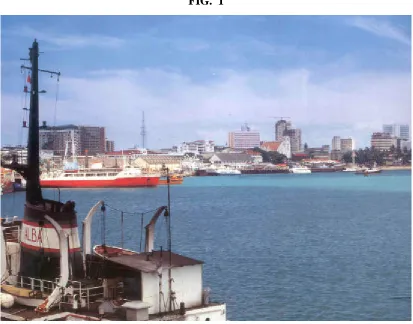
Port of Dar-es-Salaam
2.5 Management in Coastal waters
The Tanzania Harbours Authority is a service agency under the Ministry of
Communications and Transport, apart from running ports activities such as handling of
through the Senior Harbour Master’s Office under clause 312 of the Merchant
Shipping Act to take the role of General Superintendence in managing maritime safety
and marine environment protection in ports and coastal waters.
Limitations and deficiency in its delegated powers are to be mentioned at a later stage.
2.6 Management around the Zanzibar Islands
The ports around the Zanzibar Islands should ideally be under the jurisdiction of the
Tanzania Harbours Authority, however for reasons not known to the writer, the
management of maritime safety and marine environment protection around those
islands falls under the Zanzibar Ports Corporation. The Zanzibar Ports Corporation is
also a service agency under the Ministry of Communications and Transport of the
Revolutionary Government of Zanzibar.
The ambiguity as well as limitations shall also be discussed at a later stage.
2.7 Management in Inland waterways
Management of maritime safety and marine environment protection in inland
waterways has for quite some time been left to Tanzania Railways Corporation (TRC)
Marine Division. However with recent upgrading of the Division to an autonomous
company (Marine Services Company Ltd) for economic reasons, the TRC has now
been relieved of this obligation.
The Marine Services Company operates vessels on three big lakes in the East African
Region namely, Lake Victoria, Tanganyika, and Nyasa (see Appendix 5).
The three lakes are shared with other neighbouring countries having their own vessels
operating between their ports as well as into Tanzania’s ports.
One may now realise that in the absence of a Maritime Safety Administration it is this
responsibilities of a fully-fledged Maritime Safety Administration as indicated by its
list of activities as cited above.
Recalling the four main parts in managing maritime safety and marine environment
protection i.e. policy making, regulating, services and, enforcement. It should be clear
that in the existing set up, there is bound to be a conflict of interest and at times
confusion in the part of those who have to undertake the role of Maritime Safety
Administration.
2.8 The Need for a Maritime Safety Administration
Having seen what the Ministry is doing it is now considered necessary to expand on
the general explanation given under section 1.0.
According to a former Professor in Maritime Safety and Marine Environment
Protection at the World Maritime University the following should be the objectives of
a Maritime Administration:
1. The object of a Maritime Administration Organisation within the framework of a
country’s overall maritime activities is to provide the Government with the
machinery which would enable it to satisfactorily and efficiently undertake those
functions which are embodied within the country’s Merchant Shipping Legislation
(i.e., National Maritime Laws). These functions would include the implementation
of the requirements of International Maritime Conventions, and National Rules and
Regulations framed under the Authority of the Merchant Shipping Act.
2. In pursuing its activities in the development of the maritime field. Need to have an
efficient administrative machinery to advice them on the adoption and
implementation of the National Legislation and other Regulations, required for
developing and operating the maritime programme of their country, and for
discharging the obligations of the Government under International Conventions
3. This machinery can best be provided through an well-organised Maritime
Administration. Such an Administration will also be responsible, under the
general direction of the Ministry responsible for Transport, for providing and
organising the appropriate facilities for the Survey and Certification of ships. And
the training, examination and certification of ship masters, engineers and other
maritime personnel. As a whole, the areas affected within the ambit of Maritime
Administration activities are: the Ownership, Registration, Management,
Operations, and upkeep and maintenance of National Shipping Fleets, and other
related maritime activities such as shipbuilding, ship-repairing, dry-docking, port
operations and maritime training.
4. The operational aspects of a Maritime Administration within the context of Safety
of Life at Sea, take the form of:
• General Superintendence and Co-ordination
• Registration of ships and related functions
• Surveys, inspections and certification of ships
• Port State control of foreign ships
• Inspections and detention of unseaworthy / unsafe ships
• The conducting of Examinations leading to, and the issuance of the appropriate
Certificates of Competency and / or Proficiency to various seafaring personnel
• Manning of ships
• Conducting inquiries / investigations into shipping casualties
• Dealing with matters pertaining to prevention / control / combat of marine pollution
• Crew matters
• Registration of seaman
• Wrecks
• The adoption and implementation of International Maritime Conventions
Vanchiswar, P.S. (1996). (pp. 7-8)
2.9 Potential causes of inefficiency
In the context of the above objects it should now be even clearer that no efficiency
could be achieved without the establishment of a Maritime Safety Administration.
In the author’s opinion the following facts may be cited as potential causes of
inefficiency in the management of maritime safety and marine environment protection
in Tanzania, these are:
• By the Ministry undergoing several structural changes such as, merging or
separating it from the Ministry of Works, there has been a tendency of paying more
attention to road / rail transport safety. This is due to the being more aware of
accidents in those sectors than in the marine sector.
• On the same token, this has caused lack of a sound policy in managing maritime
safety and marine environment protection, hence lack of guidance for those vested
with the responsibility of looking after maritime affairs.
• In the absence of a sound maritime policy, changes in personnel have also contributed in an inconsistency in the system of managing maritime affairs.
• Lack of maritime professionals in the division responsible for maritime affairs has
contributed even further in the Ministry’s failure to accomplish its obligations
competently and confidently.
It is in the author’s opinion that subject to the above reasons, the Ministry of
Communications and Transport has had no choice but to assign or delegate its duties to
individuals and its “service agencies”. In as far as managing maritime safety and
marine environment protection the following are typical examples of delegation of
duties that contribute to potential inefficiency:
2. Casualty investigation / and or inquiries are done by summoning experts from
various Government institutions rather than having a designated department.
3. Maritime Professional Examinations are prepared and conducted at the Maritime
Institute and invidulated by professionals appointed by the Minister, (in the name of
board of Examiners) and who have their own other duties as assigned by their
respective employers.
4. Port State Control “if any” is conducted in ad hoc by THA using the Harbour
Master’s office personnel in various ports.
5. The Minister had to delegate his powers for General Superintendence and
Co-ordination to Senior Harbour Master in the port of Dar-es-Salaam by making him
the Merchant Shipping Superintendent.
6. The receiver of “Wrecks” is in the Treasury (Customs) department under the
Ministry of Finance instead of Maritime Safety Administration.
7. The Manning of ships i.e. signing on and off is handled by the Ministry instead of a
Maritime Safety Administration.
8. Registration of ships is done by two Authorities having equal powers of
registration but with different operating standards i.e. Ministry of Communication
and Transport under the United Republic of Tanzania and a similar Ministry under
the Revolutionary Government of Zanzibar. This has caused unique problems
where some ship-owners had the opportunity to dodge the law by seeking leniency
from one side of the registration authorities.
9. Dealing with matters pertaining to prevention / control / combat of marine pollution
is done separately by THA and TRC by formulating their own Rules.
10.Supervision of Shipbuilding, Docking and Repair of ships has not been properly
addressed. With “Trade Liberalisation” the country has seen a number of private
companies emerging with the interest of either importing or building small
passenger /and or cargo vessels for use in inland or coastal waters (see section
2.10(5)). The safety integrity of such vessels shall remain a nightmare for as long
11.Following the above initiation by private companies, the question that follows is
the competency of those manning such vessels and even worse those managing such
companies in sensitive positions such as “Marine Superintendents.
12.Use of professional bodies for advisory purposes such as the Merchant Navy
Officers’ Association of Tanzania (MNOAT).
2.10 New developments (yet another challenge to the Administration)
Under this section the author seeks to note and quote some relevant information from
recent newspapers (retrieved from the Internet), that call for even more improvement
in the management of maritime safety and marine environment protection in Tanzania.
2.10.1 “Dar es Salaam Harbour Opens Modern Terminal for speed boats”
“Dar-es-Salaam Harbour has opened a modern terminal for sea boats bound for
Zanzibar that has significantly speeded up boarding and disembarkation of passengers.
A senior public relations officer at the port of Dar-es-Salaam, told The East African
that the construction of the modern passenger terminal was part of a multi-million
shilling port rehabilitation project commenced in December 1998.
The Dar-es-Salaam port rehabilitation project, worth T.Shs 19.2 billion ($ 24
million), was financed by the Tanzania Harbours Authority (THA) and the Netherlands
government.
With a draft of 10.7 metres and 140-metre wide channel, access to the port has been
greatly boosted by the provision of new navigation aids and lightening of the entrance
channel. The port can now service ships around the clock, loading or offloading
general loose cargoes, containers and grains.
The rehabilitation of the port has enabled vessels larger than 40,000 dwt (fourth
generation vessels) to enter the port. The first large ship to berth in Dar port was the
64,000-tonne MV Liberty Sun on April 4. It offloaded 10,000 tonnes of rice and
The dredging has already reduced waiting time for ships entering or leaving the port
by reducing the transit time and permitting movements at most states of the tide and at
night. Previously, ships could only enter the port during the day.
All these improvements lead to lower shipping costs for the overall trade arising from
reduced waiting time for ships in port and increased ship load,”
(The East African. 2000, May 1).
2.10.2 “Mtwara Port Will ‘ Open Up’ Southern Africa”
“ The planed expansion modernisation of Mtwara port is expected to help four
landlocked countries transport their bulk cargoes.
Mozambique, Malawi, Zimbabwe and Zambia will be the main beneficiaries as
Tanzania opens up this mineral rich-area.
The move follows an initiative by Tanzania and Malawi to set up the Mtwara
Development Corridor that aims at unlocking the wealth of Tanzania’s south and
providing landlocked Malawi a shorter and more direct route to the Indian Ocean via
Mtwara port.
With the expansion and modernisation, the port will provide facilities for international
cruise ships that sail the Indian Ocean. Such ships call at Cape Town, Port Elizabeth,
Durban, Maputo, Dar-es-Salaam, Zanzibar and Mombasa. They will be able to bring
visitors to southern Tanzania tourist attractions, while cargo ships will load and
offload cargo for countries in southern Africa.
The Lindi port and Mafia Island harbour in southern Tanzania have also been upgraded
to boost business in the south. The Government of Denmark has pledged to donate
Tsh. 200 million ($ 250,000) for the Mafia Island wharf expansion and modernisation
programme, due to begin this year.
Mtwara port is a natural harbour, one of the major ports managed by THA, is being
developed within the framework of the Southern Africa Development Community.”
(The East African. 2000, April 21).
“The Tanzania and Mozambique Friendship Association (Tamofa) will buy a new
ferry to ease transportation problems between southern Tanzania and northern
Mozambique.
The ferry is a prelude to the promised Friendship Bridge, to be built jointly by the two
countries to provide a permanent link between them. Currently, there is no bridge
across the wide Ruvuma; travel is by canoes and other small boats.
The German- made pontoon meets the Safety of Life at Sea (SOLAS) standards and
will ferry both people and cargo only during the day.
The pontoon would run at a speed of 15 knots and be equipped with life and rescue
boat facilities. It will have capacity two trucks and four land Rovers, passengers and
their cargo.
(The East African. 2000, April 21).
2.10.4 “Delayed Transport Deal Holds Up Lake’s Tourist Cruises”
“The MV Victoria, which stopped sailing between Mwanza and Port Bell last
November due to high operational costs, cannot resume services by June 16 due to
delay by Tanzania Railways Corporation (TRC) to finalise a transport deal with
Transafrica Touring Company.
Transafrica officials claim that there many tourists waiting for the ship to make guided
expeditions to the Ngamba chimpanzee island, boat wildlife, exotic bird and nature
expeditions to the Ssese islands. The MV Victoria can carry 1200 passengers and up
to 300 tonnes of cargo. She was built in 1960 and is the largest passenger ship owned
and operated by TRC.
The islands are some of Uganda’s little known tourist destinations.”
(The East African. 2000, April 17).
2.10.5 “Firm to Open Ship Building Plant in Dar”
“A PRIVATE Dar-es-Salaam maritime firm will soon start manufacturing small
specifications. The Dar shipyard would also undertake repairs of ships and other steel
vessels plying the Indian Ocean coastline of Tanzania.
The boats will comply with rules and regulations for the construction of vessels as
laid down by the Tanzania’s Ministry of Communication and Transport.
Small ferries to be constructed will have a capacity of 100 passengers and cruising
speed of 29 knots.
It is expected that introduction of the locally made marine vessels will increase their
availability, improve the safety of the seagoing population and ease transportation in
Tanzania’s coastal and inland waterways.
TanBoat is the second company to engage in boat making in Tanzania, the first being
the Mwanza-based Songoro Maritime Transport Boatyard, started operations in 1998.
(The East African. 2000, April 14).
2.10.6 “Tanzania Waters Unsafe Four Years After Bukoba”
“Four years after Tanzania witnessed its worst marine disaster near the port of
Mwanza in Lake Victoria, when the MV Bukoba capsized in 1996 killing 800 people,
the country still lacks effective and well co-ordinated search and rescue services.
Marine and aviation experts say most of the victims would not have died if Tanzania
had had a well co-ordinated search and rescue service in place on the lake.
The marine experts say even after the Bukoba tragedy in May 1996, Tanzania had not
done anything significant to monitor marine distress and prepare a comprehensive
rescue plan.
The aeronautical SAR manual of the International Civil Aviation Organisation (ICAO)
has been merged with the IMO SAR manual and are now one consolidated manual,
commonly referred to as the International Aeronautical and Maritime SAR Manual
(IAMSAR).
“Before, it was assumed that the search and rescue operations would automatically be
carried out by Marine Police, the Navy and the Port and Ferry services, but it dawned
May 21, 1996,” “When the MV Bukoba capsized and sank, killing nearly 800
passengers, we realised the dangers associated with marine navigation and the need to
regulate maritime services.”
The government has since been in the preparation of a National Search and Rescue
(SAR) Plan and a National SAR Manual (Maritime and Aeronautical).”
(The East African. 2000, May 1).
2.10.7 Impact of the above developments on management of maritime safety and
marine environment protection
All the above items with exception to item number five have positive impact to the
economy of the country and therefore to the social well being of the population.
However if we are to analyse one by one the most likely conclusion will be an
increase in maritime operations both on coastal waters and in inland waterways with
the following end results:
• more ships will be calling the ports
• more passengers and cargo will be carried per year
With point number five lacks of a Search and Rescue Organisation, we may conclude
that the Administration is not really prepared to face any catastrophe.
One thing is obvious that increased traffic means increased risk of all other dangers
associated with maritime adventures. We are therefore looking at more risk to safety
of people and property and from oil pollution from ships.
The outcry from experts in the industry is a sign of dissatisfaction, increasing public
awareness and a demand for improved safety standards in the management of maritime
safety and marine environment protection.
In this chapter the author has attempted to analyse the role of the Ministry of
Communications and Transport in managing maritime safety and marine environment
It has been clear under various sections that there are potential causes of inefficiency
that need to be addressed. New developments such as shipbuilding; ship management
and operation by private companies; and the manning of such vessels calls for a more
organised system. The need for harmonisation and improvement of safety standards in
CHAPTER THREE
The Oil industry and the discovery of Offshore Gas
In this chapter the author discusses the ongoing exploration of offshore oil, the
discovery of offshore gas in Tanzania, and its impact on the management of maritime
safety and marine environment protection.
FIG. 2
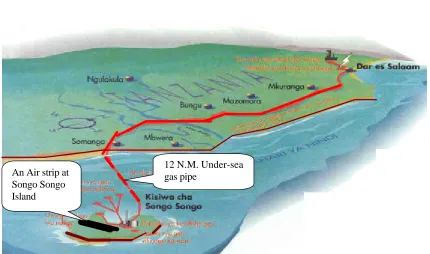
Tanzania’s first offshore gas supply pipe
It is said that the search for oil and gas to satisfy the world’s growing energy demand
has increasingly moved offshore. This trend, plus widely publicised accounts of Source: Tanzania Petroleum Development Corporation
12 N.M. Under-sea gas pipe
several blowouts and spills resulting from drilling and producing activities, has given
rise to public concern about the impact on the offshore environment.
Drilling offshore is normally more difficult and significantly more expensive than
drilling onshore. But the potential reward is also greater. There is a better chance of
finding large fields of significant production in the undrilled offshore basins than in the
mature, well-drilled onshore producing areas. It is stated that:
“In 1979 offshore areas accounted for an estimated 13 million barrels daily, or about
20% of the world-wide crude oil production of approximately 63 million barrels
daily”
(Exxon Corporation. 1980, p. 2.)
During the research period in December 1999 the author visited the TPDC offices
“Exploration Department” and had the opportunity to discuss with the Chief
Geophysicist.
This chapter is therefore made up of a combination of information from interviews,
professional textbooks, Internet texts and relevant Acts etc.
3.1 Oil and gas exploration in Tanzania
Tanzania’s Upstream Profile, with its oil seeps, seismic and other data, shows strong
hydrocarbon potential. However, only 23 wild exploration wells have been drilled in
a 222,000 sq. km area, and therefore Tanzania can be classified as underexplored.
Oil exploration in Tanzania started way back in 1952 when the British Petroleum (BP)
and Shell companies were awarded a concession covering the onshore coastal basins
and the islands of Zanzibar, Pemba and Mafia.
The second exploration phase coincided with the formation of the Tanzania Petroleum
Development Corporation (TPDC) in 1969 when Agip were awarded a concession
covering a similar onshore areas to that held by BP but which also included the
by Amoco and drilled three onshore and 3 offshore wells resulting in the discovery of
the Songo Songo and Mnazi Bay gas fields.
The government expects that the realisation of the Songo Songo gas-to-electricity
project will attract more companies to acquire acreages for exploration.
It should however be recalled from the previous chapter that despite having 48 years
of oil exploration, Tanzania is yet to have an established Maritime Safety
Administration. However a former World Maritime University Professor has it all:
“In developed countries the structures and the roles of the Maritime
Administrations have been the results of circumstantial evolution and not
necessarily planed from the beginning. Therefore, there are likely to be
areas deserving improvement and/or strengthening.
On the other hand, developing maritime countries, particularly those which
are in the early stages of development, can be said to have the advantage of
creating pre-planed structures and functional approaches, provided that all
concerned have proper understanding of the objectives, criteria and
functions.”
(Vanchiswar P. S. Rev.1996, p. X)
In the light of the above said facts, it is the author’s intention through this chapter to
examine the various legal provisions and their practicability in connection to the
management of offshore safety and marine environment protection. The processes
involved in oil exploration are also described in order to appreciate their implication.
It is considered that, this approach would allow the writer to establish areas of
concern for the Ministry of Communications and Transport, responsible for maritime
safety and marine environment protection. It should also be a basis for even better
policies and clear line of action between the different Ministries and their relevant
agencies on how each of them should effectively and efficiently be involved in the
3.2 The Tanzania Petroleum Act
While the Ministry of Communications and Transport through its Merchant Shipping
Act, generally regulates the management of maritime safety and marine environment
protection, the Ministry for Water Energy and Minerals regulates the Oil Industry.
Petroleum exploration and development in Tanzania is governed by the Petroleum
(Exploration and production) Act 1980. These Act vests title to petroleum deposits
within Tanzania in the State, and are designed to create a favourable legal environment
for exploration by oil companies.
The National Energy objectives are set out as:
• “Exploitation and utilisation of the country’s abundant indigenous
resources such as hydroelectricity, coal and natural gas.
• Reduction of dependency on imported petroleum products.
• Stemming of woodfuel depletion and use of woodfuel in a sustainable and ecologically sound manner.
• Development of indigenous manpower capacity in the development of the
energy sector.”
(Govt. of Tanzania Oil Industrial Sector. 1999)
The Petroleum Act therefore expressly permits the Government to enter into a
petroleum agreement under which an oil company may be granted exclusive rights to
explore for and produce petroleum. Tanzania Petroleum Development Corporation
(TPDC) is granted the licences under the Act with the Government and TPDC entering
into agreement with the oil companies.
The Act also provides for the exploration, appraisal, development and production
periods.
With regard to the management of offshore safety and marine environment protection
(Conservation) Act, 1981, provides under its Part II, number 5 sub-sections (g) to (j)
that:
The Minister may make regulations generally for the better carrying out of the
purposes and provisions of this Act, and may in those
regulations-(g) Regulate the description and construction of vehicles and vessels to be
used in the conveyance of petroleum by road rail, sea or inland water;
(h) Prohibit or restrict the carriage of goods and passengers in a vehicle or
vessel carrying petroleum;
(i) Prescribe the quantity of petroleum, which may be conveyed at one time or
in one vehicle or vessel;
(j) Prescribe the precautions to be observed in the conveyance of petroleum by
road, rail, sea or inland water, the manner of packing and the mode and time of
transit and in the loading and unloading of vehicles and vessels used in such
conveyance.
According to the TPDC Chief Geophysicist, it is not until just recently (1999) that
TPDC working with the National Environment Management Council (NEMC) has
completed a draft on “Drilling Regulations”. The draft has been submitted to the
Ministry of Energy Water and Natural Resources for approval, with a view to
adopting the Norwegian system.
It is however in the author’s opinion that along with the Drilling Regulations in the
making, the Petroleum Act is also lacking some important provisions for better
management of offshore safety and marine environment protection.
For example: the Act should differentiate between installations and vessels. As
installations are included load-bearing structures with equipment used for shallow
drilling, exploration drilling, recovery and pipeline transportation, as well as
structures with equipment directly assisting in the activity. The Act should also be
applying to the offshore loading of petroleum, but not for the transportation itself as
“As vessels are included, supply, auxiliary, and diving vessels, vessels used in
connection with emergency preparedness, service, construction, pipelaying, seismic
investigations and helicopters etc. The Act should address the functions that the above
vessels have in the activities”.
(Vinnem J.E & Hope B. 1986, p.33).
Nevertheless, it is in the author’s opinion that, the adoption of the Norwegian
Regulations in the oil industry, should be in parallel with other related industrial
regulations. The Merchant Shipping Act and the Labour Law(s) for which
Occupational Health Regulations should be reviewed with the assistance of the
International Labour Organisation are some of the instruments to be looked into.
3.3 Survey of potential oil and gas fields
Among other things that were discussed was the issue of offshore safety and marine
environment protection, ranging from:
• survey of potential oil and gas fields,
• commissioning and decommissioning of oil and gas rigs,
• safety of offshore personnel and equipment and
• marine environment protection
Since the Government of Tanzania does not have the capacity to undertake oil
exploration, it was said that, the Government’s objective is to negotiate terms with the
oil industry which are fair and balanced, bearing in mind the usual risks associated
with exploration. To achieve this objective Tanzania uses what is called “Model
Production Sharing Agreement” (PSA) which serves as the basic document for
negotiations between foreign oil companies and the Government and TPDC.
The (PSA) agreement is said to be setting out in detail the terms under which
it also allows for the negotiation of important issues such as Area, Work Program and
economic terms etc.
It was further narrated that, on average one well is explored in every two years.
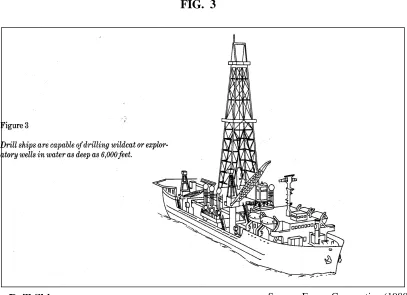
Seismic surveys (a non-marine life destructive survey method) are done by a hired
ship (drill-ship), whose inspection is done by surveyors from the Port Authority
(THA), through the initiation of a TPDC officer and without any standing instructions
from the Marine section in the Ministry of Communications and Transport.
3.3.1 The survey process
The oil and gas survey would involve the following process:
The spudding (initial drilling into the seabed in order to place risers to the surface) of
a well by the drilling rig or ship, there follows a period of analysis to establish
whether hydrocarbons are present and whether the development is likely to be
profitable. It is likely that appraisal wells will be drilled in order to gain more
information about the potential of the reservoirs. If the findings remain promising then
production tests are made under conditions as near as possible to those, which would
exist if the well were in actual production. It is then that a final assessment can be
made, followed by an announcement of a commercial find, its potential production rate
and potential reserves. Commercial development can then begin - but it may have
taken two or more years to reach this stage.
By the time the decision has been made that the production will be viable, work will
already be advanced on planning what kind of production facilities will be required.
Decisions will, for example, have to be made concerning the type and size of
installation, the facilities needed, the materials of construction; indeed, whether more
than one platform is required. If there will be two or more platforms, it will have to
be decided whether they should be permanently bridged.
In relation to the above process, it is difficult for the author to speculate how much the
PSA agreement does cover involved safety issues in detail, as there was no specimen
provided. It was however mentioned, that all safety and marine environment
protection matters are resting in the hands of the oil exploration companies (being the
licensee). Nevertheless, the (PSA) agreement was said to be prepared with the
supervision of the TPDC only expert (a professional Explorationist) since 1977.
3.4 Safety of offshore personnel and equipme nt
According to the TPDC official only 5 % of the workers in the offshore industry
constitute for indigenous Tanzanian employees otherwise the majority of them would
remain on call. This is taken as a means for transferring drilling skills to the
Tanzanian employees.
When the installation is complete and technical problems overcome, to enable the
operation of the installation and the transportation of the petroleum products from the
installation to shore, there still remains a problem to be considered: namely, the
workforce or human resources.
In Tanzania where foreign companies from different countries, and employees of
different nationality are involved with a small proportion of indigenous employees, the
offshore workforce is likely to be an ever-changing population: even on the
installation itself.
Whatever the employment relationships, persons work offshore at least 12 hours a day,
often for 14 consecutive days before they are relieved. Thus the equipment can not
stand-alone: because people are placed onto and into the structure of the installation,
the needs of the ‘crew’ must be considered at the design stage and built into the
operational system.
It was noted that the Exploration Company has the responsibility to make sure that, the
ensure their safety within the overall plan. The administrative systems must ensure
that the parts are knitted together. The quality of management must be considered and
only appropriate personnel appointed, and that supervision must be adequate. The
level of skill and training of all personnel must be of high quality and all must be able
to work as a team, both during normal operations and in emergencies.
It was also learnt however, that in the history of exploration in Tanzania there has been
only one serious accident in the offshore industry, which happened in 1976, when a
whole rig was blown out at the Songo Songo gas fields. Luckily there were no
casualty, and the reason was established to be a failure of the “Blow-out preventer” on
land.
The author also learnt that Lloyd’s surveyors are contracted to look after the safety
viability of equipment at the commissioning stage.
In ensuring that structures and equipment are capable of carrying out works for which
they were designed, and under the conditions in which they were expected to operate,
there should be responsible bodies. Such bodies are as follows: designers,
contractors, the certifying authorities and the government of the state involved e.g.
Lloyds, TPDC, BP and Shell and the United Republic of Tanzania.
Despite lack of a comprehensive set of Drill Regulations, safety matters are said to be
taken care of by a TPDC Petroleum Engineer who is the “Chief Safety and
Environment Officer” (CSC). Detrimentally the Ministry of Communications and
Transport is not in any way involved for regular inspections of the survey ship and
competency of its personnel on board.
It was also established that in the event of a major accident in the offshore industry