41 | P a g e
School Change Management: A Multi-frame analysis
Eman I. Ahmed *
Abstract
The purpose of the present paper is to examine how the school leaders frame their own experiences of managing change within the school system. The mixed method design was used to answer the research questions and understand the research problems. Both the qualitative and the quantitative data were used to identify the frames orienting school leaders to manage change within the school setting. The obtained data showed that the participants employed most of the frames (structural, political, human resource, and symbolic) in managing school change. The data revealed that the human resource frame appeared universal in most of the cases. Understanding principals’ perceptions of change management can help practitioners as well as academics to work more efficiently and address the needs of the school leaders.
Keywords: school change, multi frame analysis, public education
Introduction
Over the past few years, national entities have issued a call to re-examine the Saudi educational system. Saudi Arabia's vision for 2030 reported the rising tide of mediocrity that characterized Saudi public schools. The National Transformation Program (2020) has significantly increased the pressure on school leaders to raise student achievement and improve the quality of public education (Ministry of Education, 2019). The low student expectations, new mandates and initiatives, and decreasing parental involvement in education signaled a threat to the quality of public education. Other national commissions have also added their voices to the growing concern over the quality of public schools in Saudi Arabia.
School leaders must respond to the widespread concern about education today and the need for change (Daniels, 2009). The school leader's response to change determines its effectiveness in the future (Ahmed, 2018). The demands for school change have redefined the role of the school leaders nationwide. While change should be dealt with by school leaders, supervisors alike, the role of the school leaders has been identified as significant factor in successful educational change. School leaders have had increased expectations placed on them in their roles (Fullan, 2001).
The school leader occupies a position between the educational office and the teaching staff. This position is critical to the change management process. Understanding the school leaders' perceptions of the change process as well as which frames and approaches they use to achieve transformation is critical to the success of the change efforts. Bolman and Deal (2003) introduced four frames orienting the leaders to manage the change process within the school. The focus of this study was to add to the existing literature by examining how the school leaders frame their own experiences of managing change within the school system. The more can be learned about the perceptions and the expectations that school leaders have of the change management process, the more educators will be able to address the needs of the school leaders.
42 | P a g e
Conceptual Framework
The study’s theoretical framework draws upon the four-frame model developed by Bolman and Deal (1991). Bolman and Deal introduced their model and defined reframing as "the use of multiple lenses" (Bolman & Deal 1991a, xv). The four frames are (a) the structural frame, (b) the human recourse frame, (c) the political frame, and (d) the symbolic frame. Each of these four approaches offers a distinct perspective with specific identified behaviors with negative and positive aspects (Bolman & Deal, 2003). The Bolman and Deal framework was designed as a comprehensive tool to understand managerial action (Zhixian, 2010). It is also a powerful way to match change management situation to a particular change situation.
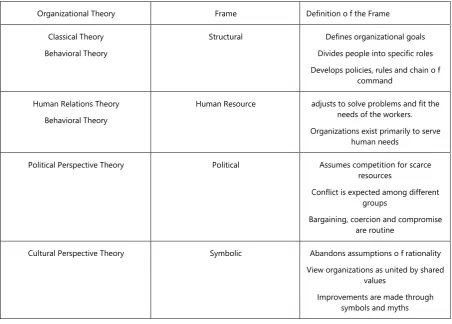
Bolman and Deal's four-frame model concerns the change that can be managed from a variety of frames. Each frame "is a coherent set of ideas forming a prism or lens that enables you to see and understand more clearly" (Bolman & Deal, 2008, p. 41) the decisions that must be made. The four-frame model is based on the major schools of organizational change research and theory. These frames are classifications that describe the way leaders/principals think and react to situation. Bolman and Deal suggest that organizations have multiple realities and leaders need multiple perspectives or lenses with which to manage a particular situation. Each of the four frames, as detailed below, is focused on a different aspect of organizational behavior (Sypawka, 2008). Table 1 shows the relationship of the frames and the major schools of organizational theory.
Table 1 Relationship of the Leadership Frames and Major Schools of Organizational Theory
Organizational Theory Frame Definition o f the Frame Classical Theory
Behavioral Theory
Structural Defines organizational goals Divides people into specific roles Develops policies, rules and chain o f
command Human Relations Theory
Behavioral Theory
Human Resource adjusts to solve problems and fit the needs of the workers. Organizations exist primarily to serve
human needs Political Perspective Theory Political Assumes competition for scarce
resources
Conflict is expected among different groups
Bargaining, coercion and compromise are routine
Cultural Perspective Theory Symbolic Abandons assumptions o f rationality View organizations as united by shared
values
43 | P a g e The Structural Approach
The structural frame had its roots in the scientific management and the bureaucratic model of the classical management theory. The structural frame was developed based on assumptions that organizations exist primarily to establish mission and goals, rationality rather than personal agendas is the key to organizational improvement and effectiveness. For any organization, a structural form can be designed to fit its political goals, strategies, environment, and people. Coordination and control are essential to the organization effectiveness. Structural leaders always value analysis and dada, set clear directions, and held people accountable for the outcomes. They resolve change problems with new polices and rules or through restructuring. Behavior of the individuals should be rational and controlled by the organizations structure.
The Human Resource Approach
The human resource frame had its roots in the human relations and the behavioral management theories. The human resource leadership frame uses assumptions from psychology and organizational behavior (Sypawka, 2008) to focus on the relationship between human needs and the organization. A human resource frame leaders value relations and lead through empowering the workers. The human resource frame was developed based on assumptions that organizations exist primarily to serve human needs, the leader is adjusted to solve problems and fit the needs of the workers, workers are dependent on the organization for satisfaction and meaning for their lives, people should be rewarded for their work, and people satisfaction and organizational effectiveness are dependent on interpersonal relationship. The central idea of the human resource approach is the interplay between organizations and people. Human resource leaders value relation feelings and interpersonal relations. Change may result in people feeling incompetent (Zhixian, 2010). When change leaders had this issue, they should provide employee with training, participation, and psychological support (Bolman & Deal, 2003).
The Political Approach
The political frame had its roots in the political perspective theory. The political frame described organizations as places where individuals used power and influence to affect the allocation of scarce resources. The political frame was developed based on assumptions that organizations such as school system consists of varied individuals, interest groups, and demands outside and inside the school, most of the important decisions in the organization involve the allocation of scarce resources, there are enduring differences among individuals in values, beliefs, and perceptions of reality, scarce resources and enduring differences make conflict at the center of organizational dynamic and the underlies power as a key activity, limited resources inhibit change and when resources are available, power is needed to make things happen, overcome resistance, and influence the people to do things" (Bolman & Deal, 2008, p.196). Power is one of the key mechanisms of organizational change. Sometimes, it could be the only mechanism to change the system. Political leaders are negotiators who "spend most of their time, networking, creating coalitions, building power base and negotiation compromises ” (Bolman & Deal, 1991, p. 512). Organizational goals and decisions emerge from barraging and negotiation among leaders. This approach is limited by the fact that political perspective focus strongly on politics as to underestimate the significance of rationality and collaboration in organization, overstate the inevitability of conflict (Bolman & Deal, 2008).
The Symbolic Approach
44 | P a g e it means, activity and meaning are loosely coupled, events have multiple meanings because people interpret experiences differently and culture is the glue that holds an organization together and unites people around shared values and beliefs (Bolman & Deal, 2003).
The organizational culture theory is present in these assumptions (Roddy, 2010). Symbolic leaders use symbols as means to lead the organization. They are effective when they place the symbolic value on intentions rather relying on the formal power. have powerful impact on how people react to events around them. “Symbols carry powerful intellectual and emotional messages they speak to both the mind and the heart" (Bolman & Deal, 2008, p.248). In order to get things happen, the meanings and the culture of the symbols of the people have to be changed. Sometimes, people resist changing, because they carry different meanings and symbols different from the ones involved in the change process.
Bringing the Frames Together
Identifying and using a combination of the structural, human resource, political, and symbolic frames allows leaders to better understand the complexities of the organization (Bolman & Deal, 2003). The use of a collection of frames to make sense out of complex organizational events is a powerful asset for leaders as they make sense of situations and solve problems (Roddy, 2010). Bolman and Deal (2003) describe the organization as having multiple realities which produce confusion and conflict as the individuals interpret the same events through their own frames. An effective leader can use this knowledge and match a particular frame or combination of frames to a situation. When a person’s actions appear to make no sense, a leader should use these lenses and peer into contrasting realities (Sypawka, 2008). An individual’s frame can help explain his or her actions: “Their frame, not yours, determines how they act” (Bolman & Deal, 2003, p. 309).
Purpose and Research Questions
The purpose of this study was to examine the Saudi school leaders’ perceptions of the change management in using the four -frame perspective developed by Bolman and Deal. In order to address the purpose of the study, this study sought to answer the following questions:
1. Which frame(s) of Bolman and Deal’s four-frame leadership orientations do the school leaders report as the most dominant frame(s)?
2. Are there any significant differences in the management of change based on the leaders’ demographic-related variables?
Significance of the Study
45 | P a g e
Methodology
Population and Sample
The population of this study was all full-time school leaders employed in in the Eastern Province of Saudi Arabia. The study involved a random sample of school leaders (N= 151).
Research Design
In order to better address the study’s questions, the author decided that the best design to conduct this study is the mixed -methods design. Mixed--methods has been identified as a research design with philosophical assumptions as well as -methods of inquiry. As a methodology, it involves philosophical assumptions that guide the direction of the collection and analysis and the mixture of quantitative and qualitative approaches in many phases of the research process. As a method, it focuses on collecting, analyzing, and mixing both quantitative and qualitative data in a single study (Ahmed, 2011). Its central premise is that the use of the quantitative and the qualitative approaches provides a better understanding of the research problems than either approach or method by itself (Creswell, 2008 and Creswell, & Plano Clark, 2011).
Based on Creswell and Plano Clark (2011), the best mixed methods design to use in order to answer the study’s questions is the Explanatory Sequential Design. The Explanatory Sequential Design is well suited to the study’s purpose in which the researcher needs the qualitative strand to explain, examine, and refine the initial results of the quantitative data (Creswell & Plano Clark, 2007). The Explanatory Sequential Design is a two-phase structure starting with designing and implementing a quantitative strand that includes collecting and analyzing quantitative data. This first step is followed by a sequential collection and analysis of qualitative data. The qualitative result helps “explain and add insight into the quantitative results and what overall is learned in response to the study’s purpose” (Creswell & Plano Clark, 2011, p. 85).
The quantitative component of the study consisted of a questionnaire administered to a sample of 151 school leaders. The questionnaire consisted of 36 items developed by the author to address the respondents’ perceptions regarding the change process in the school setting. The qualitative component of the study consisted of a content analysis of written incidents the principals encountered in their schools with a sub sample of those principals surveyed.
Quantitative Investigation
46 | P a g e Participants
A mixed purposeful sampling is employed in this study. It combines various sampling strategies. Mixed purposeful sampling helps achieve triangulation and variety. The author believes that the gender of the principals, their experiences, and the settings of the schools that they work in have sufficient power to fulfill this variety.
A purposeful sample of 151 school leaders compromised the participants for this study, 91 females and 60 males. The school leaders were chosen from different school settings and school enrollment sizes in the school year of 2017-2018. Seventy three of the principals surveyed had 1-5 years of leadership experience, seventy eight had 6-10 years of leadership experience or more.
Results
The data revealed that there were significant differences between men and women school principals on most of the (frames) as shown in table 1. Female principals were significantly higher on the human resource and the symbolic frames than their male colleagues.
Table 1. Gender differences on Frames
Group F M F M
M M Sd Sd t Structural 15.5 15. 1.8 2. 0 1. 1 .273
Human resource 27.2 19.1 2.4 6.7 -10.4 000
Political 15.4 14.4 2.1 1.6 -4.0 .000 Symbolic 27.2 19.1 2.4 6.7 -10.4 000
Significance levels: * = < .05 by two-tailed test. Table 2. Experience differences on Frames
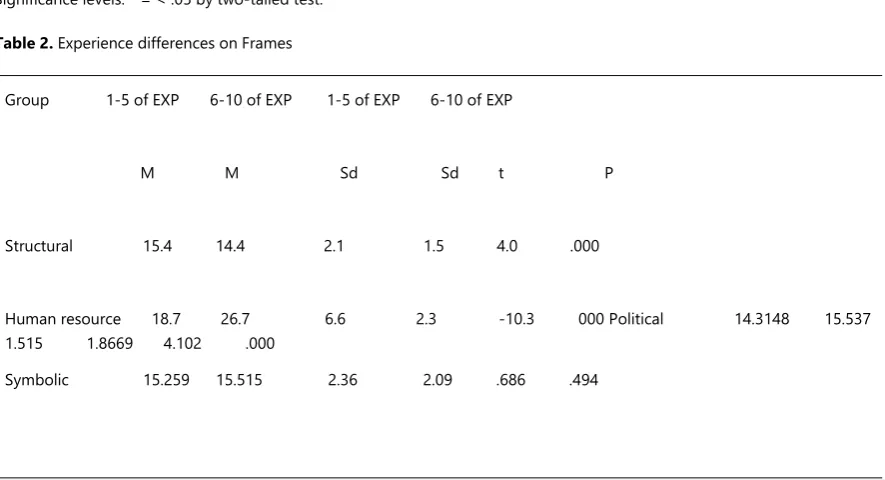
Group 1-5 of EXP 6-10 of EXP 1-5 of EXP 6-10 of EXP
M M Sd Sd t P
Structural 15.4 14.4 2.1 1.5 4.0 .000
Human resource 18.7 26.7 6.6 2.3 -10.3 000 Political 14.3148 15.537 1.515 1.8669 4.102 .000
47 | P a g e Significance levels: * = < .05 by two-tailed test.
The data revealed that there were significant differences between 1-5 years of experience and 6-10 years of leadership Experience or more school principals on most of the frames as shown in table 2. Principals with 6-10 years of leadership Experience or more were significantly higher on the human resource and the political frame than their colleagues with less experience. Principals with 1-5 years of leadership Experience were significantly higher than their on the structural frame. The differences principals were not statistically significantly on the symbolic frame.
Qualitative Investigation
The qualitative component of the study was conducted to follow the quantitative component. In other words, the overall purpose of the qualitative investigation was to explain and refine the results of the quantitative data. The qualitative component of the study consisted of a content analysis of written incidents the principals encountered in their schools with a sub sample of those principals surveyed.
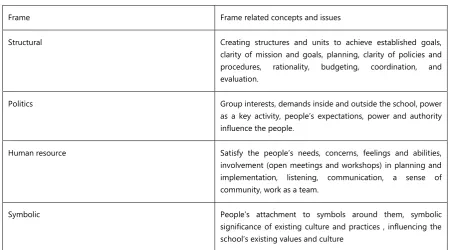
Written incidents descriptions were used for several reasons. First, these descriptions provide rich and detailed data on how the principals frame their experiences of managing change. Second, writing these incidents took only five to ten minutes remembering and writing the incidents (Rao, 2000). The participants in this study were asked to provide written, critical incidents that describe a challenging situation of managing change within the school setting. The researcher analyzed these narratives to identify the fames used by the school leaders to manage the change process in the school setting. The author used a coding system based on criteria summarized on the following:
Table 3. Criteria for Coding the Frame Responses
Frame Frame related concepts and issues
Structural Creating structures and units to achieve established goals, clarity of mission and goals, planning, clarity of policies and procedures, rationality, budgeting, coordination, and evaluation.
Politics Group interests, demands inside and outside the school, power as a key activity, people’s expectations, power and authority influence the people.
Human resource Satisfy the people’s needs, concerns, feelings and abilities, involvement (open meetings and workshops) in planning and implementation, listening, communication, a sense of community, work as a team.
Symbolic People’s attachment to symbols around them, symbolic significance of existing culture and practices , influencing the school’s existing values and culture
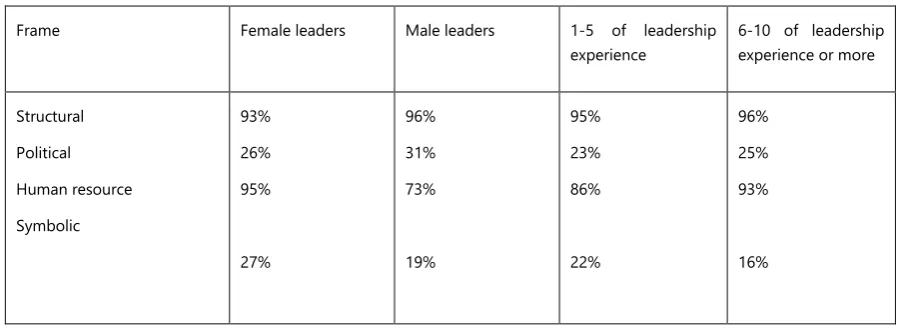
48 | P a g e Table 4. Which Frame do School Leaders Employ?
Frame Female leaders Male leaders 1-5 of leadership experience
6-10 of leadership experience or more
Structural Political Human resource Symbolic
93% 26% 95%
27%
96% 31% 73%
19%
95% 23% 86%
22%
96% 25% 93%
16%
Table 4 reports the frames used among the school leaders in the four samples in managing change within the school setting. For the political and the symbolic frames there were no differences among the participants. However, all the female leaders employed the human resource perspective more than their male colleagues Regardless of the demographic background, all the school leaders in the four samples rated high on the structural frame.
Discussion
School leaders play a crucial role in managing change. Understanding which frames school leaders use to achieve transformation is important to the success of the change efforts. Bolman and Deal (2003) introduced four frames orienting the leaders to manage the change process within the school: structural, human resource, political, and symbolic. The focus of this study was to add to the existing literature by examining how the school leaders frame their own experiences of managing change within the school system.
The mixed method design was used to answer the research questions and understand the research problems. The explanatory sequential design is a two-phase mixed-methods design. The first phase starts with the collection and the analysis of the quantitative data. This first phase is followed by the collection and the analysis of the qualitative data. The qualitative data resulted in probing the qualitative data in more detail. While the results of the quantitative data identified the frames the principals use to achieve transformation and the differences in how these played out for the males versus the female school leaders, the qualitative data painted a rich picture of how prominent each frame in orienting the school principals in managing change and achieving transformation within the school setting.
Both the qualitative and the quantitative data were used to identify the frames orienting them to manage change within the school setting. Both the qualitative and the quantitative data showed that the participants employed most of the frames (structural, political, human resource, and symbolic) in managing school change. Both the qualitative and the quantitative data indicated revealed that the human resource frame appeared in were universal in most of the cases.
49 | P a g e natures and personalities. Nel Nodding (1984) stated that caring, support, and concern are central to women's nature and psychological development. Females like to get discuss all implications of the change, trying to find out what questions people might have so they can address them as much as possible. Male Leaders, on the other hand employed the structural frame. For them, coordination and control are essential to the organization effectiveness. The always value analysis and data, set clear directions, and held people accountable for the outcomes.
Implications for practice
Each frame highlights significant possibilities for leadership, but each of them is incomplete in capturing the whole picture Guidry (2007). Leaders who view their organizations through one of the four frames are likely to have an unbalanced view in their leadership; whereas leaders who can call upon multiple frames have alternative ways of considering problems and a repertoire of behaviors from which to choose.
References
Ahmed, E .(2018).An Investigation of Faculty Members' Engagement in Saudi Arabia. Journal of Education in Black Sea Region, 3( 2), 2018.
Ahmed, E. I (2011). Barriers and Facilitators to Career Advancement by Top-Level, Entry-Level and Non-Administrative Women in Public School Districts: A Mixed Methods Study. Doctoral Dissertation. USA: The Pennsylvania State University.
Bolman, L.G. & Deal, T. (1984). Modern Approaches to Understanding and Managing Organizations. San Francisco: Jossey-Bass Publishers.
Bolman, L. & Deal, T. (1991). Leadership and management effectiveness, Human Resource Management, 30(4), 509-534. Bolman, L. & Deal, T. (2003). Reframing Organizations: Artistry, Choice, and Leadership. 3rd ed. San Francisco: Jossey-Bass
Publishers.
Bolman, L. & Deal, T. (2008). Reframing Organizations: Artistry, Choice, and Leadership. San Fransicso: Jossey-Bass.
Creswell, J. (2008). Educational Research: Planning, Conducting, and Evaluating Qualitative and Quantitative Research, (3rd ed.). New Jersey: Pearson Education, Inc.
Creswell, J., & Plano Clark, V. (2007). The Mixed Methods Reader. Thousand Oaks, CA: Sage Publications, Inc.
Creswell, J., & Plano Clark, V. (2011). Designing and Conducting Mixed Methods Studies. Thousand Oaks, CA: Sage Publications, Inc. Daniels, D. (2009). Leadership, learning, and school change: The elementary principal's role in teacher professional development.
Pennsylvania: the Pennsylvania State University.
Fullan, M. (2001). The New Meaning of Change. New York: Columbia University, Teacher’s College Press.
Guidry, T. (2007). Women Deans' Perceptions of Their Leadership Styles. (Doctoral Dissertation). Heyward, CA: East California University.
50 | P a g e Noddings, N. (1984). Caring, a Feminine Approach to Ethics & Moral Education. Berkeley: University of California Press. Rao, J. (2000). Content analysis of critical incidents to redesign a university walk-in clinic. Quality Management in Health Care,
8(2), pp. 49-63.
Roddy, T. (2010). Frame Analysis of the Self-Perceived Leadership Orientations of Headmasters of the Independent Schools Association of the Southwest, Southern Association of Independent Schools, and the Association of Independent Schools of Greater Washington Member Schools. (Doctoral Dissertation). New Orleans, LA: University of New Orleans.
Sypawka, W. (2008). A study of division dean’s in the North Carolina community college system self perceived leadership style based
on Bolman and Deal’s four frame theory. (Doctoral Dissertation). Greenville, NC: East Carolina University