Study and Characterization of Soil Properties and
Productivity Management Arrangement in
Bastar of Chhattisgarh State
Prabhakar Mishra1, Manish Upadhayay1, G.P. Khare2 and D.S. Thakur3
1
Chemistry,
Dr. C. V. Raman University Bilaspur, INDIA. 2Civil Engineering,
GEC Jagdalpur, INDIA. 3
Soil Science,
Govt. Horticulture College Jagdalpur, INDIA.
email:[email protected], [email protected], [email protected]
(Received on: May 31, 2019)
ABSTRACT
Study of soil properties that affect plant growth and biological processes in and of the soil depend on soil and, air, and soil temperature. Typical soil on volume basis contains half solid and half pore space part consisted of minerals, materials and organic matter space part is filled with water and air. The composition of soil air undergoes rapid changes due to continuous consumption of oxygen by plant root and soil microorganism and production of CO2 and also with several factors biological
Keywords: Hydraulic conductivity, electric diffuse double layer technique. eEE, stripping technique.
INTRODUCTION
Soil as a medium of plant growth should also be physically fertile the soil which supports plant is a variable mixture of solids, liquid and gases and is called a three phase system. The physical properties of a soil play an important role in determining its sustainability for crop production the characteristics like the supporting power and bearing capacity tillage practices, moisture storage capacity and its possibility. The properties of soil like consistency, compatibility, strength, swelling and shrinkage are strongly influenced by the water content. While studying such chemical processes in soil as ion exchange absorption, precipitation, complexation and chelation etc.
Soil composition concerns the geochemistry of that portion of the mantle of the earth which is currently under exposure to the atmosphere and is subjected to biotic influences. Considering soil as a material its essential ingredients are mineral matter of chemical biochemical and physical process. These processes affect the earth material under various topography and climatic conditions. So some amount’s of salts are always present in soil when the concentration of these salts content of the soil to high levels plant growth is adversely affected which in turn decreases the productivity of agriculture crops. The extent of reduction in growth and productivity however depend upon many factors such as soil texture, distribution of salt constituents and soil profile the seventeen nutrients recognized essential for fertility of the soil where a crop is raised the difference fertility. Efficient nutrients management is the has received the maximum attention during the last consumption in bastar plated region farmers are traditionally trained and minimum consumption of chemical fertilizers as the population ratio getting survey report.
MATERIAL AND METHOD
Profile soil samples were collected from assigned area of district bastar were cut the vertical section upto a depth of 1.5-2.0 meters in deep soils in the case of different made upto a block area of a bastar these shallow soils the vertical cut is made upto water table in the case of water logged soils width of profile ranges from 1meter to 2.5meter road cut or brick kiln or query are near about 3.6 to 6.2 meters of each depth
Order of soil survey for characterization
samples should be taken prior to seeding. In order to make an intelligent use of periodical soil test careful recording of input and output is essential
Physical characteristics of constrained soil
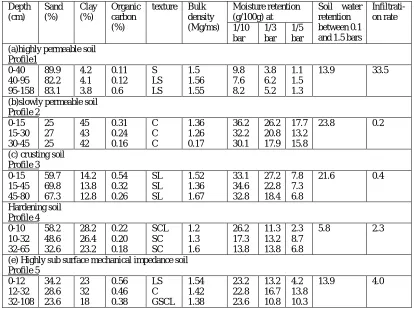
In Chhattisgarh state a big hectares area of land produce very low yield of crops due to unfavorable soil physical condition the major soil physical constraints identified are low water retention and high permeability, surface and sub surface mechanical impedance and shallow depth of the soil which either restrict crop growth to reduce efficiency of basic inputs shown in
Table 1:- physical characteristic of representative physically constrained soil
Ion exchangeable characteristics of soil sample-
These soil sample randomly collected in given assigned area of projected range in bastar district in this process makes a colloidal solution of soil carry electrical charges and acts as a ion the process is ion exchange capacity of soil hold cation and anions is called cation
Depth (cm) Sand (%) Clay (%) Organic carbon (%)
texture Bulk density (Mg/ms)
Moisture retention (g/100g) at
Soil water retention between 0.1 and 1.5 bars
Infiltrati-on rate 1/10 bar 1/3 bar 1/5 bar (a)highly permeable soil
Profile1 0-40 40-95 95-158 89.9 82.2 83.1 4.2 4.1 3.8 0.11 0.12 0.6 S LS LS 1.5 1.56 1.55 9.8 7.6 8.2 3.8 6.2 5.2 1.1 1.5 1.3
13.9 33.5
(b)slowly permeable soil Profile 2 0-15 15-30 30-45 25 27 25 45 43 42 0.31 0.24 0.16 C C C 1.36 1.26 0.17 36.2 32.2 30.1 26.2 20.8 17.9 17.7 13.2 15.8
23.8 0.2
(c) crusting soil Profile 3 0-15 15-45 45-80 59.7 69.8 67.3 14.2 13.8 12.8 0.54 0.32 0.26 SL SL SL 1.52 1.36 1.67 33.1 34.6 32.8 27.2 22.8 18.4 7.8 7.3 6.8
21.6 0.4
Hardening soil Profile 4 0-10 10-32 32-65 58.2 48.6 32.6 28.2 26.4 23.2 0.22 0.20 0.18 SCL SC SC 1.2 1.3 1.6 26.2 17.3 13.8 11.3 13.2 13.8 2.3 8.7 6.8
5.8 2.3
(e) Highly sub surface mechanical impedance soil Profile 5 0-12 12-32 32-108 34.2 28.6 23.6 23 32 18 0.56 0.46 0.38 LS C GSCL 1.54 1.42 1.38 23.2 22.8 23.6 13.2 16.7 10.8 4.2 13.8 10.3
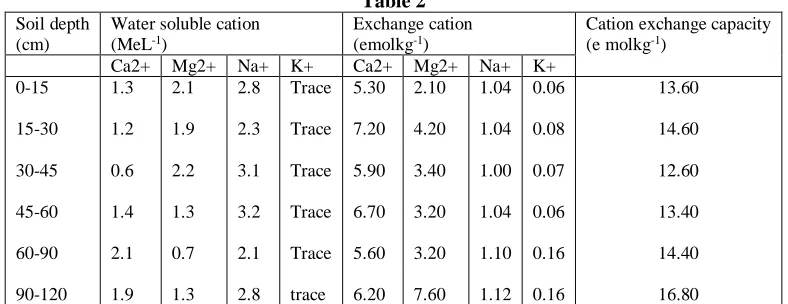
exchange capacity (cec) and anion exchange capacity (AEC) respectively using techniques conventional technique (1) stripping technique (2) Isotopic dilution technique (3) electrical diffuse double layer technique (4) quantity intensity (Q/I) relationship. Following this method & technique to conduct the water sample data finds are as below.
Table 2
Soil depth (cm)
Water soluble cation (MeL-1)
Exchange cation (emolkg-1)
Cation exchange capacity (e molkg-1)
Ca2+ Mg2+ Na+ K+ Ca2+ Mg2+ Na+ K+ 0-15 15-30 30-45 45-60 60-90 90-120 1.3 1.2 0.6 1.4 2.1 1.9 2.1 1.9 2.2 1.3 0.7 1.3 2.8 2.3 3.1 3.2 2.1 2.8 Trace Trace Trace Trace Trace trace 5.30 7.20 5.90 6.70 5.60 6.20 2.10 4.20 3.40 3.20 3.20 7.60 1.04 1.04 1.00 1.04 1.10 1.12 0.06 0.08 0.07 0.06 0.16 0.16 13.60 14.60 12.60 13.40 14.40 16.80
Essential nutrients function & deficiency characteristics collected soil samples of different zone may carried out and distributed chemical analysis in the soil a nutrient element is different discrete chemical forms which often exist in a state of dynamic equilibrium and constitute the pool from which plants draw it soil available form of a nutrient is that fraction whose variation in amount is responsible for significant changes in yield and response. In plant nutrient it is that portion of the nutrient in the soil that can be readily absorbed by the plants Nutrient uptake –
N uptake by root = 2.5 (t/ha) x 0.2 (kg/100kg) = 0.005 t/ha = 5.0 kg/ha N uptake by grain = 4 (t/ha) x 1.5(kg/100kg) Total N uptake by wheat = 5+30+60 = 95kg/ha
Table 3:- Micronutrient availability in vertichaplustept at Bastar
Soil depth (cm) DTPA -fe (mg/kg) DTPA -Mn (Mg/Kg) DTPA -Zn (mg/kg)
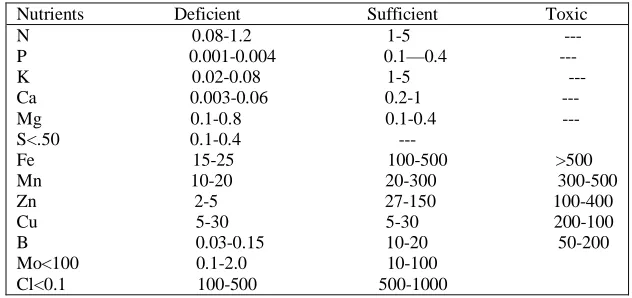
Table 4 :Various sample concentration of nutrients in mature leaf tissue of various crop plants in Bastar.
Nutrients Deficient Sufficient Toxic N 0.08-1.2 1-5 --- P 0.001-0.004 0.1—0.4 --- K 0.02-0.08 1-5 --- Ca 0.003-0.06 0.2-1 --- Mg 0.1-0.8 0.1-0.4 --- S<.50 0.1-0.4 ---
Fe 15-25 100-500 >500 Mn 10-20 20-300 300-500 Zn 2-5 27-150 100-400 Cu 5-30 5-30 200-100 B 0.03-0.15 10-20 50-200 Mo<100 0.1-2.0 10-100
Cl<0.1 100-500 500-1000
Increasing productivity monitoring and technological intervention:-
Under upland conditions rice moong(2:2) and rice-urud(1:1) gives 20-25% extra benefits than the rice alone
Sesbania green maturing and 40kg seed/ha proved to be highly beneficial in increasing the productivity of various crops and cut down N requirement by 30-40%
Gram mustard intercropping in 2:2 patterns observed to be highly remunerated in bastar region of Chhattisgarh
Pigeon pea can be successfully taken on the bunds of the rice field and help in enhancing the productivity and ensures nutritionals security.
LITERATURE REVIEW
Bases on rainfall pattern. Temperature, soil type and existing cropping pattern Chhattisgarh state can be divided into three natural regions/zone/and bastarplateu region belong to entisol, inceptisol and mollisol order and the dominating sub groups are typic ustorthent. Adaptation of suitable soil and water conservation measure will be necessary to improve water use efficiency in all the soil of this region. Use of organic materials like green manures FYM and FYMT green manures both will prove very effective for improving water use efficiency and crop production in these soils
Water use efficiency (WUE)
Following whereby the land is cropped in alternate seasons is traditionally
= M2/M1 + R or Sc (whichever is less)
Where E= is the efficiency of moisture conservation M1 = is the available moisture at the beginning (mm)
M2= is the available moisture at the end of the period(mm) R = is the rainfall received (mm) and
Sc = is the storage capacity of the profile(mm)
To make the following more effective it should be combined with conservation tillage system that leave the crop residues on the surface utilize land and rainwater resources maintains soil fertility without-restoring to following.
Companies of productivity and soil characteristics phenomenon.
In plateu region of bastar technologies for upland diversification hold in entire chattisgarh state used of green manuring should be encouraged entisols, inceptisols and alfisol where found to be deficient in available Zn application of Zn fertilizers will be required to realize crop yield potentials of these soils
Autor in5 revieew to exchange of colloids in soils samples to changes of physical characteristics of soil for good crop production, Authors in2 reviewed In fixation of fertilizers in soil also, Authors in3 defined the green manures spreading during the rainy time also authors in 1 reviewed the salinity & alkalinity of soil saturation for good productivity, Authors in4 reviewed genesis and chemical properties of soil and specific vertisol soil, Authors in6 reviewed ion absorption of soil for good yield, Authors in8 reviewed how to gain the best crop yield by management of crop reclamation, Authors in11 reviewed for using in advance technology for spreading for spreading the micronutrients for best yield of crop, Authors in13 reviewed management of manures according the sustainability of soils. Authors in9 reviewed how the absorption of micronutrients by crop roots and productivity ratio, Authors in14 reviewed to protest the pollution in soil for using intensive technology, Authors in10 reviewed the absorption of atmosphere nitrogen by plant and their fixation also loss of nitrogen from rice field. Also using good manures for enhance the production.
REFERENCES
1. Scott H. Don. soil physics agriculture and environmental application soil science 32 181-193 (2000)
2. Gupta R. K, Singh N.T and Sethi. ground water quality for irrigation in india technical collection No.19 Central Soil Salinity Research Institute Kernel India (1994).
3. Tomat V.s and anidyal A.S. short note on the wilting phenomenon in plants agronomy
journal 65, 514-515 (1973).
4. Dasog G.S and Hadimani A.S. genesis and chemical properties of some vertisols Journal
of the Indian Society of Soil Science 28,49-56 (1980).
5. Saha P.B and Sanyal S.K. synthetic humic acid their shape and dimensions. Journal of the
6. Bolt G.H. Ion adsorption by clay soil science 79, 267-276 (1955)
7. Bowered C.A. cation exchange equilibrium in soils. Soil Science, 88, 25-35 (1959). 8. Epstein E. mechanism of ion absorption by rot mature 171,83 (1953).
9. Gupta R. K and AbrolI. P. salt affected of soils their advance in soils science 12,223-275 (1990).
10. Mohanty S.K. Ga seems loss of nitrogen from rice field to atmosphere proceeding of the national academy of science of India 67(b) spi. Issue – 50-63 (1997).
11. Takkarp. N. micronutrients research and sustainable agriculture productivity in India.
Journal of the Indian Society of Soil Science 44, 562-581 (1996).
12. Ghosh A.B and Hasan R. phosphorus in soils crop and fertilizers bulletin of the Indian society of soil science (1979).
13. Nayyar V. K. micronutrients management for sustainable intensive agriculture. Journal of
the Indian Society of Soil Science 47, 666-680 (1999).
14. Sharm V.K and Kansal B.D. heavy metal contamination in soil and plants. Pollution