68
USING LINEAR PROGRAMMING IN SOLVING THE PROBLEM OF
SERVICES COMPANY’S COSTS
Kourosh Rajeiyan1, Farhang Khalaghdoost Nejati2, Reza Hajati3, Hamid Reza Safari4, Ebrahim Alizadeh5
1,2,3,4,5
M.A. Student of Business Management, Rasht Branch, Islamic Azad University, Rasht, Iran
Abstract
In today's competitive world, markets are outside the geographical boundaries of their traditional mode and manufacturers attempt to provide their products in all global regions with lowest cost. In recent years, providing a proper service has been one of the most important factors in customer satisfaction that is one of the things that imposes large costs to companies and appropriate policies can prevent such these unnecessary costs. This article aims to solve transportation problems using linear programming in a services company. Keywords: Linear Programming, Service, Cost
1. Introduction
In mathematics, linear programming issues include optimization linear objective function that should be established a series of limitations in form of linear equality and unequal. Informally, goal of linear programming is using mathematical model to get the best output linear (e.g. maximum profit, minimum working).
The standard form of linear programming can be displayed:
Maximize cTx
Subject to Ax ≤ b
x ≥ 0
X represents a vector of variables and c and b are the vector of coefficients. A is matrix of coefficients.
words that must be maximized or minimized that is called the objective function. In this case , cTx term b Ax ≤ is conditions that show a convex polyhedral and the objective function should be optimized on.
Linear programming can be used in various fields of study. Linear programming is mainly used in commercial and economic situation; however, it can be used for some engineering problems. Some of the industries that used linear programming are transportation, energy, telecommunications and factories. In addition, it is useful in modeling issues of planning, routing, scheduling, allocation and design. An evaluation of 500 largest companies in the world showed that 85% of them have used linear programming (Chasten, 2001, 124).
2. History of Linear Programming
69
mathematicians, statisticians, and government agencies quickly noted linear programming. In summer 1949 a conference were developed about planning costs and returns which was held by Cowles commission for the study economy. Papers presented at this conference in 1951 were collected by TCKoopmans in a book entitled analysis of allocation and production activity. At the same time, John von Neumann developed the dichotomy theories and Leonid Khashyan, russian mathematician used simple techniques in economics before Dantzig and won the Nobel Prize in economics in 1975. Dantzig found the best assignment of 70 people to 70 jobs and still shows his success. To compute large needed to view all permutation to select the best allocation is impossible. He observed that by using the simplex algorithm takes just a few moments to find the answer and also found that the answer is at the corner of polygon formed by the constraints of the problem (Dantiziz, 2003: 117).
3. Applications
Linear programming has several applications in military, government, industry and civil engineering. In addition, it is often used as part of a calculated plan, solving nonlinear programming problem, discrete programming problems, chemicals, optimal control problems and contingency planning. Linear programming is an important optimization for several reasons: Many practical problems in operations research can be expressed as a linear programming problem and also a number of other algorithm of optimization problems by linear programming work as sub- problem. Historically, ideas of linear programming inspire many basic concepts of optimization theory such as duality, decomposition and importance of convexity and its generalizations.
Linear programming mainly is used in macroeconomics, business management, maximizing revenue and minimizing the cost of production. For example, inventory management, asset and stock management, human and non-human resources allocation, planning and advertising tours (Chaharsooghi and Jafari, 235, 2007).
Many companies and government agencies have saved millions of dollars in successful application of linear programming. The following are some of these achievements:
Taylor and Hawks Lee (1989) designed using linear programming and integer programming, a method for scheduling patrol police officers in San Francisco. Eleven million dollars annual savings were achieved with this method.
Using dynamic programming, Chao and others (1989) saved about 79 power substations and more than $ 125 in purchasing inventory and shortage costs.
Using integer programming, Vasco and others (1989) helped Bethlehem Steel in design of ingots facility form. Integer programming caused savings of $ 8 million in annual operating costs.
Using a network model of Powell and others (1988), a model has been developed for the allocation loads for truck drivers in lines of business in North America. This model can provide better service to customers and reduce about 5/2 billion dollars of annually costs.
70
proposed method is provided to solve this model and then implemented and analyzed on an actual example. Data of Milan stock market showed that the new model can be solved in shorter time. Whereas, expected return rate of 12% in based model cannot solve a problem with more than 14 types of stocks. The new model can solved a problem with 20 different stocks easily and in a short time. Furthermore, a new model greatly reduced undesirable risk very much compared to the base model. So that the process continued decreasingly with increasing the number of shares. Another study by Kuhpaei & others (2007) as a program to determine the optimal transportation of wheat was done using linear programming. Every year, millions tonnes of wheat from domestic shopping centers and import origins was transported to storage center and then distributed among regions based on consumer demand. In 2000, wheat allocated the largest volume of goods transported after cement. Using a logical model is necessary to reduce the cost of transportation. This study presents a mathematical model for determining the optimal plan of wheat transport from provincial centers and import origins to storage centers and thence to applied regions. Based on the data from 2000 and Lingo software package, studies was done separately for each month. The proposed program reduced the cost to 138 billion rials (13.5 percent) compared to the program performed in 2000. After solving the problem and determining the optimal schedule by using the concept of shadow price, time and place schedule and the method of direct or indirect transportation of wheat from shopping centers to storage centers was identified according to priorities determined by time and place. With implementation of this program, cost of transportation is reduced to 45 billion rials.
4. Focus of research
These are cases that are continuing their research on
- To find more efficient polynomial time algorithm for solving linear programming problems - To find more efficient strong polynomial time algorithm for solving linear programming problems
- To determine the runtime issues by strong polynomial algorithms (specific conditions) These are matters among 18 unresolved issues in 21 centuries that indicated by Stephen Smith. Although there are algorithms to solve high degree polynomial linear programming problems such as elliptical method and interior point but has not been found any algorithm for low-degree polynomial. The development of algorithms can be a help theory and also is a practice for solving linear programming problems. Can be created simplex for polynomial by lining?
This question is related to the analysis and development of methods like simplex (Holladay ,2007, 78).
5. Simplex Method for Transportation Problems:
Transportation problem is a linear programming problem that can be solved using Simplex Method, but due to its special nature, the work is computational and time consuming. Nevertheless, the simplex method can be easier and more effective by applying the shortcut method.
6. To simplify the simplex method for the transportation
In a standard linear programming problem, there are a number of variables in optimal solution with some restrictions. Due to the special characteristics of the standard transportation issues, a number of decision variables are as follows: Product m (source) and n (targets or goals). Although, there are (m+n) limitations and number of initial variables with (m+n-1) limitations.
71
solution of these problems can be putting zero for variable. Solving equations with m constraints for n variables will be done.
n-m are variables those are equal to zero and point the secondary variables when the remaining n variables (which usually is not zero) are the primary variables. Initial solution does not require to be the possible solution. For example, an initial solution may not confirm the non-negative condition. However, when an initial solution is possible in such circumstances, all primary variables are non-negative that provides the primary solution. Placing data in a rectangular table is an important feature of transport issues. The data includes c si dj
g, , .
The first basic possible solution: Some conditions for variable selection in basic possible solutions are:
1- Northwest corner rule (right and upwards)
2- Lowest price rule
3- Vogel’s approximation method
4- Russell's approximation method
5- Aston rule
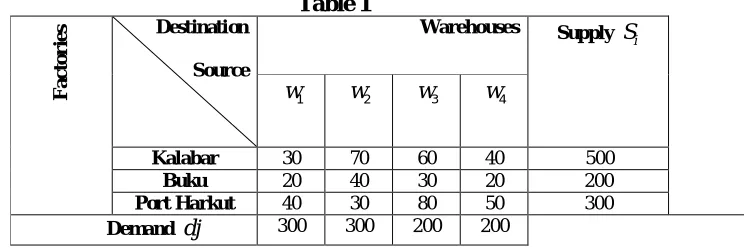
Rule number one is considered in this paper. It is assumed that a number of institutions of cement production to eliminate the distribution method and allocation sex discrimination, have been under considerable pressure. Company officials are agreed with customers that to distribute cement (50kg bags) to the warehouses in Abuja, Lukuja, Ogoja and Suleja over afterward 5 years use Kalabar - Boko - Harkut port companies. The cost of transportation from the factory to a particular warehouses is shown. Demand (dj)in 4
storage, ability to supply (si) at three factories are shown in the following table:
Table 1
i
S
Supply Warehouses
Destination
Source
F
a
c
to
r
ie
s
w1 w2 w3 w4
500 40
60 70 30
Kalabar
200 20
30 40 20
Buku
300 50
80 30 40
Port Harkut
200 200 300
300
dj
Demand
Input data required in the transportation simplex method are considered as the initial possible solution. Current values Vj,Vi and the values obtained (Cij uiVj)are secondary variables.
7. Stages of the initial possible solution:
Start: sources column and destinations in simplex table of transportation are investigated to provide a basic variable (allocation).
72
Step Two: to create the variables selected, a large allocation is used to present all demands variables in the row and supply variables in column.
Step Three: to remove rows and columns (where supply and demand are smaller) for greater allocation if the rows and columns or both are zero, rows will be deleted more. It is often useful to provide a degenerate basis variable. A degenerate variable is zero for an allocative domain.
Step Four: Step 1 to 3 is repeated until the only remaining column in a row until only one row of columns remains in the table.
Step Five: When only one row or column remains, all work is over. It means that basic variable with only one allocation can be obtained by selecting any variable mutual between the rows and columns.
Description of solution by base of northwest corner: This method and rule
provides a possible solution that does not have higher positive value of mn1 Variables that have occupied the northwestcorner were selected as basic variables in table relating to transportation. First choice is y11 and if Xij are selected as the final base variable, Xi,j1
will be considered as next election (If the source is still in demand).
1 ,j i
X Along the same row but in the next adjacent column
j
i
X 1, Next row below it, but in the same column
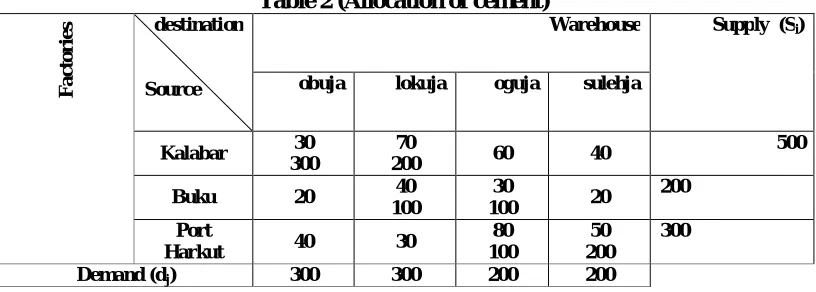
According to the data of allocated table, m=3 and n=4 and should be a basic possible solution(mn1) with basic variable(6341). The first allocation is for X11 and equal to 300 bags.
Therefore, 200 bags were demanded in the first row and X1,11 X12 is the next basic variable, because demand is greater than supply in column and 200 bags allocate
12
X . Demand of first row would be out now and the row are removed for further investigation. By removing the row and column, X22 X11,2 will be the variable that is occupied the Northwest corner (table 2) and will be selected as the basic variable. In this stage, demand in column 2, the remaining bags are 100 which is accepted by allocation of 100 bags from 200 bags in the first row of demand variable. By this way, the supply of column 2 would be completed and the column would be deleted. X2,3 X2,21 will be selected as next basic variables. This procedure continues until the first possible answer or solution is obtained from table. The arrows in the following table are to understand the numbers and functions to represent the selected basic variables.
Table 2 (Allocation of cement)
Supply (Si)
Warehouse
destination
Source
F
a
c
to
ri
e
s
sulehja oguja lokuja obuja
500 40
60 70
200 30
300 Kalabar
200 20
30 100 40
100 20
Buku
300 50
200 80
100 30
40 Port
Harkut
200 200
300 300
Demand (dj)
73
Therefore, there are 6 variableX34,X33,X23,X21,X11,X12 in this problem. The total of rows equal to the storage capacity and the total of columns equal to the destination demand. Therefore, a possible solution would be for this transportation problem.
Regarding the possible solutions, the cost of total transportation is as follows:
) 200 ( 50 ) 100 ( 80 ) 100 ( 30 ) 100 ( 40 ) 200 ( 70 ) 300 ( 30 34 50
33 80 23 30 22 40 12 1 1 . 30 11 70
X
X X
X X
m
i n
j Cij Xij X
Z
Preliminary results presented in the northwest corner method may be very far from the optimal solution. If this method is able to provide an optimum solution, it may be quite random because in this method differences in the cost of transportation routes is ignored. Therefore, it cannot choose the lowest cost.
Four other conditions can also calculate and obtain different cost of transportation.
8. Result
Allocation or issue of the costs of transportation could be easier to solve by a linear programming. Because solving by linear programming method, the objective function can be written as a linear equation and limitations are imposed. In simple charting, optimal solution is in a possible space of limits and boundaries or to be more specific, optimal solution can be used at the top of a possible multifactor complex. Although nobody can present complex linear programming problems in two-dimensional diagram, other methods such as the simplex method are effective for solving such problems. Linear programming is an important and crucial decision making process and has positive role in solving the above problems. Production and marketing managers have been hired to apply linear programming as the best way to solve problems in transportation and warehousing services.
The linear programming can be used in the daily tasks of product management and marketing for production - labor and schedule - assessment - allocation - market research, media choice, media mix, combination of factors - financial stocks and production and composition…
References
Chasten, L. G. (2001) A Graphical Approach to Linear Programming of Shadow Prices. The Accounting Review, Vol. 47, October.P124.
Dantiziz, G. B. (2003) Linear Programming and Extension. Princeton, N. J: Princeton University Press.P117.
Hillier, F. S. and Lieberman, G. J. (2008) Introduction to Operations Research. 3rd ed. San Francisco: Holden-Day, Inc.P49.
Holladay, J. (2007)“Some Transportation Problems and Techniques for Solving them”, Naval Research Logistics Quarterly, Vol. 2.P78.