RESEARCH NOTE
STALL VORTEX SHEDDING OVER A COMPRESSOR
CASCADE
Nima Amanifard
Mechanical Engineering Department, Faculty of Engineering, University of Guilan Rasht, Iran, [email protected]
(Received: July 25, 2004 – Accepted in Revised Form: December 20, 2004)
ABSTRACT The unstable flow with rotating-stall-like (RS) effects in a rotor-cascade of an axial compressor was numerically investigated. The RS was captured with the reduction in mass flow rate and increasing of exit static pressure with respect to design operating condition of the single rotor. The oscillatory velocity traces during the stall propagation showed that the RS vortices repeat periodically, and the mass flow rate was highly affected by the blockage areas made by stall vortices. The results also showed that large scale vortices highly affects on the generation and growth of the new vortices. An unsteady two-dimensional finite-volume solver was employed for the numerical study which was developed based on Van Leer’s flux splitting algorithm in conjunction with TVD limiters and the κ-ε turbulence model was also employed. The good agreement of the computed mass flow rate with the experimental results validates the numerical study.
Key Words Stall, Single Rotor, Axial Compressor
ﻩﺪﻴﻜﭼ
ﺭﺍﺮﻗﻱﺩﺪﻋﻲﺑﺎﻳﺯﺭﺍﺩﺭﻮﻣﻱﺭﻮﺤﻣﺭﻮﺳﺮﭙﻤﻛﻚﻳﺯﺍﻱﺍﻩﺮﭘﺞﻨﭘﺭﻮﺗﺭﻩﺮﻴﺠﻧﺯﻚﻳﻥﻭﺭﺩﺭﺍﺪﻳﺎﭘﺎﻧﻥﺎﻳﺮﺟ
ﺖﺳﺍ ﻪﺘﻓﺮﮔ
.
ﺖﺳﺍ ﻲﻧﺍﺭﻭﺩ ٌﻪﺘﻜﺳ ﻥﺎﻤﻫﺎﻳ ﺭﺍﻭﺩ ﻱﺎﻫ ﻪﺑﺍﺩﺮﮔ ﻉﻮﻧ ﺯﺍ ﻥﺎﻳﺮﺟ ﻱﺭﺍﺪﻳﺎﭘﺎﻧ
.
ﻭ ﻲﻣﺮﺟ ﻲﺑﺩ ﺶﻫﺎﻛ ﺎﺑ
ﻣﻲﺟﻭﺮﺧﺭﺎﺸﻓﺶﻳﺍﺰﻓﺍ ﺖﺳﺍﻩﺪﻳﺩﺮﮔﺎﻴﻬﻣﺭﺍﺪﻳﺎﭘﺎﻧﻂﻳﺍﺮﺷ،ﺭﺍﺪﻳﺎﭘﺩﺮﻜﻠﻤﻋﻂﻳﺍﺮﺷﺎﺑﻪﺴﻳﺎﻘﻣﺭﺩﻲﺗﺎﺒﺳﺎﺤﻣٌﻩﺩﻭﺪﺤ
.
ﻪﺟﻮﺗﻞﺑﺎﻗﺮﻴﺛﺎﺗﻞﻴﻟﺩﻪﺑﻭﺖﺳﺍﻂﻳﺍﺮﺷﻦﻳﺍﺭﺩﺎﻫﻪﺑﺍﺩﺮﮔﻥﺩﻮﺑﻱﺭﺍﺮﻜﺗﺯﺍﻲﻛﺎﺣﺖﻋﺮﺳﻱﺎﻫﻪﻟﺎﺒﻧﺩﻲﻧﺎﺳﻮﻧﺭﺎﺘﻓﺭ ﺮﮕﻴﻣ ﻱﺍ ﻪﺟﻮﺗ ﻞﺑﺎﻗ ﺕﺎﻧﺎﺳﻮﻧ ﺭﺎﭼﺩ ﻲﻣﺮﺟ ﻲﺑﺩ ، ﻱﺭﻮﺤﻣ ﻥﺎﻳﺮﺟ ﺮﻴﺴﻣ ﻱﻭﺭ ﺎﻫ ﻪﺑﺍﺩﺮﮔ ﺩﺩ
.
ﻦﻴﻨﭽﻤﻫ ﺞﻳﺎﺘﻧ
ﺖﺳﺍ ﺮﺘﻜﭼﻮﻛﻱﺎﻫ ﻪﺑﺍﺩﺮﮔ ﻞﻴﻜﺸﺗﺭﺩﮒﺭﺰﺑ ﻱﺎﻫ ﻪﺑﺍﺩﺮﮔﻱﺍﺰﺴﺑﺮﻴﺛﺎﺗٌﻩﺪﻨﻫﺪﻧﺎﺸﻧ
.
ﻡﺮﻧﻱﺩﺪﻋﻲﺳﺭﺮﺑﻦﻳﺍ ﻱﺍﺮﺑ
ﺭﺎﺷﻚﻴﻜﻔﺗﺵﻭﺭﺯﺍﻥﺁﺭﺩﻪﻛﻪﺘﻓﺮﮔﺭﺍﺮﻗﻩﺩﺎﻔﺘﺳﺍﺩﺭﻮﻣﻭﻪﺘﺷﻮﻧﻱﺩﻭﺪﺤﻣﻢﺠﺣﺭﺍﺰﻓﺍ
"
ﺮﻴﻟﻥﻭ
"
ﺩﻭﺪﺤﻣﻩﺍﺮﻤﻫﻪﺑ
ﻱﺎﻫ ﻩﺪﻨﻨﻨﻛ
TVD
ﻩﺪﺷ ﻩﺩﺎﻔﺘﺳﺍ ﻲﺋﺎﺠﺑﺎﺟ ﺕﻼﻤﺟ ﻱﺍﺮﺑ ﺖﺳﺍ
.
ﺲﻧﻻﻮﺑﺭﻮﺗ ﻝﺪﻣ ﻦﻴﻨﭽﻤﻫ
"Baldwin-Lomax"
ﺖﺳﺍ ﻩﺪﺷﻪﺘﻓﺮﻛﺭﺎﻜﺑ ﻲﮕﺘﻔﺷﺁﺩﺭﻭﺁﺮﺑﻱﺍﺮﺑ
.
ﺖﺤﺻﺯﺍﻲﻛﺎﺣﻥﺍﺮﮕﻳﺩﻲﻫﺎﮕﺸﻳﺎﻣﺯﺁﺞﻳﺎﺘﻧ ﺎﺑﻱﺩﺪﻋﺞﻳﺎﺘﻧ ﻖﻴﺒﻄﺗ
ﺖﺳﺍﻱﺩﺪﻋﻱﺎﻫﻲﺳﺭﺮﺑﻲﺒﺴﻧ
.
1. INTRODUCTION
Recent issues on rotating stall have been focused on mechanisms associated with short length scale disturbances [1] growing to fully developed rotating stall. Inception of this type of stall is significantly influenced by end-wall phenomena, and modal wave analysis is not always applicable. Hoying et al. [2] suggested through a 3-D computation that a tip clearance vortex induces an upstream directing velocity composing a blade passage blockage. Such active behavior of the tip vortex is also suggested by precise hot-wire measurements [3]. A best understanding about processes to a fully developed rotating stall
without using turbulence model on compressor stage with 18 rotor blade and 30 stator-vanes, and the Newton-Raphson iteration was also employed [10]. A further numerical study on a stage of an axial compressor was made [11]. The Navier-Stokes equations were discretized in space by finite-volume method and integrated in time by using a four stage Rung-Kutta scheme and the second- and fourth-order blended smoothing was adopted in both the stream wise and circumferential directions for numerical damping, and Baldwin-Lomax turbulence model was also adopted. In case of the 2-D analysis, rotating stall under uniform inlet flow condition is triggered off by an incidental coupling of a rotor light stall with stator stall blockages. When there exists an inlet flow distortion, rapid circumferential changes of the flow incidence will also excite an onset of rotating stall, as observed in high speed compressor experiments [12].
In the present work, the history of rotor-cascade flow in rotating stall operation is discussed based on the 2-D analysis, indicating (1) a multiple vortices system ahead of the rotor, (2) temporal change in the system composed of evolution, merging and recession of vortices, which is a source of fluctuation in the performance, (3) structure causing the well known large scale hysteresis between rotating stall and recovered stable flows.
2. NUMERICAL PROCEDURE
The governing equations in conservative form are transformed to a computaional space for a structured grid finite-volume solution. Hence, they are as following:
η
ξ
η
ξ
τ
∂
∂
+
∂
∂
=
∂
∂
+
∂
∂
+
∂
∂
Q
E
EF
EE
vF
v(1)
Q
is the premitive variables matrix, EE andE
F are the transformed convective flux
matricies in ζ and η directions respectively, and
ν
E and Fν are the transformed viscous
matrices in ζ and η directions respectively. τ is
the dimensionless time variable.
The Equation 1 is rearranged to its discrete form, the time derivative is approximated by a first-order backward differencing quotient and the remaining terms are evaluated at time level n+1. Thus: 1 n ) F ( 1 n ) E ( n Q 1 n Q + η ∂ ∂ + + ξ ∂ ∂ + τ ∆ − + 1 n ) v F ( 1 n ) v E ( + η ∂ ∂ + + ξ ∂ ∂
= (2)
The inviscid flux vectors on cell faces were evaluated by Van-Leer’s Flux splitting scheme. To prevent the oscillatory behavior of the numerical results and to increase the accuracy, the Van-Leer’s limiter was added to the flux splitting algorithm [13].
The second-order derivatives are evaluated by central difference approximation.
The standard κ-ε turbulence model was also
employed in turbulent boundary layer over the blades. This model was compared with the Baldwin-Lomax (BL) model and experimental results by Bohn et al. [14], over a cascade and the comparing results gives the required
assurance of using the κ-ε and BL models in
cascade problems. Additionally, using BL model by Farhanieh et al. [15-16] for flow instability calculations over a cascade, gives the
more assurance of using κ-ε.
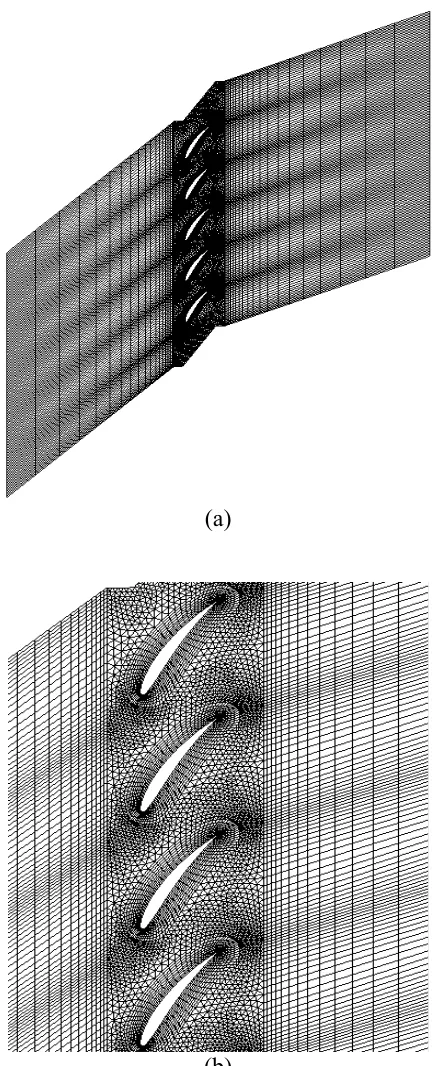
The grid system is composed of O-type
grids structured grids around the blades,
Unstructured near the cascade, and H-type
at the inlet and the outlet zones. The grid resolution is chosen upon grid dependency studies (Figure 1).
3. EXPERIMENTAL RESULTS
The geometrical characteristics of the blades in the stage are given in table 1 and the flow characteristics in the normal and unstable operating point are given in tables 2nd 3respectively.
trigger the stall condition. The numerical solution is started at the conditions given in table 2. After
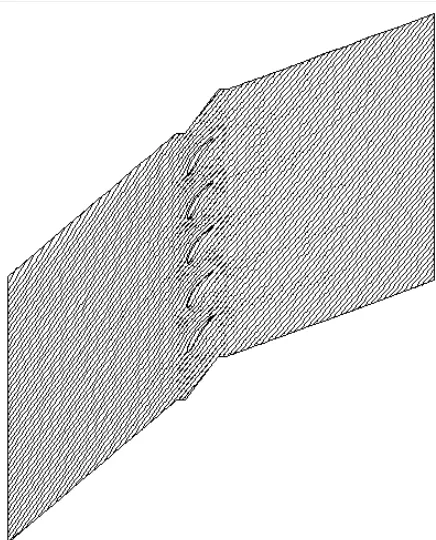
about 3 rotor revolutions, the solution reaches to the normal operating condition (Figure 3). At the normal operating point, the counter was set to zero and the unstable conditions were imposed to the computational area. The inlet flow angle, the axial velocity and the exit pressure were changed to the values given in table 3, and the rotating speed remained unchanged.
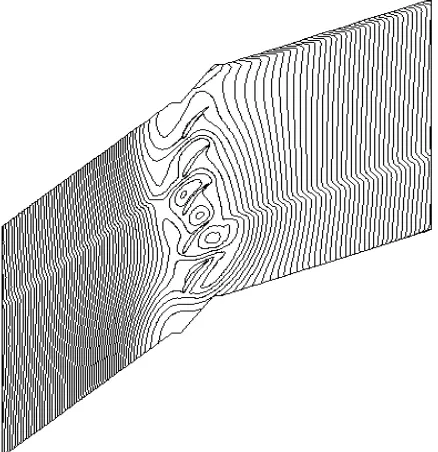
A stall vortex comes to exist near the leading edge of lower blades, and through the cascade passages (Figure 4). After some rotor revolutions the stall vortices move and propagate in circumferential direction, and a
(a)
(b)
Figure 1. (a) Grid system for the rotor cascade and (b) the
enlarged grid system for the rotor cascade.
TABLE 1. Geometrical Characteristics of the Cascade. Stagger angle of rotor blades 55°
Stagger angle of stator blades 35°
Rotor blade profile NACA65-(A10) Stator blade profile NACA65-(A10)
Solidity 1.35
TABLE 2. The Stable Condition.
t h
r
r 0.6
R 0.56
Pin 100000 Pa
Tin 300 K°
Pexit/ Pin 1.02589
β1 62°
ψ 0.28
φ 0.4
Vxin
36 m/s
Min 0.223
Ur
90 m/s
RPM
1240
TABLE 3. The Unstable Condition.
Pexit/Pin 1.02989
β1 72°
Vxin
22 m/s
φ 0.24
deep cell vortex comes to exist in front of the cascade (Figure 5). The deep cell spreads over the cascade and diffuses within the passages of the cascade (Figure 6). This is the final step of the
Figure 2.Schematic instability process for a compressor.
Figure 3.Normal operating streamlines for the cascade.
Figure 4.Stall initiation over the cascade.
formation of the maximum blockage against normal flow direction. In this condition, the overall mass flow rates through the cascade decreases to its minimum value. Then, the complete blockage is partially removed and again the deep cell generation initiates (Figure 7). The recycling of the deep cell generation and the growth of the large scale vortices indicates the hysteresis character of the rotating stall phenomena. The hysteresis character of deep cell generation which is shown during the Figures 5 to 9 highlights the reality of energy consumption of the fully developed rotating stall and the complete reduction of the rotor performance.
This is probably the main reason of sudden reduction of the exit pressure for an axial compressor during the stall condition. Additionally, the hysteresis character fortifies the remaining of the exit pressure reduction of the compressor. The corrected mass flow rates of the first, third and the fifth passages (in y direction) are sketched and named in Figure 10 as the 1, 2, and 3 curves respectively. The curve 1 is compared with similar numerical study [17] with geometric and thermodynamic condition but with different blade number, different numerical procedure, and without any turbulence model. The qualitatively, good agreement of the compared results gives the required assurance of the numerical study and the employed computer code. The periodic behavior of the passage mass flow rates interprets the hysteresis and recycling of the deep cell generation and the rotating stall. Besides, the average frequency of the waves shown in Figure 10 is lower than the rotation frequency of the rotor. Further, the phase difference among the curves explains the movement of the deep cells and the minor blockage area.
5. CONCLUSION
The results and the discussions give the following conclusion remarks:
1.
In rotating-stall propagation in a 2-D stage, thevelocity traces showed a periodic behavior
.
Figure 6.Grown vortex and blockage initiation.
Figure 7. Fully developed deep stall over the rotor and
2. The rotating stall and large-Scale vortex
generation have a recycling character.
3. The mass flow rate and consequently the rotor
performance reduce to very low levels and remain decreased and oscillate around the low levels.
4.
The rotating stall effects can be numericallyobserved with much shorter cascades with respect to previous long cascade studies. This may save a lot of CPU times and memory usage.
5.
Comparing the current results and the previousrelated works [15-17] we conclude that the turbulence models seem to have minor effects on captured results.
6. NOMENCLATURE
τ
time in transformed coordinate
time step
ξ horizontal
axis
of transformed
coordinate
Figure 8.Recycling and the hysteresis of the stall propagationand large vortex diffusion.
Figure 9. Diffusion and spreading of the vortices at the
blockage area of the cascade.
Figure 10. Corrected mass flow for three selected passages
ρ density
β
1inlet angle of relative velocity
ψ
load coefficient
φ
flow coefficient
η
vertical axis of transformed
coordinate
E
E
inviscid transformed flux vector
v
E
viscous
transformed flux vector
r
ttip
radius
t
time in physical coordinate
T
sstatic
temperature
Tin inlet
temperature
V
xAxial velocity in stage
Subscripts
ξ
partial derivative with respect to
ξ
η
partial derivative with respect to
η
b
index of bottom face flux
h
hub for blade radius
in
inlet condition
l
index of left face flux
r
index of right face flux
t
index of top face flux
t
total state for thermodynamic
properties
Superscript
n
previous time level
n+1
current time level
7. REFERENCES
1. Day, I. J., Breuer, T., Escuret, J., Cherrett, M., and Wilson, A., “Stall Inception and the Prospects for Active Control in Four High-Speed Compressors,” ASME Journal of Turbomachinery, Vol. 121, (1999), 18-27.
2. Hoying, D. A., Tan, C. S., and Greitzer, E. M., “Role of Blade Passage Flow Structures in Axial Compressor Rotating Stall Inception, Journal of Turbomachinery”, Transactions of ASME, Vol. 121, No. 4, (1999),
181-188.
3. Inoue, M., Kuroumaru M., Tanino T., Yoshida S. and Furukawa M., “Comparative Studies on Short and Long Length-Scale Stall Cell Propagating in an Axial Compressor Rotor”, ASME Paper 2000-GT-0425, (1999).
4. Hah, C., Schulze, R., Wagner, S. and Hennecke D. K., “Numerical and Experimental Study for Short Wavelength Stall Inception in a Low-Speed Axial Compressor”, Proc. 14th Int. Symposium Air Breathing Engines, Florence, Italy, ISABE Paper 99-7033, (1999). 5. Outa, E., Katto, D., and Chiba, K., “An N-S Simulation
of Stall Cell Behavior in a 2-D Compressor Rotor-Stator System at Various Loads”, ASME Paper 94-GT-257, (1994).
6. Kato, D., Outa, E. and Chiba, K., “A two-Dimensional Compressible Navier-Stokes Simulation of Transient Flows in Compressor Rotor/Stator Cascades (3rd
report)”, Trans. JSME, Vol. 63, No. 614, (1997), 69-77. 7. Kato, D., Outa, E. and Chiba, K., “On Sub-Cell Structure
of Deep Rotating stall in an Axial Compressor, Unsteady Aerodynamics and Aeroelasticity of Turbomachine”, T.H. Fransson (Ed.), Kluwer Academic Publishers, (1998), 181-188.
8. Outa, E., Ohta, Y., Kato, D., and Chiba, K., “Two-Dimensional Study on Evolution of Deep Rotating Stall under Uniform Inlet Condition in an Axial Compressor Cascade”, ISABE Paper 99-7219, (1999).
9. Saxer-Flelici, H. M., Saxer, A. P., Inderbitzen, A., Gyarmathy, G., “Prediction and Measurement of Rotating Stall Cell in an Axial Compressor,” ASME Journal of Turbomachinery, Vol. 121, (1999), 365-375.
10. Outa, E., Kijima, M., Ohta, Y., and Kato D., “Hysteresis of Rotating Stall in a Compressor Stage under Uniform and Stationary Distorted Inlet Flow Conditions”, The 9th Int. Symp. on ISUAAAT and Legender Lecture Series, (2000), 264-279.
11. He, L., “Computational study of Rotating-Stall inception in axial compressors,” Journal of Propulsion and Power, Vol. 13, 1997, 31-38.
12. Jahen, W., Peters, T., and Fotter, L., “An Experimental Flow Investigation of an HP Five-Stage, Compressor Exihibition Rotating Stall due to Distorted Inlet Flow Conditions, Unsteady Aerodynamics and Aeroelasticity of Turbomachine”, T.H. Fransson (Ed.), Kluwer Academic Publishers, (1998), 243-257.
13. Peyret, R., Grasso, F. and Meola, C., “Handbook of Computational Fluid Mechanics”, Chapter#4: Euler and Navier-Stokes Equations for Compressible Flows: Finite Volume Methods,Academic Press, ISBN 0-12-553010, (1996).
14. Bohn, D. and Emunds, R., “A Navier-Stokes Computer Code for Theoretical Investigations on the Application of Various Turbulence Models for Flow Prediction Along Turbine Blades,” Proceeding of the International Gas Turbine and Aero-Engine Congress and Exposition, Houston, Texas, June 5-8, 95, (1995), GT-90.
of Rotating-Stall with a Variable-Cascade-Length Approach in an Axial Compressor”, International Journal of Engineering, Vol. 16. No. 2, (2003), 97-105. 16. Farhanieh, B., Amanifard N., and Ghorbanian, K., “A
Numerical Investigation on the Unstable Flow in a single
Stage of an Axial Compressor”, International Journal of Engineering, Vol. 16, No. 2, (June 2003), 171-182. 17. Nishizawa, T. and Takata, H., “Numerical Study on Stall