Volume 3, Issue 2, February 2014
Page 334
A
BSTRACTUntreated multi-walled carbon nanotubes (MWCNTs) with different weight percentage (0.1,0.5,1,2 ,3, 4 and 4.5) % wt. were used to fabricate MWNT/epoxy composite samples by hand lay up method. Ultrasonic mixing process was used to disperse the nanotubes into the resin system. Mechanical reinforcement of polymer matrices loaded by carbon nanotubes is expected to benefit by both the high aspect ratio and the very high modulus of nanofillers. The mechanical properties of the composite with different weight percentages of nanotubes have been investigated. The Young’s modulus has been doubled and quadrupled for composites with respectively 0.5 and 4 wt.% nanotubes, compared to the pure resin matrix samples.While flexural strength has been increased in random manner
Keywords: Epoxy, Mechanical Properties, Nanocomposites, MWCNTs
1.
INTRODUCTIONDue to their high-adhesion, low-weight, and good chemical resistance, epoxy-based composite materials are being increasingly used as structural components in aerospace and automobile industry. However, the relatively weak mechanical properties of epoxy have prevented its application in the components that demand high mechanical strength and stability[1],[2],[3].
Carbon nanotubes (CNTs), one graphene layer (SWNT) or many graphene layers wrapped onto themselves (MWNT) are a novel crystalline carbon form.The recent theoretical and experimental investigations indicate that they have properties suitable for applications in many fields. Their interesting mechanical (axial Young modulus 1–5 TPa, high flexibility, bending fully reversible up to a 110_ critical angle for SWNT, and physical (metallic or semi-conducting character,field emission, high thermal and electrical conductivity and hydrogen adsorption [4],[5],[6]. In order to achieve optimal enhancement in the properties of CNT/polymer composites, two key issues should be considered: homogeneous dispersion of CNTs in the polymer resin and strong interfacial bonding between the CNTs and the polymer matrix [7]. Several researchers have prepared epoxy resin/CNT composites to obtain outstanding mechanical properties. Chen et al. fabricated epoxy resin/CNT composites by resin transfer molding [8]. The results indicated that the mechanical and electrical properties of the composites were dramatically improved with the addition of the CNTs. Kim et al. studied the effects of surface modification on rheological and mechanical properties of epoxy resin/CNT composites [9]. They concluded that the rheological properties of CNT-containing epoxy resin and mechanical properties of epoxy resin/CNT composites were improved due to the improved dispersion of CNTs in epoxy matrix and interactions between the CNT and the epoxy resin.
In this study, our goal is focused on how to increase the content and the homogeneous dispersion of MWCNTs without a solvent in the matrix. As a result, some evidence is given which indicate an improvement of the strength of the composites.The influence of different contents of MWCNTs loading on the dispersion and interfacial adhesion with epoxy resin and then on the mechanical properties of nanotube-based composites were investigated. The three points bending flexural test provides values for the Young modulus( Yf), flexural stress ( σf), flexural strain ( ϵf), and the flexural stress- strain response of the material. The three-point bending test illustrated schematically in figure(1), a flat rectangular specimen is simply supported close to its ends and centrally loaded in three-point bending [10].
For rectangular beam the flexural strength ( σf ) or modulus of rupture describes the materials strength [10]:
2
2
3
wh
FL
f
………..(1)Young modulus in bending or the flexural modulus calculated in the elastic region is :
Concentration Effect of multi-walled carbon
nanotube on Mechanical properties of
epoxies composites
A.Badran ALsafee1
, Ikram A. Al-Ajaj
2 A. shawky1khalil
1,2,3
Volume 3, Issue 2, February 2014
Page 335
33
4
wh
S
L
Y
f
………..……(2)Where (S) is the slope of the straight-line portion of force-deflection curve as in figure (5) .
2. Materials and experimental methods
2.1 Materials
The multiwalled carbon nanotubes (MWCNTs), used in this study synthesized by thermal chemical vapor deposition (CVD) procees, were supplied by Intelligent Materials Pvt. Ltd. , these have a diameter of 20–30 nm and a length of 10– 30 micrometers as shown in figure (1) which represented a Scanning Electron Microscope(SEM) and (2) which represented Transmission Electron Microscope . Epoxy as a matrix (Nitofill, EPLV with Nitofill EPLV hardener from Fosroc Company). The mixing ratio for resin and hardener is 3:1 and gelling time 40 minute at 35 oC, mixed viscosity 1.0 Poise at 35 oC .
Fig. (1) SEM image for MWCNTs
A Transmission Electron Microscope were measured in TEM Philips CM30 for MWCNTs to indicate their diameter (20-30) nm as shown in figure (2).
Fig.(2) TEM for MWCNTs
2.2. Preparation of EP/MWCNTs Composites
All samples for neat epoxy and epoxy nanocomposites were prepared according to ASTM specification as shown in figure (3) .
L = 80 mm
h
= 4 mmW = 10 mm Ls = 64 mm
Volume 3, Issue 2, February 2014
Page 336
Where (h) is specimen thickness, ( L ) is specimen length, (w) is specimen width and (Ls) as support span.
The preparation steps of the neat epoxy and epoxy nanocomposites for mechanical tests were prepared by hand lay up technique by mixing process which consists of three steps.
2-2.1 Neat epoxy preparation
Firstly epoxy resin and hardener are weighted for suitable mixing ratio, and then manually mixing then epoxy resin and hardener by magnetic stirror at 600 rpm for 30 minutes to have good homogeneity between epoxy resin and hardener. Secondly, for better homogeneity homogenizer device were used for 4 minutes. The third step as shown in figure (4) vacuum system was using to remove the bubble before molding the epoxy in the mold as shown in figure (5)
Fig. (4) Vacume system
Fig.(5) Mold was used to molding samples 2-2.2 Epoxy nanocomposites preparation
The epoxy nanocomposites were prepared with MWCNT with weight percentage 0.1,0.5,1,2,3,4,and4.5 .Epoxy nanocompositeswere prepared in three steps; firstly, the nanotubes are weighted and manually mixed with epoxy resin under gloves box in nitrogen atmosphere as shown in figure (6) .
Fig. (6) Gloves box (handmade by researcher)
Volume 3, Issue 2, February 2014
Page 337
Fig. (7) Epoxy and epoxy nano/microcomposite Fig.(8) Vacuum chamber specimens 2.3. Characterization of MWCNTs and their epoxy composites
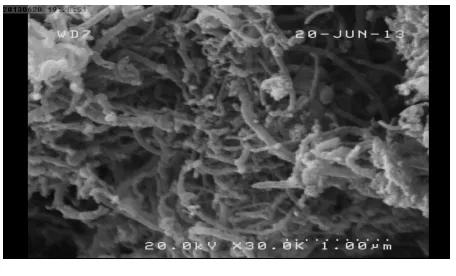
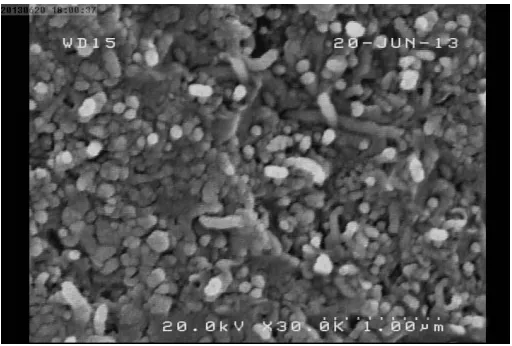
A scannining electron microscope (SEM HITACHI S-4160) were used to measure the morphology of MWCNTs and EP/MWCNT as shown in figure 1 and 9.After examine the specimens with three point bending , the Scanning Electron Microscopy (SEM) explains well dispersed nanotubes in the matrix. No evidence of agglomeration of the nanotubes can be found in this micrograph.The mechanical properties of CNTs/epoxy composites were measured by an Instron 1122 mechanical testing machine. Three point bending test were carried out at a constant cross-head rate of 0.5mm/min to determine the mechanical properties; flexural strength and Young for epoxy and EP/MWCNT composites. The choice of this quite low loading rate is to consider the brittle character of composites.
Fig. 9. SEM images of EP/ MWCNTs composite.
3. Results and Discussion
Volume 3, Issue 2, February 2014
Page 338
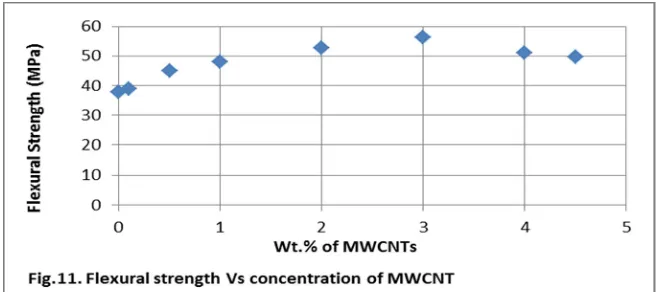
Flexural test for Epoxy and EP/MWCNTs composites were done in accordance to ASTM D-790 standard. The specimens were mounted on two supports with a span with constants cross head speed of 0.5 mm/min. Specimens were tested until a maximum strain where the rupture occurs in the outer surface of the test specimens. The flexural strength was defined as the maximum stress in the corresponding load-displacement curve. The flexural strength versus the deflection curves for the neat epoxy resin and the nanocomposite are shown in Fig. 10.
According to equations (1) and (2) and from the curves in the figure (10) we can calculate flexural strength and Young modulus for all samples as shown in table (1)
Table (1). Flexural strength and Young modulus of epoxy and EP/ MWCNTs composites
As indicated in this Table(1) and figure (11) flexural strength increased with the increasing of MWCNTs contents exept at the high ratios (4 and 4.5%) where the flexural strength decreased . EP/MWCNTs composites show flexural strength variation due to decreasing in space distance between chains caused by addition MWCNTs which are multipolar, creating attractive polar forces, and Van der-Waals bonding between chains and nanotubes this lead to increase constraint between (i) tubes/epoxy chains and (ii) epoxy chains itself, complicated epoxy chains which approached one another, will reducing free volume space. This effect of MWCNTs leads epoxy chains to bear extra loading. After 3% wt. of MWCNTs flexural strength begin to decrease from maximum enhancement. Increasing the weight percentage of MWCNTs lead to increasing the constraint between epoxy chains, which decreases the length of epoxy chains lead to decreasing flexural strength. The flexural strength depends highly on chains length and free volume space (reducing free volume space indicate the increase in immobility of epoxy chains of matrix system), Flexural strength after the 3% wt. percentage of MWCNT still higher than that of epoxy resin because of Van der-Waals bonds which is weak bond but with huge numbers.
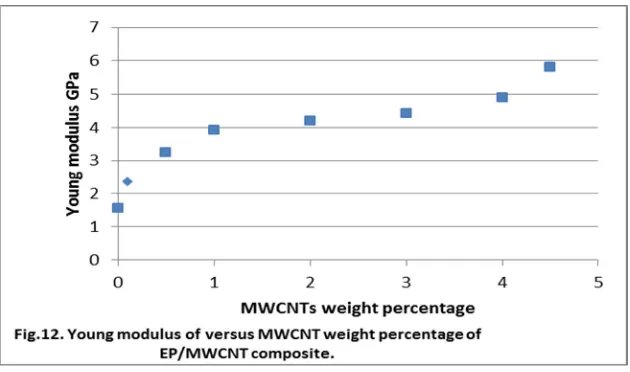
Table (1) and figure (12) show; Young modulus of EP/MWCNTs composites increases with increasing the concentration of MWCNTs. Raising Young modulus due to increase nanotubes concentration which leads to increase the constraint between epoxy chains reducing the mobility of epoxy chains. this behaviour of EP/MWCNTs composites is in good agreement with the behaviour obtained byArash Montazeriet al. [1].
sample EP EP/ 0.1% MWCNT
EP/ 0.5% MWCNT
EP/ 1 % MWCNT EP/ 2% MWCNT EP/3% MWCNT EP/ 4% MWCNT EP/ 4.5% MWCNT Flexural strength (MPa)
37.8 39 45 48 52.8 56.4 51 49.8
Young modulus (GPa)
1.559
2.369 3.252 3.911 4.197
Volume 3, Issue 2, February 2014
Page 339
4. Scanning Electron Microscope (SEM) Images of EP/MWCNTs Nanocomposites Topography
of Fractured Surface
Figure 13 shows the SEM micrographs taken from the fracture surfaces of the epoxy and epoxy/MWCNTcomposites. The smooth fracture surface of the neat epoxy is a typical feature of brittle fracture behaviour. As the filler content increases the surface roughness increases, suggesting that the crack propagation in the nanocomposite is opposed by rigid and stiff fillers. In other words, since the segments of primary crack front had to move quickly between the fillers, more energy is needed for such local deviations. In fact it leads to higher fracture toughness.As indicate in the figures 13
a,13b,13c,13d,13e,13f,13g,and13 h
(a) pure epoxy (b)0.1%wt.MWCNTs
(c) 0.5%wt.MWCNTs
Volume 3, Issue 2, February 2014
Page 340
(
e
) 2%wt.MWCNTs (f
) 3%wt.MWCNTs(g) 4%wt.MWCNTs (h) 4.5%wt.MWCNTs
5. Conclusion
This study has demonstrated the intrinsic potential of the CNT. Small quantity addition can modify considerably the mechanical behavior of asoft polymer matrix. The exceptional mechanical properties of MWNT have been used to improve the performance of a rubbery epoxy matrix nanocomposites. The addition of CNT into the epoxy matrix has a remarkable effect on the mechanical properties. The maximum Young modulus and the flexural strength of nanocomposites reached to 300% and 50% respectively compared to the pure matrix.
References
[1] Arash Montazeri , Jafar Javadpour , Alireza Khavandi , Abbas Tcharkhtchi , Ali Mohajeri. Mechanical properties of multi-walled carbon nanotube/epoxy composites. Materials and Design 31 (2010) 4202–4208.
[2] Frisch HL, Mark JE. Nanocomposites prepared by threading polymer chains through zeolites, mesoporous silica, or silica nanotubes. Chem Mater 1996;8:1735–8.
[3] Park J, Jana SC. Effect of plasticization of epoxy networks by organic modifier on exfoliation of nano clay. Macromolecules 2003;36:8391–7.
[4] A. Allaouia, S. Baia,b, H.M. Chengb, J.B. Baia, Mechanical and electrical properties of a MWNT/epoxy composite. Composites Science and Technology 62 (2002) 1993–1998.
[5] Robertson DH, Brenner DW, Mintmire JW. Energetics of nanoscale graphitic tubules. Phys Rev B 1992;45:12592–5. [6] Yakobson BI, Brabec CJ, Bernholc J. Nanomechanics of carbon tubes: instabilities beyond linear response. Phys Rev
Lett 1996;76: 2511–4.
[7] Jin Ah Kim, Dong Gi Seong, Tae Jin Kang, Jae Ryoun Youn. Effects of surface modification on rheological and mechanical properties of CNT/epoxy composites. Carbon 44 (2006) 1898–1905.
[8] P.M. Ajayan, O. Stephan, C. Colliex, D. Trauth, Science 265 (1994) 1212. [9] Z. Spitalsky, D. Tasis, K. Papagelis, C. Galiotis, Prog. Polym. Sci. 35 (2010) 357.