Volume 3, Issue 3, March 2014
Page 77
Abstract
This research deals with storage of the thermal solar energy in the soil in summer season (from May to Oct) for latter utilization (in winter) to reduce the energy consumption. The quasi-three-dimensional model and finite line source model are used to compute the heat transfer from the used solar water heater at 90oc of active area 4.16m2 to the underground using U-tube with length of 12m and diameter 0.1m, for storage the thermal solar energy of the summer season to use it in winter for supplying heat water and space heating of domestic consumption. The results indicated that the capacity of stored thermal energy in the soil is 38% of the total collected energy, which equal to 1.013Mwh in the soil of Al-kreaat quarter in Baghdad. The energy saving per the borehole length is 84.8 kWh/m, the result also show that the amont of storage energy depended on the borehole length.
Keywords: seasonal heat storage; quasi-three-dimensional model; borehole; solar collector
1. Introduction
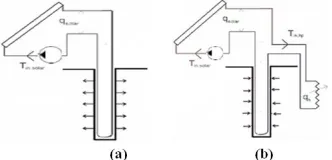
The using of fossil fuel causes many effects on the environment such as the greenhouse effect which causes increase in the temperature of the earth because emission the CO2 and these sources are limited and predicted to become scarcer and more expensive in coming years [1]. The renewable sources would help to reduce the emission of greenhouse gasses. One of an important source of renewable energies is the sun. The thermal energy storage (TES) can be used to reduce the fossil fuel consumption by storing of huge solar thermal energy in summer for later utilization in winter season as shown in figure (1). Borehole thermal energy storage (BTES) is a method for storing thermal energy in the underground. The borehole used as ground heat exchanger (GHE) for the thermal energy which collected by the solar collector and transfer to the ground by circulation the fluid in the U-tube. Thus, the present work aims tostore thermal solar energy in soil and compute the quantity of thermal energy that can be stored around the heat exchanger (grout) along six months of the
summer season in Algreaat quarter in Baghdad
.
Figure 1: System connection (a) in summer, (b) in winter
2. Solar collector
The solar radiation that can be absorbed by the evacuated tube collector and converted to thermal energy on an hourly basis is depending on incident solar radiation , area of the absorber and the collector efficiency . The amount of energy stored in the fluid of collector's tank can describes as [2]:
.
The temperature of the fluid inside the tank can be evaluated by the balance equation. . ( - )
Where m is mass and specific heat of heat transfer fluid HTF, is initial fluid temperature and is final fluid temperature. The final fluid temperature in the solar collector tank is
The average daily efficiency of an evacuated tube collector was found approaching 60% [3]. In summer season, the appropriate tilt angle for the collector system in Baghdad is 15o [4].the solar evacuated tube collector specification is shown in table1.
The Seasonal Storage of Thermal Solar
Energy in Iraq
Al-Sudany Naseer K1, Al-Sa'ady Ahmed F2, Al-Bahadly Fadhil M.3, Al-Sudany Alaa H.2
Volume 3, Issue 3, March 2014
Page 78
Table (1): The solar evacuated tube collector designTube Length (m) 1.8 Tube Radius (m) 0.058
No of tubes 40
Distance between tubes (m) 0.042 Collector Area (m2) 4.16 Collector efficiency 60% Collector tank Length (m) 4 Collector tank Radius (m) 0.098 Collector tank Volume (liter) 120
3. Solar Radiation
Incident solar insolation on the collector of 4.16m2 at tilt angle of (15o) in Baghdad for the months ( May, June, July, Aug, Sep and Oct ) are shown in table 2 [5].
Table 2: Solar Insolation in Baghdad at tilt angle of 15o [5]
For the whole system, the resulted thermal energy from used solar collector for six summer months is 2.66Mwh. Daily the gained thermal energy is used to raise the temperature of 120 liter of HTF to 90oc. This fluid will be circulated by the pump of power 0.37 kW with flow rate of 0.08 kg/s through borehole tube of 12 liter capacity. According to equations 1 and 3 the HTF (120 L) in May, June, July and Aug will be circulated for 4 times every day, this corresponds to 40 cycles per day through borehole. In Sep and October the HTF Aug will be circulated for %times and 8 times every day respectively. However, the on-off heat pump will be controlled by temperature sensors (thermocouple) which put in HTF tank.
4. Heat transfer inside borehole
The borehole is consisted of two pipes made of high-density Polyethylene with a center-to- center distance 2D, often called the shank spacing, the space between the pipes and the borehole wall are usually filled with a grout (soil) as shown in figure 2a. The grout is used to augment heat transfer from the fluid to the ground [6].In the GHE, the HTF flows along the borehole in one channel down to the bottom of the borehole and back upward in another channel, while exchanging heat with the ground. A two dimensional horizontal cross section of a U-tube borehole is presented schematically in Figure 2b.
Figure 2: Schematic diagram of a-grout borehole, b-Thermal Resistance in the borehole [7]
The actual heat transfer processes occurring in a single U-tube ground heat exchanger include: (1) the convective heat transfer between the HTF in the U-tube and the tube wall; (2) the conduction of heat in the tube wall; and (3) the conduction of heat in the grout and the ground soil [8]. The heat transfer from the circulating fluid in the pipes to the surrounding ground can be describe by a quasi-three-dimensional model was proposed by Zeng et al [9].The main objective of the model is to determine the entering and leaving temperatures of the circulating fluid in the exchanger according to the borehole wall temperature and its heat flow [9], and taking into account the fluid axial convective heat transfer and thermal “short-circuiting” among U-tube legs[8]. Being minor in order, the conductive heat flow in the grout
kWh per month kWh/m2 Per
month kWh/m2 Per
Volume 3, Issue 3, March 2014
Page 79
and ground in the (z) direction is neglected to keep the model concise and analytically manageable. The energy balance equations for up-flow and down-flow of the circulating fluid can be written as [7].Where Tf1 , Tf2, Tb , and H are the temperatures of the fluid running downwards, the temperatures of the fluid
running upward, the temperatures of the borehole wall, mass flow rate, heat specific and borehole length respectively . are dimensionless thermal resistance. .
Here, R11 and R22 are the thermal resistance between the circulating fluid and the borehole wall, and R12 is the resistance between the circulating fluid in the pipes [10]. In most engineering applications, the configuration of the U-tube in the borehole may be assumed symmetric, and here it is assumed that R22=R11, therefore,
Hellström (1991) presented a technique to evaluate R11and R12 based on the line source solution for each pipe [11]:
Where k and kb are the ground and grout thermal conductivities, respectively ,rb is the borehole radius, rp is the outer
radius of the pipe, Rpipe is the heat transfer resistance from the fluid inside the U-tubes to the pipe outer surface
(considered constant along the borehole depth), which combines the fluid convective resistance (Rfluid), the pipe resistance in the pipe (Rp) and a contact resistance associated with gaps between the pipes and the grout (Rair) can be calculated with Equations [6]:
where is the inner pipe radius, the fluid resistance can be calculated using Equations [12]:
Where is the Heat-transfer coefficient, rip is the inner pipe radius, kpis the pipe thermal conductivity, hi is convective
heat transfer coefficient inside the U-tubes, and Rair is a contact resistance at the grout/pipe interface. The resistance
was set to zero in this work, the value of hi is assumed to be the same in both circuits and constant along the depth of the borehole. Two boundary conditions are necessary to complete the solution
Volume 3, Issue 3, March 2014
Page 80
The temperature profiles of the fluids flowing in the upward pipe in the boreholeWhere the dimensionless parameters are defined as
Where is a fluid temperature for any point per length, the parameter P is always larger than zero, but it is always smaller than 1, that is ( 0<P<1) [8], the heat transferred to the soil from each of the pipes in the borehole can be obtained from Equation (4) and (5). In these equations, only the first term on the right hand side is taken.
Using dimensionless parameters introduced in Eq. (16) and Equation (17), Equation (20) can be rewritten in terms of the dimensionless parameters:
Assuming that the heat is dissipated symmetrically in the soil around the borehole and assuming there is another borehole, the distance between the boreholes ( ) is 2m. Equation (21) can be written in the following form:
This is the spatial distribution of the heating along the rod (borehole)[7].
2.3. Heat transfer outside borehole
The finite line source model is an analytical solution of the transient temperature response in a semi-infinite medium for a single borehole in a geothermal heat exchanger is illustrated in Figure 3. The borehole diameter is 0.1 m, and its depth is 12 m, compared to its depth, the borehole diameter is much smaller. However, the ground can be treated as a semi-infinite medium. Thus the borehole, which extracts/rejects heat from/to the ground, can be approximated as a line source. The following assumptions are made in the model [13] :
1. The ground is regarded as a homogeneous semi-infinite medium, and its thermo physical properties do not change with temperature.
2. The medium has a uniform initial temperature (Tb).
3. The boundary of the medium—the ground surface—keeps a constant temperature throughout the period considered. 4. The radial dimension of the borehole is neglected so that it may be approximated as a line source stretching from the boundary to a certain depth, H.
5. The heating rate per length of the source ( q1) is constant since the starting instant, τ = 0.
Figure 3: The geometry of a finite line-source system [13].
Volume 3, Issue 3, March 2014
Page 81
line source and the virtual line sink. Select a differential increment, dh, from the line source, which can be regarded as a point heat source. The temperature rise at the time τ in the point, m, of an infinite medium caused by this point source can be written as [13]:Where
Where , denote the thermal diffusivity of the medium and soil density respectively. Where (erfc) is the complementary error function is defined as[14]:
Where the Gauss error function is defined as
The real solution of the temperature excess can be obtained by integrating contributions of all the increments of the line source and sink that is [13].
Equation (26) may be expressed in a dimensionless form as follows [3]:
Introduce dimensionless variables Z = z/H, = h/H, = r/H, is the heating strength per unit length, Fo=
τ/H2, Fo is a Fourier numberwhich is compared a characteristic body dimension with an approximate temperature wave penetration depth for given time τ [14]. The temperature response at the middle of the borehole wall may be chosen as representative of the borehole temperature, fixed as (0.5), Zeng et al, in 2004 using this procedure for the case of vertical boreholes containing U-pipes with running fluid[15]. Koohi & Rosen used the heating strength along borehole in Eq.22 to substitute in Eq.27 to obtain the temperature rise in the soil surrounding a borehole [7].
3. Result and discussion.
For specific incoming solar radiation, specific time and specific soil, the underground thermal solar storage tank capacity is limited by the characteristic of borehole system and solar collector system. Thus for Alkreaat quarter and according to its soil type (see table.3), the characteristics of borehole system are listed intable 4[16].
.
Table (3): Alkreaat quarter soil properties[16]
Water Content (Moisture) (%) 56
Dry Specific Heat (J/kg.k) 840
Specific Heat (J/kg.k) 2710.4
Thermal Conductivity (W/m.k) 2.15
Density (kg/m3) 1350
Volume 3, Issue 3, March 2014
Page 82
Table (4). BHE configurations and thermal properties
3.3. Heat transfer rate along borehole
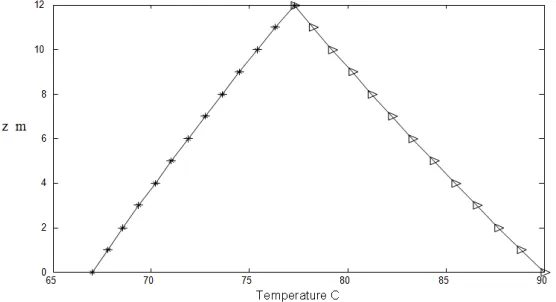
According to Equations 16 and 17, the temperature profile from the water at 90oc in the pipes is plotted in figure 4 for
May month. The temperature of water will be reduced and lose 23oc per cycle along borehole length.
Figure 4: The variation of HTF temperature along borehole in May
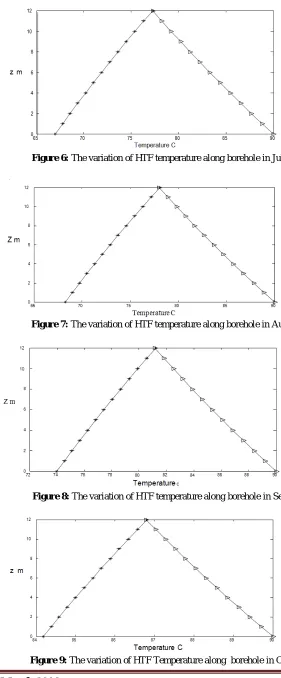
Figure 4 shows that the HTF temperature will be reduced and reached, approximately, 77oc at maximum depth (12m) and then the decrease in temperature will be continued and reached, approximately 67oc at the end of borehole. Thus, the temperature of HTF will lose 23oc for one cycle along borehole. The heat transfer from the hot water to pipes wall and thus, to soil around borehole, this transfer is due to the temperature difference ( between fluid (90oc) and soil (24oc), where ( between down-flow and soil in is large than ( between up-flow and soil.The thermal energy transfer to soil for one cycle is 92.4w.The soil temperature will be increase with time, this causes a reduction in heat transfer levels. These levels are limited by ( . This fact is demonstrated for each cycle along borehole, in figures for May, June, July, Aug, Sep, and Oct respectively. It is clear that the mean temperature transfer value for each cycle will be reduced exponentially with time as: 23oc, 23oc, 22oc, 16oc and 5.8oc.These values of temperature are corresponding to amount of transfer thermal energy as: 92.4w, 92.4w, 92.4w, 74.9w, 51w respectively as listed in table 5. By using equation 27, the borehole walls temperature for summer months were 24.027oc, 26.3oc, 36.5oc, 53.5oc, 72.9oc and 85.9oc in the end of May, June, July, Aug, Sep, and Oct respectively.
Figure 5: The variation of HTF temperature along borehole in June 0.05 rb
Borehole radius(m)
12 H
Borehole length(m)
0.0127 rip
Pipe Inner radius(m)
0. 0147 rp
Pipe Outer radius(m)
12 v
Borehole volume (liter)
0.025 D
U-tube Shank Spacing(m)
2.15 kb
Grout Conductivity(w/m k)
0.08 Mass flow rate(Kg/s)
0.4 kp
pipe Conductivity(W/m K)
700 hi
convection heat-transfer coefficient (W/m2K)
Volume 3, Issue 3, March 2014
Page 83
Figure 6: The variation of HTF temperature along borehole in July
Figure 7: The variation of HTF temperature along borehole in Aug
Figure 8: The variation of HTF temperature along borehole in Sep
Volume 3, Issue 3, March 2014
Page 84
Table 5: system characteristics for six month
Tb o c Qloss per Month kWh Qloss per
day kWh Qloss per
Cycle w Tloss per
cycle o c No of Cycle per day months 24.027 177.4429 5.914 92.4 23 4 May 26. 3 177.4429 5.914 92.4 23 4 June 36.5 177.4429 5.914 92.4 23 4 July 53.5 143.8363 4.794 74.9 22 4 Aug 72.9 153.3302 5.111 51 16 5 Sep 85.9 183.8954 6.192 23.2 5.8 8 Oct 1013.5906 sum
The seasonal storage of thermal sloar energy for six month in underground is 1.013590 MWh and the efficiency of storage are 38% from the total heat gained by the solar collector (2.66 MWh). The saved energy per the borehole length is 84.4 MWh/m.
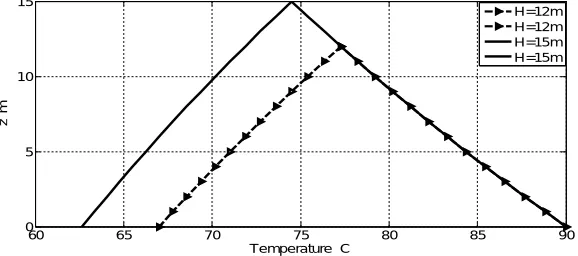
When the borehole length equal 15m, the heat transfer rate will increase to 27oc due to increase the Area of thermal conductivity and it is depending on solar collector area which dertermind the input energy to borehole as shown in figure 10.
60 65 70 75 80 85 90
0 5 10 15
Temperature C
z m H=12m H=12m H=15m H=15m
Figure 10: The heat transfer rate inside the soil around Borehole for two lengths of borehole.
The temperature rise in the soil arround borehole through days of six months is shown in figure (11). Where the high heat capacity lead to a little temperature rising in may and june. The heat capacity of soil will reduce and the soil temperature will increase for the other months.
20 40 60 80 100 120 140 160 180 200
20 30 40 50 60 70 80 90 100 day te m p e ra tu re C
Figure 11: Temperature rise in soil with day.
Volume 3, Issue 3, March 2014
Page 85
20 40 60 80 100 120 140 160 180 200
0 200 400 600 800 1000 1200
H
e
a
t
e
n
e
rg
y
k
W
h
Day
Figure 12: The heat transfer to soil every month
4. Conclusions
The thermal solar energy can be storage seasonally in soil and give a source of renewable energy, especially at sunny country for later utlization for supplying heat water or space heating. The loss of more than 60% of the gained energy by the solar collector as a result of the high heat capacity of the soil , in addition to that, the model neglects the heat flowing up and down of the borehole.The thermal solar energy systemsare vaild in iraq is asunny country its soil is clay and has larg amount of underground water in low depths.
References
[1] Abedin, A. H., & Rosen, M. A. (2011).'' A Critical Review of Thermochemical Energy Storage Systems''. The open Renewable Energy Journal, 4, 42-46.
[2] S, Kalogirou,2007,'' Recent Patents in Solar Energy Collectors and Applications'', Recent Patents on Engineering 2007, 1, 23-33
[3] H J. Hammad, "THERMAL PERFORMANCE OF EVACUATED TUBE SOLAR HEATING SYSTEM " Msc Thesis 2009,University of Baghdad, Engendering collage, mechanic dep
[4] Alsudany N.k et al,2010,''Effect of Geometrical losses on the PV solar panel performance in Baghdad",17th scientific converence of college of Education, Al-Mustansiriyah University 5 - 6 May 2010, 4,474-491
[5] Raad. Kilabi, 2011,''Performance Improvement of PV Solar Panel Using SunTracking System'', Msc thesis, Al-Mustansiriyah University,College of Education
[6] Parham Eslami nejad, 2011,''Double U-Tube Geothermal Borehole Operation Under Phase Chang Condition'',Universite De Montereal Ph.D thesis
[7] Koohi-Fayegh, S., & Rosen, M. A. 2012b.'' Thermally Multiple Boreholes with Variable Heating Strength''. In Proceedings of the eSim Conference.
[8] Ma, Chong-Fang, Z. X. Gu, and Y. T. Wu. " Numerical Study of heat transfer a singal U-tubein vertical Ground Heat Pump Systems" In International Heat Transfer Conference 13. Begel House Inc., 2006
[9] Zeng, H., Diao, N., & Fang, Z. (2003)b.''Heat transfer analysis of boreholes in vertical ground heat exchangers''. International Journal of Heat and Mass Transfer, 46(23), 4467-4481
[10]Zeng, H., Diao, N., & Fang, Z. (2003)a.'' Efficiency of vertical geothermal heat exchangers in the ground source heat pump system''. Journal of Thermal Science, 12(1), 77-81
[11]Hellström, G., 1991. Ground heat storage: ''Thermal analyses of duct hysics, University of Lund, Lund, Sweden
[12]Drake, R., and E. Eckert, 1972. ''Analysis of Heat and Mass Transfer''. New York:McGraw-Hill Bookompany{young04
[13]Zeng, H.Y., N,R, Diao. and Z.H, Fang. 2002. A finite line-source model for boreholes in geothermal heat exchangers. Heat Transfer, Asian Research 31(7):558-567
[14]Holman, J. P. (1986). Heat transfer (pp. 15-100). New York: McGraw-Hill. tenth Edition, 2010
[15]Zeng, H. Y ,Diao, N. R.,., & Fang, Z. H. (2004). Improvement in modeling of heat transfer in vertical ground heat exchangers. HVAC&R Research, 10(4), 459-470
![Figure 2: Schematic diagram of a-grout borehole, b-Thermal Resistance in the borehole [7]](https://thumb-us.123doks.com/thumbv2/123dok_us/9760043.1960844/2.612.240.380.566.623/figure-schematic-diagram-grout-borehole-thermal-resistance-borehole.webp)