156
Copyright © 2018. IJEMR. All Rights Reserved.
Volume-8, Issue-1 February 2018
International Journal of Engineering and Management Research
Page Number: 156-160
A Study on Factors Influence on Consumers’ Leisure Shopping (With
Special Reference to the Purchasing in Shopping Malls in Colombo
District)
Perera K.J.T1 and Sutha.J2
1Lecturer (Temporary), Department of Management Sciences, Uva Wellassa University, Badulla, SRI LANKA 2Senior Lecturer, Department of Management Sciences, Uva Wellassa University, Badulla, SRI LANKA
1
Corresponding Author: [email protected]
ABSTRACT
Shopping is widely regarded as a major leisure time activity and entertainment aspect of retail industry is increasingly being recognized as a key competitive tool in the present situation. Therefore retailers and shopping Centre developers are seeking ways to make shopping more of a leisure pursuit. While retailers are focusing more on entertainment, academic research is lagging in investigating the hedonic reasons people go shopping. Absence of knowledge in this background makes marketers unclear and difficult to satisfy expectations of the customers who are responsive to leisure shopping. A sample of 400 shopping mall customers in Sri Lanka was empirically investigated with the aim of identify the nature of leisure shopping behavior in shopping malls and to determine the factors influence consumers to go for leisure shopping in shopping malls. A structured questionnaire was used to collect data through mall intercept technique. The pilot study 49 shopping mall customers informed a high reliability level of the questionnaire in all the dimensions of the questionnaire. The Exploratory Factor Analysis identified that the consumer’s leisure shopping was influenced by the seven different hedonic factors. These seven factors are especially remarkable theoretical implications which should prompt one to reconsider categories of shopping motives as indicated by Tauber (1972). Based on the literature these factors are named as Learning about new trends, Diversion, social Interaction, Gratification, Emotional Bonding, Mental Stimulants and Pleasure in bargaining. The study revealed that consumers go for shopping not only to purchase the products or services but also for fun. Hedonic Shopping also tended to be very social in nature and was often enhanced by the presence of friends and the trend is most marked among younger adults. And shopping is a major source of relaxation as well as a household chore associated with females in Sri Lankan shopping mall concept.
Keywords-- Exploratory Factor Analysis, Hedonic Shopping, Leisure shopping, Shopping Malls
I.
INTRODUCTION
Shopping trips are not always related to the purchase of goods and that a number of other social and personal motives accounts for shopping behavior (Tauber, 1972). Meanwhile, the business literature suggests two fundamental categories or types of shopping. The first is purposeful shopping (Backstrom, 2006), this type of shopping is characterized as task-related and rational (Arnold, M.J., Reynolds, K.E, 2003). Moving on, the second category of shopping is leisure shopping and it is typically defined as an activity, which consumers enjoy as a leisure-time pursuit (Bellenger, D.N., Korgaonkar, P.K, 1980). Leisure shopping can involve both “task-related, or product-acquisition, and hedonic value through responses evoked during the experience” (Babin, B.J., Darden, W.R., Griffin, M., 1994)
II.
METHODOLOGY
157
Copyright © 2018. IJEMR. All Rights Reserved.
shopping were analysed by using Exploratory Factor Analysis (EFA).
III.
PRIOR APPROACH
Many studies examine the idea that consumers may find shopping a pleasurable experience (Jones, 1999).In its contemporary sense, shopping has become an activity of leisure and recreation that is as relevant and popular as going to a movie or simply strolling in the park (Bäckström, 2006; Moss, 2007). Jones (1999) in exploring the range of factors involved in entertaining shopping experiences (rather than focusing on the ways in which particular factors, such as in-store music, might impact consumers). There is of course a considerable body of work which attempts to identify and measure motivations for shopping. Tauber‟s (1972) seminal paper discussed 11 motives for shopping (apart from acquisition of goods). Most can be described as pleasure and 25 leisure related. Of the studies, which have followed, Buttle and Coates (1983) is particularly interesting in attempting to validate these motives, and produce some evidence of how these sociological or psychological concepts are played out in reality by shoppers. Dawson et al. (1990) identified two broad shopping motives, product and experiential, and related them to emotions while shopping and to various outcomes. Some (Babin, B.J., Darden, W.R., Griffin, M., 1994) have developed concepts about, and ways of measuring, consumers‟ non-utilitarian values – in other words the pleasure of shopping rather than the economic outcomes. Consumers often benefit from increased competition in differentiated product settings during leisure shopping season. The consumer shopping behavior during leisure is largely driven by the recreational infrastructure as a competitive strategy of retailers. This also helps developing store loyalty, innovative concern and the high-perceived customer values whereby individuals experience enjoyment from shopping. Rajagopal (2006) explains that the leisure shopping behavior is largely driven by store attractions, inter-personal influences and comparative gains, consumers feel high risk and entangle in decision making in reference to their perceived use values. Jones (1999) examined the range of factors involved in entertaining shopping experiences. He examined retailer factors (prices, selection, store environment and salespeople) and customer factors (social aspects, tasks, times, product involvement and financial resources) together. The overall conclusion from critical incident analysis was that almost two-thirds of the factors in entertaining shopping experiences were customer factors, especially social factors such as the companions on the shopping trip. Less than a third were retailer factors. Of the retail factors, “store environment” or sales personnel were mentioned far less often than product-related factors of price and selection.
158
Copyright © 2018. IJEMR. All Rights Reserved.
entertainment factors (Masood U.L,Hassan and Javeria Abbas, 2013). Moreover, females have a more propensity towards hedonic value while shopping in contrast to male and conveyed more delight and fun at shopping malls thus spending more time as compared to males (Wong, Y.T.,S.Osman,A.Jamaluddin and B.C.Yin-Fah,, 2012). There is evidence of an increasing proportion of people saying that they spend time looking around the shops as a leisure activity and the trend is most marked among younger adults (Mintel, 2000).
Meanwhile, Schwartz (1992) found that individualistic societies have got more hedonic consumer as compared to collectivists (Schwartz,S.H.,1992., 1992). Guiry and his colleagues have accentuated recreational shopping as a multidimensional activity that extends far beyond just feelings of enjoyment (Guiry, 1999; Guiry et al., 2006).Moreover, in his dissertation Guiry (1999) identified three different types of recreational shopping trips (i.e., mission shopping, window shopping, mood shopping) and argued that the type of shopping trip influences the extent to which recreational shoppers experience different leisure dimensions (e.g., intrinsic satisfaction, spontaneity, fantasy). Guiry also argued that there are different „subgroups‟ of recreational shoppers who vary in their sociability as well as in their level of involvement with shopping (e.g., „low involvement‟ or „high involvement‟ recreational shoppers). Other studies have improved our understanding of the enjoyment derived from this shopping by turning attention to the relative prevalence of various sources of enjoyment. For instance, Cox et al. (2005) found that bargain hunting seemed to be a major source of shopping enjoyment while few shoppers liked to mingle with other shoppers. Kim and Kim (2008), however, found that shopping enjoyment was more strongly related to browsing behavior as compared to bargain hunting. Nevertheless, explorations of variations in consumers‟ ways of experiencing and pursuing leisure shopping are rare. Howard (2007) has recently argued that leisure shopping exists in a variety of circumstances and that the complexity of such shopping needs to be further considered. Michael and Richard (2000) identify seven of the ten leisure dimensions (mastery, fantasy, escape/enjoyment, compulsion, salesperson, spontaneity, and social) increased in intensity across three groups of shoppers, namely: non recreational shoppers, ordinary recreational shoppers, and recreational shopping enthusiasts. Moreover, while previous research has described leisure shopping as reflecting social values (e.g., Tatzel, 1982; Williams et al., 1985; Arnold and Reynolds, 2003), Backstrom (2011) shows that many consumers prefer to enjoy this activity individually and also he argued pleasure and delight associated to leisure shopping was commonly alternated with feelings of frustration and disillusionment, e.g., when consumers did not succeed to accomplish a much desired purchase. Consumers‟ leisure shopping reflects a variety of consumer meanings and
accordingly also a wide range of shopping practices. In addition, the dynamic nature of such shopping implies that consumers shopping practices may be characterized by sudden shifts in its related meanings and focus. For retailers thus, it is important to recognize that leisure shopping may involve a composite set of motives, including for instance both hedonic and utilitarian aspects. In retail store settings it might for instance be crucial to balance hedonic values (e.g., design) against more practical (e.g., product accessibility). Retailers should furthermore strive to hold a flexible and an open approach that allow for manifoldness as well as variations in consumers‟ preferences and practices. (Backstrom, 2011). Convenience and functional values may be of significant importance to individuals engaged in leisure shopping activities (Kim, H., Kim, Y., 2008). However, there is still a lack of more thorough empirical investigations of the multifaceted and varied nature of such shopping. (Backstrom, 2011).
Howard (2007) found that most of the purchases made in the shopping Centre were pre-planned, indicating the determination of a majority of shoppers to avoid any unplanned spending of what can be tight household budgets. It is worth noting the difference in use of shopping malls in different parts of the world. In Thailand, for instance, people may regard shopping malls as places to spend time with friends, or to spend time in pleasant (climate controlled) surroundings, much more than is general in Europe. And leisurely shopping requires sufficient free time (Howard, 2007). Chebat et al. (2005) Spending leisurely time at a shopping center may be the last thing on the agenda of many typical mall visit may involve both shopping tasks and recreational elements. Bloch et al. (1991) report a similar segment of American consumers, who visited the mall specifically to browse. Consumers with strong shopping motives are found to experience more pleasure and arousal, and find the mall ambience to encourage impulse buying behavior (McGoldrick and Pieros, 1998; Mattila and Wirtz, 2004). A larger shopping center can facilitate a greater variety of shops, and can create a more pleasant environment for shoppers, thus enticing them to visit more often and stay longer. (Rajagopal, 2009)
IV.
OUR APPROACH
159
Copyright © 2018. IJEMR. All Rights Reserved.
shows Eigen value of fifteen factors more than 1 explaining 65.259 percent of total variance.
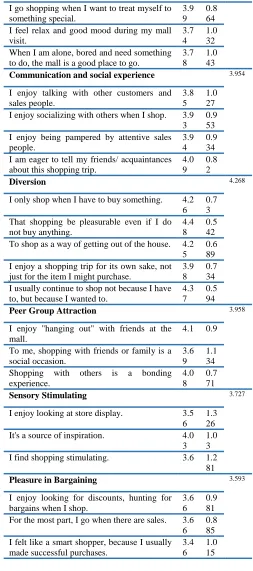
Table 1 presented the results from exploratory components factor analysis is taken into consideration for grouping of variables. First factor comprises of six items with factor loading values of .690, .584, .608, .620, .632, .559 and this factor named as Learning about new trends. Second factor shows the highest loading of five items with factor loadings of .726, .772, .754, .807, and .692. This factor named as Gratification. Third factor show the highest loading of four items with factor loadings of .737, .833, .839, .674 this factor can be named as Communication and social experience. Fourth factor shows the highest loading of five items with factor loadings of .710, .670, .702, .528, and .610 this factor can be named as Diversion. Fifth factor shows the highest loading of three items with factor loadings of .570, .681, .600 and factor named as Peer group attraction. Sixth factor show only two highest loadings so this factor is not considered. Seventh factor shows the highest loading of three items with factor loadings of .831, .818, and .674 this factor named as Sensory stimulation. Eighth factor show only two highest loadings so this factor is not considered. Ninths factor shows the highest loading of three items with factor loadings of .518, .652, and .720. Factor named as Pleasure in bargaining. Factor 10, 11, 12, 13, 14 shows only two highest loadings so this factors are not considered. Factor 15 show only one highest loading so this factor was also not considering. So results of principal component place 52 variables into 7 factors.
Table 1- Factor Grouping Means and Standard Deviations
Question Me
an
SD Fact or Mea n
Learning about new trends 3.709
I enjoy window shopping and browsing through stores.
3.2 6
1.1 84 I feel modern by visiting the mall. 4.1
1 0.6 63 I often shop to keep up with the latest trends. 3.2
2 1.2 06 I go to shopping mall to see what new
products/ designs/brands are available.
4.0 4
0.8 2 I was looking for insights and new ideas to
buy.
3.8 9
0.9 21 I wanted to explore/touch/try different
products while shopping.
3.7 3
1.0 22
Gratification 3.87
It's especially fun to buy "impulse" item. 4.0 4
0.9 68 When I am in a down mood, I go shopping
to make me feel better because it is a way to relieve stress.
3.7 9
0.9 88
I go shopping when I want to treat myself to something special.
3.9 9
0.8 64 I feel relax and good mood during my mall
visit.
3.7 4
1.0 32 When I am alone, bored and need something
to do, the mall is a good place to go.
3.7 8
1.0 43
Communication and social experience 3.954
I enjoy talking with other customers and sales people.
3.8 5
1.0 27 I enjoy socializing with others when I shop. 3.9
3 0.9 53 I enjoy being pampered by attentive sales
people.
3.9 4
0.9 34 I am eager to tell my friends/ acquaintances
about this shopping trip.
4.0 9
0.8 2
Diversion 4.268
I only shop when I have to buy something. 4.2 6
0.7 3 That shopping be pleasurable even if I do
not buy anything.
4.4 8
0.5 42 To shop as a way of getting out of the house. 4.2
5 0.6 89 I enjoy a shopping trip for its own sake, not
just for the item I might purchase.
3.9 8
0.7 34 I usually continue to shop not because I have
to, but because I wanted to.
4.3 7
0.5 94
Peer Group Attraction 3.958
I enjoy "hanging out" with friends at the mall.
4.1 0.9
To me, shopping with friends or family is a social occasion.
3.6 9
1.1 34 Shopping with others is a bonding
experience.
4.0 8
0.7 71
Sensory Stimulating 3.727
I enjoy looking at store display. 3.5 6
1.3 26
It's a source of inspiration. 4.0
3 1.0 3
I find shopping stimulating. 3.6 1.2
81
Pleasure in Bargaining 3.593
I enjoy looking for discounts, hunting for bargains when I shop.
3.6 6
0.9 81 For the most part, I go when there are sales. 3.6
6 0.8 85 I felt like a smart shopper, because I usually
made successful purchases.
3.4 6
1.0 15
V.
CONCLUSION
160
Copyright © 2018. IJEMR. All Rights Reserved.
Sensory stimulation and Pleasure in bargaining. The study revealed that consumers go for shopping not only to purchase the products or services but also for fun. There are especially remarkable theoretical implications which should prompt one to reconsider categories of shopping motives as indicated by Tauber (1972). Compare with male, female customers are visiting to shopping mall is high. Going shopping is a major source of relaxation as well as a household chore associated with females in Sri Lankan shopping mall concept. Hedonic Shopping also tended to be very social in nature and was often enhanced by the presence of friends.
REFERENCES
[1] Ann Marie Fiore, Jihyun Kim. (2007). An integrative framework capturing experiential and utilitarian shopping experience. International Journal of Retail & Distribution
Management, 35(6), 421-422.
[2] Kempf, D.A., Laczniak, R.N. & Smith, R.E. (2006). The effects of gender on processing advertising and product trial information. Marketing Letters, 17(1), 5-16. [3] Babin, B.J., Darden, W.R., & Griffin, M. (1994). Work and/or fun: measuring hedonic and utilitarian shopping value and utilitarian shopping value. Journal of Consumer
Research, 20, 644-656.
[4] Backstrom, K. (2006). Understanding recreational shopping. The International Review of Retail, Distribution
and Consumer Research, 16(2), 143 - 158.
[5] Rook, D.W. & Hoch, S.J. (1985). Consuming impulse.
Advances in Consumer Research, 12(1), 23- 27.
[6] Ballantine, P. W., Jack, R., & Pearsons, A. G. (2010). Atmospheric cues and their effect on the hedonic retail experience. International Journal of Retail and
Distribution Management, 38(8), 641-653.
[7] Fam, K.S., Merrilees, B., Richard, J.E., Jozca, L., Li, Y., & Krisjanous, J. (2011). In-store marketing: a strategic perspective. Asia Pasific Journal of Marketing and
Logistic, 23(2), 165-176.
[8] Miranda M.J., L. Konya & I. Havrila. (2005). Shoppers‟ satisfaction levels are not the only key to store loyalty. Marketing Intelligence and Planning, 23(2), 220-232.
[9] Babin, L.A., B.J. Babin & J.S. Boles. (1999). The effects of consumer perceptions of the sales person, product and dealer on purchase intentions. Journal of
Retailing and Consumer Services, 6(2), 91-97.
[10] Baker, J., A. Parasuraman, D. Grewal & G.B. Voss. (2002). The influence of multiple store environment cues on perceived merchandise value and patronage intentions.
Journal of Marketing, 66(2), 120-142.
[11] Bakewell, C. & V-W. Mitchell. (2004). Male consumer decision-making styles. International Review of
Retail, Distribution and Consumer Research, 14(2),
223-40.
[12] Sorce, P., Perotti, V., & Widrick, S. (2005). Attitude and age differences in online buying. International Journal
of Retail & Distribution Management, 33(2), 122-132.
[13] Williams, P., P. Hubbard, D. Clark & N. Berkeley. (2001). Consumption, exclusion and emotion: the social geographies of shopping. Social and Cultural Geography, 2(2), 203-219.
[14] Whyatt, G. (2004). Town centre management: How theory informs a strategic approach. International Journal
of Retail and Distribution Management, 32(7), 346-353.
[15] Teo, T. S. H. (2002). Attitudes toward online shopping and the Internet. Behaviour & Information
Technology, 21(4), 259-271.
[16] Sorce, P., Perotti, V., & Widrick, S. (2005). Attitude and age differences in online buying. International Journal