Photo:
A gorilla gr
oup in a for
est clearing. Gorillas ar
e r
eluctant to cr
oss lar
ge unfor
ested gaps. © Jabruson, 2013. All Rights Reserved. www
.jabruson.photoshelter
Introduction
This chapter explores the significant threats and risks to apes, and their habitat, that result from the activities of extractive indus-tries. All apes are protected by national and international laws throughout their geo-graphic range. It is therefore illegal to kill, capture, or trade in either live apes or their body parts. It is important to understand where and how extractive industries affect great apes and their habitat during each phase of a project. In mining, oil, and gas projects (Chapter 5), these phases include exploration and evaluation, preliminary engineering and alternatives analysis, final engineering and site selection, construc-tion and commissioning, operaconstruc-tion, closure, and post-closure phases. All phases of all
CHAPTER 3
extractive industries are likely to have some impact on resident apes, although the scale and severity are likely to vary. Generally speaking, the behavior and physiology of wildlife are known to be impacted by human activities (Griffiths and van Schaik, 1993; Kinnaird and O’Brien, 1996; Woodford, Butynski, and Karesh, 2002; Blom et al., 2004a; Wikelski and Cooke, 2006; Rabanal
et al., 2010; Ruesto et al., 2010; Chan and Blumstein, 2011). Species’ responses to envi-ronmental disturbance will, however, vary according to their biological dispositions and the type and scale of disturbance. For exam-ple, species with highly specialized require-ments may manifest significant adverse impacts, as found in studies looking at the impact of logging on terrestrial and bark-gleaning insectivorous birds or bats, while those with more general requirements may be less affected (Putz et al., 2001; Peters, Malcolm, and Zimmerman, 2006).
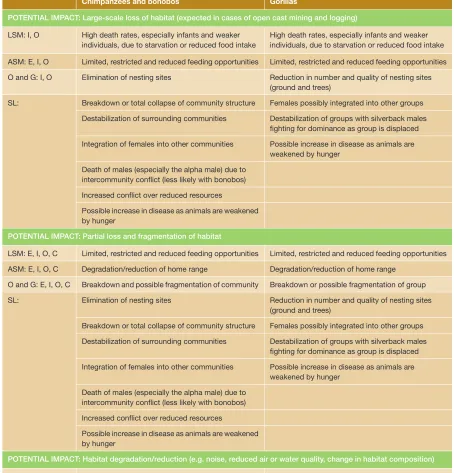
The list of potential impacts of extractive industries on ape populations is extensive and diverse: (1) Habitat loss from large-scale clear-fell logging and opencast mining will result in total loss or displacement of resident ape populations. (2) Habitat disturbance and degradation from selective logging, subter-ranean, and smaller-scale mining opera-tions will likely impact the home range and resource use of resident apes, potentially resulting in additional knock-on effects. Changes in resource abundance could, for example, drive changes in activity patterns and energy budgets. These changes may be adaptive, but in some circumstances low-ered energy budgets may lead to increased mortality through starvation, stress, and low-ered fertility, ultimately reflected in lowlow-ered carrying capacity in affected habitats. Indeed, reduced population densities in forests degraded through selective logging are a common theme discussed below. Habitat fragmentation caused by infrastructure development and general reduction in forest
quality may also have long-term effects, including the isolation of sub-populations and a reduction in long-term population viability (see Box 3.1). Social effects may also be expected as habitats are impacted, forcing groups into neighboring areas and increasing contact with conspecifics, poten-tially causing loss of social cohesion in groups and increased aggression, conflict, and mor-tality. All of these factors may also increase levels of stress on ape populations with impacts potentially including altered energy budgets, changes in social behavior, higher mortality rates, immunosuppression, low-ered growth rates, and reduced reproductive success (Woodford et al., 2002; Wikelski and Cooke, 2006).
box 3.1
Can great apes survive in forest fragments?
As Southeast Asia’s forests are cleared, orangutans are seeking refuge in surrounding areas. They may return as for-est regenerates, but degraded forfor-ests do not meet all of the orangutan’s biological requirements. They need a mosaic of habitat types, as in the highly fragmented Kinabatangan flood-plain of Malaysia, where riparian and mixed lowland diptero-carp forest can still be found along the riverbanks (Ancrenaz
et al., 2010). Orangutans are also known to persist in acacia and eucalyptus plantations (Meijaard et al., 2010), although the long-term viability of these individuals is uncertain. In Africa, great ape populations outside the central basin are greatly threatened by habitat fragmentation, and much of East and West Africa has been deforested by human activities, prin-cipally slash-and-burn agriculture (e.g. Brncic, Amarasekaran, and McKenna, 2010). Chimpanzees and bonobos are capable of occupying a wide range of habitat types, so they are not confined to dense forest. Chimpanzees inhabit mosaics of savanna–woodland, gallery forest, and relatively impoverished dry forests in Guinea, Mali, Senegal, and Tanzania; some bonobos occur in mosaics of swamp forest, dry forest, marshy grassland, and savanna–woodland. Nonetheless, chimpan-zees and bonobos are heavily dependent on any available tree cover for shade and nesting in these open environments. In Gabon, chimpanzee densities have been found to be simi-lar in fragmented forest patches and swaths of continuous forest, whereas gorilla densities were much lower in fragmented than in continuous forest because of their general reluctance to cross large unforested gaps (Tutin, White, and Mackanga-Missandzou, 1997).
Studies of habitat fragmentation as a result of logging sug-gest that the impacts on great apes depend on the species (Tutin and Fernandez, 1984; Plumptre and Reynolds, 1994; Hashimoto, 1995). Onderdonk and Chapman (2000) studied primate occupation and the characteristics of forest fragments outside Kibale National Park, Uganda. Evidence of chimpan-zee presence was found in 9 of 20 fragments, some as small as 0.008 km2 (less than 1 hectare). However, the authors had
the impression that chimpanzees were foraging in these locali-ties for short periods only and frequently moved between patches. They did not find a relationship between primate pres-ence and specific patch characteristics (size of the patch, distance to the next nearest patch, distance to the national park, or number of food trees present). Chimpanzees in Bulindi, also in Uganda, survive in fragmented riverine habi-tat comprised of markedly different food sources to those in nearby Budongo. Apparently, those resources are sufficient for the chimpanzees to survive and may even be a direct result of persistent human disturbance (McLennan and Plumptre, 2012). Similarly in Gabon, chimpanzees and gorillas visited natural forest fragments but did not continuously occupy these small patches of forest, which were surrounded by savanna grasslands (Williamson, Tutin, and Fernandez, 1988; Tutin, 1999).
A recent survey in Sierra Leone (Brncic et al., 2010) revealed that approximately 2000 chimpanzees are living outside offi-cially protected areas, travelling between the remaining forest patches, feeding in regenerating farmbush and secondary forest, but relying heavily on crops grown for human consump-tion. It is not yet clear if these individuals will survive into the long term or if they are remnants of a dwindling population. Chimpanzees seemed to have managed to survive in frag-mented forests in Nigeria, but sites surveyed recently are losing their remaining chimpanzees (Greengrass, 2009).
According to Harcourt and Doherty (2005), 65% of forest fragments where primates are found have an area of less than 1 km2, which is too small to support great apes in the
long term unless connected to other suitable habitats. These habitats can be natural or human modified, such as the forest– farm mosaics that are typical of East and West Africa and frequently used by great apes (Hockings and Humle, 2009). The critically endangered Cross River gorilla persists in a largely fragmented landscape; however, habitat and dispersal corridors are extensive (Bergl et al., 2012). So it seems that great apes in modified habitats are dependent on resources elsewhere in the landscape, and that habitat connectivity via networks of forest corridors must be maintained if they are to survive.
consequences for ape survival. Increasingly, these direct and closely linked indirect consequences are further intensified by the cumulative impacts resulting from multiple industries and activities operating within the same landscapes (Chapter 7).
Despite the large list of potential impacts that extractive industry operations may have on apes, many are speculative in that causal links have not been demonstrated. However, we can extrapolate from what is known about
faced by apes from the extractive indus-tries of logging and mining separately. We also split analysis along taxonomic and geo-graphical lines, and consider the great apes – orangutans and African apes (gorillas, chimpanzees, and bonobos) – and gibbons separately owing to their differing ecological requirements and threats posed by different extractive industries and regional standards. We begin by describing the apes’ socio-ecology to provide a backdrop to the docu-mented and potential ecological impacts on these species. We then review studies that have detailed the impacts of extractive industries on apes and speculate on impacts that addi-tional study may reveal.
Key findings:
Clear felling is incompatible with ape persistence and it results in their total absence.
Ape tolerance of selective or responsible logging is not fully understood, but over-harvesting of timber can lead to a signifi-cant reduction in population densities. Changes in ape behavior as a result of
logging are poorly understood, but could lead to a negative energy balance in apes in logged forest owing to changes in the availability of food.
Clear themes on the impacts of logging on gibbon persistence are difficult to iso-late, especially given the family’s large geographic range.
Crucial information on the impacts of mining on all apes is lacking.
There is a clear and pressing need for edu-cation in extractive industries, so that they understand the importance of early stage (baseline) ape population studies. There is a need for legal requirements in
all ape countries to adopt wildlife-friendly best practices before, during, and after exploration/extraction have occurred.
Ape socioecology
Great ape socioecology
There are six species of great ape: two oran-gutans (Bornean and Sumatran), two gorillas (eastern and western), the chimpanzee, and the bonobo. Here we present an overview of the aspects of great ape socioecology and the basic requirements for their survival that are important in the context of this book. There is considerable variation among spe-cies and even among populations of the same subspecies. For more detailed information on orangutans see the volume by Wich et al.(2009b) and for recent syntheses on African great apes see Emery Thompson and Wrangham (2013), Reinartz, Ingmanson, and Vervaecke (2013), Williamson and Butynski (2013a, 2013b), and Williamson, Maisels, and Groves (2013).
Social organization and structure
Social organization differs considerably among the three great ape genera: orangu-tans are semi-solitary, gorillas live in stable mixed-sex groups, and chimpanzees and bonobos form dynamic (fission–fusion) communities. The chimpanzee and bonobo communities are multi-male/multi-female closed social networks, which fission into smaller parties according to food availabil-ity and presence of cycling females (e.g. Wrangham, 1986), or come together (fusion) at large food sources. The average size of a chimpanzee community is 35 individuals, although one especially large community of 150 members is known in Uganda (e.g. Mitani, 2009). In forest habitats, party size is usually 5–10 individuals; in the savanna–woodlands of Fongoli, mean party size is 15 (Pruetz and Bertolani, 2009). Bonobo communities com-prise 10–120 individuals. When foraging on the ground, bonobo social units splinter into mixed-sex parties that are larger and more cohesive than chimpanzee parties,
“
There is a need for legal requirements in all ape countries to adopt wildlife-friendly best practices before, during, and after exploration/ extraction have occurred.averaging 5–23 individuals. In both species, party sizes tend to be smaller when fruit is scarce (e.g. Mulavwa et al., 2008).
Large body size and folivorous (leaf-eating) tendencies enable gorillas to cope with fruit shortages and reside in cohesive social units. Gorillas live in relatively stable groups with one or more adult “silverback” males, several females, and their offspring. Group size, composition, and patterns of dispersal are similar across all gorilla taxa; median group size of both species is 10 individuals. One of the main roles of the dominant male is to use his strength, size, and intimidating displays to defend females from other males. Among female great apes, only gorillas live in permanent association with males, relying on males to protect their infants against infanticidal attacks by other males (Robbins et al., 2004). A female who transfers to another group with an infant faces the risk of her offspring being killed by the dominant male in her new group (Watts, 1989; see also “Reproduction”).
Orangutans have loosely defined com-munities in which residents are familiar with other orangutans in their neighborhood. Most flanged adult male orangutans lead a semi-solitary existence, while the smaller unflanged adult males are comparatively tolerant of other males (some adult male orangutans increase in size and develop cheek flanges, linked to increases in testosterone levels (Emery Thompson, Zhou, and Knott, 2012)). Adult female orangutans are more gregarious than adult males and related females sometimes travel together. Unflanged males will travel with females and off-spring, and this gregariousness significantly impacts their habitat requirements and rang-ing behavior. The forests of Sumatra are more productive than on Borneo (Wich et al., 2011c) and Sumatran orangutans congregate when food is abundant (Wich et al., 2006). Sumatran orangutans also have slightly larger party sizes (1.5–2.0 individuals; Mitra Setia
et al., 2009).
Reproduction
Great apes reproduce very slowly. Gestation length in gorillas and orangutans is about the same as for humans, i.e. 9 months; it is slightly shorter in the smaller chimpanzees and bonobos at 7.5–8.0 months. Females usually give birth to just one infant at a time, although twin births do occur. In those cases, it is often not possible for the mother to keep both infants alive (e.g. Goossens et al., 2011). There are no birth seasons; however, because the female’s reproductive cycle is energetically demanding and requires her to be in good health, conception will be determined by food availability and this may be seasonal (Emery Thompson and Wrangham, 2008). Number of births may peak during particular months in relation to resource availability. Bornean orangutans living in highly seasonal dipterocarp forests are most likely to conceive during mast fruit-ing events, when seeds high in fat are plen-tiful (Knott, 2005). Sumatran orangutans do not face such severe constraints (Marshall
et al., 2009a). Gorillas are somewhat less
dependent upon fruit and there is no season-ality in their reproduction. However, chim-panzee and bonobo females are more likely to ovulate when fruit is abundant, so in some populations there are peaks in numbers of females conceiving, with contingent peaks in birth rates (e.g. Anderson, Nordheim, and Boesch, 2006).
2009). Resumption of a female’s reproduc-tive cycle is inhibited by lactation, so while her infant is nursing, she cannot become pregnant (e.g. Stewart, 1988). As a result, births are widely spaced, averaging 4–7 years in African apes, 6–8 years in Bornean oran-gutans, and 9 years in Sumatran orangutans. The orangutans’ exceptionally long inter-birth intervals are thought to be a conse-quence of their more solitary lifestyle. This investment by orangutan mothers results in lower mortality and about 90% survival of infants, compared to 73% in mountain goril-las and as low as 50% for some chimpanzee populations, such as those in western Tanzania (Wich et al., 2004, 2009a).
Interbirth intervals can be shortened by a phenomenon common throughout the animal kingdom and significant in the con-text of behavior resulting from external impacts: infanticide is the killing of unweaned offspring by a member of the same species (Harcourt and Greenberg, 2001). In great apes this is typically an unrelated adult male and results in early resumption of the moth-er’s reproductive cycle (since the infant is no longer suckling). Infanticide has been docu-mented among gorillas and chimpanzees, but has not been observed in orangutans – due in part to their more solitary lifestyle (Beaudrot, Kahlenberg, and Marshall, 2009). Some female great apes adopt tactics to “create confusion” about paternity by mating with multiple males. Bonobo males have no indi-cation of whether or not they sired any par-ticular offspring, and infanticide seems to be absent in their communities (Furuichi, 2011).
Slow rates of reproduction are common to all great apes, due to the mother’s high investment in a single offspring and the infant’s slow development and matura-tion. Male bonobos reach sexual maturity by 10 years of age, and male chimpanzees mature between the ages of 8 and 15 years (Emery Thompson and Wrangham, 2013). Male eastern gorillas mature at 15 years;
male western gorillas reach full maturity at 18 years (Breuer et al., 2009). Male orangu-tans reach sexual maturity between the ages of 8 and 16 years, but may not become flanged until they are at least 35 years old (Wich et al., 2004). Orangutans and gorillas are among the most sexually dimorphic of primates, reflecting intense physical competition between adult males. Some flanged male orangutans are extremely aggressive and are able to monopolize an area into which they attract receptive females (Delgado, 2010).
Female great apes reach maturity at sim-ilar ages: orangutan females begin to display sexual behavior at 10–11 years, chimpan-zees 7–8 years, bonobos start cycling at 9–12 years, gorillas at 6–7 years. Age of giv-ing birth for the first time in orangutans is 15–16 years, 10 years in gorillas (range of aver-ages 8–14 years), 13.5 years in chimpanzees (mean at different sites 9.5–15.4 years), and 13–15 years in bonobos. Mean birth rate in gorillas and chimpanzees is 0.2–0.3 births/ adult female/year, or one birth per adult female every 3.3–5.0 years. Female lifetime reproductive success has been estimated for mountain gorillas and chimpanzees: on average, chimpanzee females give birth to four offspring during their lifetime, but only 1.5–3.2 survive beyond infancy (e.g. Sugiyama and Fujita, 2011); mountain gorilla females produce an average of 3.6 offspring during their lifetime (Robbins et al., 2011). Orangutans have the slowest life history of any mammal, with later age at first reproduction, longer interbirth inter-vals, and longer generation times than the African apes (Wich et al., 2009a). Generation time in the great apes is between 20 and 25 years (IUCN, 2013).
Habitat preferences and
nest building
forest types, including lowland, swamp, seasonally inundated, gallery, coastal, sub-montane, sub-montane, and secondary re growth. Eastern and western chimpanzees also occur in savanna-dominated landscapes. The largest great ape populations are found below 500 m elevation in the vast terra
firma and swamp forests of Africa and Asia
(e.g. Morrogh-Bernard et al., 2003; Stokes
et al., 2010) although eastern gorillas range up to 3800 m altitude. Gorillas, chimpan-zees, and bonobos are rarely found in monodominant stands of Gilbertiodendron
dewevrei where the herb layer is sparse,
except during mast fruiting that occurs every 4–5 years in Central Africa (e.g. Blake and Fay, 1997).
African great apes are semi-terrestrial. Orangutans have been assumed to be almost exclusively arboreal, but recent studies show that Bornean orangutans use terrestrial locomotion (Loken, Spehar, and Rayadin, 2013). Nevertheless, orangutans are not
adapted to travel on the ground and they depend more heavily on lianas to help them move through the canopy without descend-ing to the forest floor than the other great apes (Thorpe and Crompton, 2009). Great apes not only feed but also rest, socialize, and sleep in trees, although gorillas and chimpanzees often rest on the ground during the daytime. Being large-brained mammals, they need to sleep for long periods. A behav-ior that is partially innate to all great apes is that they build nests to spend the night in; each weaned individual makes a new nest almost every night (e.g. Tutin et al., 1995). Gorillas often nest on the ground, building cushions of vegetation, usually from herbs. In some populations, chimpanzees occasionally sleep on the ground (e.g. Koops et al., 2007). To build nests, great apes need access to trees sturdy enough to support their weight, yet flexible enough that the branches can be bent and secured, and with abundant foliage to provide a cushion against hard
surfaces. These beds are constructed high in the trees, generally 10–30 m above the ground (e.g. Morgan et al., 2006). Orangutans choose to nest in trees with a large diameter and other features that increase stability, such as buttresses, in a position that will offer protec-tion from wind and rain (e.g. Prasetyo et al., 2009; Cheyne et al., 2013).
Nests provide comfort and support that improves the quality of sleep. A recent study comparing the nesting habits of chimpan-zees in Senegal and Tanzania has shown that nests have multiple functions, which include providing insulation and simply prevent-ing a fall from a tree while asleep, but that predation is also an important factor for nest-building above ground (Stewart and Pruetz, 2013). Nesting in trees is a way to avoid predators and large forest mammals that are active at night, such as pigs and elephants. Sleeping location is critical for populations vulnerable to poaching: western lowland gorillas in Cameroon and Grauer’s gorillas in eastern DRC (Democratic Repub-lic of Congo) are known to nest at steep locations that humans would find difficult to reach (E.A. Williamson, personal observa-tion). Various anti-parasite and anti-disease functions have been ascribed to nest build-ing, particularly as nest reuse is uncommon (e.g. Fruth and Hohmann, 1996; McGrew, 2010). It is evident, therefore, that the struc-ture of the habitat and diversity of tree spe-cies are critical to great apes.
Foods and feeding
Great apes are not strictly vegetarian, as all taxa consume insects and some eat meat; however, they are all adapted to a diet of plant parts that are easy to digest: succulent pulp, new leaves, petioles, buds, shoots, and herbs. Ripe, sugary fruits produced by forest trees are their primary source of nutrition, with the sole exception of mountain gorillas, which live at high altitude where few
suc-culent fruits are available (Watts, 1984). The other African apes average 62–85% fruit in their diet, with marked seasonal variation (e.g. Rogers et al., 2004). Bornean orangutans are less frugivorous than Sumatran orangu-tans as they experience months when almost no fruit is available (Russon et al., 2009). The great apes’ frugivorous nature is an important factor in maintaining forest diver-sity as they are important seed dispersers (e.g. Tutin et al., 1991; Gross-Camp, Masozera, and Kaplin, 2009; Beaune et al., 2013).
Even the largest of the apes occasion-ally climb to heights of 30 m or more when feeding. They do not forage randomly, but are selective feeders, tending to choose items from relatively few of the wide range of foods available (e.g. Leighton, 1993). Although much of their food is harvested in the can-opy, African apes forage at all levels of the forest, and most also specialize on the abun-dant terrestrial herbs that are available all year round in more humid forested areas.
During periods of food scarcity, dietary flexibility is crucial. “Fallback foods” are food items that are always available but which are “not preferred” and are usually poor qual-ity, such as bark and unripe fruit (Marshall and Wrangham, 2007). When succulent fruit is rare, bonobos, chimpanzees, and gorillas eat more herbaceous and woody vegetation, such as shoots, young leaves, and bark (e.g. Rogers et al., 1994); at many sites, chimpanzees eat more figs when preferred alternatives are rare. Similarly, orangutans may consume large quantities of bark and figs, which are produced in abundant crops year-round. Some Bornean orangutan populations live in such highly seasonal habitats that they expe-rience periods of negative energy balance during food shortages (Knott, 1998a, 2005).
Ranging
Great apes travel through the forest in daily searches for food. Their movements are not
“
The great apes’ frugivorous nature is an important factor in maintaining forest diversity as they are important seed dispersers.random and are generally restricted to a par-ticular location, an area of forest that the ape or group of apes knows well. Foraging in complex forest environments requires spatial memory and mental mapping, and it has been demonstrated that chimpanzees are capable of memorizing the individual locations of thousands of trees over many years (Normand and Boesch, 2009). The other great ape species are likely to possess similar mental capacities.
More or less restricted to the canopy, orangutans do not travel long distances: Bornean adult females and flanged adult males move 200 m to 1 km each day. The lighter and more agile unflanged adult males are able to move faster and usually double the distance. Sumatran orangutans move farther, but still average less than 1 km each day (Singleton et al., 2009). The semi-terrestrial African apes range considerably longer dis-tances and the most frugivorous roam several kilometers each day: chimpanzees 2–3 km, with occasional 10 km excursions; and bono-bos and western lowland gorillas average 2 km, but sometimes 5–6 km (e.g. Doran-Sheehy et al., 2004). Habitat and season affect day length as well as home-range use.
The size of the area used habitually by an individual, group, or community (depend-ing on the species) is called the home range. This averages 4–8 km2 for male Bornean orangutans, which is small compared with Sumatran males, whose home ranges in swamp forest may exceed 25 km2 (Singleton and van Schaik, 2001). Orangutan home-range overlap is usually extensive. High-status flanged males are to some degree able to monopolize both food and females, and so may temporarily reside in a relatively small area (e.g. Delgado and van Schaik, 2000). Establishment of a circumscribed home range helps secure access to resources within it (e.g. Delgado, 2010), and a male’s home range may encompass several (smaller) female home ranges. Flanged male
orangu-tans do not tolerate one another, but rather than using active defense, they establish per-sonal space by emitting long calls. Unflanged Sumatran males occasionally congregate around a favored food source where a flanged male may also be present and as long as distance is maintained, physical conflicts are rare; however, close encounters between adult male orangutans trigger aggressive dis-plays that sometimes lead to fights (Knott, 1998b). When males do battle and inflict serious injuries on their opponent, infec-tion of the wounds can result in casualties. Such deaths have been known amongst male Bornean orangutans (Knott, 1998b).
Eastern gorillas range over areas of 6–34 km2 (Williamson and Butynski, 2013a). Western gorilla home ranges average 10–20 km2, although Head et al. (2013) reported a home range size of over 50 km2 in coastal Gabon. Gorillas are not territorial and range overlap between neighboring groups is sub-stantial. Encounters between groups using the same area can occur without them being able to see each other, due to the poor visi-bility in dense forest. Instead, dominant males may exchange vocalizations and chestbeats, sometimes for hours, until one or both groups move away. Groups ignore each other under particular conditions, such as in the large swampy clearings found in northern Congo, where good visibility allows adult males to monitor potential competitors from a safe distance (Parnell, 2002). These males may display, but physical contact between them is rare. In contrast, in a study of moun-tain gorillas, adult males engaged in contact aggression during 17% of group encounters (Sicotte, 1993). Serious aggression between gorillas is rare, but when contests escalate, fighting can be intense and the outcome fatal. Deaths from septicemia have followed injuries sustained during intergroup inter-actions (Williamson, in press).
The home ranges of chimpanzees living in forest habitats vary between 7 and 41 km2
“
The structure of the habitat and the diversity of tree species are critical to great apes.(e.g. Emery Thompson and Wrangham, 2013), but are larger in drier habitats (e.g. over 65 km2, Pruetz and Bertolani, 2009). Females have small “core” areas within a community home range defended by the males. Males are highly territorial and patrol the bound-aries of their range, especially if it borders that of another community’s range. Groups of males may attack members of neighbor-ing communities and some populations are renowned for their aggression (Williams et al., 2008). Wilson et al. (2012) reported that most attacks are launched by communities and patrols with large numbers of males, and that victims are usually adult males and infants. The protagonists benefit by gaining females or increasing the size of their range. Bonobo communities share home ranges of 22–58 km2 and the overlap between com-munity ranges is 40–66% (e.g. Hashimoto
et al., 1998). Bonobos exhibit neither terri-torial defense nor cooperative patrolling. Encounters between bonobo parties from different communities are frequent and char-acterized by high-pitched excitement rather than conflict (e.g. Hohmann et al., 1999). Some encounters are aggressive, but thus far no lethal incidents have been recorded (e.g. Hohmann et al., 1999).
Where gorillas and chimpanzees are sympatric, the two species occasionally meet at the same fruiting trees. In most circum-stances, there is dietary partitioning between chimpanzees and gorillas to avoid direct competition over food sources. If the area of available habitat is restricted, such mech-anisms for reducing competition will be compromised. Observations of interactions between the two species are rare, and encoun-ters can either be peaceful or result in ago-nistic contests. In Uganda, a gorilla was seen feeding in a fig tree within a few meters of several adult male chimpanzees, although at the same site a party of chimpanzees tem-porarily prevented a gorilla group from entering the tree they occupied (Stanford,
2006). Co-feeding has also been witnessed in the Republic of Congo. Aggressive encoun-ters between gorillas and chimpanzees have not been observed and it is thought that both species may be more tolerant when they are mutually attracted to a highly pre-ferred food source, especially in times of fruit scarcity (Morgan and Sanz, 2006).
Two key points to be noted here are:
1. that documenting the biology of these long-lived species takes decades of study due to their slow rates of reproduction; and
2. that a great ape population that has been reduced in size is likely to take several generations to recover.
These factors make great apes far more vulnerable to threats than smaller, faster breeding species. The orangutan’s rate of reproduction is the slowest of all and they are, therefore, the most susceptible to popu-lation losses. Also significant is that great apes have large brains and rely heavily on social learning. Populations and individuals exhibit differences in learned behavior and different ways to exploit their natural habitat. Based on these observations, we can expect great apes to adapt to habitat changes to a certain degree and therefore to show some resilience to habitat degradation and exploitation.
Gibbon socioecology
Gibbons (Family Hylobatidae) are the most widely distributed of ape taxa, occurring from Assam, India, eastwards through Bangladesh, Myanmar, Thailand, South-western China, Cambodia, Laos, and Vietnam, and southwards through Malaysia and Indonesia. Currently 19 species in 4 genera are recognized; Hylobates which contains 9 species, Nomascus the next most speciose with 7 species, Hoolock with 2 spe-cies, and the monospecific Symphalangus
“
A great ape population that has been reduced in size is likely to take several generations to recover.(IUCN, 2013). Indonesia holds the most gib-bon taxa with 8, followed by Laos, Vietnam, and China with 6 each. Sympatry between species occurs between some taxa in gener-ally narrow bands with the exception of the ecologically distinct siamang and white-handed gibbon species Hylobates lar and
H. agilis, which may be sympatric.
Gibbons are highly threatened, and have been referred to as the most threatened of primate families (Melfi, 2012) with four spe-cies critically endangered, 13 endangered, one vulnerable, and one not yet assessed
(Nomascus annamensis) on the IUCN Red
List of Threatened Species (IUCN, 2013). The urgent nature of this conservation situation has been driven by large-scale habitat loss and fragmentation, and hunting. Drivers for these threats and their relative severity are variable given the wide distribution of the Hylobatidae across ten countries with variable ethnological and legislative envi-ronments, levels of forest dependency of rural communities, and commercial forest exploi-tation. Hunting of gibbons occurs largely for subsistence, traditional Chinese-based medi-cine, and for the pet trade, while habitat loss and degradation is driven by conversion of forest for small-scale and industrial-scale agriculture, infrastructure development and of specific relevance to this publication, log-ging and mining operations (see Chapter 7 for more information on indirect impacts).
The Hylobatidae occur across a wide range of habitats, including predominantly lowland, sub-montane, and montane broad-leaf evergreen and semi-evergreen forests, as well as dipterocarp dominated and mixed deciduous forests. Some members of the
Nomascus genus also occur in limestone
karst forests and some populations of the
Hylobates genus occur in swamp forest.
Gibbons may occur from sea level up to around 1500–2000 m asl (above sea level) although this is taxon and location specific.
Nomascus concolor has been recorded up
to 2900 m asl in China, for example. Being strictly arboreal (Bartlett, 2007) (with the exception of the rarely recorded behavior of moving bipedally and terrestrially across forest gaps or to access isolated fruiting trees in more degraded and fragmented habitats) the Hylobatidae are intimately impacted by the extent and quality of forest.
Gibbons are also reliant on forest eco-systems for sourcing food. Gibbon diets are generally characterized by high levels of fruit intake, with figs dominating in some studies, supplemented with young leaves and, to a lesser extent, mature leaves as well as flowers (Bartlett, 2007; Elder, 2009). Reliance on other protein sources such as insects, birds’ eggs, and small vertebrates has been recorded but is likely underrepresented in the literature. The gibbons’ frugivorous nature is also signifi-cant in maintaining forest diversity as they are important seed dispersers (McConkey, 2000, 2005; McConkey and Chivers, 2007).
Gibbons are territorial, with each fam-ily group maintaining a territory defended from other groups. Territories average about 0.42 km2 (42 ha) across the family (Bartlett, 2007) but there is considerable variation and there is some indication that the more north-erly Nomascus taxa may maintain larger ter-ritories, possibly related to lower resource abundance at some times of year in these more seasonal forests. Gibbons are also gen-erally typified as forming socially monoga-mous family groups. More recent studies, however, have revealed they are not necessar-ily sexually monogamous (Palombit, 1994). Some notable exceptions include extra-pair copulations (mating outside of the pair-bond), individuals leaving the home territory to take up residence with neighboring indi-viduals, and male care of infants (Palombit, 1994; Reichard, 1995; Lappan, 2008). It also appears that the more northerly N. nasutus,
N. concolor, and N. haianus commonly form polygynous groups composed of more than one breeding female (Zhou et al., 2008; Fan
“
Gibbons are highly threatened, and have been referred to as the most threatened of primate families.Peng-Fei et al., 2010; Fan Peng-Fei and Jiang Xue-Long, 2010). There is still no conclusive argument regarding these variable social and mating structures, but they may be natural or a by-product of small population sizes, com-pression scenarios, or sub-optimal habitats. Both males and females disperse from their natal groups (Leighton, 1987), at approx-imately 9 years of age, based on limited data (Brockelman et al., 1998), and set up their own territories. They generally have their first offspring at around the same age. Data from captive settings, however, suggest gib-bons may become sexually mature much earlier than this, as early as 5.5 years of age (Geissmann, 1991). Interbirth interval is in the range of 2–4 years, with a gestation period of approximately 7 months (Bartlett, 2007). Although captive individuals have been recorded living upwards of 40 years of age, gibbon longevity in wild conditions is unknown and thought to be considerably shorter. Due to the gibbons’ relatively late age of maturation and long interbirth inter-vals, reproductive lifetime may be only 10–20 years (Palombit, 1992). Population replace-ment in gibbons is therefore relatively slow.
Studies of the direct
impacts of logging on
ape populations
Commercial and artisanal logging cause changes in both forest composition and structure, ranging from degradation to elim-ination of habitat. As forest dependent spe-cies, the magnitude of negative impacts on apes is greatest in the case of clear felling as this results in the removal of most if not all trees. Clear felling and ape persistence are incompatible. Since it results in the total absence of apes, we do not consider clear felling in this section and focus instead on selective logging. There are differences between selective logging and responsible
logging (reduced-impact logging (RIL), as described in Chapter 4). Selective logging is a forestry technique devised to mimic at some level natural rates of tree fall through the removal of only a percentage of commer-cially saleable trees (Okimori and Matius, 2000). Theoretically this allows for the sus-tainable use of forests, as natural regeneration is allowed before logging is recommenced (Rijksen, 1978). Even at low levels of removal, however, significant damage to forest can be expected, with extraction machinery and falling trees causing additional damage to standing trees (Mittermeier and Cheyney, 1987). It has been variously reported that even with the removal of only 10% of trees in an area, 55% of other trees were lost (Rijksen, 1978), or that with removal of only 3.3% of trees, 50.9% of trees with a diameter at breast height (DBH) ≥ 30 cm were also destroyed (Johns, 1986b).
Three main considerations will deter-mine how seriously wildlife populations are impacted by logging operations. First, that populations are able to survive the logging process itself, second that they are able to survive and reproduce successfully on the resources remaining after logging, and third that recolonization and population stabi-lization post-logging are possible (Grieser Johns and Grieser Johns, 1995). Assessment is limited by the fact that there are very few studies of change in populations from pre-logging through the pre-logging process to regen-eration. A common approach has been to compare logged and unlogged sites, and while we draw information from these stud-ies, it should be noted that results may be confounded due to lack of information on original pre-logging population densities, which may be variable over even small areas.
Further, a temporal effect can be seen whereby patterns in responses observed immediately following logging may change as time passes. A study in East Kalimantan, Indonesia, showed that, after an initial decline related to the disturbance of the log-ging process, primates in general seem to cope relatively well, particularly those with a generalist diet, although it should be noted that these changes are confounded in the face of hunting (Meijaard et al., 2005). Clark
et al. (2009) sought to tease apart the direct and indirect impacts of logging on the abun-dance of a suite of species in northern Congo. They reported a pattern similar to that noted by Meijaard and colleagues, in that many species increased in abundance after the initial disturbance of logging had passed, linked perhaps to the opening up of the can-opy stimulating new growth, and numbers returning to previous levels with time.
Although many primates are relatively tolerant of habitat disturbances, others are negatively affected, and different species may be variably impacted at a single site (Johns and Skorupa, 1987; Weisenseel, Chapman,
and Chapman, 1993; Plumptre and Reynolds, 1994; Chapman and Lambert, 2000; Paciulli, 2004; Stickler, 2004). Logging is likely to change both the abundance and the distri-bution of food sources in the apes’ home ranges, which in turn will impact feeding strategies. These changes will alter the effi-ciency of foraging, which will be reflected through changes in activity budgets, the way the animal spends its time foraging, moving or resting on a daily, seasonal or other basis. For example, primates may have to forage more intensively in logged over forests to find resources (Johns, 1986b) or, alternatively, primates may adopt an energy conservation strategy, limiting activity as a result of low-ered energy budgets brought about by lower resource abundance. This has been found in orangutans in monocultural acacia planta-tions where they feed on low-quality bark and rest much more than orangutans in natu-ral forest (S. Spehar, unpublished data). Such effects can be identified through changes in daily ranging distance and amount of time spent feeding versus other activities.
While early studies suggested that frugiv-orous species are most likely to be negatively impacted by logging (Johns and Skorupa, 1987), which is particularly important given the generally frugivorous nature of the apes, a simple relationship between fruit abun-dance and ape persistence is unlikely to be found in most instances. For example, a meta-study of nine primate species (not includ-ing any member of the Hylobatidae) found that there was only a weak and inconsistent correlation between mortality and resource abundance and that, contrary to the results of Johns and Skorupa (1987), this was more pronounced in folivores than in frugivores (Gogarten et al., 2012). This lack of a simple relationship between mortality and resource availability is likely to be because mortality is regulated by many factors, including resource abundance, disease, parasitism, and stress-related reduction in immune function. All of
“
Although many primates are relatively tolerant of habitat distur-bances, others are negatively affected, and different species may be variably impacted at a single site.these factors act synergistically to impact animal abundance (Chapman, Lawes, and Eeley, 2006; Gogarten et al., 2012), further confounding attempts to draw hard and fast conclusions about the impacts of resource extraction.
In the following sections, we summa-rize what is known to date of the impacts of logging on orangutans, African apes, and gibbons, and the possible mechanisms driv-ing any changes in population density and persistence. We highlight some information gaps and provide recommendations based on this assessment.
Logging and orangutans
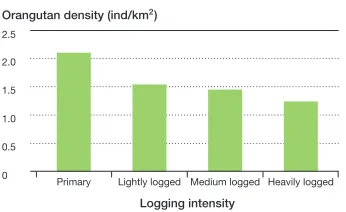
In Borneo and Sumatra, damage from tim-ber harvesting is generally severe, with up to 80% damage to the canopy and potentially large ecological impacts on the apes living in these forests (Husson et al., 2009; Ancrenazet al., 2010; Hardus et al., 2012). Studies on Borneo show that over-harvesting of timber significantly degrades orangutan habitat and results in reduced population densities (Husson et al., 2009; Ancrenaz et al., 2010), and that the higher the intensity of logging, the greater the decrease in orangutan den-sity (see Figure 3.1). Nonetheless, orangutans can survive in logged areas (Felton et al., 2003; Knop, Ward, and Wich, 2004; Husson
et al., 2009) and orangutan densities can be maintained with appropriate management (Marshall et al., 2006; Ancrenaz et al., 2010). In fact, Ancrenaz and colleagues found higher nest densities in logged forests than in nearby primary forests.
A recent large-scale nest survey on Sumatra (S.A. Wich, unpublished data) shows similar results to those from Borneo, with transects in primary forests having a higher mean number of nests per kilometer than transects in forests that have been logged. The effects of logging intensities and dura-tion after logging could not be quantified, but, in several cases, the transects were in concessions where logging had ceased more than 20 years previously, indicating that orangutans are able survive in such areas in the long term (Knop et al., 2004). However, surveys carried out in the late 1990s recorded some transects that had been heavily logged and did not contain any orangutan nests, while adjacent primary forests still contained orangutans (S.A. Wich, unpublished data). It is difficult to be certain, but it appears that after heavy logging Sumatran orangutans disappear from logged areas. Although spec-ulative, observations indicate that some males might move away, but that females remain and would die if food availability decreased to a level that cannot support them anymore (van Schaik, 2004; S. Wich, per-sonal observation, 2013).
Although there is now a reasonable amount of data on changes in orangutan density associated with logging, there are fewer data on behavioral change. Some stud-ies have assessed activity budgets during and after logging. Rao and van Schaik (1997) showed that there were more feeding bouts on leaves in the logged forest than in the primary forest. More time was spent feed-ing on fruits in primary than in logged for-est. Both studies also showed a difference in locomotion styles between logged and unlogged, indicating that in logged forest FiguRE 3.1
Orangutan densities for Borneo under different logging intensities
Based on Husson et al., 2009.
2.5
2.0
1.5
1.0
0.5
0
Orangutan density (ind/km2)
Logging intensity
more energetically expensive styles of loco-motion are used. More recently, a long-term study of the effects of logging on Sumatra orangutan behavior showed that orangutans spend more time travelling and less time resting in logged than in primary forest (Hardus et al., 2012). Such energetically more expensive locomotion in combination with less time spent feeding on fruits could potentially lead to negative energy balances in orangutans living in logged forest, as described for the fruit-scarce periods between mast-fruiting periods in primary forest at Gunung Palung in Borneo (Knott, 1998a). There is some evidence that orangutans are traveling on the ground more frequently in logged forests, thus potentially addressing those energy imbalances (e.g. Loken et al., 2013). However, a follow-up study for all of Borneo indicated that although the degree of forest disturbance and canopy gap size had an influence on terrestriality, orangutans were recorded on the ground as frequently in primary forests as in heavily degraded hab-itats (M. Ancrenaz, unpublished data).
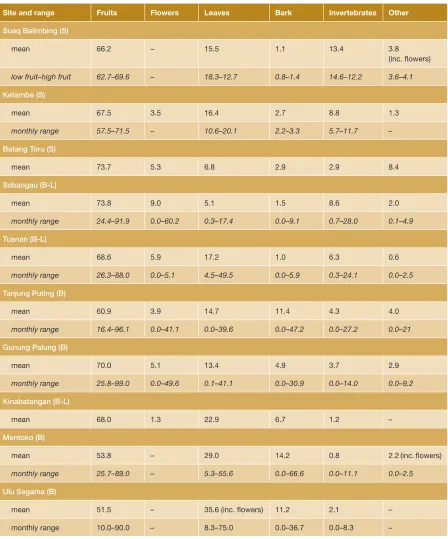
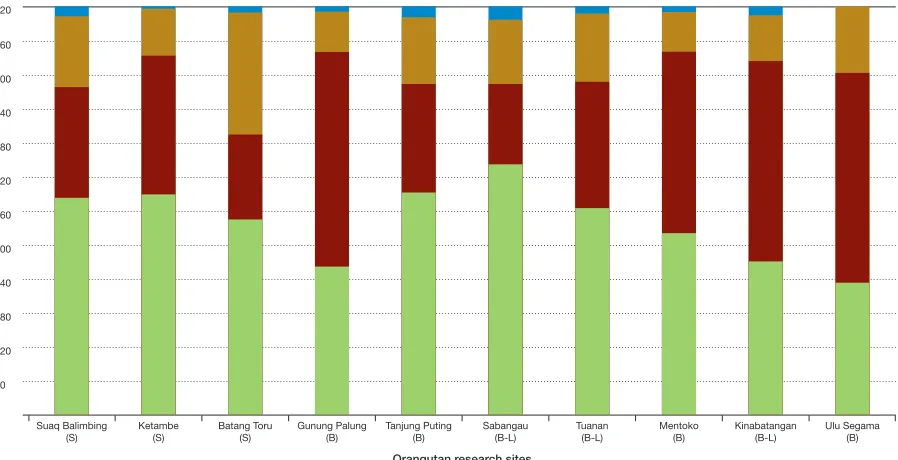
No other studies have been able to make such direct comparisons of behavior in logged and unlogged forest, but an alterna-tive approach is to do a cross-site compari-son and assess whether differences in activity budgets and diet between logged and un -logged sites exist. It appears that activity pat-terns do not show clear differences between logged and unlogged sites (see Figure 3.2); however, this rough comparison does not take into consideration potential age or sex differences, subspecies variation, or whether the sites were in dryland forests, peat swamp areas, or a mixture of the two. Nor does comparing diet across sites reveal clear dif-ferences between logged and unlogged sites (see Table 3.1), but, again, caution should be taken when comparing mean and range data without carefully controlling for the above-mentioned confounding variables. Nonetheless, both activity and diet in these
logged areas seem to be comparable to the patterns seen in orangutans in primary for-ests. It is also worth mentioning that the sites labeled as unlogged in the cross-site com-parison have been logged since those studies took place. Consequently, Ketambe, Suaq Balimbing, Gunung Palung, Mentoko, and Ulu Segama are now sites that have under-gone logging at various intensities and where data were collected when the forest was still primary. Thus, in the coming years we can expect behavioral data to come out of these sites that will allow for pre- and post-logging comparisons.
TAblE 3.1
Orangutan diets in logged and unlogged forests
Site and range Fruits Flowers Leaves Bark Invertebrates Other
Suaq Balimbing (S)
mean 66.2 – 15.5 1.1 13.4 3.8
(inc. flowers)
low fruit–high fruit 62.7–69.6 – 18.3–12.7 0.8–1.4 14.6–12.2 3.6–4.1
Ketambe (S)
mean 67.5 3.5 16.4 2.7 8.8 1.3
monthly range 57.5–71.5 – 10.6–20.1 2.2–3.3 5.7–11.7 –
Batang Toru (S)
mean 73.7 5.3 6.8 2.9 2.9 8.4
Sabangau (B-L)
mean 73.8 9.0 5.1 1.5 8.6 2.0
monthly range 24.4–91.9 0.0–60.2 0.3–17.4 0.0–9.1 0.7–28.0 0.1–4.9
Tuanan (B-L)
mean 68.6 5.9 17.2 1.0 6.3 0.6
monthly range 26.3–88.0 0.0–5.1 4.5–49.5 0.0–5.9 0.3–24.1 0.0–2.5
Tanjung Puting (B)
mean 60.9 3.9 14.7 11.4 4.3 4.0
monthly range 16.4–96.1 0.0–41.1 0.0–39.6 0.0–47.2 0.0–27.2 0.0–21
Gunung Palung (B)
mean 70.0 5.1 13.4 4.9 3.7 2.9
monthly range 25.8–99.0 0.0–49.6 0.1–41.1 0.0–30.9 0.0–14.0 0.0–9.2
Kinabatangan (B-L)
mean 68.0 1.3 22.9 6.7 1.2 –
Mentoko (B)
mean 53.8 – 29.0 14.2 0.8 2.2 (inc. flowers)
monthly range 25.7–89.0 – 5.3–55.6 0.0–66.6 0.0–11.1 0.0–2.5
Ulu Segama (B)
mean 51.5 – 35.6 (inc. flowers) 11.2 2.1 –
monthly range 10.0–90.0 – 8.3–75.0 0.0–36.7 0.0–8.3 –
If forests are allowed to regenerate, the longer-term impacts of unsustainable log-ging can be limited as long as the logged area is adjacent to forest where orangutans still exist. Recolonization can even occur in cases where the logging intensity was at such a level that it led to the complete disappearance of orangutans (e.g. Knop et al., 2004). With time, orangutan populations are able to recover to pre-logging densities if the volume of timber harvested was low and residual forest damage was limited. However, in Southeast Asia, the level of damage that occurs during the logging process is usually significant and, as a result, orangutan densities tend to be much lower.
Overall, the findings of recent studies indicate that conventional logging practices will cause decreases in orangutan density (but see Marshall et al., 2006), although these decreases are likely to become less marked
FiguRE 3.2
Orangutan activity budgets in a 12-hour day Key: Feed Rest Travel Other
S = Sumatra, B = Borneo, L = logged
Based on Morrogh-Bernard et al., 2009; Wich et al., 2012.
720
660
600
540
480
420
360
300
240
180
120
60
0
Minutes
Orangutan research sites
Suaq Balimbing
(S) Ketambe (S) Batang Toru (S) Gunung Palung (B) Tanjung Puting (B) Sabangau (B-L) Tuanan (B-L) Mentoko (B) Kinabatangan (B-L) Ulu Segama (B)
Logging and African apes
Studies of the African apes in logged forests thus far have produced ambiguous results and have failed to identify consistent patterns of impact. Whilst conventional logging has definite negative impacts on ape populations (Morgan and Sanz, 2007), the impacts of selective logging are less clear. Bonobos have not been studied in logging concessions, whereas some gorilla and chimpanzee pop-ulations in logging concessions have been monitored for more than a decade. Some nest-count surveys have indicated that gorillas are relatively unaffected by logging once the ini-tial disturbance has passed (White and Tutin, 2001; Arnhem et al., 2008) and, indeed, longer-term studies have found gorillas occur-ring at fairly high densities in concessions in northern Congo that are considered to be well-managed (Morgan and Sanz, 2006; Stokes et al., 2010). Nonetheless, gorilla den-sities decline in proximity to the roads and human settlements throughout logging con-cessions (Poulsen, Clark, and Bolker, 2011; see also Chapter 6), indicating possible variability in population responses within active or previously logged concessions.For chimpanzees, the picture is less clear; an early investigation in Uganda demon-strated an inverse relationship between log-ging intensity and chimpanzee density, and identified the degree of habitat disturbance as a key factor in determining chimpanzee abundance in post-logged forests (Skorupa, 1988). Subsequent nest-count surveys at various sites found no consistent response: some chimpanzee populations decreased, others increased or showed no change (Plumptre and Reynolds, 1994; Hashimoto, 1995; White and Tutin, 2001; Dupain et al., 2004; Matthews and Matthews, 2004; Arnhem et al., 2008). The accuracy of nest counts can differ, depending on survey inten-sity and ability to assess nest decay rates. However, long-term monitoring of chim-panzees in logged and unlogged habitats in
northern Congo has been able to detect pref-erences for less disturbed forest and sug-gests that chimpanzees are more adapted to mature forest (Stokes et al., 2010; D. Morgan, C. Sanz, S. Strindberg, J. Onononga, C. Eyana-Ayina, and E. Londsorf, personal communi-cation, 2013). Even if they avoid human contact and favor mixed mature forest for nesting, chimpanzees seem to be able to slowly restore a stable population in regenerating forest on logging concessions if hunting pressure is controlled. Over the long term, chimpan-zee densities in forests logged 15 years prior remained low compared to unlogged habi-tat in Congo (Stokes et al., 2010). Similarly, a 28-year study of primates in Uganda has shown that chimpanzees consistently occur at lower densities in logged areas than in un- logged areas (Chapman and Lambert, 2000).
Apes generally move away from opera-tional areas and their forced migration into adjacent home ranges will stress both immi-grant and resident apes. It has been suggested that, in the short term at least, chimpanzees appear to be more negatively impacted than gorillas by the disturbance associated with logging (e.g. Arnhem et al., 2008). A plausible explanation for this is that chimpanzees are territorial and incursions into another chimpanzee community’s home range are generally hostile (Mitani, Watts, and Amsler, 2010). Logging activities will displace resi-dent chimpanzees and may force them to encroach on a neighboring community’s home range, resulting in social upheaval and sometimes in lethal conflict: females might be able to transfer between groups, but males are likely to be attacked and possibly killed. Aggressive intercommunity interactions in association with logging are thought to have reduced chimpanzee densities at Lopé in Gabon (White and Tutin, 2001). Gorillas are not territorial and it has been suggested that they do not have the same constraints on their movements as chimpanzees, and this may help them to resist the impacts of forestry
“
Logging activities will displace resident chimpanzees and may force them to encroach on a neighboring community’s home range, resulting in social upheaval and sometimes in lethal conflict.activities. However, the vulnerability of gorilla group stability should not be over-looked: extreme social disruption leads to higher rates of infanticide in mountain goril-las (Kalpers et al., 2003).
To date, there has been little research on how changes in forest productivity may ultimately affect the demography and den-sity of ape populations. However, rare insights into the impacts of logging on chimpanzee ecology and reproductive fitness come from ongoing studies at Kibale in Uganda, where logging took place in the 1960s, with the inten-sity of timber extraction varying between logging compartments. Female chimpanzees had lower reproductive success with longer interbirth intervals and higher infant mor-tality in areas with outtake rates of 17.0 m3/ha (50.3% of basal area reduction) and 20.9 m3/ha (46.6% basal area reduction) than females residing in less disturbed forests (Emery Thompson et al., 2007). One might conclude that more intensive logging regimes had reduced the food resource base for chimpan-zees. However, more recent research indicates that the explanation may be more complex because the impact of logging on the chim-panzees’ diet was low, even in cases where preferred food items had been exploited (Potts, 2011). In Potts’ study, chimpanzee abundance did not appear to be related to logging history, highlighting the fact that previously logged forests may still retain resource attri butes important for ape sur-vival. However, it is important to consider the difference in spatial and temporal scales of these investigations and that indirect impacts could also be influencing chimpanzee den-sities (see Chapter 7).
The density data compiled in Annex II show that both chimpanzees and gorillas are able to persist in timber production forests, but with varying degrees of success and undetermined prospects for long-term sur-vival. Studies in northern Congo indicate that Forest Stewardship Council (FSC)
cer-tification processes have positively benefitted conservation in the context of timber exploi-tation (Stokes et al., 2010; Morgan et al., 2013); however, it has not yet been determined if and how specific low-impact logging prac-tices are affecting gorillas and chimpanzees. See also the Goualougo Triangle case study and the Wildlife Wood Project (WWP) case study in Chapter 4 (pages 117 and 120).
Logging and gibbons
As with the great apes, the impacts of logging on gibbons are somewhat equivocal. There are doubtless numerous variables which interact to determine how well gibbons are able to persist and recover after logging. These variables include the intensity and extent of logging operations; the incidental damage incurred to habitats during opera-tions; the time since the logging event; the silvicultural techniques used before, during, and after logging; the species of tree targeted for extraction, and the resident population’s reliance on them as keystone species or fall-back resources; the taxon’s dietary flexibility; how marginal the site was for gibbon persist-ence pre-logging; degree of competition with sympatric taxa; and the severity of any additional anthropogenic impacts such as hunting, road access, human influx, and agricultural expansion. It is therefore not surprising that clear themes on the impacts of logging on gibbon persistence are diffi-cult to isolate, especially given the family’s large geographic range.
Within the Hylobatid family, the genus
Hylobates is the best studied in terms of
and Grieser Johns, 1995) found that there were no clear trends in density of gibbons at the site over this period, including no sign that the population had decreased post logging, despite increased mortality dur-ing the loggdur-ing process itself. Conversely, Southwick and Cadigan (1972) found in their study of H. lar thatgroup densities were marginally higher in primary forest (0.43 groups per km2) than disturbed or second-ary forests (0.34 groups per km2) caused by selective logging in the past. Pileated gibbon (Hylobates pileatus) in Thailand have lower densities and tend to avoid selectively logged areas and even areas of undisturbed forest nearby (Brockelman et al., 1977). Gibbon densities in areas which had not been logged since the 1970s were almost three times higher than those logged in the 1990s but still lower than those in pristine conditions, sug-gesting some recovery over long time periods but probably restricted by lower resource abundance (Brockelman and Srikosamatara, 1993; Phoonjampa et al., 2011).
Studies of Müller’s gibbon (Hylobates
muelleri) on Borneo are contradictory. One
study showed no difference in group density between primary forest and low intensity, selectively logged forest (Wilson and Wilson, 1975). A second study showed decreases in group density from 7.3 groups per km2 in primary forest, 5.0 groups per km2 in forest logged three to five years previously, and 2.3 groups per km2 in forest logged one week previously, suggesting populations go through a bottleneck caused by mortality, or possibly migration out of the area, at the time of logging with subsequent recovery still not complete five years later (Wilson and Johns, 1982). Another Bornean gibbon spe-cies, the Bornean white-bearded gibbon (Hylobates albibarbis), living in peat-swamp forest in the Sabangau catchment, Central Kalimantan, Borneo, has been shown to have densities correlated with canopy cover and
tree height and it has been surmised that, at one site, 30 years of logging had negatively impacted gibbon densities (Buckley, Nekaris, and Husson, 2006; Hamard, Cheyne, and Nijman, 2010). Conversely, a study on Kloss’s gibbon (Hylobates klossii), a species endemic to the Mentawai Islands, Indonesia, showed no difference in densities between unlogged forests and those logged 10–12 years and 20–23 years earlier (Paciulli, 2004). Paciulli (2004) surmised that this lack of relation-ship between density and logging may be because tree species targeted by loggers are dipterocarps, which are not used by H. klossii
as a feeding resource (Whitten, 1982), suggest-ing that the resource base was not impacted by the logging regime. However, this hypothesis disregards the likely significant incidental damage caused by the logging process.
Information from the other three genera of the Hylobatidae is generally lacking, being largely comprised of anecdotal observations. For example, the siamang (Symphalangus
syndactylus) reportedly occurs in lower
densities in logged over forests in southern Sumatra (Geissmann, Nijman, and Dallmann, 2006), an observation apparently borne out by lower recorded densities in forest dis-turbed by logging (0.20 groups per km2) compared to undisturbed habitats (0.42 groups per km2) (Southwick and Cadigan, 1972). Qualitative observations suggested that the northern yellow-cheeked gibbon
(Nomascus annamensis) was absent in
sev-eral areas that had been subjected to logging in southern Laos (Duckworth et al., 1995; Evans et al., 1996). However, high hunting pressure may have confounded these assess-ments (Duckworth et al., 1995) as they prob-ably do for all Nomascus species (Duckworth, 2008; Rawson et al., 2011). Large home range size in the eastern black-crested gibbon
(Nomascus nasutus) was anecdotally
Where detected, changes in population density may be driven by a number of fac-tors including direct and indirect mortality, changes in resource abundance and habitat fragmentation. Gibbons, due to their terri-torial and strictly arboreal nature, may be more affected by the immediate impacts of logging regimes than many other wildlife species. Gibbons have been shown to stay in their home ranges during logging activities because of their territoriality, maintaining distance from areas actively being logged by staying in unlogged or already logged areas within their home ranges, and only margin-ally travelling outside the home range to skirt logging activities if necessary (Wilson and Johns, 1982; Johns, 1986b). It is surmised that in instances where gibbons are forced from their home ranges during logging oper-ations, high levels of mortality will result (Johns and Skorupa, 1987), with constant dis-placement by resident gibbon groups, unfa-miliarity with the distribution of resources, and stress all playing a role. Additionally, their arboreal nature coupled with fragmen-tation of home ranges by logging roads and tree falls may also limit their ability to effectively avoid logging operations (Meijaard
et al., 2005) and may also result in increases in fatal falls. These factors may result in the complete loss of groups from areas during the logging process (e.g. Fan Peng-Fei, Jiang Xue-Long, and Tian Chang-Cheng, 2009).
Increases in infant mortality for resident gibbons may also occur during the logging process. Infant mortality in all primates com-monly increases at times of environmental stress and resource shortages (Dittus, 1982; Hamilton, 1985; Gould, Sussman, and Sauther, 1999), and pregnancy and lactation are particularly energetically expensive for female mammals (Clutton-Brock, Albon, and Guiness, 1989; Rogowitz, 1996; Lee, 1998). Displacement and stress caused by logging, plus changes in the abundance and
Photo: Gibbons, due to their territorial and strictly arboreal nature, may be more affected by the immediate impacts of logging regimes than many other wildlife species. © Terry Whittaker distribution of resources within a home
a population of H. lar was 100%. Although the cause of this was not described, it was likely through abandonment and infant mal-nutrition (Meijaard et al., 2005).
Finally, an indirect impact of the logging operation itself on gibbons can be increased levels of hunting (Bennett and Gumal, 2001; see also Chapter 7). It is quite common for logging crews, for example, to be involved in hunting activities during operations and some reports suggest the volumes of bush-meat consumed can be staggeringly large, for example, 29 086 kg, including 445.5 kg of primates, in one year for one logging camp in Sarawak (Bennett and Gumal, 2001). For hunters using guns to take species such as deer and bearded pigs, gibbons can make relatively easy targets, particularly because of gibbons’ proclivity to vocalize loudly in the morning from fixed locations (Bennett and Gumal, 2001). Areas with high hunting pressures may have localized extirpation of gibbon populations (Duckworth, 2008; Rawson et al., 2011), and even low levels of off-take can impact population viability in already small and vulnerable populations (e.g. Waldrop et al., 2011). As such, control of hunting, specifically with guns, during log-ging may be an important determinant of gibbon persistence and recovery.
While it appears clear that increases in mortality occur during the logging process, as described above, the ability of gibbons to adapt to and recover in forests post log-ging is less conclusive. Johns and Skorupa’s (1987) review of the literature relating to impacts of logging on primates showed that a primate species’ degree of frugivory was negatively correlated to persistence in recently logged forests, in contrast to more recent meta-studies (Gogarten et al., 2012). This relationship is especially relevant for gibbons given their large reliance on fruit sources both as primary food sources and fallback resources (Bartlett, 2007). Some commenta-tors have maintained that selective logging
will have little effect on gibbon populations as gibbon diets are relatively flexible so the removal of food trees either deliberately or incidentally will only change relative species utilization in the diet (Chivers, 1972; Wilson and Wilson, 1975). Gibbon responses to this relatively quick change in the availability of food resources, specifically fruit, will likely depend on behavioral and dietary flexibility, including the ability to rely on low quality leafy matter. Gibbons possess simple stom-achs, thus do not have the same ability to digest foliage as the often sympatric colobine monkeys, such as leaf-monkeys or langurs (e.g. Trachypithecus and Presbytis species), which possess specialized stomachs and symbiotic bacteria which break down and aid in digestion of leaf cellulose (Raemaekers, 1978; Chivers and Hladik, 1980; Chivers, 1994; Caton, 1999). As fruits generally have more free sugars available than leafy matter (Raemaekers, 1978; Johns, 1986b) this may in turn impact energy budgets and, potentially, mortality and fertility.
Existing evidence suggests that gibbons are likely to change behavior in response to changes in resource availability brought about by logging events. Gibbons commonly reduce ranging behavior and other activities in times of low resource abundance under natural conditions, for example when fruit is not seasonally available (Chivers, 1974; Raemaekers, 1980; Gittins, 1982; Fan Peng-Fei and Jiang Xue-Long, 2008). In his compar-ison between pre- and post-logged forest, Johns (1986b) found that gibbons responded similarly, with significant reductions in activity levels post logging. These changes in activity patterns in response to changes in resource abundance may be functional, however if there are insufficient resources, this may result in negative energy budgets, resulting in increases in mortality through starvation and associated factors. Lowered energy budgets will have different impacts on different age and sex classes in gibbons.