The Ratio and Product of the Multiplicative Zagreb
Indices
RAMIN KAZEMI
Department of Statistics, Imam Khomeini International University, Qazvin, Iran
ARTICLE INFO ABSTRACT
Article History:
Received 9 May 2016 Accepted 7 June 2016 Published online 20 April 2017 Academic Editor: Sandi Klavžar
The first multiplicative Zagreb index 1(G) is equal to the product of squares of the degree of the vertices and the second multiplicative Zagreb index 2(G) is equal to the product of the products of the degree of pairs of adjacent vertices of the underlying molecular graphs G. Also, the multiplicative sum Zagreb index 3(G) is equal to the product of the sums of the degree of pairs of adjacent vertices of G. In this paper, weintroduce a new version of the multiplicative sum Zagreb index and study the moments of the ratio and product of all indices in a randomly chosen molecular graph with tree structure of order n. Also, a supermartingale is introduced by Doob’s supermartingale inequality.
© 2017 University of Kashan Press. All rights reserved
Keywords:
molecular graph with tree structure multiplicative Zagreb index moment
Doob’s supermartingale inequality
1.
I
NTRODUCTIONMolecular graphs can distinguish between structural isomers, compounds which have the same molecular formula but non-isomorphic graphs- such as isopentane and neopentane. On the other hand, the molecular graph normally does not contain any information about the three-dimensional arrangement of the bonds, and therefore cannot distinguish between conformational isomers (such as cis and trans 2-butene) or stereoisomers (such as D- and L-glyceraldehyde).
In some important cases (topological index calculation etc.) the following classical definition is sufficient: molecular graph is connected undirected graph one-to-one corresponded to structural formula of chemical compound so that vertices of the graph
Corresponding author (Email: [email protected]) DOI: 10.22052/ijmc.2017.53731.1198
correspond to atoms of the molecule and edges of the graph correspond to chemical bonds between these atoms.
In the fields of chemical graph theory, molecular topology, and mathematical chemistry, a topological index also known as a connectivity index is a type of a molecular descriptor that is calculated based on the molecular graph of a chemical compound. Topological indices are numerical parameters of a graph which characterize its topology and are usually graph invariant. Topological indices are used for example in the development of quantitative structure-activity relationships (QSARs) in which the biological activity or other properties of molecules are correlated with their chemical structure. The simplest topological indices do not recognize double bonds and atom types (C, N, O etc.) and ignore hydrogen atoms (“hydrogen suppressed") and defined for connected undirected molecular graphs only. More sophisticated topological indices also take into account the hybridization state of each of the atoms contained in the molecule. Hundreds of indices were introduced. The Hosoya index is the first topological index recognized in chemical graph theory, and it is often referred to as the topological index. Other examples include the Wiener index, Randic’s molecular connectivity index, Balaban’s J index, and the TAU descriptors [12].
Let G be a molecular graph. Two vertices of G, connected by an edge, are said to be adjacent. The number of vertices of G, adjacent to a given vertex v, is the degree of this vertex, and will be denoted by d(v). Gutman [5] introduced the following general form for topological indices:
)), ( ), ( ( =
) ( =
) (
v d u d F G
TI TI
T E uv s
s
where the summation goes over all pairs of adjacent nodes u,v of molecular graph G, and where F =F(x,y) is an appropriately chosen function. In particular,F(x,y) = (xy)−1/2 for Randić index, F(x,y)=xy for the first Zagreb index, F(x,y)=xy for the second Zagreb index, F(x,y)=|xy| for the third Zagreb index, F(x,y)=(xy)(R) for the second variable Zagreb index, F(x,y) = ((x+y−2)(xy)−1)1/2 for the ABC index,
3 1
) 2) (
( = ) ,
(x y xy xy
F , for the augmented Zagreb index, 1
) ( 2 = ) ,
(x y xy x y
F for
the geometric-arithmetic index, F(x,y)=2(xy)1 for the harmonic index and F(x,y) = (x+y)−1/2 for the sum-connectivity index.
Todeschini et al. [15,16] proposed that multiplicative variants of molecular structure descriptors be considered. Thus we have the following general form for topological indices:
)). ( ), ( ( =
) ( =
) (
v d u d F G
TI TI
T E uv p
p
When this idea is applied to Zagreb indices, one arrives at their multiplicative versions )
(
1 G
and 2(G), defined as 2 ) (
1(G)=
vV G(d(v)) and ( )= ( ) ( )
) (
2 G
uvEGd u d v
[3, 4]. Réti and Gutman [14] provided lower and upper bounds for 1 and 2 of a connected graph in terms of the number of vertices, number of edges, and the ordinary, additive Zagreb indices M1 and M2. Let Tn be the set of trees with n vertices. Gutman [6] determined the elements of Tn, extremal w.r.t. 1 and 2. Iranmanesh et al. [7] computed these indices for link and splice of graphs. In continuation, with use these graphs, they computed the first and the second multiplicative Zagreb indices for a class of dendrimers. Liu and Zhang [13] introduced several sharp upper bounds for 1-index in terms of graph parameters including the order, size, radius, Wiener index and eccentric distance sum, and upper bounds for 2-index in terms of graph parameters including the order, size, the first Zagreb index, the first Zagreb coindex and degree distance. Xu and Hua [18] obtained a unified approach to characterize extremal (maximal and minimal) trees, unicyclic graphs and bicyclic graphs with respect to multiplicative Zagreb indices, respectively. Recently, Wang and Wei studied these indices in k-trees [17].
Another multiplicative version of the first Zagreb index is defined as ))
( ) ( ( =
) (
) (
3 G uv EG d u d v
and is named as the multiplicative sum Zagreb index. Eliasi
et al. [2] proved that among all connected graphs with a given number of vertices, the path has minimal 3. They also determined the trees with the second-minimal 3. Kazemi [11] studied 1,2 and 3 in random molecular graphs with tree structure. He gave the lower and upper bounds related to the moments of these indices.
We introduce the modified multiplicative sum Zagreb index, defined as
, )) ( ) ( ( =
)
( ( ) ( )
) ( 4
v d u d
G E uv
v d u d
G
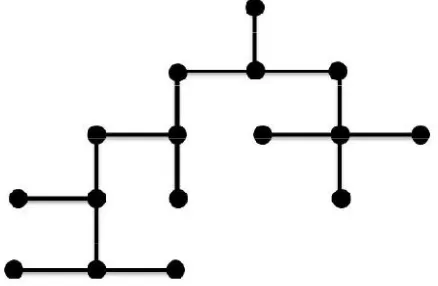
and study it in random molecular graphs with tree structure. An illustrative example is provided in Figure 1.
2.
E
VOLUTIONP
ROCESSThe structures of many molecules such as dendrimers and acyclic molecules are tree like. We present the following evolution process for random trees of order n, which turns out to be appropriate when studying the multiplicative Zagreb indices of molecular graphs with tree structure [10].
Every order-n tree can be obtained uniquely by attaching nth node to one of the
1
trees of order n are considered to appear equally likely. Equivalently one may describe random trees via the following tree evolution process, which generates random trees of arbitrary order n. At step 1 the process starts with a node. At step i the ith node is attached to any previous node v of the already grown tree T of order i1 with probability
pi(v) = 1/(i−1). For applicability of our own results and specially connection with the chemical relevance, see [9].
Figure 1. A molecular graph with 1=6718464, 2 =8707129344, 3 =14400000000 and
51
4 410
.
Let d(v,n) denote the degree of node v in our structure of order n. It is obvious that 1d(v,n)n1. We define Bn to be the sigma-field generated by the first n stages of the random molecular graphs with tree structure. Let Tn be the set of trees with order n. Then by definition of the multiplicative Zagreb indices for k1 and i=1,2,3 [11],
, 1)) , ( ( = ) (
) (
1
k
i k n i
k n i
n U d f T
T
(1)
where U is independent of Bn1. Let {y1,...,yk} be the neighborhood of the vertex U. Also
3. = ,
1) , ( 1) , (
1 1) , ( 1) , (
2 = 1),
1) , ( ( 1)
, (
1 1) , (
1 = ,
1) , (
1 1) , (
= 1)) , ( (
1) , (
1 =
1) , ( 2
i for n
y d n
U d
n y d n
U d
i for n
U d n
U d
n U d
i for n
U d
n U d
n U d f
k k n
U d
k
n U d
i
3 = ,
2 1 3
2 = ,
4
1 = ,
3 2
= 1)) , ( ( min :=
2
i for n
n
i for
i for n
n
n U d f a
k k
k
k
i i
and
3. = ,
1) ( 2 1
2 = ,
2) ( 3 2
1 = ,
4
= 1)) , ( ( max :=
3) (
3) (
i for n
n n
i for n
n n
i for
n U d f d
k n
k
k n
k k
k
i i
Theorem 1 [11] Let E(i(Tn)k)(k1,i=1,2,3) be the kth moment of i(Tn) of a molecular graph T with tree structure of order n n. Then for n5,
.), . ( 4
) ) ( ( 2)
(n 2k E 1 Tn k k(n2) ae
.), . ( , 2) ( ) ) ( (
4k(n2)E 2 Tn k n (n2)k ae
.). . ( , 1) ( 2 ) ) ( ( 1)
( 3 9
2 ( 2)
3 T n ae
n n k k kn
k
n
E
3.
M
AINR
ESULTS3.1 RATIO OF THE MULTIPLICATIVE ZAGREB INDICES
In this section, we obtain lower and upper bounds for the moments of the ratio of the multiplicative Zagreb indices (1,2 and 3).
Theorem 2 Suppose
1,2,3. = , , , ) (
) ( =
) (
,
, i j i j
T T T
k
n j
n i n
k j
i
E
Then
, 3)
( 2 )
(
2) (
2 1,2,
n k
n k
n n
T ,
1) 3)( (
2 2
1 ) (
2) ( 2
2 1 1,3,
n k
k n k
n n
1, ) (
2,1,
k Tn ,
1 4 2 1 ) ( 2) ( 2,3, n k k n k n T , 2 1 4 3 2 ) ( 2) ( 3,1, n k k n k n n T . 2) ( 1) 3( 2 ) ( 2) ( 2 3,2, n k k n k n n T
Proof. It is obvious that for i=1,2,3, i(Tn)k >i(Tn1)k. Then
, , | 1
) ( ) ( = )
( k n
n j k n i n k j i T T T E E B
1 1 | ) ( ) (
> k n
n j k n i T T B E E
1 | 1 ) (
1 )
(
= k n
n j k n i T T E B
E
2 | 1
) (
1 )
( k n
n j k n i
i T T
a E B
E
2 1
2 | ) ( 1 )
( k n
n j k i n
i T T
a E B
E ) ( = , | ) ( 1
= 1 2
2
T b
T b
a k n i i n
j k
i n
i
E E B
, ) ( 1 = 2 k n j k i n
i b T
a E
where = =1 2
1
b
b , =2 3
b . By Jensen’s inequality [1],
, ) ) ( ( 1 ) ( 2 , , k n j k i n i n k j i T b a T E
and proof is completed by Theorem 1.
Corollary 1 Suppose mn(m,nN) and
1,2,3. = , , ) ( ) ( = ) , ( ,
, i j
T T T T k m j n i n m k j
i
E Then , 4 3 2 ) ,
( ( 2)
2) ( 2 1,1,
k m
n k n m k n n T T , 2) ( 4 ) ,
( ( 2)
2) ( 2,2,
k m
, 1) ( 2 1) 3( ) ,
( ( 2)
2) ( 3,3,
k m
n k n m k m n n T T , 2) ( 3 2 ) ,
( ( 2)
2) ( 2 1,2,
k m
n k n m k m n n T T , 1) ( 3 2 2 1 ) ,
( ( 2)
2) ( 2 1,3,
k m
n k k n m k m n n T T , 4 ) , ( 2,1, m n n m
k T T
, 1) ( 2 4 ) ,
( ( 2)
2) ( 2,3,
k km
n k n m k m T T , 4 2 1 3 2 ) ,
( ( 2)
2) ( 3,1,
k m
n k k n m k n n T T . 2) ( 2) ( 1) 3( 2 ) ,
( ( 2)
2) ( 2 3,2,
km
n k k n m k m n n T T
With this approach, we can obtain the sharp lower bounds for different values of k.
Theorem 3 Suppose
1,2,3. = , , , ) ( ) ( = ) ( ,
, i j i j
T T T k n j n i n k j
i
E Then , 4 )
( ( 2)
1,2,
k Tn kn 4 , 2
1 )
( ( 2)
1,3,
k n
k n k T , 2) ( 3 2 )
( ( 2)
2) 3)( ( 2,1,
k n
n n k n k n n n T , 2) ( 3 2 2 1 )
( ( 2)
2) 3)( ( 2,3,
k n
n n k k n k n n n T , 1) ( 2 1 2 )
( ( 2)
2) 3)( ( 3,1,
k n
n n k k n k n n n T . 1) ( 2 1 2 )
( ( 2)
2) 3)( ( 3,2,
k n
n n k k n k n n n T
Proof. We have [11]:
.), . ( , ) ( ) | ) (
( 1 T 1 d 1 1 T 1 ae
k n n
k
n
B E .), . ( , ) ( ) | ) (
( 2 1
2 1
2 T d T ae
k n n
k
n
B E .). . ( , ) ( ) | ) (
( 3 1
3 1
3 T d T ae
k n n
k
n
B
Thus
, , | 1
) (
) ( =
)
( k n
n j
k n i n
k j i
T T T E E B
1 1
| ) (
) (
n k n j
k n i
T T
B
E E
( ) ( ( ) | ) 1
= 1
1
n k n i k n j
T T E B
E
k
n j
k n i
i T
T d
) (
) (
1 1 E
k
n j
k n i
i T
T d
) (
) (
2 1 E
2
2
1 |
) (
) (
= k n
n j
k n i
i T
T
d E E B
( ( ) | )
) (
1
= 1 2
2
n k n i k n j
i T T
d E E B
k
n j
k n i
i T
T d
) (
) (
2 2 2
E
k
j k i n
i T
T d
) (
) (
2 2 2
E
), (
= , , 2
2
T d i jk
n
i
where
k k
k(T2)= 2,3, (T2)=(1/2)
1,3,
,
k k
k(T2)= 3,2, (T2)=2
3,1,
,
1 = ) ( = )
( 2 1,2, 2
2,1,k T k T
.
Now, the proof is completed by inequalities (2).
We can introduce the upper bounds similar to Corollary 1.
Corollary 2 Let i,j,k,l=1,2,3, n,p5 and
. ) (
) ( ) (
) ( =
) , ( , ,
,
p l
p k
n j
n i p
n l k j i
T T T
T T
T E
. ) ( )
( )
, (
1
, , 1
, , ,
, ,
s p s l k r n r j i p n l k j
i T T T T
For example,
s s r
r T T
T T
1
6 3,2, 1
5 1,2, 6
5
1,2,3,2( , ) ( ) ( )
.
4 5
9 16
3.2 MODIFIED MULTIPLICATIVE SUM ZAGREB INDEX For a path Pn,
3 18, 3) 256( = ) (
4
Pn n n
and for a star Sn,
2 1), ( = )
( 1
4
Sn nn n n
Lemma 1 Let
3. 1,2,3,..., =
, , ) (
1) (
2) ( = ) ,..., , (
1) (
1 = 1
1
x y ny x
y x x
y y x
f i
i xy i
i y x i x
i x x
Then
3). 3,..., 3,
( ) ,..., , ( )
(1,1,...,1 f x y1 y f n n n
f x
Proof. It is enough to note that the function f(x,y1,...,yx) is increasing in each yi and x. Let vertex U is uniformly distributed on the vertex set {v1,v2,...,vn1}. Then by definition of the modified multiplicative sum Zagreb index,
1 1) , ( 1
4
4( )= ( )( ( , 1) 2)
Tn Tn d U n dUn
, 1))
, ( 1) , ( (
1) 1) , ( 1) , ( (
1) , ( 1) , (
1) , ( 1) 1) , ( ( 1)
, (
1 =
ni y d n U d i
n i y d n U d i
n U d
i d U n d y n
n y d n
U d
(3)
where U is independent of Bn1 and node yi is the neighborhood of the vertex U .
Theorem 4 Let E(4(Tn)k)(k1) be the kth moment of 4(Tn) of a molecular graph
n
T with tree structure of order n. Then for Tn \{Pn,Sn},
.). . ( , 4)
(2 3) (2 81
) ) ( ( 2
81 2
2 2) (
2 1 1)
( 1
3 = 4
2) (
e a j
j j
T
j k
j j j
k n
j k k n n
k k
E (4)
Proof. It is obvious that 4(Tn1) is Bn1-measurable and the nth vertex is attached to any previous vertex v of the already grown structure Tn1 with probability 1/(n−1) [8,10]. From Lemma 1 and Equation (3),
1) 1,..., = 1), , ( | ) ( ( = ) | ) (
(4 T 1 4 T d vj n j n
k n n
k
n E
1) , ( 1) 1) , ( ( 1) 1) , ( ( 1) , ( 1 = 1 1 = 1 4 1) 1) , ( ( 2) 1) , ( ( 2) 1) , ( ( 1 ) (
nj v kd j n j v d k j n j v d k j n j v d i n j k n n v d n v d n v d n T .) . ( , 2 81 ) ( 1
4 T ae
k k n , 2 81 2 2) ( n k k
since 4(T2)=2. We can obtain the upper bound from Lemma 1 and 4(T3)=81.
Theorem 5 Assume
k i i k i T T ) ( ) ( = 1 4 1 4 ,
4, , for i5 and k1. Then almost everywhere,
. 6) (2 5) (2 1) ( 6) (2 5) (2 1) ( ) ( 2 81 2 3) ( 3 2 2) ( 2 3) ( 3 2 2) ( , 4, 2
k j
j j j k i k i i i k k i k j j j i i i E
Proof. Suppose
k i i k i T T Y
) ( ) ( = 1 4 4 ,
4, for i5. Then E(4,i,k)=E(Y4,i,kY4,i1,k). Now, from
Theorem 4 and the law of the iterated expectation,
)) | ( ( = )
(4,i,k E E Y4,i,kY4,i1,k Bi
E .) . ( )), | ( (
=E Y4,i,kEY4,i1,k Bi ae
) ( 2 81
, 4,ik k Y E )) | ( ( 2 81
= 4,, 1 i k i k Y B E E . 2 81 2k
With this approach, we can obtain the upper bound.
Corollary 3 We have
, 4) (2 3) (2 81 4 ) ( 2 2) ( 2 1 1) ( 1 3 = 2) ( 2,4,
j k j j j k n j k n k n k j j j T , 4) (2 3) (2 81 2 1) 3( 2 ) ( 2 2) ( 2 1 1) ( 1 3 = 2) ( 3,4,
j k j j j k n j k n k k n k j j j n n T , 4 2 81 2 )( ( 2)
2) ( 4,1,
k n
n k k
n
k T ,
2) ( 2 81 2 )
( ( 2)
2) ( 4,2,
k n
n k k n k n T , 1) ( 2 81 )
( ( 2)
2) ( 4,3,
kn
n k n k n T , 2 4 ) ( 2) ( 1,4, k n k n k T , 2) ( 3 2 2 1 )
( ( 2)
3) 2)( ( 2,4,
k n
n n k k n k n n n T , 1) ( 2 1 )
( ( 2)
2) 3)( ( 3,4,
kn
n n k n k n n n T , 6) (2 5) (2 1) ( 2 ) ( 2) ( 2 3) ( 3 2 2 2) ( 4,1, n n k n n n k k n k n n n T , 6) (2 5) (2 1) ( 2 ) ( 2) ( 2 3) ( 3 2 2 2) ( 4,2, n n k n n n k k n k n n n T . 6) (2 5) (2 1) ( ) ( 2) ( 2 3) ( 3 2 2 2) ( 4,3, n n k n n n k n k n n n T since k a 2 81 =
4 , b4 =2,
2 3) ( 3 2 2) (
4 (2 6)
5) (2 1) ( = n k n n n k n n n d .
Also,1,4,k(T2)=2,4,k(T2)=(1/2)k, 4,1,k(T2)=4,2,k(T2)=2k, 3,4,k(T2)=4,3,k(T2)=1.
Theorem 6 Let T be a finite stopping time for
5 4 1 , ) ) ( ( ) ( n n k n k n T T B
E . Then
Also, for 0,
. 1 )
) ( (
) ( sup
4 1
5
n k
k n
n T
T P
E
Proof. We have
) ) ( (
) | ) ( ( = |
) ) ( (
) (
4
1 1
1 4
1
k n
n k n n
k n
k n
T T T
T
E E E
E B B
.) . ( , ) ) ( ( 2 81
) ( 4
1 4
1
1 ae
T T
k n k
k n k
E
.). . ( , ) ) ( (
) (
1 4
1 1
e a T
T
k n
k n
E
Then
5 4
1 ,
) ) ( (
) (
n n k n
k n T T
B
E is a supermartingale. Also, ( ( ) ) >0 ) ( 4 1
k n
k n
T T
E . Proof is completed by Doob’s supermartingale inequality [1].
Theorem 7 Suppose 5m<n. For i=1,2,3,4 and k1,k2 1,
, ) ) ( ) ( (
) ) ( ) ( (
2 1
2 1
i k
m j k m i
k m j k n i
a T
T
T T
E E
where =min ( ( , 1))k1
i
i f d U n
a .
Proof. If m<n, then i(Tm)i(Tn1) and BmBn1. Then
)) | ) ( ) ( ( ( = ) ) ( ) (
( 1 2 1 2
m k m j k n i k
m j k n
i T T T T B
E E
E
= ( ( ) ( ( ) | )) 1 2
m k n i k m
j T T B
E
E
= ( ( ) 2 ( ( ( )1| n 1)| m)) k
n i k
m
j T T B B
E E
E
( ( ) ( ( ) | )) 1 1 2
m k
n i i k
m
j T a T B
E E
( ( ) ( ) ), 2
1 k
m j k
m i
i T T
a E
since by [1, Theorem 5.5.10],
.). . ( ) | ) | ) ( ( ( = ) | ) ( ( = ) | ) | ) ( (
(E i Tn Bm Bn1 E i Tn Bm E E i Tn Bn1 Bm ae
E For example,
. 2 81 2 )) ( ) ( (
1
4 4
m
m
n T
T
Suppose 5m <n and r,s[1,] with 1/r1/s=1. Then for i=1,2,3,4 and k1,k2 1, .)
. ( , )) ) ( ( ( )) ) ( ( ( ) ) ( ) ( (
1 2 1
1 2
1 T T T ae
T k s s
m j r r k
n i k
m j k
n
i
E E
E
This bound is an immediate consequence of Holder’s inequality. Let 4
1 ), ( =
) (
1
=
T
m i Tn mi n
m . Then for r>1,
. )) ( ( ))
( (
1 =
1 r
n i m
i r r n
m T m T
E EFor example, E((1(Tn)3(Tm))2)2(42(n2)(m2)2(m2)).
R
EFERENCES1. R. B. Ash, C. A. Doléans-Dade, Probability and Measure Theory, Second Edition, Academic Press, 2000.
2. M. Eliasi, A. Iranmanesh, and I. Gutman, Multiplicative versions of first Zagreb index, MATCH Commun. Math. Comput. Chem. 68 (2012) 217−230.
3. M. Ghorbani, M. Songhori, Computing Multiplicative Zagreb Indices with respect to Chromatic and Clique Numbers, Iranian J. Math. Chem. 5 (1) (2012) 11−18. 4. M. Ghorbani, N. Azami, Note on multiple Zagreb indices, Iranian J. Math. Chem. 3
(2) (2012) 137−143.
5. I. Gutman, Degree-based topological indices, Croat. Chem. Acta 86 (4) (2013) 351−361.
6. I. Gutman, Multiplicative Zagreb indices of trees, Bull. Internat. Math. Virt. Inst. 1
(2011) 13−19.
7. A. Iranmanesh, M. A. Hosseinzadeh, and I. Gutman, On multiplicative Zagreb indices of graphs, Iranian J. Math. Chem.3(2) (2012), 145−154.
8. R. Kazemi, Probabilistic analysis of the first Zagreb index, Trans. Comb. 2 (2) (2013) 35−40.
9. R. Kazemi, The eccentric connectivity index of bucket recursive trees, Iranian J. Math. Chem. 5 (2) (2014) 77−83.
10.R. Kazemi, The second Zagreb index of molecular graphs with tree structure,
MATCH Commun. Math. Comput. Chem. 72 (2014) 753−760.
11.R. Kazemi, Note on the multiplicative Zagreb indices, Discrete Appl. Math. 198 (1) (2016) 147−154.
12.R. Kazemi, A. Fallah, Analysis on some degree-based topological indices, J. of Sci. Math. Issue 25 (98.2) (2016) 15−24.
14.T. Réti, I. Gutman, Relations between ordinary and multiplicative Zagreb indices,
Bull. Internat. Math. Virt. Inst. 2 (2012) 133−140.
15.R. Todeschini, D. Ballabio, and V. Consonni, Novel molecular descriptors based on functions of new vertex degrees, in: I. Gutman, B. Furtula (Eds.), Novel Molecular Structure Descriptors Theory and Applications I, Univ. Kragujevac, Kragujevac, (2010) 72−100.
16.R. Todeschini, V. Consonni, New local vertex invariants and molecular descriptors based on functions of the vertex degrees, MATCH Commun. Math. Comput. Chem. 64 (2010) 359−372.
17.S. Wang, B. Wei, Multiplicative Zagreb indices of k-trees, Discrete Appl. Math.
180 (2015) 168−175.