Preparing Future Foreign Language Faculty to Teach Online: A Case Study
Edwige Simon
The University of Colorado, Boulder ATLAS Institute, UCB 320 Boulder CO 80309-0320 USA
Abstract
Online learning has become a critical element of the U.S higher educational landscape. Given its growth, it is likely that both current and future faculty will be engaged in some form of online learning at some point in their career. Although teaching online is an increasingly common occurrence for faculty in higher education, the transition from the physical to the virtual classroom is a challenging experience for which many faculty are unprepared. Adequate preparation to teach online is particularly important, as online learning is especially unforgiving of pedagogical shortcomings. This paper describes a case study conducted at the University of Colorado at Boulder, in which five graduate teaching assistants (TAs) enrolled in a graduate course that explored the theory and practice of online foreign language course design were followed. As a capstone project, TAs designed and developed a three-week non-credit online course for their language of expertise, which they taught the following summer. One major finding of this study is the importance of addressing faculty perceptions about online learning when preparing them to teach online and suggests that one way to address perception issues is to provide future faculty with a chance to experience online teaching for themselves in non-threatening conditions.
Keywords: Online learning, teacher training, higher education, teacher perceptions
Online learning has experienced tremendous growth over the past five years and today it is a critical element of the higher educational landscape. During fall 2007, over 20% of higher education students participated in at least one online course, a 12% increase over the previous year and in 2009, one third of U.S higher education faculty had taught online in the past, and one in four was teaching online at the time of the survey (Seaman, 2009).
Given the current economic situation, it is likely that higher education institutions and students alike will continue to take advantage of the many benefits of studying online. From an institutional standpoint, online learning may be an affordable way to increase student enrollment and revenues without having to make corresponding investments in physical infrastructure. In addition, by removing the need for physical presence in the classroom, online learning has the potential to make education accessible to a much larger population, while accommodating the demands of a fast-paced and global society. Students benefit from the flexibility of online and hybrid degree programs as it allows them to integrate their professional and personal lives, while remaining competitive in rapidly evolving professional landscapes. Given the growth of online learning, it is likely that both current and future faculty will be engaged in some form of online learning at some point in their career.
Although teaching online is an increasingly common occurrence for higher education faculty, the transition from the physical to the virtual classroom is a challenging experience for which many faculty are largely unprepared (Seaman, 2009; Moore, 2006; Gunawardena, 2004).
This paper describes a case study involving five foreign language teachers and their experiences preparing to teach online. Using this case study as a backdrop, one possible model of preparing teachers to teach online is explored.
Literature Review
overcome anxieties about technology and might improve teacher attitudes” (Gunawardena, 2004, p. 377). Most higher education institutions offering online courses provide some form of training and faculty support to their faculty, usually in the form of “mentoring and training options” (Allen & Seaman, 2009, p. 3). The report focused on faculty voices published by Sloan C the same year further revealed that the support structures offered failed to adequately meet the needs of online teachers who on an average rated the latter “below average” (Seaman, 2009). This shortfall is not especially surprising given that teacher education in the US largely targets K-12 education and that higher education faculty generally receive very little pedagogical training (Laurillard, 2002). Pedagogy itself often represents a negligible fraction of graduate program requirements, which emphasize the acquisition of discipline specific knowledge. This state of affairs occurs within a higher education system that tends to favor and reward scholarship and research over teaching. However, adequate preparation to teach online is particularly important, as faculty cannot be expected to improvise the significant pedagogical adjustments necessary to transition successfully to the virtual classroom. Unfortunately, empirical research on the outcomes of such efforts is particularly scarce (Moore, 2006).
Methodology
The case study was conducted at the University of Colorado at Boulder and followed five graduate teaching assistants (TAs) enrolled in a graduate course that explored the theory and practice of online foreign language course design. The course was designed and taught by the author. As a capstone project, TAs designed and developed a three-week non-credit online course for their language of expertise, which four of them taught the following summer. One summer course was canceled for personal reasons at the request of the instructor.
In the context of the class, the TAs were responsible for exploring ways to effectively teach languages online, and were offered an opportunity to test their ability to design a course and teach online by developing and teaching a component of an online course. The readings exposed them to the repertoire of online learning, which they quickly acquired and began to use routinely as the semester progressed. Selection Criteria
Potential candidates were recruited through e-mail and recommendations from teaching assistant coordinators. To participate in the case study, the TAs had to be foreign language graduate students near completion of their degree and have a minimum of four years of classroom experience. They also needed to have consistently received high faculty course evaluation ratings. There were no required technical skills. This decision was deliberate as one goal of this case study was to investigate whether it was possible to teach teachers the technology skills necessary to build an online course in one semester. This is the reason why a significant portion of the course was devoted to hands-on technology workshops.
Course Structure
The first three weeks of the course met entirely online. The five TAs were required to record their personal impressions with online learning in a journal. Face-to-face meetings began on the fourth week of the fifteen-week semester. The class met once a week for two and half hours in a computer lab. The first half of the class was devoted to hands-on technology workshops, which exposed the TAs to a variety of tools designed to develop their educational technology skills. The second half of the class was devoted to reading discussions and student presentations. The readings drew from the small but growing body of scholarly research in online foreign language instruction and the larger body of research of online learning in general. In addition to these scholarly readings, the TAs were introduced to the important journals and conferences in the field on computer assisted language learning and online learning. All students submitted a paper about the class project to the 2009 MERLOT conference (the paper was accepted) and engaged in a chat session with a professional in the field of online foreign language instruction. As a capstone project for the class, they were required to design and develop the first week of a three-week online refresher course, and provide a detailed outline of the remaining two weeks. They were offered the option to develop the remaining two weeks over the months of May and June and teach their course in July. A small teaching stipend was provided by the tuition fee that undergraduate students paid to take the online refresher course.
course and a 30-minute in-class presentation on the progress they were making on the 10th week of the semester.
Participants
TA for Spanish: Mary-Ann (pseudonym) is an American doctoral student in Spanish and Portuguese who is working on her dissertation on twentieth century Spanish literature. She is an experienced language teacher who appears passionate about teaching and about technology integration in the classroom. At the time of the course, she was considering making instructional technology her research specialty in lieu of Spanish literature.
TA for French: Sophie (pseudonym) is an American doctoral student in French currently working on her dissertation in nineteenth century French literature. She is also an experienced and enthusiastic teacher, but reports having little attraction to technology and a lack of computer skills. She entered the class feeling skeptical about the usefulness of technology in the classroom but reportedly decided to participate in the project to get a more informed perspective on the subject.
TA for German: Paula (pseudonym) is a German doctoral student in the Comparative Literature department; she is writing her dissertation on the relationship between immigration and art in Germany. She is teaching German courses in the Germanic and Slavic Languages and Literatures department. She entered the course with a pragmatic attitude towards instructional technology, reporting being interested in learning more about the subject.
TA for Japanese: Yuko (pseudonym) is a Japanese student in the Japanese Master’s program. She is a teaching assistant in the Japanese department. She is the only student in the group to have ever taken an online course. She is writing a thesis exploring the connection between visual appeal of learning material and learning outcomes.
TA for Chinese: Rose (pseudonym) is a Chinese student in Linguistics writing her dissertation on patterns of repairs in the Chinese language. She entered the course with a positive attitude towards technology, expressing curiosity about the ways foreign languages may be taught online.
The following sections report findings from this case study. Tables 1 to 5 report findings from the online survey that participants filled out during the first and last week of class. The author chose to use a semi-structured interview instead of administering the same survey a third time to collect information from the TAs after they taught their class in order to give them an opportunity to discuss their experiences at length. Findings from these interviews are incorporated in each section.
Data Collection
This paper reports findings from the initial and final survey completed by all five TAs, a one-on-one interview conducted at the end of the case study with the TAs who taught their courses, the graduate course evaluations and the refresher course evaluations. The survey and its findings, as well as the questions from the final interview, can be found in Appendices A, B and C.
Findings
Findings show that, as a result of their participation in this extensive course project, all five TAs felt more prepared to teach online and more aware of the strength and challenges associated with online course design and online teaching. The course helped address their at times negative perceptions vis-à-vis online learning and instructional technology. However, they generally commented on the fact that a three-week non-credit online teaching experience was not enough for them to feel entirely confident about this teaching modality.
Overall Feeling of Preparedness
Table 1: TAs Overall Feeling of Preparedness Before and After the Course
I feel prepared to teach online:
First week of course Last week of course
Strongly agree 0 0
Agree 0 4
Disagree 2 0
Strongly disagree 1 0
Don’t know 2 1
When first asked whether they felt prepared to teach online, three disagreed or strongly disagreed and two didn’t know. When asked the same question again at the end of the course, four reported feeling prepared to teach online and one still didn’t know. In the comment section of this online survey however, four of them expressed reservations, which reveals that although they felt more prepared than before the course, they needed the validation of a successful online teaching experience to be certain.
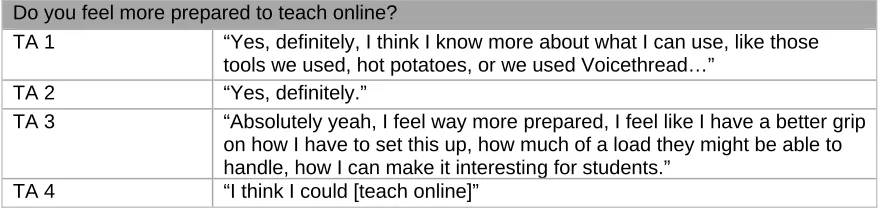
The four TAs who had a chance to teach at least part of their online course were asked the same question after teaching their course during a final interview. Three out of four provided a definitive affirmative answer as to whether they felt prepared and one remained hesitant, as shown in Table 2.
Table 2: TAs’ Comments on their Feeling of Preparedness After the Course
Do you feel more prepared to teach online?
TA 1 “Yes, definitely, I think I know more about what I can use, like those tools we used, hot potatoes, or we used Voicethread…”
TA 2 “Yes, definitely.”
TA 3 “Absolutely yeah, I feel way more prepared, I feel like I have a better grip on how I have to set this up, how much of a load they might be able to handle, how I can make it interesting for students.”
TA 4 “I think I could [teach online]”
Through their participation in the course, the TAs gained confidence in their online course design and online teaching ability.
Attitudes Towards Online Learning
One of the most persistent challenges that faculty need to overcome before agreeing to teach online is the still wide-spread perception, both inside and outside of academic circles, that online learning is a less worthy form of education.
The 2009 Sloan-C survey focused on the faculty side of the online experience and reported that 80% of the faculty with no online teaching or online course design experience believed that the outcomes of online learning were inferior to those of face-to-face courses (Seaman, 2009). However, the majority of faculty with experience in online teaching and course design believed that the outcomes were either equivalent or better (Seaman, 2009). Despite evidence that carefully designed online courses yield excellent learning outcomes (U.S Department of Education, 2009), the stigma attached to this modality remains a major hurdle to overcome for those who never have taught online. One goal of this study was to investigate and address future foreign language facultys’ attitudes about online learning. Therefore, in the online survey, the TAs were asked whether they had any reservations about online foreign language learning. The results are shown in Table 3.
Table 3: TAs Reservations about Online Teaching Before and After the Course
I have reservations about foreign language instruction online:
First week of course Last week of course
Strongly agree 1 0
Agree 4 3
Disagree 0 2
Strongly disagree 0 0
Don’t know 0 0
When asked the question again at the end of the course, three still agreed that they had reservations and two disagreed. In the comment section, one of the TAs who reported not having reservations about online learning nonetheless expressed doubts about fully online courses (as opposed to blended ones). Another TA explained her reservations by pointing to the lack of spontaneity that characterizes student-teacher interactions in online courses.
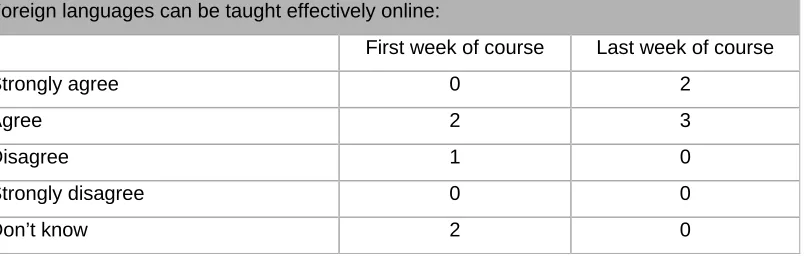
In order to further probe into TAs’ perception of online foreign language instruction, they were asked whether they thought foreign languages could be taught effectively online:
Table 4: TAs Opinion on Online Courses as a Modality
Foreign languages can be taught effectively online:
First week of course Last week of course
Strongly agree 0 2
Agree 2 3
Disagree 1 0
Strongly disagree 0 0
Don’t know 2 0
When asked the question at the beginning of the course, two TAs agreed, one disagreed and one didn’t know. In the comment section, one TA expressed reservations about beginner level courses, and another one had concerns about the ability of an online course “to prepare students for real-time interactions with other people.”
When asked the same question again at the end of the course, all five TAs either strongly agreed or agreed that foreign languages could be taught effectively online but maintained some reservations about first year courses and oral proficiency and emphasized the importance for teachers to possess strong pedagogical training. Interestingly, the TAs were able to express their reservations in much more specific terms after participating in this project. One goal of this case study was to prepare future faculty to make well-informed decisions pertaining to the adoption of online courses and their integration in the traditional curriculum. These findings seem to confirm that the course helped them refine their opinion about online learning, therefore allowing them to make knowledgeable decisions when necessary.
When asked whether foreign languages could be taught as effectively online as they are in the classroom, the TAs provided the answers shown in Table 5.
When asked the question again at the end of the course, all five either agreed or strongly agreed that foreign languages could be taught as effectively online as they are in the classroom. In the comment section, one TA emphasized careful design as a condition for effective online courses and another noted that she wanted to see for herself and teach her course before making up her mind.
Table 5: TAs’ Perception of Online versus Face to Face
Foreign languages can be taught as effectively online as they are in the classroom: First week of course Last week of course
Strongly agree 0 1
Agree 1 4
Disagree 2 0
Strongly disagree 0 0
Don’t know 2 0
Because face-to-face interaction is a major element of classroom-based foreign language instruction, TAs were asked whether they thought face-to-face interaction was necessary for learning to occur:
Table 6: TAs’ Opinion on the Importance of Face-to-Face Contact
Face-to-face interaction is necessary for learning to occur:
First week of course Last week of course
Strongly agree 1 0
Agree 1 1
Disagree 2 3
Strongly disagree 1 1
Don’t know 0 0
When first asked the question, two strongly agreed or agreed, one disagreed and one didn’t know. When asked the question again at the end of the course, four either disagreed or strongly disagreed and one agreed. Several students noted the importance of providing opportunities for real-time interactions but noted that these interactions didn’t have to be face-to-face and that they could be technology-mediated. This represents an important shift in the participants’ attitude towards online learning. The course helped them realize that distance-learning courses were not necessarily deprived of rich interactions. The course introduced them to a large number of communication tools and helped them realized that technology could mediate such exchanges.
Impact of Course on Participants’ Attitude Towards Technology and Classroom Teaching
Limitations and Recommendations
Although all five TAs reported feeling more prepared to teach online as a result of their participation in the course, a three weeks’ experience is not likely enough for them to be fully prepared to face the many challenges of online course design and online teaching. The TAs were looking forward to reading their students courses evaluations, hoping to get feedback on the course they had designed and taught, however, only four undergraduate students (out of the nineteen who enrolled in the courses) filled out the end of course faculty course questionnaires, despite many reminders and incentive to do so. Since the course was non-credit and students did not receive any grades, the teachers had very little leverage to encourage students to fill out the evaluation forms. This limited the amount of feedback they received on their work.
When the author next teaches the course used to inform these results, she will make the following modifications and additions to its structure:
Usability Testing
Each teacher will be given a chance to test portions of their online course with students in order to conduct usability tests that evaluate the level of difficulty of the instructional material developed, as well as the workload. Several students dropped out of the refresher courses at the end of the second week. While the limited number of faculty course evaluations makes it challenging to find out why, the author suspects that the workload was overall too demanding for a non-credit summer review course.
Evaluation Plan
Receiving feedback from students on the course they designed and taught is an integral part of both the teacher training experience and the instructional design process. In the future, the author will provide additional incentive for students to fill out course evaluation forms, and will organize a focus group between teacher and students upon completion of the online course.
Conclusion
One major finding of this study is the importance of addressing faculty perceptions about online learning when preparing them to teach online. Since 80% of faculty who never taught online have reservations about doing so, and since the majority of those who have taught online before are more confident about doing so in the future (Seaman, 2009), one obvious yet rarely employed way to address perception issues is to provide future faculty with a chance to experience online teaching for themselves in a scaffolded and non-threatening environment, as was done here. Our approach offers a safe and authentic chance to learn about online course design and teaching, and to develop relevant technology skills. By integrating practical experience with theoretical knowledge, this approach suggests how future faculty may adjust their negative perceptions and confront their real concerns regarding online education. A significant amount of class time was devoted to discussion during which the TAs were prompted to expose their doubts and reservations about online learning and speak about them openly with the group. Being able to discuss their perceptions with colleagues and confront such perceptions against scholarly research gave them an opportunity not only to form a better informed understanding of online learning for themselves but also gave them tools that will allow them to lead educated discussions on this topic with the academic community at large. As mentioned before, given the tremendous growth experienced by online learning, future foreign language faculty will most likely be asked to discuss the possibility of offering online courses, be asked to design such courses and teach them. It is crucial that they be given the tools and skills necessary to contribute significantly to these discussions and efforts so that the decisions made and the paths taken do not compromise but rather enhance the education delivered though this modality.
References
Garrisson, D., Anderson, T., & Archer, W. (2000). Critical inquiry in a text-based environment: Computer conferencing in higher education. The Internet and Higher Education, 2(2-3), 87-105.
Gunawardena, C., & McIsaac, M. (2004). Distance education. Handbook of Research on Educational Communications and Technology (pp. 355-395). Mahwah: Lawrence Erlbaum Associates. Laurillard, D. (2001). Rethinking university teaching (2nd ed.). New York: Routledge.
Seaman, J. (2009). Online Learning as a Strategic Asset. Volume II: The Paradox of Faculty Voices: Views and Experiences with Online Learning. Needham, MA: Sloan Center for Online Education. U.S Department of Education, (2009). Evidence-based practices in online learning: A meta-analysis and
review of online learning studies.
APPENDIX A: Table of findings
Foreign languages can be taught effectively online:
First week of course Last week of course
Strongly agree 2
Agree 2 3
Disagree 1
Strongly disagree
Don’t know 2
Foreign languages can be taught as effectively online as they are in the classroom:
First week of course Last week of course
Strongly agree 1
Agree 1 4
Disagree 2
Strongly disagree
Don’t know 2
Face-to-face interaction is necessary for learning to occur:
First week of course Last week of course
Strongly agree 1
Agree 1 1
Disagree 2 3
Strongly disagree 1 1
Don’t know
I will be asked to teach online at some point in my career:
First week of course Last week of course
Strongly agree 2 2
Agree 1 2
Disagree 1 1
Strongly disagree
I feel prepared to teach online:
First week of course Last week of course
Strongly agree
Agree 4
Disagree 2
Strongly disagree 1
Don’t know 2 1
I have reservations about foreign language instruction online:
First week of course Last week of course
Strongly agree 1
Agree 4 3
Disagree 2
Strongly disagree
Don’t know
Teaching online represents more work than traditional teaching:
First week of course Last week of course
Strongly agree
Agree 1 2
Disagree 1 1
Strongly disagree 1 1
Don’t know 2 1
Designing an online course represents more work than traditional teaching:
First week of course Last week of course
Strongly agree 1
Agree 1 4
Disagree
Strongly disagree 1 1
Don’t know 2
APPENDIX B: Before /after survey
Hi everybody:
Here is the questionnaire I told you about. As you can see, it is not anonymous because it is meant to record any changes about the way you think about online learning. I will ask you to fill out this survey again at the end of the semester. I will then compare your answer and see if there are any changes. There is room for you to comment on your answers to each question. Feel free to use this space to expand on your answers. Please be as honest and open as possible. The goal of this course as you know is not to glorify or vilify online learning but to learn as much as possible about it and try it for ourselves. There is no right or wrong answer to these questions. Thank you so much!
Foreign languages can be taught effectively online: Strongly agree
Agree Disagree
Strongly disagree I don't know
Foreign languages can be taught as effectively online as they are in the classroom: Strongly agree
Agree Disagree
Strongly disagree I don't know
Face-to-face interaction is necessary for learning to occur: Strongly agree
Agree Disagree
Strongly disagree I don't know
I will be asked to teach online at some point in my career: Strongly agree
Agree Disagree
Strongly disagree I don't know
I feel prepared to teach online: Strongly agree
Agree Disagree
Strongly disagree I don't know
I have reservations about foreign language instruction online: Strongly agree
Agree Disagree
Strongly disagree I don't know
Teaching online represents more work than traditional teaching: Strongly agree
Agree Disagree
Strongly disagree I don't know
Designing an online course represents more work than designing a traditional course: Strongly agree
Strongly disagree I don't know
How does online learning compare to classroom learning?
What do you see as obstacles to effective foreign language instruction online? If asked to design an online course, how would you go about it?
APPENDIX C: Final Instructor Interview (Semi-structured)
1. Tell me about your course, how did it go? 2. Did your course go as expected?
3. Did you enjoy teaching your course? Why/why not?
4. Were you surprised by any aspects of this online teaching experience? 5. Did you encounter any problems or technical difficulties during the course? 6. Were you satisfied with the quality of the interaction with your students?
7. How does the online teaching experience compare with in classroom teaching, both from a teacher and from a student standpoint?
8. If you were to teach the same course again, what would you change? 9. Do you feel prepared to teach online in the future?
10. Would you like to teach online in the future?
11. Do you think online courses have a place in the FL curriculum? 12. How did you like Ning as a course management system?
13. What were the shortcoming/strengths of Ning as a teaching tool?
14. If you could make suggestions to the designers of Ning, what would tell them? 15. Has this course changed you as a teacher in any way?
16. Has this course changed your take on technology? 17. Has this course changed your take on online learning?
Manuscript received 16 Jan 2011; revision received 5 Jun 2011.
This work is published under a Creative Commons Attribution-Non-Commercial-Share-Alike License