Liu Estimates and Influence Analysis in Regression
Models with Stochastic Linear Restrictions and AR (1)
Errors
H. Mohammadi and A. R. Rasekh
*Department of Statistics, Faculty of Mathematical Sciences and Computer, Shahid Chamran University of Ahvaz, Ahvaz, Islamic Republic of Iran
Received: 17 February 2019 / Revised: 27 April 2019 / Accepted: 26 May 2019
Abstract
In the linear regression models with AR (1) error structure when collinearity exists,
stochastic linear restrictions or modifications of biased estimators (including Liu
estimators) can be used to reduce the estimated variance of the regression coefficients
estimates. In this paper, the combination of the biased Liu estimator and stochastic
linear restrictions estimator is considered to overcome the effect of collinearity on the
estimated coefficients. In addition, the deletion formulas for the detection of influential
observations are presented for the proposed estimator. Finally, a simulation study and
numerical example have been conducted to show the superiority of the proposed
procedures.
Keywords: Liu estimator; Linear stochastic restrictions; Collinearity; Autocorrelated error; Influence analysis.
* Corresponding author: Tel: +986133331043; Fax: +986133331043; Email: [email protected]
Introduction
The problem of collinearity in regression models refers to the situation where the explanatory variables have the near-linear dependency. By considering independent and identically distributed errors (homoscedasticity), it is well known that the ordinary least squares estimators (OLSE) are unbiased and have minimum variance in the class of linear unbiased estimators. However, in the presence of collinearity, they are no more reliable estimators, [1,2]. Collinearity causes the variance of the estimates to be large, and so the estimates of parameters will be unstable. To overcome this problem, one way is to make use of prior knowledge of observations and to deal with this information as linear stochastic restrictions. In such a case, the mixed estimators proposed by Theil and
Goldberger [3] and Theil [4] can be used, which is gained by unifying the sample and the prior information.
The other remedy to combat the collinearity problem is to use biased estimators such as the popular ridge estimator [5]. In 1993, Liu [6] introduced a new biased estimator called the Liu estimator by combining the Stein estimator [7] and the ridge estimator and showed that it can be superior over each of them in the MSEM sense. He also pointed out that it is easier to choose the Liu biasing parameter than to choose that of the ridge estimator since the Liu estimator is a linear function of its biasing parameter, but the ridge estimator is a complicated function of it.
assumption of homoscedasticity by combining the mixed estimator and the ridge estimator. Also, Hubert and Wijekoon [9] introduced the stochastic restricted Liu estimator under the same assumption and Yang and Xu [10] introduced another stochastic restricted Liu estimator by combining them in an alternative way.
In practice, the assumption of independent and identically distributed errors (homoscedasticity) does not always hold. Sometimes the data are collected over time and so cause the errors to be correlated. A commonly occurring case is when the errors follow a 1st
order autoregressive process (AR(1)). In such cases fitting an inappropriate model can have deleterious effects. A classic example can be found in Box and Newbold [11] who commented on a paper by Coen et al. [12]. The latter seemingly showed that car sales seven quarters earlier could be used to predict stock prices. But they failed to examine residuals and there was strong evidence that the errors were correlated. After fitting an appropriate model, Box and Newbold showed that there was no significant relationship between the two variable [13]. In fact, in practical applications, the neglect of such correlation in the errors may lead to inefficient parameter estimates and misleading inferences from hypothesis tests and inefficient predictions. The reason is that the OLSEs fail to achieve minimum variance estimates and the usual estimator of the variance-covariance matrix will be biased (see Griffith et al. [14]). To overcome these effects of autocorrelation, Aitken [15] proposed the generalized least squares estimator (GLSE). However, the presence of collinearity in the regression models with AR(1) error, will also result in unreliable GLS estimates, because of the large total variance. So these two problems should be examined simultaneously in order to achieve an appropriate estimation procedure for regression coefficients. The interested reader may refer to [16-20] for more details.
On the other hand, all the observations do not have the same impact on the estimated regression coefficients or on the resulting fitted values, therefore after fitting a regression model and using an estimation procedure to understand the relationship between variables, it is important to detect influential observations and (or) outliers in the framework of influence analysis. There are different statistical measures to detect these potentially influential observations, some of which are based on deleting cases. For example, the influence function for ith observation can be obtained as differences between the parameter estimated with and without the ith observation. The limitation of this approach is that it cannot be easily generalized to the linear regression model with 1st order autoregressive
errors, in which the dependency structure of the autoregressive model will not be valid after deleting a single observation from the data except for the last observation. But here with suitable modification as in Roy and Guria [21], we have kept intact the inherent autocorrelation structure. Detecting outliers is another problem, which has been extensively studied in the influence analysis of linear regression models, [1,2,22]. The method of mean-shift outlier model is one of the most important approaches for detecting discordant outliers in the regression analysis. Since the existence of outliers and influential observations are complicated by the presence of collinearity, it seems reasonable that after reducing the effects of collinearity by an appropriate estimator, the methods of influence analysis adequately be modified. Ullah et al. [23] and Jahufer [24] used the procedure of case deletion and derived influence measures for the Liu estimator in regression models with independent and identically distributed errors and without stochastic restrictions on parameters. Ullah et al. [23] also investigated the mean shift outlier model for the above-mentioned Liu regression. Zaherzadeh et al. [20] extended the method of mean-shift outlier model for detecting outliers in case of the ridge regression model with stochastic linear restrictions when the errors follow the AR(1) process. They also derived extensions of measures for diagnosing influential observations based on case deletion methods.
In the present paper, we have considered an estimator, which is a combination of the Liu estimator, and the mixed estimator in regression models with stochastic linear restrictions, in the case of correlated errors and especially when they are 1st order
autoregressive. Also, a method has been given for choosing the Liu biasing parameter. Furthermore, some diagnostic measures are studied to identify influential observations or outliers that may be involved in the data modeled by the proposed method of estimation. In the preliminary section, the proposed model is introduced and the estimators are derived. In the results section, the case deletion diagnostics DFBETAS and DFFITS, are developed for the detection of influential observations. Furthermore, an outlier detection procedure based on the mean-shift outlier model is presented. Finally, an example to illustrate our results and a simulation study to show the performance of the achievements are given.
Preliminaries
Consider the following linear regression model
observations on the explanatory variables,
β
is ap
×
1
vector of unknown regression coefficients and
ε
is an1
n
×
vector of error terms. Also, we assume that( )
0
E
ε
=
and( )
2var
ε
=σ
V , in whichV
is ann n
×
known p.d. matrix which can be decomposed asV
=
TT
′
; whereT
is a nonsingular matrix. Under these assumptions, by pre-multiplying the linearregression equation (1) with
T
−1, we would have the following transformed model:* * *
y
=
X
β ε
+
(2) wherey
*=
T y
−1 ,X
*=
T X
−1 andε
*=
T
−1ε
. Therefore, the generalized least squares (GLS) estimateof
β
is(
)
1
1 1
X V
X
X V Y
β
=
′
− −′
−.
When the collinearity problem is presented, the matrix
X V
′
−1X
will be near singular. In such a case, the generalization of the Liu estimator can be used to reduce the effect of collinearity on the parameters estimates [18]. The biased generalized Liu estimatord
β
is expressed as:d
F
dβ
=
β
(3)where
F
d=
(
X V X
′
−1+
I
) (
−1X V X
′
−1+
dI
)
,0
< <
d
1
is the Liu biasing parameter, andβ
is the (GLS) estimator ofβ
. In addition, we have( )
(
)
12 1
d d d
var
β
=
σ
F X V X
′
− −F
′
. Alsoβ
d can be considered as the GLS estimator in the augmentedmodel
p
X
y
I
d
ε
β
ε
=
+
withn
(= +
n
p
)observations, where
ε
satisfies the conditions in the model (1) and whereε
is considered to be a random vector of errors such thatE
( )
ε
=
0
and2
var( )
ε
=
σ
I
p.Besides using biased estimators, one can use the mixed estimators to overcome the collinearity problem, when there is some prior knowledge of the data in the form of linear stochastic restrictions. Suppose that historical observations related to the linear regression model (1) are available, which can be written as linear stochastic restrictions of the following form:
r
=
R
β φ
+
(4) wherer
is a knownm
×
1
random vector,R
is a knownm p
×
matrix of prior information ofrank (
m
≤
p
)
andφ
is a random vector independent ofε
withE
( )
φ
=
0
andvar
( )
φ
=
σ
2W
, whereW
is an
m m
×
known p.d. matrix.By combining the linear regression model (1) with the restrictions (4), we would have the augmented
model, y X
r R
ε
β
φ
= +
or
y
=
X
β ε
+
(5)where
E
( )
ε
=
0
,var
( )
ε
=
σ
2W
and0
0
V
W
W
=
is a p.d. matrix. The generalized mixedleast squares estimator of
β
in (5) is:(
)
(
) (
)
1
1 1
1
1 1 1 1
.
m X W X X W y
X V X R W R X V y R W r
β − − −
−
− − − −
′
′ ′
=
′ ′
= + ′ +
(6)
The mixed estimator
β
m is unbiased and( )
2m
var
β
=
σ
A
(7)where
A
=
(
X V X
′
−1+
R W R
′
−1)
−1.Hubert and Wijekoon [9] improved the Liu estimator in the ordinary linear regression model by considering simultaneously the two approaches followed in
obtaining the mixed estimator
β
m withV
=
I
and the Liu estimator and proposed a new biased estimator ofβ
called stochastic restricted Liu estimator. We consider such an estimator in the case of unequal variance and (or) correlated errors and combine the Liuestimator
β
d and the mixed estimatorβ
m. Bysubstituting
β
in equation (3) withβ
m, we havesrd
F
d mβ
=
β
(8)
Since the mixed estimator
β
m can be written as1 1 1
(
) (
)
m
S R W
RS R
r
R
β
= +
β
−′
+
−′
−−
β
it will be
easily seen that
β
srd can also be considered as the GLS estimator in the following augmented model withn
(n
p
= +
) observations:d p
m
X
y
I
d
Sg
ε
β
β
ε
=
+
+
(9)where 1
1 1 1
)
(
)
(
g
=
S R W
−′
+
RS R
−′
−r
−
R
β
, andε
satisfies the conditionsE
( )
ε
=
0
and( )
2var
ε
=
σ
V
, andε
d is considered to be a random vector of errors independent ofε
such thatE
( )
ε
d=
0
and( )
d 2 pvar
ε
=
σ
I
. We refer to the augmentedregression model (9) as stochastic restricted Liu regression under unequal-variance or correlated errors.
The expectation and variance of
β
srd, are obtainedby the unbiasedness of
β
m and its variance in (7), as( )
( )
2,
srd d srd d d
E
β
=
F
β
var
β
=
σ
F AF
′
(10)The conditions for the superiority of
β
srd overβ
dand
β
m can be obtained by a simple modification of the proofs given in Hubert and Wijekoon [9] which are for the case ofV
=
I
.In what follows, we consider a special structure of V, in which the data are collected over time and the error terms follow a 1st order autoregressive process (AR (1)),
that is
1
i i
u
iε ρε
=
−+
whereE u
( )
i=
0
and( )
2i
var u
=
σ
fori
= …
2,
,
n
and where
ρ
<
1
. In this case, as it is well known, the matrix V is expressed as2 1
2 2
1 2 3
1 1 1 1 1 n n
n n n
V
ρ ρ ρ
ρ ρ ρ
ρ
ρ ρ ρ
− − − − − = − (11)
and its inverse is given by
2 1
2
1 0 0 0
1 0 0
0 0 0 1
0 0 0 1
V
ρ
ρ ρ ρ
ρ ρ ρ − − − + − = + − − (12)
which can be decomposed as
V
−1=
P P
′
, where2
1
0
0
0
0
1
0
0
0
0
0
0
1
0
0
0
0
1
P
ρ
ρ
ρ
−
−
=
−
. (13)
In practice, the matrix
V
in (11) is generallyunknown. By writing
V
as a function of the unknownparameter
ρ
, sayV
( )
ρ
, an estimator ofV
can be defined by replacing unknownρ
by an estimatorρ
ˆ
, which can be derived, using the OLS technique as [1]1 2 2 1 1
ˆ
n i i i n i ie e
e
ρ
= −− =
=
∑
∑
(14)where
e
i is the ith element of the residual vector by ordinary least squares estimator. By denoting anestimator of
V
byV
( )
ρ
ˆ
, the estimatorβ
srd in (8) can be expressed in the following expansion form( )
( )
( )
( )
1
1 1
1
1 1 1 1
ˆ ˆ
ˆ ˆ .
srd X V X I X V X dI
X V X R W R X V y R W r
β ρ ρ
ρ ρ − − − − − − − − ′ ′ = + + ′ ′ ′ ′ × + + (15)
Selection of d
It should be noted that Liu [6] has given different estimates of the Liu parameter
d
, in the linear model (1) with the assumption of independent and identically distributed errors. The given estimates are extended to the case of unequal variance or correlated errors by Alheety and Kibria [25]. They gave the optimal value ofd
by minimizing theMSE
of the Liu estimator in the canonical form of the transformed regression model (2).By symmetry of (
X
*'
X
*=
)X V X
'
−1 , there exists an orthogonal matrixE
containing normalized eigenvectors ofX V X
'
−1 such thatE X V
′
'
−1X
E
= Γ
, whereΓ =
diag
{
γ
1,
…
,
γ
p}
is a diagonal matrix and theγ
i,i
= …
1,
,
p
, are eigenvalues ofX V X
'
−1 . Since the matrixE
is orthonormal, the transformed model (2) can be written in the following canonical form:* *
y
=
Z
α ε
+
, whereZ
=
X
*E
andα
=
E
′
β
. (16) The least squares estimate and the Liu estimate ofα
areα
=
( )
Z Z
′
−1Z
′
y
*= Γ
−1E X V y
′
'
−1 and(
) (
1)
(
) (
1)
d
Z Z
I
Z
Z
dI
α
I
dI
α
′
−′
−α
=
+
+
= Γ +
Γ +
respectively, where
( )
E
α
=
α
and( )
2( )
1 2 1var
α
=σ
Z Z ′ − =σ
Γ− (17) and1
(
d)
(
)
(
)
E
α
= Γ +
I
−Γ +
dI
α
and2 1 1 1
)
(
(
d)
(
)
(
)(
)
d
α
is used which is defined as( )
d( ) ( )
d dvar
α
+
B
α
B
α
′
, whereB
( )
α
d is the bias of dα
in estimatingα
. Since from (18),( ) (
) (
1)
d
B
α
= Γ +
I
−Γ +
dI
−
I
α
, the trace ofMSE
ofα
d is obtained as2 2
2 2
2 2
1 1
( )
( ( 1)
( 1) ( 1)
)
p p
i i
d
i i i i i
d
TMSE
σ
γ
dα
γ
γ
γ
α
= =
+
= + −
+ +
∑
∑
where
γ
i’s are the diagonal elements of the matrixΓ
, andα
i (i
= …
1,
,
p
) is the ith element of the regression coefficients vectorα
in the canonical model (16). By differentiating theTMSE
(
α
d)
with respect tod
, and equating it by zero, an estimate ofd
is found which minimizes the
TMSE
criteria. After some simplifications, it is obtained1
2 2
2 2
2 2
1
(
1)
1(
1)
p i p j j
j
j i
i i
d
α
σ
σ
γ α
γ
γ
γ
−
= =
+
−
=
+
+
∑
∑
. Now by
substituting unknown parameters
σ
2 andα
i2 with their unbiased estimates, an estimate ofd
can beobtained. Since the expectation and the variance of
α
i, the ith element of the estimated regression coefficientsα
, are as given in (17), we have2
2 2 2
)
)
(
(
i(
i i)
ii
E
α
var
α
E
α
σ
α
γ
=
+
=
+
. So anunbiased estimator of
α
i2 is 2 ˆ2 ii σ
γ
α − , where in turn,
1
2
(
)
(
)
ˆ
y
X
mW
y
X
mn m
p
β
β
σ
=
−
′
−−
+ −
is an estimator of
2
σ
based on the mixed model (5).By the above substitution, the optimal value of
d
after some simplifications is obtained as:
2 2 2 1 1
1 1
1 ( 1) ( 1
ˆ ˆ p ( ))
i j
p i
j j i
d σ α γ = γ γ
−
− −
=
= −
∑
+∑
+ . (19)Results
Some diagnostic measuresAfter using a particular estimation procedure and fitting a regression model, one may be interested in the influence of individual observations on different aspects of the model including estimates of the parameters and
predicted values. Different measures of influence have been proposed, some of which are based on the deletion of cases.
Here we concentrate on the influential measures
based on the estimator
β
srd, which is presented in the preliminary section and especially we consider the case where the error terms of the linear model are 1st orderautocorrelated. To determine the effect of the ith observation on the jth element of
β
srd, we considerDFBETAS criteria, which are based on the deletion of the ith case and are defined as:
( )
. .( ( )
) ) ( srd j srd j srd j
srd j
DFBETA
S
i S
E
i β β
β
−
= (20)
where
β
srd j andβ
srd j( )
i are the jth elements ofsrd
β
with and without the ith observation, respectively.In addition,
S E
. .(
β
srd j)
in the denominator of (20) isthe standard error of jth regression coefficient estimated
by
β
srd, which is an estimate of the square root of the diagonal element ofvar
(
β
srd)
in (10), namely,,
(
)(
F
d)
j jS
i
A
F
′
.S i
( )
is the estimate of σ based on the mixed model (5) and after deleting the ith case.Although, Kim and Huggins [26] and Tsai and Wu [27] claim that the deletion approach is inappropriate in studying the diagnostics in a regression model with autocorrelated errors, but Roy and Guria [21] mentioned that this claim is relevant to the point that the deletion of an observation disrupt the autocorrelation structure. Roy and Guria [21] with suitable modification, found a transformation matrix for the case of AR(1) errors, that incorporates the deletion of an observation keeping intact the inherent autocorrelation structure.
For AR(1) errors, by using the matrix
P
given in (13) and puttingT
−1=
P
in the transformed model (2), we haveX
*=
PX
,y
*=
Py
andε
*=
P
ε
. In this case, the elements ofy
* andX
* are as follow:2 2
* 1 * 1
1 1
1 1 1
,
2, ,
i i
i i i i
y x i
y x
y y x x i n
ρ ρ
ρ ρ
′
− −
′
− − =
= =
′ ′
− + − + = …
(21)
where
y
i* andx
i*′
denotes the ith element ofy
* and the ith row ofX
*, respectively, and wherey
i andi
x
′
are the ith element ofy
and the ith row ofX
. Now, following Roy and Guria [21], by deleting theof this deletion on
V
−1 andP
has been shown in Roy and Guria [21]. Suppose thatV
( )i is the matrixV
after deleting its ith row and ith column and the matrices1 ( )i
V
− andP
( )i are obtained fromV
( )i .Result 1 (Roy and Guria [21]) For
i
= … −
2,
,
n
1
,1 ( )i
V
− is obtained fromV
−1 in (12) by deleting its ith row and ith column, and replacing inV
−1 the(
i
−
1,
i
−
1
)
and(
i
+
1,
i
+
1
)
elements by4 2
(1
+
ρ
)
/
(1
+
ρ
)
, and the(
i
−
1,
i
+
1
)
and(
i
+
1,
i
−
1
)
elements by(
−
ρ
2)
/ (
1
+
ρ
2)
. The correspondingP
( )i is obtained fromP
in (13) by deleting its ith row and ith column, and replacing the(
i
+
1,
i
−
1
)
element ofP
by(
−
ρ
2)
/ (1
+
ρ
2)
12, andreplacing the
(
i
+
1,
i
+
1
)
element of it by 1 / (1+ρ2)12.Remark 1 It should be noted that by deleting the first row and the first column, or by deleting the last row and the last column of the matrix V, the overall structure of this matrix does not change. So for
i
=
1
andi
=
n
,( )i
V
will be of the same form as V except for a single reduction in the dimension. That is the difference betweenV
andV
( )i will be that V is a square matrix of ordern
butV
( )i is a square matrix of ordern
−
1
, where both are of the form given in (11). Hence the correspondingV
( )i−1 andP
( )i will also be the same as1
V
− andP
with one dimension less.Let
X
( )i andy
( )i be the matrixX
and the vectory
without the ith observation. DefineX
( )*i=
P X
(i) ( )i andy
*( )i=
P y
(i) ( )i , whereP
( )i is as obtained in result 1. It can be seen fori
= … −
2,
,
n
1
that (Roy and Guria [21]):* * * * * *
( )i
'
( )i'
i iX
X
=
X
X
−
u u
′
and* * * * * *
( )i
'
( )i'
i iX
y
=
X
y
−
u
ϑ
,i
= … −
2,
,
n
1
(22)in which * 2 12 * *
1
(1
)
(
)
i i i
u
= +
ρ
−ρ
x
+−
x
and1
* 2 2 * *
1
(
)
1
)
(
i
y
iy
iϑ
ρ
−ρ
+
= +
−
, and wherex
*iandy
*i are as defined in (21).We found similarly for the cases of
i
=
1 and
n
.First, we define
X
(1)*=
P X
(1) (1) andy
*(1)=
P y
(1) (1), whereP
(1) is as mentioned in remark 1. It is seen that the first row ofX
(1)* is equal to the1
−
ρ
2x
2′
, and forj
= … −
2,
,
n
1
the jth row ofX
(1)* is equal to the (j+1)th row ofX
*, where the rows ofX
* are as given in (21). So we have the following result:* *
* * * * 2
(1) (1) 2 2
3
* * * * * * 2 1 1 2 2 2 2 * *
1 1
' (1
(1
)
)
n i i i
X X x x x x
X X x x x x x x
X X w w
ρ
ρ
′=
′ ′ ′
′ ′
′
= + −
′
= − − + −
= −
∑
(23)
in which
w
1*=
1
−
ρ
2x
1*−
ρ
x
*2.Also, it is seen that the first element of
y
(1)* is equal to the1
−
ρ
2y
2, and forj
= … −
2,
,
n
1
the jthelement of
y
*(1) is equal to the (j+1)th element ofy
*, where the elements ofy
* are as given in (21). So we have* * * * 2
(1) (1) 2 2
3 * *
*
* * * * 2 1 1 2 2 2 2 * *
1 1 * (1
(1
)
) n
i i i
X y x y x y
X y x y x y x y
X y v w
ρ
ρ
′ =
′
′
= + −
= − − + −
= −
∑
(24)
where
v
1*=
1
−
ρ
2y
1*−
ρ
y
*2.Doing the same for the nth observation, and by defining
X
( )*n=
P X
( )n ( )n andy
( )*n=
P y
( )n ( )n , where( )n
P
is as mentioned in Remark 1, we also have:* * * * * *
( )n ( )n n n
X
′X
=
X X
′−
x x
′ and* * * * * *
( )n ( )n n n
X
′y
=
X y
′−
y x
. (25) Now in order to find an expression forβ
srd( )
i
interms of
β
srd, we first consider the mixed estimatorm
β
in equation (6). Suppose that( )
m
i
β
is theestimator
β
m after deleting the ith observation, which is computed as* * 1 1 * * 1
( ) ( ) ( ) ( )
( )
) ( )
(
m i X i X i R W R X i y i R W r β = ′ + ′ − − ′ + ′ − .
( )
mi
β
can be written as:(
)
* * * * 1 1 * * * * 1
1 * * 1
1 * * 1 * *
* 1 *
( ) ( ) )
.
1
(
m i i i i
i i
i i i i
i X X u u R W R X y u R W r M u u M
M X y R W r u
u M u
β ϑ ϑ ′ − − ′ − − − ′ − − − ′ ′ = − + − + ′ = + + − − ′ ′ ′
i
= … −
2,
,
n
1
Moreover,
β
m( )
i
can be simplified as1 * * * * 1 *
1 * 1 * 1 2 2 1 *
1 ( ) 1 (1 (1 ( ) ) ) ( )
i i i m
m m
i i
m i i i m i m i
M u u u M u
u M u M u e e
i ϑ β
β β
β ρ ρ
− − − − − − + − = − − = ′ ′ ′ − − + −
2,
,
1
i
= … −
n
(26)where
e
m i is the ith residual given by* *
m i i i m
e
=
y
− ′
x
β
. Doing similarly fori
=
1,
n
andusing the expressions given in (23), (24) and (25), the
estimators
β
m(1)
andβ
m( )
n
are * 1 * 1 1 * 2 121 1 1 1 2
(1) (1 ) ((1 ) )
m m w M w M w em em
β =β − − ′ − − − −ρ −ρ ,
* 1 * 1 1 *
( )
(1
)
m
n
mx M x
n nM x e
n m nβ
=
β
− −
′ − − −
where
e
m i (i
=
1, 2,
n
) is as defined in (26). Now we investigate the estimatorβ
srd after deleting the ith case, which can be obtained as* * 1 * *
( ) ( ) ( ) ( )
(
)
(
) (
)
(
)
srd
i
X X
i iI
X X
i idI
mi
β
=
′+
− ′+
β
.
For
i
=
2,...,
n
−
1
, we have* * * * 1 * * * *
( ) ( ) ( ) ().
srd i X X u ui i I X X u ui i dI m i
β
= ′ − ′+ − ′ − ′+β
By using Sherman-Morrison-Woodbury formula and after substituting
β
m( )
i
with the expression obtainedin equation (26), and putting
h
i=
u M u
i*′
−1 i* and(
)
1* * * *
i i i
g
=
u
′
X X
′+
I
−u
, the estimatorβ
srd( )
i
canbe expressed as
β
srd( )
i
=
β
srd−
ζ
i, in which1 2 2
* * 1 1
1
* * * * *
1 2 2
* * 1 1
*
(1
) 1
(1 )( )
1 (1 ) ) ( )( ( ) ) ( )( 1
i m i m i
i
i i i d i
i
srd i sr i i
p
i d
e e X X I g
M
g X X dI u u I F u h
e e
I
X I
g X u
ρ ζ ρ ρ ρ − ′ − + − ′ − ′ − + + = − + − − + − − − + + − + ′ × − − (27) where
e
srd i is the ith residual given by* *
srd i i i srd
e
=
y
− ′
x
β
. Fori
=
1,
n
, by defining thescalars * 1 *
1 1 1
h =w M w′ − , *
(
* *)
1 *1 1 1
g
=
w
′X X
′+
I
−w
, * 1 *n n n
h =x M′ − x and
g
n=
x
n*′(
X X
*′ *+
I
)
−1x
n*, we find:( )
srd
i
srd iβ
=
β
−
ζ
(i
=
1,
n
), in which 1ζ
andζ
n are obtained as(
)
1 * * * 1 * 12 2 * * 1
1 2
1
1 * *
1 1 1 1
1
2 2 * * 1 1 2 1 1 1 (1 ) 1 ( ) 1 ) 1 ( ((1 ) ( ) 1 )
1 ( )
m m
d
srd srd
p
e e X X I
g
M
g X X dI w w I F w
e e X X
h
I g
I
w
ζ ρ ρ
ρ ρ ′ − − ′ − ′ ′ × − − = − − + − − + − − + − − + − (28) * * 1
1
* * * * *
* * 1 *
( )
(1 )( ) ( )
1
1
(
1 ) .
m n n
n n n d p n
n s n n n rd n e
X X I
M
g X X dI x x I F I x
h e X X g I x g
ζ ′ −
− ′ ′ ′ − = + − + − − − − − × + + − (29) By defining
ζ
i j (i
=
1,...,
n
,j
=
1,...,
p
) to be thejth element of the vector
ζ
i, whereζ
i(i
=
2,...,
n
−
1
),
ζ
1andζ
n are respectively defined as in (27), (28) and (29). The DFBETAS criteria in (20) can be considered as below:( ) ( ) . .( ) i j srd j srd j DFBETAS i S E
ζ
β
= ⋅ (30) DFFITS criteriaDFFITS is another criterion, which can be used to derive the impact of each observation on the predicted values of the response variable by considering the predicted values before and after deleting the ith observation. Using the estimator
β
srd, the DFFITScriteria for the ith observation is defined as
* ( ) *
(
( )
(
)
)
. .(
)
i srd srdsrd
i srd
x
DFFITS
i
i
S E x
β
β
β
′ ′−
=
where
S E x
.
.(
i*′β
srd)
is the estimated standard error of the fitted values by the estimatorβ
srd. This criterion can be written as* ( ) * . . ( .( ) ) i srd i s i rd x DFFITS S x i E ζ β ′ ′
= (31)
respectively as defined in (27), (28) and (29). It should be noted that in the denominator of (31), using the equation (10), we have:
1
* * * 2
. .( i srd) ( )( i d d i)
S E x′
β
=S i x F AF x′ ′ fori
= …
1,
,
n
. At last, it should be noted that regularly in ordinary least squares regression, the cutoff points forDFBETAS and
DFFITS
criteria are taken as 2n
and
2 p n−p
. But here they have to be modified according
to equation (9). By taking into account the number of data in the augmented model and substituting
n
in the above expressions withn
, the cutoff points are considered as 2n+p
and 2 p n
.
Mean shift outlier model
In fitting a regression model, some of the observations may arouse suspicions as they are discordant with other observations. Such observations are usually referred to as outliers and they may or may not have an effect on estimation and inference using the prescribed regression model [14]. The mean shift outlier model can be used to test if any observation is an outlier. For the regression model (1), it is defined as
i
y
=
X
β
+
z
γ ε
+
,i
=
1,...,
n
where
z
i is an n-dimensional vector with1
at the ith position and zero elsewhere, andγ
is the shift for the possibly outlying observation. In the above mean shift outlier model,γ
≠
0
indicates that the suspected observation (that is the ith case) is an outlier. For testing0
:
0
H
γ =
againstH
1:
γ ≠
0
, the following F-statistic can be considered0 1
1
RSS RSS
F
RSS −
= (32)
where
RSS
0 andRSS
1 are the residual sum of squares underH
0 andH
1, respectively. We consider the mean shift outlier model and define it in the stochastic restricted Liu regression (9) when the data have AR(1) errors where the variance of the error termin (9) is 2 0
0 p V
I σ
, in which
V
is as defined in (11).We continue by testing if the ith (
i
=
1, 2,...,
n
) observation is an outlier. For this purpose, we reorder the data such that the suspected observation to be located at the end of the data.In the previous subsection, we mentioned that Roy and Guria [21] with a suitable modification found a transformation matrix that with a deletion of an observation the AR(1) structure do not be disrupted. In the same way, in what follows and after reordering the data, we will also find an appropriate covariance structure of the reordered error term such that the inherent autocorrelation structure be kept intact. and it’s inverse will be used in the F-statistic (32).
Suppose that the
n
×
1
vector of responses afterreordering is
( )i o
m i y
y d Sg
y
β
= +
, where ( )
i
y
is thevector
y
without the ith case, and also then
×
p
reordered matrix of explanatory variables is
( )i o
p
i
X
X I
x
=
′
, where
X
( )i is the matrixX
without theith case. Similarly, the
n
×
p
reordered error vector is( ) .
i o d
i
ε
ε
ε
ε
= In other words, suppose that the regression
model (9) is stated in the following reordered form
o o o
y
=
X
β ε
+
(33)where
( )
o 0E
ε
= and( 1) 2 2
( 1 ( )
) 1
2 1
1 0
( )
( )
( ) )
0 0
0 (1
n p i
o o
p n p p
i p
i
V var
i
V I
i
ϑ
ε σ σ
ϑ ρ
− ×
× − ×
× −
= =
′ −
, and
where
V
( )i is the matrixV
without the ith row and theith column, and the vector
ϑ
i( )
i
'
is the ith row of the matrixV
which its ith case is omitted. In addition, for1,...,
i
=
n
, the inverse of the covariance matrix of errors isσ
−2V
o−1, whereV
o−1 is found as1( ) ( 1) 1
( 1) 1
2 1
0
0 0
0 1
i
n p
o
p n p p
p
V b
V I
b
ρ
−
− × −
× − ×
×
=
′ +
(34)
where
V
−1( )i is the matrixV
−1 in (12) without the
o o o
oo o
y X z
X
β
γ ε
δ ε
= + +
= + (35)
where 0 1 1 n
z= −
,
X
oo=
(
X
oz
)
andγ
β
δ
= . The
GLS estimate of
β
and the residual sum of squares under the hypothesisH
0:
γ
=
0
are obtained as1 1 1
0 ( )
o o o o o o
X V X X V y
β
= ′ − − ′ − and1 1
0
( )
o o o o o o
e V′ −e =y ′V − −P y (36)
respectively, where 1 1 1 1
0 ( )
o o o o o o o
P =V −X X V′ −X − X V′ −
and
β
0 is the stochastic restricted Liu estimatorβ
srd with AR(1) errors. Under the alternative hypothesis1
:
0
H
γ ≠
, the GLS estimates ofβ
,γ
and the corresponding residual vector are1 1 1
1
1
(
X
ooV
oX
oo)
X
ooV
oy
oβ
δ
γ
− − −
′
′
=
=
ando o oo
r
=
y
−
X
δ
. Similarly, the residual sum of squares can be expressed as1 1
1
(
)
o o o o o o
r V
′
−r
=
y
′
V
−−
P y
(37)where
P
1=
V
o−1X
oo(
X
oo′
V
o−1X
oo)
−1X
oo′
V
o−1. By the expressions obtained in equations (36) and (37), the difference between the residual sum of squares under 𝐻𝐻0 and 𝐻𝐻1(that is the ith observation isn’t an outlier or it is), equals1 1
1 0
(
)
o o o o o
o o o
e V
′
−e
−
r
′
V
−r
=
y
′
P
−
P y
On the other hand, by the definition of
X
oo andz
in (35), we have1
1 2
1 1 1 1
2 2
1 1
(1 )
( ) .
(1 ) 1
o o o
oo o oo i i i
i i i
X V X x x x
X V X
x x x
ρ ρ ρ
ρ ρ ρ ρ
− − − − − + − + ′ − − + + ′ = − ′ − ′ + + ′ +
Using the theorem of the inverse of partitioned matrices [1], it is found that
1 1 1 1
1 1 1 1 1 1
2 0
1 1 1
2 0
1 1 1
2 2 0 0 ( ) ( ) 1 ( ) ( ) 1 1 ( ) 1 1 ( ) 1 1
oo oo o oo oo o o o o o
o o o o o o o o o o o o l
o o o o o o l
o o o o o
l l
X X V X X X X V X X
X X V X X V zz V X X V X X p
zz V X X V X X p
zz X V X X V zz
p p ρ ρ ρ ρ − − − − − − − − − − − − − − − − ′ ′= ′ ′ ′ ′ ′ ′ ′ + + − ′ ′ ′ − + − ′ ′ ′ ′ − + + − + −
where
p
0l is the last element ofP
0 defined in (36). Using the above expression and after some simplifications,P
1−
P
0 can be expressed as1 1
1 0 2 0 0
0 1 ( ) ( ). 1 o o l
P P V P zz V P
p
ρ
− ′ −
− = − −
+ − (38)
Therefore, the difference between the residual sum of squares can be stated as
1 1
0 0
2 0
1 1 1
( ) ( )
1
o o o o o o l
o o o o
e V e r V r y V P zz V P y
p ρ − − − − ′ − ′ ′ − ′ − + − = (39) By (32) and using the expressions given in (37) and (39), the following F-statistic can be used
1 1
0 0
2 1
0 1
(
1)
(
)
(
)
(1
)
(
)
o o o o
o o o
l
n
p
y V
P zz V
P y
F
p
y V
P y
ρ
− − −′
′
− −
−
−
=
′
+
−
−
(40)which has F distribution with 1 and
n
− −
p
1
degrees of freedom under
H
0, when the parameterρ
is known. In practice, the parameterρ
is unknown. By Judge et al. [28], an estimate ofρ
(ρ
ˆ
) can be used in place of the actual parameter value and the F-statistic given in (40) goes in distribution toχ
(1)2 . Therefore, for finding the outliers using the mean shift outlier model (35), theχ
(1)2 value can be used as the critical value of the proposedF
-statistic in (40).Numerical Example
In this section, the dataset due to Bayhan and Bayhan [17] is considered to illustrate the theoretical results of the previous sections. There are 75 observations and the dataset consists of two independent variables: weekly list prices (averages from selected supermarkets) of the shampoos (
X
1) and of a certain brand of soap, substituted for shampoos (X
2), and one response variable: the weekly quantities of shampoos sold. As the data are given for a high and irregular inflationary period, the sixty of observations are taken as historical data, and the fifteen observations of the last 15 weeks as fresh data. In what follows the rescaled data are used, and each variable is centered and scaled by the unit length scaling technique. Bayhan and Bayhan [17] have shown that the data are strongly collinear by finding the correlation matrix of regressor variables and the error terms have AR(1) structure by the Durbin-Watson statistic.the transformed historical data, and constructed the stochastic linear restriction (4); that is we have chosen
0.1450
0.1049
0.0077
0.1850
R
=
and0.1303 0.1380
r=
. By taking
the first and the second elements of the first two rows and columns of the matrix
V
, the variance of the error termφ
in stochastic linear restriction is determined as( )
2 2 11 2 11 22 2
1.413
( ) ( )
1.413
( ) ( )
1.999
1 1
1.999
1 1
var φ σ ρ ρ σ
ρ ρ
ρ ρ
− −
− −
− −
−
=
− =
. Now in order to find the Liu biasing parameter
d
, we first consider the canonical model (16) and estimate the regression coefficientα
asα
′ =
(0.5, 2.8)
−
, then using the estimator of the parameterd
given in (19), we havean estimate of
d
asd
ˆ
=
0.417
, whereσ
ˆ
2=
0 06
.0
.Different estimators of
β
which were discussed in the preliminary section and the corresponding estimated standard errors are calculated and given in Table 1. For the estimatorβ
, the estimated standard errors areobtained about 1.5 but using the Liu estimator (
β
d), the estimated standard errors reduce to about 0.6. Furthermore, by taking into account additional observations and combining mixed estimator with theLiu estimator (
β
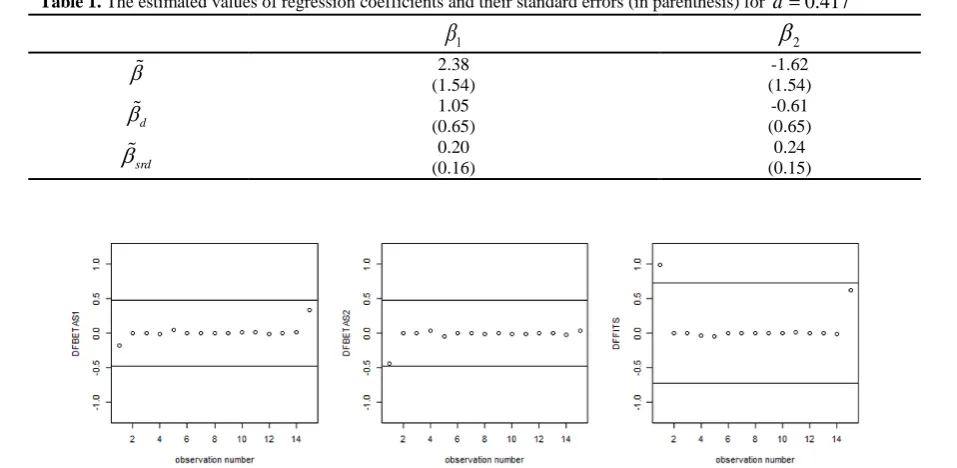
srd), the standard errors are about 0.1, which shows that lower standard errors of the estimated parameters are achieved. Also as mentioned in [8], these additional information corrects the wrong sign problem of the estimated coefficients.For more investigation, the DFBETAS values for the
jth (
j
=
1, 2
) element ofβ
srd and theDFFITS
values are calculated and the results are presented in Figure 1. The Straight lines are the cutoff points. The cutoffpoints are chosen as
2
n
+
p
and 2 p n
, which are 0.48
and 0.73, respectively, for this study. From Figure 1, one can find out that only the first observation is recognized as influential with respect to the
DFFITS
criteria since the calculated value exceeds the cutoff point 0.73.
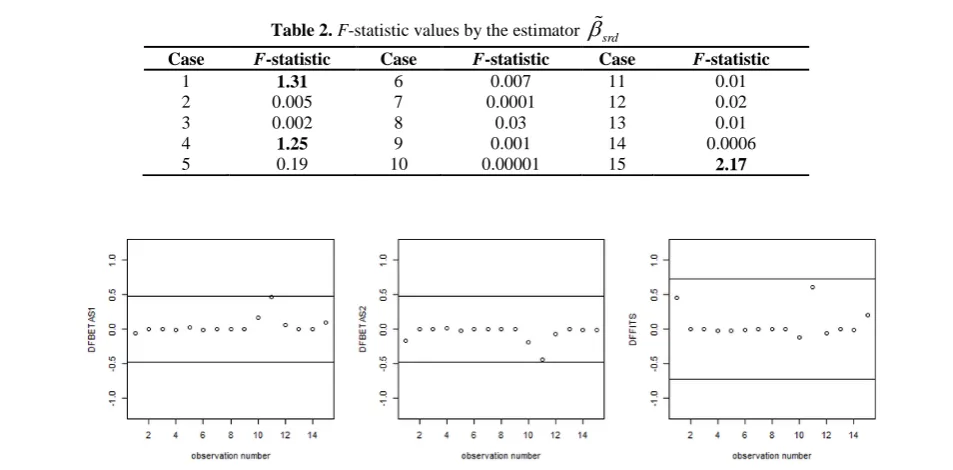
At last, we calculated the F-statistic in (40) for the fresh data. The results are given in Table 2. The first, the fourth and the fifteenth observations have the largest values of the F-statistic, which are 1.31, 1.25 and 2.17, respectively. For other observations, the F-statistic is obtained less than 1. Therefore, since
χ
(1)2=
3.84
(for0.05
α
=
), none of the observations can be considered as an outlier for this data set.To reveal the efficiency of our methods, a shift is
Table 1. The estimated values of regression coefficients and their standard errors (in parenthesis) for
d
=
0.417
1β
β
2β
2.38 -1.62(1.54) (1.54)
d
β
1.05 -0.61(0.65) (0.65)
srd
β
0.20 0.24(0.16) (0.15)
imposed on the dependent variable to investigate its impact on finding the outlier and on diagnosing influential observations. We have chosen a shift equal to 0.52 (which is about two standard deviation of y) and exerted on 11th observation. In fact, the chosen shift
value is the largest possible value such that ensures us that the error terms of the rescaled shifted data are still of the form AR(1). For the new data set, the Liu biasing parameter is estimated as d=0.855, where
2
ˆ
0.018
σ
=
. The corresponding calculated DFBETAS andDFFIT
values are displayed in Figure 2.As it is seen in Figure 2, the absolute value of the
DFBETAS and DFFITS criteria for the 11th observation
tends to be near the cutoff points but do not exceed the corresponding values 0.48 and 0.73. Also, the imposed shift on 11th observation has reduced the influence effect
of the first observation on the estimated fitted values. Also, the values of F-statistic for the shifted data is given in Table 3. It can be seen from table 3, the calculated F-statistic for the 11th observation is 4.73 and
for other observations, it is less than 3. So, since
2 (1)
7.70
>
χ
=
3.84
, the 11th observation is correctlyrecognized as an outlier.
Simulation study
In what follows a simulation study is carried out to investigate the performance of the proposed mean-shift outlier model and to conduct a survey on changes in influential measures in the presence of influential observation. Following McDonald and Galarneau [29], two collinear explanatory variables are generated from the following equation:
1 2 3
1
(
)
,
ij ij i
x
λ
z
z
λ
−
=
+
i
=
1,..., ,
t
j
=
1, 2
where
z
i1,z
i2 andz
i3 are independent standard normal pseudo-random numbers, andλ
represents the correlation between two explanatory variablesx
1 andTable 2. F-statisticvalues by the estimator
β
srdCase F-statistic Case F-statistic Case F-statistic
1 1.31 6 0.007 11 0.01
2 0.005 7 0.0001 12 0.02
3 0.002 8 0.03 13 0.01
4 1.25 9 0.001 14 0.0006
5 0.19 10 0.00001 15 2.17
Figure 2.
DFBETAS
forβ
1 (DFBETAS
1) and DFBETAS forβ
2 (DFBETA S
2) andDFFITS
for fitted values by the estimatorβ
srd after changing the 11th observation. The straight lines are cutoff points.Table 3.F-statistic value by the estimator
β
srd after changing the 11th observationCase F-statistic Case F-statistic Case F-statistic
1 0.65 6 0.003 11 4.73
2 0.0001 7 0.0004 12 2.59
3 0.00003 8 0.009 13 0.000004
4 0.36 9 0.002 14 0.003
2
x
, which is set to be 0.9 and 0.99 in this study. Also, the response variable is generated based on the model2
1
i j ij i
j
y
β
x
ε
=
=
∑
+
,i
=
1,...,
t
, withε
i=
ρε
i−1+
u
i,where
u
i~
NID
(0,1)
and the initial valueε
0 is sampled fromN
(0, (1
−
ρ
2) )
−1 . The vector of coefficients is set toβ
=
(1, 0.5)
−
′
. With 0.6 and 0.9 values ofρ
, 75, 90, 130 and 160 units of samples are produced for 1000 times. Each time the first 60 observations are taken as historical data, and after being rescaled by the unit length scaling technique, they are used for estimating theρ
parameter. The remaining (i.e.n
=
15
, 30, 70 and 100) are taken as fresh data. Also for the fresh data, thex
1,x
2 and y values are rescaled. Furthermore, the 59th and 60th historicaldata(which are the nearest observations to the fresh data) are used as the stochastic restrictions. In each iteration, the optimal
d
Liu parameter is found for the stochastic restricted Liu regression under AR(1). For different values ofλ
,ρ
andn
, the probability of type I error (α
=
0.05
) is calculated using the method of mean-shift outlier model. For this purpose, the percentage of the time that the F-statistic for testing0
:
0
H
γ
=
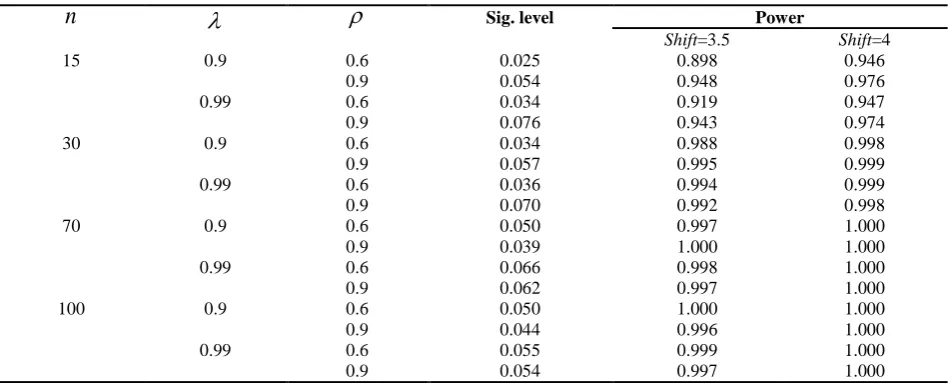
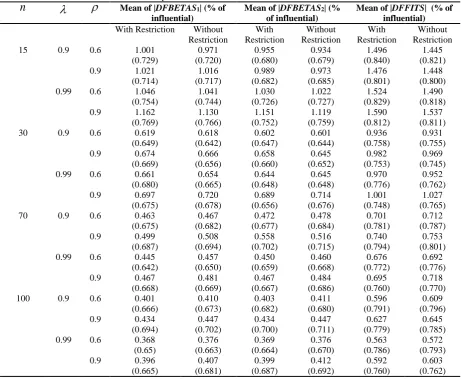
is greater than the corresponding critical value is calculated and the results are shown in Table 4. A glance in the results of this table indicates that the significance level remains around 0.05.Also, the power of the test for the mean-shift outlier model is investigated in Table 4 after shifting the
generated data set. At this point, in each dataset, the 4th
fresh observation is taken as an outlier by exerting two shift values 3.5 and 4 to the original value of the response. These values are more than one time the mean of standard deviation of generated dependent observations and less than twice of it. Then the power of the test is calculated for the shifted data by the foregoing method. We remind that also here the shifted data are rescaled and before being used in the calculations, they’re AR(1) structure is checked by the Durbin-Watson statistic. It is shown in Table 4 that for each combination of
n
,λ
andρ
, the power of the test increases with the increase of the value of the shift. Also, it increases by the increase in the sample size.In order to study the impact of the shifted 4th
observation on the estimated regression coefficients
β
1,2
β
the predicted values of the response variable, the mean of absolute values of theDFBETAS
andDFFITS
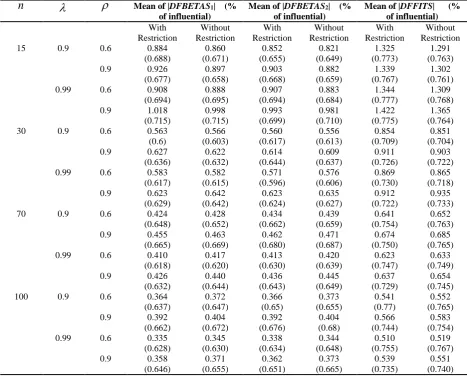
in 1000 replications, with and without stochastic linear restrictions, are computed. The results are shown in Tables 5 and 6 for the shift values 3.5 and 4. The proportion of times that the absolute values of calculatedDFBETAS
andDFFITS
values exceedthe cutoff points 2 n+p
and 2 p n
(in which
p
=
2
in this study) are reported in parenthesis.
From Tables 5 and 6, it can be seen that for larger sample sizes, the mean of
DFBETAS
,DFFITS
and their related proportions for the stochastic linear restrictions cases are smaller than theTable 4. The probability of type I error and Power of the F test for the mean-shift outlier model for
( ,
β β
1 2) (1, 0.5)
= −
n
λ
ρ
Sig. level PowerShift=3.5 Shift=4
15 0.9 0.6 0.025 0.898 0.946
0.9 0.054 0.948 0.976
0.99 0.6 0.034 0.919 0.947
0.9 0.076 0.943 0.974
30 0.9 0.6 0.034 0.988 0.998
0.9 0.057 0.995 0.999
0.99 0.6 0.036 0.994 0.999
0.9 0.070 0.992 0.998
70 0.9 0.6 0.050 0.997 1.000
0.9 0.039 1.000 1.000
0.99 0.6 0.066 0.998 1.000
0.9 0.062 0.997 1.000
100 0.9 0.6 0.050 1.000 1.000
0.9 0.044 0.996 1.000
0.99 0.6 0.055 0.999 1.000
measures for the cases with no stochastic linear restrictions. This result may be due to the achievement of improved accuracy for the advanced model when the sample size is enough large, and its reduced sensitivity to the observation which do not have a large displacement from the bulk of data.
For fix values of
λ
andρ
, the mean value ofDFBETAS
andDFFITS
decreases asn
increases for both models. But not any significant effect on the proportion of detection of influential observation can be shown. This may happen because cutoff points have an inverse relationship with the sample size and they decrease by the increase ofn
. So although we have a decrease in the mean of absolutes of measures, but simultaneously a decrease in cutoff points happens and causes the proportions to remain almost unchanged. It can also be seen from Tables 5 and 6 that with theincrease in the degree of collinearity (
λ
from 0.9 to 0.99), the mean value of the measures increases for small samples while it decreases for large samples. Also, it is seen in all cases that increasing ofρ
(the autocorrelation parameter) causes a gr