Effect of Integrated Curriculum on Micro Thinking Skill of Elementary
School Students
Dr. Minalba Jadeja1
1Assistant Professor, Centre of Education, Children’s University, Gandhinagar, Gujarat
E-mail: [email protected]
Revised: 13-06-2018 Accepted: 14-06-2018
ABSTRACT
The present paper focuses on the effectiveness of the integrated curriculum. The paper investigates the effectiveness of the integrated curriculum on micro thinking skills of the students of standard 3. Another objective of the paper was to modify the integrated curriculum. The integrated curriculum was developed by Children’s University. To know the effectiveness one group pretest-posttest experimental design was implemented. To suggest a correction to the integrated curriculum the content analysis has been done. For the implementation of the program one school was selected by the purposive sampling technique. The cluster standard 3rd of the selected school was selected as a sample. First of all, the pretest was given to the student and after that program was implemented. After that again the posttest was administrated. Data was analyzed and the effectiveness of the program was derived. The result shows that the program was effective for the enhancement of micro thinking skills. The program was effective on higher order and lower order micro thinking skills. The program was effective regardless of students’ gender, educational achievement, socioeconomic status, their parents’ education. The results of the content analysis suggest that the program has more emphasis on two skills: remembering and analyzing. At the end of this study, the effectiveness of the integrated program was established and some suggestions for the improvement in the program were collected.
Keywords:-Integrated Curriculum, Micro Thinking skills
1. Introduction
Education is the process of molding character and behavior of human being. It brings out inherent competences of a child. Education gives the power of distinguishing between good and bad, right and wrong, true and false (Sataya and Astaya) and dharma and adharma. It distinguishes mankind from other living objects. Education leads to self-realization. It gives freedom (mukti) from all kind of Bandhan. Education teaches the true meaning of life. It is a lifelong process. Human being learns throughout life with experiences of life.
ानमतु व वधं ो तंशाि दकं थमं मृतं| अनुभवा यं वतीयंतु ानंतदुलभंनृप||
It shouldn’t be in form of three R i.e. Reading, writing and arithmetic but it should be of three H i.e. hand, heart and head.
University has developed integrated learning material. The vision behind integrated teaching and learning is that when subjects, disciplines, tasks or activities are combined, a child begins to see a meaningful connection between different subjects and perceives the information, served by various subjects, as a wholesome knowledge. By integrated curriculum, education can be a vehicle for better life and holistic development. Present education system emphasizesmerely on the development of the memory skill where holistic development means the development of some other type of skills too. The present paper attempts to trace down the effect of an integrated curriculum on some mental skills. 2. Integrated curriculum
An integrated curriculum has its root in the 20th century. In 1991 Beane said that disciplines were created in an attempt to organize the world around them (Beane 1991). It means that it is not an integration of fractions of subjects. In progressive era reforms in traditional education system started. During this era education emphasizes on creativity, applicable outcomes, natural learning and student experiences (Grosvenor, I., Lawn, M., &Rousmaniere, 1999).The investigation in traditional education system gave new ways of thinking about how student learn. The ways to reform education system prepared the base for integrated curriculum. The educationalist believed that different disciplines prevented students from making connections between the different subjects. Because of it, the relevance of the material diminished. Thus the attempt of crossing boundary of subjects results in the creation of an integrated curriculum. In India, no such attempt has been made by any regularizing body or Government. Children’s University has done this type of attempt and constructs integrated curriculum. Hon. Vice Chancellor, Prof. K. S. Likhia gave the idea of integration. He guided the University teachers during the task. As a result of this exercise an integrated
curriculum has been developed by the Children’s University. The components of the integrated curriculum are as follows:
2.1Components of Integrated Curriculum developed by Children’s University
Major Focus on basic micro level thinking skills
Emphasis on Panchkoshatmak
development
Emphasis on real-life oriented, lifelong learning
Interlinked subjects in each and every task.
Promotion of thinking and not memory
Value and cultural education
Promotes Cooperative learning, Self-learning, Pear group Self-learning, Social learning theory, intrinsic motivation, reflective thinking
3. Micro thinking Skills
For the present study thinking skill were identified before starting the study. As per Berry & Beyer, Benjamin Boom and his colleagues has developed best list of micro thinking skills which are important in day to day teaching. ( Berry & Beyer). For the present study micro thinking skills developed by Benjamin Blooms with Max Englehart and David Krathwohl were taken as micro thinking skills. They published a framework for categorizing educational goals: Taxonomy of Educational Objectives. This framework has been applied by generations of K-12 teachers and college instructors in their teaching. As this study is on the students of standard 3rd it is found proper to consider micro thinking skills given by Bloom for this paper.
Bloom has given six major categories
of thinking skills:- Knowledge,
From the Handbook one ( page no 201 to 207) the brief explanations of these main categories are as below.
• Knowledge “involves the recall of specifics and universals, the recall of methods and processes, or the recall of a pattern, structure, or setting.”
• Comprehension is “a type of understanding or apprehension such that the individual knows what is being communicated and can make use of the material or idea being communicated without necessarily relating it to other material or seeing its fullest implications.”
• Application represents the “use of abstractions in particular and concrete situations.”
•Analysis refers to the “breakdown of a communication into its constituent elements or parts such that the relative hierarchy of ideas is made clear and/or the relations between ideas expressed are made explicit.” • Synthesis includes the “putting together of elements and parts so as to form a whole.” • Evaluation involves the “judgments about the value of material and methods for given purposes.”
In 2001 cognitive psychologist and other researchers revised Blooms taxonomy. They gave the six categories in the form of action words which are as follows.
Remember
Understand
Apply
Analyze
Evaluate
Create
In the present study revised taxonomy of the Bloom was used to analyze and test micro thinking skills of students of standard 3rd.
4. Research review
As a part of innovations in education, the integrated curriculum has surfaced as a competent tool of holistic development. The main aim of the integrated curriculum is to
simplify the learning process. The theory behind the integrated approach is that when subjects are combined, learners can make a connection between different disciplines. Integrated curriculum creates an opportunity for more meaningful, life oriented and lifelong learning of different subjects. The curriculum supports an assumption that learning through direct experiences is important for meaningful learning. The integrated curriculum supports Bandura’s Social learning theory and cooperative learning (Ormrod, 1999). Researchers showed the effectiveness of cooperative learning.
The main base of the integrated curriculum is on the fact that meaningful learning occurred when student experience is essential in the teaching-learning process. As per Vars (1991), the integrated curriculum can empower students, parents, and teachers (Vars, 1991), but the current education system lays emphasis on fractions of knowledge. Students learn each area of subject separately, knowledge is disconnected and the connection of acquired knowledge with life found nowhere. Progressives were against the traditional education system where children are treated as if they were some objects. They believed that school learning of the education system was different from the real world hence, very often, an average child might feel difficulty in comprehending it (Ellis &Fouts 1997). Such assumption about the education system became the base for integrated curricular efforts.
want to sell the product. The integrated curriculum makes students alert about the connection of content area. It provides students with a more responsive learning environment to social needs.
As per research of Perkins, interdisciplinary teaching motivates Students. More connected experiences enhance motivation and achievement of students (Perkins,1996).
Integrated curriculum developed by Children’s University focuses on the concept rather than content. In 2000 Guthrie has developed concept-oriented reading instructions. He integrated language, arts, reading and science. He found that students who take the CORI are more curious than the students who had taken the traditional method of learning(Guthrie, 2000). The researches show that integrated curriculum makes a connection between different content areas, motivate students, connect content with life, and develop students socially. On the basis of theabove results, the university has developed an integrated curriculum. The present paper investigates the effect of integrated learning material on micro thinking skills of the students.
5. Objective of the study:-
1. To study the effect of integrated learning program on the Micro Thinking skills. 2. To study the effect of integrated learning
program on the Micro Thinking skills in relation to the gender of students.
3. To study the effect of integrated learning program on the Micro Thinking skills in relation to the social economic status of the students.
4. To study the effect of integrated learning program on the Micro Thinking skills in relation to their parent’s education.
5. To study the effect of integrated learning program on the Micro Thinking skills in relation to their educational achievement.
6. Variable of the study: Independent Variable: - 1. Integrated Learning Program 2. Secondary Independent Variables
(1) Gender :- (i) Male (ii) Female (2) Economic Status: - (i) Low (ii) High
(3) Educational Qualification of Parents: - (i) Less than SSC (ii) More than SSC
(4) Educational Achievement: - (i) High (ii) Low
Dependent Variable:-Micro Thinking Skill
Intervening Variable:-
Individual differences between students like Interest, Curiosity etc..
7. Hypothesis of the Study:-
H01 There will be no significant difference between the mean score on micro thinking skills pretest and posttest of students of the experimental group.
H02 There will be no significant difference between the mean score on higher order thinking skill pretest and posttest of students of the experimental group.
H03 There will be no significant difference between the mean score on lower order thinking skill pretest and posttest of students of the experimental group.
H05 There will be no significant difference between the mean score on micro thinking skills posttest of students from low economic status and high economic status of the experimental group.
H06 There will be no significant difference between the mean score on micro thinking skills posttest of the students whose parents have higher education qualification and the students whose parents have lower education qualification of the experimental group.
H07 There will be no significant difference between the mean score on micro thinking skills posttest of the students with high achievement and low achievement of the experimental group.
8. Population
The main objective of the present study was to study the effectiveness of an integrated learning program constructed by Children’s University. To implement the program students of standard 3rd of Government Primary schools were selected as a population for the study.
9. Sample
For the selection of the sample, the purposive sample technique was used. The present study was an experimental study. To implement the experiment, permission of the school and some necessary facilities were essential. Keeping in the mind the above said purposes Government primary school of sector 20/1 was selected as a sample. All the students of class 3 of 20/1 government primary school were the sample of the study. There were 30 students studying in the year of 2016-17 were selected as a sample.
10. Tool
In the present study, the researcher was keen to study the effect of the integrated learning program
For the present research, a test was constructed to measure micro thinking skills of the students. The tool was constructed by the researcher. Reliability and validity of the tools were not established.
The main tool of the study was an integrated learning program. The program was developed by Children’s University. There were 5 chapters in the program. Total 145 activities were developed on the basis of different micro thinking skills and domains of knowledge given by Bloom.
11. Methodofthestudy
Children’s University had constructed an integrated learning program for standard 3. The program was constructed for helping students to make connections across curricula. The program is designed in a way so that it connects skills and knowledge from multiple sources and experiences. Students can apply skills in day to day life; utilize diverse and even contradictory points of view; and, understand issues and can position contextually. The integrated curriculum developed by Children’s University prominences on 6 types of mental skills: Remember, Understand, Application, Analysis, Evaluation, and Creation.
The main objectives of the study To study the effect of integrated learning program on the levels of micro thinking skills.
For the objective systematic process was followed. One group pre-test post-test experimental design was selected for the implementation of the study.
implementation of the program again post-test was implemented to know the effect of the program. The research scholar of the Children’s University, Mrs. Hetal Patel went for implementation of the program. Data were analyzed with Mann Whiteny U test. Results of data analyses are given below.
12. Hypothesis Testing
To reach to the objective of the study hypothesis were formulated. Testing of hypothesis is given below.
Ho1 There will be no significant difference between mean score on micro thinking skills pretest and post test of students of experimental group.
Table 1
Statistics regarding mean score on micro thinking skills pretest and post test of students
of experimental group
Tes t Sum of ran ks Mea n of rank s U-valu e U-valu e Z Val ue Significan t Pos t Tes t
385 8.94 7 7 -4.5 4 Signific ant Pre
test 143
24.0
6 249
From above table it is shown that sum of ranks for post test is 385 and for pre test is 143. Mean ranks for post test is 8.94 and for pre test is 24.06. U value for post test is 7 and for pre test is 249. The smallest value is 7. Thus value of U for this hypothesis testing is 7. The value of Z is -4.541 which is significant at 0.05 level of significance. From the result it is revealed that null hypothesis is rejected. It means that difference is significant. From the data it is clear that the mean score of post test is higher than mean score of pre test.
H02 There will be no significant difference between mean score on higher order thinking skill pretest
and post test of students of experimental group.
Table 2
Statistics regarding mean score on higher order thinking skills pretest and post test of
students of experimental group
Highe r order thinki ng skills Su m of ran ks Mea n of ran ks U-val ue U-val ue Z Val ue Significa nt Post Test 382
23. 88 10
10 4.4 - Significant Pre
test 146 9.1
2 24
6
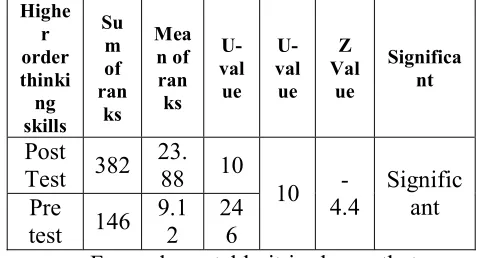
From above table it is shown that sum of ranks for higher order thinking skills post test is 382 and for pre test is 146. Mean ranks for post test is 23.88 and for pre test is 9.12 . U value for post test is 10 and for pre test is 246. The smallest value is 10. Thus value of U for this hypothesis testing is 10. The value of Z is -4.428 which is significant at 0.05 level of significance. From the result it is revealed that null hypothesis is rejected. It means that difference is significant. From the data it is clear that the mean score of post test is higher than mean score of pre test.
H03 There will be no significant difference between mean score on lower order thinking skill pretest and post test of students of experimental group.
For the testing of the Ho4 hypothesis Mann Whitney U test has been calculated. The statistics regarding the test is given below.
Table 3
Statistics regarding mean score on lower order thinking skills pretest and post test of
students of experimental group
skills
Post
Test 378 23.62 14
14 4.2 -7
Signific ant Pre
test 150 9.3
8 24
2
From above table it is shown that sum of ranks for lower order thinking skill post test is 378 and for pre test is 150. Mean ranks for post test is 23.62 and for pre test is 9.38. U value for post test is 14 and for pre test is 242. The smallest value is 14. Thus value of U for this hypothesis testing is 14. The value of Z is -4.278 which is significantat 0.05 level of significance. From the result it is revealed that null hypothesis is rejected. It means that difference is significant. From the data it is clear that the mean score of post test is higher than mean score of pre test.
H04 There will be no significant difference between mean score on micro thinking skills post test of girls and boys of experimental group.
For the testing of the Ho4 hypothesis Mann Whitney U test has been calculated. The statistics regarding the test is given below.
Table 4
Statistics regarding mean score on micro thinking skills post test of boys and girls of
experimental group
Catego ry
Su m of ran ks
Mea n of ran
ks U-val ue
U-val ue
Z Val
ue
Signific ant
Boys 77 8.56 31
31 0.05 - SignificNot ant
Girls 59 8.43 32
From above table, it reveals that sum of ranks for post test of boys and girls are 77 and 59 respectively. Mean ranks for post test of boys and girls is 8.56 and 8.43 respectively. U value for boys is 31 and for girls 32. The smallest value is 31. Thus value of U for this hypothesis testing is 31. The value of Z is -o.053 which is not significantat 0.05 level of significance. From the result it is
revealed that null hypothesis is not rejected. It means that difference is not significant. The mean score of post test of girls and boys is not significantly different.
H05 There will be no significant difference between mean score on micro thinking skills post test of students from low economic status and high economic status of experimental group.
Table 5
Statistics regarding mean score on micro thinking skills post test of students from low economic status and high economic status of
experimental group.
Econo mic Status
Su m of ran ks
Me an of ran ks
U-val ue
U-val ue
Z Val
ue
Signific ant
High 80.5 8.94 27.5 27.
5 0.37
Not Signific
ant
Low 55.5 7.93 35.5
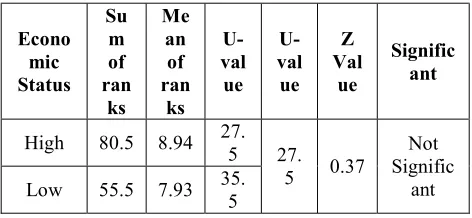
From above table, it reveals that sum of ranks for post test of students from High Educational Status and students from Low Economic Status is 80.5 and 55.5 respectively. Mean ranks for post test of students from High Educational Status and students from Low Economic Status is 8.94and 7.93 respectively. U value for High Economic Status is 27.5, and for Low Economic Status is35.5. The smallest value is 27.5. Thus value of U for this hypothesis testing is 27.5. The value of Z is 0.370 which is not significantat 0.05 level of significance. From the result it is revealed that null hypothesis is not rejected. It means that difference is not significant. The mean score of post test of students from High Educational Status and students from Low Economic Status is not significantly different.
skills post test of the students whose
parents have higher education
qualification and the students whose
parents have lower education
qualification of experimental group. Table 6
Statistics regarding mean score on micro thinking skills post test of the students whose
parents have higher education qualification and the students whose parents have lower education qualification of experimental group
Parent’ s Educat
ion Su
m of ran ks
Me an of ran ks
U-val ue
U-val ue
Z Val
ue
Signific ant
High 65.5 10.9
2 15.5 15.
5 1.51
-Not Signific
ant
Low 70.5 7.05 45.
5
From above table it is shown that sum of ranks for post test of students whose parents have higher education qualification and the students whose parents have lower education qualification is 65.5 and 70.5 respectively. Mean ranks for post test of students whose parents have higher education qualification and the students whose parents have lower education qualification is 10.92 and 7.05 respectively. U value for students whose parents have higher education qualification is 15.5 and the students whose parents have lower education qualification is45.5. The smallest value is 15.5. Thus value of U for this hypothesis testing is 15.5. The value of Z is -1.519 which is not significantat 0.05 level of significance. From the result it is revealed that null hypothesis is not rejected. It means that difference is not significant. The mean score of post test of students whose parents have higher education qualification and the students whose parents have lower education qualification is not significantly different. H07 There will be no significant difference
between mean score on micro thinking skills post test of the students with high
achievement and low achievement of experimental group.
Table 7
Statistics regarding mean score on micro thinking skills post test of the students with
high achievement and low achievement of experimental group
Student’ s Achieve
ment Su
m of ran ks
Me an of ran ks
U-val ue
U-val ue
Z Val
ue
Signific ant
High 73 9.12 27 27 0.47 Not
Signific ant
Low 63 7.88 37
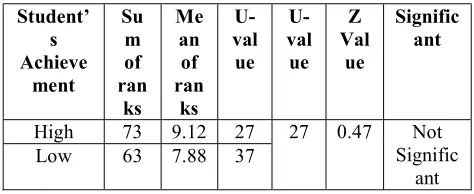
From above table it is shown that sum of ranks for post test of students with high achievement and low achievement is 73 and 63 respectively. Mean ranks for post test of students with high achievement and low achievement is 9.12 and 7.88 respectively. U value for students with high achievement is 27 and low achievement is 37. The smallest value is 27. Thus value of U for this hypothesis testing is 27. The value of Z is 0.473 which is not significant at 0.05 level of significance. From the result it is revealed that null hypothesis is not rejected. It means that difference is not significant. The mean score of post test of students with high achievement and low achievement is not significantly different.
13. Finding of the study:-
Significant difference was found between the mean score on pretest and posttest of students of the experimental group. It shows that integrated learning program was found effective for the development of micro thinking skill.
enhancement of higher order as well as lower order thinking skills.
There was no significant difference between other levels’ variables like boys and girls, students from low economic status and high economic status, students whose parents have lower education qualification and higher educational qualification.
There was no significant difference between mean score of the students with high achievement and low achievement, means program was found equally effective for each and every student simultaneously.
As per the result of content analysis it was found that program lays emphasis more on two skills; recalling and analysis than other skills.
14. Conclusion
As the result of this study, Integrated learning Program was found effective for development and enhancement of micro thinking skills (both higher and lower order thinking skills) of standard 3rd students.
Integrated learning Program was found equally effective in relation to their educational achievement, parents’ education and their socio economic status and gender for the development of thinking skills.
Some suggestions from the stakeholders were acquired during the study. At last the effective integrated learning program was found as a result of the study. Children’s University can now implement the program in all Vidyaniketans as well as other schools of Gujarat State.
References:
Beane, J. (1991). The middle school: The natural home of integrated curriculum. Educational Leadership retrievedfrom
http://middlegradescurriculum.yolasite.co m/resources/The%20natural%20home%2 0of%20int.%20curr.%20%20BEANE.pd fon 06/12/2017
Berry & Bayer. (1984). Improving thinking Skill – Practical Approach. The Phi Delta Kappan Vol. 65, pp. 556-560 (5 pages) Bloom et al. (1956). Taxonomy of
Educational Objectives : Hand book I Cognitive Domain : David MaKcy, New York
Ellis, A. &Fouts, J. (2001) Interdisciplinary Curriculum: the research base, Music Educators Journal,87(5), 22-68.
http://dx.doi.org/10.2307/3399704
Grosvenor, I., Lawn, M., &Rousmaniere, K. (1999). Silences and Images: The Social History of the Classroom. History of Schools and Schooling, Volume 7. Peter Lang Publishing, 275 Seventh Avenue, 28th Floor, New York, NY 10001.
Guthrie, J. T., Wigfield, A., &VonSecker, C. (2000).Effects of integrated in stmction on motivation and strategy use in reading. Journal of Educational Psychology, 29, 331-341.
Karri Holley (2017) Interdisciplinary Curriculum and Learning in Higher Education, Oxfrod research Encyclopedia DoI10.1093/acrefore/9780190264093.01 3.138
Ormrod, J. E. (1999). Human learning (3rd ed.). Upper Saddle River, NJ: Merrill. Perkins (1996).Educating for insight.
Educational leadership, 49