R E S E A R C H A R T I C L E
Open Access
High resolution chromosomal microarray
analysis in paediatric obsessive-compulsive
disorder
Edna Grünblatt
1,2,3,4,8*†, Beatrice Oneda
5†, Arif B. Ekici
7, Juliane Ball
1, Julia Geissler
6, Steffen Uebe
7,
Marcel Romanos
6, Anita Rauch
2,4,5†and Susanne Walitza
1,2,4*†Abstract
Background:Obsessive-Compulsive Disorder (OCD) is a common and chronic disorder in which a person has
uncontrollable, reoccurring thoughts and behaviours. It is a complex genetic condition and, in case of early onset (EO), the patients manifest a more severe phenotype, and an increased heritability. Large (>500 kb) copy number variations (CNVs) previously associated with autism and schizophrenia have been reported in OCD. Recently, rare CNVs smaller than 500 kb overlapping risk loci for other neurodevelopmental conditions have also been reported in OCD, stressing the importance of examining CNVs of any size range. The aim of this study was to further investigate the role of rare and small CNVs in the aetiology of EO-OCD.
Methods: We performed high-resolution chromosomal microarray analysis in 121 paediatric OCD patients and
in 124 random controls to identify rare CNVs (>50 kb) which might contribute to EO-OCD.
Results: The frequencies and the size of the observed rare CNVs in the patients did not differ from the controls. However, we observed a significantly higher frequency of rare CNVs affecting brain related genes, especially deletions, in the patients (OR = 1.98, 95% CI 1.02–3.84; OR = 3.61, 95% CI 1.14–11.41, respectively). Similarly, enrichment-analysis of CNVs gene content, performed with three independent methods, confirmed significant clustering of predefined genes involved in synaptic/brain related functional pathways in the patients but not in the controls. In two patients we detectedde-novo
CNVs encompassing genes previously associated with different neurodevelopmental disorders (NRXN1, ANKS1B, UHRF1BP1).
Conclusions:Our results further strengthen the role of small rare CNVs, particularly deletions, as susceptibility factors for paediatric OCD.
Keywords:OCD, CNV, Enrichment analysis, De-novo, Early-onset
Background
Obsessive-compulsive disorder (OCD) is characterized by distressing, intrusive obsessive thoughts and/or repetitive compulsive behaviours [1]. According to a survey of adult US citizens, OCD is a frequent psychiatric disorder with 2.3% of respondents meeting full OCD DSM-IV criteria for lifetime and 1.2% for 12-month prevalence [2]. Similar
prevalence rates of 0.1 to 2.3% have been reported in European countries [3]. In up to 50% of the cases, OCD emerges already during childhood or adolescence [4], and a bimodal age of onset, during early puberty or in the early twenties [5], has been described. The definition of“ early-onset” OCD (EO-OCD) differs among studies regarding the cut-off for age of onset; below 7 years of age was the lowest and under 18 years of age was the highest cut-off age, which thus marks the“minimal”consensus for defin-ition criteria. Accordingly, patients with“late onset”(LO) must be older than 18 years at onset. EO-OCD may represent a more severe or more “biological” subtype of the disorder in comparison to LO [6], with an increased * Correspondence:[email protected];[email protected]
Edna Grünblatt and Beatrice Oneda are equal first authors †Equal contributors
1Department of Child and Adolescent Psychiatry and Psychotherapy, University Hospital of Psychiatry Zurich, University of Zurich, Neumünsterallee 9, 8032 Zürich, Switzerland
Full list of author information is available at the end of the article
heritability as well as differences in gender distribution, symptomatology, and comorbidity. In addition, in OCD with early and childhood onset, triggering life events seem to be observed to a lesser extent [2, 7]. Therefore, it has been hypothesized that EO-OCD represents a specific highly heritable subtype of OCD [8].
Despite the strong heritability estimates between 40 and 80% [9–11], two recent genome-wide studies [12, 13] failed to detect association of common single nucleotide polymorphisms (SNPs) with OCD. However, in a meta-analysis [14] an association between OCD and polymor-phisms in the serotonin-related genes (5-HTTLPR/
SLC6A4and HTR2A) and in the catecholamine modula-tion genes (COMT and MAOA) have been reported. Similarly, we showed for the first time the association of 5-HTTLPRpolymorphisms with EO-OCD [15, 16] as well as association toHTR2Apolymorphism [17].
In order to further explain the heritability, it has been suggested that copy number variations (CNVs) play an important role in neurodevelopmental disorders [18–20]. There is rising awareness that common variants may explain a relatively small amount of common diseases, while rare variants with relatively large functional effects may add up to a significant disease contribution [21].
Up to now, five CNV studies in patients with OCD have been conducted [22–26]. The first study assessed the recurrent 15q11-q13 Prader-Willi syndrome and the 22q11.2 DiGeorge syndrome regions [22] in adults with OCD, since both disorders are often accompanied by OCD symptoms. However, in 236 OCD-patients no CNVs affecting the two regions were detected [22]. In a study, conducted by our group, an association between a ~100 base pairs (bp) deletion in the HTR2A promoter region and paediatric EO-OCD [23], as well as increased OCD-severity and an earlier age-of-onset, were reported. Recently, the first genome-wide analysis in a cohort of 1613 OCD and 1086 Tourette syndrome (TS) patients was performed. The study focused on CNVs larger than 500 kb and revealed aberrations in 16p13.11, 22q11.21 and in 6q25.2-q27 [24]. Additionally, a study on CNVs smaller than 500 kb screened 16 adults with EO-OCD and 12 controls [25] and a rare intragenic FMN1 microdeletion in 15q13.3 was detected. In a very recent study 307 EO-OCD (259 of European ancestry) have been investigated for small and rare CNVs [26]. Interest-ingly, the authors found CNVs in genes involved in neuronal migration, synapse formation and postsynap-tic scaffolding, which might be relevant to the patho-genesis of OCD. Four cases had CNVs involving known genomic disorder loci (1q21.1, 15q11.2-q13.1, 16p13.11 and 17p12). [26].
In light of these current findings and the notion of a stronger genetic contribution in patients with EO-OCD, we conducted a genome-wide CNVs analysis, using
high-resolution chromosomal microarray analysis (CMA) in 121 homogenous phenotyped paediatric EO-OCD patients.
Methods
Paediatric patients with OCD
121 paediatric patients with EO-OCD were recruited from the Departments of Child and Adolescent Psychiatry at the University of Würzburg, Germany and the University of Zürich, Switzerland (all Caucasian). The mean age ± SD of the patients was 12.99 ± 2.8; mean age of onset = 10.43 ± 3.2; 75 were males and 46 females. Although an EO-OCD sample could in principle also consist of adult patients with a retrospectively analysed onset, the present study includes only paediatric patients that guaranteed an early-onset of the disorder.
All patients fulfilled the diagnostic criteria for OCD ac-cording to the Diagnostic and Statistical Manual of Mental Disorders, 4th edition (DSM-IV) [27] and the Inter-national Statistical Classification of Diseases and Related Health Problems, 10th Revision (ICD-10) [28]. Patients and parents from Würzburg were interviewed separately by senior clinicians with a semi-structured diagnostic interview of psychiatric disorders in children and adoles-cents (Kinder-DIPS; children and parents version) [29]. The patients and parents of Zürich underwent the Ger-man version of a semi-structured clinical interview (K-SADS-PL) [30] to investigate their phenotype, including psychiatric comorbidities. Autistic spectrum disorders were screened within an ascertainment for psychopath-ology (CASCAP-D) [31].
The Children’s Yale Brown Obsessive Compulsive Scale (CY-BOCS) [32] was used in all patients to assess severity and characteristics of OCD symptomatology. A summary score above 16 points was determined to be the cut-off for clinical impairment caused by OCD. In the present patients’ sample, the mean CY-BOCS score was 22.1, SD = 6.98. The DSM-IV and DSM-5 [1] do not require children to fulfil the criterion of insight into the irrationality of their symptoms. Therefore, it is possible that the CY-BOCS scores underestimated the severity of OCD in cases of reduced insight into the disorder. For the assessments of TS and tic-disorders, the German version [33] of the Child and Adult Schedule for Tourette and Other Behavioural Syndromes (STOBS) [34] was used in the Würzburg patients, the Yale Global Tic Severity Scale (YGTSS) [35] in the Zürich patients.
Patients with comorbid disorders (n= 75 /121) were included in the study when the OCD was the primary diagnosis, as assessed by two senior clinicians independ-ently (see Additional file 1: Table S1).
Scale (WISC) [36] in the majority of cases (over 85%) while in few cases (less than 15%) the IQ was assessed by Culture Fair Intelligence Test (CFT) [37]. Since IQ < 70 was used only for exclusion criteria to avoid inclusion of any ID pro-bands, using two scales do not affect the paediatric OCD population selection. Mean IQ score in our patient cohort was 108.27 (SD = 13.29).
The study was approved by the respective local ethics committees with the latest version of the Declaration of Helsinki, including an ethical permission granted by the Ethic Committees from Würzburg and the Cantonal Ethic Commission of Zürich (Ref. Nr. 39/97, 140/3 and EK: KEK-ZH-Nr. 2010–0340/3) and written informed consent was obtained in all cases from the participants or/and their parents.
Control sample for statistical comparison
We analysed the data of 124 random population samples of Caucasian origin (DNA was extracted from native tissue), recruited at the Institute of Medical Genetics, University of Zurich, in the same manner, on the Cytoscan HD Array as the patient samples (76 males and 48 females, X2= 0.012,
p> 0.999 compared to EO-OCD).
DNA extraction and chromosomal microarray analysis (CMA)
Constitutional genomic DNA was extracted from whole blood (EDTA-tubes; n= 74 cases and family) with the desalting Proteinase K methodology [38] or from saliva samples (Oragene DNA, DNA Genotek Inc., Ontario, Canada; n= 47 cases and family) using the manufac-turer’s protocol. To assess genomic DNA purity, the ratio of absorbance at 260 nm and 280 nm was used. 74/ 121 cases were part of the previous reported genome-wide CNV (>500 kb) analysis [24], in which only one large CNV was reported and confirmed in the current study (patient #9025079001 7q21.11 deletion), without any previous findings that were not confirmed in the current study. DNA from available parents and/or siblings of 30 patients was investigated consecutively due to CNV findings in the patients.
DNA was analysed with the Cytoscan HD Array (containing about 750,000 SNPs and 1.9 million non-polymorphic probes) (Affymetrix Inc., Santa Clara, CA, USA) at a genome-wide resolution of 50 kb for both du-plications and deletions. We have chosen this resolution in order to minimize the possibility of false positive CNVs, which according to our previous assessment have a me-dian size of 19 kb [20]. Array hybridization and quality control was performed according to the manufacturer’s protocol. Data were analysed with Chromosome Analysis Suite (ChAS) software (Affymetrix) for changes of relative intensities. The CNV analysis was based on build 32.1. Genomic coordinates are based on GRCh37/hg19. In
order to exclude common benign CNVs, we used a refer-ence set of 820 in-house healthy controls and 1038 Affy-metrix controls in combination with the Database of Genomic Variants (DGV) from the Centre for Applied Genomics (February 2009, hg19).
CNVs including coding sequences of genes that were absent in our in-house and Affymetrix primary control cohort and either unreported or reported only from limited sources in the DGV database were defined as rare CNVs in both the EO-OCD and the random control cohorts and used for statistical comparison.
Statistical analysis and enrichment analysis
Frequency analysis was conducted usingΧ2test and the power was calculated using G*Power v.3.1.9.2 [39]. For continuous measures, the two-tailed t-test was used.
The genes within the rare CNVs identified in the patients and controls were investigated for their enrich-ment in pathways and functional groups using the Enrichment Analysis of Selected Entities (EASE) tool, based on Gene Set Enrichment Analysis (GSEA) method [40, 41], with the Pathway Studio software v.11.2.04 (Elsevier; Mammal database). Significant enriched path-ways were considered withp< 0.005. As additional valid-ation, we used the Database for Annotation, Visualization and Integration Discovery (DAVID) [42] for functional annotation clustering. The genes within CNVs were entered using the identifier “Official_gen-e_symbol” to create gene lists for EO-OCD and for con-trol samples. We reported clusters with enrichment score > 1.3 as suggested by Huang da W et al. [42]. Sig-nificant enriched pathways were considered with p< 0.05 following Bonferroni, Benjamini and FDR correc-tions. In addition, as a third confirmation analysis, we performed a CNV enrichment analysis using PLINK [43] version 1.07 and its –cnv-enrichment-test option on all CNVs called [44]. Following multiple testing correction (6 tests) p< 0.008 was considered as significant, and nominal significant forp< 0.05.
Statistical analysis was performed with SPSS v.21 (IBM) and StatView v.5.0 (SAS Inst.). The level of significance was alpha = 0.05.
Results
scores or OCD severity (measured with CY-BOCS) between carriers and non-carriers of rare CNVs.
However, we observed a significantly higher number of CNV carrying brain/synaptic genes in the patients in comparison to the controls (Χ2
= 4.225, p= 0.0398; odds ratio (OR) = 1.98, 95% CI 1.02–3.84; Power 1-β=0.858). In particular, the number of rare deletion carrying brain/ synaptic genes was significantly higher in patients (n= 13 vs. 108 non-carriers) compared to controls (n = 4 vs. 120 non-carriers; Χ2= 5.360, p= 0.021; OR = 3.611, 95% CI 1.14–11.41; Power 1-β=0.8909).
In line with this finding, both enrichment cluster ana-lyses (Pathway Studio and DAVID), revealed a higher number of synaptic and brain related functional pathways in the patients (10 brain/synapse clusters, 103 none brain/ synapse clusters in Pathway studio; 6 brain/synapse clus-ters, 31 none brain/synapse clusters in DAVID) in com-parison to the controls (2 brain/synapse clusters, 98 none brain/synapse clusters in Pathway studio; 0 brain/synapse clusters, 25 none brain/synapse clusters in DAVID;Χ2= 4.682, p= 0.03 for Pathway Studio; Χ2= 4.488, p= 0.033 for DAVID Additional file 3: Table S3a & b).
Both enrichment cluster analyses resulted in similar top clusters for the patients group (KRAB domain, zinc-finger protein family) and for the control group (serum amyloid A, high-density lipoprotein), confirming the integrity of both analyses. The most significant (p< 0.0001) GO func-tional group enrichment cluster in the patient cohort belong to: axon guidance (genes within the CNVs:RAF1, EPHB2, MYH11, SEMA3A, ITGA10, HFE2, NRXN1, COL4A1, COL4A2), axonal fasciculation (genes within the CNVs:EPHB2,NCAM2,SEMA3A), synapse (genes within the CNVs: EPHB2, GABRA4, GABRB1, NRXN1, MYO6, PIAS3, ANKS1B, PACSIN1) and neuron cell-cell adhesion (genes within the CNVs: NCAM2, NRXN1), as analysed by Pathway Studio (for details see Additional file 3: Table S3a). Similarly, DAVID analysis revealed in the pa-tients several GO related to synaptic and brain related genes, like in cluster 5: axonogenesis, cell morpho-genesis involved in neuron differentiation, and neuron projection morphogenesis (gene cluster: NCAM2,
PARD3, NRXN1, SEMA3A, EPHB2) (for details see Additional file 3: Table S3b). Interestingly, the control group did not show any synaptic or brain related clusters when the DAVID software was used, while only 2 clusters (p< 0.005) were found using Pathway Studio analysis: catecholamine metabolic process (genes within the CNVs: SULT1A3, SULT1A4) and axonal fasciculation (genes within the CNVs: CNTN4, NRCAM; for details see Additional file 3: Table S3a).
We could further confirm a significant enrichment (p= 1.28 x 10⁻³
) of CNVs in brain expressed genes by applying the PLINK enrichment analysis [44].
Notably, there was no significance for the
enrichment analysis for overall genes. The signifi-cance threshold was 8.33 x 10⁻³ (0.05/6, because 6 tests were performed) (Additional file 4: Table S4).
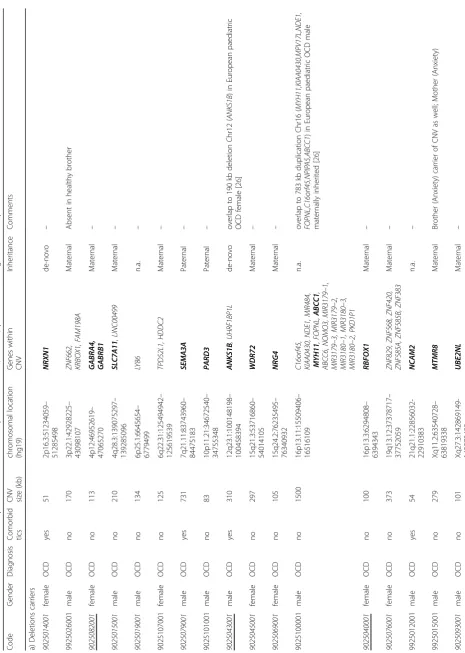
Where possible, the heritability of rare CNVs was assessed by analysing the parents/siblings of the index patients. We detected twode-novoCNVs in two patients with EO-OCD (one male and one female), both of whom had a comorbid tic disorder (Table1 & Additional file 2: Table S2a). Twenty-six patients inherited the CNVs (16 from the mother and 10 from the father). In two additional patients (9025100001 & 9925022001) CNVs were not maternally inherited (paternal DNA was un-available). Three patients carried CNVs located on the X-chromosome: two deletions (affecting the genes
UBE2NL and MTMR8) and one duplication (affecting the genes KDM6A and CXorf36). Interestingly, both deletions are hemizygous aberrations.
Discussion
We did not detect a higher number of rare CNVs in paediatric patients with EO-OCD compared to controls, which is in line with previous publications [24, 26]. However, cluster analyses of the gene content of the rare CNVs revealed a significantly higher number of genes involved in synaptic and brain related pathways in the cases compared to controls, similarly to previous find-ings [24, 26]. Our results, therefore, further support the hypothesis that the aetiopathology of EO-OCD may be related to neurodevelopmental processes [9, 45]. In addition, we demonstrate that the OR of 3.6 (p= 0.021) for EO-OCD in carriers of rare small deletions is in the same range as that reported previously for larger dele-tions (OR = 4.4, p= 0.04) [24]. Therefore, as Gazzellone et al. [26] recently postulated, not only large CNVs >500 kb but also smaller rare CNVs (≥50 kb), particu-larly deletions in brain related genes, might represent a risk factor for paediatric EO-OCD.
We observed two large deletions (>500 Kb) in our cohort. The first one was a 1.5 Mb deletion in 16p13.11 with undeterminable inheritance in a male patient. The second was a 731 kb deletion in 7q21.11 (finding of this patient previously reported [24]) affecting the SEMA3A
gene, which was inherited from the healthy father. While
We detected another variant in a recurrent CNV locus in a male patient with EO-OCD and comorbid tics, who carries a 437 kb duplication encompassing the region 1q21.1. The duplication was inherited from the mother and present in the sister, both according to the CY-BOCS presenting sub-threshold OCD with similar phenotype including ordering behaviours. Notably, a du-plication of that region has also been detected in a paediatric EO-OCD patient and his unaffected mother and dizygotic twin brother in the recently published co-hort of Gazzellone et al. [26]. We, therefore, suggest that CNVs on the chromosome region 1q21.1, which have been reported to associate with congenital heart defects, developmental delay, ASD, and psychosis [49, 50], repre-sent also a susceptibility locus for OCD. These pheno-types are subject to incomplete penetrance and variable expressivity, since in most of the cases they are inherited from apparently healthy parents [51].
We found several other smaller rare CNVs encom-passing interesting candidate genes that have already been described in neurodevelopmental disorders, for which, however, additional evidence is needed to prove the possible relation with EO-OCD. One of these findings is the 258 kb duplication encompassing the geneGRM8, coding for a glutamate receptor, in 7q31.33, paternally inherited, observed in a female patient with EO-OCD and comorbid tics, but not in her sister with EO-OCD. CNVs encompassing the gene GRM8 have been reported in patients with attention-deficit hyper-activity disorder (ADHD) [52] and with developmental delay, hypotonia, and strabismus [20]. Recent evidence has highlighted the role of glutamatergic synaptic dys-functions in the cortico-striatal-thalamo-cortical circuit in the aetiology of OCD and related disorders [9, 53, 54]. A further noteworthy CNV, 113 kb deletion encom-passing the two genes GABRA4 and GABRB1 in 4p12, was found in a female patient of maternal origin that carried also a 66 kb duplication (EMILIN2 gene in 18p11.32). Involvement of GABA receptor subunit genes in the aetiology of autism has been reported [55–57]. Both GABRA4 and GABRB1 mRNA and protein were found to alter their expression in the parietal and frontal cortex and cerebellum of patients with ASD and in the lateral cerebellum of patients with schizophrenia and with affective disorders [58, 59]. In peripheral blood samples of patients with TS, mRNA expression of GABA receptors includingGABRA4correlated with tic severity. Furthermore, there was indication of GABRA4 being alternatively spliced in TS compared to healthy con-trols [60]. For the duplication, little is known about the EMILIN2 gene and neurodevelopment. However, patients carrying large deletions in 18p11.32 were reported to have developmental delay and mental re-tardation [61] while linkage study could show some
evidence for schizophrenia susceptibility near this region [62].
A 279 kb deletion in Xq11.2 encompassing the gene
MTMR8 was found in a patient with EO-OCD as well as in his mother and brother, who both suffer from anxiety disorder. Anxiety is very often a core feature of OCD symptomatology and in the DSM-IV [27], OCD was even classified among the anxiety disorders, which shows the close relationship between the two diseases. MTMR8 encodes a phosphatidylinositol kinase and reduced protein expression is associated with impaired survival of specific neuronal popula-tions [63]. Loss-of-function mutapopula-tions occurring in the phosphatidylinositol kinase gene family are known to cause different X-linked neurological diseases, including schizophrenia, bipolar disorder and age-related neurodegeneration, probably due to endosomal trafficking defects and accumulations of the lipid sub-strates [64, 65].
A de-novodeletion of 51 kb in 2p16.3 was detected in a male diagnosed with very EO-OCD (4 years old at age of onset) who suffered also from comorbid tics and hyperkinetic symptoms. The deletion encompasses the
NRXN1 gene, for which an association with TS, ASD, ID, and schizophrenia has been described [24, 46, 66, 67]. Interestingly, theNRXN1-αknock-out mouse model supports the role ofNRXN1 in neurodevelopmental dis-orders, since these mice displayed non-social behaviour as well as hyperactivity and learning deficits [68].
In another patient with comorbid tics we found a de-novo deletion of 310 kb in 12q23.1 harbouring the genes
ANKS1B and UHRF1BP1 and a duplication of 80 kb in 19p13.11 harbouring the genes GMIP, ATP13A1, ZNF101
and ZNF14. ANKS1B is predominantly expressed in the brain and known to interact with the amyloid beta pro-tein precursor that may play a role in normal brain de-velopment and in the pathogenesis of Alzheimer’s disease [69, 70]. CNVs affecting ANKS1B have been reported in ASD and ID including a de-novo deletion in a male with ASD and delayed early language development but aver-age languaver-age abilities and IQ [47, 71]. In addition, a 190 kb deletion encompassing the ANKS1B gene was reported in a patient with EO-OCD [26], enhancing the possible role of the gene in neurodevelopmental disorders. Within the duplication, GMIP, coding for RhoA-specific GTPase-activating protein, was reported to be a key factor for neuronal migration in the post-natal brain [72] as well as regulating vesicular traf-ficking [73]. Moreover, in a large population-based twin-family study exploring genome-wide association of obsessive-compulsive symptoms, a significant asso-ciation in 4 genes (MEF2BNB, RFXANK, MEF2BNB
Conclusions
Our findings further support the role of rare CNVs in the aetiology of OCD and emphasize the role of rare small deletions encompassing brain genes as potential susceptibility factors in the aetiology of paediatric EO-OCD. Further studies are necessary to confirm the contribution of the individual variants in OCD.
Additional files
Additional file 1: Table S1.Comorbidities according to ICD-10 of the pediatric OCD cohort. (DOCX 13 kb)
Additional file 2: Table S2a.Rare CNVs discovered in the paediatric obsessive compulsive disorder (OCD) patients; and inheritance pattern in
cases with available parents.Table S2b.Rare CNVs discovered in the
population control cohort. (PDF 236 kb)
Additional file 3: Table S3a.According to Pathway Studio.Table S3b.
According to DAVID. (PDF 115 kb)
Additional file 4: Table S4.(a) CNV burden analysis results from PLINK.
Thep-values shown are for the GCNT test statistic from PLINK’s
cnv-enrichment-test algorithm, applied to the particular gene list versus the
entire genome. Although Brain expressed and ID genes resulted inp
values below 0.05, only the brain-expressed genes list remains significantly
enriched in CNVs after correction for multiple testing (6 tests). (b) CNV
burden analysis results from PLINK. The Gene List used. (PDF 1722 kb)
Abbreviations
ADHD:Attention-deficit hyperactivity disorder; ASD: Autism spectrum disorder; CMA: Chromosomal microarray analysis; CNV: Copy-number
variation; CY-BOCS: Children’s Yale Brown Obsessive Compulsive Scale;
DAVID: Database for Annotation, Visualization and Integration Discovery; DGV: Database of Genomic Variants; EO: Early-onset; GEO: Gene Expression Omnibus; GO: Gene ontology; ID: Intellectual disability; IQ: Intelligence quotient; LO: Late-onset; OCD: Obsessive-compulsive disorder; OR: Odds ratio; SNPs: Single nucleotide polymorphisms; TS: Tourette syndrome
Acknowledgments
The authors thank the families, patients, and control volunteers who participated in this research. The authors would like to acknowledge Dr. Alexander Roth for his statistical analysis support, Prof. Dr. Soumya Raychaudhuri for providing us with the gene list files to be used in PLINK for the enrichment analysis, Ms. Miryame Hofmann and Dr. Regina Reissmann for their laboratory technical support and to Mr. Luca Sciancalepore for English editing support.
Funding
The study was funded by the University of Zurich.
Availability of data and materials
The datasets generated and/or analysed during the current study are not publicly available due to limits in consents but are available from the corresponding author on reasonable request.
Authors’contributions
EG, BO, AR, SW contributed substantially to the conception and design of the study. EG, BO, ABE, JB, JG, SU, MR, AR, SW contributed substantially to the acquisition, analysis, and interpretation of data. All listed authors drafted the article and revised it critically for important intellectual content. Moreover, all authors gave their final approval of the version to be published. And all authors agree to be accountable for all aspects of the work in ensuring that questions related to the accuracy or integrity of any part of the work are appropriately investigated and resolved. All authors read and approved the final manuscript.
Ethics approval and consent to participate
The study was approved by the respective local ethics committees with the latest version of the Declaration of Helsinki, including an ethical permission
granted by the Ethic Committees from Würzburg and the Cantonal Ethic
Commission of Zürich (Ref. Nr. 39/97, 140/3 and EK: KEK-ZH-Nr. 2010–0340/3)
and written informed consent was obtained in all cases from the participants or/and their parents.
Consent for publication
Not applicable
Competing interests
The authors declare that they have no competing interests. SW has received lecture honoraria from Eli-Lily, Opopharma in the last 5 years. Outside profes-sional activities and interests are declared, for AR and SW, under the link of the University of Zurich www.uzh.ch/prof/ssl-dir/interessenbindungen/client/ web/. However, the above did not affect the reporting in the current work.
Publisher’s Note
Springer Nature remains neutral with regard to jurisdictional claims in published maps and institutional affiliations.
Author details
1Department of Child and Adolescent Psychiatry and Psychotherapy, University Hospital of Psychiatry Zurich, University of Zurich, Neumünsterallee 9, 8032 Zürich, Switzerland.2Neuroscience Center Zurich, University of Zurich and ETH Zurich, Zurich, Switzerland.3Department of Psychiatry,
Psychosomatic and Psychotherapy, University Hospital of Würzburg, Würzburg, Germany.4Zurich Center for Integrative Human Physiology, University of Zurich, Zurich, Switzerland.5Institute of Medical Genetics, University of Zurich, Zurich-Schlieren, Switzerland.6Center of Mental Health, Department of Child and Adolescent Psychiatry, Psychosomatics and Psychotherapy, University Hospital of Würzburg, Würzburg, Germany. 7Institute of Human Genetics, University Hospital Erlangen, Erlangen, Germany.8Department of Child and Adolescent Psychiatry and
Psychotherapy, University Hospital of Psychiatry Zurich, University of Zurich, Wagistrasse 12, 8952 Schlieren, Switzerland.
Received: 22 December 2016 Accepted: 6 November 2017
References
1. American Psychiatric Association. Diagnostic and statistical manual of mental
disorders, fifth edition (DSM-5) 5thedn. Washington DC: APA; 2013.
2. Ruscio AM, Stein DJ, Chiu WT, Kessler RC. The epidemiology of
obsessive-compulsive disorder in the National Comorbidity Survey Replication. Mol
Psychiatry. 2010;15(1):53–63.
3. Wittchen HU, Jacobi F, Rehm J, Gustavsson A, Svensson M, Jonsson B,
Olesen J, Allgulander C, Alonso J, Faravelli C, et al. The size and burden of mental disorders and other disorders of the brain in Europe 2010. Eur
Neuropsychopharmacol. 2011;21(9):655–79.
4. Flament MF, Whitaker A, Rapoport JL, Davies M, Berg CZ, Kalikow K, Sceery W,
Shaffer D. Obsessive compulsive disorder in adolescence: an epidemiological
study. J Am Acad Child Adolesc Psychiatry. 1988;27(6):764–71.
5. Delorme R, Golmard JL, Chabane N, Millet B, Krebs MO, Mouren-Simeoni
MC, Leboyer M. Admixture analysis of age at onset in obsessive-compulsive
disorder. Psychol Med. 2005;35(2):237–43.
6. Fontenelle LF, Mendlowicz MV, Marques C, Versiani M. Early- and late-onset
obsessive-compulsive disorder in adult patients: an exploratory clinical and
therapeutic study. J Psychiatr Res. 2003;37(2):127–33.
7. Taylor S. Early versus late onset obsessive-compulsive disorder: evidence for
distinct subtypes. Clin Psychol Rev. 2011;31(7):1083–100.
8. Geller D, Biederman J, Jones J, Park K, Schwartz S, Shapiro S, Coffey B. Is
juvenile obsessive-compulsive disorder a developmental subtype of the disorder? A review of the pediatric literature. J Am Acad Child Adolesc
Psychiatry. 1998;37(4):420–7.
9. Pauls DL, Abramovitch A, Rauch SL, Geller DA. Obsessive-compulsive
disorder: an integrative genetic and neurobiological perspective. Nat Rev
Neurosci. 2014;15(6):410–24.
10. Mataix-Cols D, Boman M, Monzani B, Ruck C, Serlachius E, Langstrom N,
Lichtenstein P. Population-based, multigenerational family clustering study
of obsessive-compulsive disorder. JAMA Psychiat. 2013;70(7):709–17.
11. van Grootheest DS, Cath DC, Beekman AT, Boomsma DI. Twin studies on
12. Stewart SE, Yu D, Scharf JM, Neale BM, Fagerness JA, Mathews CA, Arnold PD, Evans PD, Gamazon ER, Davis LK, et al. Genome-wide association study
of obsessive-compulsive disorder. Mol Psychiatry. 2013;18(7):788–98.
13. Mattheisen M, Samuels JF, Wang Y, Greenberg BD, Fyer AJ, McCracken JT,
Geller DA, Murphy DL, Knowles JA, Grados MA, et al. Genome-wide association study in obsessive-compulsive disorder: results from the OCGAS. Mol Psychiatry. 2014;
14. Taylor S. Molecular genetics of obsessive-compulsive disorder: a comprehensive
meta-analysis of genetic association studies. Mol Psychiatry. 2013;18(7):799–805.
15. XZ H, Lipsky RH, Zhu G, Akhtar LA, Taubman J, Greenberg BD, Xu K, Arnold
PD, Richter MA, Kennedy JL, et al. Serotonin transporter promoter gain-of-function genotypes are linked to obsessive-compulsive disorder. Am J Hum
Genet. 2006;78(5):815–26.
16. Walitza S, Marinova Z, Grünblatt E, Lazic SE, Remschmidt H, Vloet TD,
Wendland JR. Trio study and meta-analysis support the association of genetic variation at the serotonin transporter with early-onset
obsessive-compulsive disorder. Neurosci Lett. 2014;580:100–3.
17. Walitza S, Wewetzer C, Warnke A, Gerlach M, Geller F, Gerber G, Gorg T,
Herpertz-Dahlmann B, Schulz E, Remschmidt H, et al. 5-HT2A promoter polymorphism -1438G/a in children and adolescents with
obsessive-compulsive disorders. Mol Psychiatry. 2002;7(10):1054–7.
18. Kirov G. CNVs in neuropsychiatric disorders. Hum Mol Genet. 2015;24(R1):R45–9.
19. Torres F, Barbosa M, Maciel P. Recurrent copy number variations as risk
factors for neurodevelopmental disorders: critical overview and analysis of
clinical implications. J Med Genet. 2016;53(2):73–90.
20. Asadollahi R, Oneda B, Joset P, Azzarello-Burri S, Bartholdi D, Steindl K,
Vincent M, Cobilanschi J, Sticht H, Baldinger R, et al. The clinical significance of small copy number variants in neurodevelopmental disorders. J Med
Genet. 2014;51(10):677–88.
21. Gratten J, Wray NR, Keller MC, Visscher PM. Large-scale genomics unveils the
genetic architecture of psychiatric disorders. Nat Neurosci. 2014;17(6):782–90.
22. Delorme R, Moreno-De-Luca D, Gennetier A, Maier W, Chaste P, Mossner R,
Grabe HJ, Ruhrmann S, Falkai P, Mouren MC, et al. Search for copy number variants in chromosomes 15q11-q13 and 22q11.2 in obsessive compulsive disorder. BMC Med Genet. 2010;11:100.
23. Walitza S, Bove DS, Romanos M, Renner T, Held L, Simons M, Wewetzer C,
Fleischhaker C, Remschmidt H, Warnke A, et al. Pilot study on HTR2A
promoter polymorphism,−1438G/a (rs6311) and a nearby copy number
variation showed association with onset and severity in early onset
obsessive-compulsive disorder. J Neural Transm. 2012;119(4):507–15.
24. McGrath LM, Yu D, Marshall C, Davis LK, Thiruvahindrapuram B, Li B, Cappi
C, Gerber G, Wolf A, Schroeder FA, et al. Copy number variation in obsessive-compulsive disorder and tourette syndrome: a cross-disorder
study. J Am Acad Child Adolesc Psychiatry. 2014;53(8):910–9.
25. Cappi C, Hounie AG, Mariani DB, Diniz JB, Silva AR, Reis VN, Busso AF, Silva
AG, Fidalgo F, Rogatto SR, et al. An inherited small microdeletion at 15q13.3 in a patient with early- onset obsessive-compulsive disorder. PLoS One. 2014;9(10):e110198.
26. Gazzellone MJ, Zarrei M, Burton CL, Walker S, Uddin M, Shaheen SM, Coste
J, Rajendram R, Schachter RJ, Colasanto M, et al. Uncovering obsessive-compulsive disorder risk genes in a pediatric cohort by high-resolution analysis of copy number variation. J Neurodev Disord. 2016;8:36.
27. American Psychiatric Association. DSM-IV. Diagnostic and statistical manual
of mental disorders. 4th ed. Washington DC: APA; 1996.
28. Dilling H, Freyberger HJ, Stieglitz RD. ICD-10 field trial of the diagnostic
criteria for research in German-speaking countries. Introduction.
Psychopathology. 1996;29(5):258–9.
29. Unnewehr S, Schneider S, Margraf J. Kinder-DIPS: Diagnostisches Interview
bei psychischen Störungen im Kindes- und Jugendalter. Berlin, Heidelberg, New York: Springer; 1995.
30. Kaufman J, Birmaher B, Brent D, Rao U, Flynn C, Moreci P, Williamson D, Ryan N.
Schedule for affective disorders and schizophrenia for school-age children-present and lifetime version (K-SADS-PL): initial reliability and validity data. J Am
Acad Child Adolesc Psychiatry. 1997;36(7):980–8.
31. Döpfner M, Berner W, Flechtner H, Lehmkuhl G, Steinhausen H.
Psychopathologisches Befundsystem für Kinder und Jugendliche (CASCAP-D). Göttingen: Hogrefe Verlag; 1999.
32. Scahill L, Riddle MA, McSwiggin-Hardin M, Ort SI, King RA, Goodman
WK, Cicchetti D, Leckman JF. Children's Yale-Brown obsessive compulsive scale: reliability and validity. J Am Acad Child Adolesc
Psychiatry. 1997;36(6):844–52.
33. Hebebrand J, Klug B, Fimmers R, Seuchter SA, Wettke-Schafer R, Deget F, Camps
A, Lisch S, Hebebrand K, von Gontard A, et al. Rates for tic disorders and obsessive compulsive symptomatology in families of children and adolescents
with Gilles de la Tourette syndrome. J Psychiatr Res. 1997;31(5):519–30.
34. Pauls DL, Raymond CL, Stevenson JM, Leckman JF. A family study of Gilles
de la Tourette syndrome. Am J Hum Genet. 1991;48(1):154–63.
35. Leckman JF, Riddle MA, Hardin MT, Ort SI, Swartz KL, Stevenson J, Cohen DJ.
The Yale global tic severity scale: initial testing of a clinician-rated scale of
tic severity. J Am Acad Child Adolesc Psychiatry. 1989;28(4):566–73.
36. Petermann F, Petermann U, editors. WISC-iv. Frankfurt am Main: Pearson
Assesment; 2011.
37. Wiess R, editor. Grundintelligenztest Skala-2 Revision- (CFT-20R). Göttingen:
Hogrefe; 2006.
38. Miller SA, Dykes DD, Polesky HF. A simple salting out procedure for extracting
DNA from human nucleated cells. Nucleic Acids Res. 1988;16(3):1215.
39. Faul F, Erdfelder E, Buchner A, Lang AG. Statistical power analyses using
G*power 3.1: tests for correlation and regression analyses. Behav Res
Methods. 2009;41(4):1149–60.
40. Subramanian A, Tamayo P, Mootha VK, Mukherjee S, Ebert BL, Gillette MA,
Paulovich A, Pomeroy SL, Golub TR, Lander ES, et al. Gene set enrichment analysis: a knowledge-based approach for interpreting genome-wide
expression profiles. Proc Natl Acad Sci U S A. 2005;102(43):15545–50.
41. Mootha VK, Lindgren CM, Eriksson KF, Subramanian A, Sihag S, Lehar J,
Puigserver P, Carlsson E, Ridderstrale M, Laurila E, et al. PGC-1alpha-responsive genes involved in oxidative phosphorylation are coordinately
downregulated in human diabetes. Nat Genet. 2003;34(3):267–73.
42. Huang d W, Sherman BT, Lempicki RA. Systematic and integrative analysis
of large gene lists using DAVID bioinformatics resources. Nat Protoc. 2009;
4(1):44–57.
43. Purcell S, Neale B, Todd-Brown K, Thomas L, Ferreira MA, Bender D, Maller J, Sklar
P, de Bakker PI, Daly MJ, et al. PLINK: a tool set for whole-genome association
and population-based linkage analyses. Am J Hum Genet. 2007;81(3):559–75.
44. Raychaudhuri S, Korn JM, McCarroll SA, International Schizophrenia C,
Altshuler D, Sklar P, Purcell S, Daly MJ. Accurately assessing the risk of schizophrenia conferred by rare copy-number variation affecting genes with brain function. PLoS Genet. 2010;6(9):e1001097.
45. Yu D, Mathews CA, Scharf JM, Neale BM, Davis LK, Gamazon ER, Derks EM,
Evans P, Edlund CK, Crane J, et al. Cross-disorder genome-wide analyses suggest a complex genetic relationship between Tourette's syndrome and
OCD. Am J Psychiatry. 2015;172(1):82–93.
46. Grayton HM, Fernandes C, Rujescu D, Collier DA. Copy number variations in
neurodevelopmental disorders. Prog Neurobiol. 2012;99(1):81–91.
47. Abrahams BS, Arking DE, Campbell DB, Mefford HC, Morrow EM, Weiss LA,
Menashe I, Wadkins T, Banerjee-Basu S, Packer A. SFARI gene 2.0: a community-driven knowledgebase for the autism spectrum disorders (ASDs). Molecular autism. 2013;4(1):36.
48. Tropeano M, Ahn JW, Dobson RJ, Breen G, Rucker J, Dixit A, Pal DK,
McGuffin P, Farmer A, White PS, et al. Male-biased autosomal effect of 16p13.11 copy number variation in neurodevelopmental disorders. PLoS One. 2013;8(4):e61365.
49. Dolcetti A, Silversides CK, Marshall CR, Lionel AC, Stavropoulos DJ, Scherer
SW, Bassett AS. 1q21.1 microduplication expression in adults. Genet Med.
2013;15(4):282–9.
50. Bernier R, Steinman KJ, Reilly B, Wallace AS, Sherr EH, Pojman N, Mefford HC,
Gerdts J, Earl R, Hanson E, et al. Clinical phenotype of the recurrent 1q21.1
copy-number variant. Genet Med. 2016;18(4):341–9.
51. Brunetti-Pierri N, Berg JS, Scaglia F, Belmont J, Bacino CA, Sahoo T, Lalani SR,
Graham B, Lee B, Shinawi M, et al. Recurrent reciprocal 1q21.1 deletions and duplications associated with microcephaly or macrocephaly and
developmental and behavioral abnormalities. Nat Genet. 2008;40(12):1466–71.
52. Elia J, Glessner JT, Wang K, Takahashi N, Shtir CJ, Hadley D, Sleiman
PM, Zhang H, Kim CE, Robison R, et al. Genome-wide copy number variation study associates metabotropic glutamate receptor gene networks with attention deficit hyperactivity disorder. Nat Genet. 2011;
44(1):78–84.
53. Brem S, Grünblatt E, Drechsler R, Riederer P, Walitza S. The neurobiological
link between OCD and ADHD. Attention deficit and hyperactivity disorders.
2014;6(3):175–202.
54. Grünblatt E, Hauser TU, Walitza S. Imaging genetics in obsessive-compulsive
disorder: linking genetic variations to alterations in neuroimaging. Prog
55. Kakinuma H, Ozaki M, Sato H, Takahashi H. Variation in GABA-A subunit gene copy number in an autistic patient with mosaic 4 p duplication
(p12p16). Am J Med Genet B Neuropsychiatr Genet. 2008;147B(6):973–5.
56. Ma DQ, Whitehead PL, Menold MM, Martin ER, Ashley-Koch AE, Mei
H, Ritchie MD, Delong GR, Abramson RK, Wright HH, et al. Identification of significant association and gene-gene interaction of GABA receptor subunit genes in autism. Am J Hum Genet. 2005;77(3):
377–88.
57. Collins AL, Ma D, Whitehead PL, Martin ER, Wright HH, Abramson RK,
Hussman JP, Haines JL, Cuccaro ML, Gilbert JR, et al. Investigation of autism and GABA receptor subunit genes in multiple ethnic groups.
Neurogenetics. 2006;7(3):167–74.
58. Fatemi SH, Reutiman TJ, Folsom TD, Rooney RJ, Patel DH, Thuras PD.
mRNA and protein levels for GABAAalpha4, alpha5, beta1 and GABABR1 receptors are altered in brains from subjects with autism. J
Autism Dev Disord. 2010;40(6):743–50.
59. Fatemi SH, Folsom TD, Rooney RJ, Thuras PD. Expression of GABAA
alpha2-, beta1- and epsilon-receptors are altered significantly in the lateral cerebellum of subjects with schizophrenia, major depression and bipolar disorder. Transl Psychiatry. 2013;3:e303.
60. Tian Y, Gunther JR, Liao IH, Liu D, Ander BP, Stamova BS, Lit L, Jickling
GC, Xu H, Zhan X, et al. GABA- and acetylcholine-related gene expression in blood correlate with tic severity and microarray evidence for alternative splicing in Tourette syndrome: a pilot study. Brain Res.
2011;1381:228–36.
61. Moog U, Engelen JJ, de Die-Smulders CE, Albrechts JC, Loneus WH,
Haagen AA, Raven EJ, Hamers AJ. Partial trisomy of the short arm of chromosome 18 due to inversion duplication and direct duplication.
Clin Genet. 1994;46(6):423–9.
62. Faraone SV, Skol AD, Tsuang DW, Young KA, Haverstock SL, Prabhudesai
S, Mena F, Menon AS, Leong L, Sautter F, et al. Genome scan of schizophrenia families in a large veterans affairs cooperative study sample: evidence for linkage to 18p11.32 and for racial heterogeneity on chromosomes 6 and 14. Am J Med Genet B Neuropsychiatr Genet.
2005;139B(1):91–100.
63. Zou J, Zhang C, Marjanovic J, Kisseleva MV, Majerus PW, Wilson MP.
Myotubularin-related protein (MTMR) 9 determines the enzymatic activity, substrate specificity, and role in autophagy of MTMR8. Proc
Natl Acad Sci U S A. 2012;109(24):9539–44.
64. Clayton EL, Minogue S, Waugh MG. Phosphatidylinositol 4-kinases and PI4P
metabolism in the nervous system: roles in psychiatric and neurological
diseases. Mol Neurobiol. 2013;47(1):361–72.
65. Holman SK, Morgan T, Baujat G, Cormier-Daire V, Cho TJ, Lees M,
Samanich J, Tapon D, Hove HD, Hing A, et al. Osteopathia striata congenita with cranial sclerosis and intellectual disability due to contiguous gene deletions involving the WTX locus. Clin Genet. 2013;
83(3):251–6.
66. Dabell MP, Rosenfeld JA, Bader P, Escobar LF, El-Khechen D, Vallee SE,
Dinulos MB, Curry C, Fisher J, Tervo R, et al. Investigation of NRXN1 deletions: clinical and molecular characterization. Am J Med Genet A. 2013;
161A(4):717–31.
67. Nag A, Bochukova EG, Kremeyer B, Campbell DD, Muller H,
Valencia-Duarte AV, Cardona J, Rivas IC, Mesa SC, Cuartas M, et al. CNV analysis in Tourette syndrome implicates large genomic
rearrangements in COL8A1 and NRXN1. PLoS One. 2013;8(3):e59061.
68. Esclassan F, Francois J, Phillips KG, Loomis S, Gilmour G. Phenotypic
characterization of nonsocial behavioral impairment in Neurexin 1alpha knockout rats. Behav Neurosci. 2014;
69. Smirnova E, Shanbhag R, Kurabi A, Mobli M, Kwan JJ, Donaldson LW.
Solution structure and peptide binding of the PTB domain from the AIDA1 postsynaptic signaling scaffolding protein. PLoS One. 2013;8(6): e65605.
70. Ghersi E, Vito P, Lopez P, Abdallah M, D'Adamio L. The intracellular
localization of amyloid beta protein precursor (AbetaPP) intracellular domain associated protein-1 (AIDA-1) is regulated by AbetaPP and
alternative splicing. Journal of Alzheimer's disease : JAD. 2004;6(1):67–78.
71. Pinto D, Pagnamenta AT, Klei L, Anney R, Merico D, Regan R, Conroy
J, Magalhaes TR, Correia C, Abrahams BS, et al. Functional impact of global rare copy number variation in autism spectrum disorders.
Nature. 2010;466(7304):368–72.
72. Ota H, Hikita T, Sawada M, Nishioka T, Matsumoto M, Komura M,
Ohno A, Kamiya Y, Miyamoto T, Asai N, et al. Speed control for neuronal migration in the postnatal brain by Gmip-mediated local inactivation of RhoA. Nat Commun. 2014;5:4532.
73. Johnson JL, Monfregola J, Napolitano G, Kiosses WB, Catz SD. Vesicular
trafficking through cortical actin during exocytosis is regulated by the Rab27a effector JFC1/Slp1 and the RhoA-GTPase-activating protein
gem-interacting protein. Mol Biol Cell. 2012;23(10):1902–16.
74. den Braber A, Zilhao NR, Fedko IO, Hottenga JJ, Pool R, Smit DJ, Cath DC,
Boomsma DI: Obsessive-compulsive symptoms in a large population-based twin-family sample are predicted by clinically based polygenic scores and by genome-wide SNPs. Transl Psychiatry 2016, 6:e731.
• We accept pre-submission inquiries
• Our selector tool helps you to find the most relevant journal • We provide round the clock customer support
• Convenient online submission • Thorough peer review
• Inclusion in PubMed and all major indexing services • Maximum visibility for your research
Submit your manuscript at www.biomedcentral.com/submit