Impact Factor: 4.123
A Study on Multimodal Biometrics System
D.Shobana
1, A.Logeshwari
2, Dr. S.Uma Maheswari
3123
Assistant professors, Department of IT, Sri Krishna Arts and Science College, Coimbatore
Abstract
Recently there has been an extensive growth in the use of biometrics for person identification
applications .Biometrics which is defined as anatomical / physiological (fingerprint, iris, face) and
behavioural (ridges, gait) characteristics are used by FBI (Federal Bureau of Investigation), law enforcement
and intelligence departments for the identification or authentication of an individual .Biometric identification
systems which use a single biometric trait of the individual for identification and verification are called
unimodal systems. Biometric identification systems which use or are capable of using a combination of two
or more biometric modalities to identify an individual are called multimodal biometric systems. The most
important reason behind using multimodal biometric systems is these systems depend on multiple sources of
information and thereby improve the recognition rate. In order to choose multimodal biometric technology
for identification a study on multimodal biometric system is required. This paper presents an overview of
multimodal biometrics system.
Keywords: Biometrics, FBI, Unimodal, multiple source, Multimodal, recognition.
1. Introduction
Biometrics is the technical term for body measurements and calculations. It refers to metrics related to human characteristics. Biometrics authentication (or realistic authentication) is used in computer science
as a form of identification and access control.[1] It is also used to identify individuals in groups that are under
surveillance. Biometric identifiers are then distinctive, measurable characteristics used to label and describe
individuals.[2] Biometric identifiers are often categorized as physiological versus behavioral characteristics.[3]
Physiological characteristics are related to the shape of the body. Examples include, but are not limited to
fingerprint, palm veins, face recognition, DNA, palm print, hand geometry, iris recognition, retina and
Impact Factor: 4.123 limited to typing rhythm, gait,[4] and voice.[5] Some researchers have coined the term behaviometrics to
describe the latter class of biometrics.[6]
1.1
Unimodal Biometric systems
Biometric identification systems which use a single biometric trait of the individual for identification
and verification are called unimodal systems.
1.2
Multimodal biometric systems
Biometric identification systems which use or are capable of using a combination of two or more
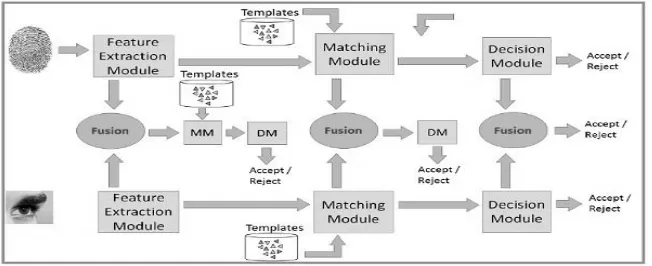
biometric modalities to identify an individual are called multimodal biometric systems. The block diagram of
multimodal biometric system is shown in figure 1
Figure.1 Block diagram of multimodal biometric system 2.
Multimodal biometric system
Biometric systems which rely on Unimodal authentication system rely on single source of
information like face, fingerprint, voice, gait, iris, retina, etc.. These systems lack level of accuracy due to
noisy data, intra-class variations, inter-class similarities, non-universality and spoofing. It leads to
considerably high false acceptance rate (FAR) and false rejection rate (FRR), limited discrimination
capability, upper bound in performance and lack of permanence [7].These disadvantages imposed by
unimodal biometric systems can be overcome by including multiple sources of information for establishing
identity. These systems allow the integration of two or more types of biometric systems known as
Impact Factor: 4.123 biometrics [8]. These systems are able to meet the stringent performance requirements imposed by various
applications. They address the problem of non-universality, since multiple traits ensure sufficient population
coverage. They also deter spoofing since it would be difficult for an impostor to spoof multiple biometric
traits of a genuine user simultaneously. Furthermore, they can facilitate a challenge – response type of
mechanism by requesting the user to present random subset of biometric traits thereby ensuring that a „live‟
user is indeed present at the point of data acquisition.
2.1 Process of Multimodal Biometric Systems
The major steps involved in multimodal biometric systems are
Acquistion
Feature extraction Comparison Decision making Fusion process
The fusion process to integrate the information from two different authentication systems can be done at
any of the following levels −
During feature extraction.
During comparison of live samples with stored biometric templates.
During decision making.
Figure 2 shows how multimodal biometric system works.
Impact Factor: 4.123 If the fusion process is done at initial stage are considered to be more effective than the systems those
integrate the information at the later stages. The reason is the early stage contains more accurate
information than the matching scores of the comparison modules.
3. Fusion levels in multimodal biometric system
3.1 Fusion at data or feature level, (data/features)
Signals coming from different traits are preprocessed and then fusion specific algorithm is used to
obtain composite feature vector, which is again used for classification.
3.2 Fusion at the match score level.
Instead of combining feature vectors each matching is done individually then fusion is done to obtain
composite matching score
3.3 Fusion at the decision level.
The final outputs of multi classifiers are consolidated. Fusion at the match score is preferred. The
fusion improves performance, accuracy reliability, robustness, efficiency, fault tolerance. Figure 3 below
depicts the fusion levels in multimodal biometrics system.
Figure 3: Fusion levels in multimodal biometrics system
Biometric systems that integrate information at an early stage of processing are believed to be more
effective than those systems which perform integration at a later stage. The reasons are i) Feature set from
various modalities may not be compatible. ii) Most commercial biometric systems do not provide access to
feature sets. Fusion at decision level is considered rigid due to availability of limited information. Thus,
Impact Factor: 4.123
4.
Fusion Scenarios in Multimodal Biometric System
Within a multimodal biometric system, there can be variety in number of traits and components. They
can be as follows −
Single biometric trait, multiple sensors.
Single biometric trait, multiple classifiers (say, minutiae-based matcher and texture-based matcher).
Single biometric trait, multiple units (say, multiple fingers).
Multiple biometric traits of an individual (say, iris, fingerprint, etc.).
These traits are then operated upon to confirm user‟s identity. [10]
5.
Applications
The defense and intelligence communities require automated methods capable of rapidly
determining an individual‟s true identity as well as any previously used identities and past activities, over a
geospatial continuum from set of acquired data. A homeland security and law enforcement community
require technologies to secure the borders and to identify criminals in the civilian law enforcement
environment. Key applications include border management, interface for criminal and civil applications, and
first responder verification. Enterprise solutions require the oversight of people, processes and technologies.
Network infrastructure has become essential to functions of business, government, and web based business
models. Consequently securing access to these systems and ensuring one‟s identity is essential. Personal
information and Business transactions require fraud prevent solutions that increase security and are cost
effective and user friendly. Key application areas include customer verification at physical point of sale,
online customer verification etc.[11-13]
6
. Conclusion
This paper presents the study on multimodal biometric systems in an expectation that future
biometrics applications will use multiple biometric modalities so that the performance of identification will
be improved with a good accuracy level. To conclude, as biometrics is popularly effective for person
identification in various levels of implementation it can be made more effective by combining more than one
biometric traits , that is multimodal biometric systems. Such systems is expected to be unavoidable in the
Impact Factor: 4.123
References
[1]"Biometrics:Overview". Biometrics.cse.msu.edu. 6 September 2007. Archived from the original on 7 January 2012. Retrieved 2012-06-10.
[2] Jain, A.; Hong, L. and Pankanti, S. (2000). "Biometric Identification". Communications of the ACM, 43(2), p. 91– 98. DOI 10.1145/328236.328110
[3] Jain, Anil K.; Ross, Arun (2008). "Introduction to Biometrics". In Jain, AK; Flynn; Ross, A. Handbook of Biometrics. Springer. pp. 1–22. ISBN 978-0-387-71040-2.
[4] Damaševičius, R.; Maskeliūnas, R.; Venčkauskas, A.; Woźniak, M. Smartphone User Identity Verification Using Gait Characteristics, Symmetry 2016, 8, 100.
[5] Sahidullah, Md (2015). "Enhancement of Speaker Recognition Performance Using Block Level, Relative and Temporal Information of Subband Energies". PhD Thesis (Indian Institute of Technology Kharagpur).
[6] "Biometrics for Secure Authentication" (PDF). Archived from the original (PDF) on 25 March 2012. Retrieved 29 July 2012.
[7] https://www.bayometric.com/unimodal-vs-multimodal/
[8] A. Ross, A.K. Jain, “Multimodal Biometrics: An Overview ”, 12th European Signal Processing Conference (EUSIPCO), Vienna, Austria, pp . 1221- 1224, 9/2004.
[9] L. I. Kuncheva, C. J. Whitaker, C. A. Shipp, and R. P. W. Duin, “Is independence good for combining classifiers?” in Proceedings of International Conference on Pattern Recognition (ICPR), vol. 2, (Barcelona, Spain), pp. 168–171, 2000.
[10] https://www.tutorialspoint.com/biometrics /multimodal_biometric_systems.htm
[11] V.Sireesha, K.Sandhyarani,” Overview of multimodal biometrics”, publications of problems & application in
engineering research –paper, vol 04, special issue01,pp. 170-173,2013.
[12] Deepthi Bala “Biometrics and Information security “,Proceedings of the 5th annual conference on Information
security curriculum development 64-66.2008