_____________________________________________________________________________________________________ *Corresponding author: E-mail: [email protected], [email protected];
Optimization for Oxalic Acid Production by
Aspergillus niger
Using Response Surface
Methodology
D. M. Chioma
1*and O. K. Agwa
11Department of Microbiology, Faculty of Science, University of Port Harcourt, P.M.B 5323
Port Harcourt, Rivers State, Nigeria.
Authors’ contributions
This work was carried out in collaboration among all authors. Author DMC designed the study, performed the statistical analysis, wrote the protocol and wrote the first draft of the manuscript. Author OKA managed the analyses of the study and the literature searches. All authors read and approved the final manuscript.
Article Information
DOI: 10.9734/JAMB/2019/v17i330145 Editor(s): (1) Dr. Niranjala Perera, Department of Food Science and Technology, Wayamba University of Sri Lanka, Sri Lanka. Reviewers: (1) Tihomir Kovač, University of Osijek, Croatia. (2)Prabha R, Karnataka Veterinary, Animal and Fisheries Sciences University, India. (3) V. Mageshwaran, ICAR-Central Institute for Research on Cotton Technology, India. Complete Peer review History:http://www.sdiarticle3.com/review-history/50308
Received 17 May 2019 Accepted 27 July 2019 Published 05 August 2019
ABSTRACT
Aims: To optimize selected process variables for oxalic acid production by Aspergillus niger using Response surface methodology.
Study Design: Central composite design.
Place and Duration of Study: Department of Microbiology, University of Port Harcourt, Rivers State, Nigeria.
Methodology: Three media for the study was set up- algal biomass medium, sucrose medium and
mixture of both algal biomass and sucrose medium. Inoculum of Aspergillus niger was prepared and
subsequently inoculated into media for oxalate production by submerged fermentation. The oxalate produced after 14 days was determined by the catalytic effect of oxalic acid on the redox reaction between rhodamine B and dichromate.
Results: The predicted conditions of pH 6.838, temperature 35ºC and substrate algal biomass and
sucrose with oxalic acid production of 8.618 g/L were reported in the study. This slightly varies with the experimental conditions of pH 6, temperature 35ºC, algal biomass and sucrose mixture and
oxalic yield of 12.12 g/L. The R2 value of 0.968 validates the model and adjusted R2 of 0.9449
shows that the model is significant.
Conclusion: The study shows the feasibility of using the response surface methodology (RSM) in optimizing pH, temperature and substrate for the production of oxalic acid (g/l). It further shows the increased possibility of algal biomass as alternative feedstock for production of organics.
Keywords: Aspergillus niger; algal biomass; response surface methodology; oxalic acid.
1. INTRODUCTION
Oxalic acid is a dicarboxylic acid with the IUPAC
formula, H2C2O4. It is a strong acid and usually
occurs as a free acid but more often as calcium salt. It has wide applications in pharmaceutical, textile, wastewater treatment and food industry as well as hydrometallurgy [1]. It is used as an anti-browning agent for apples [2] and for removal of kaolin iron as a result of its high reducing power [3,4].
Currently, most of the oxalic acid used today is produced by synthetic methods. These chemical processes include: (i) oxidation of olefins and glycols (ii) fusion of sawdust with caustic soda
(iii) fermentation of carbohydrates (iv)
decomposition of formats (v) radiation processing of carbonate solutions and molasses [5,6] Regrettably, these synthetic processes have
been reported to be eco-harmful and
unsustainable thus, the need for a more sustainable ecologically friendly approach.
Oxalic acid has been reported to be
biosynthetically produced by bacteria, fungi, plants and animals [7]. Some microorganisms that have been reported to produce oxalic acid
include: Aspergillus ficuum [8]; Glyophyllum
trabeum [8]; Paxillus involutus [9]; Penicillium oxalicum [10] and Aspergillus niger [11]. A. niger has been reported to give the highest amount of yield hence its preference over other isolates. The organism is generally accepted because of ease of handling, rapid growth and its versatility in fermenting cheap raw materials [12,13].
In a bid to synthesize oxalic acid from cheap substrates and optimize process parameters, some authors have employed experimental design and optimization tools such as Annual Neural Network (ANN) and Response Surface Methodology (RSM) for their research [11]. RSM is an experimental design and mathematical modeling tool which involves the partial regression fitting of the experimental factors [14].
It is currently preferred because it has an edge of reducing the number of experimental runs needed to give satisfactory information for statistically acceptable results. The conventional
one-factor method used for optimizing
fermentation media parameters one at a time is labourious, time consuming and ignores the
interaction between independent process
parameters [15]. In addition, [16] reported that optimization of process variables is very important because of its impact on the feasibility and economy of the fermentation process.
Furthermore, optimization of fermentation
variables is essential because of the complexity of the metabolic state in fungus for increased yield of the desired product [17]. RSM has been applied in research for optimizing various processes such as biodiesel production by Novozym 435 [18]; production of scleroglucan [19], production of citric acid [20]; thermostable lipase [21]; biodiesel production from alkaline transesterification of rice bran oil [22]; production of ethanol [14]; oxalic acid production from sweet potato starch hydrolyzate [23] and oxalic acid production from cashew apple juice [11].
In this study, oxalic acid production from algal biomass slurry, sucrose medium and mixture of algal biomass and sucrose medium using A. niger in submerged fermentation system was investigated. In order to optimize the process variables, the central composite design (CCD) and RSM were employed to determine the effect of three factors (substrate type, pH, and temperature) and their reciprocal interactions on oxalic acid yield.
2. MATERIALS AND METHODS
2.1 Media Preparation
2.1.1 Cultivation of microalgae
of the organism was obtained by repeated sub-culturing of the isolate on nutrient agar using spread plate technique, supplemented with a mixture of chloramphenicol (62.5 μg/ml) and nystatin (100 μg/ml) to ensure free fungal and bacterial cultures. The algal strain was selected after preliminary screening using biochemical and morphological characteristics and was finally maintained on agar slants until when required [24]. Five milliliters of the bloomed culture was aseptically inoculated into flasks containing effluent-and freshwater medium. About 1ml of the bloomed culture was inoculated into a defined synthetic medium (0.132 g/L Potassium nitrate, 0.066 g/L sodium silicate, 0.066 g/L monosodium phosphate and 0.066 g/L EDTA. The pH of the medium was adjusted to 6.5 with 4M NaOH prior to autoclaving at 121ºC for 15 minutes [25]. The setups were maintained at 28±2ºC under natural illumination and aerated intermittently by shaking at interval for 14 days. Samples were periodically removed every 48 h to monitor changes in algal concentration, optical density and biomass as dry weight was determined [25].
Three different media were setup: algal biomass medium, sucrose medium and mixture of both algal biomass and sucrose medium. The algal biomass medium was setup by aseptically harvesting 100 ml of wet algal biomass and subsequently transferred into 250 ml conical flask. The sucrose medium (100 ml) was prepared in line with the manufacturer’s specification and supplemented with 1.6 g/L
yeast extract, 0.025 g/L KCL, 1.5 g/L NaNO3,
0.025 g/L MgSO4.7H2O and 0.5 g/L KH2PO4 [11].
The third medium was setup by measuring 50 ml of the two media previously prepared and aseptically transferred into a 250 ml conical flask. In order to maintain the pH conditions of 5,6 and 7; the pH condition of the three set-ups were then adjusted with 4.0 M NaOH and 3.0 M HCl and maintained during the study [26].
2.2 Inoculum Preparation for Oxalic Acid
The strain of Aspergillus niger which served as
the inoculum was obtained locally from the department of Microbiology, University of Port
Harcourt, Choba, Nigeria. Spores of A. niger
were grown on Potato dextrose agar (PDA) for
5-7 days at 30ºC. Afterwards, the Aspergillus
niger spores were aseptically transferred into 100 ml sterile distilled water [11]. Inoculum size of 5% (v/v) was inoculated aseptically into the setups.
2.3 Oxalic Acid Determination
The oxalic acid produced after 14 days was measured using the technique reported by Jiang et al. [26] which is based on the catalytic effect of oxalic acid on the redox reaction between rhodamine B and dichromate neasured at
absorption wavelength of 555 nm in
tetraoxosulphate (vi) acid (H2SO4). 10 ml of the
sample was taken from the fermentation medium and filtered with Whatman No 1 filter paper. Afterwards, 1 ml from the filtrate was added to 0.5mL of 0.06M potassium dichromate. Then,
0.20 mL of 2.5M H2SO4 and 0.10 mL of 3.28x10
-4
M rhodamine B were added and brought up to 10mL in a test tube and mixed vigorously. The resulting mixture was placed in a water bath at 90ºC for 8 minutes. After cooling, the absorbance of the mixture was read at 555 nm against the blank solution. The oxalic acid concentration was determined using a standard curve prepared with synthetic oxalic acid.
2.4 Experimental Design by Central Composite Design (CCD)
This study was designed to optimize some
process variables for oxalic acid production by A.
niger Three factors that have been reported to influence oxalic acid synthesis (pH, temperature and substrate) were chosen as independent variables. The factors were tested at three levels: minimum, middle and maximum (Table 1). A central composite design was used to generate 27 experimental conditions used to investigate the selected factors for optimization. A first-order polynomial was used to express oxalic acid as a function of the independent variable as follows:
e x x x x x x x x x x x y 2 2 8 2 1 7 3 2 6 3 1 5 2 1 4 3 3 2 2 1 1 0
(1) wherey is the predicted response factor (oxalic acid)
β0, β1, β2, β3, β4, β5, β6, β7 and β8 are constant
regression coefficients of the model, in which β0
is the intercept term, β1 and β2 are linear
coefficients, β7 and β8 are quadratic coefficients
and β3, β4, and β5 is the interactive coefficient.
2.5 Statistical Analysis
Table 1. Coding of factors and levels for oxalate production
Factor Symbols Coded factors
-1 0 +1
pH A 5.00 6.84 7.00
Temperature B 25 35 35
Substrate C Algal biomass Algal biomass+sucrose Sucrose
optimization of oxalic production. The f-value and
p-value were determined and used to appraise
the significance of the model. The multiple
coefficient of determination R2, the adjusted R2
and predicted R2 were used to evaluate the
performance of the regression equation. The statistical evaluation of the model was evaluated with the analysis of variance (ANOVA).
3. RESULTS AND DISCUSSION
3.1 Effluent-freshwater Characteristics and Wet Algal Biomass Composition
The results of analysis of the medium for growth of algal biomass used in this study and the composition of the algal biomass has been reported in previous study by authors [25].
3.2 Modelling and Optimization of Oxalate Production
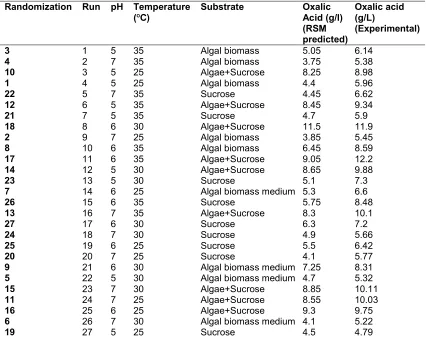
After the preliminary studies, response surface methodology with central composite design was used to model for oxalic acid production. Table 2 below shows the conditions, predicted and experimental oxalic acid yields.
The data obtained were fitted into the second-order equation for the three different substrates as shown below.
Algal medium
Y= -78.19259 + 18.88333A + 1.895*B–
0.017500*A*B - 1.56389*A2 - 0.028889*B2 (2)
Algal biomass-sucrose medium
Y= -74.98704 + 19.35000*A + 1.82833*B –
0.017500*A*B - 1.56389*A2 - 0.028889*B2 (3)
Sucrose medium
Y= -78.84259 + 19.15000*A + 1.8650*B –
0.017500*A*B - 1.56389*A2 - 0.028889*B2 (4)
Where Y is oxalic yield in g/L, A is pH and B is temperature in ºC.
Table 2 shows the predicted and experimental oxalic yields for the different factors considered in the study. Table 3 shows the analysis of variance, test of significance of the regression
equation model results, coefficient of
determination (R2), adjusted R2 and predicted R2.
The R2 of the model demonstrate good
correlation between the predicted and observed
values. The R2 value of 0.9682 showed that
96.82% sample variation for oxalic acid production is attributable to the independent factors and 3.18% of the total variation are not
accounted for by the model [1]. The R2 value
reported in this work varies with 0.9964 as reported by Betiku et al. [1] and this could be attributed to the different independent variables
employed in the study. The adjusted R2 of
0.9449 indicated that the model was significant
as it has been suggested that R2 should be
greater than 80% for the good fit of a model [27]. The results showed that the p-values of the
model were significant at p<0.05 and the
observed p-value of 0.0001 and the
corresponding high F-value of 41.51 obtained was significant. Also, it is evident from table 3 that the linear effect of substrate have significant
(p<0.05) effect on oxalic acid production. Also,
there is significant (p<0.05) effect of the square
of pH and temperature on the production of oxalic acid. However, the linear terms of pH and temperature were reported as not having a
significant effect (p<0.05) on the oxalic acid
production. This disagrees with [1] who reported that pH has significant effect on oxalic acid production.
3.3 Model Prediction
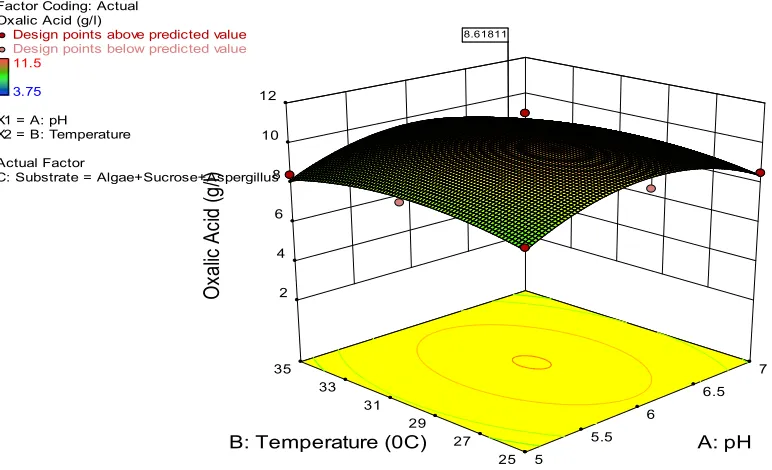
optimal production of oxalic acid by A. niger. The differences in optimal conditions could be attributed to the different fermentation media and study designs used. The oxalic acid yield
reported disagrees with [28,29] who reported an oxalic acid yield of 21.5 g/L and 68 g/L. This disagreement is attributable to the different substrates employed for the study. The oxalic
Table 2. Experimental design for the processing conditions for oxalic acid production (g/l)
Randomization Run pH Temperature (ºC)
Substrate Oxalic
Acid (g/l) (RSM predicted)
Oxalic acid (g/L)
(Experimental)
3 1 5 35 Algal biomass 5.05 6.14
4 2 7 35 Algal biomass 3.75 5.38
10 3 5 25 Algae+Sucrose 8.25 8.98
1 4 5 25 Algal biomass 4.4 5.96
22 5 7 35 Sucrose 4.45 6.62
12 6 5 35 Algae+Sucrose 8.45 9.34
21 7 5 35 Sucrose 4.7 5.9
18 8 6 30 Algae+Sucrose 11.5 11.9
2 9 7 25 Algal biomass 3.85 5.45
8 10 6 35 Algal biomass 6.45 8.59
17 11 6 35 Algae+Sucrose 9.05 12.2
14 12 5 30 Algae+Sucrose 8.65 9.88
23 13 5 30 Sucrose 5.1 7.3
7 14 6 25 Algal biomass medium 5.3 6.6
26 15 6 35 Sucrose 5.75 8.48
13 16 7 35 Algae+Sucrose 8.3 10.1
27 17 6 30 Sucrose 6.3 7.2
24 18 7 30 Sucrose 4.9 5.66
25 19 6 25 Sucrose 5.5 6.42
20 20 7 25 Sucrose 4.1 5.77
9 21 6 30 Algal biomass medium 7.25 8.31
5 22 5 30 Algal biomass medium 4.7 5.32
15 23 7 30 Algae+Sucrose 8.85 10.11
11 24 7 25 Algae+Sucrose 8.55 10.03
16 25 6 25 Algae+Sucrose 9.3 9.75
6 26 7 30 Algal biomass medium 4.1 5.22
19 27 5 25 Sucrose 4.5 4.79
Table 3. ANOVA for response surface quadratic model
Source Sum of
Squares
df Mean Square
F Value
p-value Prob> F
Model 114.72 11 10.43 41.51 < 0.0001 Significant
A-pH 0.48 1 0.48 1.92 0.1856
B-Temperature 0.27 1 0.27 1.07 0.3173
C-Substrate 95.08 2 47.54 189.24 < 0.0001
AB 0.092 1 0.092 0.37 0.5544
AC 0.66 2 0.33 1.31 0.2992
BC 0.33 2 0.17 0.67 0.5285
A2 14.67 1 14.67 58.41 < 0.0001
B2 3.13 1 3.13 12.46 0.0030
Residual 3.77 15 0.25
Cor Total 118.49 26
R-squared (R2)=0.9682
Fig. 1. Optimal response surface plot of oxalic acid production as a function of pH, temperature and substrate
Fig. 2. Optimal response contour plot of oxalic acid production as a function of pH, temperature and substrate
yield reported in this work also is lesser than that of [8] who reported a yield of 38 g/L. The relatively lower oxalic acid yield as reported in this work could be ascribed to the unavailability
of the nutrients in the fermentation medium as the algal biomass used in this work was not pretreated prior to its usage as main carbon source.
Design-Expert® Software Factor Coding: Actual Oxalic Acid (g/l)
Design Points 11.5
3.75
X1 = A: pH X2 = B: Temperature
Actual Factor
C: Substrate = Algae+Sucrose+Aspergillus
5 5.5 6 6.5 7
25 27 29 31 33
35 Oxalic Acid (g/l)
A: pH
B
: T
em
pe
ra
tu
re
(
0C
)
8.5
8.5
9
9 9
9.5 9.5
10 10.5
Prediction 8.61811
Design-Expert® Software Factor Coding: Actual Oxalic Acid (g/l)
Design points above predicted value Design points below predicted value
11.5
3.75
X1 = A: pH X2 = B: Temperature
Actual Factor
C: Substrate = Algae+Sucrose+Aspergillus
25 27 29 31 33 35
5
5.5 6
6.5 7 2
4 6 8 10 12
Ox
a
lic
A
ci
d
(
g
/l)
A: pH B: Temperature (0C)
4. CONCLUSION
The study has shown the feasibility of using the
response surface methodology (RSM) in
optimizing pH, temperature and substrate for the production of oxalic acid (g/l). The study also highlights the prospect of using algal biomass as a source of carbon for oxalic acid production. The model predicted the conditions: pH value of 6.8, temperature value of 35ºC and algal biomass-sucrose substrate as optimal conditions for oxalic acid production.
ACKNOWLEDGEMENTS
The authors wish to acknowledge the assistance of the technologists in the department of
Microbiology, University of Port Harcourt,
Nigeria.
COMPETING INTERESTS
Authors have declared that no competing interests exist.
REFERENCES
1. Betiku E, Emeko HA, Solomon BO.
Fermentation parameter optimization of microbial oxalic acid production from cashew apple juice. Heliyon. 2016;2: e00082.
2. Son SM, Moon KD, Lee CY. Kinetic study
of oxalic acid inhibition on enzymatic browning. J.Agric.FoodChem. 2000;48: 2071–2074.
3. Aghaie E, Pazouki M, Hosseini M, Ranjbar
M, Ghavipanjeh F. Response surface methodology (RSM) analysis of orgnic acid production for kaolin beneficiation by Aspergillus niger. Chem. Eng. J. 2009; 147:245-251.
4. Musiał I, Cibis E, Rymowicz W. Designing
a process of kaolin bleaching in an oxalic
acid enriched medium by Aspergillus niger
cultivated on biodiesel-derived waste
composed of glycerol and fatty acids, Appl.Clay Sci. 2011;52:277–284.
5. Mandel SK, Banerjee PC. Oxalic acid
production by Aspergillus niger: Influence
of hydrogen ion concentration and nitrogen source. Research Journal of Microbiology. 2006;1(2):190-197.
6. Nakata PA, He C. Oxalic acid
biosynthesisis encoded by an operon in
Burkholderia glumae, FEMS Microbiol.Lett. 2010;304:177–182.
7. Hodgkinson A. Oxalic acid in biology and
medicine, Academic Press, London, New York, San Francisco;1977.
8. Strasser H, Burgstaller W, Schinner E.
High-yield production of oxalic acid for
metal leaching processes by Aspergillus
niger. FEMS Microbiology letters. 1994; 9(31):365-370.
9. Lapeyrie F, Chilvers GA, Bhen CA. Oxalic
acid synthesis by the mychorrizal fungus Paxillus involutus. New Phytologist. 1987; 106(1):139-146.
10. Ikotum T. Production of oxalic acid by
Penicillium oxalicum in culture and in infected yam tissue and interaction with
macerating enzyme. Mycopathologia.
1984;88:9-14.
11. Emeko HA, Olugbogi AO, Betiku E.
Appraisal of artificial neural network and response surface methodology in modeling and process variable optimization of oxalic acid production. BioResources. 2015; 10(2):2067-2082.
12. Nadeem A, Syed Q, Baig S, Irfan M,
Nadeem M. Enhanced Production of Citric
acid by Aspergillus niger M-101 using
lower Alcohols. Turkish Journal of
Biochemistry. 2010;35(1):7-13.
13. Pandey P, Putatunda S, Dewangan L,
Pawar VS, Belorkar SA. Studies on citric
acid production by Aspergilllus niger in
batch fermentation. Recent Research in Science and Technology. 2013;5(2):66-67.
14. Wang M, Wang J, Tan JX, Sun JF, Mou,
JL. Optimization of ethanol fermentation from sweet sorghum juice using response surface methodology. Energy Sources. 2011;33:1139-1146.
15. Vishwanatha KS, Rao AG, Singh SA. Acid
protease production by solid-state
fermentation using Aspergillus oryzae
MTCC 5341: Optimization of process
parameters. Journal of Industrial
Biotechnology. 2010;37(2):129-138.
16. Liu BL, Tzeng YM. Optimization of growth
medium for production of spores from Bacillus thuringiensis using response
surface methodology. Bioprocess
Engineering J. 1998;18:413–418.
17. Dhillon GS, Brar SK, Verma RD. Tyagi,
18. Chang HM, Liao HF, Lee CC, Shieh CJ. Optimized synthesis of lipase-catalyzed biodiesel by Novozym 435. J. Chem. Technol. Biotechnol. 2005;80:307-312.
19. Desai KM, Survase SA, Saudagar PS, Lele
SS, Singhal RS. Comparison of artificial neural network and response surface
methodology in fermentation media
optimization: Case study of fermentative production of scleroglucan. Biotech. Eng. J. 2008;41:266-273.
20. Imandi SB, Bandaru VVR, Somanlanka
SR, Bandaru SR, Garapati HR. Application
statistical experimental design for
optimization of medium constituents for the production of citric acid from pineapple
waste. Bioresour. Technol. J.
2008;99:4445-4450.
21. Ebrahimpour A, Rahman RNZRA, Chng
DHE, Basri M, Salleh AB. A modeling study by response surface methodology and artificial neural network on culture parameters optimization for thermostable lipase production from a newly isolated
thermophilic Geobacillus sp. strain ARM.
BMC Biotechnol. 2008;8:96-110.
22. Rashid U, Anwar F, Asari TM, Arif M,
Ahmad M. Optimization of alkaline
transesterification of rice bran oil for
biodiesel production using response
methodology. J.Chem. Technol.
Biotechnol. 2009;84:1364-1370.
23. Adesina OA, Oluwabunmi KE, Betiku E,
Fatuntele LT, Ayodele OA, Adesanwo CA.
Optimzation of process variables for the production of oxalic acid from sweet potato starch hydrozylate. Chemical and Process Engineering Research. 2014;18:16-25.
24. Agwa OK, Abu GO. Utilization of poultry
waste for the cultivation of Chlorella sp. for
biomass and lipid production. International Journal Current Microbiology and Applied Sciences. 2014;3(8):1036-1047.
25. Chioma DM, Agwa OK. Production of
oxalic acid by Aspergillus niger using
Chlorella vulgaris grown with an industrial effluent as potential feedstock. Curr Trends Biomedical Eng & Biosci. 2018;16(1): 555928.
26. Jiang ZL, Mei-Xiu Z, Lin-Xiu L. Catalytic
Spectrophotometric for the determination of oxalic acid. Anal. Chim. Acta. 1996; 320:139-143.
27. Joglekar A, May A. Product excellence
through design of experiments. Cereal
Foods World. 1987;32:857-868.
28. Rymowicz W, Lenart D. Oxalic acid
production from lipids by a mutant of Aspergillus niger at different pH. Biotechnol. Lett. 2003;25:955–958.
29. André A, Diamantopoulou A, Philippoussis
A, Sarris A, Komaitis D, M. et al. Biotechnological conversions of bio-diesel derived waste glycerol into added- value compounds by higher fungi: Production of biomass, single cell oil and oxalic acid. Ind.Crop Prod. 2010;31:407–416.
_________________________________________________________________________________ © 2019 Chioma and Agwa; This is an Open Access article distributed under the terms of the Creative Commons Attribution License (http://creativecommons.org/licenses/by/4.0), which permits unrestricted use, distribution, and reproduction in any medium, provided the original work is properly cited.
Peer-review history: