Crack Failure Analysis of Scaffolding Frame
Intersection using ADINA
KrIShNAprAKASh AruNAChAlAm
1and moNIKANDoN SuKumArAN
2*
1Department of Civil Engineering, University College of Engineering Nagercoil,
Kanniyakumari, 629004, Tamil Nadu, India.
2Department of Basic Engineering, College of Fisheries Engineering,
Tamil Nadu Fisheries University, Nagapattinam 611 001, Tamil Nadu, India. *Corresponding author E-mail: [email protected]
http://dx.doi.org/10.13005/msri/140108
(Received: March 01, 2017; Accepted: March 22, 2017) AbStrACt
This paper describes the analysis of scaffold frame intersection joint crack. Independent scaffolding type is selected and analyzed for the cracks and deformations. The modelling of the structure is done with the Solid works software and the rendered model was imported to ADINA structures software. All the dimensions for the scaffold design were followed as specified in the standard codes BS4945. Live loads of 2kN/sq.m were taken. The post processing is executed and the results were generated. The results show that maximum bending moment 11.94N-m is at intersection joints particularly at joints. The minimum bending moment -13.44N–m has occurred below the junction the effective stress calculated around the junction of the scaffold is 3.493N/mm2 and the deformation of the scaffolding frame is at intersection joints and the cracks are formed. Visualizing the crack by using ADINA may be the best way to estimate the deformation modes and crack. This will definitely be useful for the remedial measures to prevent cracks in a scaffold structure.
Keywords: ADINA Structures, crack visualizing, Crack failure analysis, independent scaffold type, Deformation of Scaffold.
INtroDuCtIoN
Scaffolding is used on new building projects, and for existing structure including maintenance, repair and painting work. The temporary structure needs to be structurally safe yet also capable of rapid erection, disassembly and reuse. Scaffolds are temporary structures commonly used in construction to support various types of loads12. In Building
construction some form of temporary support is required to provide a safe and convenient working area above ground level8. The main elements
of scaffolding are standards, ledgers, transoms, base plate, base jack and diagonal bracings8.
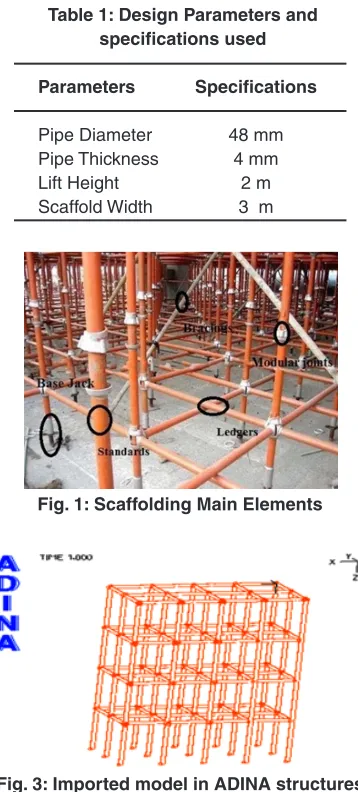
Figure 1 represents the main element of the scaffolding structure. The scaffolding failure occurs due to crack/collapse due to excess load, poor
design of the scaffolding structure10. Generally steel
tubular scaffoldings are used due the high strength, durability as well they can be reused the diameter of the tubular steel used as ledgers and standards vary from 42mm to 48mm with the approximate thickness of 3mm12, 13, 14. Scaffolding for the single storey
double bay scaffolds with boundary conditions, joints are assumed as rigid were reported1. The objective
of this paper is to describe the analysis of scaffold frame intersection joint crack for independent scaffolding using ADINA structures software.
ExpErImENtAl
modelling of scaffold frame
Scaffold frame sections are designed for the 6 m x8 m side wall. Selected model was independent scaffolding frame system. Table 1 describes the dimension of the scaffolding frame. After completing the scaffolding model the section are saved as the parasolid (X_t) model type. Figure 2 represents the independent scaffold model for G+1 residential building using solid works software. The output scaffold model is imported to the ADINA structures software. Figure 3 represents the imported model of independent scaffold section from solid works to ADINA structures.
Design procedure
The following design principles are used in creating the model and analyzing the scaffold frame intersection
• Defining Model Geometry • Specifying Boundary conditions • Applying loads and material properties • Meshing
• Post-processing Defining model geometry
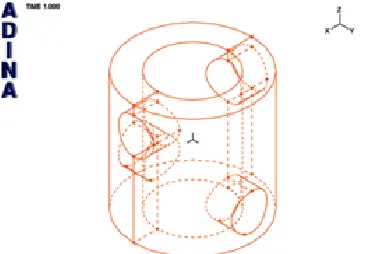
The model geometry already done with the help of solid works is imported to ADINA structures. The Import model is saved in the parasolid format and the analysis are done for the intersection and joints. Figure 4 represents the intersection member of the scaffold frame. Figure 5 shows the scaffold frame intersection joints.
Specifying boundary conditions
The boundary conditions are given through the fixity icon. It is used to fix some or all degrees of freedom on certain parts of model to geometric entities or sets of nodes, element faces/edges. Applying loads and material properties
Load conditions are applied using load icon. Live loads of 2kN/sq.m were taken. Load acting on the scaffold frame intersection members are generally considered as distributed load and in scaffold frame intersection joints it is considered as
Fig. 1: Scaffolding main Elements Fig. 2: Scaffold Design using Solid works
Fig. 3: Imported model in ADINA structures Fig. 4: Scaffold frame intersection member table 1: Design parameters and
specifications used
parameters Specifications
Pipe Diameter 48 mm Pipe Thickness 4 mm
Lift height 2 m
point load. Figure 6 shows the load acting on the ledgers (ie) the horizontal member of the scaffold frame. For scaffold frame joints load are considered as the same value given on the scaffold frame member. After applying the load we can visualize the cracks formed between the junctions of the scaffolding frame. Figure 7 evidently shows the load acting on the joints of the intersection frame and also the crack formed. Young’s modulus 2.07E11 and the Poisson’s ratio 0.29 are taken as common
material properties for both the intersection frames and intersection joints frame sections.
meshing
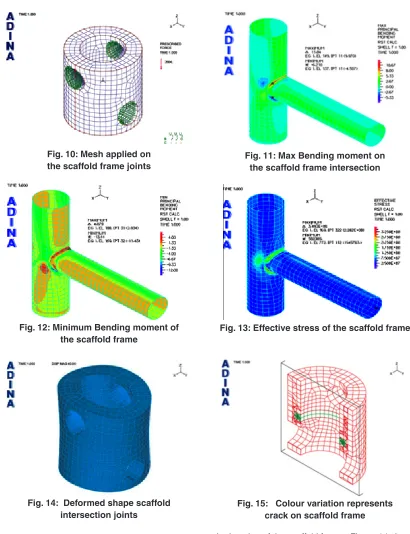
Meshing is performed to generate finite elements on geometry in the model. Figure 8 represents the mesh created on the surface of scaffold intersection member. For cracks which are formed inside the scaffold frame junction also meshing group elements are created. Figure 9 represents the mesh created on the crack surface. Figure 10 shows the meshing group elements created for the scaffold frame joints.
rESultS and DISCuSSIoNS
Post-processing method helps in getting the results. The output model (.por) file is open with the help of post-processing AUI database. The concentration of bending moment at intersection particularly joints are getting higher value. From figure 11 and graph red colour indicates higher bending moment. The graphics window show the Fig. 5: Scaffold frame intersection joint
Fig. 6: load acting on the scaffold frame member
Fig. 8: mesh created on the scaffold frame
Fig. 7: load acting on the scaffold frame joint
Fig. 10: mesh applied on
the scaffold frame joints Fig. 11: max bending moment on the scaffold frame intersection
Fig. 12: minimum bending moment of the scaffold frame
Fig. 13: Effective stress of the scaffold frame
Fig. 14: Deformed shape scaffold intersection joints
maximum bending moment as 11.94 N-m. From figure 12 and the graph, blue colour represents minimum bending moment has occurred below the junction. The graphics window shows the minimum bending moment is -13.44 N-m. The graphics window and figure 13 shows the maximum effective stress as 3.493 N/mm2 which is calculated around
the junction of the scaffold frame. Figure 14 shows that deformations take place due to applied load and the round shape scaffold gets deformed. After deformation it is similar to oval shape and deformation of the scaffold frame is at intersection joints. Figure 15 shows the difference between the crack and scaffold frame structure joints. Cross
sectional views can clearly make understand the crack formation inside the structure. The colour variation also helps to understand the purpose. This shows the exact crack design can be visualized in the ADINA structures.
CoNCluSIoN
This paper using ADINA structures shows that the crack could possibly occur in the joints of scaffolding. Using ADINA structures estimation of deformation modes can be done with accuracy. All
the stresses, strains and other calculations can also be computed and analyzed. Visualizing cracks will definitely be useful for the remedial measures to prevent cracks in a scaffold structure.
ACKNowlEDgEmENt
Monikandon Sukumaran thanks College of Fisheries Engineering, Tamil Nadu Fisheries University Nagapattinam for motivation towards research.
rEFErENCES
1. Chu AYT, Chan SL, Chung KF., Stability of modular steel scaffolding systems – theory and verification. Proceedings of International Conference, Advances in Building Technology, hong Kong, 2002, pp. 621-628.
2. Godley MhR, Beale RG., Analysis of large proprietary access scaffold structures. Proceedings of the Institution of Civil Engineers: Structures and Buildings, 146 UK, pp. 31-39, 2001.
3. Godley, MNR and Beale, RG, Sway Stiffness of Scaffold Structures. The Structural Engineer, 75(1), 1997.
4. Gylltoft K, Mroz K., Load carrying capacity of scaffolds. Structural Engineering International; 1:37-42, 1995.
5. John Enright, Robert harriss, and Gregory J. hancock, Structural Stability of Braced Scaffolding and Formwork with Spigot Joints. International Specialty Conference on Cold-Formed Steel Structures. Paper 2, October 2000.
6. Jui-Ling Peng, Chi-Ling Pan, Kuan-Hung Chen, and Siu-Lai Chan, Structural Analysis of Scaffolding with the Plank and Anchor Rod During Construction, International Specialty Conference on Cold-Formed Steel Structures. October 14, 2008, Paper 3.
7. Lightfoot, E and Oliveto, G, The Collapse Strength of Tubular Steel Scaffold Assemblies, Proceedings, Institution of Civil Engineers, Part 2(63), pp-311-329, June 1997.
8. Mogarkar, Valsson VargheseA Concept for Development, Safe Erection and Use of Scaffolding for high Rise Buildings,
International Journal of Innovative Technology and Exploring Engineering,1(2), pp224-226, 2012.
9. Matthew Ryan Diering, Ergonomic evaluation of scaffolding task interventions for power plant maintenance, http://www.lib.ncsu. edu/resolver/1840.16/1034, accessed Date 18.04.2016.
10. Peng JL, Chan SL, Wu CL., Effects of geometrical shape and incremental loads on scaffold systems. Journal of Constructional Steel Research; 63(4): 448-459, 2007. 11. R. Lacalle, S. Cicero, D. Ferreno, J.A.
Alvarez, Failure analysis of a bolt in a scaffolding system. Engineering Failure Analysis, 15(3), Pages 237–246, 2008. 12. Tayakorn Chandrangsu, Kim JR Rasmussen,
Review of past research on scaffold system, Research Report No R905 October 2009. 13. Tayakorn Chandrangsu, Kim JR Rasmussen,
Structural Modelling of Support Scaffold Systems, Research Report No R896, June 2009.
14. Tayakorn Chandrangsu, Kim JR Rasmussen, Scaffold cuplock joint test, Research Report No R893, December 2008.
15. Viunov Valerii, Comparison of scaffolding system in Finland and in Russia, Saimaa University of Applied Sciences Technology, Lappeenranta, Bachelor Thesis 2011. 16. Yu WK, Chung KF, Chan SL. Structural