R E S E A R C H A R T I C L E
Open Access
Effects of clobazam for treatment of
refractory status epilepticus
Dominik Mad
ž
ar
*, Anna Geyer, Ruben U. Knappe, Stephanie Gollwitzer, Joji B. Kuramatsu, Stefan T. Gerner,
Hajo M. Hamer and Hagen B. Huttner
Abstract
Background:Clobazam (CLB) is a well characterized antiepileptic drug (AED) that differs from other benzodiazepines by its basic chemical structure and pharmacodynamic properties. Only one previous study examined the efficacy of CLB as add-on therapy in refractory status epilepticus (RSE).
Methods:We analyzed RSE episodes treated in our institution between 2001 and 2012. Successful treatment with CLB was scored if CLB was the last AED added to therapy before RSE termination. We assessed the differences between patients with and without CLB and correlated CLB with outcome. Among patients treated with CLB, we studied responders and non-responders and compared our CLB cohort with recently published data.
Results:CLB was part of the AED regimen in 24/70 (34.3 %) RSE episodes. In six of these (25.0 %) RSE resolution was attributed to CLB. Baseline characteristics of episodes with and without CLB treatment showed no significant differences and RSE termination rates were very similar (83.3 % vs. 80.4 %). CLB was administered in clinically more complex RSE with longer RSE duration and worse outcome, but CLB was not related independently to outcome. Comparison of our results with previously published data revealed that baseline characteristics as well as CLB maintenance doses and time of treatment initiation were similar in both cohorts. CLB was less frequently the last AED added to RSE therapy in our patients indicating a lower treatment success rate than previously reported.
Conclusions:CLB represents a reasonable AED and promising add-on agent for treatment of RSE. However, rates of successful CLB response were substantially lower than in a recently published study. Differing RSE characteristics and treatment strategies may account for the discrepancy between study results, as RSE etiologies and seizures types associated with unfavorable prognosis were more common in our cohort, while anesthetics tended to be less frequently applied to achieve seizure control.
Keywords:Refractory status epilepticus, Clobazam, Antiepileptic drugs, Outcome
Background
Treatment of refractory status epilepticus (RSE) fre-quently requires application of more than three antiepi-leptic drugs (AEDs). As there is a limited number of intravenous AEDs, orally administered AEDs represent a therapeutic option particularly for longer RSE episodes [1–3]. Recently, clobazam (CLB) has been associated with high rates of RSE termination [4]. CLB is a well characterized benzodiazepine with a unique chemical structure and special pharmacodynamic properties. While various studies investigated the efficacy of CLB
for treatment of refractory epilepsy, its potential in sta-tus epilepticus (SE) and particularly RSE remains uncer-tain [5]. We investigated the efficacy of CLB as add-on treatment in RSE and compared results with those of a recently published study.
Methods
Definition of refractory status epilepticus
SE was diagnosed on the basis of clinical and/or electro-encephalographic evidence of seizure activity with a dur-ation of at least 5 min, or of a series of seizures without interictal clinical recovery [6]. RSE was defined as SE re-fractory to administration of at least two properly dosed AEDs [7, 8].
* Correspondence:[email protected]
Department of Neurology, University Hospital Erlangen, Schwabachanlage 6, 91054 Erlangen, Germany
Identification of RSE episodes and inclusion/exclusion criteria
For identification of RSE episodes, we screened all consecutive patients treated for SE between January 2001 and December 2012 by analyzing our institutional databases including hospital records, clinical notes, and EEG reports. RSE due to hypoxic brain damage was ex-cluded as it was considered an entity of its own with a particularly poor prognosis [9]. Furthermore, for reasons of comparability with previous studies on RSE, simple-partial and absence RSE episodes were excluded [7, 10].
Collection of clinical and RSE-specific data
We obtained demographic baseline characteristics, labora-tory findings on hospital admission, RSE-specific informa-tion, and data on treatment and complications. RSE duration was defined as time from the onset of seizures until termination, the latter being confirmed either elec-troencephalographically or based on clinical improvement arguing against ongoing seizure activity. RSE etiology was assessed according to ILAE criteria (cryptogenic, acute, remote, or progressive symptomatic) [11] and was consid-ered potentially fatal when fulfilling the criteria proposed by Rossetti and coworkers [12]. Clinical severity was graded according to the Status Epilepticus Severity Score (STESS) and RSE episodes were dichotomized into STESS < 3 and STESS≥3 [13]. For every AED administered, we recorded the date of first application, the duration of treat-ment, and the dosage. All AEDs used for RSE therapy (in-cluding initial benzodiazepines as well as anesthetics) were counted as contributing to the total number of AEDs. In all episodes in which patients received CLB, EEG data were reviewed and the episodes were grouped into the following categories based on the findings on the first EEG: +/− lateralized periodic discharges (LPD), +/− lateralized seizure patterns or lateralized rhythmic delta activity (RDA), +/−generalized periodic discharges (GPD), generalized seizure patterns, or generalized RDA.
Outcome definition and assessment
The primary outcome measure was successful response to CLB, defined as“CLB responders”if CLB was the last AED added to treatment before RSE termination. The secondary outcome measure was functional outcome at last available follow-up. Functional outcome was assessed using the modified Rankin Scale (mRS). Poor outcome was defined when episodes either resulted in an mRS >2 or–in case of a premorbid mRS between 3 and 5 –if there was further functional decline, i.e. increase in the mRS.
Statistical analysis
We compared CLB responders and non-responders, pa-tients treated with and without CLB, and our CLB co-hort with the one reported by Sivakumar et al. [4].
Statistics were performed using SPSS Statistics 20.0 (www.spss.com). P values of 0.05 or less were considered statistically significant and all tests were two-sided. For assessment of frequency distributions of categorical vari-ables, Pearson χ2 test, or where appropriate, Fisher’s exact tests were applied. We used the Kolmogorov-Smirnov test to distinguish between normal and non-normal data distribution. Normally distributed data were compared with the Student’s t-test, non-normally dis-tributed data with the Mann-WhitneyUtest. In order to identify independent predictors of outcome, all variables significant on univariate analysis were entered into a for-ward inclusion multivariable logistic regression model. Parameters representing components of STESS were not added separately into the model when the overall STESS showed significant association upon univariate analysis.
Results
We identified 71 RSE episodes in 65 patients. We excluded one episode because CLB treatment had been initiated be-fore progression into RSE. Overall, RSE was treated with CLB in 24/70 (34.3 %) episodes. CLB was initiated after a median RSE duration of 2 days (IQR, 0–9 days) with a me-dian maintenance dose of 20 mg/day (IQR, 14–23 mg/ day) and was applied for a median of 8 days (IQR, 5–13 days). Therapy was preceded by a median of 4 (IQR, 3–6) other AEDs, while a median of 2 more AEDs (IQR, 0–4) followed CLB.
CLB was the last AED added to therapy and– accord-ing to the a priori definition – terminated RSE in 6/24 (25.0 %) episodes. Comparing CLB responders with non-responders revealed a significantly higher rate of acute symptomatic RSE etiology in non-responders, whereas essentially all basic characteristics as well as EEG fea-tures were similar among both groups (Table 1).
Table 1Comparison of clobazam responders and non-responders
Variable Treated with CLB (n= 24) CLB responders (n= 6) CLB non-responders (n= 18) P value Demographics
Gender, female 16 (66.7) 3 (50.0) 13 (72.2) 0.362b
Age on admission, y 64 (52–72) 70 (59–71) 64 (50–72) 0.820c
Age≥65 y 11 (45.8) 4 (66.7) 7 (38.9) 0.357b
Premorbid mRS 4 (1–4) 4 (4–5) 1 (1–4) 0.104c
RSE characteristics
NCSE in coma 4 (16.7) 1 (16.7) 3 (16.7) 1.000b
Generalized convulsive SE 8 (33.3) 3 (50.0) 5 (27.8) 0.362b
Complex-partial SE 12 (50.0) 2 (33.3) 10 (55.6) 0.640b
Stuporous or comatose 16 (66.7) 4 (66.7) 12 (66.7) 1.000b
Acute symptomatic etiology 10 (41.7) 0 (0) 10 (55.6) 0.024b
History of seizures 10 (41.7) 4 (66.7) 6 (33.3) 0.192b
Potentially fatal etiology 11 (45.8) 3 (50.0) 8 (44.4) 1.000b
STESS 3 (1–4) 3 (3–4) 3 (1–4) 0.537c
STESS≥3 15 (62.5) 5 (83.3) 10 (55.6) 0.351b
EEG features
Lateralized seizure patterns/RDA 9 (37.5) 2 (33.3) 7 (38.7) 1.000b
Lateralized periodic discharges 10 (41.7) 4 (66.7) 6 (33.3) 0.192b
Lateralized periodic discharges or seizure patterns/RDA 19 (79.2) 6 (100) 13 (72.2) 0.280b Laboratory findings on admission
Leukocyte count, ×103/μl 8.5 (6.3–12.0) 8.5 (8.0–10.3) 8.8 (5.8–12.2) 0.914c C-reactive protein, mg/l 18.0 (4.2–56.2) 3.4 (1.2–56.6) 33.0 (13.8–56.3) 0.446c
Hemoglobin, g/dl 11.2 (1.6) 10.9 (0.9) 11.3 (1.7) 0.622d
Serum sodium, mmol/l 136.5 (7.3) 136.8 (4.7) 136.4 (8.1) 0.908d
Treatment and complications
Duration of RSE, d 16 (8–32) 6 (4–36) 16 (10–27) 0.820c
Length of hospital stay, d 29 (13–61) 14 (6–53) 29 (14–57) 0.673c
Mechanical ventilation 13 (54.2) 3 (50.0) 10 (55.6) 1.000b
Length of mechanical ventilation, d 6 (0–43) 0 (0–30) 6 (0–48) 0.770c
Use of anesthetics 11 (45.8) 3 (50.0) 8 (44.4) 1.000b
Induction of burst suppression 11 (45.8) 3 (50.0) 8 (44.4) 1.000b
Number of AEDs 7 (5–11) 9 (5–14) 7 (4–11) 0.537c
Use of vasopressors 13 (54.2) 3 (50.0) 10 (55.6) 1.000b
Sepsis 8 (33.3) 3 (50.0) 5 (27.8) 0.362b
Outcome
RSE terminated 20 (83.3) 6 (100.0) 14 (77.8) 0.539b
Poor outcome at follow-upa 18 (78.3) 4 (80.0) 14 (77.8) 1.000b
In-hospital mortality 4 (16.7) 0 (0.0) 4 (22.2) 0.539b
Values are n (%), mean (±standard deviation) or median (interquartile range); significant (p< 0.05) parameters are expressed in bold
Abbreviations:AEDantiepileptic drug,CLBclobazam,mRSmodified Rankin Scale score,NCSEnoncunvulsive status epilepticus,RDArhythmic delta activity,RSE
refractory status epilepticus,SEstatus epilepticus,STESSStatus Epilepticus Severity Score
a
Data available for 23 episodes
b
Fisher’s exact test
c
Mann-WhitneyU-test
d
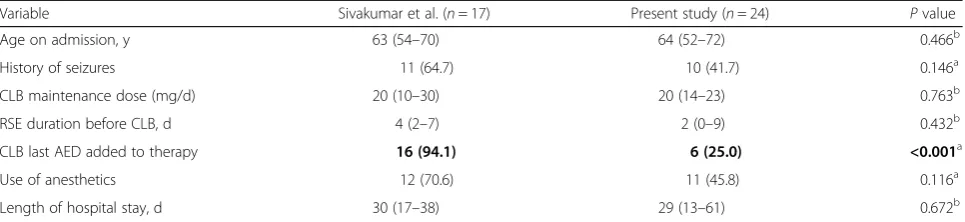
The comparison of our RSE patients treated with CLB with those from the study by Sivakumar and coworkers revealed no significant differences regarding patient age and duration of hospital stay. In our cohort, a history of seizures tended to be rarer and there was a trend toward
less frequent use of anesthetics. CLB maintenance doses and days in RSE before initiation of CLB treatment were similar, whereas CLB was the last AED added to therapy in a significantly lower number of patients in our cohort (Table 3).
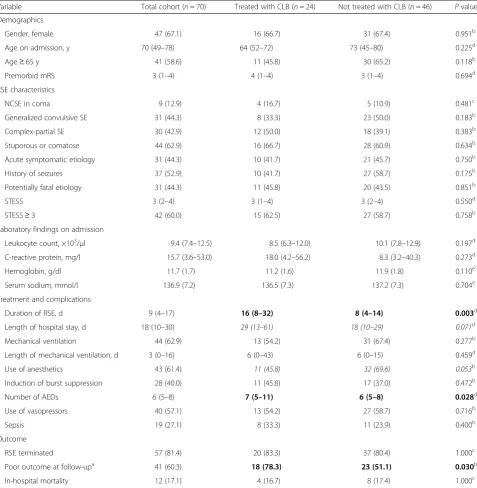
Table 2Comparison of episodes treated with and without clobazam
Variable Total cohort (n= 70) Treated with CLB (n= 24) Not treated with CLB (n= 46) Pvalue Demographics
Gender, female 47 (67.1) 16 (66.7) 31 (67.4) 0.951b
Age on admission, y 70 (49–78) 64 (52–72) 73 (45–80) 0.225d
Age≥65 y 41 (58.6) 11 (45.8) 30 (65.2) 0.118b
Premorbid mRS 3 (1–4) 4 (1–4) 3 (1–4) 0.694d
RSE characteristics
NCSE in coma 9 (12.9) 4 (16.7) 5 (10.9) 0.481c
Generalized convulsive SE 31 (44.3) 8 (33.3) 23 (50.0) 0.183b
Complex-partial SE 30 (42.9) 12 (50.0) 18 (39.1) 0.383b
Stuporous or comatose 44 (62.9) 16 (66.7) 28 (60.9) 0.634b
Acute symptomatic etiology 31 (44.3) 10 (41.7) 21 (45.7) 0.750b
History of seizures 37 (52.9) 10 (41.7) 27 (58.7) 0.175b
Potentially fatal etiology 31 (44.3) 11 (45.8) 20 (43.5) 0.851b
STESS 3 (2–4) 3 (1–4) 3 (2–4) 0.550d
STESS≥3 42 (60.0) 15 (62.5) 27 (58.7) 0.758b
Laboratory findings on admission
Leukocyte count, ×103/μl 9.4 (7.4–12.5) 8.5 (6.3–12.0) 10.1 (7.8–12.9) 0.197d C-reactive protein, mg/l 15.7 (3.6–53.0) 18.0 (4.2–56.2) 8.3 (3.2–40.3) 0.273d
Hemoglobin, g/dl 11.7 (1.7) 11.2 (1.6) 11.9 (1.8) 0.110e
Serum sodium, mmol/l 136.9 (7.2) 136.5 (7.3) 137.2 (7.3) 0.704e
Treatment and complications
Duration of RSE, d 9 (4–17) 16 (8–32) 8 (4–14) 0.003d
Length of hospital stay, d 18 (10–30) 29 (13–61) 18 (10–29) 0.071d
Mechanical ventilation 44 (62.9) 13 (54.2) 31 (67.4) 0.277b
Length of mechanical ventilation, d 3 (0–16) 6 (0–43) 6 (0–15) 0.459d
Use of anesthetics 43 (61.4) 11 (45.8) 32 (69.6) 0.053b
Induction of burst suppression 28 (40.0) 11 (45.8) 17 (37.0) 0.472b
Number of AEDs 6 (5–8) 7 (5–11) 6 (5–8) 0.028d
Use of vasopressors 40 (57.1) 13 (54.2) 27 (58.7) 0.716b
Sepsis 19 (27.1) 8 (33.3) 11 (23.9) 0.400b
Outcome
RSE terminated 57 (81.4) 20 (83.3) 37 (80.4) 1.000c
Poor outcome at follow-upa 41 (60.3) 18 (78.3) 23 (51.1) 0.030b
In-hospital mortality 12 (17.1) 4 (16.7) 8 (17.4) 1.000c
Values are n (%), mean (±standard deviation) or median (interquartile range); significant (p< 0.05) parameters are expressed in bold, parameters showing a statistical trend (p< 0.1) are expressed in italics
Abbreviations:AEDantiepileptic drug,CLBclobazam,mRSmodified Rankin Scale score,NCSEnoncunvulsive status epilepticus,RSErefractory status epilepticus,SE
status epilepticus,STESSStatus Epilepticus Severity Score
a
Data available for 68 episodes
b
Pearsonχ2test
c
Fisher’s exact test
d
Mann-WhitneyU-test
e
Discussion
CLB has an interesting pharmacological profile and its role in the treatment of refractory epilepsy is increas-ingly studied [5]. The possibility of nasogastral tube ad-ministration with excellent bioavailability [14] makes CLB moreover an AED alternative worth considering in RSE. In this study, we analyzed CLB for RSE and aimed to compare our findings with recently published data. We observed less convincing results regarding CLB effi-cacy in seizure termination. As a consequence of differ-ent definitions of CLB treatmdiffer-ent success, however, comparing our results with those of Sivakumar and co-workers is difficult. In their study, the latter used a strict definition only attributing RSE termination to CLB when SE was terminated within 24 h of CLB administration without changes in concurrent AEDs. Given that not all of our patients were monitored with continuous EEG and that we felt we could not with certainty exclude modifications in co-administered AEDs in a retrospect-ive approach, we chose to use a surrogate for successful CLB treatment, i.e. whether CLB was the last AED added to therapy before RSE termination. Sivakumar and coworkers reported that CLB was the last AED added in the vast majority of their cases. Compared to our findings, this would equal a significantly higher rate of successful CLB treatment according to our definition (94.1 % vs. 25.0 %; p< 0.001) [4]. As dosing and timing of CLB were similar in both studies, factors not directly associated with CLB treatment seem to substantially contribute to the discrepancies between study findings. A history of seizures, for instance, tended to be rarer in our cohort. As we furthermore excluded simple-partial RSE from analysis, seizure types and RSE etiologies gen-erally associated with a rather unfavorable prognosis [15] were probably more common in our study popula-tion. Despite this fact, the number of episodes treated with anesthetics tended to be lower than in the study of Sivakumar et al. which probably reflects diverse RSE treatment strategies and again underscores the difficulty of comparing the two studies.
Regarding our cohort, patients with and without CLB were similar in their baseline characteristics, but there were significant differences in RSE treatment-specific pa-rameters such that CLB treated episodes appeared clinic-ally more complex with longer RSE duration requiring more AEDs. Furthermore, CLB therapy was overrepre-sented in episodes in which the use of anesthetics was avoided or postponed, presumably to prevent negative side effects of therapeutic coma induction [16]. As far as one can conclude from existing studies, including the present one, it appears that CLB is rather applied in more severe RSE and is currently not considered an early choice AED [4]. Despite a comparatively low suc-cess rate, initiation of CLB was still linked to RSE reso-lution in some episodes and – in light of an internalization of GABA receptors with prolonged seiz-ure activity – CLB appears to still have effects despite RSE refractoriness to benzodiazepines [17]. That we ob-served no CLB responders among patients with acute symptomatic RSE etiology may potentially suggest differ-ent pathophysiological mechanisms involved.
The retrospective nature limits the interpretation of our data and large confidence intervals reflect certain data instability. Moreover, the small number of RSE epi-sodes treated with CLB reduces the generalizability of our findings. Not all of our patients received continuous EEG monitoring; this may cause imprecision in the as-sessment of time of RSE termination. Given the high median number of AEDs applied, effects of AEDs other than CLB in aborting seizures in our cohort cannot be ruled out in those cases in which CLB was the last AED added to therapy. We compared our patients with a co-hort from a previous study which applied different cri-teria for inclusion and assessment of treatment response. The results of this analysis have therefore to be inter-preted with due caution. We used the mRS for outcome assessment. Given a high median premorbid mRS score with some patients having 5 points already prior to ad-mission, it is possible that in certain cases new deficits caused by RSE may have not been reflected adequately. Table 3Comparison of clobazam treated patients from the study by Sivakumar et al. and the present study
Variable Sivakumar et al. (n= 17) Present study (n= 24) Pvalue
Age on admission, y 63 (54–70) 64 (52–72) 0.466b
History of seizures 11 (64.7) 10 (41.7) 0.146a
CLB maintenance dose (mg/d) 20 (10–30) 20 (14–23) 0.763b
RSE duration before CLB, d 4 (2–7) 2 (0–9) 0.432b
CLB last AED added to therapy 16 (94.1) 6 (25.0) <0.001a
Use of anesthetics 12 (70.6) 11 (45.8) 0.116a
Length of hospital stay, d 30 (17–38) 29 (13–61) 0.672b
Values are n (%), or median (interquartile range); significant (p< 0.05) parameters are expressed in bold
Abbreviations:CLBclobazam,RSErefractory status epilepticus
a
Pearsonχ2test
b
Conclusions
Even if we were unable to confirm the high rates of RSE resolution reported, CLB remains an interesting AED with evident effects on RSE. Despite CLB representing a reasonable therapeutic option in RSE, based on present data, rapid SE termination–if necessary with the use of anesthetics – should not be delayed for treatment at-tempts with CLB. Further studies using stronger statis-tical designs are warranted to determine the clinical efficacy of CLB in SE and RSE.
Abbreviations
AED:Antiepileptic drug; CI: Confidence interval; CLB: Clobazam;
EEG: Electroencephalography; IQR: Interquartile range; mRS: Modified Rankin Scale; NCSE: Nonconvulsive status epilepticus; RSE: Refractory status epilepticus; SE: Status epilepticus; STESS: Status Epilepticus Severity Score
Acknowledgements Not applicable.
Funding
This work was supported by a research grant (ELAN-13-07-15-1) from the ELAN Fonds University of Erlangen-Nuremberg, Germany.
Availability of data and material
The datasets on which the conclusions of our manuscript rely are stored in our institutional database. We did not obtain permission to deposit these data on publicly available repositories from our institutional Ethics Committee and we can therefore not share them.
Authors’contributions
DM: study concept and design, data acquisition, analysis and interpretation of data, statistical analysis, manuscript drafting. HBH: study concept and supervision, data interpretation, manuscript drafting. AG: study design, data acquisition and interpretation, manuscript drafting. JBK, STG, RUK, SG and HMH: data interpretation, critical revision for important intellectual content. All authors have read the manuscript, agreed with the contents, and approved the final version of the manuscript.
Competing interests
The authors declare that they have no competing interests.
Consent for publication Not applicable
Ethics approval and consent to participate
The study was approved by the Local Ethics Committee of the Friedrich-Alexander University Erlangen-Nuremberg, Germany (vote number: 48_15Bc). Given the retrospective nature of the study, the need for informed consent was waived.
Received: 17 March 2016 Accepted: 15 October 2016
References
1. Kellinghaus C, Berning S, Stogbauer F. Use of oxcarbazepine for treatment of refractory status epilepticus. Seizure. 2014;23(2):151–4.
2. Synowiec AS, Yandora KA, Yenugadhati V, Valeriano JP, Schramke CJ, Kelly KM. The efficacy of topiramate in adult refractory status epilepticus: experience of a tertiary care center. Epilepsy Res. 2012;98(2–3):232–7. 3. Novy J, Logroscino G, Rossetti AO. Refractory status epilepticus: a
prospective observational study. Epilepsia. 2010;51(2):251–6. 4. Sivakumar S, Ibrahim M, Parker Jr D, Norris G, Shah A, Mohamed W.
Clobazam: an effective add-on therapy in refractory status epilepticus. Epilepsia. 2015;56(6):e83–9.
5. Gauthier AC, Mattson RH. Clobazam: a safe, efficacious, and newly rediscovered therapeutic for epilepsy. CNS Neurosci Ther. 2015;21(7):543–8.
6. Brophy GM, Bell R, Claassen J, Alldredge B, Bleck TP, Glauser T, Laroche SM, Riviello Jr JJ, Shutter L, Sperling MR, et al. Guidelines for the evaluation and management of status epilepticus. Neurocrit Care. 2012;17(1):3–23. 7. Hocker SE, Britton JW, Mandrekar JN, Wijdicks EF, Rabinstein AA. Predictors
of outcome in refractory status epilepticus. JAMA Neurol. 2013;70(1):72–7. 8. Holtkamp M, Othman J, Buchheim K, Meierkord H. Predictors and prognosis
of refractory status epilepticus treated in a neurological intensive care unit. J Neurol Neurosurg Psychiatry. 2005;76(4):534–9.
9. Sutter R, Marsch S, Fuhr P, Kaplan PW, Ruegg S. Anesthetic drugs in status epilepticus: risk or rescue? A 6-year cohort study. Neurology. 2014;82(8):656–64. 10. Claassen J, Hirsch LJ, Emerson RG, Mayer SA. Treatment of refractory status
epilepticus with pentobarbital, propofol, or midazolam: a systematic review. Epilepsia. 2002;43(2):146–53.
11. Guidelines for epidemiologic studies on epilepsy. Commission on epidemiology and prognosis, international league against epilepsy. Epilepsia. 1993;34(4):592–596.
12. Rossetti AO, Hurwitz S, Logroscino G, Bromfield EB. Prognosis of status epilepticus: role of aetiology, age, and consciousness impairment at presentation. J Neurol Neurosurg Psychiatry. 2006;77(5):611–5.
13. Rossetti AO, Logroscino G, Milligan TA, Michaelides C, Ruffieux C, Bromfield EB. Status Epilepticus Severity Score (STESS): a tool to orient early treatment strategy. J Neurol. 2008;255(10):1561–6.
14. Rupp W, Badian M, Christ O, Hajdu P, Kulkarni RD, Taeuber K, Uihlein M, Bender R, Vanderbeke O. Pharmacokinetics of single and multiple doses of clobazam in humans. Br J Clin Pharmacol. 1979;7 Suppl 1:51S–7. 15. Rossetti AO, Logroscino G, Bromfield EB. A clinical score for prognosis of
status epilepticus in adults. Neurology. 2006;66(11):1736–8. 16. Marchi NA, Novy J, Faouzi M, Stahli C, Burnand B, Rossetti AO. Status
epilepticus: impact of therapeutic coma on outcome. Crit Care Med. 2015; 43:1003–9.
17. Betjemann JP, Lowenstein DH. Status epilepticus in adults. Lancet Neurol. 2015;14(6):615–24.
• We accept pre-submission inquiries
• Our selector tool helps you to find the most relevant journal • We provide round the clock customer support
• Convenient online submission • Thorough peer review
• Inclusion in PubMed and all major indexing services • Maximum visibility for your research
Submit your manuscript at www.biomedcentral.com/submit