SYNOPSIS
The thesis entitled “Theoretical studies on inclusion complexes of cyclodextrins and
hydrogen bonding.” has been divided into six chapters. Chapter-I provides introduction to non-covalent interactions accentuating host-guest interactions and hydrogen bonding
interactions. Chapter-II gives a detailed description of the methods and computational
approaches involved in the study. All the methods employed in the thesis, which includes
the molecular mechanics methods, docking methods, molecular dynamics and quantum
mechanical approaches are discussed. Chapter-III is deals with the quantum chemical
treatment of hydrogen bonding interactions. The hydrogen bond energy is correlated with
the geometrical parameters, frequency analysis and topological parameters, which are
derived using AIM theory. Chapter-IV has been divided into two parts. The first part
deals with the host-guest interactions of divinyl monomers and β-cyclodextrins (β-CDs)
complexes, by means of conformational search, docking studies, molecular dynamics and
quantum mechanical calculations. Following this, studies on the inclusion complexes of
trivinyl monomers with β-CDs and intra-molecular hydrogen bonding effect on
stoichiometry of complexes. Chapter-V describes molecular dynamics simulations and
quantum mechanically, the host-guest interaction of bisimidazolyl compounds with α, β
and γ-CDs and the disparity in the geometrical parameters of host-guest complexes in the
MD simulations in comparison with the crystal structures. Chapter-VI gives the
CHAPTER-I: INTRODUCTION
The realm of non-covalent interactions is extensive and covers the whole of science. The
role of noncovalent interactions and the quest to quantitatively and qualitatively
understand it has gained momentum both theoretically and experimentally in the last three
decades. Noncovalent interactions play very important roles in many areas of science
such as molecular recognition, protein folding, stacking of nucleobases, crystal packing,
vaporliquid condensation, polymer packing, host-guest complexes, soft materials design,
self-assembly, supramolecular chemistry, solvation, and molecular scattering. The
noncovalent interactions or van der Waals forces involved in supramolecular entities may
be a combination of several interactions, e.g. ion-pairing, hydrogen bonding, cation-π, π-π
interactions etc. Hydrogen bonding is arguably the most important among this class of
interactions and has caught the attention of theoreticians and experimentalists alike for
several decades. In this thesis we studied the hydrogen bonding capabilities of modified
formamide system and host-guest complexes formed by cyclodextrins using appropriate
theoretical methods. We also applied high level quantum mechanical calculations to
understand the H-bonding in five model systems.
Inclusion complexes of Cyclodextrins
Cyclodextrins are cyclic oligosaccharides of α-(1, 4)-linked D-glucose units in a ring
formation containing a relative hydrophobic central cavity and a hydrophilic outer
surface. The most common cyclodextrins are α, β and γ-cyclodextrin (CD), which are
formed by six, seven, and eight glucose units, respectively. Most of the interests in natural
and chemically modified cyclodextrins go to their ability to form inclusion complexes
with wide varieties of guest molecules ranging from organic, inorganic and
characteristic of an adduct, in which one compound (host molecule) spatially encloses
another. The enclosed compound (guest molecule) is situated in the cavity of host without
significantly affecting the structure of the host frame work. There is no covalent bond is
established between host and guest. In cyclodextrin inclusion complexes, the only
interaction with the guest molecule is secondary interactions. In spite of this, the stability
of cyclodextrin inclusion complexes can be quit high depending on the nature of CDs and
guest molecules. The resulting inclusion complexes belong to the type of “host-guest”
complexes. Cyclodextrin have been the subject of extensive experimental and theoretical
research due to their ability to form inclusion complexes. Thus, they become of central
interest in the scientific field as well as for practical applications. Cyclodextrins and their
derivatives constitute excellent hosts for both native and modified enzymes. This
important property has encouraged use of CDs in a range of applications such as
enzyme-catalyzed reactions, Nanodevices, Electrochemical Biosensors and Optical Biosensors.
Organometallic inclusion complexes now form a variable and challenging
interdisciplinary topic which offers much scope for the design of new supramolecular
entities and new uses for the advanced materials. CD polyrotaxanes are very interesting
candidates for drug delivery systems, sensor devices, imprints, contrasting agents,
fluorescent probes, or other diagnostic systems. The major driving forces of the formation
of CD inclusion compounds are hydrophobic and van der Waals interactions between the
inner surface of the CD ring and the hydrophobic sites in the guest. The higher the
binding constant, Ks, of a CD inclusion compound is, the better a guest fills out the CD
cavity. Other driving forces are dipole-dipole interaction, charge-transfer interactions
between CDs and certain guest molecules and hydrogen bonding.In the past two decades,
rationalization of CD chemistry. However, still the understanding behind this interaction
remains elusive, especially in inclusion complexes of acrylic acid derivatives and styrene
derivatives at both electronic and atomic levels.
Hydrogen bonding Interactions:
Hydrogen bonds (H-bond) plays a critical role in various chemical and biological systems
including stabilizing biomolecular structures, modulating specificity and speed of
enzymatic reactions and constructing supramolecular structures. The classical picture of
hydrogen bond involves the interaction between an electronegative atom that has at least
one lone pair of nonbonding electrons and a hydrogen atom that is covalently bound to
another (highly) electronegative atom. The hydrogen bond is usually symbolized by
X―H···Y and results from the interaction between a proton-donating bond X—H and a
proton acceptor Y, where X and Y designate electronegative atoms such as O, N and CL.
Hence O―H···O, N―H···N, O―H···N, N―H···CL and other similar systems are
treated as typical, conventional hydrogen bonds. However, the ability of carbon atoms to
act as proton donors has been the subject of many studies and C―H···Y hydrogen
bonds have been indicated in many systems. Additionally, π-electrons or carbon atoms
may act as such accepting centers and thus X―H···π or X―H···C hydrogen bonds
are possible. The above-mentioned interactions, C—H···Y and X—H···C (or
π-electrons as acceptor), are usually known as unconventional H-bonds. Formamide
complexes such as formamide-water, formamide-methanol and formamide-formamide
complexes can serve as model systems for protein-water and protein-solvent interactions,
numerous experimental and theoretical studies have been reported. The amide linkage
(-CONH-) is an important functional group in chemistry, biochemistry and material
linkage versatile in molecular assembly and recognition. The H-bond among peptide
bonds in proteins is the key driving force for forming organized α-helix and β-sheet
secondary structures. The linkage also plays important role in the phamacophores of the
anti-bacterial agents such as penicillins and carbacephems and has been utilized in
designing enzyme inhibitors. Because the amide linkage is an important building block in
proteins as well as in drugs, the variations of the H-bond strength may be utilized in the
drug design or refinement for improving the specificity and affinity of drug molecules.
We present studies on hydrogen-bonding capabilities of C=O group and N-H group of
formamide-water system with increasing the size of alkyl groups, investigated by
theoretical methods.
CHAPTER II: METHODS
This chapter describes the theoretical methodologies employed in the thesis. The
importance and relevance of giving emphasis to qualitative and quantitative measure are
discussed. Our selection of choosing a given computational method for a given class of
compounds is discussed.
The present chapter focuses on the molecular mechanics, force fields, minimization
methods such as steepest descent and conjugate gradient methods. This is followed by
introduction to docking method and docking algorithms such as genetic and Lamarkian
Genetic Algorithms are discussed. After we discussed on molecular dynamics methods
and theory. The majority of important dynamics methodologies are highly dependent
upon the availability of a suitable potential-energy function to describe the energy
landscape of the system with respect to the atomic coordinates. In this we discussed
principles, verlet algorithm, leap-frog alogirhm, periodic boundary conditions, SHAKE
algorithm, statistical ensembles, explicit solvent models, Ewald summation technique,
Particle Mesh Ewald method. The purpose of a MD simulation is often to derive kinetic
and thermodynamic data about the model system. Important thermodynamics properties
are entropy and free energy of binding. Methods (such as MMPBSA) for calculating
these thermodynamics properties are discussed.
Finally we brief discussed about quantum mechanical methods such as Hartree-Fock
(HF), coupled cluster (CC) method, Møller-Plesset perturbation (MP) theory, density
functional theory (DFT) and semiempirical methods which are used in the thesis.
CHAPTER III: H-bond energy ranges of modified formamide with alkyl groups:
A computational study
In this chapter we discussed about the hydrogen bond strengths of C=O, N-H groups of
modified formamide with size of alkyl groups. Modeled systems considered in this
chapter are given in scheme A, scheme B and scheme-C. Exhaustive calculations were
performed at density functional theory (B3LYP) methods with basis set aug-cc-PVDZ for
all the possible 215 complexes.
Scheme A:
N O R1
H R2
H O R3
N O R1
H R2
H O
R3
(A)R1=H
R2=H, CH3, C2H5, n-C3H7, iso-C3H7, ter-C4H9 R3=H, CH3, C2H5, iso-C3H7, ter-C4H9
(B) R1=H, CH3, C2H5, n-C3H7, iso-C3H7, ter-C4H9 R2=H
R3=H, CH3, C2H5, iso-C3H7, ter-C4H9
(A)R1=H
R2=H, CH3, C2H5, n-C3H7, iso-C3H7, ter-C4H9 R3=H, CH3, C2H5, iso-C3H7, ter-C4H9
(B) R1=H, CH3, C2H5, n-C3H7, iso-C3H7, ter-C4H9 R2=H
R3=H, CH3, C2H5, iso-C3H7, ter-C4H9
Scheme B:
N O
H R2
R1
H
O R3
(A)R1=H
R2=H, CH3, C2H5, n-C3H7, iso-C3H7, ter-C4H9 R3=H, CH3, C2H5, iso-C3H7, ter-C4H9
(B) R1=H, CH3, C2H5, n-C3H7, iso-C3H7, ter-C4H9 R2=H
R3=H, CH3, C2H5, iso-C3H7, ter-C4H9
Type-III
Scheme C:
N O R1
H R1
H O R2
N O R1
H R1
H O
R2
(A)R1=H, CH3, C2H5, n-C3H7, iso-C3H7, ter-C4H9 R2=H, CH3, C2H5, iso-C3H7, ter-C4H9
(A)R1=H, CH3, C2H5, n-C3H7, iso-C3H7, ter-C4H9 R2=H, CH3, C2H5, iso-C3H7, ter-C4H9
Type-IB Type-IIB
Density functional method B3LYP with aug-cc-pvDZ basis set was applied to
study the H-bond strength of modified formamide with size of alkyl groups. More
specifically, the groups considered in this work are CH3, C2H5, n-C3H7, iso-C3H7, and
t-C4H9 groups attached to amide and HOR (R=H, C2H5, iso-C3H7, and t-C4H9) as a
hydrogen bond acceptor and donor. The strength of hydrogen bond was measured based
on geometrical and topological parameters such as proton-acceptor (H···Y) distance, the
length of proton donating bond, electron density at H···Y bond critical point, the
hydrogen bond energy and frequency shifts. The topological parameters are derived from
the AIM theory and analyzed. In Type-IA complexes C=O group of C-3 form more
stable complex with H-O-1 whereas in Type-IIA complexes, N-0 form strong H-bonds
with H-O-3a. However Type-III forms more stable complex as comparative other types of
complexes. When N–H group is participating in formation of bond, the strength of
Type-IIB complexes) whereas decreases with increasing alkyl groups on H-bond donors. In
case of C=O as H-bond acceptor, the strength of H-bond decreases with increasing alkyl
groups on H-bond donors except for H-O-1(Type-IA, Type-III and Type-IB complexes)
whereas increases with increasing alkyl groups on H-bond acceptors and decreases with
bulky groups. These are good agreement with geometrical and topological parameters
0 1 2 3 4 5 6 7 8 9 10 11 12 -29 -28 -27 -26 -25 -24 -23 -22 -21 1:C-4a 2:C-3a 3:C-3 4:C-2 5:C-1 6:N-0 7:N-1 8:N-2 9:N-3 10:N-3a 11:N-4a H -b o n d e n e rg y i n k J /m o l H-bond acceptors H-O-H H-O-1 H-O-2 H-O-3a H-O-4a (a)
0 1 2 3 4 5 6 7 8 9 10 11 12 -22.5 -22.0 -21.5 -21.0 -20.5 -20.0 -19.5 -19.0 -18.5 -18.0 -17.5 -17.0 -16.5 -16.0 -15.5 -15.0 H -b o n d e n e rg y i n k J /m o l H-bond donors H-O-H H-O-1 H-O-2 H-O-3a H-O-4a 1:C-4a 2:C-3a 3:C-3 4:C-2 5:C-1 6:N-0 7:N-1 8:N-2 9:N-3 10:N-3a 11:N-4a (b)
Figure 1: Variation of H-bond energy with size of alkyl groups in (a) Type-IA complexes
(b) Type-IIA complexes from scheme A.
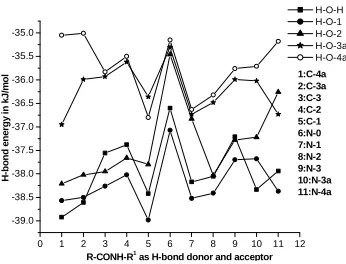
0 1 2 3 4 5 6 7 8 9 10 11 12 -39.0 -38.5 -38.0 -37.5 -37.0 -36.5 -36.0 -35.5 -35.0 1:C-4a 2:C-3a 3:C-3 4:C-2 5:C-1 6:N-0 7:N-1 8:N-2 9:N-3 10:N-3a 11:N-4a H -b o n d e n e rg y i n k J /m o l
R-CONH-R1 as H-bond donor and acceptor
H-O-H H-O-1 H-O-2 H-O-3a H-O-4a
Figure 2: Variation of H-bond energy with size of alkyl groups in Type-III complexes
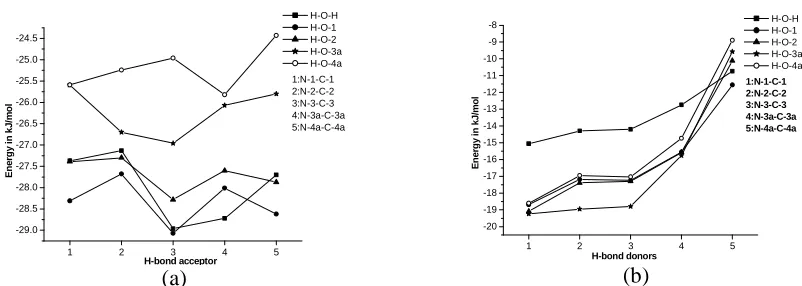
1 2 3 4 5 -29.0 -28.5 -28.0 -27.5 -27.0 -26.5 -26.0 -25.5 -25.0 -24.5 1:N-1-C-1 2:N-2-C-2 3:N-3-C-3 4:N-3a-C-3a 5:N-4a-C-4a E n e rg y i n k J /m o l H-bond acceptor H-O-H H-O-1 H-O-2 H-O-3a H-O-4a (a)
1 2 3 4 5
-20 -19 -18 -17 -16 -15 -14 -13 -12 -11 -10 -9 -8 1:N-1-C-1 2:N-2-C-2 3:N-3-C-3 4:N-3a-C-3a 5:N-4a-C-4a H-O-H H-O-1 H-O-2 H-O-3a H-O-4a E n e rg y i n k J /m o l H-bond donors (b)
Figure 3: Variation of H-bond energy with size of alkyl groups in (a) Type-IB complexes
(b) Type-IIB complexes from scheme C.
CHAPTER IV: Formation of Linear Polymers with Pendant Vinyl Groups via
Inclusion Complex Mediated Polymerization of Divinyl Monomers
In this fourth chapter we discussed about the inclusion complexes of β-CDs with divinyl
monomers such as ethylene glycol dimethacrylate (EGDMA) and ethylene glycol
methacrylate 4-vinyl benzoate (EGMAVB). Cross-linked polymers obtained by
simultaneous polymerization cross-linking of monomers containing multiple double
bonds find a wide range of applications, such as ion exchange resins, adsorbents,
molecularly imprinted polymers, supports for reagents in organic synthesis, enzyme
immobilization, and drug delivery system. Wherein a soluble linear polymer are obtained
by blocking the functional group of monomers (vinyl group) by forming inclusion
complexes with β-CDs. These linear polymers have applications in microlithography, as
chromatography supports, reagents in organic synthesis, in drug delivery systems and
other biomedical applications. Interaction energy of host-guest complexes are evaluated
by using conformational search, docking protocols, molecular dynamics simulations and
(a)EGDMA (b)EGMAVB (c)β-CD-EGDMA complex (d)β-CD-EGMAVB complex
Figure 1: Divinyl monomers (a) Ethylene glycol dimethacrylate (b) Ethylene glycol
methacrylate 4-vinyl benzoate are used in the present study and their inclusion complexes
with β-CD obtained from molecular dynamics simulations are given in (c) and (d) respectively.
Stoichiometry of divinyl monomers and β-CD complexes are estimated by
evaluation of binding energies. Docking studies and the subsequent binding energies
evaluated at the B3LYP/6-31G level of theory revealed that the complexation of the
ligand with the first β-CD has substantial stabilization of the order of 50-100 kJ/mol,
while the addition of a second β-CD does not provide substantial stabilization. β-CDs
form 1:1 inclusion complex (IC) with divinyl monomers such as ethylene glycol
dimethacrylate (EGDMA) and ethylene glycol methacrylate 4-vinyl benzoate
(EGMAVB).
Hydrogen Bonding in Trivinyl Monomers: Implications for Inclusion Complexation and Polymerization
In this section we discussed about the inclusion complexes of Trimethylolpropane
trimethacrylate (TMPTMA), Trimethylolpropane triacrylate (TMPTA) and
Trimethylolpropane diacrylate 4-vinylbenzoate (TMPDAVB) with β-CDs. Stoichiometry
of trivinyl monomers and β-CD complexes are estimated by evaluation of binding
energies. These bonding energies are evaluated by using conformational search, docking
protocols, molecular dynamics simulations and density functional theory approaches.
with β-cyclodextrin (β-CD). Trimethylolpropane triacrylate (TMPTA) formed a 1:1
complex with β-CD. The complexation of the ligand TMPTA with the first β-CD has
substantial stabilization of the order of 27-30 kJ/mol, while the addition of a second β-CD
does not provide substantial stabilization. In case of TMPTMA the addition of a second
β-CD provides substantial stabilization of the order of 46-50 kJ/mol. Computational
analysis confirmed that in TMPTA hydrogen bonding between C-H···O=C brings two
acryloyl groups in close vicinity of one another. As a result, both acryloyl groups were
included in the same β-CD cavity. Trimethylolpropane diacrylate 4-vinylbenzoate
(TMPDAVB) once again formed 1:2 IC as a result of disruption of hydrogen bonds
between two acryloyl groups. The stoichiometry of ICs (TMPTA, TMPTMA and
TMPVBDA) as well as disposition of the functional groups included within the β-CD
cavity are governed by hydrogen bonding within the monomer, and influence the course
of polymerization as well as the polymer structure. The study highlights that an
understanding of the composition of the IC is more important than its stoichiometry
(a) TMPTA (b) TMPTMA (c ) TMPVBDA
(d) β-CD-TMPTA (e ) β-CD-TMPTMA (f) β-CD-TMPVBDA
Figure 2: Trivinyl monomers (a) TMPTA (b) TMPTMA and (c)TMPVBDA are used in
the present study and their inclusion complexes with β-CD obtained from molecular dynamics simulations are given in (d) (e) and (f) respectively.
CHAPTER-V: Theoretical studies on inclusion complexes of cyclodextrins
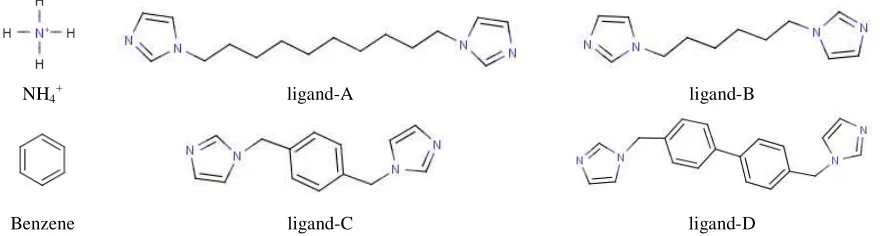
In this chapter, we discussed about the host-guest complexes of α, β, γ-cyclodextrins (α, β and γ-CD) wherein guest molecules are NH4+, benzene, bisimidazolyl compounds
(shown in Figure 3 ). Quantum mechanical and molecular dynamics simulation methods
are applied on host-guest complexes to study the interaction energies as well as
stoichiometry of complexes. These results are validated with available experimental data
and a satisfactory enough agreement is found between theoretical studies and
NH4+ ligand-A ligand-B
Benzene ligand-C ligand-D
Figure 3: Systems (guest molecules) considered for the study.
CHAPTER-VI: Addition Fragmentation Chain Transfer by AMSD Inclusion complex:
Implications for Macromonomer Synthesis
In this chapter, we demonstrate inclusion complexes of α methyl styrene dimer (AMSD)
with β – CD and DMCD and the activity of CH=CH2 group of styrene in presence and
absence of CDs. Stability of the complexes are estimated by interaction energies.
Interaction energy of host-guest complexes are evaluated by using conformational search,
docking protocols, molecular dynamics simulations and density functional theory
approach. The activity of CH=CH2 group was analyzed in two ways (I) from the
observation of trajectory generated by molecular dynamics simulation (II) calculating the
quantum chemical descriptors such as natural bond orbital (NBO), natural population
analysis (NPA), Fukui-functions and HOMO-LUMO. The quantum chemical descriptors
are calculated at HF/3-21G level of theory on AM1 optimized geometries. Docking
studies and the subsequent binding energies evaluated at B3LYP/6-31G level of theory
revealed that the complexation of the ligand with the first β-CD resulted in substantial
stabilization of the order of 15-20 kJ/mol and with first DMCD of the order of 10-15
kJ/mol; while the addition of second β-CD and DMCD does not provide substantial
stabilization. Activity of CH=CH2 was explained from molecular dynamics trajectory by
charges and hybridization of CH=CH2 groups calculated from NBO method,
HOMO-LUMOs and Fukui-functions descriptors specifies that activity of R-CH=CH2 group is in
the order, AMSD > AMSD-DMCD > AMSD- β-CD complex. This is validated by
experimental results. The disposition of the allyl group within the CD cavity has a strong
influence on its chain transfer activity. Increase in steric hindrance results in enhanced
addition fragmentation efficiency resulting in macromonomer bearing terminal
unsaturation.
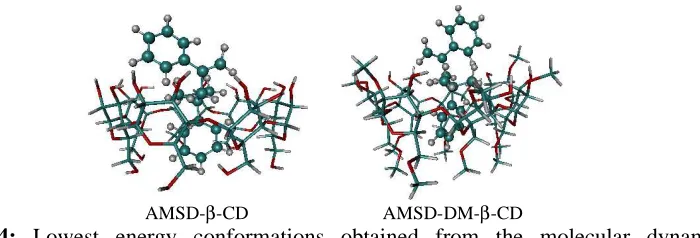
AMSD-β-CD AMSD-DM-β-CD
Figure 4: Lowest energy conformations obtained from the molecular dynamics
simulations.
Publications
1) Active site acidic residues and structural analysis of modelled human aromatase: A potential
drug target for breast cancer, J. Narashima Murthy, M. Nagaraju, G. Madhavi Sastry, A.
Raghuram Rao, and G. Narahari Sastry, J. Comp. Mole. Design 2006, 19, 857–870.
2) Formation of Linear Polymers with Pendant Vinyl Groups via Inclusion Complex Mediated
Polymerization of Divinyl Monomers, Sunita S. Satav, Rohini N. Karmalkar, Mohan G.
Kulkarni, Nagaraju Mulpuri, and G. Narahari Sastry, J. Am. Chem. Soc. 2006, 128,
7752-7753.
3) Hydrogen Bonding in Trivinyl Monomers: Implications for Inclusion Complexation and
Polymerization, Sunita S. Satav, Rohini N. Karmalkar, Mohan G. Kulkarni, M. Nagaraju and
G. Narahari Sastry Macromolecules, 2007, 40, 1824-1830.
4) Addition Fragmentation Chain Transfer by AMSD Inclusion Complex:Implications for
Macromonomer Synthesis, Prerana M. Patil, P. R. Rajamohanan, Mohan G. Kulkarni, M.
5) Theoretical studies on inclusion complexes of cyclodextrines. M. Nagaraju and G.Narahari
Sastry, in preparation.