125 Available online at www.ijiere.com
International Journal of Innovative and Emerging
Research in Engineering
e-ISSN: 2394 - 3343 p-ISSN: 2394 - 5494
Experimental study of 1-D Transient method for measuring
the thermal properties of metal rod
Raut Sima G.1
aand Talwar Shivanand. 2
ba Student 1,Hadapsar Pune (M.S.) India b Assi Professor 2, Hadapsar Pune (M.S.) India
ABSTRACT:
The main aim of paper is to describe the transient method for the determination of thermal properties like thermal diffusivity and thermal conductivity & specific heat of metal rods. The transient technique for determination of thermal properties considered as an effective tool for measuring the thermo physical and mechanical properties metallic materials. The thermal properties of metal, used to isolate thermal components, are also extremely important, and a variety of techniques have focused primarily on determining the thermal diffusivity of metal.
The present transient method is based on the application of constant heat flux to the top surface of cylindrical metal rod that is insulated on all other surfaces. Constant heat flux is achieved by using circular coiled heater which is placed 8mm above the metal rod. The experimental study on determining thermal diffusivity of various metal rods like Iron, Copper, Aluminum, Brass. Which having diameter 50mm & 25mm length and thermal conductivity and specific heat can be calculated
Keywords: Transient method, Thermal diffusivity, Thermal conductivity, Specific heat, Metal rods.
I. INTRODUCTION
Over the years, a number of methods have been developed to measure thermal properties of many different materials. Now a day, it is often not enough to get approximate data from textbooks, but determination of thermal properties experimentally of metal samples are necessary. Small variation in composition, processing parameters and utilization conditions change the behaviour and properties, and if new materials are to be used at their optimum potential, accurate measurements are essential.
The use of short measuring time is perhaps the most distinctive feature of the any experimental method. Different metals used various applications depend upon use and conditions required. Metal is considered sustainable development because of its advantages in industrial sector, excellent physical and mechanical characteristics. Metals which contain excellent properties that used in automotive applications and production because of their attractive combination of low coefficient of thermal expansion, high elastic modulus, high wear resistance, lower density, higher thermal stability, corrosion resistance, good thermal conductivity and Machinability.
Thermal properties of Metals can be described by three physical quantities; thermal conductivity (K), thermal diffusivity (α) and specific heat (CP).
The three quantities are related by the equation. [2]
K=ρ CP α (1.1) Where, ρ is the density.
II. MATERIAL AND METHOD
A. Material
A circular metal rod of approximately Φ 50mm x 25mm in vertical dimension is machined and lightly polished to achieve flat surfaces. The surfaces other than the top are thermally insulated with low thermal conductivity material (wooden block with Glass wool insulation around the specimen).As maximum diameter used so heat transfer rate is also maximum. Used metals Aluminum alloy, Copper, Brass, Iron, at 270c Atmospheric temperature. [6]
B. Method [6]
126 equivalent to an “oven effect”, and a constant heat flux boundary condition is approximately realized. The other advantage of the configuration is that problems of thermal contact resistance are avoided at the top surface, and thus also the necessity to provide a finely polished surface.
1. Heater holder 2.Heating coil 3 .Metal rod (Sample) 4.Aluminum foil 6.Ktype thermo couple 7. Sample holder 8.Temperature indicator 9. Dimmer stat 10. Ammeter
Figure 1: Experimental setup
The present study aims at describing a transient method of measuring thermal diffusivity and thermal conductivity of metals. The measurement method involves the application of constant heat flux at the top surface of specimen, which is insulated all around. This ensures 1-D heat conduction through the specimen. The temperature is measured at the base of the specimen, at various times after introduction of the constant heat flux. The theory of thermal conduction describing 1-D heat conduction is given by Cars law and Jaeger .They consider a slab that is initially at zero temperature, which is insulated all around and has a constant heat flux at top surface. They showed that temperature at a distance x within the specimen and at time t (after the introduction of constant heat flux at x = a) is given by [3] 𝜕
2𝑇
𝜕𝑋2 =
1 𝛼
𝜕𝑇
𝜕𝑡 (1.2)
The analytical solution to the above governing equation is given by
𝑇(𝑋, 𝑡) =𝐹𝛼𝑡
𝑎𝐾 + 𝐹𝑎
𝐾[ 3𝑋2−𝑎2
6𝑎2 −
2 𝜋2∑
(−1)𝑛 𝑛2 𝑒
[−𝑎𝑛2𝜋2𝑡
𝑎2 ]
∞
𝑛=1 cos
𝑛𝜋𝑥
𝑎 ] (1.3)
Where α is thermal diffusivity, k is thermal conductivity, and ‘a’ is the thickness of the slab. If measurement is made at the base of the slab (x = 0), the expression for temperature becomes
𝑇(𝑎, 𝑡) =𝐹𝛼𝑡
𝑎𝐾 + 𝐹𝑎
6𝐾+transientterms (1.4)
For times large relative to απ/a , the transient terms are negligible, and the temperature versus time behavior becomes linear, the intercept ti on the T=0 axis is;
𝑇(𝑎 = 0, 𝑡 = 0) =𝐹𝛼𝑡
𝑎𝐾+ 𝐹𝑎
6𝐾 𝐹𝛼𝑡
𝑎𝐾 = 𝐹𝑎
6𝐾
αt a=
a
6
𝛼 = 𝑎2/6ti
ti = 𝑎2/6𝛼 (1.5)
Equation (1.5) can be used to find the thermal diffusivity directly from a series of temperature versus time measurements.
The thermal diffusivity is determined from the intercept ti by rearranging equation ti =a2/6α
C.Temperature measurement.[1]
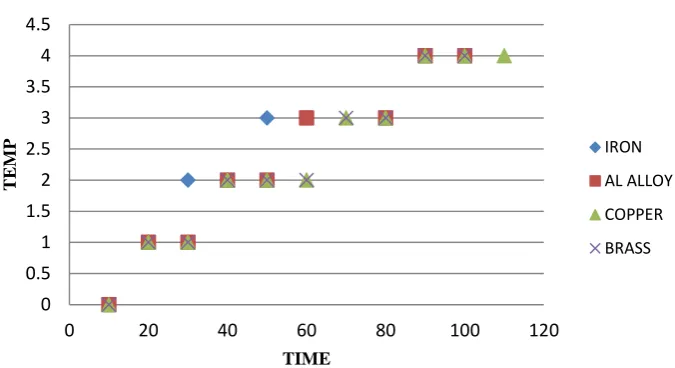
127 Figure 2: Temperature versus time for metal and Alloy.
D.Specific heat measurement[10]
Measure and note down the mass of unknown metal block, the empty calorimeter and stirrer provided.
Filled the calorimeter with a certain volume of water, and measure new mass .then calculate the mass of water by subtracting the two values (mass of water +calorimeter)-(mass of empty calorimeter) Measure and note down the temperature of the cold water in the calorimeter as T1 .Half filled 250ml beaker with water and heated it. Inserted a metal block with the thread into the beaker being heated and waited for the water to come to a certain temperature which in this case will also be the temperature of the unknown metal block before being transferred to the calorimeter . Measure and note down the temperature of the water being heated as T2 which was also the temperature of the metal block then remove the metal block and immediately immersed it into the water in the calorimeter and straight away covered the calorimeter in the order to avoid any heat loss to the atmosphere. Left the metal block in the calorimeter and stirred while constantly looking at the thermometer until the water inside the calorimeter reached a constant temperature which was the final temperature of both the metal block and the water.
Measure and noted the final temperature as T3 Q = m Cp ΔT
Where, Q = Heat supplied m = mass of the metal rod ΔT = temperature difference. Cp = specific heat of metal.
Figure 3: Experimental set up for measuring specific heat.
E. Thermal conductivity measurement.[9]
A thermal conductivity is the amount of heat conducted per unit time across unit area and through unit thickness, when a temperature difference if 1 degree is maintained across the bounding surface.”The magnitude of thermal conductivity tells us how well a material transports energy by conduction. The thermal conductivity of a material is essentially depends on the material structure (chemical composition, physical state and texture), moisture content and density of the material and the operating conditions of pressure and temperature. The thermal
0 0.5 1 1.5 2 2.5 3 3.5 4 4.5
0 20 40 60 80 100 120
TEM
P
TIME TEMP/TIME
IRON
AL ALLOY
COPPER
128 conductivity is always higher in the purest form of metal. The alloying of metals and presence of other impurities cause an appreciable decrease in thermal conductivity. The thermal conductivity is essentially a coefficient of static heat transfer. By the calculated values of thermal diffusivity and specific heat thermal conductivity is estimated by equitation 1.1.
IV.RESULT AND DISCUSSION
F. Thermal diffusivity for varying metal and Alloy.
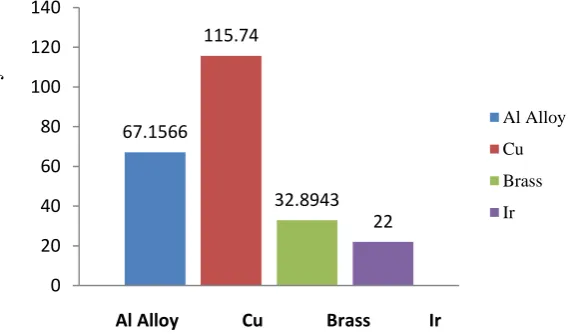
Figure 4. Shows the results obtained for the variation of thermal diffusivity with various metals. It is observed that the thermal diffusivity of metals increase or decreases depending upon their composition properties will vary.
Figure 4. Variation of Thermal diffusivity for varying metals
In heat transfer analysis, thermal diffusivity is the thermal conductivity divided by density and specific heat capacity at constant pressure. Thermal diffusivity is another term that is relevant in this regard. It is the ratio of Thermal conductivity and volumetric heat capacity. If two identical objects made of different material, is kept in same surrounding and allowed to cool, the material with higher thermal diffusivity (alpha) will cool faster. In our case, thermal diffusivity of copper is higher than that of Iron. Hence it cools fast.
G. Thermal conductivity for varying metal and Alloy.
Figure5. shows the results obtained for the variation of thermal conductivity with various metals. It is observed that the thermal conductivity of metals increase or decreases depending upon their composition properties will vary
Figure 5: Variation of Thermal conductivity for varying metals.
As you can see, out of the more common metals, copper and aluminum have the highest thermal conductivity while steel and brass have the lowest. Heat conductivity is a very important property when deciding which metal to use for a specific application. As copper is an excellent conductor of heat, it’s good for heat exchangers, heat sink.
H. Specific heat for varying metal and Alloy. 67.1566
115.74
32.8943 22
0 20 40 60 80 100 120 140
Th
er
m
a
l
Diffu
siv
ity
Al Alloy Cu Brass Ir Thermal Diffusivity
Al Alloy
Cu
Brass
Ir
165.35
398.52
106.39
80
0 50 100 150 200 250 300 350 400 450
Th
e
rmal
c
o
n
d
u
cti
vi
ty
Al Alloy Cu Brass Ir Thermal conductivity
Al Alloy
Cu
Brass
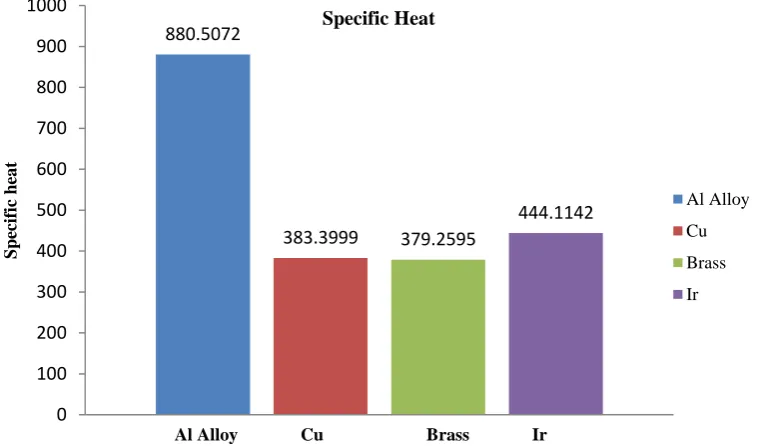
129 The values of thermal properties of metals in Figure 6 show the variation of specific heat with various metals. It is observed that specific heat changes with metals composition and properties .Figure 6. Shows the specific heat of metals, Al Alloy having the highest specific heat. Aluminum is remarkable for the metal's low density and its ability to resist corrosion through the phenomenon of passivation.
Figure 6: Variation of Specific heat for varying metals.
V. CONCLUSION
It is observed in the present study that, different metals having different thermal properties due to different composition. Transient 1-D method is acquired the approximate readings as that of standard reading. This method presents a laboratory procedure for determining the thermal diffusivity of metals using a 1-D method. The pure metal having high thermal conductivity, thermal diffusivity as impurity increases thermal properties decreases. Directly Thermal diffusivity can be calculated using this technique is come by experimental method without finding thermal conductivity and specific heat.
References
[1] B. M. Angadi & C. R. Hiremath, A.C.Reddy, V. V. Katti, S. A. Kori., “Studies on the Thermal Properties of Hypereutectic Al–Si Alloys by Using Transient Method”., Journals of Mechanical Engineering Research And Technology Volume 2, Number 1, (2014) PP 536-544
[2] D. Ramakrishnan, RishikeshBharti, M. Nithya, K. N. Kusuma, and K. D. Singh.”Measurement of thermal properties of select intact and weathered granulites and their relationship to rock properties”., GEOPHYSICS, VOL. 77, NO. 3 (MAY-JUNE 2012); P. D63–D73, 8 FIGS., 6 TABLES. 10.1190/GEO2011-0225.1
[3] K. Midttomme, E. Roaldset and P. Aagaard., “Thermal conductivity clay stones and mudstones of selected from England”., clay mineral (1998)33, 131-1451998
[4] Olukayode D. Akinyemi,Yemi S. Onifade,Badmus And O. S.Awokola.,”Determination of Thermal Properties of Rock Samples Using Modified Thermal Block Method”.Open access e-Journal Earth science india,elSSN:0974-8350 Vol. 5(II), April, 2012, pp. 38-50
[5] Zuo lei sunkangzhu , Ningpan.,”Transient methods of thermal properties Mesurment on Fibrous Materials” [6] Hiremath C. R, W Katti , KadoliRavikiran.,”Experimental determination of specific heat and thermal
conductivity of clay+ additives cacl2 composite desiccant” .,Procedia Materials Science 5 ( 2014 ) 188 – 197
[7] J.M. Laskar, S. Bagavathiappan, M. Sardar, T. Jayakumar, John Philip, Baldev Raj,”Measurement of thermal diffusivity of solids using infrared thermography.”Materials Letters 62 (2008) 2740–2742
[8] Mike F. Middleton., “A transient method of measuring the thermal properties of rocks”., GEOPHYSICS, VOL. 58, NO. 3 (MARCH 1993); P. 357-365,9 FIGS., 4TABLES.
[9] Olusola O. FASUNWON, John A.OLOWOFELA. Ojok O. Ocan and Olukayode D. ANKINYEMI., “Determination of thermal Conductivity of rocks samples using fabricated equipment.”,Thermal Science; Vol.12(2008), No. 2,pp.119-128
[10]S. Krishnaiah, D.N. Singh, G.N. Jadhav.,” A methodology for determining thermal properties of rocks “ 880.5072
383.3999 379.2595
444.1142
0 100 200 300 400 500 600 700 800 900 1000
S
p
ec
ifi
c
h
ea
t
Al Alloy Cu Brass Ir Specific Heat
Al Alloy
Cu
Brass