Please cite this article as: M. El-Hiri, A. En-Nadi, A. Chafi, Suppliers Selection in Consideration of Risks by a Neural Network, International Journal of Engineering (IJE), IJE TRANSACTIONS A: Basics Vol. 32, No. 10, (October 2019) 1454-1463
International Journal of Engineering
J o u r n a l H o m e p a g e : w w w . i j e . i r
Suppliers Selection in Consideration of Risks by a Neural Network
M. El-Hiri*, A. En-Nadi, A. Chafi
Industrial Techniques Laboratory, Department of Industrial Engineering, Faculty of Science and Technology, Fez, Morocco
P A P E R I N F O
Paper history:
Received 08 April 2019
Received in revised form 05 September 2019 Accepted 12 September 2019
Keywords:
Artificial Neural Networks Criteria
Supplier Selection Supplier Selection Process
A B S T R A C T
Faced with the dynamic demands of a changing market, companies are facing fierce competition, which forces them to consider more and more new approaches to improve quality, reduce costs, produce on time, control their risks and remain successful in the face of any disruption. It is clear that the choice of appropriate suppliers is one of the key factors in increasing the competitiveness of companies. Thus, suppliers selection has a very important impact on the control of risks throughout the supply chain and on increase of its performance. Therefore, it is important for managers to realize the long-term impact of their supplier selection strategies on the benefits and effective functioning of the organization. To minimize supply and demand risks, this work presents a generic supplier selection model based on artificial neural networks (ANNs) to help manufacturers to choose the most efficient suppliers and monitor their performance. The results showed that ANNs are very well adapted to our problem since they have provided a very considerable efficiency in terms of the results obtained. Indeed, the application of the ANN will avoid the difficulty of desiging an algorithm to solve our problem, it is through the expertise of the managers in the purchasing department that our ANN will learn to be efficient and serve as a tool to help a decision makers to choose the best suppliers.
doi: 10.5829/ije.2019.32.10a.15
1. INTRODUCTION1
Today, companies are forced to innovate to remain competitive with highly demanding customers, to be able to keep up with new technology and competitors' innovations, and to avoid the threats of risks and disruptions in their supply chains. Therefore, it is essential to adopt appropriate strategies within a competitive and dynamic industrial field. Currently, companies are increasingly aware of the importance of the purchasing function in promoting the development of their supply chains. It became a value creation function that no longer allows errors. Indeed, the growth of each company depends on its suppliers. The quality of products and services, the increase in flexibility of companies, a company's ability to satisfy its customers and its own continuity are closely linked to the suppliers. Any interruption in supply can lead to a major disaster throughout the supply chain and force the organization to take risks. The increased dependence on suppliers creates the need to develop a systematic and formal approach to the various activities that characterize the procurement function, including supplier selection [1]. Supplier *Corresponding Author Email: [email protected] (M. El-Hiri)
selection is an essential activity to improve the result of a company's efforts to maintain and improve its market position.
Strong competition and the desire to make the most profit encourage decision-makers to choose suppliers who offer better prices. However, experience has shown that the cheapest is not necessarily the best. Because, the choice of a supplier who offers low prices but is not able to deliver on time will have disastrous consequences on the downstream side of the supply chain. For the most popular ratio''quality/price'' which is considered in most cases as an optimum criterion, it is not always functional nowadays.
In this paper, we propose a generic suppliers selection model in consideration of risks based on artificial neural networks, to bring good results to the supplier selection problem. Regarding the selection criteria, we used the literature review and a survey of 32 Moroccan companies from different sectors.
This article is structured as following: in the second section we discuss a literature review on criteria and methods for suppliers selection, the third section is dedicated to the approach we proposed to solve the
problem of supplier selection. Finally, a conclusion is presented in section four.
2. LITTERATURE REVIEW
Due to the importance of the supplier selection problem, a lot of works has been done to select the best performing supplier based on several criteria.
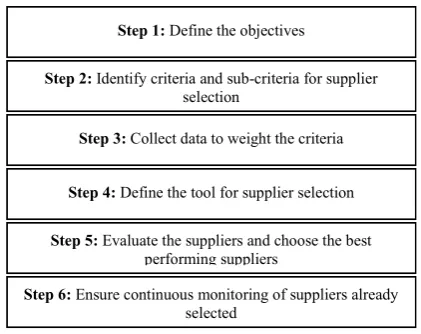
2. 1. Supplier Selection Process To conduct an effective selection of its suppliers, a formal and well-structured process can generate very effective results. According to literature [1], to establish supplier selection within a company, it is necessary to define the problem, then to go on to the criteria for selecting suppliers, then to qualify the suppliers and finally to select the best suppliers. Azadnia el al.[2] define six steps to solve the problem of supplier selection: selection of products to be ordered, identification of potential suppliers for products, determination of criteria, sub-criteria and appropriate influencing factors to evaluate suppliers, vendor assessment for social and environmental criteria, vendor evaluation by economic quality criteria, and construction of a model for orders allocation. Other researchers have followed only three steps in the selection of suppliers: the first step is to identify the selection criteria, the second step establishes the weights of the identified criteria based on an empirical study, the last step includes the creation of supplier alternatives and the selection of the best supplier [3]. The structuring of a supplier selection process is one of the main factors for the success of supplier evaluation and selection, as well as the growth and development of each company. In our study, since we have opted for the selection of the best suppliers as a risk minimization strategy, we must first define the companies' objectives in order to be able to deduce the criteria for choosing suppliers. Once the criteria are defined, it is necessary to move on to weight the criteria to determine which suppliers are qualified or rejected. To judge whether a supplier is qualified or not requires choosing and defining a high-performance tool to achieve satisfactory results. Once the selection tool is determined, we will proceed to the evaluation to select the best suppliers. Since we apply supplier selection to ensure risk minimization, we have added a phase that will ensure the continuous monitoring of suppliers already selected. The process shown in Figure 1 is proposed to ensure the qualification and selection of suppliers.
Among the steps in the supplier selection process to which researchers have given more attention are the steps of identifying criteria and tools or methods for selecting suppliers. These two steps have received more attention from researchers because of the importance they can bring to the results of choosing the right supplier adapted to the company's intentions.
Figure 1. Supplier Selection Process
2. 2. Supplier Selection Criteria To make an efficient supplier selection, it is first necessary to determine the criteria of selection. The definition of the selection criteria requires that the elimination criteria to be indicated. The choice of criteria depends on the nature of the need to be met for each company. For an industrial good, managers adopt criteria related to product quality, flexibility, prices, etc.
In the literature, two main studies have often been considered as a base in the selection of supplier selection criteria. The survey of 274 American and Canadian companies showed that the supplier selection problem is a multi-criteria problem and provided 23 criteria for companies to evaluate their suppliers [4]. Weber et al. [5] reviewed Dickson's work by analyzing 74 articles published between 1966 and 1990, addressing supplier selection. They gave a new aspect to the criteria mentioned by Dickson by assigning them a new ranking. Weber et al. [5] also confirmed that supplier selection is a multi-criteria problem. Indeed, more than one criterion at a time is taken into account in more than 50% of the cases studied. The change in the ranking of criteria between two studies can be explained by the acceleration of globalization and new technologies, rapid changes in customer requirements and the increase in use of high quality. Table 1 shows the two types of classification by Dickson [4] and Weber et al. [5] according to the degree of importance of the criteria.
In the last few decades, the ranking of supplier selection criteria has been constantly changing. Indeed, companies must react quickly to short product life cycles, fluctuations in demand and delivery times [6], which is why the introduction of flexibility criteria is essential [7, 8]. The price, which generally ranked first in the list of purchasing decision criteria, is now perceived as less important. Product quality and delivery are among the most common and important criteria for supplier selection in recent decades [9]. In addition, due to increase in customer requirements, many companies
Step 6: Ensure continuous monitoring of suppliers already
selected
Step 5: Evaluate the suppliers and choose the best
performing suppliers
Step 4: Define the tool for supplier selection Step 3: Collect data to weight the criteria Step 2: Identify criteria and sub-criteria for supplier
selection
TABLE 1. Classification of supplier selection criteria according to Dickson and Weber [10]
Criteria Dickson
Rank [4]
Weber et al. Rank [5]
Price 6 1
Delivery 2 2
Quality 1 3
Production capacity 5 4
Geographical location 20 5
Technical capacity 7 6
Management and organization 13 7
Reputation and position in the
industry 11 8
Financial situation 8 9
Performance Passé 3 9
Past Performance 15 9
Attitude 16 10
Packing capacity 18 11
Control of operations 14 11
Training and support 22 12
Process compliance 9 12
Social relations 19 12
Communication system 10 12
Reciprocity of the relationship 23 12
Impression 17 12
Desire to do business 12 13
Volume of purchases in the
past 21 13
Warranty policy 4 14
expect suppliers to participate in the development of their new products and provide continuous improvement plans, which may require criteria related to innovation and research and development capacity [7]. From this point on, companies consider customer satisfaction rather than cost factors.
Through the literature, we note that several criteria have been introduced in different research to solve the problem of suppliers selection. Indeed, different researchers have provided their own categories of criteria based on their own problems and interpretations. The application of the criteria from the literature review will not be recommended. Since the choice of criteria depends mainly on the opinion of practitioners. According to them, the criteria are identified according to the management strategies and interests of the company.
2. 3. Supplier Selection Methods The selection
and evaluation of suppliers has attracted the attention of several researchers, as a result, many methods and techniques have been presented in the literature. Ease, flexibility and speed of execution are the desirable criteria that can attract researchers to choose for a supplier selection tool. Several authors have classified the selection methods in different ways, there are generally individual and integrated methods.
analysis (DEA), and analytic hierarchy process (AHP). To select suppliers under uncertainty, distinguish between cost and benefit criteria and select the solutions which are closest and farthest from the positive and negative ideal solution. Kumar et al. [23] used fuzzy TOPSIS multi criteria model.
3. PROPOSED APPROACH
In this study, we are interested in developing an effective decision-making model to solve the problem of selecting the best suppliers. The objective is to minimize the risks that can come from the upstream and downstream parts of the supply chain. Effect, taking into account the requirements related to the downstream part, the criteria for supplier selection are formulated.
One of the main objectives of our model is to be able to make reliable decisions for managers. The development of effective learning models has recently increased within the research community for decision-making issues. ANN is considered to be very efficient as they offer a powerful alternative for the development of such systems. In such a case, the neural network learns the rules that govern decision-making through experimentation. In recent years, ANN have been widely used because of their ability to represent very complex mathematical maps.
For our problem, we have chosen to propose a model based on multilayer perceptrons (MLP) which are a type of ANN. Because the MLP allows a global representation of the space of the problem to be solved with a simple architecture, also it can accept noisy data and non-linear classification.The objective is to present an effective and appropriate solution to the problem of multi-attribute decision-making and the errors that other techniques can generate. We present a model based on backpropagation MLP, where we have deployed the characteristic of learning through empirical data that will be equivalent to a decision making algorithm to make our model efficient. The model was developed by VisualGeneDeveloper software.
For the development of our model, we followed the steps of the supplier selection process shown in Figure 1 to solve the problem of choosing the best suppliers.
3. 1. Definition of Objective To develop a common efficient supplier selection model, the following objectives have been defined:
- improving product quality, - improving flexibility,
- improving the level of customer satisfaction,
- improving competitiveness and brand image in the market,
- minimization of risks and failures related to suppliers, - improving the performance of companies through their suppliers.
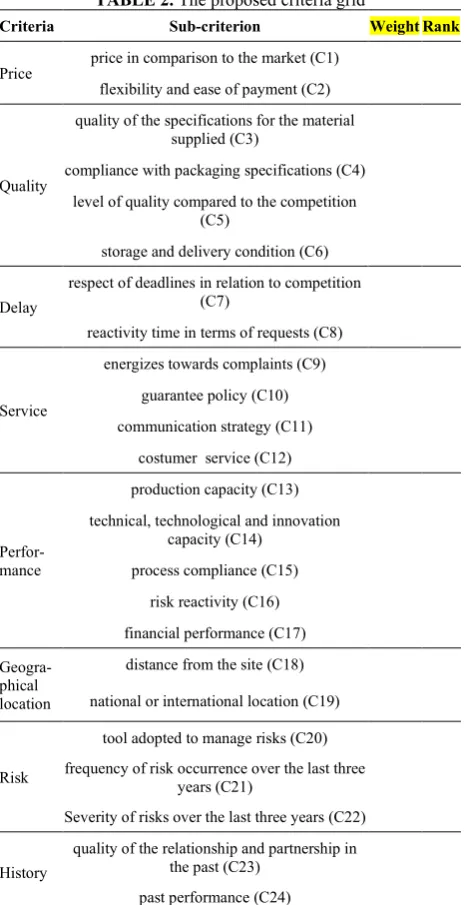
3. 2. Identification of Criteria and Sub-criteria for Supplier Selection Once the objectives to be achieved have been determined, we will move on to the definition of criteria and sub-criteria to conduct an effective and efficient supplier evaluation in consideration of risks. We have based on the criteria existing in the literature and on the opinion of experts. Through discussion with experts and qualified managers in supply and production field, we were able to identify eight important criteria for selecting the best supplier : - price: it is linked to the cost of acquiring the product and the method of payment required by the supplier, it concerns the costs of purchase, packaging, transport, etc. - quality: this criterion is of considerable importance, it concerns the quality of the products to be supplied, the packaging and the storage conditions.
- delay: this criterion refers to everything relating to the supplier's ability to meet the delivery schedule.
- service: this criterion represents the quality of the service offered by the supplier, regarding customer service and communication policy.
- performance: it indicates the supplier's performance in terms of its ability to adapt to changes in production plans, process compliance, reactivity to disruptions and financial capacity.
- geographic location: it indicates the distance from the supplier and whether it is located inside or outside the country.
- risk: this criterion provides information on suppliers regarding the tools adopted to manage risks, and the level of risk presence among suppliers.
- history: this criterion informs us about the quality and performance of suppliers in the past.
The table below illustrates the grid of criteria resulting from the survey.
3. 3. Data Collecion to Weight the Criteria After the identification of the criteria, we identify in this step the weights of the sub-criteria according to the customers' requirements. We have sent the grid of criteria proposed in Table 2 to 100 Moroccan companies in different sectors: agri-food, automotive, textiles, detergent production and the pharmaceutical sector. Indeed, procurement managers were asked to give weight to the sub-criteria to identify two types of suppliers: qualified and unqualified suppliers. During this survey, we had the opportunity to discuss with 18 people qualified to assign weights to our criteria grid.
TABLE 2. The proposed criteria grid
Criteria Sub-criterion WeightRank
Price
price in comparison to the market (C1)
flexibility and ease of payment (C2)
Quality
quality of the specifications for the material supplied (C3)
compliance with packaging specifications (C4)
level of quality compared to the competition (C5)
storage and delivery condition (C6)
Delay
respect of deadlines in relation to competition (C7)
reactivity time in terms of requests (C8)
Service
energizes towards complaints (C9)
guarantee policy (C10)
communication strategy (C11)
costumer service (C12)
Perfor-mance
production capacity (C13)
technical, technological and innovation capacity (C14)
process compliance (C15)
risk reactivity (C16)
financial performance (C17)
Geogra-phical location
distance from the site (C18)
national or international location (C19)
Risk
tool adopted to manage risks (C20)
frequency of risk occurrence over the last three years (C21)
Severity of risks over the last three years (C22)
History
quality of the relationship and partnership in the past (C23)
past performance (C24)
All sub-criteria are weighted according to a scale that varies from 1 to 5 except for the subcriterion of national or international location, 0 is assigned to a national supplier and 1 to an international supplier.
Through this survey, we were able to collect 96 responses from respondents. This data will be used to form the model for solving the problem of supplier selection through supervised learning.
In the case of supervised learning, the robustness of the algorithm will depend on the accuracy of its training. Our model will learn from the collected data and produce an internal map that can be reused to classify new amounts of data.
3. 4. Definition of Tool for Supplier Selection
Generally, the problem of supplier selection is characterized by the difficulty and complexity of generating a good decision in a multi-attribute environment. Backpropagated MLP are adopted to provide a solution to this type of problem, thanks to the learning and backpropagation characteristics. Indeed, learning will help to structure the model to deliver a good decision and backpropagation will ensure the correction of the results to make the model highly accurate.
We chose the ANN models because they have several advantages: their ability to process and represent both linear and non-linear relationships, their ability to learn these relationships directly from the modeled data, and their ability to learn from examples. As well, if the data is well structured, the ANN can give rise to the generalization characteristic that goes beyond learning data, i.e. produce correct results for new cases not introduced in the learning phase.
3. 5. Supplier Evaluation For supplier evaluation, a supervised learning model with MLP based on back propagation was developed. The design of the ANN for supplier selection model requires the following phases: - Model construction: this phase includes the determination of input, output, and hidden layer parameters for model design. In our case the inputs are the subcriteria indicated in Table 2, for the output we have only one data to recover from the output and which indicates if the supplier is selected or not. Our model receives suppliers as input data in terms of the sub-criteria that define them. Regarding the output, it is either equal to''0'', or ''1'', such that''0'' means that the supplier is not qualified, and ''1'' shows that the supplier is qualified. For the choice of the number of hidden layers and their sizes we have chosen to follow the general rules that exist in the literature. In most situations, it is impossible to determine the best number of hidden units without forming several networks and estimating the error of each network. Swingler [24] indicates that a single hidden layer with two units in the size can give good results. Berry and Linoff [25] answered the question of "What should be the size of the hidden layer?" with an answer considered such as a general rule that "the size of the hidden layer should never be more than twice as large as the input layer". In our case, we tried to choose the number of hidden layers and the size of each layer in order to minimize the model error that is given by the following formula:
Model error = ∑ ∑ ( − )
Such as:
Nt: the total number of training data sets No: the total number of output variables Yr: the actual value of te output variable
- Neural network training: it consists in training the model so that it can generate good results. Once the model is structured, it will be ready for training. To start this process, the initial weights are randomly generated where all weights are equal probability. Then the training or learning begins. Based on the data obtained in step 3, a supervised learning technique with backpropagation is used for the training phase. In our case, a set of 90 cases was deployed to train our model. The learning data are presented to the model in terms of input and output, then the error between the desired and calculated outputs are quantified and the model weights are adjusted to minimize this error. Finally, the total error is evaluated to validate the structure of the final model.
During the training phase, it is necessary to choose some parameters or characteristics to make the model powerful and efficient. First, it is necessary to choose the transfer function that is used to introduce non-linearity into the functioning of the neuron. For our model, we opted for the modified sigmoid function since it takes into account values between 1 and -1 and gives more flexibility to the model. Then, so that our model converges towards an optimal solution, we need to define the learning rate and momentum. Indeed, the learning rate is a hyper parameter that determines to what extent the newly acquired information replaces the old information. Momentum is a parameter that helps the model to avoid converging towards local minimum solutions and thus make the model more likely to find a better solution. These two parameters can take values between 0 and 1.
A learning rate value close to 1 can help the model to converge very quickly, but in some cases weights could be oscillated without ever converging, and this may
require high durations to find the best solution. A value that deviates from 1 will slowly converge the weights towards good results but in a short duration.
For the momentum parameter, a high value of the latter means that convergence will take place quickly. But if both momentum and learning rate are maintained at high values, several solutions could be skipped with a big step. A small momentum value cannot reliably avoid local solutions, and can also slow down the formation of the model. No momentum value is recommended, a good momentum value can be set either by stroke or by test. - Model validation: this phase is based on the analysis of the model's performance using cases not used in the learning phase. In our case, the validation was performed by a data set of 6 cases.
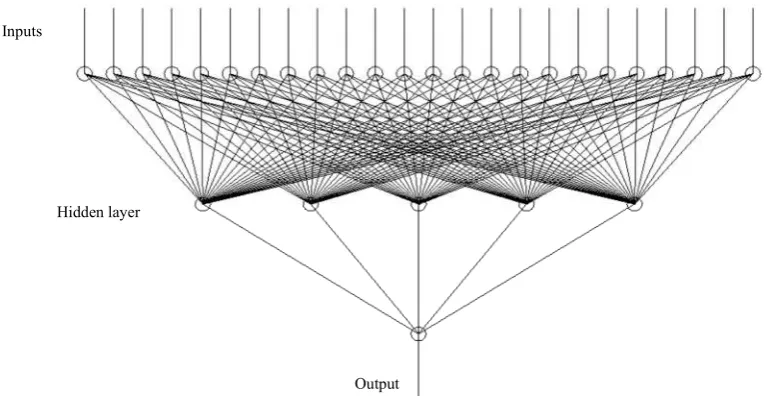
After the realization of the three phases to design our model. The architecture of the model is illustrated in Figure 2. A single hidden layer with five hidden neurons was obtained as the best model architecture for the current problem. With a learning rate of 0.01, a model error of 0.0051 and a momentum coefficient of 0.3. The architecture of the illustrated model is obtained after 555248 iterations.
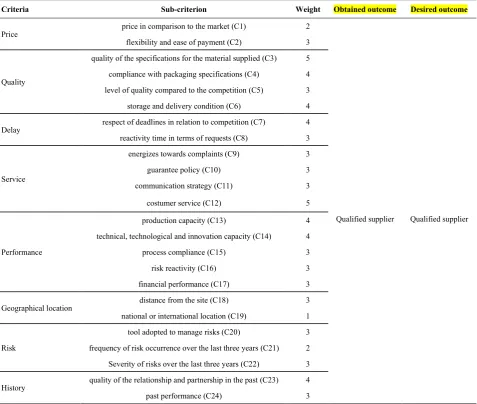
3. 6. Choose the Best Supplier Once the model is designed and validated, we can move on the choice of suppliers. To ensure this phase and validate the effectiveness of the proposed model, we tested our model using data from a company that belongs to another sector of activity that differs from those used to build our model. We were able to collect five cases for the validation of this step. Table 3 presents the results obtained for a situation for the selection of the best supplier.
Figure 2. Architecture of the neural network for the choice of the best suppliers
Inputs
Hidden layer
TABLE 3. Example and result obtained for the selection of suppliers
Criteria Sub-criterion Weight Obtained outcome Desired outcome
Price
price in comparison to the market (C1) 2
flexibility and ease of payment (C2) 3
Qualified supplier Qualified supplier Quality
quality of the specifications for the material supplied (C3) 5
compliance with packaging specifications (C4) 4
level of quality compared to the competition (C5) 3
storage and delivery condition (C6) 4
Delay respect of deadlines in relation to competition (C7) 4 reactivity time in terms of requests (C8) 3
Service
energizes towards complaints (C9) 3
guarantee policy (C10) 3
communication strategy (C11) 3
costumer service (C12) 5
Performance
production capacity (C13) 4
technical, technological and innovation capacity (C14) 4
process compliance (C15) 3
risk reactivity (C16) 3
financial performance (C17) 3
Geographical location
distance from the site (C18) 3
national or international location (C19) 1
Risk
tool adopted to manage risks (C20) 3
frequency of risk occurrence over the last three years (C21) 2
Severity of risks over the last three years (C22) 3
History
quality of the relationship and partnership in the past (C23) 4
past performance (C24) 3
3. 7. Continuous Monitoring of Suppliers Since we have applied the supplier selection strategy in a risk management context, continuous supplier monitoring must be performed to ensure that selected suppliers continue to meet the buyer's requirements, to monitor their improvement over time and to provide them with recommendations in case of poor performance. The continuous supplier monitoring model based on ANN was designed by performing the same steps as those defined in step 4. The criteria for continuous supplier monitoring depend on the manufacturer and its future objectives. Based on the survey we conducted and interviews with procurement managers, the following criteria were determined as inputs to the continuous supplier monitoring model:
- the degree of performance: according to the performance criterion, suppliers are divided into three categories: suppliers who offer the required performance,
suppliers who need to improve the level of performance and suppliers who have performed poorly.
- the scrap rate: this criterion informs us about the rate of rejected parts for each selected supplier. Under this criterion, suppliers can provide three scrap rates, one rate according to the required standard, an average scrap rate and an unacceptable scrap rate.
- innovation capacity and mastery of new technologies: this criterion informs us about the state of suppliers' participation in innovation and bringing value and differentiation to the product, as well as the state of suppliers' technology development.
For the design of the model, a data set of 90 cases was used for the formation of the network, and 6 cases were used for the validation of the model. The values of the weights of the criteria range from a scale of 1 to 5, such that the value 1 indicates that the supplier is poorly rated in terms of this criterion and the value 5 that the supplier is perfectly rated.
With regard to the architecture of the model, we have four inputs, namely the degree of performance, the scrap rate, the capacity for innovation and mastery of new technologies and the level of quality, for the output, we consider five outputs to define the category to which the evaluated supplier belongs. In this research, we distinguish three categories of suppliers:
- category 1: these suppliers are highly rated, and buyers will continue to work with them,
- category 2: these suppliers need to improve in some aspects,
- category 3: these suppliers will not continue to work with buyers given their poor results.
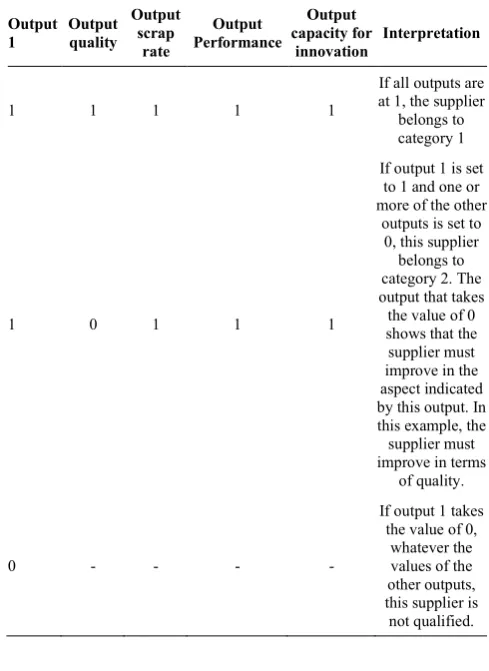
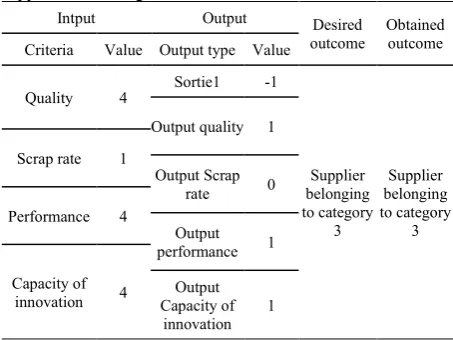
We illustrated the output in Table 4.
The best architecture of the model is obtained after 1301882 iterations, and it contains two hidden layers with a number of five neurons in the first hidden layer and ten neurons in the second. The values of the learning step of 0.01, the model error and the momentum coefficient are 0.01, 0.68 and 0.3 respectively. The architecture of the model is illustrated in Figure 3.
In Table 5 we present an example of a test for the proposed continuous supplier monitoring model. The models proposed for the selection and continuous monitoring of suppliers have shown effectiveness in terms of the results obtained. Indeed, in the example illustrated in Table 5, the supplier subjected to the monotoring step will be rejected, because it is very poorly rated in terms of the scrap rate criterion.
In our case, the MLP is very well adapted to our needs since it has generated very good results in terms of choosing the best supplier based on several criteria. In addition, the results obtained by our model confirm the capacity and performance of the ANNs in terms of
decision making, which has already been evaluated by several researchers.
Supplier selection has become a necessity for the success of a supply chain. Indeed, companies depend more and more on their suppliers, and the consequences of poor decision-making can be very critical and can impact several entities in the chain. Thus, in a volatile, heterogeneous market that encourages the emergence of risks, an effective method of selecting suppliers is essential for any company.
TABLE 4. Interpretation of the model output Output
1
Output quality
Output scrap
rate
Output Performance
Output capacity for
innovation
Interpretation
1 1 1 1 1
If all outputs are at 1, the supplier
belongs to category 1
1 0 1 1 1
If output 1 is set to 1 and one or more of the other
outputs is set to 0, this supplier belongs to category 2. The output that takes the value of 0 shows that the supplier must improve in the aspect indicated by this output. In this example, the supplier must improve in terms
of quality.
0 - - - -
If output 1 takes the value of 0,
whatever the values of the other outputs, this supplier is not qualified.
Figure 3. Neural network architecture for continuous supplier monitoring
Outputs Intputs
First hidden layer
TABLE 5. Examples of application of the model for continuous supplier monitoring
Intput Output Desired
outcome
Obtained outcome Criteria Value Output type Value
Quality 4
Sortie1 -1
Supplier belonging to category
3
Supplier belonging to category
3 Output quality 1
Scrap rate 1
Output Scrap rate 0 Performance 4
Output performance 1
Capacity of
innovation 4 Capacity of Output innovation
1
To minimize risks, we have developed in this article a new model for selecting suppliers based on eight criteria, taking into account the risk criterion in decision-making. This model, based on artificial neural networks, can be qualified as a generic model since the criteria for evaluation and continuous monitoring of suppliers were adopted following a survey conducted at the level of Moroccan companies in different sectors.
The objective of this model is to help decision-makers minimize the risks associated with the downstream and upstream parts of the company, given their very negative impact on supply chain performance [26–28]. The choice of the most efficient suppliers will ensure the minimization of the appearance of supply-related risks and their impact on the performance of the supply chain. Thus, it will ensure the ability of companies to control the changing behaviours and requirements of customers, since the selection criteria are chosen and weighted taking into account the needs of customers.
4. CONCLUSION
Since decisions on the selection of suppliers can be very complex, since they take into account several conflicting criteria. It appears that the application of ANN as a supplier selection tool can overcome the limitations of other techniques. Thus, ANN do not require an algorithm with well-defined steps, the correct structuring of the data is sufficient to generate an efficient model that can provide good results. Indeed, the application of ANN eliminates uncertainties in terms of choosing the right supplier, which will help to minimize the risks of shipping delays, poor quality, product returns, etc.
As a perspective, it seems too interesting to us to take up this study for different sectors of activity, with criteria specific to the sector of activity studied. Thus a
comparison with other methods that have been requested to solve the supplier selection problem is planned to identify the strengths and weaknesses of MLPs.
5. REFERENCES
1. De Boer, L., Labro, E. and Morlacchi, P., “A review of methods supporting supplier selection”, European Journal of Purchasing & Supply Management, Vol. 7, No. 2, (2001), 75–89. 2. Azadnia, A.H., Saman, M.Z.M. and Wong, K. Y., “Sustainable
supplier selection and order lot-sizing: an integrated multi-objective decision-making process”, International Journal of Production Research, Vol. 53, No. 2, (2015), 383–408. 3. Cengiz, A.E., Aytekin, O., Ozdemir, I., Kusan, H. and Cabuk, A.,
“A Multi-criteria Decision Model for Construction Material Supplier Selection”, Procedia Engineering, Vol. 196, (2017), 294–301.
4. Dickson, G.W., “An analysis of vendor selection systems and decisions”, Journal of Purchasing, Vol. 2, No. 1, (1966), 5–17. 5. Weber, C.A., Current, J.R. and Benton, W.C., “Vendor selection criteria and methods”, European Journal of Operational Research, Vol. 50, No. 1, (1991), 2–18.
6. Liao, Z. and Rittscher, J., “A multi-objective supplier selection model under stochastic demand conditions”, International Journal of Production Economics, Vol. 105, No. 1, (2007), 150– 159.
7. Ho, W., Xu, X. and Dey, P.K., “Multi-criteria decision making approaches for supplier evaluation and selection: A literature review”, European Journal of Operational Research, Vol. 202, No. 1, (2010), 16–24.
8. Abdolshah, M., “A review of quality criteria supporting supplier selection”, Journal of Quality and Reliability Engineering, Vol. 2013, (2013), 1–9.
9. Sureeyatanapas, P., Sriwattananusart, K., Niyamosoth, T., Sessomboon, W. and Arunyanart, S., “Supplier selection towards uncertain and unavailable information: An extension of TOPSIS method”, Operations Research Perspectives, Vol. 5, (2018), 69– 79.
10. Aguezzoul, A. and Ladet, P., “Sélection et évaluation des fournisseurs: Critères et méthodes”, Revue Française de Gestion Industrielle, Vol. 2, (2006), 5–27.
11. Lv, J., Wen, D.C. and Liu, X. X., “Research of Supplier Selection Based on Multi-Objective Programming”, In 2010 International Conference on Management and Service Science, IEEE, (2010), 1–4.
12. Sadeghi, M., “Using analytic network process in a group decision-making for supplier selection”, Informatica, Vol. 23, No. 4, (2012), 621–643.
13. Sahai, M., Agarwal, P., Mishra, V., Bag, M. and Singh, V., “Supplier Selection through Application of DEA”, International Journal of Engineering and Manufacturing, Vol. 4, No. 1, (2014), 1–9.
14. Ramírez-Granados, M., Hernández, J.E. and Lyons, A. C., “A Discrete-event Simulation Model for Supporting the First-tier Supplier Decision-Making in a UK’s Automotive Industry”,
Journal of Applied Research and Technology, Vol. 12, No. 5, (2014), 860–870.
supplier portfolios for service supply chain”, PLOS ONE, Vol. 11, No. 5, (2016), 1–19.
17. Hashim, M., Nazam, M., Yao, L., Baig, S.A., Abrar, M. and Zia-ur-Rehman, M., “Application of multi-objective optimization based on genetic algorithm for sustainable strategic supplier selection under fuzzy environment”, Journal of Industrial Engineering and Management, Vol. 10, No. 2, (2017), 188–212. 18. Kuo, R.J. and Lin, Y.J., “Supplier selection using analytic
network process and data envelopment analysis”, International Journal of Production Research, Vol. 50, No. 11, (2012), 2852– 2863.
19. Moghaddam, K.S., “Supplier selection and order allocation in closed-loop supply chain systems using hybrid Monte Carlo simulation and goal programming”, International Journal of Production Research, Vol. 53, No. 20, (2015), 6320–6338. 20. Nazim, R. and Yaacob, R. A. I. R., “Criteria for Supplier
Selection: An Application of AHP-SCOR Integrated Model (ASIM)”, International Journal of Supply Chain Management, Vol. 6, No. 3, (2017), 284–290.
21. Ortiz‐Barrios, M.A., Kucukaltan, B., Carvajal‐Tinoco, D., Neira‐ Rodado, D. and Jiménez, G., “Strategic hybrid approach for selecting suppliers of high‐density polyethylene”, Journal of Multi‐Criteria Decision Analysis, Vol. 24, No. 5–6, (2017), 296– 316.
22. Chul Park, S. and Lee, J.H., “Supplier selection and stepwise
benchmarking: A new hybrid model using DEA and AHP based on cluster analysis”, Journal of the Operational Research Society, Vol. 69, No. 3, (2018), 449–466.
23. Kumar, S., Kumar, S. and Barman, A.G., “Supplier selection using fuzzy TOPSIS multi criteria model for a small scale steel manufacturing unit”, Procedia Computer Science, Vol. 133, (2018), 905–912.
24. Swingler, K., Applying neural networks: a practical guide, Morgan Kaufmann, London: Academic Press, 1996.
25. Berry, M.J. and Linoff, G., Data mining techniques: for marketing, sales, and customer support, John Willey & Sons, 1997.
26. Nguyen, H.V., Nguyen, H.T., Deligonul, S. and Cavusgil, S. T., “Developing visibility to mitigate supplier risk: the role of power-dependence structure”, Asia-Pacific Journal of Business Administration, Vol. 9, No. 1, (2017), 69–82.
27. Hafezalkotob, A., Mahmoudi, R., Hajisami, E. and Wee, H. M., “Wholesale-retail pricing strategies under market risk and uncertain demand in supply chain using evolutionary game theory”, Kybernetes, Vol. 47, No. 6, (2018), 1178–1201. 28. El Hiri, M., En-Nadi, A. and Chafi, A., “Risk and Performance
within Supply Chains-Case of Moroccan Industries”,
International Journal of Engineering Research in Africa, Vol. 34, (2018), 189–197.
Suppliers Selection in Consideration of Risks by a Neural Network
M. El-Hiri, A. En-Nadi, A. Chafi
Industrial Techniques Laboratory, Department of Industrial Engineering, Faculty of Science and Technology, Fez, Morocco
P A P E R I N F O
Paper history:
Received 08 April 2019
Received in revised form 05 September 2019 Accepted 12 September 2019
Keywords:
Artificial Neural Networks Criteria
Supplier Selection Supplier Selection Process
! "# $ % & ' & $ " ( ) * % + $ ,- & . / 0 %
1 02 ! 1 !
$ 3 4 ! 56 & 7
8 % 1 %% '
9 : ; )- * . % 7 $ 3 4 ! 7 =>$ 1 %% ? @ #! . / 0 % A
$ 7 )- & * '9@; . % 7 B
C$ .
$ 7 ) A %% & =D @ . ! 6 ,$ & 6 ; . / ! : E 7
$ 3 4 ! 0 7
@; A %% % " '" "F; ; %F + $ @ 1 %% $ 3 4 !
7 '9@; . G! & = 1 %% H
.
! I '" J! "F;
! $ I
? A % ?
. "F; '" A ( K & ; %F K! E L M+ N & OF4$ P/+ :'J :E *4
7
& ! '" ; %F
M ! ) %; & %
@F$ @ N 1 1 ! 7 $ 7 A %% 3 4 ! . %
![TABLE 1. Classification of supplier selection criteria according to Dickson and Weber [10]](https://thumb-us.123doks.com/thumbv2/123dok_us/16683.2001677/3.595.60.281.123.515/table-classification-supplier-selection-criteria-according-dickson-weber.webp)