World Maritime University
The Maritime Commons: Digital Repository of the World
Maritime University
World Maritime University Dissertations Dissertations
2000
An investigation into the feasibility of onboard
assessments of competency during port state
control inspections
Jennifer Ketchum World Maritime University
Follow this and additional works at:http://commons.wmu.se/all_dissertations
Part of thePublic Affairs, Public Policy and Public Administration Commons
Recommended Citation
Ketchum, Jennifer, "An investigation into the feasibility of onboard assessments of competency during port state control inspections" (2000).World Maritime University Dissertations. 81.
WORLD MARITIME UNIVERSITY
Malmö, SwedenAN INVESTIGATION INTO
THE FEASIBILITY OF ONBOARD
ASSESSMENTS OF COMPETENCY
DURING PORT STATE CONTROL
INSPECTIONS
By
JENNIFER KETCHUM
United States of AmericaA dissertation submitted to the World Maritime University in partial fulfilment of the requirements for the award of the degree of
MASTER OF SCIENCE
in
MARITIME EDUCATION AND TRAINING (Nautical)
DECLARATION
I certify that all the material in this dissertation that is not my own work has been identified, and that no material is included for which a degree has previously been conferred on me.
The contents of this dissertation reflect my own personal views, and are not necessarily endorsed by the University.
Jennifer A. Ketchum……… Date ………
Supervised by:
Professor Peter Muirhead ……… Course Professor, Maritime Education and Training
World Maritime University
Assessor:
Professor Patrick Donner ……… Associate Professor, Port and Shipping Management
World Maritime University
Co-assessor:
Mr. Christoper Young ……… Maritime Personnel Qualifications Division (G-MSO-1)
ACKNOWLEDGEMENTS
First and foremost I thank my husband, Clement, and my sons Benjamin and William for their patience, understanding and uncomplaining support during the program of study at the World Maritime University.
Thank you to Susan Jackson from the World Maritime University for organizing sponsorship for my attendance at WMU, and for answering my endless questions prior to my arrival.
Thank you to Jerry Dzugan of the Alaska Marine Safety Education Association for interesting me in the field of Maritime Education and Training and for being the groundbreaker for Alaskans at the World Maritime University.
Thank you to Professor Peter Muirhead for coordinating a program at WMU where excellence is the norm, and the field studies are unsurpassed.
Thank you to my classmates in the MET 2000 class for their support and extra study sessions for that vast amount of unfamiliar material.
Thank you to those in the U.S. Coast Guard who thought “out of the box” and allowed me to undertake this unique opportunity, especially LCDR Carolyn DeLeo, LCDR Charlie Howard, CDR Andrea Contratto, and LT Dave Kalis
ABSTRACT
Title of Dissertation: An Investigation into the Feasibility of Onboard Assessments of Competency during Port State Control Inspections
Degree: MSc
This dissertation is an investigation of the feasibility of conducting onboard assessments of competency during Port State Control (PSC) Inspections by examining the potential issues involved in the conduct of such assessments and possible solutions to these issues.
PSC is an acknowledged part of the safety net designed to eliminate substandard shipping from the world’s oceans. Provisions for PSC written into international conventions ensure that Port State Control Officers (PSCOs) have the power to check the human systems of a vessel just as thoroughly as the structural systems of a vessel. Onboard assessments permitted by international conventions, in particular STCW 95, have the potential to change the conduct of PSC Inspections to reflect the emphasis on human factors that currently dominates the debate on maritime safety.
The present conduct of PSC Inspections worldwide is investigated, with an emphasis on situations where the PSCO must assess mariner competency. A definition of onboard assessment of competency is proposed and situations which fit the parameters of this definition are analyzed with the intent of codifying standard terminology and procedure as a partial solution to some of the issues raised.
TABLE OF CONTENTS
Declaration ii
Acknowledgements iii
Abstract iv
Table of Contents v
List of Tables ix
List of Figures x
List of Abbreviations xi
1 Introduction and Research Methodology
1.1 Introduction 1
1.2 Research objectives and methodology 6
2 IMO Conventions and Port State Control: Provisions For Onboard Assessments of Competency
2.1 Introduction 8
2.2 SOLAS 74 9
2.3 The International Safety Management (ISM) Code 10
2.4 MARPOL 73/78 11
2.5 STCW 78 12
2.6 STCW 95 13
2.7 Onboard assessments of competency 14 2.8 Types of onboard assessment 15
3 The MOU View of the Provisions for Onboard Assessments in IMO Conventions
3.1 Introduction 17
3.3 Statistics regarding onboard assessment from the
Paris MOU 21
3.4 Tokyo MOU 23
3.5 Statistics regarding onboard assessments from the
Tokyo MOU 24
3.6 Vina del Mar MOU 25
3.7 Statistics regarding onboard assessments from the
Vina del Mar MOU 26
4 Questions Regarding Onboard Assessments of Competency
4.1 Introduction 27
4.2 Question 1: What conditions will prompt an onboard
assessment under STCW 95? 31 4.3 Question 2: What can practically be assessed during
an onboard assessment? 33 4.4 Question 3: What evaluation criteria should be used? 34 4.5 Question 4: What are the results of an onboard
assessment?
4.6 Question 5: How much time will onboard assessments
add to a PSC Inspection? 36 4.7 Question 6: Are PSCOs adequately trained to be able
to conduct onboard assessments? 37 4.8 Question 7: Are there any legal issues involved? 38 4.9 Question 8: Is there really a need for onboard assessments
5 Toward a Harmonized Approach to Onboard Assessments
5.1 Introduction 45
5.2 Acceptance of standard terminology 46 5.3 Standardized purpose for onboard assessments of
competency 50
5.4 Reducing subjectivity 52
5.5 Legal issues 53
5.6 Fraudulent seafarer documents 54 5.7 Transitional provisions 55 5.8 The "White List" 55
5.9 Corruption 55
6 The Port State Control Program in the United States
6.1 Introduction 56
6.2 History and legal basis 56 6.3 Training for Port State Control personnel 58 6.4 Background of personnel involved in the U.S. Port
State Control program 58 6.5 Current operational procedures in PSC exams 60 6.6 Onboard assessments of crew competency 64 6.7 Comments on the status of the U.S. Port State Control
Program 68
7 Training of Port State Control Officers
7.1 Introduction 69
7.2 Experience of PSCOs 69 7.3 Importance of PSCO training on onboard assessments
of competency 71
7.5 Recommended training for the U.S. PSC Program 75 7.6 Additional comments on USCG PSCO training 78
8 Conclusions and Recommendations
8.1 Introduction 80
8.2 The need for onboard assessments: the GMDSS case 80 8.3 Review of the objectives of this dissertation 82
8.4 Conclusions 83
8.5 Recommendations 84
References 85
Appendices
Appendix A List of nations participating in each MOU 89 Appendix B Sample of MERPAC assessment standard table
LIST OF TABLES
LIST OF FIGURES
LIST OF ABBREVIATIONS
AB Able-bodied Seaman
AIS Automated Identification System AMSA Australia Maritime Safety Authority AT Annual Training
ECDIS Electronic Chart Display
FSI Flag State Implementation Subcommittee (IMO) GMDSS Global Maritime Distress Safety System
G-MOC USCG Office of Compliance
ICLL International Convention on Load Lines IMO International Maritime Organization ISD Instructional Systems Design
ISM International Safety Management (Code) MARGRAD Maritime Academy (US) Graduate MARPOL Marine Pollution
MERPAC Merchant Marine Personnel Advisory Committee (USCG) MIC Marine Inspector Course
MMIRRG Merchant Marine Individual Ready Reserve Group MOU Memorandum of Understanding
MSC Marine Safety Committee (IMO) MSPOC Marine Safety Petty Officer Course NMC National Maritime Center
NVIC Navigation and Vessel Information Circular PSC Port State Control
PSCO Port State Control Officer
SIRC Seafarer’s International Research Center SMS Safety Management System
STCW Standards of Training, Certification and Watchkeeping U.S. United States
UK P&I United Kingdom Protection and Indemnity (Club) UK United Kingdom
Chapter 1
Introduction and Research Methodology
1.1 Introduction
Nations have long been able to check foreign-flag vessels calling on their ports to ascertain compliance with both international conventions and domestic law. Only within the past ten years has the term Port State Control become a standard name for this process. As an example, the United States began checking foreign-flagged passenger vessels for compliance with certain domestic laws as early as the 1970s; however, the official U.S. Port State Control program was not created until the mid-1990s. Whatever the terminology used, the past five years have witnessed a dramatic growth in the significance of Port State Control as it has become an acknowledged part of the global effort to eliminate substandard shipping from the world’s oceans.
Sea; one on the drawing board: Persian Gulf; and one nation, the United States (U.S.), operating unilaterally due to domestic law. Appendix A contains a list of nations involved in each MOU.
Port State Control provisions are written into many of the IMO’s conventions. These include: the International Convention on Load Lines 1966 (LL66); the International Convention on Safety of Life at Sea 1974 (SOLAS 74); the International Convention for the Prevention of Pollution from Ships, 1973, as modified by the Protocol of 1978 (MARPOL 73/78); the International Convention on Standards of Training, Certification and Watchkeeping for Seafarers, 1978 (STCW 78); and the International Convention on Standards of Training, Certification and Watchkeeping for Seafarers, 1978, as amended in 1995 and 1997 (STCW 95). The control provisions in all conventions focus primarily on the verification of certificates issued under each convention. A representative example of the wording of each convention is found in the SOLAS 74 Convention, which states in regulation 19:
Every ship when in a port of another Party is subject to control by officers duly authorized by such Government in so far as this control is directed towards verifying that certificates issued under regulation 12 or regulation 13 of this chapter are valid.
Although the regulations continue to include other circumstances, it is important to note that the drafters of IMO conventions generally saw PSC activities as a certificate check. The underlying presumption was that the flag state or classification society issuing certificates under each convention had already ensured that the certificates reflected the reality of the condition of the ship and seafarers.
human factors were not adequately accounted for in the IMO conventions. Casualty investigations confirmed the latter revelation, and contributed the statistic that 65% to 80% of maritime casualties were due in whole or in part to some sort of human error (United States Coast Guard, 1996). The implication was that the issue of certificates under various IMO conventions had become somewhat of a paper exercise, and that some flag states and classification societies were not doing a thorough job of oversight.
IMO responded by encouraging flag states and classification societies to improve the quality of their processes, and by making an urgent effort to revise the convention which dealt primarily with human factors, namely STCW 78, a document which was generally seen as weak and easy to circumvent. In his book which elucidated the proceedings of the revision process, Captain W.S.G. Morrison (1997, p. 19) commented on the urgency of revising STCW 78:
By the late 1980s and early 1990s, investigations of shipping casualties and pollution incidents and public inquiries into shipping disasters repeatedly identified human error in the operations of the ship as the major contributory factor. This further eroded any remaining confidence in the value of STCW 78.
Amendments to STCW 78, commonly known as STCW 95, came into force in February of 1997.
(19), which was designed to set global standards for PSC activities. Section 1.3.3 of this resolution states:
. . . control procedures are complementary to national measures taken by Administrations of flag States in their countries and abroad and are intended to provide assistance to flag State Administrations in securing compliance with convention provisions in safeguarding the safety of crew, passengers and ships, and ensuring the prevention of pollution.
The expectation was that port states and flag states would be cooperating with each other as well as with the other parties with a vested interest in maritime safety, including classification societies, insurers, ship owners, and ship operators in the battle against substandard shipping.
The new approach embodied in STCW 95 took into consideration the idea that human systems needed to be checked just as thoroughly as structural systems. The flag state and the classification society were responsible for periodically ensuring that the structural systems of the ship met and continued to meet international standards. However, there was a gap when it came to periodically checking the “human systems” of a vessel. The flag state was still responsible for the training and certification of seafarers and the condition of a vessel entitled to fly its flag, but after initial certification of seafarers, the flag state was primarily focused on structural systems. There was no provision for periodic checks on the competency of seafarers to which many of the casualties of the past two decades were attributed.
shipping company determined the validity of the qualifications (by a certificate check), and the seafarer went to work, many times on a ship which was not of the same flag as his or her nationality or license. Continuing competence on the job was not addressed in subsequent flag state and classification society surveys, which tended toward checking only structural systems of a vessel.
Only in nations which had an assessment or exam for upgrading licenses would a seafarer’s continued competency be ascertained. Thus, a seafarer who remained at the same level, such as able-bodied seaman (AB) for an entire career would only be examined at the entry level. An officer who had a license from a nation which only assessed competence at the entry level (front-ended system) would similarly not be checked. An engineer with a license from one nation and sailing under an equivalent license from another nation without a training infrastructure would also not be checked. Furthermore, as many of the expectations of competency were in emergency procedures that were not performed on a regular basis, an erosion of skills was the logical result.
Section B/I-4, of the STCW Code, while non-mandatory, states simply the philosophy behind the strengthening of the control provisions in STCW 95. Paragraph one of this section says: “The purpose of the control procedures of regulation I/4 is to enable officers duly authorized by port states to ensure that the seafarers on board have sufficient competence to ensure safe and pollution free operation of the ship.” The Code continues in paragraph two: “This provision is no different in principle from the need to make checks on the ship’s structures and equipment. Indeed, it builds on these inspections to make an appraisal of the total system of on-board safety and pollution prevention.” (STCW Code, 1995, p. 177)
Port State Control regimes have been slow to recognize and hesitant to exercise the strengthened control provisions granted to them under STCW 95. There are several reasons for their hesitation, not the least of which are a number of transitional provisions which render STCW 95 largely unenforceable until 2002. Other issues involving objectives, procedures, legality and training needed for PSCOs to fully enforce the STCW 95 Convention are also unresolved.
1.2 Research objectives and methodology
A desirable goal is, when the transitional provisions expire in 2002, PSC personnel worldwide are ready to use STCW 95 in a uniform, consistent, legal manner which complements and continues ongoing efforts to enhance maritime safety worldwide.
To these ends, specific objectives of this paper are:
• to address concerns raised within the framework of what is permitted under international conventions and what is practical under prevailing conditions in the maritime industry.
• to emphasize the need for international standardization of terms, operational procedures, purpose for detentions, reporting procedures, and analysis of information with regard to onboard assessments of competency.
• to propose a starting point for standardization of PSC efforts with regard to onboard assessments of competency.
• to investigate the training needs for a consistent application of PSC efforts.
Chapter 2
IMO Conventions and Port State Control: Provisions for
Onboard Assessments of Competency
2.1 Introduction
This chapter will investigate the IMO conventions which currently allow for onboard assessment of mariner competency, and how these provisions are interpreted by the IMO. There are several provisions currently in place which allow a PSCO to assess the competence of mariners onboard the ship during PSC inspections. The IMO has consolidated provisions from all of the applicable conventions and written them in IMO Resolution A787 (19). This document has been simplified further in a booklet published by the IMO in 1997 entitled Procedures for Port State Control. Amendments to IMO Resolution A787 (19) were accepted in 1999 and are contained in IMO Resolution 882 (21).
All PSC Inspections begin with a certificate check. Common to all conventions is that if a PSCO has “clear grounds” to suspect that the certificates do not reflect the reality of the condition of the particular vessel or the competency of its crew, then the PSCO may require seafarers to perform certain operational procedures which are required for each convention. These procedures are outlined in Resolution A787 (19). This type of action is called "operational control" by the IMO. According to the working definition of onboard assessment presented earlier, this operational control is an assessment of competency because it is an evaluation of a seafarer’s competence to perform a specific task. As an example, the provision for operational control of the muster list states: “The PSCO may determine whether the crew members are familiar with the duties assigned to them in the muster list, and are aware of the locations where they should perform their duties.” (IMO Res. A787(19), 1995, section 3.5.4) To ascertain this, a PSCO would have to assess whether a particular seafarer knew the location of his or her muster station, and what duties were assigned upon arrival to the muster station.
A short analysis of the conventions which allow for onboard assessment during PSC Inspections follows:
2.2 SOLAS 74
SOLAS 74, chapter XI, regulation 4, part 1 states:
A footnote in the SOLAS text refers the reader to IMO Resolution A787(19). Section 3.5 of this resolution, entitled, “Guidelines for Control of Operational Requirements,” contains relevant sections which apply to SOLAS. Under this convention, a PSCO may ascertain the effectiveness of a muster list, and the degree to which crewmembers are aware of their duties. A PSCO may require the crew to perform a fire or abandon ship drill. A PSCO may also ensure that crewmembers are familiar with the fire control plan and the damage control plan.
If a discrepancy is found between what a seafarer should know and the results of an assessment, then SOLAS advocates: “. . . the Contracting Government carrying out the control shall take such steps as will ensure that the ship shall not sail until the situation has been brought to order in accordance with the requirements of the present Convention.” (SOLAS 74, 1997, p. 456)
2.3 The International Safety Management (ISM) Code
2.4 MARPOL 73/78
Control provisions under MARPOL are similar to those in SOLAS. Each annex of MARPOL has a provision for exercise of control concerning operational requirements.
Each says:
A ship when in a port of another Party is subject to inspection by officers duly authorized by such Party concerning operational requirements under this Annex, where there are clear grounds for believing that the master or crew are not familiar with essential shipboard procedures relating to the prevention of pollution by (oil-annex1, noxious liquid substances-annex 2, harmful substances-annex 3, garbage-annex 5). (MARPOL 73/78, 1997, pp. 49, 251, 342, 366)
Referring back to Resolution A787(19): Under MARPOL, a PSCO may assess, among other things, the familiarity of an officer with handling of bilge water, oil, garbage, or dangerous goods. In addition, a PSCO may ask to witness operational requirements outlined in any of the annexes. (IMO Res. A787(19), 1995, section 3.5)
2.5 STCW 78
Under STCW 78, a PSCO may conduct an “assessment of the ability of seafarers to maintain watchkeeping standards if there are clear grounds for believing that such standards are not being maintained . . . .” (STCW 78, p. 18) STCW 78 specifies certain clear grounds. Generally, these are evidence that the conditions on the ship do not correspond with the certificates held by the ship, or evidence that officers or crewmembers are not familiar with procedures necessary to run a safe and pollution-free ship.
STCW 78 further contains three specific situations when clear grounds exist. First, the ship has been involved in a casualty, specifically, a "collision, grounding or stranding". Second, the ship has had an illegal discharge of substances (under an international convention) either in a berth in port or at anchor. Third, the ship "has been maneuvered in an erratic or unsafe manner," including ship operations in which "safe navigation and procedures have not been followed". (STCW 78, pp. 18-19)
When clear grounds are established by the PSCO, then a “more detailed inspection” can be initiated. Included in this more detailed inspection is a provision for "operational control" or "operational checks". These checks not only verify that the equipment is working, but also, an individual seafarer’s ability to operate the equipment on that specific ship.
emergency generator, the fire pumps, the emergency steering mechanism, the lifeboat engine, or the fire detection system, among other items.
If the ship's crew cannot demonstrate the procedures to the satisfaction of the PSCO, then detention is an option. As it is written, detention may be exercised over a ship if it can be determined that a seafarer who needs to hold a certificate does not hold one; if watch arrangements do not conform to flag state requirements; if there is no one competent in a watch who can operate navigation or pollution prevention equipment; or if sufficiently rested persons are not available to take watch during first watch or any other watch.
2.6 STCW 95
STCW 95 takes STCW 78 a step further. In addition to the aforementioned three circumstances for establishing clear grounds, a fourth has been added: “the ship is otherwise being operated in such a manner as to pose a danger to persons, property, or the environment.” (STCW 95, p. 25) The STCW Code clarifies this and describes specific situations which can be considered to pose this danger. These coincide with the detainable deficiencies listed in STCW 78 (STCW 95, p. 25):
• failure of seafarers to hold a certificate
• failure to comply with safe manning
• failure of navigation or engineering watch arrangements to conform to requirements specified by the Administration.
• absence in a watch of a person qualified to operate equipment essential to safe navigation, safe communications or prevention of marine pollution
If a ship cannot correct any of these deficiencies, then the PSCO must use his or her judgement and determine if the situation on the ship poses “a danger to persons, property, or the environment.” (STCW 95, p. 25) If so, the ship may be detained until the problem is corrected.
2.7 Onboard assessments of competency
A provision contained in STCW 78 is that control exercised by a PSCO is limited to three situations: verification of certificates, verification that ship’s crew conforms with the safe manning document, and most importantly for this discussion: “assessment of the ability of the seafarers of the ship to maintain watchkeeping standards as required by the convention if there are clear grounds for believing that such standards are not being maintained because any of the following have occurred . . .” (STCW 78, p. 18-19) These provisions are found in the preceding section on “clear grounds.” STCW 95 uses almost identical language in Regulation I/4 section 1.3. But a major difference between the two documents is that STCW 95 contains the phrase “assessment, in accordance with section A-I/4 of the STCW Code . . .” (STCW 95, p. 25) thus correcting a major shortcoming of STCW 78, that is the lack of guidance for the conduct of onboard assessments of competency.
The STCW Code was written along with the revised STCW Convention to amplify some aspects of STCW 78 which were seen as unclear or weak. Section A-I/4 of the STCW Code, entitled “Control Procedures” elaborates on these onboard assessments of competency, imposing several conditions:
• the occurrences in paragraph 1.3, section A-I/4 need to have occurred
results in a grounding, the crew may be assessed in emergency steering procedures, or other subjects relevant to the casualty
• the relationship to the ISM code must be considered in an assessment
• certificates of seafarers should be checked as the first part of an any assessment
• a demonstration can be required at the workplace (i.e. on the ship)
• the demonstration of competency can cover both watchkeeping standards and operational requirements
• the assessment cannot be beyond a seafarer's certificated level of competence
• only the "methods for demonstrating competence” together with the “criteria for its evaluation" in part A of the STCW Code can be used
Part B of the STCW Code, which is optional, further amplifies this information, and supplies some of the “why?” behind both the provision for and the stipulations of onboard assessments. In chapter one, which referenced the first two provisions of Part B, an analogy was drawn between the need to check a ship’s human systems just as much as a ship’s structural systems. In addition, Part B comments on three important elements of the differences between STCW 78 and STCW 95: reducing subjectivity by relating assessment to criteria in Part A of the STCW Code, the connection of nature of the clear grounds with the subject of assessment, and the importance of professional judgement when making a determination of whether any shortcomings in individuals assessed make the ship “a danger to persons, property or the environment”. (STCW 95, p. 177)
2.8 Types of onboard assessment
Based on the information from the various conventions, three types of onboard assessment can be identified:
Chapter 3
The MOU View of the Provisions for Onboard Assessments in
IMO Conventions
3.1 Introduction
The seven MOUs have based their PSC programs on IMO Conventions and their interpretations of provisions for PSC largely reflect guidance given by the IMO, specifically, Resolution A787(19) and Res. 882(21), which provided amendments to A787(19). Guidance from the IMO indicates that provisions in STCW 95 should not be enforced at this time because of the transitional provisions in place until 01 February 2002. For this reason, the MOUs are still requiring STCW 78 compliance. The U.S. is enforcing some of the more urgent requirements of STCW 95 (as outlined in chapter 6).
3.2 Paris MOU
Section 3.1 of the Paris MOU on PSC first directs a PSCO to visit a ship to check certificates and documents. It then advocates a walk-through inspection for the PSCO to see if the overall condition of the ship and crew “meets generally accepted international rules and standards.” (Paris MOU, 1982, section 3.1) If a PSCO has “clear grounds” to believe that the certificates on the ship do not reflect the condition of the ship or crew, either an expanded inspection or a more detailed inspection may be conducted.
An expanded inspection is one which is required every 12 months for certain types of ships, namely, certain oil tankers, bulk carriers older than 12 years, passenger ships, and gas and chemical tankers over 10 years old. No clear grounds are required for vessels in this category; however, clear grounds are required for other types of ships for which a PSCO deems an expanded inspection necessary.
The Paris MOU states that for all ships subject to expanded inspection, a PSCO may check crewmembers’ ability to operate a number of systems onboard, including: the emergency generator, emergency lighting, emergency fire pump, bilge pumps, watertight doors, remote emergency stops for certain equipment, steering gear, emergency power to communications gear, oily water separator, and the lowering of a lifeboat to the water. (Paris MOU, 1982, section 8.4.2) This section is very extensive and contains all of the provisions listed in IMO Resolution A787(19).
• a report or notification by another Authority
• a report or complaint by the master, a crew member, or any person or organization with a legitimate interest in the safe operation of the ship, shipboard living and working conditions or the prevention of pollution, unless the Authority concerned deems the report or complaint to be manifestly unfounded.
• other indications of serious deficiencies, having regard in particular to Annex I. (Paris MOU, 1982, section 3)
Further, the Paris MOU makes a distinction between clear grounds for a more detailed inspection and clear grounds for conducting operational checks:
For the purpose of control on compliance with onboard operational requirements, specific ‘clear grounds’ are the following:
• evidence of operational shortcomings revealed during PSC procedures in accordance with SOLAS 74, MARPOL 73/78, and STCW 78
• evidence of cargo and other operations not being conducted safely or in accordance with IMO guidelines
• involvement of the ship in incidents due to failure to comply with operational requirements
• evidence, from the witnessing of a fire or abandon ship drill, that the crew are not familiar with essential procedures
• indications that key crew members may not be able to communicate with each other or with other persons onboard (Paris MOU, 1982, annex I, section 4)
Provisions for the “more detailed inspection” are found in annex 1, section 5. In this section is the authority for a PSCO to test operational requirements relating to emergency musters, drills, communications, SAR plan, bridge operation, cargo operations, machinery operation, and compliance with shipboard and company manuals.
Detention is always an option in cases in which a ship is found deficient in any operational area. The Paris MOU charges PSCOs with exercising professional judgement to:
determine whether the operational proficiency of the crew as a whole is of a sufficient level to allow the ship to sail without danger to the ship or persons onboard, or presenting an unreasonable of harm to the marine environment. (Paris MOU, 1982, annex I, section 5.5.3)
Further guidance in exercising professional judgement to determine if deficiencies are serious enough to warrant a detention is found in section 6.3. This section gives several circumstances related to the vessel’s “forthcoming voyage.” These criteria may be framed into a series of questions. On the forthcoming voyage, can the ship:
• navigate safely?
• handle, carry and monitor cargo?
• operate the engine room safely?
• maintain proper propulsion and steering?
• prevent pollution?
• maintain adequate stability?
• maintain adequate watertight integrity?
• communicate in distress situations?
• provide safe and healthy conditions onboard?
If the answer to any of these questions is negative in the PSCO’s judgement, “the ship should be strongly considered for detention”. (Paris MOU, 1982, annex I, section 6.3)
3.3 Statistics regarding onboard assessments from the Paris MOU
Table 3.1 Paris MOU Deficiency Statistics on Onboard Assessments
Safety in General 1997 1998 1999
Musters and drills 266 382 432
Operational Control SOLAS 1997 1998 1999
Musters/drills/communication 269 316 352 Fire/damage control plan 177 185 220 Bridge/engine room/cargo operations 57 84 76 Manuals/instructions, etc. 162 190 295
Other 58 56 32
Total (for Operational control SOLAS) 723 831 975
Operational Control MARPOL 1997 1998 1999
Oil/oily mixtures in machinery spaces 85 102 106
Garbage 138 381 382
Other 39 63 70
Total (for Operational control MARPOL)
262 546 558
Source: 1999 Annual Report-Paris MOU on PSC
Clearly, there has been a rise in detentions for operational checks, both SOLAS-related and MARPOL-SOLAS-related. The Paris MOU concluded:
recognise the seriousness of these figures and take adequate measures to improve operational safety onboard. (Paris MOU, 2000, p. 1)
3.4 Tokyo MOU
The Tokyo MOU is very similar to the Paris MOU. Section 3.1 of the Tokyo MOU states that a PSCO will first conduct a certificate check for compliance with international conventions. PSCOs will also look at various areas of a ship, including accommodation spaces, the engine room, and the galley to get an impression of the overall condition of the ship. A more detailed inspection will be carried out if certificates are not valid or if a PSCO has clear grounds for believing that a ship or crew does not meet the actual requirements of international conventions, or if certificates attesting to compliance are absent.
The provisions for clear grounds with regard to compliance with operational requirements are identical to the Paris MOU provisions (Greenaway, 1998, p. 19):
• evidence of operational shortcomings revealed during PSC procedures in accordance with SOLAS 74, MARPOL 73/78, and STCW 78.
• evidence of cargo and other operations not being conducted safely or in accordance with IMO guidelines
• involvement of the ship in incidents due to failure to comply with operational requirements
• evidence, from the witnessing of a fire and abandon ship drill, that the crew are not familiar with essential procedures
• indications that crew members may not be able to communicate with each other or with other persons onboard.
The elements of a more detailed inspection are the same as outlined in the Paris MOU in the preceding section. Detention criteria are found in Appendix 1 of IMO Resolution A.787 (19).
3.5 Statistics regarding onboard assessments from the Tokyo MOU
The 1999 report for the Tokyo MOU also recognized an increase in MARPOL-related operational deficiencies, but a decrease in SOLAS MARPOL-related operational deficiencies (though not large enough to represent a trend).
Table 3.2 Tokyo MOU Deficiency Statistics on Onboard Assessments
Category 1997 1998 1999
SOLAS related operational deficiencies 1,757 3,047 2,641 MARPOL related operational deficiencies 183 486 814
Source: 1999 Annual Report Tokyo MOU on PSC
As a representative sample of the Tokyo MOU, the 1999 report of the Australia Maritime Safety Authority (AMSA), elaborated on these statistics indicating increases in operational deficiencies statistic by including in the text of their annual report for 1999, this statement:
ship and its equipment to also include the crew’s ability and familiarity with the safe and pollution free operations of their ship. (AMSA, 2000, p. 9)
3.6 Vina Del Mar (South America) MOU
PSCOs in the Vina del Mar region (South America) initially survey the ship for validity of certificates and documents, as do the other regions. However, in a break from the others, the agreement mandates checking for compliance with operational requirements as part of the initial inspection. If a ship is not in compliance with conventions, including operational requirements checked in the initial inspection, then the PSCO may conduct a more detailed inspection. As with the Paris and Tokyo MOUs, a form of clear grounds, called “clear indications” for a more detailed survey, are listed (Greenaway, 1998, p. 26):
• A report or notification from another Maritime Authority
• A report or complaint from the Master of the ship, a member of the crew or any other person or organization interested in maintaining the safety of operations of the ship or in preventing marine pollution, unless the respective Maritime Authority considers that the report of the complaint are evidently groundless.
• other signs of serious deficiencies
Similar to the other MOUs, the Vina del Mar MOU specifics more “clear indications” for operational checks, including (Greenaway, 1998, p. 26):
• Evidence of operational failures verified during PSC procedures of ships, pursuant to SOLAS, MARPOL, and STCW 78
• Ascertained evidence, during fire fighting drills and/or ship deserting drills, that the crew is not familiar with basic procedures
• Lack of an updated muster plan
• Indications that it is impossible for the key members of the crew to communicate among themselves or with other persons onboard
Detention is an option if the ship is found not to be in compliance with any aspect of any international convention.
3.7 Statistics regarding onboard assessment from theVina del Mar MOU
Chapter 4
Questions Regarding Onboard Assessments of Competency
4.1 Introduction
One of the most significant changes made to STCW 78 in STCW 95, was the strengthening of control provisions. To understand the implications of this change, it is first necessary to understand the shortcomings of STCW 78. The drafters of STCW 78 intended for the convention to establish global minimum professional standards for seafarers. It was written as primarily a flag state document, with the expectation that flag states would implement these minimum standards for certification of seafarers or use them as a guide for implementing more stringent standards. Dr. Rolf Schulte-Strathaus (1998, p. 31) commented on what really happened:
In practice STCW 78 standards were regarded as a maximum level of education and training that was often not reached or enforced by the Flag States. Therefore the quality of training throughout the world’s merchant fleet still varied widely.
which was left ‘to the satisfaction of the Administration.’” (IMO, 1997, p. 2) The result of this shortcoming was “. . . Widely varying interpretation of standards and many Parties failed to effectively administer and enforce Convention requirements. STCW certificates could no longer be relied upon as evidence of competence.” (IMO, 1997, p. 2)
The coordinator of the group of international consultants who participated in the revision of STCW 78 was Captain W.S.G. Morrison, who wrote a book intended to facilitate understanding of the process of that revision. According to his book, there was a rapid expansion of the maritime labor pool from nations that did not have maritime training infrastructures subject to control and audit, a situation described by him:
Experience within the shipping industry soon indicated that large numbers of poorly trained seafarers were being granted STCW certificates of competency. Since both well-trained and poorly trained seafarers were issued exactly the same type of certificate, the only means of identifying one from the other was through evaluating their performance onboard after they were already employed. (Morrison, 1997, p. 18)
In addition to within a company, the other place where these variations in competence were manifest was during PSC Inspections.
using consultants working for the STW Subcommittee to prepare the new convention. To further enhance the speed at which the convention was implemented, a tacit acceptance procedure was used. This meant, that unless one third of the Parties or the Parties whose combined merchant fleets constituted not less than 50% of the world tonnage rejected it, the amendments would enter into force in one to two years.
The International Convention on Standards of Training, Certification and Watchkeeping for Seafarers, 1978, as amended in 1995 and 1997 (STCW 95) and the Seafarer’s Training, Certification and Watchkeeping Code (STCW Code) came into effect on 01 February 1997.
Before STCW 95 came into effect, PSC was recognized as a time during a seafarer’s career in which a third party could observe performance on the job. Thus, the enhancement of the PSC provision was seen as one of the priorities for the revised STCW Convention. However, the drafters realized that certain conditions would have to be placed on such procedures in order to prevent PSCO carte blanche. This intention is stated in IMO guidance:
Enhanced procedures concerning the exercise of Port State Control under Article X of the Convention have been developed to allow the competence of seafarers in carrying out watchkeeping to be assessed and to permit intervention in the case of deficiencies deemed to pose a danger to persons, property and the environment. (IMO, 1997, p. 7)
The conditions that were placed on PSC procedures were outlined in chapters two and three as “clear grounds.”
competency, based both on what has happened immediately preceding the inspection or observation during the inspection. If these circumstances meet the criteria of clear grounds, then, a PSCO has an option to assess the watchkeeping skills of crewmembers as compared to the tables in the STCW Code. Then, he or she must make another judgement as to whether or not whatever level of competency he or she finds poses a danger to persons, property or the environment, and if so, whether to recommend the vessel for a detention until the problem can be rectified.
From chapter two, the definition for shipboard assessment as presented in MSC Circular 853 is: “. . . a process by which shipboard performance is observed, measured, and compared to standards of performance in order to determine a mariner’s proficiency.” (MSC Circular 853, 1998) Current PSC practice reveals three categories which are assessments:
Based on the information from the various conventions, three types of onboard assessment can be identified:
1. Operational checks under the SOLAS 74 and MARPOL 73/78 Conventions 2. Fire and boat (abandon ship) drills
3. Onboard assessment of watchkeeping skills as provided for in STCW 78 and STCW 95.
A distinction is made between operational checks and fire and lifeboat drills because the two items focus the PSCOs attention in a different way.
and the U.S. Coast Guard indicate that assessments of competency under STCW 95 are not being used at this time due to several uncertainties and issues involved with full implementation of this option.
This chapter contains an enumeration of several issues that come to mind when considering implementing the onboard assessment provision of STCW 95. They are framed as questions. The first eight questions are intrinsic to the idea of onboard assessments. The last four are issues not necessarily limited to onboard assessments, but rather, they are concerns that are more broadly linked to PSC in general.
4.2 Question 1: What conditions will prompt an onboard assessment under STCW 95?
The four items that would alert a PSCO to conduct an assessment are termed “clear grounds” for believing that watchkeeping standards according to STCW 95 are not being maintained (STCW 95, p. 25):
• collision, grounding or stranding of ship
• illegal discharge of substances from ship
• the ship has been maneuvered in an unsafe manner
• the ship is being operated in a manner which may “pose a danger to persons, property or the environment.”
The fourth clear ground is the most open to interpretation. STCW 95 continues with five criteria that can be used as evidence of the clear ground that the ship may pose a danger to persons, property and the environment. These may be phrased as questions based on the provisions found in STCW 95, Regulation I/4, paragraph 2:
1. Do all seafarers hold a certificate or dispensation?
3. Do the navigation and engineering watchkeeping arrangements comply with Administration guidelines?
4. Is there a person in each watch qualified to operate equipment that is needed for safe and pollution free operation of the ship?
5. Are there enough persons onboard who are sufficiently rested to cover the watches required?
The Paris MOU, Tokyo, and Vina del Mar MOUs have not specified any additional clear grounds for STCW assessments, either 78 or 95, however, they do have additional clear grounds for control of operational requirements, which would prompt a “more detailed inspection,” which would include operational checks (assessments). These additional clear grounds are specified in chapter three, but some of them are: evidence of operational shortcomings with regard to IMO conventions, including failure of a fire or boat drill or questionable cargo handling practices; absence of a current muster list; and indications that the crew may not be able to communicate with each other.
The U.S. Coast Guard has specified additional clear grounds as well. These are: crew unable to perform fire and lifeboat drills, watchkeeping officers cannot communicate with the PSCO in English, crewmembers cannot operate shipboard equipment required for operational tests, observation by the PSCO that ship personnel are unfamiliar with the ship or their duties, and the crew not being able to communicate with each other. (NVIC 3-98, p. 8)
illegal discharge of substances is usually not at his or her best mentally or emotionally. It would be difficult to rely on the validity of an assessment conducted under such circumstances.
4.3 Question 2: What can practically be assessed during an onboard assessment?
Modern shipping requires that a ship spend a very limited amount of time in port. Cargo loading and discharging, crew changeovers, inspections by classification societies, flag states and cargo and charter concerns all need to be completed during the time in port. The in port work of a ship usually involves every crewmember. In this environment, what can be completed during an onboard assessment?
Capt. J. Brusseau of the U.S. Coast Guard (2000, p. 66) writes about the problem: . . . the assessment scheme under the STCW Code has the effect of broadening those criteria considerably, to include virtually every aspect of ship operations where a seafarer is involved as a human element. . . . on one hand, ship operators are concerned that a comprehensive assessment would make everything about the ship subject to the PSCO’s microscopic scrutiny. PSCOs, on the other hand, are concerned about the time and expertise it would take to do a full assessment.
4.4 Question 3: What evaluation criteria should be used?
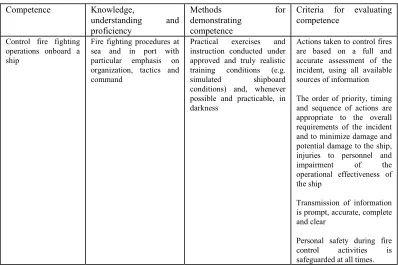
In giving “full and complete effect” to the Convention, many nations are finding that STCW 95 specifies certain items as criteria for evaluating competence, but that this is not detailed enough in how to execute the assessments. This is important with regard to Section A-I/4 paragraph 5, which states: “In the assessment, only the methods for demonstrating competence together with the criteria for its evaluation and the scope of the standards given in part A of this Code shall be used.” (STCW Code, 1995, p.13) For example, in Table A-VI/3, which applies to advanced firefighting, and partially reproduced in Table 4.1, the lack of assessment criteria is clear. It would be difficult for a PSCO to use these published and very general criteria to determine if a seafarer does in fact possess the knowledge of fire fighting operations at sea. A recent article comments on this particular shortcoming of the STCW Code:
Tables in the STCW Code provide general instructions on the methods and criteria for evaluating competence, but the terms of reference in these tables are not specific enough to permit assessments that are both valid and reliable, and the conditions for demonstration are not stated. (Bobb, 2000, p. 5)
Please note that only one knowledge is listed in table 4.1 in order to facilitate comparison with the assessment measures expanded by the USCG in Appendix 2.
Table 4.1 Excerpt from STCW 95 Table A-VI/3 on Advanced Firefighting Competence Knowledge, understanding and proficiency Methods for demonstrating competence
Criteria for evaluating competence
Control fire fighting operations onboard a ship
Fire fighting procedures at sea and in port with particular emphasis on organization, tactics and command
Practical exercises and instruction conducted under approved and truly realistic training conditions (e.g. simulated shipboard conditions) and, whenever possible and practicable, in darkness
Actions taken to control fires are based on a full and accurate assessment of the incident, using all available sources of information
The order of priority, timing and sequence of actions are appropriate to the overall requirements of the incident and to minimize damage and potential damage to the ship, injuries to personnel and impairment of the operational effectiveness of the ship
Transmission of information is prompt, accurate, complete and clear
Personal safety during fire control activities is safeguarded at all times.
Source: STCW 94, Code A, Table A-VI/3
4.5 Question 4: What are the results of an onboard assessment?
If clear grounds for the assessment are an occurrence such as a casualty, then that danger has already been determined, and the onboard assessment becomes more of a judgement of competency of an individual seafarer that merits an investigation by the flag state or nation that licensed the individual. Morrison (1997, p. 239) writes:
Evidence of incompetency may be revealed through poor performance in the sequence of events leading to or during the incident as judged against the relevant standard of competence in part A of the STCW Code. If incompetency is confirmed and poses a direct threat to safety of life or property at sea or to the marine environment, then steps should be taken to withdraw, suspend, or cancel the certificate, at least until the competence has been reestablished. Weaknesses in performance can be corrected through refresher or upgrading training.
In considering the results of an onboard assessment, a distinction must be made between human error and incompetence. A seafarer may have made an error, but he or she still knows how to perform the skill in question (is competent). A finding of incompetency as defined by Morrison would be difficult to do in the realm of PSC.
4.6 Question 5: How much time will onboard assessments add to a PSC Inspection?
There is a provision in all conventions for not delaying ships. In Article X of STCW 95, this provision reads:
delayed it shall be entitled to compensation for any loss or damage resulting therefrom. (STCW 95, p. 12)
In addition, a ship in port is subject to all manner of inspectors, from flag state surveyors to classification societies, to purpose inspectors (grain, tankers, passengers, cargo, etc.). The maritime press is full of articles and editorials lambasting the current regulatory climate in port. Is there enough time to complete an onboard assessment if needed?
4.7 Question 6: Are PSCOs adequately trained to be able to conduct onboard assessments?
Ideally, all PSCOs should possess a professional qualification that enables them to accurately assess a seafarer onboard. This means they should possess the skill they are assessing. Suggested qualifications for those PSCOs carrying out inspections of operational requirements are found in Section 2.5 of Resolution A787(19):
• qualified as master or chief engineer with seagoing experience
• have maritime-related qualifications (recognized by the Administration) and have specialized training to “ensure adequate competence and skill”
• be an officer of the Administration and have an “equivalent level of experience and training” in the conduct of operational checks.
for more compensation. How can administrations attract and pay PSCOs with the appropriate qualifications?
4.8 Question 7: Are there any legal issues involved?
Although onboard assessments are legally within the purview of a PSCO according to international conventions, the element of subjectivity inherent in onboard assessments increases the probability of legal issues. Among these are:
• entitlements for compensation for delay of ships
• who should be contacted prior to an onboard assessment or be present during an onboard assessment?
• right of appeal of person assessed, master, agent/company
• confidentiality of results
• jurisdiction on parties who have not ratified some or all of the conventions
4.9 Question 8: Is there really a need for onboard assessments of competency during a PSC Inspection?
In an article in Proceedings, Captain J. Brusseau stated that practical realities restrict the need for onboard assessments of competency. After analyzing the statistics in the U.S. from Sept. 1, 1998 to August 31, 1999, he remarked:
He concluded: “The lesson is pretty clear; most port state control problems go away by taking care of the basics.” While he noted that the number of STCW-related deficiencies remained steady over the months of that year-long period, the actual number was still low compared to the number of total deficiencies, yet he concluded that: “. . . it is safe to say the human element in general will remain a prominent focus of PSC in the U.S. in coming years, certainly until there is a noticeable decrease in STCW-related deficiencies.” (Brusseau, 2000, p. 66)
Despite this view, there is a general view among those of traditional maritime nations that the skill level of serving and incoming seafarers is lower than in the past. This view is confirmed by a large study undertaken by the Seafarers Industrial Research Center (SIRC), in Cardiff, Wales, in which marine pilots in various ports were asked to rate crew competency on vessels that they piloted. Most of the study (80%) was completed in six European ports, with the other 20% completed in ten ports in Africa, Southeast Asia and Australasia. The pilots were asked to rate the crews on: the ship’s condition, the Captain and officers’ performance on the bridge, handling lines and tugs, and ability to communicate with the pilot. A tabulation of the results revealed that pilots felt that 25% of ships they evaluated were manned by seafarers whose competence was “poor”. Ten percent of ships were reported to have “abysmal” crew competence. This study was completed as “. . . a response to a prevailing view that crew competence was in general a growing problem . . .” (The Sea, 1999, p. 1)
In addition to these questions specific to onboard assessments of competency under STCW 95, there are a number of issues that are not necessarily intrinsic to that issue, but are more generally related to PSC. These concerns will be presented in the following paragraphs.
4.10 Fraudulent seafarer documents
The first task a PSCO is authorized to perform onboard a ship is a certificate check. According to Morrison (1997, p. 41):
Every certificate must be accepted by port State authorities unless there are clear grounds for believing it was fraudulently obtained or is being used by a person other than the person to whom it was issued. Note that these two circumstances are the only reasons why a valid certificate is not accepted. One trend noted by the IMO in recent years is the proliferation of fraudulent certificates of competency. The widespread use of computers and scanners has made it easier to produce very authentic looking fraudulent documents. Most flag states do not have the resources to combat this burgeoning practice.
The IMO MSC has recently commissioned a study to be completed by the Seafarer’s International Research Center (SIRC) on unlawful practices linked to seafarer certificates. Some of the preliminary findings are that there are four main areas of unlawful practice (IMO, 2000, p. 22):
• seafarers possessing certificates which do not reflect actual functions performed on the ship or limitations due to tonnage, area of work, etc. or certificates which are expired
• certificates issued based on flawed or lax examination procedures or official corruption
• blatant forgeries given by a manning agency or shipowner, or purchased “on the street”
While the complete research is not available, a recent article in IMO News stated: “There is evidence to suggest that the problem is more widespread than previously thought.” (IMO, 2000, p. 22)
4.11 Transitional provisions
Verbal guidance from the IMO given at the MSC Subcommittee meeting in May 1999 stated that nations should not be concentrating on STCW 95 enforcement until the transitional provisions expire on 01 February 2002. There are two regulations in STCW 95 on transitional provisions that are relevant to PSC. Regulation I/15, entitled “Transitional Provisions” says that a Party can issue, recognize and endorse certificates in accordance with STCW 78 until 01 February 2002. This provision applies to those seafarers who began their seagoing service toward certification or their training program prior to 01 August 98. The U.S. is an example of a nation that is still issuing STCW 78 certificates for those seafarers who began their service prior to 01 August 98. These certificates all expire on 01 February 2002. Mariners with existing licenses need to meet STCW 95 requirements and have certificates attesting to that fact prior to 01 February 2002.
certificate is grounds for a more detailed inspection or an expanded inspection. A PSCO who is not fully versed in the individual arrangement for each nation could unknowingly impose his or her own national requirements on a ship that is fully compliant with the Convention under their particular arrangement. As an example, the STCW Convention entered into force for Estonia on 29 November 1995. The Estonian government may continue to issue STCW 78 certificates until 29 November 2000. This certificate is issued under Article VII, and is considered equivalent to an STCW 95 Certificate. It will be valid until 20 November 2005. However, if the seafarer wants to serve on a non-Estonian ship, he or she needs to receive an STCW 95 endorsement from the flag state of that ship prior to 01 February 2002. The IMO STW Subcommittee has written guidance for this confusing issue in IMO STCW.7/Circ.1. A supplement to Morrison’s book contains several tables and a country-by-country list of the status of the STCW 78 Convention.
4.12 The "White List"
Regulation I/7 of the STCW Convention (amplified by Section A-I/7 of the STCW Code) requires parties to STCW to submit a report to the IMO that demonstrates that the party is giving “full and complete effect” to the STCW Convention. Some specific items required in this report are a detailed exposition on a nation’s maritime training and licensing infrastructure, including schools, training centers, administrative oversight, and certification procedures. These reports are reviewed by a panel of “competent persons” for the IMO who make the determination as to the sincerity of the Party’s efforts toward “full and complete effect”.
of the pace of work produced by its particular panel. The 72nd (May 2000) meeting of the MSC indicated that publication of the results would be delayed indefinitely pending work of all 81 panels.
The anticipation for the results of this list, dubbed “the White List” is intense. Parties and those in maritime press have added to the hype by creating the perception that if a party is not on the white list, they must be on a “black list”. Mr. Young commented: “. . . the wording of the STCW Convention does not provide a basis for automatically presuming that any country which is not yet on the list is fundamentally in non-compliance with the convention.” (Young, 2000, p. 62) He points to the transitional provisions in place until 2002 and the fact that the process of evaluation of a party’s QSS under regulation I/8 presupposes the existence of such a system for five years prior to evaluation as indicia that the white list is not the end of the evaluation process, but rather just a piece of the puzzle. He wrote: “...the working presumption should be that the Party is making good faith efforts to address deficiencies and to meet its obligations.” (Young, 2000, p. 62)
Despite the official intentions of the white list process, a review of press articles seems to indicate that perceptions of the maritime community do not fall in line with the recommended view. In a comprehensive UK P&I Club handbook on PSC, the Secretary General of the IMO was quoted as saying that:
‘Following publication of the list, certificates issued by countries not included in the list will not be accepted as prima facia evidence that the holders have been trained and meet the standards of competency required by the convention.’ (Greenaway, 1998, p. 5)
The consequence of this will be that ships on which such seafarers are sailing may suffer costly delays in ports while inspectors verify that they are competent to safely man the ships, and this may in turn lead to an unwillingness by foreign shipowners to employ such seafarers. (Greenaway, 1998, p. 5)
Despite the intention of the IMO with regard to the white list, interpretations such as that published in the UK P&I Club are common. Parties to the convention who hold such a view, either publicly or privately, may choose to use absence of another party on the white list as a clear ground that a ship poses a danger to persons, property or the environment because the level of training of the seafarers onboard cannot be ascertained on the basis of their certificates.
4.13 Corruption
Chapter 5
Toward a Harmonized Approach to Onboard Assessments
5.1 Introduction
The questions and issues discussed in the preceding chapter can be addressed collectively by advocating an approach which at each step bears in mind the greater objective of Port State Control: to make the maritime industry more safe for seafarers, ships and the environment. Onboard assessments of competency have the potential to directly assist in this goal. In order to realize this potential, harmonization as to the reasons, procedures, criteria, purposes for detention, and training needed to conduct onboard assessments is required. The only organization in a position to do this is the IMO.
In addition to enhancing maritime safety by ensuring that seafarers are proficient in shipboard tasks relating to safety, PSC can play another role. Dr. Heike Hoppe of the IMO comments on a global vision of PSC as a knowledge-gathering element. The knowledge “will provide the maritime community with the opportunity to better analyze the causes of incidents and casualties and to ascertain, more accurately than ever before, how they can be prevented from occurring again.” (Hoppe, 2000, p. 14) She continues:
problems being hidden and ignored rather than revealed and solved. (Hoppe, 2000, p. 14)
Onboard assessments of competency have a place in this knowledge-gathering role of PSC. The knowledge gained from the onboard assessments conducted on a daily basis during PSC activities now should be analyzed, and information gathered should be used to assist in setting procedures for onboard assessments specifically under conditions enumerated in STCW 95. At this time, too much uncertainty and apprehension exists about the provisions in STCW 95 to make it useful in today’s PSC activities. Information gained from previous onboard assessment activity should be used to ensure maritime authorities the STCW 95 provision is only another form of what is currently occurring in everyday PSC activities.
In addition to commenting on the questions and issues raised in the preceding chapter, this chapter will provide some suggestions for the IMO to develop a harmonized approach to facilitate onboard assessments of competency. This step-by-step approach contains the following elements:
1. acceptance of standard terminology
2. acceptance of what is implied by the terminology 3. standardized purpose for onboard assessments 4. reducing subjectivity by good practices
The end of this chapter contains comments on the other issues contained the preceding chapter: legal concerns, fraudulent documents, transitional provisions, the white list, and corruption.
5.2 Acceptance of standard terminology
process by which shipboard performance is observed, measured, and compared to standards of performance in order to determine a mariner’s proficiency.” (IMO Res. 853, 1998) Again, onboard assessments encompass not only those under STCW 95, but also, operational checks under IMO conventions and fire and lifeboat drills. These operational checks and drills have been part of a PSC Inspection for many years, however, they have not been treated as assessments, but rather tasks which a crew or individual seafarer either passes or fails, based on a PSCO’s professional judgement.
Once the idea that all these actions during a PSC Inspection are indeed assessments, standard assessment philosophy and procedures can then be adopted. Although the competency-based approach embodied in assessments is new to the maritime world, parallels exist to other industries where this type of assessment has been the norm for many years. As a result, a whole body of research and procedure already exists on competency-based assessments in general. With the advent of STCW 95’s more competency-based approach to training being about six years old, a body of research has also appeared in the maritime community as well. Included in this is guidance from the IMO in the form of the previously referenced MSC Circular 853. Though this document was written with training institutions and companies in mind, the procedures are relevant to PSC.
As outlined in the previous chapter, STCW 95 is not detailed enough to permit flag state assessors or maritime training personnel to complete proper assessments. As an example, in STCW 95, table A-II/4, the criteria for evaluating a seafarer’s competence to “steer the ship and comply with helm orders also in the English language”, and specifically knowledge of use of the gyro-compass in doing this, the criteria for evaluating competence is: “A steady course is steered within acceptable limits having regard to the area of navigation and prevailing sea state.” What is missing is the standard for the acceptable limits. Using guidance on writing assessments, Dr. Myriam Smith of the U.S. Coast Guard comments on applying assessment methodology to these rough criteria found in the STCW Code:
An example of an objective might be to assess a mariner’s ability to steer by gyrocompass. The corresponding observable measure might be the accuracy with which the mariner is able to maintain the ordered heading. The standard might be to maintain the ordered heading to an accuracy of plus or minus three degrees. (Smith, 2000, p. 15)
To rectify this shortcoming in STCW 95, The U.S. Coast Guard’s Merchant Marine Personnel Advisory Committee (MERPAC) has written specific criteria for many of the competence tables in the STCW Code. They used the five steps of Instructional System Design (ISD) (Bobb, 2000, p. 5):
1. determine the assessment objective 2. determine the assessment method 3. specify the assessment condition
4. develop the assessment measures and standards 5. prepare the assessment package