Open Access
Research article
Vignette studies of medical choice and judgement to study
caregivers' medical decision behaviour: systematic review
Lucas M Bachmann*
1,2, Andrea Mühleisen
†1, Annekatrin Bock
†1, Gerben ter
Riet
1,3, Ulrike Held
1and Alfons GH Kessels
1,4Address: 1Horten Centre, University of Zurich, Bolleystrasse 40, CH-8091 Zurich, Switzerland, 2Division of Epidemiology and Biostatistics,
Department of Social and Preventive Medicine, University of Bern, Switzerland, 3Department of General Practice, Academic Medical Center,
Amsterdam, The Netherlands and 4Department of Clinical Epidemiology and Medical Technology Assessment, Maastricht University Hospital,
Maastricht, The Netherlands
Email: Lucas M Bachmann* - [email protected]; Andrea Mühleisen - [email protected];
Annekatrin Bock - [email protected]; Gerben ter Riet - [email protected]; Ulrike Held - [email protected]; Alfons GH Kessels - [email protected]
* Corresponding author †Equal contributors
Abstract
Background: Vignette studies of medical choice and judgement have gained popularity in the medical literature. Originally developed in mathematical psychology they can be used to evaluate physicians' behaviour in the setting of diagnostic testing or treatment decisions. We provide an overview of the use, objectives and methodology of these studies in the medical field.
Methods: Systematic review. We searched in electronic databases; reference lists of included studies. We included studies that examined medical decisions of physicians, nurses or medical students using cue weightings from answers to structured vignettes. Two reviewers scrutinized abstracts and examined full text copies of potentially eligible studies. The aim of the included studies, the type of clinical decision, the number of participants, some technical aspects, and the type of statistical analysis were extracted in duplicate and discrepancies were resolved by consensus.
Results: 30 reports published between 1983 and 2005 fulfilled the inclusion criteria. 22 studies (73%) reported on treatment decisions and 27 (90%) explored the variation of decisions among experts. Nine studies (30%) described differences in decisions between groups of caregivers and ten studies (33%) described the decision behaviour of only one group. Only six studies (20%) compared decision behaviour against an empirical reference of a correct decision. The median number of considered attributes was 6.5 (IQR 4–9), the median number of vignettes was 27 (IQR 16–40). In 17 studies, decision makers had to rate the relative importance of a given vignette; in six studies they had to assign a probability to each vignette. Only ten studies (33%) applied a statistical procedure to account for correlated data.
Conclusion: Various studies of medical choice and judgement have been performed to depict weightings of the value of clinical information from answers to structured vignettes of care givers. We found that the design and analysis methods used in current applications vary considerably and could be improved in a large number of cases.
Published: 30 July 2008
BMC Medical Research Methodology 2008, 8:50 doi:10.1186/1471-2288-8-50
Received: 14 May 2007 Accepted: 30 July 2008
This article is available from: http://www.biomedcentral.com/1471-2288/8/50 © 2008 Bachmann et al; licensee BioMed Central Ltd.
BMC Medical Research Methodology 2008, 8:50 http://www.biomedcentral.com/1471-2288/8/50
Page 2 of 8 (page number not for citation purposes)
Background
Preferences and perceived similarities or differences between choice alternatives can be evaluated using struc-tured vignettes. There are two prominent methods of con-structing such models of medical judgements, each with their own literature and set of advocates. These are con-joint analysis, developed in the 1970s to study preference and choice [1], and judgement analysis, also called social judgement theory, developed in the 1950s from Brunswik's lens model [2,3]. The two have developed along very different theoretical lines and have developed somewhat different methodology, although there is con-siderable overlap. Today there is a large number of mar-keting applications, where the joint effects of multiple product attributes on product choice have been studied. The types of choices include 'ranking', 'rating', and 'dis-crete choice'.
These methods can be carried forward to the analysis of medical decision making, as medical decisions require judgement under uncertainty. This uncertainty may con-cern a state, such as the presence of illness, the likelihood of future events, such as those in the natural course of an illness, or the likelihood with which such events may be averted, that is, treatment effects. For many years decision-making research has explored physicians' estimation of probabilities given clinical scenarios [4]. However, there have been concerns whether physicians' probability set-ting leads to consistent raset-tings [5]. Moreover, cognitive psychological research shows that physicians do not apply probabilities as suggested by decision-making theory but use their own heuristics to decide [6-8].
Studies of medical choice and judgement offer a way to elicit the public's, patients' and caregivers' views on healthcare that circumvents probability statements [9-11]. The technique is gaining widespread use in healthcare and has been applied in different areas for example to estab-lish patients' preferences in the doctor-patient relation-ship [12], or to determine optimal treatments for patients [13]. Increasingly, discrete choice analyses are being employed to study how physicians weigh clinical infor-mation in the diagnostic work-up. In particular, respond-ents are asked to rank, rate, or choose between simulated clinical cases varying in values of different symptoms along the possibility that this case will have a certain ill-ness or will need a certain treatment. Comparison with the results of clinical studies allows an analysis of poten-tial discrepancies (e.g. undervaluation of signs and symp-toms, overvaluation of test results). Moreover, such comparisons with reference data from clinical studies allow linking physicians' behaviour to illness probabili-ties and therefore allow examining (implicit) decision thresholds.
A considerable number of studies have been published recently. We provide an overview of existing reports, present an inventory of their objectives and methods, and evaluate them using systematic review methodology.
Methods
We defined a study of medical choice and judgement as an investigation in which preferences were elicited in physi-cians, nurse practitioners or medical students and that allowed the estimation of the relative importance of dif-ferent characteristics.
Search strategy
We performed electronic searches in Medline, PsychINFO,
CINAHL (Ovid®-version). Web of Science (ISI web of
Sci-ence®) was used to locate studies that cited four key papers [14-17]. The last update search was performed on 25/3/ 2005. The exact search strategy may be obtained from the authors.
Inclusion criteria
Eligible articles for this review had to infer cue or attribute weighting from answers to structured vignettes and had to report on caregivers' decision making.
Data extraction strategy
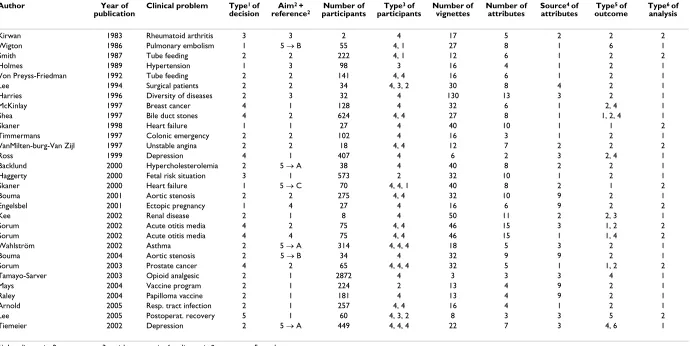
We developed a data extraction form based on the assess-ment of three articles [17-19]. The form contained twelve items describing a study's salient features of context, design and analysis (for details see Table 1).
typi-ical Rese
arch Me
th
odol
ogy
200
8,
8
:50
http
://www.bio
m
e
dcent
ral.com/147
1-228 Page
(page nu
mber not
for
cit
a
tion pur
Author Year of
publication
Clinical problem Type of decision
Aim +
reference2 participantsNumber of participantsType of Number of vignettes Number of attributes Sourceattributesof outcomeType of Typeanalysisof
Kirwan 1983 Rheumatoid arthritis 3 3 2 4 17 5 2 2 2
Wigton 1986 Pulmonary embolism 1 5 →B 55 4, 1 27 8 1 6 1
Smith 1987 Tube feeding 2 2 222 4, 1 12 6 1 2 2
Holmes 1989 Hypertension 1 3 98 3 16 4 1 2 1
Von Preyss-Friedman 1992 Tube feeding 2 2 141 4, 4 16 6 1 2 1
Lee 1994 Surgical patients 2 2 34 4, 3, 2 30 8 4 2 1
Harries 1996 Diversity of diseases 2 3 32 4 130 13 3 2 1
McKinlay 1997 Breast cancer 4 1 128 4 32 6 1 2, 4 1
Shea 1997 Bile duct stones 4 2 624 4, 4 27 8 1 1, 2, 4 1
Skaner 1998 Heart failure 1 1 27 4 40 10 1 1 2
Timmermans 1997 Colonic emergency 2 2 102 4 16 3 1 2 1
VanMilten-burg-Van Zijl 1997 Unstable angina 2 2 18 4, 4 12 7 2 2 2
Ross 1999 Depression 4 1 407 4 6 2 3 2, 4 1
Backlund 2000 Hypercholesterolemia 2 5 →A 38 4 40 8 2 2 1
Haggerty 2000 Fetal risk situation 3 1 573 2 32 10 1 2 1
Skaner 2000 Heart failure 1 5 →C 70 4, 4, 1 40 8 2 1 2
Bouma 2001 Aortic stenosis 2 2 275 4, 4 32 10 9 2 1
Engelsbel 2001 Ectopic pregnancy 1 4 27 4 16 6 9 2 2
Kee 2002 Renal disease 2 1 8 4 50 11 2 2, 3 1
Sorum 2002 Acute otitis media 4 2 75 4, 4 46 15 3 1, 2 2
Sorum 2002 Acute otitis media 4 4 75 4, 4 46 15 1 1, 4 2
Wahlström 2002 Asthma 2 5 → A 314 4, 4, 4 18 5 3 2 1
Bouma 2004 Aortic stenosis 2 5 →B 34 4 32 9 9 2 1
Sorum 2003 Prostate cancer 4 2 65 4, 4, 4 32 5 1 1, 2 2
Tamayo-Sarver 2003 Opioid analgesic 2 1 2872 4 3 3 3 4 1
Mays 2004 Vaccine program 2 1 224 2 13 4 9 2 1
Raley 2004 Papilloma vaccine 2 1 181 4 13 4 9 2 1
Arnold 2005 Resp. tract infection 2 1 257 4, 4 16 4 1 2 1
Lee 2005 Postoperat. recovery 5 1 60 4, 3, 2 8 3 3 5 2
Tiemeier 2002 Depression 2 5 → A 449 4, 4, 4 22 7 3 4, 6 1
1) 1 = diagnosis, 2 = treatment, 3 = risk, prognosis, 4 = diagnosis & treatment, 5 = other
2) 1st digit describes aim: 1 = descriptive, 2 = group comparison, 3 = consistency, 4 = change over time, 5 = comparison with reference
2nd digit describes reference: A = guidelines, B = actual patients, C = clinical study
3) 1 = student, 2 = paramedic, 3 = physician in training, 4 = expert 4) 1 = literature, 2 = patients, 3 = expert, 4 = guidelines, 5 = no information
BMC Medical Research Methodology 2008, 8:50 http://www.biomedcentral.com/1471-2288/8/50
Page 4 of 8 (page number not for citation purposes)
cally not independent. Each respondent evaluates each of the vignettes. This makes the data from one respondent more alike than one would expect under the assumption of independence, and therefore standard deviations of the attributes could be underestimated. We searched for any statistical method that allows to adjust the standard errors for the intra-group correlation.
All studies were assessed in duplicate. Discordant scores based on reading errors were corrected. Discordant scores based on real differences in interpretation were discussed and resolved through consensus.
Results
The searches retrieved 2001 records. Full papers of 81 potentially relevant studies were obtained. In total 51 arti-cles did not meet the inclusion criteria and were excluded after reading the full reports, leaving 30 reports published between 1983 and 2005 for evaluation. (See flowchart in the Figure 1) The salient features of included studies are shown in the Table 1.
General aspects
Although the first study was published in 1983, 24 studies (84%) were published after 1995.
Twenty-seven out of thirty studies examined decision behaviour of medical experts [15,17-42]. In half of the studies more than one type of respondent was surveyed.
Twenty-eight different medical problems were addressed. Twenty-two (73%) studies examined treatment decisions. Eleven studies (37%) asked for a preferred diagnostic decision, sometimes (6 studies) in combination with a treatment decision.
Objectives
Ten studies (33 percent) aimed at describing decision preferences of specific groups of participants [20,24,26,27,29,30,32,38,43,44] and nine studies (30 percent) described decision preference differences between groups [18,25,28,31,34,36,37,40,41]. Three studies explored the consistency of decisions between groups of experts [15,23,45] and two studies examined change of preferences after an intervention [22,35]. Only six studies (20 percent) compared decision behaviour against some sort of empirical reference such as a guide-line [21,39,42] (n = 3), actual patient data [17,19] (n = 2) or the result of a clinical study [33].
Design
The median number of attributes was 6.5 (inter quartile range IQR 4–9, range 2–15). In 20 studies (67%) the selection of attributes was based on information like the literature [17,20,27,28,31,32,34,35,37,40,43,45] (12
studies), expert opinion (7 studies) or guidelines (1 study). In five studies patient files [15,21,24,33,41] were used to construct the vignettes.
The median number of vignettes was 25 (IQR 16–32), ranging from 3 to 130.
Authors used several response modes for the vignettes. In eight cases they used more than one response mode. In 23 cases authors used a rating procedure [15,18,20-25,27-31,34-37,40-45], where respondents had to rate the rela-tive importance of a given vignette or assign a probability (n = 6) to a diagnosis or outcome [31-33,35-37]. One study used a ranking design, where respondents had to arrange each of the attributes in descending order of importance [24]. In six studies respondents could reply with a yes/no choice [27,30,31,35,38,39]. One study used a conventional discrete choice mode, where respondents, given two or more vignettes, had to select one with the highest likelihood of postoperative recovery [26].
Analysis
Twenty (67%) studies did not correct for correlated data. Consequently, only ten studies applied some statistical procedure to account for this correlation within the data [15,22,26,32-37,41].
Discussion
This review has two main findings. First, studies of cal choice and judgement are regularly used in the medi-cal field to explore healthcare providers' decision behaviour or preferences. Second, we found a broad spec-trum of different methods, and both design and analysis were suboptimal in some cases.
Cognitive burden/complexity
suggests a maximum of 20 vignettes [48] and a review of discrete choice experiments evaluating healthcare shows that the number of vignettes seldom exceeds 16 [49]. Fur-thermore, the majority of studies either used a ranking or rating response mode. These two modes imply very strong assumptions about human cognitive abilities making it more likely that measures will be biased and invalid [50]. Consequently, we therefore recommend the choice based approach.
Validity, usefulness of study objectives
In contrast to applications in marketing research where the main topic of a study is to identify opinions regarding a new product, we would be particularly interested to
learn about the correctness of care givers' weighting of the value of clinical information in decisions. While there is no normative benchmark for a "correct" product there is usually one in medical judgement if clinical studies are available. For example, if the results of a study on medical choice and judgement showed that physicians consist-ently attribute high weights to relatively uninformative lab test but instead undervalue the informativeness of cues from clinical examination they would hint at some-thing that needed to be improved perhaps with an educa-tional intervention. Also the method would allow assessing the change in preferences after intervening with educational measures.
Study flow Figure 1 Study flow.
Medline
PsychINFO
CINAHL
ISI Web of Science
Inclusion criteria
Studies estimating caregivers’ attributed relative importance of different aspects of care (attributes) in a medical decision problem
2001 Articles
Screening
Title
Abstracts
Reading full text
30 Articles (see Table 1 for details)
1920 Articles rejected
BMC Medical Research Methodology 2008, 8:50 http://www.biomedcentral.com/1471-2288/8/50
Page 6 of 8 (page number not for citation purposes)
Most studies did not compare the attributed weights to some sort of normative benchmark such as the results of a clinical study. We only found one out of 30 studies that actually examined this and another five that used a further normative reference (guidelines or patient files). In absence of a normative benchmark these studies leave it to the reader to approve or disapprove the results. Moreover, assessment of discrepancies between different groups of participants has the problem that these could be explained by different clinical circumstances or other fac-tors rather than group specific differences. On the other hand there are medical situations in which views about optimal choices are controversial. In these situations stud-ies that do not compare caregivers' decision behaviour (or preferences) to some norm may still be useful in that they allow the examination of present opinions.
Statistical model
The majority of studies did not account for correlated data in the analysis. Correlated data occur because each respondent assesses different vignettes. Not accounting for this leads to too small estimates of the standard devia-tions for an attribute and can mimic a statistically signifi-cant association where in fact there is none. Unfortunately, guidelines on the conduct of conjoint analyses have not yet reached consensus about the opti-mal way to analyse correlated data.
Limitations
What are the limitations of this review? We think that the search and appraisal procedures were reliable. However, sometimes classifications were difficult to make because of unclear descriptions in the article. We did not contact authors to clarify these uncertainties. Second, there have been two prominent methods of constructing linear mod-els of medical judgements, each with their own literature and set of advocates. These are conjoint analysis, devel-oped in the 1970s to study preference and choice[1], and judgement analysis, also called social judgement theory, developed in the 1950s from Brunswik's lens model[2,3]. In this review we did not make a distinction between the two methods because there is substantial overlap in meth-odology. Arguably this is a weakness of our study. How-ever, since we were interested in providing an overview of all studies that examined medical decisions of care givers using cue weightings from answers to structured vignettes applying all sorts of different methods, we feel that our approach has its own merit.
Future research
Our review indicates that current applications of conjoint and judgment analysis in the medical field remain subop-timal in some instances. We think that researchers should consider our propositions to ensure internal validity. Moreover we believe that studies investigating care givers'
judgements are most valuable if they allow comparisons with some norm and if they include an assessment of deviations from that norm. Our review only found few such investigations. From a more methodological point of view we agree with a statement in a recent editorial that research is required to learn whether individuals do behave in reality as they state in a hypothetical context. [51]
Conclusion
We believe that studies of medical choice and judgement offer many attractive and new insights into medical action. Provided that both methods and application evolve they offer a unique opportunity to improve quality of care.
Competing interests
The authors declare that they have no competing interests.
Authors' contributions
AGHK conceived of the study and LMB obtained funding. AGHK and LMB designed the study, supervised the work and drafted the manuscript. AM and AB carried out the data extraction. AM, AB, UH and GtR participated in the design of the study and gave important conceptual input. All authors read and approved the final manuscript.
Acknowledgements
We thank Dr. Pius Estermann (information specialist, University Hospital Zurich) for doing the literature searches. This work was supported by the Swiss National Science Foundation (grants no. 3233B0-103182 and 3200B0-103183). The funding body played no role in study design; in the collection, analysis, and interpretation of data; in the writing of the manu-script; and in the decision to submit the manuscript for publication.
References
1. Green PE: On the Design of Choice Experiments Involving
Multifactor Alternatives. Journal of Consumer Research: An
Interdis-ciplinary Quarterly 1974, 1:61-68.
2. Cooksey RW: Judgment Analysis: Theory, Methods, and
Applications. Academic Press; 1 edition (January 16, 1996) 2007:ISBN
012187575X.
3. Hammond KR, Hursch CJ, Todd FJ: Analyzing the Components
of Clinical Inference. Psychol Rev 1964, 71:438-456.
4. Poses RM, Cebul RD, Wigton RS: You can lead a horse to water--improving physicians' knowledge of probabilities may not
affect their decisions. Med Decis Making 1995, 15:65-75.
5. Puhan MA, Steurer J, Bachmann LM, ter RG: Variability in
diagnos-tic probability estimates. Ann Intern Med 2004, 141:578-579.
6. Gigerenzer G, Goldstein DG: Reasoning the fast and frugal way:
models of bounded rationality. Psychol Rev 1996, 103:650-669.
7. Hoffrage U, Gigerenzer G: Using natural frequencies to improve
diagnostic inferences. Acad Med 1998, 73:538-540.
8. Hoffrage U, Lindsey S, Hertwig R, Gigerenzer G: Medicine.
Com-municating statistical information. Science 2000,
290:2261-2262.
9. Elstein AS, Schwarz A: Clinical problem solving and diagnostic decision making: selective review of the cognitive literature. BMJ 2002, 324:729-732.
10. Ratcliffe J, Buxton M: Patients' preferences regarding the proc-ess and outcomes of life-saving technology. An application of
conjoint analysis to liver transplantation. Int J Technol Assess
11. Ratcliffe J, Buxton M, Young T, Longworth L: Determining Priority for Liver Transplantation: A Comparison of Cost per QALY and Discrete Choice Experiment-Generated Public
Prefer-ences. Appl Health Econ Health Policy 2005, 4:249-255.
12. Ryan M: Using conjoint analysis to take account of patient preferences and go beyond health outcomes: an application
to in vitro fertilisation. Soc Sci Med 1999, 48:535-546.
13. Ryan M, Hughes J: Using conjoint analysis to assess women's
preferences for miscarriage management. Health Econ 1997,
6:261-273.
14. Addelman S: Orthogonal main-effect plans for asymmetrical
factorial experiments. Technometrics 1962, 4:47-58.
15. Kirwan JR, Chaputdesaintonge DM, Joyce CRB, Currey HLF: Clinical Judgment in Rheumatoid-Arthritis .2. Judging Current
Dis-ease-Activity in Clinical-Practice. Annals of the Rheumatic
Dis-eases 1983, 42:648-651.
16. Kirwan JR, Desaintonge DMC, Joyce CRB, Currey HLF: Clinical Judgment in Rheumatoid-Arthritis .3. British
Rheumatolo-gists Judgments of Change in Response to Therapy. Annals of
the Rheumatic Diseases 1984, 43:686-694.
17. Wigton RS, Hoellerich VL, Patil KD: How physicians use clinical information in diagnosing pulmonary embolism: an
applica-tion of conjoint analysis. Medical Decision Making 1986, 6:2-11.
18. Bouma BJ, van der Meulen JHP, van den Brink RBA, Arnold AER, Smidts A, Teunter LH, Lie KI, Tijssen JGP: Variability in treatment advice for elderly patients with aortic stenosis: a nationwide
survey in the Netherlands. Heart 2001, 85:196-201.
19. Bouma BJ, van der Meulen JH, van den Brink RB, Smidts A, Cheriex EC, Hamer HP, Arnold AE, Zwinderman AH, Lie KI, Tijssen JG:
Validity of conjoint analysis to study clinical decision making
in elderly patients with aortic stenosis. Journal of Clinical
Epide-miology 2004, 57:815-823.
20. Arnold SR, To T, McIsaac WJ, Wang FEL: Antibiotic prescribing for upper respiratory tract infection: The importance of
diagnostic uncertainty. Journal of Pediatrics 2005, 146:222-226.
21. Backlund L, Danielsson B, Bring J, Strender LE: Factors influencing GPs' decisions on the treatment of hypercholesterolaemic
patients. Scandinavian Journal of Primary Health Care 2000, 18:87-93.
22. Engelsbel S, Mol BWJ, Hajenius PJ, Ankum WM, van der Veen F, Hem-rika DJ, Bossuyt PMM: Non-invasive management of patients with suspected ectopic pregnancy: a survey among Dutch
gynaecologists. European Journal of Obstetrics Gynecology and
Repro-ductive Biology 2001, 95:81-85.
23. Harries C, Evans J, Dennis I, Dean J: A clinical judgement analysis
of prescribing decisions in general practice. Travail Humain
1996, 59:87-109.
24. Kee F, Patterson CC, Wilson AE, McConnell JM, Wheeler SM, Watson JD: Judgment analysis of prioritization decisions within a dialysis program in one United Kingdom region. Medical Decision Making 2002, 22:140-151.
25. Lee A, Lum ME, Hillman KM, Bauman A: Referral of Surgical Patients to an Anesthetic Clinic - a Decision-Making Analy-sis. Anaesth Intensive Care 1994, 22(5):562-567.
26. Lee A, Gin T, Lau AS, Ng FF: A comparison of patients' and health care professionals' preferences for symptoms during immediate postoperative recovery and the management of
postoperative nausea and vomiting. Anesthesia & Analgesia 2005,
100:87-93.
27. McKinlay JB, Burns RB, Durante R, Feldman HA, Freund KM, Harrow BS, Irish JT, Kasten LE, Moskowitz MA: Patient, physician and presentational influences on clinical decision making for
breast cancer: results from a factorial experiment. Journal of
Evaluation in Clinical Practice 1997, 3:23-57.
28. Preyss-Friedman SM, Uhlmann RF, Cain KC: Physicians' attitudes toward tube feeding chronically ill nursing home patients. Journal of General Internal Medicine 1992, 7:46-51.
29. Raley JC, Followwill KA, Zimet GD, Ault KA: Gynecologists' atti-tudes regarding human papilloma virus vaccination: a survey of Fellows of the American College of Obstetricians and
Gynecologists. Infectious Diseases in Obstetrics & Gynecology 2004,
12:127-133.
30. Ross S, Moffat K, McConnachie A, Gordon J, Wilson P: Sex and atti-tude: a randomized vignette study of the management of
depression by general practitioners. British Journal of General
Practice 1999, 49:17-21.
31. Shea JA, Asch DA, Johnson RF, Staroscik RN, Malet PF, Pollack BJ, Clarke JR, Green PE, Schwartz JS, Williams SV: What predicts gas-troenterologists' and surgeons' diagnosis and management
of common bile duct stones? Gastrointestinal Endoscopy 1997,
46:40-47.
32. Skaner Y, Strender LE, Bring J: How do GPs use clinical informa-tion in their judgements of heart failure? A Clinical
Judge-ment Analysis study. Scandinavian Journal of Primary Health Care
1998, 16:95-100.
33. Skaner Y, Bring J, Ullman B, Strender LE: The use of clinical infor-mation in diagnosing chronic heart failure: A comparison between general practitioners, cardiologists, and students. Journal of Clinical Epidemiology 2000, 53:1081-1088.
34. Smith DG, Wigton RS: Modeling Decisions to Use
Tube-Feed-ing in Seriously Ill Patients. Archives of Internal Medicine 1987,
147:1242-1245.
35. Sorum PC, Stewart TR, Mullet E, Gonzalez-Vallejo C, Shim J, Chassei-gne G, Sastre MTM, Grenier B: Does choosing a treatment depend on making a diagnosis? US and French physicians'
decision making about acute otitis media. Medical Decision
Making 2002, 22:394-402.
36. Sorum PC, Shim J, Chasseigne G, Mullet E, Sastre MTM, Stewart T, Gonzalez-Vallejo C: Do parents and physicians differ in making
decisions about acute otitis media? Journal of Family Practice
2002, 51:51-57.
37. Sorum PC, Shim J, Chasseigne G, Bonnin-Scaon S, Cogneau J, Mullet
E: Why do primary care physicians in the United States and
France order prostate-specific antigen tests for
asympto-matic patients? Medical Decision Making 2003, 23:301-313.
38. Tamayo-Sarver JH, Dawson NV, Hinze SW, Cydulka RK, Wigton RS, Albert JM, Ibrahim SA, Baker DW: The effect of race/ethnicity and desirable social characteristics on physicians' decisions
to prescribe opioid analgesics. Academic Emergency Medicine
2003, 10:1239-1248.
39. Tiemeier H, de Vries WJ, van het LM, Kahan JP, Klazinga N, Grol R, Rigter H: Guideline adherence rates and interprofessional variation in a vignette study of depression.[see comment]. Quality & Safety in Health Care 2002, 11:214-218.
40. Timmermans DRM, Gooszen AW, Geelkerken RH, Tollenaar R, Gooszen HG: Analysis of the variety in surgeons' decision strategies for the management of left colonic emergencies. Medical Care 1997, 35:701-713.
41. vanMiltenburgvanZijl AJM, Bossuyt PMM, Nette RW, Simoons ML, Taylor TR: Cardiologists' use of clinical information for man-agement decisions for patients with unstable angina: A
pol-icy analysis. Medical Decision Making 1997, 17:292-297.
42. Wahlstrom R, Hummers-Pradier E, Lundborg CS, Muskova M, Lager-lov P, Denig P, Oke T, de Saintonge DMC: Variations in asthma treatment in five European countries - judgement analysis of
case simulations. Family Practice 2002, 19:452-460.
43. Haggerty LA, Nuttall RL: Experienced obstetric nurses'
deci-sion-making in fetal risk situations. JOGNN - Journal of Obstetric,
Gynecologic, & Neonatal Nursing 2000, 29:480-490.
44. Mays RM, Zimet GD: Recommending STI vaccination to
par-ents of adolescpar-ents: the attitudes of nurse practitioners.
Sex-ually Transmitted Diseases 2004, 31:428-432.
45. Holmes MM, Rovner DR, Rothert ML, Schmitt N, Given CW, Ialongo
NS: Methods of Analyzing Physician Practice Patterns in
Hypertension. Medical Care 1989, 27:59-68.
46. Louviere JJ, Eagle CE, Cohen SH: Conjoint Analysis: Methods,
Myths and Much More. CEnSoc Working Paper No 05-001: 31,
Uni-versity of Technology, Sydney (2005) 2005.
47. Green PE, Sirnivasan V: Conjoint analysis in marketing: new
developments with implications for research and practice. J
Marketing 1990, 54:3-19.
48. Johnson RM, Orme BK: How many questions should you ask in
choice-based conjoint studies. Sawtooth Softwarte Research Papers
Sawtooth Software, Inc 1996.
49. Ryan M, Gerard K: Using discrete choice experiments to value health care programmes: current practice and future
research reflections. Appl Health Econ Health Policy 2003,
2(1):55-64.
50. Louviere JJ, Henscher DA, Swait J: Stated choice methods:
Anal-ysis and application. Cambridge University Press (2000) chapter 2 :
Publish with BioMed Central and every scientist can read your work free of charge "BioMed Central will be the most significant development for disseminating the results of biomedical researc h in our lifetime."
Sir Paul Nurse, Cancer Research UK
Your research papers will be:
available free of charge to the entire biomedical community
peer reviewed and published immediately upon acceptance
cited in PubMed and archived on PubMed Central
yours — you keep the copyright
Submit your manuscript here:
http://www.biomedcentral.com/info/publishing_adv.asp
BioMedcentral
BMC Medical Research Methodology 2008, 8:50 http://www.biomedcentral.com/1471-2288/8/50
Page 8 of 8 (page number not for citation purposes)
51. Ryan M: Discrete choice experiments in health care. BMJ 2004,
328:360-361.
Pre-publication history
The pre-publication history for this paper can be accessed here: