ISSN 2324-805X E-ISSN 2324-8068 Published by Redfame Publishing URL: http://jets.redfame.com
Saudi Science Teachers' Perceptions of Implementing Inquiry in Science
Class
Saleh Abdullah Alabdulkareem
Correspondence: Saleh Alabdulkareem: Curriculum and Instruction Department, College of Education, King Saud University, Riyadh, P.O. Box 87984, Riyadh 11652, Saudi Arabia.
Received: October 29, 2017 Accepted: November 13, 2017 Online Published: November 14, 2017
doi:10.11114/jets.v5i12.2741 URL: https://doi.org/10.11114/jets.v5i12.2741
Abstract
This study aims to measure science teachers’ perception about their students’ practices in science class, and to measure their model of inquiry teaching. The sample consisted of 127 middle school science teachers in Riyadh, Saudi Arabia, 65 males and 62 females, in the school year 2016/2017, and utilized a questionnaire with two parts, 11 items for their students’ practices, and 27 items related to model of inquiry teaching. The results showed that the general average of teacher’s assessment of their students’ practices in science class was "average", except for finding relevant literature was "low". Teachers' perceptions of their degree of practices of inquiry showed that all the three models "structured, guided, and open" rated as "average". In "Structured Inquiry", the means of males’ responses ranged between (3.60) and (2.61), while the females ranged between (3.92) and (3.02), indicating that both of them are practicing structured inquiry with a range from moderate to high practice. For the "Guided Inquiry" the means ranging between (3.52) and (2.97) for males, and (3.58) and (2.74) for females, indicating that the range from moderate to high practice. And for the perceptions of practicing "Open Inquiry" the means ranged between (3.38) and (2.42) for males, and (3.34) and (2.13) for females, indicating that they practice "Open Inquiry" between moderate and low practice. There were no statistically significant differences between male and female teachers’ perceptions for their students’ practices and of the degree to which they exercised all models of inquiry. Based on the findings, the researcher suggests a number of pedagogical implications.
Keywords: science teaching, perceptions, structured inquiry, guided inquiry, open inquiry, Saudi teachers
1. Introduction
Science education aims at preparing learners to real life, therefore preparing them to be active science practitioners. One of the essential key elements of teaching science, is actual implications of the scientific inquiry in classroom to insure the practice of this aspect in real life, this is in line with the vision set forth in many science education projects like Next Generation Science Standards NGSS (Achieve, Inc., 2013), and A Frame Work for K-12 Science Education by the National Research Council [NRE] (NRE, 2012), "Helping students develop informed views about scientific inquiry has been and continues to be a goal of K-12 science education, as evidenced in various reform documents" (Lederman et al., 2014). Science teachers need more powerful means for assessing learners' conceptions about necessary aspects of scientific inquiry (Yeomans, 2011; Jocz, Zhai, & Tan, 2014).
Rich science education environments provide education to individuals to become scientific literate (Houseal, Abd-El-Khalick & Destefano, 2014; Minner, Levy, & Century, 2010; Abd-El-Khalick et al., 2004), studies point out that the use of authentic inquiry based practical approaches support not only student’s learning of high level investigative skills, but also enhance and develop students’ meaningful learning, understanding of the nature of science, critical thinking, and communication skills (Kask & Rannikmae, 2009; Laius, Kask, & Rannikmae, 2009; Chin & Osborne, 2008; Chin, 2007; Trumbull, Bonney, & Grudens-Schuck, 2005). It is also revealed in many studies that suitable science activities can have a powerful influence on students’ understanding of science and their interest in science teaching (Blumenfeld, Kempler, & Krajcik, 2006; Hofstein et al., 2005; Anderson, 2002). "It makes good sense that teachers offer ample opportunities for themselves and their students to learn through a process of observing and asking questions that would lead them to meaningful learning outcomes" (Tan, 2011, p.113).
of science education (Koksal & Berberoglu, 2012; Sadeh & Zion, 2012; National Research Council [NRC], 2000); however, in contrast to the efforts of researchers to disseminate the inquiry practice, science teachers continuously hesitate to use scientific inquiry in their classrooms (Kang & Keinonen, 2016; Trautmann, MaKinster, & Avery, 2004).
2. Literature Review
2.1 The Meaning of the Term Inquiry
Cambridge English Dictionary (2017) defines the term Inquiry as a noun "the process of asking a question", and as a verb "an official process to discover the facts about something", while Merriam Webster Dictionary (2017) gives these meanings: "examination into facts or principles" in research, "a request for information", and "a systematic investigation often of a matter of public interest". As Wells (2001) explained that inquiry is not a method of doing science or any other subject, nor students formulating random questions to investigate, rather it is an approach in which the posing of real questions is positively encouraged. Inquiry is not only asking questions, it includes process skills to find answers for the question defined, “Human systems grow toward what they persistently ask questions about” (Brown & Isaacs, 2005, p. 7).
2.2 The Importance of Inquiry in Science Class
The development and use of inquiry builds students' awareness of the world around him and his part within a community (Lucas, 2003). School communities can become responsive to all students by implementing inquiry practices within the teaching of science. The infusion of responsive inquiry strategies into the school’s culture offers powerful opportunities to build capacity in schools to alter low student-achievement situations (Contreras, 2011; Ripley, 2014). Therefore, inquiry is an essential life skill to prepare individuals to survive with an uncertain future and inquiry should be considered as a fundamental goal of all education systems, “Research on effective teaching over the past two decades has shown that effective practice is linked to inquiry, reflection, and continuous professional growth” (Ferraro, 2000, p. 2).
Recalling Freire's (2002) term, "banking education" limits student’s creativity and the process of free inquiry. Freire (2002) recommends an alternative teaching method using the concept of problem-posing education. Problem-posing education does not draw sharp distinctions between student and teacher. Problem-posing education encourages a process in which students are no longer passive listeners, but rather “critical co-investigators in dialogue with the teacher” (Freire, p. 81). According to Schwartz, Lederman and Crawford (2003) scientific inquiry is one of the main approaches that aid in the development of scientific creativity.
Teachers play an important role as a key component of the educational system to foster inquiry in the classroom, and they are responsible to provide inquiry opportunities for students, as well as helping them to be aware of their potentials. Such learning opportunities require teachers to be aware of their students’ characteristics and abilities, along with the appropriate way to provide inquiry environment in science class. The relationship between teachers and students is a critical aspect of education, this relationship affects students when teachers meet and interact with them, either in a positive or a negative way (Selby, Shaw, & Houtz, 1993; Ramnarain, 2016). Little (1993) wrote, “Professional development prepares teachers (as well as students and their parents) to employ the techniques and perspectives of inquiry... It provides the possibility for teachers and others to interrogate their individual beliefs and the institutional patterns of practice” (p. 139). It is within such an environment of inquiry that change will occur, including teachers’ perceptions and expectations that affect student practices and achievements. This reflective and collaborative dialogue must also analyze what is working and what is not working for their students (Contreras, 2011; Kang & Keinonen, 2016).
The employment of inquiry is important to build the capacity for school enhancement, and if inquiry and reflective processes become a routine part of the school’s educational practice and precise and challenging coursework for all students is the norm, then the intended outcome would be greater achievement for all students, besides building an individual’s awareness of the world around him and his part within a community (Lucas, 2003; Contreras, 2011; Niemi, 2015). Keeping in mind, that the more student questions, the more student seeks to finds answers.
2.3 Teachers Perceptions of Inquiry
Mocovici (2001) argues that it is known that perceptions are not reproductions of reality, accordingly they are subjective mental constructions of it. It can be inferred that perceptions guide what we are and what we do (Romo & Alfonso, 2003), and their significant expectations are of greatest importance for students (Rosenthal, 1991). As a result, knowing teachers’ perceptions about inquiry can help to understand needs, misconceptions or even intolerance ideas, and to determine positive beliefs that should be reinforced. Evaluating teachers’ conceptions of inquiry can help consequently to establish better practices to promote inquiry in science classroom (Schmidt, 2011; Cavas, 2012; Newton & Newton, 2009).
styles of practices; furthermore, how these styles impact their approach and treatment with students (Copland, 2003; David, 2009). Using inquiry has become a universal feature in science education, but teachers often face challenges in implementing inquiry based learning because of, for instance, teachers’ low confidence in conducting inquiry or insufficient school resources. Much research has been conducted to identify the barriers that impede inquiry practice. (Kang & Keinonen, 2016). Within this context, teachers’ classroom practice is highly dependent of their perceptions and believes.
2.4 Models and Approaches of Inquiry
One of the most important views of inquiry, is the model of the inquiry cycle, which has 7 stages. The model was constructed by the National Research Council (NRC) (1996), and developed by Dunkhase (2003) as The Coupled-Inquiry Cycle. These “coupled inquiries” are embedded in a cycle based on traditional learning cycle models, such as the 5E model of Bybee (1997) and problem solving models, such as the Search, Solve, Create, and Share (SSCS) model (Pizzini, Shepardson, & Abell, 1989).
The stages of this model, as presented in (Cavas, Holbrook, Kask, & Rannikmae, 2013), are:
Identifying and posing appropriate scientifically oriented questions;
making prediction / developing hypothesis;
designing and conducting investigations;
identifying variables;
collecting data;
analyzing data to develop patterns;
communicating and connecting explanation.
The extent of students’ involvement in the active learning process determine the level of class inquiry practice. Therefore, there are three approaches of inquiry practice in class.
The first approach is "Structured Inquiry", where the teacher establishes parameters and procedures for inquiry. Students are provided with a hands-on problem to investigate as well as the procedures and materials necessary to complete the investigation, and questions presented by teacher. Students discover relationships between variables or generalize from data collected, which in essence leads to the discovery of expected outcomes. The value in using structured inquiry is it allows the instructor to teach students the basics of investigating as well as techniques of using various equipment and procedures that can be used in later more complicated investigations. In other words, structured inquiries provide students with common learning experiences that can be used in guided or open inquiry (NRC, 2005; Zion & Mendelovici, 2012).
The second approach is "Guided Inquiry", where the teacher provides the problem for investigation as well as the necessary materials. Students are expected to devise their own procedure to solve the problem, in this approach questions usually presented by teacher, but usually procedures designed or selected by students. The procedure for data analysis, interpretation, and making conclusion are usually teachers guided, but student interpreted (NRC, 1996; Zion, Cohen, & Amir, 2007; NRC, 2005).
The third approach is "Open Inquiry" or called "Authentic Inquiry", which has been defined as student-driven. Similar to "Guided Inquiry", students formulate their own problem to solve as well as the procedure. "Open Inquiry" is analogous to doing science. In this approach, questions are designed by students, and they also led procedures and interpretation for data analysis, interpretation, and making conclusion. Science fair projects are often examples of "Open Inquiry" (Wells, 2001; NRC, 2005; Zion & Mendelovici, 2012).
3. Statement of the Problem
The low results of Saudi students in Trends in International Mathematics and Science Study [TIMSS] (TIMSS, 2011) and (TIMSS, 2015) could be an indicator of science teaching weakness, where the reports showed that Saudi students are below average in applying their knowledge and understanding to solve problems, and to apply their understanding and knowledge in a variety of relatively complex situations and explain their reasoning. These skills can be enhanced through a rich environment of inquiry/rich environments of inquiry based learning. Based on the previous discussion, it is a necessity to shed light on teachers’ preferences related to their use of inquiry approaches in science class, therefore the purpose of this study is to investigate teachers’ perceptions of inquiry, and their perception about their students’ practices in their science class, as well as measuring teachers’ model of inquiry teaching.
4. Research Questions
This study aimed at answering the following questions:
1. How do middle school teachers perceive their students’ practices in their science class?
2. To what extent do male and female teachers differ in perception of students’ practices in science class?
3. What are middle school teachers’ models of inquiry teaching?
4. To what extent do male and female teachers differ in their models of inquiry teaching?
5. Methodology
The research was conducted during the second semester of the school year 2016/2017 in Riyadh, Saudi Arabia, to measure science teachers’ perceptions, a descriptive research method was used to describe teachers’ perceptions about their students’ practices in their science class, as well as measuring teachers’ model of inquiry teaching.
5.1 Instrument
The research instrument originally was developed by a team of researchers from Turkey and Estonia, (Cavas et al., 2013), after a thorough review of the literature. The content validity of the instrument was established based on extensive meetings and reviews by experts who were selected according to criteria related to their experience in inquiry based science education, pre-service and in-service science teacher continuous professional development and related publications focused on inquiry as an instructional strategy in teaching science (Cavas et al., 2013).
The translated version of the instrument to Arabic was initially discussed individually with four teachers for feedback and then reviewed by 14 experts in physiology, curriculum and instruction, bilingual education experts, and teachers. The elucidation from the reviewers afforded the authenticity of the translation as well as the content validity. A pilot study has been conducted on 10 teachers, 6 males and 4 females, from the same population but not from the sample of the study, to insure the validity of the translated instrument.
The researcher decided to use this instrument in specific due to its originality, where it was developed based on 7 stages of scientific inquiry and illustrates three levels of teaching for each stage, besides items related to students’ involvement of socio-scientific issues. "This allows measuring the steps used commonly in the science classroom by science teachers and the dominant level of inquiry teaching used" (Cavas et al., 2013).
The instrument has two parts, with Likert-type items that have five-point scale from almost never practice to almost always practice, the score 1 represented the option “never applicable” while score 5 on the scale represented the category “always applicable”, and all of the items were positively written.
The first part of the questionnaire (A), consists of 11 items which measure science teachers’ perception about their students’ practices in their science courses, while the second part (B) includes 27 items which measure science teachers’ model of inquiry teaching: Structured inquiry, guided inquiry, and open inquiry. Appendix A shows the dimensions of the questionnaire.
5.2 Internal Consistency
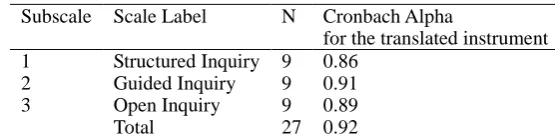
In order to determine reliability of the whole scale and sub-scales for the translated instrument, Cronbach alpha coefficients were calculated are as shown in Table 1.
Table 1. Cronbach’s-alpha reliability for the scales in the translated instrument Subscale Scale Label N Cronbach Alpha
for the translated instrument 1 Structured Inquiry 9 0.86
2 Guided Inquiry 9 0.91
3 Open Inquiry 9 0.89
Total 27 0.92
Table 1 shows that the whole scale and each sub-scales are reliable with alpha values > 0.70.
5.3 The Setting and the Participants
The survey involved 127 middle school male and female science teachers from public schools in Riyadh, Saudi Arabia. The sample was stratified by conducting sampling to ensure that it would be as representative as possible in terms of geographical regions in the city of Riyadh and the number of years of teachers’ service.
administrational works “e.g., principal, deputy principal, etc.” to eliminate the administrational views, and e) working in public school in Riyadh City.
Although public schools and private schools have the same science textbooks, the elimination of private schools from the study are due to the extra curricula in private schools, besides having teachers with qualifications from institutes out of Saudi, which may affect the results.
5.4 Data Collection and Analysis
The questionnaire was given to targeted middle school science teachers only, with equal sample of 75 male and female teachers. 65 male teachers’ questionnaires representing 86.67%, and 62 female teachers’ questionnaires representing 82.67% accurate and precise responses were received; then, the teachers’ responses were analyzed using SPSS 15.0. Descriptive statistics were used to describe, summarize, and compare the properties of the mass of data collected from the respondents.
6. Results
6.1 How to Interpret the Results
A five-point scale was used (always applicable, applicable, sometimes, not applicable, never applicable) to determine the sample responses for each of the instrument items. The response in the study instrument ranged from a lower level "never applicable", it was numerically represented by number (1), and higher level "always applicable", and it was numerically represented by number (5). To explain the results, the extent of the sample respondents' response to the instrument items was divided by the following equation:
(1)
The categories are therefore divided by the length of the category as follows: very low (1- 1.80)
low (above 1.80 to 2.60)
moderate "average" (above 2.60 to 3.40) high (above 3.40 to 4.20)
very high (above 4.20 to 5.00) 6.2 Answering Research Questions 1 and 2
The research 1st and 2nd questions are:
1. How do middle school teachers perceive their students’ practices in their science class?
2. To what extent do male and female teachers differ in perception of students’ practices in science class?
Part (A) of the instrument, with 11 items related to teachers’ perspectives for students’ practices in science class, and the results of analyzing teachers’ responses are answering research questions number 1 and number 2.
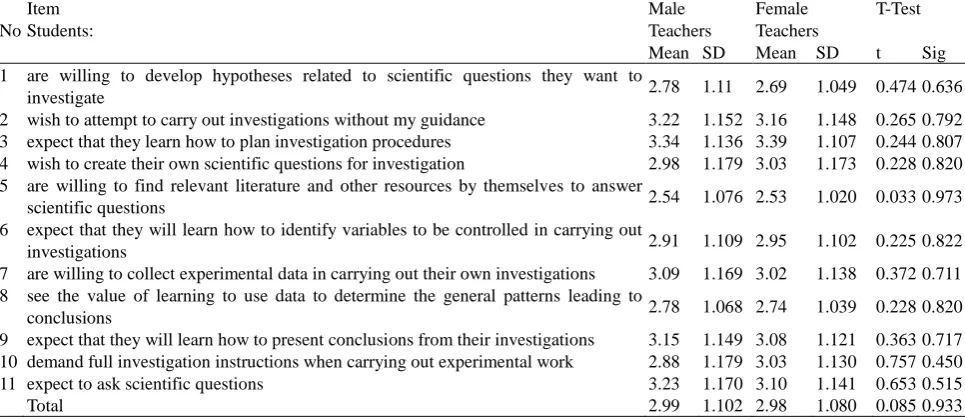
Illustrated by Table 2, the general average of teachers perceptions of their students' inquiry practices in science class was "average", where the mean was estimated by male teachers (2.99), while female teachers’ estimation was (2.98). As can be seen from Table 2, the mean for male and female teachers' perceptions of the student's practices for all items was of a degree of "average", except for one paragraph, the teachers' perceptions of the students' abilities was "low", which is "Students are willing to find relevant literature and other resources by themselves to answer scientific questions", and the highest practice as seen by male and female teachers was "Students expect that they learn how to plan investigation procedures", and with a medium degree of practice "average". Male and female teachers' estimates of practice were close, with the mean of male teachers and female teachers' estimates of (3.34) and (3.39) respectively.
Table 2. Mean scores, standard deviation and frequency analysis for part A "Teachers perspectives for students’ practices in science class"
No Item Students:
Male Teachers
Female Teachers
T-Test Mean SD Mean SD t Sig 1 are willing to develop hypotheses related to scientific questions they want to
investigate 2.78 1.11 2.69 1.049 0.474 0.636
2 wish to attempt to carry out investigations without my guidance 3.22 1.152 3.16 1.148 0.265 0.792 3 expect that they learn how to plan investigation procedures 3.34 1.136 3.39 1.107 0.244 0.807 4 wish to create their own scientific questions for investigation 2.98 1.179 3.03 1.173 0.228 0.820 5 are willing to find relevant literature and other resources by themselves to answer
scientific questions 2.54 1.076 2.53 1.020 0.033 0.973
6 expect that they will learn how to identify variables to be controlled in carrying out
investigations 2.91 1.109 2.95 1.102 0.225 0.822
7 are willing to collect experimental data in carrying out their own investigations 3.09 1.169 3.02 1.138 0.372 0.711 8 see the value of learning to use data to determine the general patterns leading to
conclusions 2.78 1.068 2.74 1.039 0.228 0.820
9 expect that they will learn how to present conclusions from their investigations 3.15 1.149 3.08 1.121 0.363 0.717 10 demand full investigation instructions when carrying out experimental work 2.88 1.179 3.03 1.130 0.757 0.450
11 expect to ask scientific questions 3.23 1.170 3.10 1.141 0.653 0.515
Total 2.99 1.102 2.98 1.080 0.085 0.933
male n=65, female n=62, total n=127
6.3 Answering Research Questions 3 and 4 The research’s 3rd and 4th questions are:
3. What are middle school teachers’ models of inquiry teaching?
4. To what extent do male and female teachers differ in their models of inquiry teaching?
Part (B) of the instrument, with 27 items related to teachers practices of inquiry in science class, based on the three models "Structured Inquiry", "Guided Inquiry", and "Open Inquiry". Teachers were asked to respond to statements "Items" of "Levels of inquiry" on a scale of 5, the score 1 represented the option “never applicable” while score 5 on the scale represented the category “always applicable”, and they respond to it as a list of items without seeing other columns that represent the stage of inquiry or the model of inquiry, so they do not know the classifications of the statements or the model of practice. Appendix A show the classifications of the statements.
To analyze the results based on the three inquiry models, each type of the three models were alienated into a separate table, and each table has a group of 9 items representing the model of inquiry.
The results of analyzing teachers’ responses are answering research questions number 3 and number 4.
The first inquiry model is "Structured Inquiry". Table 3 shows that the general average of teachers' assessment of their degree of practices of "Structured Inquiry", was rated "average", where the mean was estimated by male teachers by (3.30), while female teachers were estimating their practices of "Structured Inquiry" as "high" and with a mean of (3.46). And the results in Table 3 show that means of male teacher response to the axis "Structured Inquiry" ranged between (3.60) and (2.61). While the response of female teachers ranged between (3.92) and (3.02), indicating that male and female teachers see that they are practicing structured inquiry skills with a range from moderate practice to high practice. It is also evident from Table 3 that male and female teachers estimates of their practice of structured inquiry skills are convergent in all but two paragraphs of the instrument, which are: "I provide my students with a hypothesis which the students test through investigations" and "I give my students step by step instructions to allow them to develop conclusions from their investigations", where male teachers estimated that they practiced the skills at a moderate level, while the female teachers estimated that they practiced the two skills at a high level.
Table 3 shows that there were no statistically significant differences between male teachers and female teachers assessment of the degree to which they exercised "Structured Inquiry" in all practices where the value of statistical significance was higher than the significance level (0.05), except for an item, which is: "I undertake to interpret the data collected by my students and ask them to make a record" there were statistically significant differences in favor of female teachers.
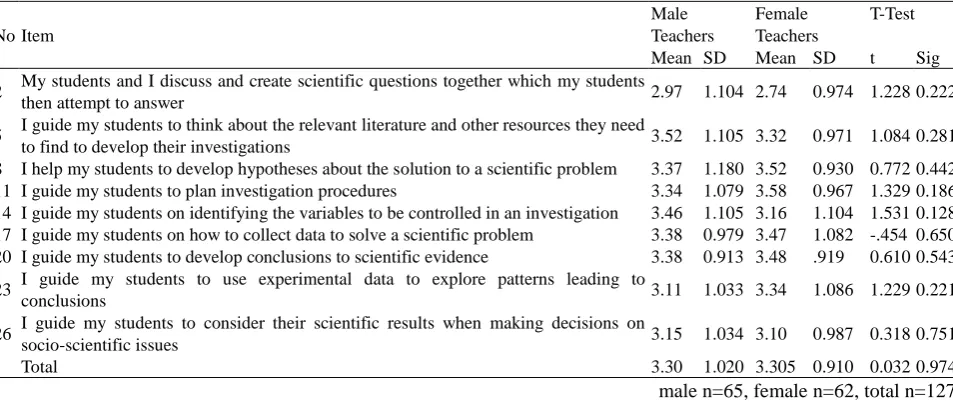
teachers responses ranged between (3.58) and (2.74), indicating that male teachers and female teachers see that they are practicing "Guided Inquiry" practices between the medium exercise and the high exercise. The table also shows that male and female teachers estimates of their " Guided Inquiry" practices were different in six items where male teachers estimated that they practiced with a high degree of items "I guide my students to think about the relevant literature and other resources they need to find to develop their investigations", and " I guide my students on identifying the variables to be controlled in an investigation", while female teachers estimated that their practices of the two items were moderate.
On the other hand, female teachers estimated that their practice was high for the following four practices: "I help my students to develop hypotheses about the solution to a scientific problem", "I guide my students to plan investigation procedures", "I guide my students on how to collect data to solve a scientific problem", and "I guide my students to develop conclusions to scientific evidence", while the male teachers were valued for their medium practices.
Table 3. Mean scores and Standard Deviation for items related to Structured Inquiry Items
No Item
Male Teachers
Female Teachers
T-Test Mean SD Mean SD t Sig 1 I supply scientific questions to be answered by my students 3.37 1.084 3.37 0.927 0.010 0.992 4 I provide my students with the relevant literature and other resources to develop their
plans for investigations 3.48 1.077 3.47 0.936 0.051 0.959
7 I provide my students with a hypothesis which the students test through investigations 3.28 1.125 3.40 1.0 0.668 0.506 10 I give my students step-by-step instructions so that they can conduct investigations 3.60 1.101 3.92 0.86 1.819 0.071 13 I tell my students the variables they need to control in undertaking their investigations 3.49 1.106 3.79 1.01 1.583 0.116 16 I give my students step-by-step instructions for obtaining data/making observations 3.40 1.115 3.52 1.02 0.611 0.542 19 I undertake to interpret the data collected by my students and ask them to make a
record 2.61 0.884 3.02 1.17 2.211 0.029
22 I give my students step by step instructions to allow them to develop conclusions from
their investigations 3.23 0.996 3.48 0.825 1.555 0.122
25 I provide guidelines for students to relate the results of their investigations to make
decisions about socio-scientific issues 3.25 0.919 3.13 0. 757 0.782 0.436
Total 3.30 1.00 3.46 0.880 0.941 0.349
male n=65, female n=62, total n=127
Table 4. Mean scores and Standard Deviation for items related to Guided Inquiry Items
No Item
Male Teachers
Female Teachers
T-Test Mean SD Mean SD t Sig 2 My students and I discuss and create scientific questions together which my students
then attempt to answer 2.97 1.104 2.74 0.974 1.228 0.222
5 I guide my students to think about the relevant literature and other resources they need
to find to develop their investigations 3.52 1.105 3.32 0.971 1.084 0.281
8 I help my students to develop hypotheses about the solution to a scientific problem 3.37 1.180 3.52 0.930 0.772 0.442 11 I guide my students to plan investigation procedures 3.34 1.079 3.58 0.967 1.329 0.186 14 I guide my students on identifying the variables to be controlled in an investigation 3.46 1.105 3.16 1.104 1.531 0.128 17 I guide my students on how to collect data to solve a scientific problem 3.38 0.979 3.47 1.082 -.454 0.650 20 I guide my students to develop conclusions to scientific evidence 3.38 0.913 3.48 .919 0.610 0.543 23 I guide my students to use experimental data to explore patterns leading to
conclusions 3.11 1.033 3.34 1.086 1.229 0.221
26 I guide my students to consider their scientific results when making decisions on
socio-scientific issues 3.15 1.034 3.10 0.987 0.318 0.751
Total 3.30 1.020 3.305 0.910 0.032 0.974
male n=65, female n=62, total n=127
Table 4 shows that there were no statistically significant differences between male teachers and female teachers assessment of the degree to which they exercised "Guided Inquiry" practices in all practices where the value of statistical significance was higher than the significance level (0.05).
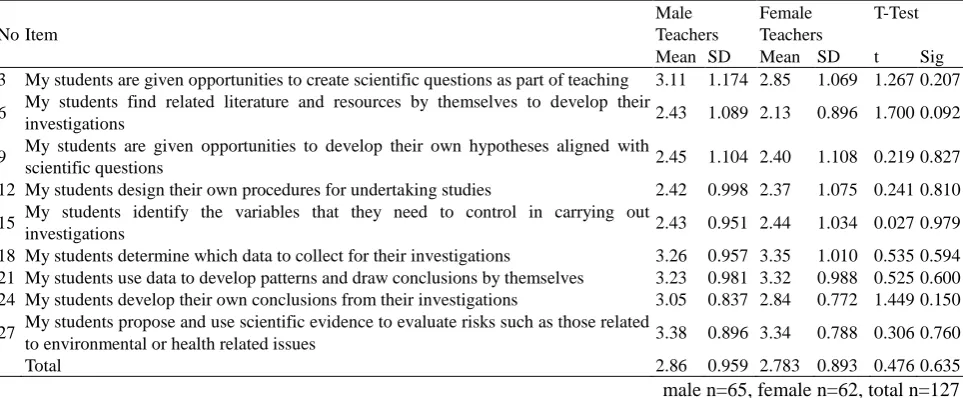
practice "Open Inquiry" between moderate practice and low practice. The table also shows that male and female teachers assessments of their "Open Inquiry" practices were close as male teachers and female teachers estimated that they were practicing low for the items: "My students find related literature and resources by themselves to develop their investigations", "My students are given opportunities to develop their own hypotheses aligned with scientific questions", My students design their own procedures for undertaking studies", and "My students identify the variables that they need to control in carrying out investigations". Male teachers and female teachers estimated that they practiced the rest of the practices to a medium degree.
Table 5. Mean scores and Standard Deviation for items related to Open Inquiry Items
No Item
Male Teachers
Female Teachers
T-Test Mean SD Mean SD t Sig 3 My students are given opportunities to create scientific questions as part of teaching 3.11 1.174 2.85 1.069 1.267 0.207 6 My students find related literature and resources by themselves to develop their
investigations 2.43 1.089 2.13 0.896 1.700 0.092
9 My students are given opportunities to develop their own hypotheses aligned with
scientific questions 2.45 1.104 2.40 1.108 0.219 0.827
12 My students design their own procedures for undertaking studies 2.42 0.998 2.37 1.075 0.241 0.810 15 My students identify the variables that they need to control in carrying out
investigations 2.43 0.951 2.44 1.034 0.027 0.979
18 My students determine which data to collect for their investigations 3.26 0.957 3.35 1.010 0.535 0.594 21 My students use data to develop patterns and draw conclusions by themselves 3.23 0.981 3.32 0.988 0.525 0.600 24 My students develop their own conclusions from their investigations 3.05 0.837 2.84 0.772 1.449 0.150 27 My students propose and use scientific evidence to evaluate risks such as those related
to environmental or health related issues 3.38 0.896 3.34 0.788 0.306 0.760
Total 2.86 0.959 2.783 0.893 0.476 0.635
male n=65, female n=62, total n=127
Table 5 shows that there were no statistically significant differences between male teachers and female teachers assessment of the extent to which they exercised practices in all practices where the value of the statistical significance was higher than the significance level (0.05).
7. Discussion
In order to explore the factors related to inquiry practice in different situations, the study compared male and female science teachers, in the middle stage of K-12 where science textbooks consists of all science subjects "biology, chemistry, physics, and earth science", and the study eliminated factors that may have an effect on the practices due to the extra science curriculum or the qualifications of teachers as well as the classes size.
The results showed common practices based on the perceptions of middle school science teachers regardless of the gender of teachers, or the gender of their students.
The general average of teachers assessment of their students’ practices in science courses was "average", with (2.99) mean for male teachers and (2.98) for female teachers. Male and female teachers' assessment for all items was of a degree of "average", except for the students' abilities to find relevant literature was "low", and the values of "t-Test" showed that there were no statistically significant differences between the male and female teachers' assessment of the practices of their students.
Teachers' perceptions of their degree of practices of "Structured Inquiry", was rated "average", with a mean of (3.30) for male teachers and (3.46) for female teachers. The means of male teacher responses ranged between (3.60) and (2.61), while the response of female teachers ranged between (3.92) and (3.02), indicating that male and female teachers see that they are practicing structured inquiry practices with a range from moderate practice to high practice. For the "Guided Inquiry" the perceptions was rated "average", where the means were (3.30) and (3.31), for male and female teachers respectively, ranging between (3.52) and (2.97) for male, while the female means ranged between (3.58) and (2.74), indicating that the range from moderate practice to high practice. There were no statistically significant differences between male teachers and female teachers assessment of the degree to which they exercised all the three models of inquiry. And for the perceptions of practicing "Open Inquiry" it was rated "average", where the mean was estimated by male teachers (2.86) and (2.78) for female teachers. The means of male teachers responses ranged between (3.38) and (2.42), while the female teachers responses ranged between (3.34) and (2.13), indicating that male teachers and female teachers believe that they practice "Open Inquiry" between moderate practice and low practice.
related to the shared factors in public schools, where although males and females’ schools are separate, they have the same textbooks, and the same administrational and supervision practices. The science textbooks in all K-12 in Saudi are a translated version of the full version of Mc-Grow Hill series with minor modifications, and teachers must cover all subjects during the school year, which needs time more than the current allocated time for science in k-12 plans, so the practice of structured inquiry is helpful more than structured and open inquiry models; the other option is decreasing the amount of content in science textbooks. The minor shift of the perceptions of male and female science teachers in Saudi towards structured inquiry are due to the timing issues, and general practices of inquiry of all models are due to the nature of the Mc-Grow Hill textbooks series which is implementing the 5E model.
8. Conclusion
Inquiry teaching has been emphasized because of its positive effect on student achievement and motivation. In general, the results of this study showed Saudi science teachers’ confidence in practicing inquiry in teaching science, and that were revealed as common and in good extent in all models of inquiry "structured, guided, and open inquiry" for male and female science teachers in Riyadh middle schools, although it were in average levels.
However, keeping in mind the results of TIMSS which revealed low abilities for Saudi students in high inquiry skills in several reports (TIMSS, 2011; TIMSS, 2015), we need further evidence to justify teachers' implementations of their perceptions in actual science teaching, as well as the outcomes of the training programs that aim to increase inquiry practice.
Therefore, from the finding of this study, in terms of further research, the researcher suggests designing a survey, for instance, to discuss the factors that affect the extent of the inquiry practices, and the model of inquiry teaching; as well as comparing the stages of K-12 schools to see if the age of the students may support or hinder the inquiry practices, besides the nature of the science subjects.
The final comment related to the teachers' implementations of their perceptions of science inquiry, is that teachers do not have to offer all types of inquiry in science class; teachers need to conduct inquiry as they see fit for each learner. Keeping in mind that the nature of the topic and the required teaching practices for each topic, and whether it is investigation or experiment or other type of activities all these issues have deep impact on the inquiry model.
Acknowledgements
This is a research project that was supported by a grant from the research center for college of education, deanship of scientific research at king Saud University.
References
Abd-El-Khalick, F., Baujaoude, S., Duschl, R., Lederman, N. G., Mamlok-Naaman, R., & Hofstein, A., (2004). Inquiry in science education: International perspectives. Science Education, 88(3), 397–419.
https://doi.org/10.1002/sce.10118
Achieve, Inc. (2013), Next Generation Science Standards. Retrieved from https://www.achieve.org/next-generation-science-standards
Anderson, R. (2002). Reforming science teaching: What research says about inquiry? Journal of Science Teacher Education, 13(1), 1–12. https://doi.org/10.1023/A:1015171124982
Blumenfeld, P. C., Kempler, T. M., & Krajcik, J. S. (2006). Motivation and cognitive engagement in learning environments. In The Cambridge Handbook of The Learning Sciences. Sawyer, R. K. (Eds.). Cambridge University Press, 475-488.
Brown, J., & Isaacs, D. (2005). The world café: Shaping our futures through conversations that matter. San Francisco: Berrett-Koehler.
Bybee, R. W. (1997). Achieving scientific literacy: From purposes to practices. Portsmouth, NH: Heinemann.
Cavas, B. (2012). The meaning of and need for “Inquiry Based Science Education (IBSE). Journal of Baltic Science Education, 11(1), 4-6.
Cavas, B., Holbrook, J., Kask, K., & Rannikmae, M. (2013). Development of an instrument to determine science teachers’ implementation of inquiry based science education in their classrooms. International Online Journal of Primary Education, 2(2).
Chin, C. (2007). Teacher questioning in science classrooms: Approaches that stimulate productive thinking. Journal of Research in Science Teaching, 44(6), 815-843. https://doi.org/10.1002/tea.20171
Chin, C., & Osborne, J. (2008). Students' questions: a potential resource for teaching and learning science. Studies in Science Education, 44(1), 1-39. https://doi.org/10.1080/03057260701828101
doctoral dissertation). California State University, San Marcos, USA.
Copland, M. A. (2003). Leadership of inquiry: Building and sustaining capacity for school improvement. Educational Evaluation and Policy Analysis, 25(4), 375-395. https://doi.org/10.3102/01623737025004375
David, J. L. (2009). Collaborative inquiry. Educational Leadership, Association for Supervision and Curriculum Development, 87-88.
Definition of Inquiry. (2017, September 22). In Merriam Webster Dictionary Retrieved 22 September, 2017, from https://www.merriam-webster.com/dictionary/inquiry
Dunkhase, J. A. (2003). The Coupled-Inquiry Cycle: A Teacher Concerns-based Model for Effective Student Inquiry. Science Educator, 12(1), 10-15.
Ferraro, J. M. (2000). Reflective practice and professional development. Clearinghouse on Teaching and Teacher Education, ERIC Number: ED449120.
Freire, P. (2002). Pedagogy of the oppressed (30th anniversary ed.). New York: Continuum.
Hofstein, A., Navon, O., Kipnis, M., & Mamlok-Naaman, R. (2005). Developing students’ ability to ask more and better questions resulting from inquiry-type chemistry laboratories. Journal of Research in Science Teaching, 42, 791–806. https://doi.org/10.1002/tea.20072
Houseal, A., Abd-El-Khalick, F., & Destefano, L. (2014). Impact of a Student-Teacher-Scientist Partnership on Students’ and Teachers’ Content Knowledge, Attitudes toward Science, and Pedagogical Practices. Journal of Research in Science Education, 5(1), 84-115. https://doi.org/10.1002/tea.21126
International Association for the Evaluation of Educational Achievement IEA (2011). Trends in International Mathematics and Science Study TIMSS 2011. Retrieved from
https://timss.bc.edu/timss2011/international-results-science.html
International Association for the Evaluation of Educational Achievement IEA (2015). Trends in International Mathematics and Science Study TIMSS 2015. Retrieved from
http://timss2015.org/timss-2015/science/student-achievement/
Jocz, J., Zhai, J., & Tan, A. (2014). Inquiry learning in the Singaporean context: Factors affecting student interest in school science, International Journal of Science Education, 36(15), 2596-2618.
https://doi.org/10.1080/09500693.2014.908327
Kang, J., & Keinonen, T (2016). Examining factors affecting implementation of inquiry-based learning in Finland and South Korea. Problems of Education in the 21st Century, 74, 31-48.
Kask, K., & Rannikmae, M. (2009). Towards a model describing student learning related to inquiry based experimental work linked to everyday situations. Journal of Science Education, 10(1), 15-19.
Koksal, E., & Berberoglu, G. (2012). The Effect of guided- inquiry instruction on 6th grade Turkish students' achievement, science process skills, and attitudes toward science. International Journal of Science Education, 36(1), 66-78. https://doi.org/10.1080/09500693.2012.721942
Laius, A., Kask, K., & Rannikmae, M. (2009). Comparing outcomes from two case studies on chemistry teachers’ readiness to change. Chemistry Education Research and Practice, 10(2), 142-153.
https://doi.org/10.1039/B908251B
Lederman, J. S., Lederman, N. G., Bartos, S. A., Bartels, S. L., Meyer, A. A., & Schwartz, R. S. (2014). Meaningful assessment of learners' understandings about scientific inquiry--The views about scientific inquiry (VASI) questionnaire. Journal of Research in Science Teaching, 51(1), 65-83. https://doi.org/10.1002/tea.21125
Little, J. W. (1993). Teachers’ professional development in a climate of educational reform. Educational Evaluation And Policy Analysis, 15(2), 129-151. https://doi.org/10.3102/01623737015002129
Lucas, S. E. (2003). The development and impact of principal leadership self-efficacy in middle level schools: Beginning an inquiry (Unpublished doctoral dissertation). University of Illinois at Urbana-Champaign, USA.
Meaning of “inquiry” in the English Dictionary. (2017, September 21). In Cambridge English Dictionary Retrieved September 21, 2017 from http://dictionary.cambridge.org/dictionary/english/inquiry
Minner, D. D., Levy, A. J., & Century, J. (2010). Inquiry-based science instruction – what is it and does it matter? Results from a research synthesis years 1984 to 2002. Journal of Research in Science Teaching, 47, 474–496. https://doi.org/10.1002/tea.20347
Mocovici, S. (2001). Social representations: Essays in social psychology. New York; New York University Press.
National Research Council (NRC). (2000). Inquiry and the National Science Education Standards. Washington, DC: National Academy Press.
National Research Council (NRC). (2005). How Students Learn: History, Mathematics, and Science in the Classroom. Washington, DC: The National Academies Press.
National Research Council (NRC). (2012). A Framework for K-12 science education: Practices, crosscutting concepts, and core ideas. Committee on a Conceptual Framework for New K-12 Science Education Standards. Board on Science Education, Division of Behavioral and Social Sciences and Education. Washington, DC: The National Academies Press.
Newton, D. P., & Newton, L. D. (2009). Some student and teachers’ conceptions of creativity in school science. Research in Science & Technological Education, 27, 45-60. https://doi.org/10.1080/02635140802658842
Niemi, H. (2015). Teacher professional development in Finland: Towards a more holistic approach. Psychology, Society and Education, 7(3), 278-294. https://doi.org/10.25115/psye.v7i3.519
Pizzini, E., Shepardson, D., & Abell, S. (1989). A rationale for and the development of a problem solving model of instruction in science education. Science Education, 73(5), 523-534. https://doi.org/10.1002/sce.3730730502
Ramnarain, U. (2016). Understanding the influence of intrinsic and extrinsic factors on inquiry-based science education at township schools in South Africa. Journal of Research in Science Teaching, 53, 598–619.
https://doi.org/10.1002/tea.21315
Ripley, A. (2014). The smartest kids in the world: And how they got that way. Simon & Schuster Paperbacks.
Romo, M., & Alfonso, V. (2003). Implicit theories of Spanish painters. Creativity Research Journal, 15, 409-415. https://doi.org/10.1207/S15326934CRJ1504_8
Rosenthal, R. (1991). Teacher expectancy effects: a brief update 25 years after the Pygmalion experiment. Journal of Research in Education, 1(1), 3-12. ERIC Number: EJ446697
Sadeh, I., & Zion, M. (2012). Which type of inquiry project do high school biology students prefer: open or guided? Research in Science Education, 42(5), 831-848. https://doi.org/10.1007/s11165-011-9222-9
Schmidt, A. L. (2011). Creativity in science: Tensions between perception and practice. Creative Education, 2(5), 435-445. https://doi.org/10.4236/ce.2011.25063
Schwartz, R. S., Lederman, N. G., & Crawford, B. A. (2003). Developing views of nature of science in an authentic context: An explicit approach to bringing the gap between nature of science and scientific inquiry. Science education, 88(4), 610-645. https://doi.org/10.1002/sce.10128
Selby, E. C., Shaw, E. J., & Houtz, J. C. (2005). The creative personality. Gifted Child Quarterly, 49, 300-314. https://doi.org/10.1177/001698620504900404
Tan, K. S. (2011). Getting to know your tools as science teachers and students: A reflective exercise on laboratory apparatus, equipment and instruments. In Science Education in International Contexts. Cheng, M. M. H., So, W. W. M. (Eds.). Sense Publishers: The Netherlands, 113-121. https://doi.org/10.1007/978-94-6091-427-0_8
Trautmann, N., MaKinster, J., & Avery, L. (2004). What makes inquiry so hard? (and why is it worth it?). Proceedings of the National Association for Research in Science Teaching (NARST) 2004 Annual Meeting. Vancouver, BC, Canada.
Trumbull, D. J., Bonney, R., & Grudens-Schuck, N. (2005). Developing Materials to promote Inquiry: Lessons Learned. Science Education, 89, 879-900. https://doi.org/10.1002/sce.20081
Wells, G. (2001). Action, talk & text: Learning & Teaching Through Inquiry. New York, NY: Teachers College Press.
Yeomans, E. (2011). Perspectives on Education: Inquiry-based Learning. Wellcome Trust. UK.
Zion, M., & Mendelovici, R. (2012). Moving from structured to open inquiry: Challenges and limits. Science Education International, 23(4), 383-399.
Zion, M., Cohen, S., & Amir, R. (2007). The spectrum of dynamic inquiry teaching practices. Research in Science Education, 37(4), 423-447. https://doi.org/10.1007/s11165-006-9034-5
Appendix A
Part (B) of the questioner
Teachers were asked to respond to statements "Items" of "Levels of inquiry" on a scale of 5, the score 1 represented the option “never applicable” while score 5 on the scale represented the category “always applicable”, without seeing other columns that represent the stage of inquiry or the model of inquiry.
First dimension “Stages of inquiry”
model of inquiry teaching
Item Second dimension “Levels of inquiry” 1. Identifying and posing appropriate
scientifically oriented questions
Structured 1 I supply scientific questions to be answered by my students Guided 2 My students and I discuss and create scientific questions together
which my students then attempt to answer
Open 3 My students are given opportunities to create scientific questions as part of teaching
2. Contextualizing research questions in current literature/resources
Structured 4 I provide my students with the relevant literature and other resources to develop their plans for investigations
Guided 5 I guide my students to think about the relevant literature and other resources they need to find to develop their investigations Open 6 My students find related literature and resources by themselves to
develop their investigations 3. Making prediction / Developing
hypothesis
Structured 7 I provide my students with a hypothesis which the students test through investigations
Guided 8 I help my students to develop hypotheses about the solution to a scientific problem
Open 9 My students are given opportunities to develop their own hypotheses aligned with scientific questions
4. Designing and conducting investigations
Structured 10 I give my students step-by-step instructions so that they can conduct investigations
Guided 11 I guide my students to plan investigation procedures
Open 12 My students design their own procedures for undertaking studies 5. Identifying Variables Structured 13 I tell my students the variables they need to control in undertaking
their investigations
Guided 14 I guide my students on identifying the variables to be controlled in an investigation
Open 15 My students identify the variables that they need to control in carrying out investigations
6. Collecting data Structured 16 I give my students step-by-step instructions for obtaining data/making observations
Guided 17 I guide my students on how to collect data to solve a scientific problem
Open 18 My students determine which data to collect for their investigations
7. Analyzing data to develop patterns Structured 19 I undertake to interpret the data collected by my students and ask them to make a record
Guided 20 I guide my students to develop conclusions to scientific evidence Open 21 My students use data to develop patterns and draw conclusions by
themselves 8. Communicating and connecting
explanation (Drawing conclusions)
Structured 22 I give my students step by step instructions to allow them to develop conclusions from their investigations
Guided 23 I guide my students to use experimental data to explore patterns leading to conclusions
Open 24 My students develop their own conclusions from their investigations
9. Socio-scientific Issues Structured 25 I provide guidelines for students to relate the results of their investigations to make decisions about socio-scientific issues Guided 26 I guide my students to consider their scientific results when
making decisions on socio-scientific issues
Open 27 My students propose and use scientific evidence to evaluate risks such as those related to environmental or health related issues
Adopted from (Cavas et al., 2013)
Copyrights
Copyright for this article is retained by the author(s), with first publication rights granted to the journal.