AUT Journal of Mechanical Engineering
AUT J. Mech. Eng., 4(1) (2020) 103-118 DOI: 10.22060/ajme.2019.15375.5770
Time-Dependent Creep Response of Magneto-Electro-Elastic Rotating Disc in
Thermal and Humid Environmental Condition
M. Saadatfar*
Department of Mechanical Engineering, University of Qom, Qom, Iran.
ABSTRACT: The aim of this paper is to analyze the time-dependent stress redistribution of a rotating magneto-electro-elastic disc. The disc is supposed to be placed in an axisymmetric temperature and moisture fields. Besides, the disc is under a centrifugal body force, an induced electric potential in addition to magnetic potential. Using equilibrium, electrostatic and magnetostatic equations, strain-displacement and stress-strain relations together with hygrothermal equations, a differential equation is obtained in which there are creep strains. Primarily, disregarding the creep strain, an analytical solution for the initial stresses, electromagnetic potentials and displacement is developed. Then, using Prandtl-Reuss relations, creep stress rates and electromagnetic potentials rates are obtained. Finally, the history of stresses, electric and magnetic potentials is obtained iteratively. In the numerical section, the influence of creep evolution, hygrothermal environmental condition, angular velocity and temperature- and moisture-dependency of elastic coefficients on the behavior of magneto-electro-elastic disc is analyzed comprehensively. The results show that the effect of hygrothermal loading and angular velocity becomes less significant after creep evolution. Also, the results imply that analysis of the effect of temperature- and moisture- dependence after creep evolution must be considered in the design progress. Besides, to avoid cracking, increasing in the tensile hoop stress at the internal surface with increasing in hygrothermal loading must be considered in design progress..
Review History:
Received: 1 Dec. 2018 Revised: 5 Feb. 2019 Accepted: 14 Apr. 2019 Available Online: 27 Apr. 2019
Keywords:
Rotating disc Magneto-electro-elastic Time-dependent creep Hygrothermal loading
103
1. Introduction
Due to huge application of rotating disc in rotating machinery, they have been focused by many researchers. They have many industrial usages such as compressors, turbo generators, flywheels, gas turbine rotors, automotive braking systems, ship propellers and computer disc drives [1]. On the other hand, Magneto-Electro-Elastic (MEE) composites that are a type of intelligent materials have been focused by many researchers. Due to the presence of magnetic and electric coupling effect, these materials allow an extra degree of freedom in the design of actuators, sensors, storage devices and transducers. Their requests can be found in turbine rotors, aerospace, magnetic storage elements and magnetic structural elements.
Since smart materials are mostly selected to work in presence of magnetic field or in high temperature and humid environments [2], several papers are presented in the literature for static hygrothermal analysis of them. Akbarzadeh and Chen [3] presented a solution for hygrothermal stress problem in Functionally Graded Piezoelectric Material (FGPM) cylinder and spheres. Analysis of the interaction of electric field, elastic deformation, thermal and moisture condition in hollow and solid piezoelectric cylinders was presented by Allam et al [4]. Saadatfar and Aghaie-Khafri [5] analyzed
the static response of a Functionally Graded MEE (FGMEE) thick-walled sphere in thermal and humid condition using an analytical method. A long Functionally Graded Material (FGM) cylindrical shell with FGPM sensor and actuators under magneto-thermo-electro-elastic loading was analyzed analytically by Saadatfar and Aghaie-Khafri [6]. Also, they illustrated that the actuation and sensing authority of FGPM layers mostly affected by the grading-index of the FGPM [7]. Then, they considered a FGM cylindrical shell integrated with FGPM layers subjected to magneto-thermo-electro-elastic [89] electro-elastic [10] and hygro-thermo-magneto-electro-elastic [11] loadings. A closed-form solution for a piezoelectric functionally graded fiber-reinforced hollow cylinder in hygrothermal condition was derived by Zenkour [12]. The static analysis of MEE plate in hygrothermal environment was presented by Vinyas and Kattimani [13] using the finite element method. Thermoelastic behavior of a rotating disc with variable thickness made of FGMEE was presented by Dai and Dai [14]. Also, several authors have tried to analyze the creep response of composite, FGM and smart discs. Using Sherby’s law, the creep progress of an isotropic FGM rotating disk with thermal gradient was considered by Gupta et al. [15]. Creep behavior of FGM rotating disks with linearly varying thickness was investigated by Deepak et al. [16]. Rattan et al. [17] tried to *Corresponding author’s email:[email protected]
M. Saadatfar, Amirkabir J. Mech. Eng., 4(1) (2020) 103-118, DOI: 10.22060/ajme.2019.15375.5770
104 analyze the creep progress of an isotropic rotating disk made of particle reinforced FGM. Dharmpal et al. [18] analyzed the steady-state stress redistribution in a FGM rotating disk with variable thickness. Gupta and Singh [19] made an attempt to present an analytical method to analyze the creep progress in non-FGM/FGM rotating disk with uniform and non-uniform thickness. The steady-state creep behavior of an isotropic rotating disk made of parabolically varying FGM in thermal environment is investigated by Bose and Rattan [20]. Loghman et al. [21] considered the creep response of FGPM rotating disc under magneto-electro-thermal loads using a semi-analytical method. They show that the history of electric potential can be used for condition monitoring of the smart disk without any need to destructive or non-destructive testing. A new analytical-numerical way to analyze creep evolution of rotating disk made of nonlinear piezoelectric polymer in thermal environmental condition was presented by Loghman and Azami [22]. They show that a significant electric potential redistribution due to stress redistribution has occurred during the lifetime of the disk.
Literature review reveals that creep analysis is vital for rotating disk. Also, smart materials are subjected to hygrothermal loading in some of their application. Moreover, they show considerable creep effects under severe environmental condition [23]. Therefore, to have advanced performance and reliability of intelligent structures, creep response must be investigated when MEE structures are used in hygrothermal environmental condition. However, the creep analysis has not been investigated for the MEE disc so far. So, the novelty of the present research is to investigate the time-dependent creep stress and electric and magnetic potentials redistributions during the lifetime of a MEE disc in steady-state hygrothermal environment considering-temperature and moisture- dependency of elastic constants using analytical methods.
2. Basic Formulation of the Problem
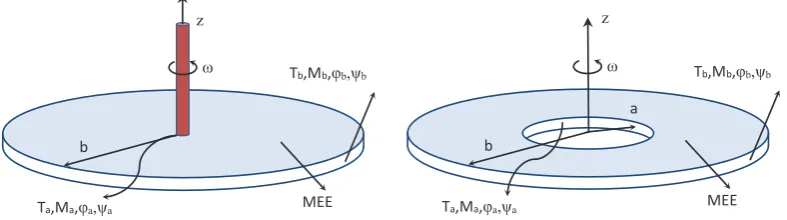
Consider a uniform thickness MEE disc rotates about z axis with a constant speed as shown in Fig. 1. The disc is assumed to be subjected to hygrothermal field in addition to electro-magnetic potentials at inner and outer surfaces. Regarding symmetry and plane stress condition, nonzero components of temperature, moisture concentration, electric potential, magnetic potential and displacement are function of radius.
2.1 Formulation of the hygrothermal field
In an uncoupled hygrothermal analysis, the temperature distribution as well as moisture concentration distribution can be achieved independently [24]. The Fourier heat conduction equation and Fickian moisture diffusion equation without source of heat and moisture for a disc in axisymmetric steady-state condition are expressed as [25,26]:
Integrating Eq. (1) twice gives:
In this research, moisture concentration change Ma and
Mb and temperatures change Ta and Tb are assumed at the inside and outside of the disc, respectively. The unknown constants can be achieved using these hygrothermal boundary conditions as:
2.2 Basic equations of the MEE rotating disc
The entire strains are supposed to be sum of magnetic, electric, elastic, hygrothermal, and creep strains. Therefore, the stress-strain relations can be written in the following form [25,27]:
Fig. 1. MEE rotating disc
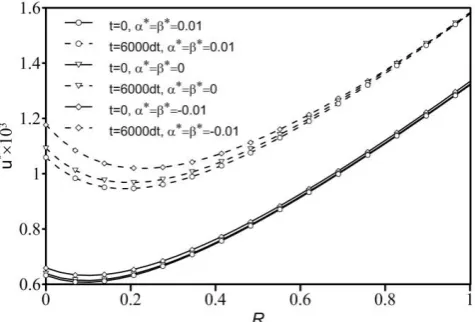
Fig. 2. Radial stress redistribution during creep progress (Free-Free) b
a
z
ω
Ta,Ma,φa,ψa MEE
Tb,Mb,φb,ψb z
b
Ta,Ma,φa,ψa MEE
Tb,Mb,φb,ψb
ω
Fig. 1. MEE rotating disc
1 (rkT T) 0,
r r r
(1-a)
1 (rkC M) 0,
r r r
(1-b)
1 2
1 2
( ) ln( ) , ( ) ln( ) .
T r W r W
M r S r S
(2)
1
2
, ln( )
ln( ) . ln( )
b a
b a
b
T T
W b
a T T
W b b T
a
(3-a)
1
2
, ln( )
ln( ) . ln( )
b a
b a
b
M M
S b
a
M M
S b b M
a
(3-b)
11 12
13 11 11 1 1
c c
r rr rr
c
zz zz r r
c c
c e E q H T M
(4-a)
12 22
23 12 12 2 2
c c
rr rr
c
zz zz r r
c c
c e E q H T M
(4-b)
13 23
33 13 13 3 3
c c
z rr rr
c
zz zz r r
c c
c e E q H T M
(4-c)
11 12
13 11 11 1 1 ,
c c
r rr rr
c
zz zz r r
D e e
e E H p T M
(4-d)
(1-a)
1 (rkT T) 0,
r r r
(1-a)
1 (rkC M) 0,
r r r
(1-b)
1 2
1 2
( ) ln( ) ,
( ) ln( ) .
T r W r W
M r S r S
(2)
1
2
, ln( )
ln( ) . ln( )
b a
b a
b
T T
W b
a T T
W b b T
a
(3-a)
1
2
, ln( )
ln( ) . ln( )
b a
b a
b
M M
S b
a
M M
S b b M
a
(3-b)
11 12
13 11 11 1 1
c c
r rr rr
c
zz zz r r
c c
c e E q H T M
(4-a)
12 22
23 12 12 2 2
c c
rr rr
c
zz zz r r
c c
c e E q H T M
(4-b)
13
2333 13 13 3 3
c c
z rr rr
c
zz zz r r
c c
c e E q H T M
(4-c)
11 12
13 11 11 1 1 ,
c c
r rr rr
c
zz zz r r
D e e
e E H p T M
(4-d)
(1-b)
1 (rkT T) 0,
r r r
(1-a)
1 (rkC M) 0,
r r r
(1-b)
1 2
1 2
( ) ln( ) ,
( ) ln( ) .
T r W r W
M r S r S
(2)
1
2
, ln( )
ln( ) . ln( )
b a
b a
b
T T
W b
a T T
W b b T
a
(3-a)
1
2
, ln( )
ln( ) . ln( )
b a
b a
b
M M
S b
a
M M
S b b M
a
(3-b)
11 12
13 11 11 1 1
c c
r rr rr
c
zz zz r r
c c
c e E q H T M
(4-a)
12 22
23 12 12 2 2
c c
rr rr
c
zz zz r r
c c
c e E q H T M
(4-b)
13 23
33 13 13 3 3
c c
z rr rr
c
zz zz r r
c c
c e E q H T M
(4-c)
11 12
13 11 11 1 1 ,
c c
r rr rr
c
zz zz r r
D e e
e E H p T M
(4-d)
(2)
1 (rkT T) 0,
r r r
(1-a)
1 (rkC M) 0,
r r r
(1-b)
1 2
1 2
( ) ln( ) ,
( ) ln( ) .
T r W r W
M r S r S
(2)
1
2
, ln( )
ln( ) . ln( )
b a
b a
b
T T
W b
a T T
W b b T
a
(3-a)
1
2
, ln( )
ln( ) . ln( )
b a
b a
b
M M
S b
a
M M
S b b M
a
(3-b)
11 12
13 11 11 1 1
c c
r rr rr
c
zz zz r r
c c
c e E q H T M
(4-a)
12 22
23 12 12 2 2
c c
rr rr c
zz zz r r
c c
c e E q H T M
(4-b)
13 23
33 13 13 3 3
c c
z rr rr
c
zz zz r r
c c
c e E q H T M
(4-c)
11 12
13 11 11 1 1 ,
c c
r rr rr
c
zz zz r r
D e e
e E H p T M
(4-d)
(3-a)
1 (rkT T) 0,
r r r
(1-a)
1 (rkC M) 0,
r r r
(1-b)
1 2
1 2
( ) ln( ) ,
( ) ln( ) .
T r W r W
M r S r S
(2)
1
2
, ln( )
ln( ) .
ln( )
b a
b a
b T T
W b
a T T
W b b T
a
(3-a)
1
2
, ln( )
ln( ) .
ln( )
b a
b a
b
M M
S b
a
M M
S b b M
a
(3-b)
11 12
13 11 11 1 1
c c
r rr rr
c
zz zz r r
c c
c e E q H T M
(4-a)
12 22
23 12 12 2 2
c c
rr rr c
zz zz r r
c c
c e E q H T M
(4-b)
13 23
33 13 13 3 3
c c
z rr rr
c
zz zz r r
c c
c e E q H T M
(4-c)
11 12
13 11 11 1 1 ,
c c
r rr rr
c
zz zz r r
D e e
e E H p T M
(4-d)