The Thirty-Third AAAI Conference on Artificial Intelligence (AAAI-19)
Learning to Compose Topic-Aware
Mixture of Experts for Zero-Shot Video Captioning
Xin Wang,
1Jiawei Wu,
1Da Zhang,
1Yu Su,
2William Yang Wang
1 1University of California, Santa Barbara2The Ohio State University
[email protected], jiawei [email protected], [email protected], [email protected], [email protected]
Abstract
Although promising results have been achieved in video cap-tioning, existing models are limited to the fixed inventory of activities in the training corpus, and do not generalize to open vocabulary scenarios. Here we introduce a novel task, zero-shot video captioning, that aims at describing out-of-domain videos of unseen activities. Videos of different activities usu-ally require different captioning strategies in many aspects,
i.e.word selection, semantic construction, and style expres-sion etc, which poses a great challenge to depict novel ac-tivities without paired training data. But meanwhile, simi-lar activities share some of those aspects in common. There-fore, we propose a principled Topic-Aware Mixture of Ex-perts (TAMoE) model for zero-shot video captioning, which learns to compose different experts based on different topic embeddings, implicitly transferring the knowledge learned from seen activities to unseen ones. Besides, we leverage ex-ternal topic-related text corpus to construct the topic embed-ding for each activity, which embodies the most relevant se-mantic vectors within the topic. Empirical results not only validate the effectiveness of our method in utilizing seman-tic knowledge for video captioning, but also show its strong generalization ability when describing novel activities.
Introduction
Video captioning aims at automatically describing the con-tent of a video in natural language. It is not only an important testbed for advances in visual understanding and grounded natural language generation, but also has many practical ap-plications such as video search and assisting visually im-paired people. As a result, it has attracted increasing atten-tion in recent years in both NLP (Venugopalan et al. 2016; Wang et al. 2018a) and computer vision communities (Kr-ishna et al. 2017). Although existing video captioning methods (e.g., sequence-to-sequence model) have achieved promising results, they largely rely on paired videos and tex-tual descriptions for supervision (Xu et al. 2016). In other words, they are solely trained to caption the activities that have appeared during training and thus cannot generalize well to novel activities that have never been seen before. However, it is prohibitively expensive to collect paired train-ing data for every possible activity. Therefore, we introduce
Copyright c2019, Association for the Advancement of Artificial Intelligence (www.aaai.org). All rights reserved.
Label
A man is seen speaking to the camera. The man then puts a shoe on the ice.
A man is seen speaking to the camera while holding up a knife. He then uses a tool to sharpen the knife.
External Corpus Existing Methods Our Method
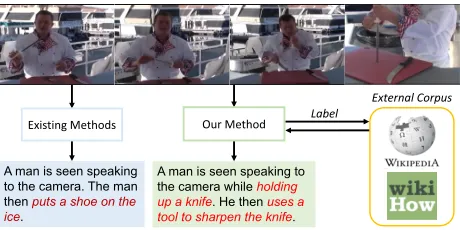
Figure 1: Example of zero-shot video captioning. “ Sharpen-ing Knives” is a novel activity unseen in training, and ex-isting methods fail to generate a pertinent caption because it is aware of neither the action “sharpening” nor the ob-ject “knife”. Our method effectively utilizes the knowledge from the external corpus based on predicted activity label and generates a more pertinent caption.
a new task of zero-shot video captioning, where a model is required to accurately describe novel activities in videos without any explicit paired training data.
An example of zero-shot video captioning is shown in Figure 1, where an existing method fails to correctly cap-tion a video about the novel activity “sharpening knives” be-cause it has learned no knowledge about the activity in train-ing. Moreover, the description of different activities vary in word selection, semantic construction, style expression etc, so videos of different activities usually require different cap-tioning strategies, which poses a great challenge in the open vocabulary scenario. Despite the difference, many activities share similar characteristics,e.g.,playing baseballand play-ing footballare both sports activities and a few words can be used to describe both in common.
primi-tive experts and compose a topic-specific captioning model based on a certain topic. Besides, in order to leverage world knowledge from external corpora, we derive atopic embed-dingfor each activity from the pretrained semantic embed-dings of the most relevant words. When captioning a novel activity, our TAMoE method is capable of inferring the com-position of the primitive experts conditioned on the topic embedding, transferring the knowledge learned from seen activities to unseen ones. Our main contributions are three-fold:
• We introduce the task of zero-shot video captioning which aims to accurately describe novel activities in videos with-out paired training data for the activities.
• We propose a novel Topic-Aware Mixture of Experts ap-proach for zero-shot video captioning, where a topic-aware gating function learns to infer the utilization of the primitive experts for caption generation from the intro-duced topic embedding, implicitly doing transfer learning across various topics.
• We empirically demonstrate the effectiveness of our method on a popular video captioning dataset and show its strong generalization capability on captioning novel activities.
Related Work
Video Captioning Since S2VT (Venugopalan et al. 2015)’s first sequence-to-sequence model for video caption-ing, numerous improvements have been introduced, such as attention (Yao et al. 2015), hierarchical recurrent neu-ral network (Yu et al. 2016; Pan et al. 2016), multi-modal fusion(Gan et al. 2017; Shen et al. 2017; Wang, Wang, and Wang 2018), multi-task learning (Pasunuru and Bansal 2017), etc. Meanwhile, a few large-scale datasets are intro-duced for video captioning, either for single-sentence gener-ation (Xu et al. 2016) or paragraph genergener-ation (Rohrbach et al. 2014). Recently, (Krishna et al. 2017) propose the dense video captioning task, which aims at detecting mul-tiple events that occur in a video and describing each of them. However, existing methods mainly focus on learn-ing from paired trainlearn-ing data and testlearn-ing on similar videos. Though some work has attempted to utilize linguistic knowl-edge to assist video captioning (Thomason et al. 2014; Venugopalan et al. 2016), none of them has formally consid-ered zero-shot video captioning to describe videos of novel activities, which is the focus of this study.
Novel Object Captioning in Images Recent studies on novel object captioning (Anne Hendricks et al. 2016; Venu-gopalan et al. 2017) attempt to describe novel objects not ap-pearing during training. Zero-shot video captioning shares a similar spirit in the sense that it also generates captions with-out paired data. But zero-shot video captioning is a more challenging task: images are static scenes, and methods based on noun word replacement can perform well on novel object captioning (Anderson et al. 2017; Wu et al. 2018; Lu et al. 2018); While describing novel activities in videos requires both temporal understanding of videos and deeper
understanding of the social or human knowledge of activ-ities beyond the object level. Different activactiv-ities need dif-ferent captioning strategies, as well as share some common characteristics. Motivated by this, our method learns the un-derlying mapping experts from the latent representations to the vocabulary, with a topic-aware gating mechanism im-plicitly transferring the utilization, which is orthogonal to these methods for novel object captioning in images.
Zero-Shot Activity Recognition In prior work, zero-shot learning has been studied on the task of activity recog-nition (Fabian Caba Heilbron and Niebles 2015; Zhang et al. 2018), to predict a previously unseen activity. Un-like zero-shot activity recognition (Gan et al. 2015; 2016; Zellers and Choi 2017), zero-shot video captioning focuses on the language generation part—learning to describe out-of-domain videos of a novel activity without paired captions but with the knowledge of the activity. This technique is valuable because caption annotations for videos are much more expensive to get compared with activity labels.
Mixture of Experts Mixture of Experts (MoE) is orig-inally formulated by Jacobs et al., which learns to com-pose multiple expert networks with each to handle a sub-set of the training cases. Then MoE has been applied to various machine learning algorithms (Jordan and Ja-cobs 1994; Collobert, Bengio, and Bengio 2003), such as SVMs (Collobert, Bengio, and Bengio 2002), Gaussian Pro-cesses (Tresp 2001), and deep networks (Ahmed, Baig, and Torresani 2016; Gu et al. 2018). Recently, Shazeer et al. proposes a sparsely-gated mixture-of-experts layer for lan-guage modeling, which benefits from conditional computa-tion. Yang et al. extends it to Mixture of Softmax to break the softmax bottleneck and thus increase the capacity of the lan-guage model. In this work, we exploit the nature of MoE for transfer learning by training a topic-aware gating function to compose primitive experts and adapt to various topics.
Describing Novel Activities in Videos
Task Definition
Here we first introduce the general video captioning task, whose input is a sequence of video frames ν =
{v1, v2, . . . , vn} wherenis the number of frames in
tem-poral order. The output is a sequence of words W =
{w1, w2, . . . , wT}, whereT is the length of the generated
word sequence. At each time stept, a model chooses a word wtfrom a vocabularyV that is built from the paired training
corpus. Normally, the vocabularyV can cover the possible output tokens if tested on the same activities as in training. But for zero-shot video captioning, the testing videos are about novel activities that have never been seen during train-ing and require many out-of-vocabulary words to describe. So zero-shot video captioning is an open vocabulary learn-ing scenario, whose objective is to produce a word sequence
W withwt ∈V∗, whereV∗is beyond the training corpus
Input Video
Sharpening Knives
Label
Document External Corpus
... Topic EmbeddingTFIDF-based
LSTM
MoE Layer
Reverse Embedding
Softmax
He Uses
tool
knife 3D CNN
Gating Function LSTM
LSTM LSTM
LSTM LSTM LSTM
!"
#$ %$&'()(+)
!
-.$/"
Gating Function 0 Embedding
Reverse Embedding
Softmax + !1
ℎ$
✖ ✖
✖
MoE Layer
d
{45} Video
Encoding Module
TAMoE Captioning Module
Attention
(a) Overview of the TAMoE method (b) TAMoE Captioning Module at time step t
Video Encoder
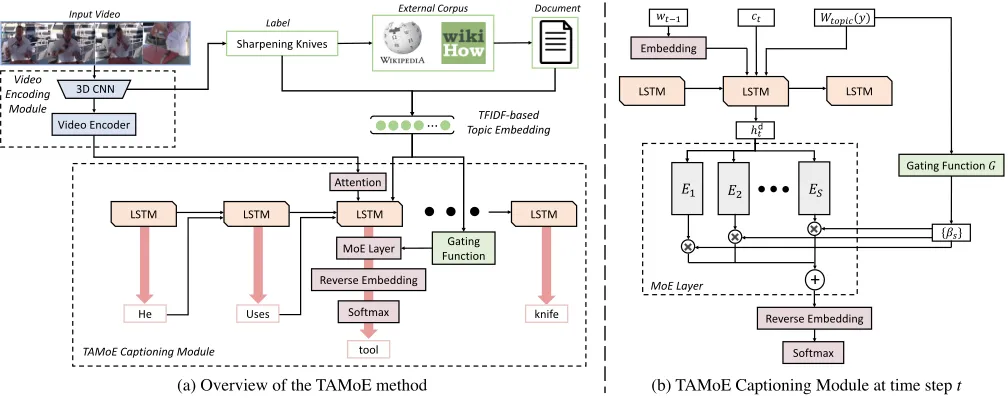
Figure 2: (a) Overview of our TAMoE method; (b) The detailed version of the TAMoE caption module at time stept.
Method Overview
We show in Figure 2(a) the overall pipeline of our Topic-Aware Mixture of Experts (TAMoE) approach, which mainly consists of thevideo encoding module, the
TFIDF-based topic embedding, and the TAMoE captioning
mod-ule. The video encoding moduleencodes video-level fea-tures and predicts the activity label. Then, the topic-related documents can be fetched from the external corpus and used to calculate theTFIDF-based topic embedding, which rep-resents the semantic meaning of the activity. In the decoding stage, theTAMoE captioning module takes both the video features and the topic embedding as input and generates the caption by dynamically composing specialized experts. In the following sections, we discuss each module in details.
Video Encoding Module
Given the input videoν ={v1, v2, . . . , vn}, we employ the
pretrained 3D convolutional neural networks to extract the segment-level features {fj}wherej = 1,2, . . . , m n.
We use I3D features (Carreira and Zisserman 2017) in our experiments. The I3D features include short-range temporal dynamics while keeping advanced spatial representations. Then our model sends the segment-level features {fj} to
the video encoder, which is a bidirectional LSTM, to model long-range temporal contexts. It outputs the hidden repre-sentations{he
j} withedenoting the video encoder, which
encodes the video-level features.
TFIDF-based Topic Embedding
To learn the knowledge of the activities without paired cap-tions, we fetch topic-related documents from various data sources, e.g., Wikipedia and WikiHow. We also employ the pretrainedfasttextembeddings (Mikolov et al. 2018) to cal-culate the representations of the topics (though we use fast-text embeddings here, our method is not limited to a particu-lar word embeddings). Given an activity labely(y∈Y) and
the related documentsDy, we need to compute the
topic-specific knowledge representations.
The documents contain many high-frequency but irrele-vant words, e.g., the, to, a, so average embedding is too noisy to effectively represent the knowledge of the topic. Term Frequency-Inverse Document Frequency (TF-IDF) is an efficient statistical method to reflect the importance of a word to a document. Here we propose a topic-aware TF-IDF weightinggk(y)to calculate the relevance of each unigram
xkto the topic-related documentsDy:
gk(y) =
zk(y)
P
xl∈Dyzl(y)
log(P |Y|
y0∈Y min(1, zk(y0))
) (1)
wherezk(y)is the number of times the unigramxk occurs
in the documentsDy related to labely. The first term is the
term frequency of the unigram xk, which places a higher
weight on words that frequently occur in the topic-related documentsDy. The second term measures the rarity ofxk
with inverse document frequency, reducing the weight ifxk
commonly exists across all the topics. Then our TF-IDF em-bedding is
Wtf idf(y) =
X
xk∈Dy
gk(y)Wf asttext(xk) (2)
whereWf asttextdenotes the pretrained fasttext embeddings.
As shown in Figure 2(a), the TF-IDF embedding is concate-nated with the average embedding of the activity label and eventually taken as the topic embeddingWtopic(y).
TAMoE Captioning Module
Attention-based Decoder LSTM The backbone of the captioning model is an attention-based LSTM. At each time steptin the decoding stage, the decoder LSTM produces its outputhd
t (ddenoting the decoder) by considering the word
embeddingWtopic(y)and its internal hidden statehdt−1. In formula,
hdt =LST M([wt−1, ct, Wtopic(y)], hdt−1) (3)
where the context vectorctis a weighted sum of the encoded
video features{hej}
ct=
X
αt,jhej (4)
These attention weights{αt,j}act as an alignment
mecha-nism by giving higher weights to certain features that allow better prediction. They are learned by the attention mecha-nism proposed in (Bahdanau, Cho, and Bengio 2015).
Mixture-of-Expert Layer and Topic-Aware Gating Func-tion Following Equation 3, the output of the decoder LSTM hd
t is then fed into the Mixture-of-Experts (MoE)
layer (see Figure 2(b)). Here each expert is an underlying mapping function from the latent representation hd
t to the
vocabulary, which learns the captioning primitives that are shareable to all topics. All the experts in the same MoE layer have the same architecture, which is parameterized by a fully-connected layer and a nonlinear ReLU activation. Let S denote the number of experts andEs be thes-th expert,
then output of the MoE layer is
ot= S
X
s=1
βsEs(hdt) (5)
whereβsis the gating weight of the expertEs, representing
the utilization of the expertEs. And it is determined by the
topic-aware gating functionG:
βs=
exp(G(Wtopic(y))s/τ)
PS
i=1exp(G(Wtopic(y))i/τ)
(6)
whereGis a multilayer perceptron in our model. The tem-perature τ determines the diversity of the gating weights. The topic-aware gating function G is conditioned on the topic embeddingWtopic(y)and learns to combine the
ex-pertise of those primitive experts for a certain topic. Intu-itively, Glearns topic-aware language dynamics and com-poses different expert utilization for different topics based on the topic embeddings, which can implicitly transfer the utilization across topics.
Embedding and Reverse Embedding Layers In addi-tion, we also employ semantic word embeddings in our cap-tioning model to help generate descriptions of unseen activ-ities. Incorporating pretrained embeddings assigns semantic meanings to those out-of-domain words and thus can facili-tate the open vocabulary learning (Venugopalan et al. 2017). Particularly, we load the fasttext embeddings into both the embedding layer and the reverse embedding layer (see Fig-ure 2(b)), and freeze their weights during training. So the embedding layer represents the input word (one-hot vector) into semantically meaningful dense vectors, while the re-verse embedding layer is placed before the softmax layer to reverse the mapping from the feature vectors into the vo-cabulary space.
Learning
Cross Entropy Loss We adopt the cross entropy loss to train our models. Let θ denote the model parameters and w∗1:T be the ground-truth word sequence, then the training loss is defined as
L(θ) =−
T
X
t=1
logp(w∗t|w∗1:t−1, θ) (7)
where is where p(wt|w1:t−1, θ)is the probability distribu-tion of the next word.
Variational Dropout In order to regularize our MoE layer and promote expert diversity, we adopt the variational dropout (Gal and Ghahramani 2016; Merity, Keskar, and Socher 2018) when training the TAMoE module. Different from the standard dropout, variational dropout samples a bi-nary dropout mask only once upon the first call and then repeatedly uses that locked dropout mask within samples. In addition, the variational dropout helps stabilize the training of the topic-aware gating mechanism by making the expert behaviors consistent within samples.
Experimental Setup
Held-out ActivityNet-Captions Dataset
ActivityNet (Fabian Caba Heilbron and Niebles 2015) is a well-known benchmark for video classification and detec-tion, which covers 200 classes of activities. Recently, (Kr-ishna et al. 2017) have collected the corresponding natu-ral language description for the videos in the ActivityNet dataset, leading to the ActivityNet-Captions dataset. We set up the zero-shot learning scenario based on the ActivityNet-Captions dataset. We re-split the videos of the 200 activi-ties into the thetraining set (170 activities), thevalidation set (15 activities), and the unseen test set (15 activities). Each activity is unique and only exists in one split above. We hold out the novel 15 activities for testing that appear during neither training nor validation. The held-out 15 ac-tivities are:“making a lemonade”, “armwrestling”, “long-boarding”, “playing badminton”, “shuffleboard”, “slack-lining”, “hula hoop”, “playing drums”, “braiding hair”, “gargling mouthwash”, “installing carpet”, “sharpening knives”, “grooming dog”, “assembling bicycle”, “painting fence”. In order to compare with the model’s performance on the supervised split, we then further split an additional
seen test setthat shares the same activities with the training set but has different video samples. The external text corpus is crawled from Wikipedia, WikiHow, and some related doc-uments in the first Google Search page. On average there are 2.72 related documents per activity (the max is 10).
Evaluation Metrics
Seen Test Set Unseen Test Set
Model Embedding CIDEr B-1 B-2 B-3 B-4 M R CIDEr B-1 B-2 B-3 B-4 M R
Base task-specific 29.67 23.57 12.06 7.02 4.42 9.77 21.45 21.59 22.34 10.57 5.76 3.45 9.01 20.06
Base fasttext 31.48 23.88 12.20 7.11 4.39 10.16 21.69 22.51 22.50 11.01 6.02 3.58 9.43 20.70
Topic task-specific 33.06 24.48 12.64 7.27 4.32 10.49 22.24 23.06 22.06 10.34 6.05 3.62 9.40 20.60
Topic fasttext 33.72 24.53 12.56 7.20 4.44 10.24 22.11 24.06 22.97 11.09 5.98 3.51 9.70 20.98
TAMoE task-specific 34.38 25.79 13.29 7.44 4.46 10.69 23.03 24.39 23.36 11.19 6.05 3.59 9.28 21.46
TAMoE fasttext 35.53 25.51 13.93 7.39 4.61 10.83 22.51 28.23 24.34 11.18 6.14 3.68 9.96 21.17
Table 1: Comparison with the baseline methods on the held-out ActivityNet-Captions dataset. We report the results of our TAMoE model and the other baseline models in terms of CIDEr, BLEU (B), METEOR (M), and ROUGE-L (R) scores.
n-grams (n= 1,2,3,4), we also report individual CIDEr-1, CIDEr-2, CIDEr-3, and CIDEr-4 scores.
Implementation Details
To preprocess the videos, we sample each video at20f ps and extract the I3D features (Carreira and Zisserman 2017) from these sampled frames. Note that the I3D model is pre-trained on the Kinects dataset (Kay et al. 2017) and used here without fine-tuning. The activity labels feeding to our model are predicted by a pretrained 3D CNN model (Wang et al. 2016) for activity classification. The vocabulary is built based on the training corpus and the unpaired external cor-pus. We use 300-dimensional pretrained fasttext embedding for words. All the hyper-parameters are tuned on the vali-dation set. The maximum number of video features is 200 and the maximum caption length is 32. The video encoder is a biLSTM of size 512, and the decoder LSTM is of size 1024. We initialize all the parameters from a uniform dis-tribution on[−0.1,0.1]. Adadelta optimizer (Zeiler 2012) is used with batch size 64. Learning rate starts at 1 and is then halved when the current CIDEr score does not surpass the previous best in 4 epochs. The maximum number of epochs is 100, and we shuffle the training data at each epoch. Sched-ule sampling (Bengio et al. 2015) is also employed to train the models. Beam search of size 5 is used at test time. It takes around 6 hours to fully train a model on a TITAN X.
Experiments and Analysis
We compare three models on the Held-out ActivityNet-Captions dataset.
Base: we first implement the state-of-the-art attention-based sequence-to-sequence model used in (Wang et al. 2018b) as our baseline (Base). Simply put, the Base model is the model in Figure 2 without the topic embedding module and the gat-ing function. Everythgat-ing else is exactly the same.
Topic: the Topic model has a very similar architecture with the Base model, except that its decoder takes the proposed topic embedding as an additional input.
TAMoE: the proposed TAMoE model is illustrated in Fig-ure 2, which consists of the video encoding module, the topic embedding, the topic-ware gating function, and the Mixture-of-Experts layer.
Moreover, we test the impact of pretrained word em-beddings by comparing two word embedding initialization
Model CIDEr BLEU-4 METEOR ROUGE-L
Base 47.2 40.9 28.8 60.9
TAMoE 48.9 42.2 29.4 62.0
Table 2: Results on the MSR-VTT dataset.
strategies: (1)task-specific, that randomly initializes the em-beddings and learns them during training, and (2)fasttext, that uses pretrained fasttext embeddings (fixed in training).
Experimental Results
Seen and Unseen Test Sets of the Held-out ActivityNet Captions Table 1 shows the results on both the seen and the unseen test sets. First, it can be noted that incorporat-ing pretrained fasttext embeddincorporat-ings brincorporat-ings a consistent im-provement across models on both test sets, especially for the zero-shot learning scenario on the unseen test set. Second, by comparing the Base model and the Topic model it can be observed that solely adding the proposed topic embedding can bring some improvement. These validate the hypothesis that the pretrained embeddings can bring useful prior knowl-edge to assist caption generation, and it facilitates the gener-ation of out-of-domain words that do not appear in the train-ing data. More importantly, our TAMoE model significantly improves the scores over the baseline models. For instance, our full TAMoE model outperforms the Base model on both the seen and the unseen test sets by a large margin, with respectively 19.75% and 30.75% relative improvement on CIDEr. The remarkable improvement on the unseen test set clearly demonstrates the superior capability of the proposed model on captioning novel activities.
Model Embedding C-1 C-2 C-3 C-4
Base task-specific 52.13 20.41 8.92 4.18
Base fasttext 55.17 21.40 8.81 4.64
Topic task-specific 55.79 20.94 9.47 4.68
Topic fasttext 58.84 23.33 9.32 4.75
TAMoE task-specific 58.81 22.98 10.42 6.00
TAMoE fasttext 67.48 25.89 12.09 7.47
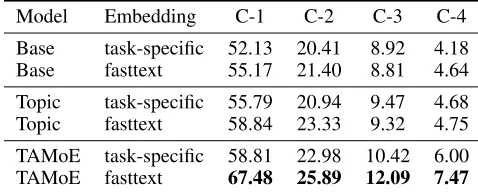
Table 3: Individual CIDEr scores of unigrams (C-1), bigrams (C-2), trigrams (C-3), and fourgrams (C-4) on the unseen test set, which are all novel activities.
I3D Video Features X X X X
Average Label Embedding X X X
TFIDF Embedding X X X
CIDEr 22.51 25.96 26.61 15.77 28.23
Table 4: Impact of different features on the TAMoE model.
I3D Video Featuresare the extracted video features using the pretrained I3D model;Average Label Embeddingis the average embedding of the words in the predicted activity
la-bel; TFIDF Embedding is the weighted embedding of the
external topic-related documents (see Equation 2).
MSR-VTT To prove the effectiveness of our method on generic video captioning, we further test it on the widely-used MSR-VTT dataset (Xu et al. 2016). As shown in Ta-ble 2, the TAMoE approach outperforms the Base model on all the metrics by a large margin. Note that for simplicity, we utilize the pretrained visual and audio features as used in (Wang, Wang, and Wang 2018) as well as the ground-truth category labels on this dataset.
Ablation Study
Evaluation on Different N-grams In order to take a closer look at the transfer influence of our TAMoE model on individual n-grams, we calculate the CIDEr score of uni-grams, biuni-grams, triuni-grams, and fourgrams on the unseen test set separately. As seen in Table 3, our TAMoE model per-forms the best on all n-grams, but the CIDEr score of 4-grams is still not very satisfactory. A general limitation of current captioning systems is that the focus is still on learn-ing word-level embeddlearn-ings and generatlearn-ing a caption word by word. Incorporating phrase-level embeddings may alle-viate this issue. We leave it for future study.
Impact of Different Features In Table 4, we test the in-fluence of the I3D video features and various versions of the topic embedding. Evidently, it performs the best to use the concatenation of the average label embedding and the TFIDF embedding from external corpus as the topic embed-ding. Besides, without videos features, the model is unable to generate diverse captions for different videos that also match the video content (the corresponding CIDEr score is as low as 15.77).
Figure 3: Learning curves of the TAMoE models with dif-ferent numbers of experts (n) and different expert dimen-sion (d). For example,n4 d512denotes the TAMoE model with 4 experts, each of dimension 512. Note the validation scores are calculated by greedy decoding, which are lower than than testing scores by beam search of size 5.
Novel Activity Base TAMoE Top-4 related words
making a lemonnade 28.63 31.66 lemonade, sugar, lemon, juice arm wrestling 23.72 35.96 wrestling, arm, opponent, strength longboarding 20.51 28.79 longboard, board, foot, riding playing badminton 20.18 22.00 shuttle, racket, shuttlecock, court shuffleboard 14.95 20.85 shuffleboard, disks, discs, puck slacklining 24.43 21.33 slackline, slacklining, line, balance hula hoop 17.50 26.29 hoop, hula, hoops, waist playing drums 31.70 39.44 drum, snare, metronome, hat braiding hair 21.30 36.80 braid, hair, section, strands gargling mouthwash 11.09 52.03 mouthwash, mouth, gargling, fluoride installing carpet 22.40 17.85 carpet, strips, tackless, wall sharpening knives 24.77 43.63 stone, knife, sharpening, blade grooming dog 18.33 26.61 dog, clippers, shampoo, fur assembling bicycle 22.17 28.74 handlebar, bike, stem, seat painting fence 23.56 23.15 fence, paint, painting, sprayer
Table 5: Topic-wise comparison. We compare the CIDEr scores of the Base model and our TAMoE model within each activity. In the right-most column, we list the top words based on their TF-IDF weights in the external topic-related documents.
Figure 4: Qualitative comparison between our TAMoE model and the Base model on describing novel activities.
Topic-wise Result Comparison To examine the perfor-mance of our method on each novel activity, we report the topic-wise comparison with the Base model in Table 5. The TAMoE model outperforms the Base model on most of the activities (12 out of 15), of which some activities are im-proved by a remarkable margin, e.g.,arm wresting,braiding hair, gargling mouthwash, and sharpening knives. Mean-while, we showcase the top-4 related words from the exter-nal corpus for each topic according to their TF-IDF weights to provide a better illustration of our topic embeddings.
Qualitative Comparison Figure 4 showcases two qualita-tive examples on the unseen test set. In the first video about “painting fence”, the Base model has no linguistic knowl-edge of the concept “fence”, while our TAMoE model suc-cessfully recognizes it and produces a more pertinent de-scription. In the second example about “grooming dog”, the Base model fails to recognize the actual action though al-ready knowing the objects, while our model generates a more accurate description of the video.
Discussion
In this paper, we formally define the task of zero-shot video captioning and set up a common setting for evaluation. In order to accurately describe videos of unseen activities, we seek solutions based on what and how to utilize and transfer. Note that one assumption of zero-shot video captioning is that the activity category can be either provided or predicted. Even so, it is still valuable because caption annotations for videos are much more expensive to get compared with activ-ity labels. But combining zero-shot activactiv-ity recognition and zero-shot video captioning is a promising direction towards more advanced approaches for transfer learning, which we leave for future study.
Acknowledgement
We thank Adobe Research for supporting our language and vision research. We also thank the anonymous reviewers for their helpful feedbacks and Yijun Xiao for cleaning the data.
References
Ahmed, K.; Baig, M. H.; and Torresani, L. 2016. Network of experts for large-scale image categorization. InECCV.
Anderson, P.; Fernando, B.; Johnson, M.; and Gould, S. 2017. Guided open vocabulary image captioning with con-strained beam search. InEMNLP.
Anne Hendricks, L.; Venugopalan, S.; Rohrbach, M.; Mooney, R.; Saenko, K.; Darrell, T.; Mao, J.; Huang, J.; To-shev, A.; Camburu, O.; et al. 2016. Deep compositional cap-tioning: Describing novel object categories without paired training data. InCVPR.
Bahdanau, D.; Cho, K.; and Bengio, Y. 2015. Neural ma-chine translation by jointly learning to align and translate. In
ICLR.
Bengio, S.; Vinyals, O.; Jaitly, N.; and Shazeer, N. 2015. Scheduled sampling for sequence prediction with recurrent neural networks. InNIPS.
Carreira, J., and Zisserman, A. 2017. Quo vadis, action recognition? a new model and the kinetics dataset. InCVPR. Collobert, R.; Bengio, S.; and Bengio, Y. 2002. A parallel mixture of svms for very large scale problems. InNIPS. Collobert, R.; Bengio, Y.; and Bengio, S. 2003. Scaling large learning problems with hard parallel mixtures. Inter-national Journal of pattern recognition and artificial
intelli-gence17(03):349–365.
Fabian Caba Heilbron, Victor Escorcia, B. G., and Niebles, J. C. 2015. Activitynet: A large-scale video benchmark for human activity understanding. InCVPR.
Gal, Y., and Ghahramani, Z. 2016. A theoretically grounded application of dropout in recurrent neural networks. InNIPS. Gan, C.; Liu, M.; Yang, Y.; Zhuang, Y.; and Hauptmann, A. G. 2015. Exploring semantic interclass relationships (sir) for zero-shot action recognition. InAAAI.
Gan, C.; Lin, M.; Yang, Y.; de Melo, G.; and Hauptmann, A. G. 2016. Concepts not alone: Exploring pairwise rela-tionships for zero-shot video activity recognition. InAAAI. Gan, Z.; Gan, C.; He, X.; Pu, Y.; Tran, K.; Gao, J.; Carin, L.; and Deng, L. 2017. Semantic compositional networks for visual captioning. InCVPR.
Gu, J.; Hassan, H.; Devlin, J.; and Li, V. O. 2018. Universal neural machine translation for extremely low resource lan-guages. InNAACL HLT.
Jordan, M. I., and Jacobs, R. A. 1994. Hierarchical mix-tures of experts and the em algorithm. Neural computation
6(2):181–214.
Kay, W.; Carreira, J.; Simonyan, K.; Zhang, B.; Hillier, C.; Vijayanarasimhan, S.; Viola, F.; Green, T.; Back, T.; Natsev, P.; et al. 2017. The kinetics human action video dataset.
arXiv preprint arXiv:1705.06950.
Krishna, R.; Hata, K.; Ren, F.; Fei-Fei, L.; and Niebles, J. C. 2017. Dense-captioning events in videos. InICCV.
Lu, J.; Yang, J.; Batra, D.; and Parikh, D. 2018. Neural baby talk. InCVPR.
Merity, S.; Keskar, N. S.; and Socher, R. 2018. Regularizing and optimizing lstm language models. InICLR.
Mikolov, T.; Grave, E.; Bojanowski, P.; Puhrsch, C.; and Joulin, A. 2018. Advances in pre-training distributed word representations. InLREC.
Pan, P.; Xu, Z.; Yang, Y.; Wu, F.; and Zhuang, Y. 2016. Hi-erarchical recurrent neural encoder for video representation with application to captioning. InCVPR.
Pasunuru, R., and Bansal, M. 2017. Multi-task video cap-tioning with video and entailment generation. InACL. Rohrbach, A.; Rohrbach, M.; Qiu, W.; Friedrich, A.; Pinkal, M.; and Schiele, B. 2014. Coherent multi-sentence video description with variable level of detail. InGCPR.
Shazeer, N.; Mirhoseini, A.; Maziarz, K.; Davis, A.; Le, Q.; Hinton, G.; and Dean, J. 2017. Outrageously large neural networks: The sparsely-gated mixture-of-experts layer. In
ICLR.
Shen, Z.; Li, J.; Su, Z.; Li, M.; Chen, Y.; Jiang, Y.-G.; and Xue, X. 2017. Weakly supervised dense video captioning. InCVPR.
Thomason, J.; Venugopalan, S.; Guadarrama, S.; Saenko, K.; and Mooney, R. 2014. Integrating language and vi-sion to generate natural language descriptions of videos in the wild. InCOLING.
Tresp, V. 2001. Mixtures of gaussian processes. InNIPS.
Venugopalan, S.; Rohrbach, M.; Donahue, J.; Mooney, R.; Darrell, T.; and Saenko, K. 2015. Sequence to sequence-video to text. InICCV.
Venugopalan, S.; Hendricks, L. A.; Mooney, R.; and Saenko, K. 2016. Improving lstm-based video description with lin-guistic knowledge mined from text. InEMNLP.
Venugopalan, S.; Hendricks, L. A.; Rohrbach, M.; Mooney, R.; Darrell, T.; and Saenko, K. 2017. Captioning images with diverse objects. InCVPR.
Wang, L.; Xiong, Y.; Wang, Z.; Qiao, Y.; Lin, D.; Tang, X.; and Van Gool, L. 2016. Temporal segment networks: To-wards good practices for deep action recognition. InECCV. Wang, X.; Chen, W.; Wang, Y.-F.; and Wang, W. Y. 2018a. No metrics are perfect: Adversarial reward learning for vi-sual storytelling. InACL.
Wang, X.; Chen, W.; Wu, J.; Wang, Y.-F.; and Wang, W. Y. 2018b. Video captioning via hierarchical reinforcement learning. InCVPR.
Wang, X.; Wang, Y.-F.; and Wang, W. Y. 2018. Watch, lis-ten, and describe: Globally and locally aligned cross-modal attentions for video captioning.NAACL HLT.
Wu, Y.; Zhu, L.; Jiang, L.; and Yang, Y. 2018. Decoupled novel object captioner. InACM MM.
Xu, J.; Mei, T.; Yao, T.; and Rui, Y. 2016. Msr-vtt: A large video description dataset for bridging video and language. InCVPR.
Yang, Z.; Dai, Z.; Salakhutdinov, R.; and Cohen, W. W. 2018. Breaking the softmax bottleneck: A high-rank RNN language model. InICLR.
Yao, L.; Torabi, A.; Cho, K.; Ballas, N.; Pal, C.; Larochelle, H.; and Courville, A. 2015. Describing videos by exploiting temporal structure. InICCV.
Yu, H.; Wang, J.; Huang, Z.; Yang, Y.; and Xu, W. 2016. Video paragraph captioning using hierarchical recurrent neural networks. InCVPR.
Zeiler, M. D. 2012. Adadelta: an adaptive learning rate method.arXiv preprint arXiv:1212.5701.
Zellers, R., and Choi, Y. 2017. Zero-shot activity recogni-tion with verb attribute inducrecogni-tion. InEMNLP.