The Thirty-Third AAAI Conference on Artificial Intelligence (AAAI-19)
MonoGRNet: A Geometric Reasoning
Network for Monocular 3D Object Localization
Zengyi Qin,
†∗Jinglu Wang,
‡Yan Lu
‡†Tsinghua University,‡Microsoft Research
{v-zeqin, jinglwa, yanlu}@microsoft.com
Abstract
Localizing objects in the real 3D space, which plays a cru-cial role in scene understanding, is particularly challenging given only a single RGB image due to the geometric infor-mation loss during imagery projection. We propose Mono-GRNet for the amodal 3D object localization from a monoc-ular RGB image via geometric reasoning in both the ob-served 2D projection and the unobob-served depth dimension. MonoGRNet is a single, unified network composed of four task-specific subnetworks, responsible for 2D object detec-tion, instance depth estimation (IDE), 3D localization and local corner regression. Unlike the pixel-level depth estima-tion that needs per-pixel annotaestima-tions, we propose a novel IDE method that directly predicts the depth of the targeting 3D bounding box’s center using sparse supervision. The 3D lo-calization is further achieved by estimating the position in the horizontal and vertical dimensions. Finally, MonoGRNet is jointly learned by optimizing the locations and poses of the 3D bounding boxes in the global context. We demon-strate that MonoGRNet achieves state-of-the-art performance on challenging datasets.
Introduction
Typical object localization or detection from a RGB image estimates 2D boxes that bound visible parts of the objects belonging to the specific classes on the image plane. How-ever, this kind of result cannot provide geometric percep-tion in the real 3D world for scene understanding, which is crucial for applications, such as robotics, mixed reality, and autonomous driving.
In this paper, we address the problem of localizing amodal 3D bounding boxes (ABBox-3D) of objects at their full ex-tents from a monocular RGB image. Unlike 2D analysis on the image plane, 3D localization with the extension to an unobserved dimension, i.e., depth, not solely enlarges the searching space but also introduces inherent ambiguity of 2D-to-3D mapping, increasing the task’s difficulty signifi-cantly.
Most state-of-the-art monocular methods (Xu and Chen 2018; Zhuo et al. 2018) estimate pixel-level depths and then regress 3D bounding boxes. Nevertheless, pixel-level depth
∗The work was done when Zengyi Qin was an intern at MSR.
Copyright c2019, Association for the Advancement of Artificial Intelligence (www.aaai.org). All rights reserved.
estimation does not focus on object localization by design. It aims to minimize the mean error for all pixels to get an aver-age optimal estimation over the whole imaver-age, while objects covering small regions are often neglected (Fu et al. 2018), which drastically downgrades the 3D detection accuracy.
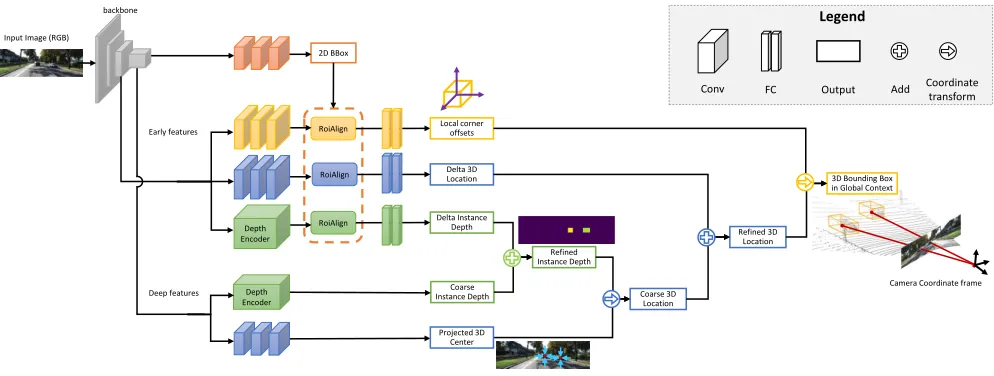
We propose MonoGRNet, a unified network for amodal 3D object localization from a monocular image. Our key idea is to decouple the 3D localization problem into several progressive sub-tasks that are solvable using only monocu-lar RGB data. The network starts from perceiving semantics in 2D image planes and then performs geometric reasoning in the 3D space.
A challenging problem we overcome is to accurately esti-mate the depth of an instance’s 3D center without computing pixel-level depth maps. We propose a novel instance-level depth estimation (IDE) module, which explores large recep-tive fields of deep feature maps to capture coarse instance depths and then combines early features of a higher resolu-tion to refine the IDE.
To simultaneously retrieve the horizontal and vertical po-sition, we first predict the 2D projection of the 3D center. In combination with the IDE, we then extrude the projected center into real 3D space to obtain the eventual 3D object location. All the components are integrated into the end-to-end network, MonoGRNet, featuring its three 3D reasoning branches illustrated in Fig. 1, and is finally optimized by a joint geometric loss that minimizes the 3D bounding box discrepancy in the global context.
We argue that RGB information alone can provide almost accurate 3D locations and poses of objects. Experiments on the challenging KITTI dataset demonstrate that our network outperforms the state-of-art monocular method in 3D object localization with the least inference time. In summary, our contributions are three-fold:
• A novel instance-level depth estimation approach that
di-rectly predicts central depths of ABBox-3D in the absence of dense depth data, regardless of object occlusion and truncation.
• A progressive 3D localization scheme that explores rich
feature representations in 2D images and extends geomet-ric reasoning into 3D context.
• A unified network that coordinates localization of objects
Input Image (RGB)
Coarse Instance Depth RoiAlign Delta Instance Depth
RoiAlign Delta 3D Location
RoiAlign 2D BBox
Coarse 3D Location
3D Bounding Box in Global Context
Camera Coordinate frame
Projected 3D Center Local corner
offsets
Refined Instance Depth
Refined 3D Location backbone
Conv FC
Legend
Add Coordinate transform Output
Early features
Deep features
Depth Encoder
Depth Encoder
Figure 1:MonoGRNet for 3D object localization from a monocular RGB image.MonoGRNet consists of four subnetworks
for 2D detection(brown), instance depth estimation(green), 3D location estimation(blue) and local corner regression(yellow). Guided by the detected 2D bounding box, the network first estimates depth and 2D projection of the 3D box’s center to obtain the global 3D location, and then regresses corner coordinates in local context. The final 3D bounding box is optimized in an end-to-end manner in the global context based on the estimated 3D location and local corners. (Best viewed in color.)
performs efficient inference (taking∼0.06s/image).
Related Work
Our work is related to 3D object detection and monocular depth estimation. We mainly focus on the works of studying 3D detection and depth estimation, while 2D detection is the basis for coherence.
2D Object Detection. 2D object detection deep net-works are extensively studied. Region proposal based meth-ods (Girshick 2015; Ren et al. 2017) generate impres-sive results but perform slowly due to complex multi-stage pipelines. Another group of methods (Redmon et al. 2016; Redmon and Farhadi 2017; Liu et al. 2016; Fu et al. 2017) focusing on fast training and inferencing apply a single stage detection. Multi-net (Teichmann et al. 2016) intro-duces an encoder-decoder architecture for real-time seman-tic reasoning. Its detection decoder combines the fast regres-sion in Yolo (Redmon et al. 2016) with the size-adjusting RoiAlign of Mask-RCNN (He et al. 2017), achieving a sat-isfied speed-accuracy ratio. All these methods predict 2D bounding boxes of objects while none 3D geometric features are considered.
3D Object Detection. Existing methods range from single-view RGB (Chen et al. 2016; Xu and Chen 2018; Chabot et al. 2017; Kehl et al. 2017), multi-view RGB (Chen et al. 2017; 2015; Wang et al. ), to RGB-D (Qi et al. 2017; Song and Xiao 2016; Liu et al. 2015). While geometric in-formation of the depth dimension is provided, the 3D detec-tion task is much easier. Given RGB-D data, FPointNet (Qi et al. 2017) extrudes 2D region proposals to a 3D viewing
frustum and then segments out the point cloud of interest ob-ject. MV3D (Chen et al. 2017) generates 3D object propos-als from bird’s eye view maps given LIDAR point clouds, and then fuses features in RGB images, LIDAR front views and bird’s eye views to predict 3D boxes. 3DOP(Chen et al. 2015) exploits stereo information and contextual models specific to autonomous driving.
The most related approaches to ours are using a monoc-ular RGB image. Information loss in the depth dimension significantly increases the task’s difficulty. Performances of state-of-the-art such methods still have large margins to RGB-D and multi-view methods. Mono3D (Chen et al. 2016) exploits segmentation and context priors to generate 3D proposals. Extra networks for semantic and instance seg-mentation are required, which cost more time for both train-ing and inference. Xu et al.(Xu and Chen 2018) leverage a pretrained disparity estimation model (Mahjourian, Wicke, and Angelova 2018) to guide the geometry reasoning. Other methods (Chabot et al. 2017; Kehl et al. 2017) utilize 3D CAD models to generate synthetic data for training, which provides 3D object templates, object poses and their corre-sponding 2D projections for better supervision. All previous methods exploit additional data and networks to facilitate the 3D perception, while our method only requires annotated 3D bounding boxes and no extra network needs to train. This makes our network much light weighted and efficient for training and inference.
𝑥 𝑦 𝑧
Camera 𝑥
𝑧
𝑥
𝑧 𝐎𝟕
𝐎1 𝐎2
𝐎3
𝐎4
𝐎5
𝐎𝟔
𝐎𝟖
(b) Camera coordinate frame (c) Local coordinate frame
𝐂
Image plane
2D BBox
3D BBox
(a) 2D Projection
𝑥 𝑦
𝑧
𝐛 𝐜
Bird’s eye view Local corners
Camera
𝐵2𝑑
𝐵3𝑑 𝒪 = {𝐎𝑘ሽ
Figure 2: Notation for 3D bounding box localization.
In a common practice, the loss values from each pixel are summed up as a whole to be optimized. Nevertheless, there is a likelihood that the pixels lying in an object are much fewer than those lying in the background, and thus the low average error does not indicate the depth values are accurate in pixels contained in an object. In addition, dense depths are often estimated from disparity maps that may produce large errors at far regions, which may downgrade the 3D localiza-tion performance drastically.
Different from the abovementioned pixel-level depth es-timation methods, we are the first to propose an instance-level depth estimation network which jointly takes semantic and geometric features into account with sparse supervision data.
Approach
We propose an end-to-end network, MonoGRNet, that di-rectly predicts ABBox-3D from a single RGB image. Mono-GRNet is composed of a 2D detection module and three ge-ometric reasoning subnetworks for IDE, 3D localization and ABBox-3D regression. In this section, we first formally de-fine the 3D localization problem and then detail MonoGR-Net for four subnetworks.
Problem Definition
Given a monocular RGB image, the objective is to lo-calize objects of specific classes in the 3D space. A tar-get object is represented by a class label and an ABBox-3D, which bounds the complete object regardless of occlu-sion or truncation. An ABBox-3D is defined by a 3D
cen-terC = (Xc, Yc, Zc)in global context and eight corners
O = {Ok}, k = 1, ...,8, related to local context. The 3D
locationCis calibrated in the camera coordinate frame and
the local cornersOare in a local coordinate frame, shown in
Fig. 2 (b) and (c) respectively.
We propose to separate the 3D localization task into four progressive sub-tasks that are resolvable using only a
monocular image. First, the 2D boxB2dwith a centerband
size(w, h)bounding the projection of the ABBox-3D is
de-tected. Then, the 3D centerCis localized by predicting its
depth Zc and 2D projection c. Notations are illustrated in
Fig. 2. Finally, local cornersOwith respect to the 3D
cen-ter are regressed based on local features. In summary, we formulate the ABBox-3D localization as estimating the fol-lowing parameters of each interest object:
B3d= (B2d, Zc,c,O) (1)
𝐛1
𝐛2
𝐛3 𝐠
(a) Scopes of instances on grid cells
(b) An image with 2D bounding box
(c) Instance depth map
𝜎𝑠𝑐𝑜𝑝𝑒
𝜎𝑠𝑐𝑜𝑝𝑒
𝜎𝑠𝑐𝑜𝑝𝑒
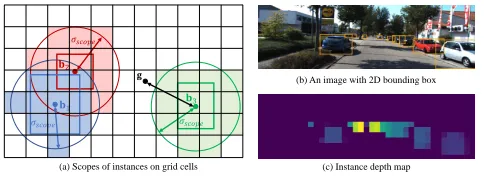
Figure 3: Instance depth. (a) Each grid cellgis assigned to
a nearest object within a distanceσscopeto the 2D bbox
cen-terbi. Objects closer to the camera are assigned to handle
occlusion. HereZ1
c < Zc2. (b) An image with detected 2D bounding boxes. (c) Predicted instance depth for each cell.
Monocular Geometric Reasoning Network
MonoGRNet is designed to estimate four components,B2d,
Zc,c,O, with four subnetworks respectively. Following a
CNN backbone, they are integrated into a unified frame-work, as shown in Fig. 1.
2D Detection. The 2D detection module is the basic mod-ule that stabilizes the feature learning and also reveals re-gions of interest to the subsequent geometric reasoning mod-ules.
We leverage the design of the detection component in (Te-ichmann et al. 2016), which combines fast regression (Red-mon et al. 2016) and size-adaptive RoiAlign (He et al. 2017), to achieve a convincing speed-accuracy ratio. An input
im-ageIof sizeW×His divided into anSx×SygridG, where
a cell is indicated byg. The output feature map of the
back-bone is also reduced toSx×Sy. Each pixel in the feature
map corresponding to an image grid cell yields a prediction.
The 2D prediction of each cellgcontains the confidence that
an object of interest is present and the 2D bounding box of
this object, namely,(P rgobj, B2gd), indicated by a superscript
g. The 2D bounding box B2d = (δxb, δyb, w, h)is
repre-sented by the offsets(δxb, δyb)of its centerbto the cellg
and the 2D box size(w, h).
The predicted 2D bounding boxes are taken as inputs of the RoiAlign (He et al. 2017) layers to extract early features with high resolutions to refine the predictions and reduce the performance gap between this fast detector with proposal-based detectors.
Instance-Level Depth Estimation. The IDE subnetwork
estimates the depth of the ABBox-3D centerZc. Given the
divided gridGin the feature map from backbone, each grid
cellgpredicts the 3D central depth of the nearest instance
within a distance thresholdσscope, considering depth
infor-mation, i.e., closer instances are assigned for cells, as illus-trated in Fig. 3 (a). An example of predicted instance depth for each cell is shown in Fig. 3 (c).
2D BBox
Grid cell Conv
fc
𝑆𝑥× 𝑆𝑦
4𝑆𝑥× 4𝑆𝑦
Coarse Depth
(𝑍𝑐𝑐)
Depth Delta
Refined Depth
(𝑍𝑐)
RoiAlign Depth
Encoder
Depth Encoder
fc Feature map
Image with𝑆𝑥× 𝑆𝑦Grid Conv
(𝛿𝑍𝑐)
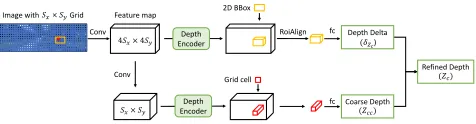
Figure 4: Instance depth estimation subnet. This shows the inference of the red cell.
Grid cells in deep feature maps from the CNN back-bone have larger receptive fields and lower resolution in comparison with that of shallow layers. Because they are less sensitive to the exact location of the targeted object,
it is reasonable to regress a coarse depth offset Zcc from
deep layers. Given the detected 2D bounding box, we are able to perform RoiAlign to the region containing an in-stance in early feature maps with a higher resolution and a smaller receptive field. The aligned features are passed
through fully connected layers to regress a deltaδZcin order
to refine the instance-level depth value. The final prediction
isZc=Zcc+δZc.
3D Location Estimation. This subnetwork estimates the
location of 3D centerC = (Xc, Yc, Zc)of an object of
in-terest in each gridg. As illustrated in Fig. 2, the 2D centerb
and the 2D projectioncofCare not located at the same
po-sition due to perspective transformation. We first regress the
projectioncand then backproject it to the 3D space based
on the estimated depthZc.
In a calibrated image, we elaborate the projection
map-ping from a 3D pointX = (X, Y, Z)to a 2D point x =
(u, v),ψ3D7→2D:X7→x, by
u=fx∗X/Z+px, v=fy∗Y /Z+py (2)
wherefxandfyare the focal length along X and Y axes,px
andpyare coordinates of the principle point. Given known
Z, the backprojection mapping ψ2D7→3D : (x, Z) 7→ X
takes the form:
X = (u−px)∗Z/fx, Y = (v−py)∗Z/fy (3)
Since we have obtained the instance depthZc from the
IDE module, the 3D location C can be analytically
com-puted using the 2D projected centercaccording to
Equa-tion 3. Consequently, the 3D estimaEqua-tion problem is con-verted to a 2D keypoint localization task that only relies on a monocular image.
Similar to the IDE module, we utilize deep features to
regress the offsetsδc = (δxc, δyc) of a projected centerc
to the grid cellgand calculate a coarse 3D locationCs =
ψ2D7→3D(δc +g, Zc). In addition, the early features with
high resolution are extracted to regress the deltaδCbetween
the predictedCsand the groundtruthCe to refine the final
3D location,C=Cs+δC.
3D Box Corner Regression
This subnetwork regresses eight corners, i.e., O =
{Ok}, k = 1, ...,8, in a local coordinate frame. Since each grid cell predicts a 2D bounding box in the 2D detector, we
apply RoiAlign to the cell’s corresponding region in early feature maps with high resolution and regress the local cor-ners of the 3D bounding box.
In addition, regressing poses of 3D boxes in camera co-ordinate frame is ambiguous (Xu et al. 2018; Gao et al. 2018; Guizilini and Ramos 2018). Even the poses of two 3D boxes are different, their projections could be similar when observed from certain viewpoints. We are inspired by Deep3DBox (Mousavian et al. 2017), which regresses boxes in a local system according to the observation angle.
We construct a local coordinate frame, where the origin is at the object’s center, the z-axis points straight from the cam-era to the center in bird’s eye view, the x-axis is on the right of z-axis, and the y-axis does not change, illustrated in Fig. 2 (c). The transformation from local coordinates to camera
co-ordinates are involved with a rotationRand a translationC,
and we obtainOcam
k = ROk +C, whereOcamk are the
global corner coordinates. This is a single mapping between the perceived and actual rotation, in order to avoid confusing the regression model.
Loss Functions
Here we formally formulate four task losses for the above subnetworks and a joint loss for the unified network. All the
predictions are modified with a superscriptgfor the
corre-sponding grid cellg. Groundtruth observations are modified
by thef(·)symbol.
2D Detection Loss. The object confidence is trained using
softmax(s·)cross entropy(CE)loss and the 2D bounding
boxesB2d= (xb, yb, w, h)are regressed using a masked L1
distance loss. Note thatwandhare normalized byW and
H. The 2D detection loss are defined as:
Lconf =CEg∈G(s·(P robjg ),P rf g
obj)
Lbbox= X
g
1objg ·d(Bg2d,Be g
2d)
L2d=Lconf +ωLbbox (4)
whereP robjandP rfobjrefer to the confidence of predictions
and groundtruths respectively,d(·)refers to L1 distance and
1obj
g masks off the grids that are not assigned any object. The
mask function1obj
g for each gridgis set to 1 if the distance
betweeng bis less thenσscope, and 0 otherwise. The two
components are balanced byω.
Instance Depth Loss. This loss is a L1 loss for instance depths:
Lzc= X
g
1objg ·d(Zccg,Zecg)
Lzδ= X
g
1objg ·d(Z g
cc+δ
g Zc,Ze
g
c)
Ldepth=αLzc+Lzδ (5)
whereα > 1that encourages the network to first learn the
3D Localization Loss. This loss sums up the L1 loss of 2D projection and 3D location:
L2d
c =
X
g
1objg ·d(g+δcg,ecg)
L3d
c =
X
g
1objg ·d(Cg
s+δ
g C,Ceg)
Llocation=βL2cd+L
3d
c (6)
whereβ >1to make it possible to learn the projected center
first and then refine the final 3D prediction.
Local Corner Loss. The loss is the sum of L1 loss for all corners:
Lcorners=
X
g X
k
1objg ·d(Ok,Oek) (7)
Joint 3D Loss. Note that in the above loss functions , we decouple the monocular 3D detection into several sub-tasks and respectively regress different components of the 3D bounding box. Nevertheless, the prediction should be as a whole, and it is necessary to establish a certain relation-ship among different parts. We formulate the joint 3D loss as the sum of distances of corner coordinates in the camera coordinate frame:
Ljoint=
X
g X
k
1objg ·d(Ocamk ,Oecamk ) (8)
Implementation Details
Network Setup. The architecture of MonoGRNet is shown in Fig. 1. We choose VGG-16 (Matthew and Rob 2014) as the CNN backbone, but without its FC layers. We adopt KittiBox (Teichmann et al. 2016) for fast 2D detection and insert a buffer zone to separate 3D reasoning branches from the 2D detector. In the IDE module, a depth encoder structure similar in DORN (Fu et al. 2018) is integrated to capture both local and global features. We present detailed settings for each layer in the supplemental material. There are 46 weighted layers in total, with only 20 weighted layers for the deepest path (i.e., from the input to the IDE output), due to the parallel 3D reasoning branches. In our design, there are 7.7 million parameters in all the 2D and 3D
mod-ules, which is approximately 6.2% of the fully connected
layers in the original VGG-16.
Training. The VGG-16 backbone is initialized with the pretrained weights on ImageNet. In the loss functions, we set
ω=α=β = 10. L2 regularization is applied to the model
parameters with a decay rate of 1e-5. We first train the 2D detector, along with the backbone, for 120K iterations us-ing the Adam optimizer (Kus-ingma and Ba 2015). Then the 3D reasoning modules, IDE, 3D localization and local cor-ners, are trained for 80K iterations with the Adam optimizer. Finally, we use SGD to optimize the whole network in an end-to-end fashion for 40K iterations. The batch-size is set to 5, and the learning rate is 1e-5 throughout training. The network is trained using a single GPU of NVidia Tesla P40.
Ground Truth Distance / m Ground Truth Distance / m
Easy Moderate Hard
Ho
ri
zon
ta
l Err
or
/ m
V
er
ti
cal
Err
or
/ m
Loc
at
ion
Err
or
/
m
Ground Truth Distance / m
Dep
th
Err
or
/ m
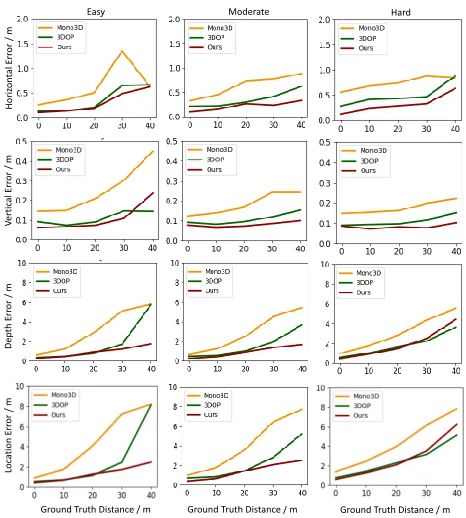
Figure 5: 3D Localization Errors in the horizontal, vertical and depth dimensions according to the distances between objects and camera centers.
Experiment
We evaluate the proposed network on the challenging KITTI dataset (Geiger, Lenz, and Urtasun 2012), which contains 7481 training images and 7518 testing images with cali-brated camera parameters. Detection is evaluated in three regimes: easy, moderate and hard, according to the occlu-sion and truncation levels. We compare our method with the state-of-art monocular 3D detectors, MF3D (Xu and Chen 2018) and Mono3D (Chen et al. 2016). We also present the results of a stereo-based 3D detector 3DOP (Chen et al. 2015) for reference. For a fair comparison, we use the train1/val1 split following the setup in (Chen et al. 2016; 2017), where each set contains half of the images.
Metrics. For evaluating 3D localization performance, we use the mean errors between the central location of pre-dicted 3D bounding boxes and their nearest ground truths. For 3D detection performance, we follow the official settings of KITTI benchmark to evaluate the 3D Average Precision
(AP3D) at different Intersection of Union (IoU) thresholds.
Method Type Time (s) AP3D(IoU=0.3) AP3D(IoU=0.5) AP3D(IoU=0.7)
Easy Moderate Hard Easy Moderate Hard Easy Moderate Hard
3DOP Stereo 4.2 69.79 52.22 49.64 46.04 34.63 30.09 6.55 5.07 4.10
Mono3D Mono 3 28.29 23.21 19.49 25.19 18.20 15.22 2.53 2.31 2.31
MF3D Mono 0.12 / / / 47.88 29.48 26.44 10.53 5.69 5.39
Ours Mono 0.06 72.17 59.57 46.08 50.51 36.97 30.82 13.88 10.19 7.62
Table 1: 3D Detection Performance.Average Precision of 3D bounding boxes on the same KITTI validation set and the
inference time per image. Note that the stereo-based method 3DOP is not compared but listed for reference.
distances grow because far objects presenting small scales are more difficult to learn.
The results indicate that our approach (red curve) outper-forms Mono3D by a significant margin, and is also supe-rior to 3DOP, which requires stereo images as input. An-other finding is that, in general, our model is less sensitive to the distances. When the targets are 30 meters or farther away from the camera, our performance is the most stable, indicating that our network deals with far objects(containing small image regions) best.
Interestingly, horizontal and vertical errors are an order of magnitude smaller than that of depth, i.e., the depth error dominants the overall localization error. This is reasonable because the depth dimension is not directly observed in the 2D image but is reasoned from geometric features. The pro-posed IDE module performs superior to the others for the easy and moderate regimes and comparable to the stereo-based method for the hard regime.
3D Object Detection. 3D detection is evaluated using the
AP3Dat 0.3, 0.5 and 0.7 3D IoU thresholds for the car class.
We compare the performance with two monocular methods, Mono3D and MF3D. The results are reported in Table 1. Since the authors of MF3D have not published their
vali-dation results, we only report the AP3D at 0.5 and 0.7
pre-sented in their paper. Experiments show that our method out-performs the state-of-art monocular detectors mostly and is comparable to the stereo-based method.
Our network is designed for efficient applications and a fast 2D detector with no region proposal is adopted. The in-ference time achieves about 0.06 seconds per image on a Geforce GTX Titan X, which is much less than the other three methods. On the other hand, this design at some de-gree sacrifices the accuracy of 2D detection. Our 2D AP of the moderate regime at 0.7 IoU threshold is 78.14%, about 10% lower than the region proposal based methods that gen-erate a large number of object proposals to recall as many groundtruth as possible. Despite using a relatively weak 2D detector, our 3D detection achieves the state-of-the-art per-formance, resorting to our IDE and 3D localization module. Note that the 2D detection is a replaceable submodule in our network, and is not our main contribution.
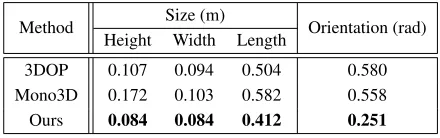
Local 3D Bounding Box Regression. We evaluate the re-gression of local 3D bounding boxes with the size (height, width, length) and orientation metrics. The height, width, length of a 3D bounding box can be easily calculated from
Method Size (m) Orientation (rad)
Height Width Length
3DOP 0.107 0.094 0.504 0.580
Mono3D 0.172 0.103 0.582 0.558
Ours 0.084 0.084 0.412 0.251
Table 2: 3D Bounding Box Parameters Error.
its eight corners. The orientation is measured by the azimuth angles in the camera coordinate frame. We present the mean errors in Table 2. Our network demonstrates a better capa-bility to learn the size and orientation of a 3D bounding box from merely photometric features. It is worth noting that in our local corner regression module, after RoiAlign layers, all the objects of interest are rescaled to the same size to introduce scale-invariance, yet the network still manages to learn their real 3D sizes. This is because our network ex-plores the image features that convey projective geometries and semantic information including types of objects (e.g., SUVs are generally larger than cars) to facilitate the size and orientation estimation.
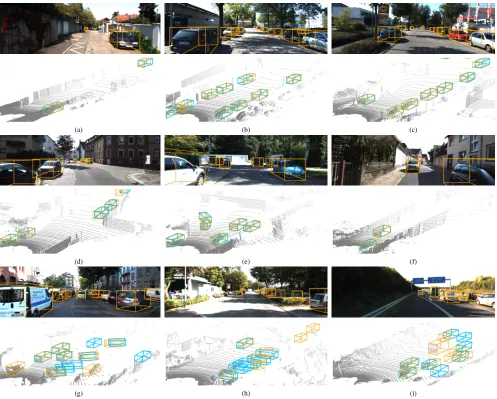
Qualitative Results. Qualitative visualization is provided for three typical situations, shown in Fig. 6. In common street scenes, our predictions are able to successfully recall the targets. It can be observed that even though the vehicles are heavily truncated by image boundaries, our network still outputs precise 3D bounding boxes. Robustness to such a corner case is important in the scenario of autonomous driv-ing to avoid collision with lateral objects. For cases where some vehicles are heavily occluded by others, i.e., in (g), (h) and (i), our 3D detector can handle those visible vehicles but fails in detecting invisible ones. In fact, this is a general lim-itation of perception from monocular RGB images, which can be solved by incorporating 3D data or multi-view data to obtain informative 3D geometric details.
Ablation Study
A crucial step for localizing 3D centerCis estimating its 2D
projectionc, sincecis analytically related toC. Although
the 2D bounding box’s centerbcan be close toc, as is
il-lustrated in Fig. 2 (a), it does not have such 3D significance.
When we replacecwithbin 3D reasoning, the horizontal
(a) (b) (c)
(d) (e) (f)
(g) (h) (i)
Figure 6:Qualitative Results.Predicted 3D bounding boxes are drawn in orange, while ground truths are in blue. Lidar point clouds are plotted for reference but not used in our method. Camera centers are at the bottom-left corner. (a), (b) and (c) are common cases when predictions recall the ground truths, while (d), (e) and (f) demonstrate the capability of our model handling truncated objects outside the image. (g), (h) and (i) show the failed detections when some cars are heavily occluded.
an object is truncated by the image boundaries, its projec-tionccan be outside the image, whilebis always inside. In this case, usingbfor 3D localization can result in a se-vere discrepancy. Therefore, our subnetwork for locating the projected 3D center is indispensable.
In order to examine the effect of coordinate transforma-tion before local corner regression, we directly regress the corners offset in camera coordinates without rotating the axes. It shows that the average orientation error increases from 0.251 to 0.442 radians, while the height, width and length errors of the 3D bounding box almost remain the same. This phenomenon corresponds to our analysis that switching to object coordinates can reduce the rotation am-biguity caused by projection, and thus enables more accurate 3D bounding box estimation.
Conclusion
We have presented the MonoGRNet for 3D object local-ization from a monocular image, which achieves superior performance on 3D detection, localization and pose estima-tion among the state-of-the-art monocular methods. A novel IDE module is proposed to predict precise instance-level depth, avoiding extra computation for pixel-level depth es-timation and center localization, regardless of far distances between objects and camera. Meanwhile, we distinguish the 2D bounding box center and the projection of 3D center for a better geometric reasoning in the 3D localization. The object pose is estimated by regressing corner coordinates in a local coordinate frame that alleviates ambiguities of 3D rotations in perspective transformations. The final unified network in-tegrates all components and performs inference efficiently.
Figure 6:Qualitative Results.Predicted 3D bounding boxes are drawn in orange, while ground truths are in blue. Lidar point
clouds are plotted for reference but not used in our method. Camera centers are at the bottom-left corner. (a), (b) and (c) are common cases when predictions recall the ground truths, while (d), (e) and (f) demonstrate the capability of our model handling truncated objects outside the image. (g), (h) and (i) show the failed detections when some cars are heavily occluded.
an object is truncated by the image boundaries, its
projec-tionccan be outside the image, whilebis always inside.
In this case, usingbfor 3D localization can result in a
se-vere discrepancy. Therefore, our subnetwork for locating the projected 3D center is indispensable.
In order to examine the effect of coordinate transforma-tion before local corner regression, we directly regress the corners offset in camera coordinates without rotating the axes. It shows that the average orientation error increases from 0.251 to 0.442 radians, while the height, width and length errors of the 3D bounding box almost remain the same. This phenomenon corresponds to our analysis that switching to object coordinates can reduce the rotation am-biguity caused by projection, and thus enables more accurate 3D bounding box estimation.
Conclusion
References
Chabot, F.; Chaouch, M.; Rabarisoa, J.; Teuli`ere, C.; and Chateau, T. 2017. Deep manta: A coarse-to-fine many-task network for joint 2d and 3d vehicle analysis from monocular
image. InComputer Vision and Pattern Recognit.(CVPR),
2040–2049.
Chen, X.; Kundu, K.; Zhu, Y.; Berneshawi, A. G.; Ma, H.; Fidler, S.; and Urtasun, R. 2015. 3d object proposals for
accurate object class detection. InAdvances in Neural
In-formation Processing Systems, 424–432.
Chen, X.; Kundu, K.; Zhang, Z.; Ma, H.; Fidler, S.; and Urtasun, R. 2016. Monocular 3d object detection for
au-tonomous driving. InConference on Computer Vision and
Pattern Recognition (CVPR), 2147–2156.
Chen, X.; Ma, H.; Wan, J.; Li, B.; and Xia, T. 2017. Multi-view 3d object detection network for autonomous driving. InIEEE CVPR, volume 1, 3.
Eigen, D., and Fergus, R. 2015. Predicting depth, sur-face normals and semantic labels with a common multi-scale
convolutional architecture. InProceedings of the IEEE
In-ternational Conference on Computer Vision, 2650–2658.
Fu, C.-Y.; Liu, W.; Ranga, A.; Tyagi, A.; and Berg, A. C.
2017. Dssd: Deconvolutional single shot detector. arXiv
preprint arXiv:1701.06659.
Fu, H.; Gong, M.; Wang, C.; Batmanghelich, K.; and Tao, D. 2018. Deep ordinal regression network for monocular
depth estimation. InComputer Vision and Pattern
Recogni-tion (CVPR).
Gao, Z.; Wang, Y.; He, X.; and Zhang, H. 2018. Group-pair convolutional neural networks for multi-view based 3d
object retrieval. InThe Thirty-Second AAAI Conference on
Artificial Intelligence (AAAI-18).
Geiger, A.; Lenz, P.; and Urtasun, R. 2012. Are we ready for autonomous driving? the kitti vision benchmark suite. In
Computer Vision and Pattern Recognition (CVPR), 3354–
3361. IEEE.
Girshick, R. 2015. Fast r-cnn. InProceedings of the IEEE
international conference on computer vision, 1440–1448.
Guizilini, V., and Ramos, F. 2018. Iterative continuous con-volution for 3d template matching and global localization. InThe Thirty-Second AAAI Conference on Artificial Intelli-gence (AAAI-18).
He, K.; Gkioxari, G.; Doll´ar, P.; and Girshick, R. 2017.
Mask r-cnn.arXiv preprint arXiv:1703.06870.
Kehl, W.; Manhardt, F.; Tombari, F.; Ilic, S.; and Navab, N. 2017. Ssd-6d: Making rgb-based 3d detection and 6d pose
estimation great again. InProceedings of the International
Conference on Computer Vision (ICCV 2017), Venice, Italy,
22–29.
Kingma, D. P., and Ba, J. 2015. Adam: A method for
stochastic optimization. In International Conference for
Learning Representations.
Liu, J.; Wang, J.; Fang, T.; Tai, C.-L.; and Quan, L. 2015. Higher-order crf structural segmentation of 3d reconstructed
surfaces. InIEEE International Conference on Computer
Vision.
Liu, W.; Anguelov, D.; Erhan, D.; Szegedy, C.; Reed, S.; Fu, C.-Y.; and Berg, A. C. 2016. Ssd: Single shot multibox
de-tector. InEuropean conference on computer vision (ECCV),
21–37. Springer.
Mahjourian, R.; Wicke, M.; and Angelova, A. 2018. Unsu-pervised learning of depth and ego-motion from monocular
video using 3d geometric constraints. InProceedings of the
IEEE Conference on Computer Vision and Pattern
Recogni-tion, 5667–5675.
Matthew, D. Z., and Rob, F. 2014. Visualizing and
under-standing convolutional networks. In European Conference
on Computer Vision, 818–833.
Mousavian, A.; Anguelov, D.; Flynn, J.; and Koˇseck´a, J. 2017. 3d bounding box estimation using deep learning
and geometry. InComputer Vision and Pattern Recognition
(CVPR), 5632–5640. IEEE.
Qi, C. R.; Liu, W.; Wu, C.; Su, H.; and Guibas, L. J. 2017. Frustum pointnets for 3d object detection from rgb-d data.
arXiv preprint arXiv:1711.08488.
Redmon, J., and Farhadi, A. 2017. Yolo9000: Better,
faster, stronger. In Computer Vision and Pattern
Recogni-tion (CVPR), 6517–6525. IEEE.
Redmon, J.; Divvala, S.; Girshick, R.; and Farhadi, A. 2016. You only look once: Unified, real-time object detection. In
Proceedings of the IEEE conference on computer vision and pattern recognition, 779–788.
Ren, S.; He, K.; Girshick, R.; and Sun, J. 2017. Faster r-cnn: towards real-time object detection with region proposal
net-works. IEEE Transactions on Pattern Analysis & Machine
Intelligence.
Song, S., and Xiao, J. 2016. Deep sliding shapes for amodal
3d object detection in rgb-d images. InThe IEEE
Confer-ence on Computer Vision and Pattern Recognition (CVPR).
Teichmann, M.; Weber, M.; Zoellner, M.; Cipolla, R.;
and Urtasun, R. 2016. Multinet: Real-time joint
se-mantic reasoning for autonomous driving. arXiv preprint
arXiv:1612.07695.
Wang, J.; Fang, T.; Su, Q.; Zhu, S.; Liu, J.; Cai, S.; Tai, C.-L.; and Quan, L. Image-based building regularization using
structural linear features. IEEE Transactions on
Visualiza-tion Computer Graphics.
Xu, B., and Chen, Z. 2018. Multi-level fusion based 3d
ob-ject detection from monocular images. InComputer Vision
and Pattern Recognition (CVPR), 2345–2353.
Xu, C.; Leng, B.; Zhang, C.; and Zhou, X. 2018. Emphasiz-ing 3d properties in recurrent multi-view aggregation for 3d
shape retrieval. InThe Thirty-Second AAAI Conference on
Artificial Intelligence (AAAI-18).
Zhuo, W.; Salzmann, M.; He, X.; and Liu, M. 2018. 3d box proposals from a single monocular image of an indoor
scene. InThe Thirty-Second AAAI Conference on Artificial