The Thirty-Third AAAI Conference on Artificial Intelligence (AAAI-19)
Segregated Temporal Assembly Recurrent
Networks for Weakly Supervised Multiple Action Detection
Yunlu Xu,
1∗Chengwei Zhang,
2∗Zhanzhan Cheng,
13†Jianwen Xie,
1Yi Niu,
1Shiliang Pu,
1Fei Wu
31Hikvision Research Institute, China;2Shanghai Jiaotong University, China;3Zhejiang University, China
{xuyunlu,chengzhanzhan,jianwen.xie,niuyi,pushiliang}@hikvision.com; [email protected]; [email protected]
Abstract
This paper proposes a segregated temporal assembly recur-rent (STAR) network for weakly-supervised multiple action detection. The model learns from untrimmed videos with only supervision of video-level labels and makes prediction of intervals of multiple actions. Specifically, we first assem-ble video clips according to class labels by an attention mech-anism that learns class-variable attention weights and thus helps the noise relieving from background or other actions. Secondly, we build temporal relationship between actions by feeding the assembled features into an enhanced recurrent neural network. Finally, we transform the output of recurrent neural network into the corresponding action distribution. In order to generate more precise temporal proposals, we design a score term called segregated temporal gradient-weighted class activation mapping (ST-GradCAM) fused with attention weights. Experiments on THUMOS’14 and ActivityNet1.3 datasets show that our approach outperforms the state-of-the-art weakly-supervised method, and performs at par with the fully-supervised counterparts.
1
Introduction
Multiple action detection, which aims at localizing tem-poral intervals of actions and simultaneously identifying their categories in videos, is a fundamental problem in video understanding. Many existing works (Shou, Wang, and Chang 2016; Zhao et al. 2017; Shou et al. 2017; Xu, Das, and Saenko 2017; Yang et al. 2018; Chao et al. 2018; Lin et al. 2018; Alwassel, Caba Heilbron, and Ghanem 2018) make efforts to address this problem in a supervised manner, where the algorithms rely on fully labeled data (i.e., videos with precise annotations of the starting and ending frames of actions). However, such supervised methods are prohibitively impractical in real applications, since frame-level annotations are substantially time-consuming and ex-pensive. Therefore, learning to detect temporal action from untrimmed videos remains a crucial and challenging prob-lem in video understanding.
A few explorations based solely on video-level annota-tions have exemplified the weakly supervised temporal
ac-∗
Authors contribute equally. Zhang did this work during an in-ternship in Hikvision Research Institute.
†
Corresponding author.
Copyright c2019, Association for the Advancement of Artificial Intelligence (www.aaai.org). All rights reserved.
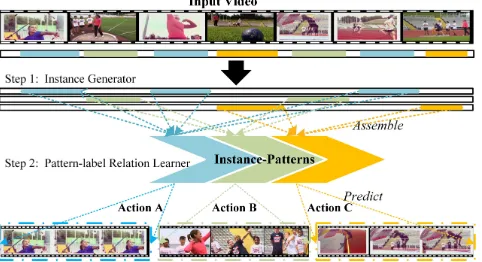
Figure 1: An illustration of the multiple action detection task from the perspective of MIML.
tion detection. UntrimmedNet (Wang et al. 2017) proposes to learn a selection module for detecting important seg-ments, and later STPN (Nguyen et al. 2018) conquers the single-label limitation by introducing temporal class activa-tion maps (T-CAM) trained with cross-entropy loss. To ad-dress the issue that performing localization via thresholds may not be robust to noises in class activation maps, Au-toLoc (Shou et al. 2018) directly predicts temporal bound-ary and proposes a Outer-Inner-Contrastive loss to provide the desired segment-level supervision. W-TALC (Paul et al. 2018) introduces the Co-Activity Similarity Loss and jointly optimizes it with the cross-entropy loss for the weakly-supervised temporal action detection. However, the interfer-ence and relationship among actions in a video hitherto have not been concerned.
In reality, a video in general describes multiple actions occurring in a complex background. Intuitively, a desired video descriptor should have two characteristics: (1) refrain-ing from the interference of other unrelated actions or back-ground, and (2) enhancing the correlation among actions.
labels (i.e., action categories). Correspondingly, we address the weakly supervised action detection task in the following two steps. Step 1: Action assembling for multi-instance pat-tern generation. In order to eliminate interference from unre-lated actions or complex background, we generate instance-patterns for each type of action via an action selector. As shown in Figure 1, three intervals of Action-A (denoted in blue) are selected and integrated as an assembled fea-ture representation Instance-pattern-A. By this way, each instance-pattern is mapped from the corresponding type of action in the input video. Step 2: Relation learning for label generation. With assembled patterns, the corresponding in-stances can be directly predicted, but some correlation (e.g., CricketShotalways co-occurs withCricketBowling) gener-ally exists in the case of multiple actions in a video. There-fore, we learn the implicit relationship between different in-stances by adopting a recurrent neural network (Hochreiter and Schmidhuber 1997). Furthermore, the corresponding in-stance proposals can be activated from the learned class-variable weights.
More specifically, we propose a weakly-supervised framework for multiple temporal action detection called
Segregated Temporal Assembly Recurrent (abbr. STAR) network. Firstly, we construct a well-designed attention module to learn the action assembly weights for integrat-ing the encoded segmented features into correspondintegrat-ing instance-patterns. Then we learn the relationship between instances by adopting an enhanced recurrent neural network (RNN) for action label generating. We also involves a rep-etition align mechanism in RNN for adaptively adjusting the attention weights to generate finer action proposals. Fi-nally, we design an operation term called segregated tempo-ral Gradient-CAM (ST-GradCAM), which is an extension of Gradient-CAM (Selvaraju et al. 2017), to indicate feature significance for a specific action category. We fuse the re-sponse of ST-GradCAM with the learned assembly weights for the purpose of action localization.
The contributions of our paper are four-fold: (1) We re-formulate the multiple action detection from a MIML per-spective, i.e., extracting instance-patterns and generating ac-tion labels, which eliminates interference among unrelated action features and captures temporal dependency between multiple concurrent actions. (2) An end-to-end framework called STAR, which includes a well-designed attention mod-ule and an enhanced RNN, is developed to be trained in a weakly supervised manner from videos with only video-level labels. (3) We design an ST-GradCAM operation fused with class-variable assembly weights for action temporal lo-calization. (4) Experiments demonstrate that our weakly su-pervised framework achieves impressive performance on the challenging THUMOS’14 (Jiang et al. 2014) and Activi-tyNet1.3 (Heilbron et al. 2015) datasets for action detection, comparable with those of supervised learning methods.
2
Related Work
Action Recognition.The task of action recognition seeks to identify a single or multiple action labels for each video and is often treated as a classification problem. Before the era of deep learning, hand-crafted features, such as the improved
dense trajectories (Wang and Schmid 2013), obtained out-standing performance on many benchmark datasets. Re-cently, there have been vast works on action recognition using convolutional neural networks (CNN). For example, a 2D CNN for large-scale video classification was first in-vestigated in (Karpathy et al. 2014), but has not achieved comparable performance with hand-crafted features. Two-stream (Simonyan and Zisserman 2014) and C3D (Tran et al. 2015; 2018; Carreira and Zisserman 2017) networks are recent mainstreams to learn discriminative features for ac-tion recogniac-tion. The incepac-tion 3D (I3D) (Carreira and Zis-serman 2017) is a two-stream network based on a 3D ver-sion of Inception network (Ioffe and Szegedy 2015), which is commonly used as a feature encoder for action localiza-tion (Nguyen et al. 2018) and dense-labeling videos (Pier-giovanni and Ryoo 2018).
Fully Supervised Action Detection.Different from action recognition, action detection aims to identify the temporal intervals containing target actions. Most existing works fo-cus on fully-supervised approaches for that. To capture ro-bust video feature representation, S-CNN (Shou, Wang, and Chang 2016) uses a multi-stage CNN for temporal action localization. SSN (Zhao et al. 2017) introduces structured temporal pyramids with decoupled classifiers for classifying actions and determining completeness. For precise bound-aries, the Convolutional-De-Convolutional (CDC) network (Shou et al. 2017) and the Temporal Preservation Convolu-tional (TPC) network (Yang et al. 2018) are proposed for frame-level action predictions. Boundary Sensitive network (BSN) (Lin et al. 2018) is recently proposed to locate tempo-ral boundaries which are further integrated into action pro-posals. Furthermore, some region-based methods, e.g., R-C3D (Xu, Das, and Saenko 2017) and TAL-Net (Chao et al. 2018), propose to generalize the methods for 2D spatial de-tection to 1D temporal localization.
Weakly Supervised Action Detection.Action detection in a weakly supervised fashion has been studied by only a few works. UntrimmedNet (Wang et al. 2017) is an end-to-end model for learning single-label action classification and ac-tion detecac-tions. Hide-and-seek (Singh and Yong 2017) tries to force the model to see different parts of the image and focus on multiple relevant parts of the object beyond just the most discriminative one by randomly masking different regions of training images in each training epoch. Such a method works well for spatial object detection but is unsat-isfied for the temporal action detection. STPN(Nguyen et al. 2018) adopts an attention module to identify a sparse subset of key segments associated with target actions in a video, and fuse the key segments via adaptive temporal pooling. The latest work (Shou et al. 2018) and (Paul et al. 2018) boost the STPN by introducing novel objective functions to separately tune coarse action boundaries and unearth co-activity relationship between videos.
(MIML) (Zhou et al. 2008) framework, where an example is described by multiple instances and associated with multi-ple class labels, has been applied to different tasks, such as multi-label image classification (Wang et al. 2016), image retrieval (Zhang et al. 2018), object detection and semantic segmentation (Wei et al. 2017; Ge, Yang, and Yu 2018), and sound separation (Gao, Feris, and Grauman 2018). Our pa-per generalizes this framework to the action detection task where a video contains multiple actions and is associated with multiple video-level classes.
3
Segregated Temporal Assembly Network
The framework of STAR, which is shown in Figure 2, con-sists of three components: (1) a pre-trained feature extractor for encoding a video into a sequence of segmental feature vectors, (2) an end-to-end trainable architecture that we call segregated temporal assembly network, including an action assembler and a label generator, and (3) a well-designed ac-tion localizor for acac-tion locaac-tion. In the following, we first present the architecture of the proposed STAR in Section 3.1; Then a well-designed action proposal mechanism is de-scribed in Section 3.2; Finally, the training strategy of the whole network is given inSection 3.3.3.1
Action Assembly and Label Generation
Stem Architecture GivenN segments ofK-dimensional feature vectors S={s1, s2, . . . , sN} ∈ RK×N, which are
extracted from a video V by a pre-trained feature extrac-tor, we first assemble actions fromS into instance-patterns
X={x1, x2, . . . , xT} ∈ RK×T, whereT is the number of
assembly actions inV. Then we use an RNN to build relation between the assembled actions inX, and further generate the action labelsyifrom a label setY = {y1, y2, . . . , yT}
one-by-one. Concretely, we first assemble actions into a spe-cific instance-pattern at timetby
xt= N
X
i=1
αt,isi, (1)
whereα is the learnt attending assembly weights overS. Generally,α is calculated by simultaneously referring the last hidden states of RNN and glimpsing the whole inputS
(Chorowski et al. 2015). Correspondingly, we first evaluate the energy stateeoverSby
et,i=vαϕ(Wαht−1+Uαsi), (2)
whereht−1is the hidden state of RNN at timet-1; Then the energy state is further normalized by
αt,i=σ(et,i), (3)
whereϕandσare the activation functiontanhandsigmoid
respectively, andWα,Uα andvαare learnable parameters.
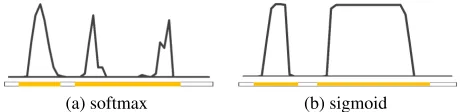
Note that, the conventional attention mechanism (Chorowski et al. 2015) usessoftmax function to normalize the energy distribution, which results in failures to capture those long or high-frequency actions. Instead ofsoftmax, we adopt the bounded logistic sigmoid activation function σon the en-ergy distribution to deal with this issue. Figure 3 illustrates a comparison of effects of different activation functions.
After assembling actions fromS toX, we use the RNN to build relation between instance-patterns inXby
ht=RN N(ht−1, yt−1, xt), (4)
where RNN is specified as the popular relation learning model long short-term memory (LSTM) (Hochreiter and Schmidhuber 1997). Then we further output the action prob-ability distribution by
yt=sof tmax(Woht), (5)
whereWois the learnt parameters.
Though the above process, denoted as the naive stem net-work, can generate action labels to a certain extent, it is still unsatisfactory to handle complicated video action tasks due to the following three key factors:
1. Attending repetition: Repetition of attending regions is a common problem for sequence-to-sequence models (Tu et al. 2016) and is especially pronounced when generat-ing multiple instance-patterns (seeRaw Attentionin Fig-ure 4), which goes against the purity of single pattern.
2. Co-occurrence: Unlike usual sequential applications (e.g., text reading, speech recognition, translation etc.), co-occurrence is universal in videos (e.g., CricketBowl-ingandCricketShotalways appear successively and have overlapping), which increases the challenge of video tasks.
3. Trivial action missing: Some repetitive but inapparent action features are usually shielded by the correspond-ing prominent representative patterns due to the lack of frame-level annotations, leading to failures of trivial ac-tion detecac-tion.
Permissive Coverage Constraint For Attending repeti-tion, coverage mechanism (Tu et al. 2016) has been in-troduced to minimize the overlapping of attention weights across time steps, assuming that once given high score-weight in one step, the input vector must not be focused in the future steps. However, shown asOriginal Coveragein Figure 4, conventional coverage mechanism strictly forbids focus on the same place, which is not suitable for video task because of actionco-occurrencesphenomenon. Instead, we design an action-friendlypermissive coverageconstraints on the weights, in which values of a certain step not only are constraint to the previous weights, but also refer to the last hidden state, which is shown asPermissive Coveragein Fig-ure 4. Specifically, we rewrite the coverage score att-th step for segmentsias
COVt,i=f(ht−1, αt−1,i)
=σ[Zi(i− N
X
k=1
αt−1,kk) +Wαht−1], (6)
whereZiis the corresponding learnable parameter, andfis a
nonlinear activation function composed of a MLP structure and thesigmoidactivation. TheCOVt,isimultaneously
Figure 2: The workflow of the STAR framework. (a) The input video; (b) A pre-trained video encoder for segmental feature extraction; (c) An action assembler for generating instance-patterns, in which stage attention weights are trained with well-designed sub-modules (e.g., RAM); (d) A LSTM-based network for action label generation ; (e) A localizer for locating actions from input video, only used for inference without any training.
(a) softmax (b) sigmoid
Figure 3: Effects of different normalization functions on en-ergy distribution for attending actions. Horizontal and ver-tical axes separately represent time and energy score. The ground truth of the action regions is represented by a bar, with yellow color indicating action occurrence.
Then we put the coverage term into the attending mecha-nism by rewriting Equation 2 as
ˆ
et,i=vα[COVt,iϕ(Wαht−1+Uαsi)], (7)
where COVt,i can be considered as a soft gating value
within the range of [0,1].
Repetition Alignment Mechanism For trivial action missing, we propose a repetition alignment module (RAM) to calculate the frequency of single-instance occurring in each video, which heuristically tunes the action proposal generation. Namely, RAM not only manifests trivial actions occurring, but also restrains the unrelated time segments. The RAM att-th step is calculated by
RAMt=Wr N
X
i=1
σ(ˆet,i), (8)
whereWr is the learned parameters.RAMt is supervised
with the number of corresponding action frequency. Then we further involve this term into the RNN structures for en-hancing the pattern-label relation learning. Thus Equation 4 is extended as
ht=RN N(ht−1, yt−1, xt, RAMt). (9)
Figure 4: Attending weights distribution in different cov-eragemechanisms. Horizontal and vertical axes separately stand for time and energy score. Theblackandorangebars refer to the ground truth of two different actions. Curves in
blackandorangeare corresponding to the energy distribu-tions in two steps.
Note that, counting the occurrence of each action category need neither the frame-level information nor precise time locations. RAM is an effective and flexible assistant sub-module in the whole action assembly generation.
3.2
Action Proposal Generation
The Class Activation Mapping (CAM) (Zhou et al. 2016) is useful for action localization, and also has been applied in the previous work (Nguyen et al. 2018). However, CAM is only designed for linear architectures, and not suitable for nonlinear architectures, such as RNN. While Gradient-CAM (Grad-Gradient-CAM) (Selvaraju et al. 2017) is applicable to any differentiable architecture even with activations. In this work, we adopt a more general Grad-CAM to calculate class response for our task, termed as Segregated Temporal Gradient-weighted Class Activation Map (ST-GradCAM).
distribu-tion for a classcbefore thesoftmax) is represented by
dct=
K
X
k=1
wct,kxkt, (10)
wherewc
t,k is the importance of thek-th feature value x k t
for a target class c, which is represented by the following gradient score
wct,k =∂d
c t ∂xk t = ∂d c t ∂hct
· ∂h
c t ∂xk t
=Wo·
∂RN N(xt) ∂xk
t
, (11)
wherehc
tis the importance ofhtfor the target classc. Since
the attention weights possess rich information regarding ac-tion intervals (Wang et al. 2017; Nguyen et al. 2018), we formulate Equation 10 as
dct=
K
X
k=1 wct,k(
N
X
i=1
αt,iski) = N X i=1 αt,i K X k=1
wct,kski, (12)
wheresk
i is thekthfeature valueski insi.
Since dct indicates the importance of representations to
each class at recurrent stept, a class-aware activation map can be derived from above. We define ST-GradCAM as
ξt,ic =
K
X
k=1
wt,kc ski, (13)
whereiindexes the segment in S. ST-GradCAM captures the important local information of feature mapkfor a target classcat recurrent stept.
To generate temporal action proposals, we train a two-stream network and derive the attended ST-GradCAM att -th step usingαt,i·σ(ξt,ic ). For each classcat the recurrent
stept, each proposal [Nstart, Nend] is assigned a score by:
Nend
X
i=Nstart [λ·αc
t,i,RGB+ (1−λ)·αct,i,f low] Nend−Nstart+ 1
·σ(ξt,ic ), (14)
where we fuse the attention values of RGB and optical flow streams by the modality ratioλ(λ = 0.5 by default) first, and then generate proposals based on RGB and flow sepa-rately. For final detection, we perform non-maximum sup-pression (NMS) among temporal proposals of each class by removing highly overlapped ones.
3.3
Network Training
The training objective of the STAR network is to solve a multi-task optimization problem. The overall loss function consists of four terms: the classification loss, coverage loss, repetition alignment loss and sparsity loss,
L=Lclass+βLsparsity+γLcov+δLram, (15)
whereγ,δandβare the hyper-parameters.
Given encoded segment inputsS,classification lossis de-fined as the softmax loss over multiple categories by
Lclass=−
1 M M X i=1 T X t=1
logPi(ˆyt|S, θ), (16)
whereM,yˆtandθrepresent the number of training videos,
the ground truth of thet-th action category, and all the train-able parameters respectively.Pi is the multinomial logistic
regression (a probability density over all action categories). The coverage lossis to overcome the common laziness
of learning problems and thus to put emphasis on different action segments, which is computed by
Lcov =max(0, N X i=1 ( i X k=1 αt,k−
i
X
k=1
αt−1,k)). (17)
The RAM loss is designed to relieve the trivial action missingproblem by checking the repetition number, which adopts the L2 loss and is defined as
Lram=
1 2T
T
X
t=1
||ct−RAMt||22, (18)
wherectis the ground-truth of thet-th action frequency.
Thesparsity lossLsparisityis the L1 regularization on the
attention weights, i.e.,||α||1.
4
Experiments
We evaluate our proposed framework (STAR) with mean av-erage precision (mAP) score on two benchmarks for tempo-ral action detection, i.e., THUMOS’14 (Jiang et al. 2014) and ActivityNet1.3 (Heilbron et al. 2015). Following the routine evaluation protocol in (Nguyen et al. 2018), our method outperforms existing weakly-supervised methods.
4.1
Implementation Details
Datasets. THUMOS’14, extracted from over 20 hours of sport videos, consists of 20 action classes. It contains 200 videos from validation set for training, and 212 videos for testing. This dataset is challenging for temporal detection because (1) averagely, each video contains more than 15 oc-currences of all actions, (2) the length of an action varies significantly (e.g., from less than one second to over 26 min-utes), and (3) averagely, each video is with about 71% back-ground. It is a good benchmark for multiple action detection.
ActivityNet1.3contains 200 activity categories, in which 10,024 videos are used for training, 4,926 for validation, and 5,044 for testing.ActivityNet1.3only contains 1.5 occur-rences per video on average and most videos simply contain single action category with averagely 36% background.
Testing Details. We retrieve one-dimensional temporal proposals from the predicted label distributiondbased on the outputs of the two-streams network. As the two streams have similar classification performance, we set a modality ratio of 1:1 (RGB:flow) as classification confidence scores and make the prediction jointly. Then we exploit Equation 14 to output the action proposals.
4.2
Ablation Study
To analyze the contributions of several different compo-nents of STAR, we conduct the ablation study on the THU-MOS’14 dataset. Performance is evaluated with average mAP (%) by calculating the multiple overlap IoU with thresholds varying from 0.1 to 0.5.
Effects of architecture modules We investigate modules includingcoverageconstraints (COV),sparsity(SP A), and
RAMwithstemnetwork of STAR. Table 1 shows the effects of each module and their combinations.
• Stem network. It serves as our baseline model.
• Stem with one module. In overall, each single module can improve the stem structure by 3%-5%. Interestingly, both(SP A)and(RAM)are constraints on the frequency and extent of attended weights, and though by different means, they obtain similar performance alone, better than (COV). We can infer that direct penalty of occurrence is more effective than the handling of action co-occurrence.
• Stem with two modules. RAM with eithersparsityor cov-eragecan achieve better performance than other compo-nents, which indicates that additional repetition informa-tion is very useful. (SP A, COV) is unsatisfying com-pared to other module combinations, even worse than (SP A)solely. We analyze the reason that both of them re-strains the extents of attended weights, but(RAM)aligns the extents by zooming in and out. So combinations with (RAM)achieve steady improvements, while the combi-nation without(RAM)tends to suppress excessively.
• Stem with all modules. STAR with all modules achieves the best performance which improve thestemby 8%.
Table 1: Performance evaluation with different modules of STAR on THUMOS’14.
Stem √ √ √ √ √ √ √ √
Sparsity √ √ √ √
Coverage √ √ √ √
RAM √ √ √ √
Ave-mAP(%) 39.0 43.8 42.4 43.8 43.3 44.0 44.7 47.0
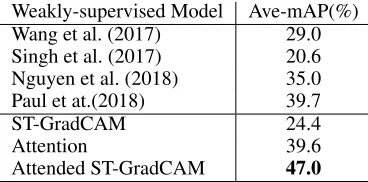
Effects of detection operations As introduced in Equa-tion 12, ST-GradCAM and the learnedassembly weightsare respectively responsible for indication of class-specific con-tribution and input segmented duration. Since the learned attention weights are sensitive to action classes, we can al-ternatively use only attention weights without ST-GradCAM to propose locations of each class, termed byAttention. Sim-ilarly, the location of each class also can be proposed based
Table 2: Effects of different modules on THUMOS’14.
Weakly-supervised Model Ave-mAP(%)
Wang et al. (2017) 29.0
Singh et al. (2017) 20.6
Nguyen et al. (2018) 35.0
Paul et at.(2018) 39.7
ST-GradCAM 24.4
Attention 39.6
Attended ST-GradCAM 47.0
on only ST-GradCAM without attention weights,(i.e., ST-GradCAM). We also integrate both learned attention weights and ST-GradCAM as a fused action detector, denoted by At-tended ST-GradCAM(used by default in our work).
Table 2 gives the results. We find thatAttentionalready has achieved comparable performance to previous methods, implying that the learned attention weights themselves con-tain rich location information and play important roles in the entire detection process. As expected, theAttended ST-GradCAM significantly outperforms each single term (i.e,
AttentionandST-GradCAM), which demonstrates the effec-tiveness of the STAR scoring mechanism (in Equation 10).
4.3
Qualitative Evaluation
STAR can iteratively segregate different actions from the origin input video segments, then assemble the correspond-ing actions into a target action-patterns. For further demon-strating the performance of STAR, we qualitatively analyze the effects of STAR from different aspects as follows:
• Effect of Attention: The learnt assembly weights are used to assemble actions into the corresponding instance-patterns so that the weights are capable of indicating action locations (e.g., see intervals [16.0s,17.6s] and [17.6s,18.1s]in Figure 5), in consonance with the perfor-mance in subsectionablation study. However, it still suf-fers from ambiguous boundaries of actions (e.g.see time 48.4sor85.6sin Figure 5).
• Effect of Attended ST-GradCAM: Considering the re-sponse mechanism of ST-GradCAM, the Attended ST-GradCAMcan achieve more precise action location than
Attention(e.g.at time85.6sor103.7sin Figure 5).
• False Positive Analysis: We also analyze the false posi-tives, and find that those falsely detected image frames usually bear high similarities to the annotations, (e.g. ac-tions before time 84.9s or after time86.4sin Figure 5) and are even ambiguous to human beings.
Figure 5: An example for action localization on THUMOS’14, which contains two actions (CricketBowlingdenoted and Crick-etShot). The video is segregated into two assemblies (TimeStep1 and TimeStep2) step-by-step.
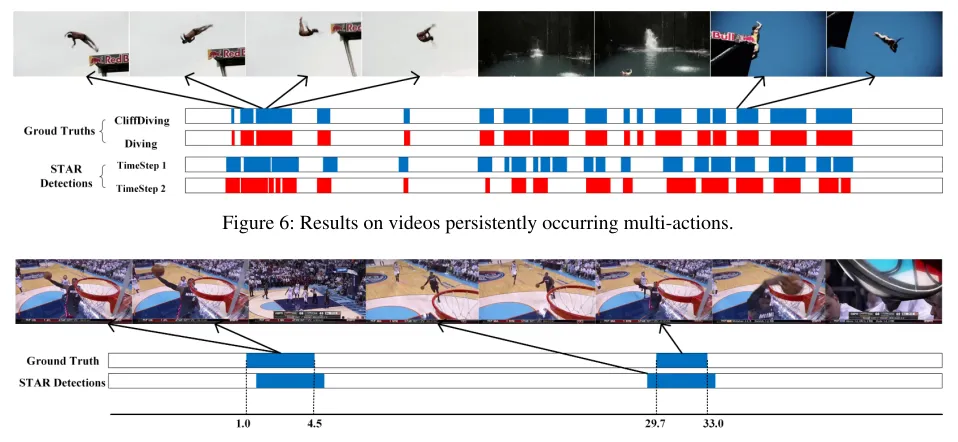
Figure 6: Results on videos persistently occurring multi-actions.
Figure 7: Results on videos with sparse single-actions.
sparse or dense action occurrence. Figure 6 and 7 display the action detection results ondenseandsparsesituations respectively, which further demonstrate the robustness of our method. We also report the performances in terms of Ave-mAP with different densities of occurring actions in videos, which is shown in Figure 8. The results show that STAR maintains high performances under different levels of action occurring density.
4.4
State-of-the-Art Comparisons
We compare STAR with state-of-the-art weakly-supervised and fully-supervised methods on THUMOS’14 and Activi-tyNet1.3 datasets. Note that, THUMOS’14 is a better bench-mark for evaluating our method, as addressed inDatasets
section. Table 3 and 4 summarize the results.
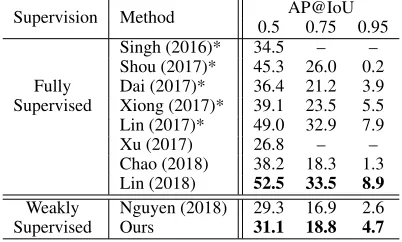
Comparison with weakly supervised methods. It is shown that STAR outperforms all other weakly supervised meth-ods by a remarkably large margin, improving the reported highest average mAP about 7% by 47.0% on THUMOS’14
and 2% by 18.1% on ActivityNet1.3. Note that, on THU-MOS’14, our model achieves more than 10% higher than existing methods on both IoU 0.1 and 0.2. This verifies the superiority of our framework.
sophisti-Figure 8: The performance (mAP) with varying actiondensityvalues on THUMOS’14. The horizontal, left-vertical and right-vertical axes separately represent the density of action occurring, the mAP and the frequency of action occurring. Three curves describe the mAP performances with IoU 0.1 and IoU 0.5, and the average IoU over 5 thresholds within[0.1,0.5]. The colored (denoted as different type of actions) histogram refers to the frequency of corresponding actions occurring at the specific density.
Table 3: Comparison with state-of-the-arts on THUMOS’14.
Supervision Method AP@IoU
0.1 0.2 0.3 0.4 0.5
Fully Supervised
Richard (2016) 39.7 35.7 30.0 23.2 15.2 Shou (2016) 47.7 43.5 36.3 28.7 19.0 Yeung (2016) 48.9 44.0 36.0 26.4 17.1 Yuan (2016) 51.4 42.6 33.6 26.1 18.8
Shou (2017) – – 40.1 29.4 23.3
Yuan (2017) 51.0 45.2 36.5 27.8 17.8 Gao (2017) 54.0 50.9 44.1 34.9 25.6 Xu (2017) 54.5 51.5 44.8 35.6 28.9 Zhao (2017) 66.0 59.4 51.9 41.0 29.8 Lin (2017) 50.1 47.8 43.0 35.0 24.6
Yang (2018) – – 44.1 37.1 28.2
Chao (2018) 59.8 57.1 53.2 48.5 42.8 Alwasssel (2018) 49.6 44.3 38.1 28.4 19.8
Lin (2018) – – 53.5 45.0 36.9
Weakly Supervised
Wang (2017) 44.4 37.7 28.2 21.1 13.7 Singh (2017) 36.4 27.8 19.5 12.7 6.8 Nguyen (2018) 52.0 44.7 35.5 25.8 16.9
Shou (2018) – – 35.8 29.0 21.2
Paul (2018) 55.2 49.6 40.1 31.1 22.8
Ours 68.8 60.0 48.7 34.7 23.0
cated multi-stage training strategy. In conclusion, STAR sur-passes all the reported weakly-supervised methods on both two benchmarks. Although fully-supervised approaches still have good results at large IoU thresholds, STAR signifi-cantly narrows down the gap between the fully and weakly supervised methods.
5
Conclusion
We propose an end-to-end weakly supervised framework STAR for action detection in MIML perspective. The model first assembles actions into corresponding instance-patterns with a well-designed attention mechanism, and then learns the temporal relationship between multiple instance-patterns by using RNN. Finally, with the predicted action labels and the learned attention weights, we use a well designed ST-GradCAM for localizing each action. Experiments show that our approach outperforms all the reported results by weakly
Table 4: A comparison on ActivityNet v1.3 validation set. The sign (*) indicates results from ActivityNet Challenge.
Supervision Method AP@IoU 0.5 0.75 0.95
Fully Supervised
Singh (2016)* 34.5 – – Shou (2017)* 45.3 26.0 0.2 Dai (2017)* 36.4 21.2 3.9 Xiong (2017)* 39.1 23.5 5.5 Lin (2017)* 49.0 32.9 7.9
Xu (2017) 26.8 – –
Chao (2018) 38.2 18.3 1.3 Lin (2018) 52.5 33.5 8.9 Weakly
Supervised
Nguyen (2018) 29.3 16.9 2.6
Ours 31.1 18.8 4.7
supervised approaches by a large margin, and also achieves comparable performance with those fully supervised meth-ods on both THUMOS’14 and ActivityNet1.3 datasets.
References
Alwassel, H.; Caba Heilbron, F.; and Ghanem, B. 2018. Ac-tion Search: Spotting AcAc-tions in Videos and Its ApplicaAc-tion to Temporal Action Localization. InECCV, 251–266.
Carreira, J., and Zisserman, A. 2017. Quo Vadis, Action Recog-nition? A New Model and the Kinetics Dataset. InCVPR, 4724– 4733.
Chao, Y. W.; Vijayanarasimhan, S.; Seybold, B.; Ross, D. A.; Deng, J.; and Sukthankar, R. 2018. Rethinking the Faster R-CNN Architecture for Temporal Action Localization. InCVPR, 2933–2942.
Chorowski, J.; Bahdanau, D.; Serdyuk, D.; Cho, K.; and Bengio, Y. 2015. Attention-based models for speech recognition. In
NIPS, 577–585.
Dai, X.; Singh, B.; Zhang, G.; Davis, L. S.; and Chen, Y. Q. 2017. Temporal Context Network for Activity Localization in Videos. InICCV, 5727–5736.
Gao, J.; Yang, Z.; and Nevatia, R. 2017. Cascaded Boundary Re-gression for Temporal Action Detection.CoRRabs/1705.01180. Ge, W.; Yang, S.; and Yu, Y. 2018. Multi-Evidence Filtering and Fusion for Multi-Label Classification, Object Detection and Semantic Segmentation Based on Weakly Supervised Learning. InCVPR, 1277–1286.
Heilbron, F. C.; Escorcia, V.; Ghanem, B.; and Niebles, J. C. 2015. ActivityNet: A large-scale video benchmark for human activity understanding. InCVPR, 961–970.
Hochreiter, S., and Schmidhuber, J. 1997. Long short-term memory.Neural Computation9(8):1735–1780.
Ioffe, S., and Szegedy, C. 2015. Batch Normalization: Accel-erating Deep Network Training by Reducing Internal Covariate Shift. InICML, 448–456.
Jiang, Y.-G.; Liu, J.; Roshan Zamir, A.; Toderici, G.; Laptev, I.; Shah, M.; and Sukthankar, R. 2014. THUMOS Challenge: Action Recognition with a Large Number of Classes. http://crcv. ucf.edu/THUMOS14/.
Karpathy, A.; Toderici, G.; Shetty, S.; Leung, T.; Sukthankar, R.; and Li, F. F. 2014. Large-Scale Video Classification with Convolutional Neural Networks. InCVPR, 1725–1732. Kay, W.; Carreira, J.; Simonyan, K.; Zhang, B.; Hillier, C.; Vi-jayanarasimhan, S.; Viola, F.; Green, T.; Back, T.; Natsev, P.; Suleyman, M.; and Zisserman, A. 2017. The Kinetics Human Action Video Dataset.CoRRabs/1705.06950.
Krizhevsky, A.; Sutskever, I.; and Hinton, G. E. 2012. Imagenet classification with deep convolutional neural networks. InNIPS, 1097–1105.
Lin, T.; Zhao, X.; Su, H.; Wang, C.; and Yang, M. 2018. BSN: Boundary Sensitive Network for Temporal Action Pro-posal Generation. InECCV, 3–19.
Lin, T.; Zhao, X.; and Shou, Z. 2017. Single Shot Temporal Action Detection. InACM MM, 988–996.
Nguyen, P.; Liu, T.; Prasad, G.; and Han, B. 2018. Weakly Su-pervised Action Localization by Sparse Temporal Pooling Net-work. InCVPR, 6752–6761.
Paul, S.; Roy, S.; and Roy Chowdhury, A. K. 2018. W-TALC: Weakly-supervised Temporal Activity Localization and Classi-fication. InECCV, 563–579.
Piergiovanni, A. J., and Ryoo, M. S. 2018. Learning Latent Super-Events to Detect Multiple Activities in Videos. InCVPR, 5304–5313.
Richard, A., and Gall, J. 2016. Temporal Action Detection Us-ing a Statistical Language Model. InCVPR, 3131–3140. Selvaraju, R. R.; Cogswell, M.; Das, A.; Vedantam, R.; Parikh, D.; and Batra, D. 2017. Grad-CAM: Visual Explanations from Deep Networks via Gradient-Based Localization. InICCV, 618– 626.
Shou, Z.; Chan, J.; Zareian, A.; Miyazawa, K.; and Chang, S.-F. 2017. CDC: Convolutional-De-Convolutional Networks for Precise Temporal Action Localization in Untrimmed Videos. In
CVPR, 5734–5743.
Shou, Z.; Gao, H.; Zhang, L.; Miyazawa, K.; and Chang, S.-F. 2018. AutoLoc: Weakly-supervised Temporal Action Localiza-tion in Untrimmed Videos. InECCV, 154–171.
Shou, Z.; Wang, D.; and Chang, S. F. 2016. Temporal Action Localization in Untrimmed Videos via Multi-stage CNNs. In
CVPR, 1049–1058.
Simonyan, K., and Zisserman, A. 2014. Two-Stream Convo-lutional Networks for Action Recognition in Videos. InNIPS, 568–576.
Singh, G., and Cuzzolin, F. 2016. Untrimmed Video Classifi-cation for Activity Detection: submission to ActivityNet Chal-lenge.CoRRabs/1607.01979.
Singh, K. K., and Yong, J. L. 2017. Hide-and-Seek: Forcing a Network to be Meticulous for Weakly-Supervised Object and Action Localization. InICCV, 3544–3553.
Tran, D.; Bourdev, L. D.; Fergus, R.; Torresani, L.; and Paluri, M. 2015. Learning Spatiotemporal Features with 3D Convolu-tional Networks. InICCV, 4489–4497.
Tran, D.; Wang, H.; Torresani, L.; Ray, J.; LeCun, Y.; and Paluri, M. 2018. A Closer Look at Spatiotemporal Convolutions for Action Recognition. InCVPR, 6450–6459.
Tu, Z.; Lu, Z.; Liu, Y.; Liu, X.; and Li, H. 2016. Modeling Coverage for Neural Machine Translation. InACL, 76–85. Wang, H., and Schmid, C. 2013. Action recognition with im-proved trajectories. InICCV, 3551–3558.
Wang, J.; Yang, Y.; Mao, J.; Huang, Z.; Huang, C.; and Xu, W. 2016. CNN-RNN: A Unified Framework for Multi-label Image Classification. InCVPR, 2285–2294.
Wang, L.; Xiong, Y.; Lin, D.; and Van Gool, L. 2017. UntrimmedNets for Weakly Supervised Action Recognition and Detection. InCVPR, 6402–6411.
Wei, Y.; Liang, X.; Chen, Y.; Shen, X.; Cheng, M.; Feng, J.; Zhao, Y.; and Yan, S. 2017. STC: A Simple to Complex Frame-work for Weakly-Supervised Semantic Segmentation. IEEE TPAMI39(11):2314–2320.
Xiong, Y.; Zhao, Y.; Wang, L.; Lin, D.; and Tang, X. 2017. A Pursuit of Temporal Accuracy in General Activity Detection.
CoRRabs/1703.02716.
Xu, H.; Das, A.; and Saenko, K. 2017. R-C3D: Region Convo-lutional 3D Network for Temporal Activity Detection. InICCV, 5783–5792.
Yang, K.; Qiao, P.; Li, D.; Lv, S.; and Dou, Y. 2018. Exploring Temporal Preservation Networks for Precise Temporal Action Localization. InAAAI, 7477–7484.
Yeung, S.; Russakovsky, O.; Mori, G.; and Feifei, L. 2016. End-to-End Learning of Action Detection from Frame Glimpses in Videos. InCVPR, 2678–2687.
Yuan, J.; Ni, B.; Yang, X.; and Kassim, A. A. 2016. Tem-poral Action Localization with Pyramid of Score Distribution Features. InCVPR, 3093–3102.
Yuan, Z.; Stroud, J. C.; Lu, T.; and Deng, J. 2017. Temporal Action Localization by Structured Maximal Sums. InCVPR, 3684–3692.
Zhang, Z.; Zou, Q.; Wang, Q.; Lin, Y.; and Li, Q. 2018. Instance Similarity Deep Hashing for Multi-Label Image Re-trieval.CoRRabs/1803.02987.
Zhao, Y.; Xiong, Y.; Wang, L.; Wu, Z.; Tang, X.; and Lin, D. 2017. Temporal Action Detection with Structured Segment Net-works. InICCV, 2933–2942.