Volume 2, Issue 10, October 2013
Page 157
ABSTRACT
A cross control strategy for the multi hop conveys the protester to employ the transmission and also alliance the transitive multi hop relaying. The study shows the bulk of the gain may be acquired with the association of the transitive relaying proposal. Throughput development might be additionally obtained by using the instantaneous relaying transmission along with the low simultaneous transmission. The results show the multi hop program can supply more even QoS in the cell area. The hop mobile system layout may also be utilized as a self configuring network system that economically comprises variance of visitor’s distribution. The analysis shows growth for the constant, also for the low standard traffic submission and determines that the usage of transitive communication in mobile networks would exist fairly robust to change in the real traffic distribution.
Keywords: Mobility prediction, mobile positioning, location tracking, handoff prioritization, dynamic, resource reservation
1.
INTRODUCTION
Multi Hop Cellular Networks were proposed as an improvement to the normal single hop cellular system by combining the set of cellular facilities together with the multi hop relaying technology that's often found in ad hoc networks. Because of the possibility of the hop relaying to enrich skill, protection and versatility, the hop mobile networks were attracting significant notice. This approach of enhancing cellular communication with multi hop relaying was additionally utilized in the uniformity effort to contain the multi hop communicate to the third generation (3G) mobile communication methods [1], [2].
Still another advantage of the multi hop communication is the path diversity increase that may be reached by selecting the mainly advantageous multi hop path within the environment. The chance of locating a communicating with smaller path loss increases too and also this diversity enlarge may expand with the amount of mobile stations (MS), as then the amount of possibly carry candidates raise.
Additionally, the system's skill can also raise by allowing concurrency between the multi hop broadcast. Such concurrency also increases the hindrance. And so, the general effect isn't immediately obvious.
The functionality of the multi hop mobile systems is dominated by dissimilar tradeoffs. The revision of aforementioned trade-offs within the materials is very restricted. In scrupulous, the evaluation of the trade brought on by the instantaneous transmissions between the channel reuse effectiveness and the hindrance is of rather relevance. Goldsmith [3] and Stavros demonstrated the parallel transmission may enhance the machine ability of the multi hop mobile systems. The results were acquired for just one mobile system and in only two instances of complicated topology, a linear topology along with just one understanding of the haphazard topology. Consequently, those results are insufficient to illustrate, in typical, the trade. Furthermore, numerous studies version that it's not simple to enhance the ability of code division multiple access (CDMA) techniques by use of the multi hop [5] [6]. That is largely because of the hindrance increase resulting in the parallel transmissions. Such disturbance could be the mainly critical element restricting the community capability. Consequently, the crash of the transmission should be vigilantly investigated. In mobile networks, there's a tradeoff issue between Qos fairness [4] and system throughput. It's not simple to provide an even Qos over the whole mobile service area and to optimize the classification throughput in the time, because the recognized signal excellence relies upon an individual location. And so, the scheme throughput, along with formula in the mobile system could be better with the usage of the multi hop relaying To enhance the look of a scheme, find the ideal location of the mobile sites is a basic issue with interference - imperfect systems, like the CDMA group scheme. Nevertheless, because of the ever changing traffic desire patterns, best positioning of cell site can be a complicated issue. It could be complicated to optimally sketch the radio system, as the set cell sites can't whenever the visitors’ allotment changes be moved, even when the traffic portion might be foreseeable. Consequently, there's a condition for a system, which may allow you to mechanically managing with the change in traffic submission. In the multi hop mobile program, the collection of the multi hop path can permit flexible layout of the mobile site, that's chiefly important in the event of low usual traffic allocation. Hence, the multi hop cellular system layout can be used as a self configuring network method that can efficiently adapt the temporary and spatial inconsistency of visitor’s patterns.
Furthermore, a few characteristics of the multi hop air, such as path variety and path loss diminution, were not calculated in their research. Consequently, their result might not have the ability to entirely clarify the behavior of the ability of multi hop relaying itself.
Bandwidth Guaranteed NVS Using Multiple
Uplink Communication
S.Abdul rasheed1, S.Vasundra2 1
M Tech (CS), CSE Dept, JNTU Anantapuramu. 2
Volume 2, Issue 10, October 2013
Page 158
The problem analyzed here is to tactic arranging criteria for multi hop relay wireless mobile networks, such that it can accurately place the simultaneous transmission situations for multi hop relay links, as well as the complete system throughput may be enhanced.2.
RELATED WORK
The analysis of combining communicate systems with mobile networks is happening for quite some time. On demand guidance - verdict protocols are built-up to find relay pathways, and motivation schemes were created to support traffic to be broadcast by the MS. In [7], a clique finding formula is proposed to put the transmissions in a multi hop relay cellular apparatus, and communicate nodes comprise WLAN or WPAN border along with the cellular network software. The writers consider the MS is offered all over within the course and may function as a node. Different from the loom additional strategies exemplify below allow the path, where a different communicate interface is needed reveal the similar physical border of the mobile program. In [8], the MS is utilized to convey traffic, while coincident transmissions are researched with a simple network topology, although the origin influenced by accounts and consequently isn't suitable for useful function. As a result, each cellular knob has to cover for the bandwidth and signaling transparency for the distributed formula. The strategies have something generally, that is the random execution of the network within mobile network architecture. One advantage of the Ad Hoc execution is the wealth of Ad Hoc routing methods that may supply in conveys routing. Anyway, the random steering protocol outcomes in versatility within the choice of relay routes. On The Other Hand, the ad hoc execution has several drawbacks. The primary disadvantage is the fact that random routing needs each node in the network to give in the path finding procedure that includes distribution, feedback, and forth of routing communication and this contribution need major changes of the signaling methods of wireless mobile system. These momentous changes within the indicator protocols of the MS and the Baloney make the current mobile network operator averse to install relay network. Second, the formula for discovery ad-hoc routing occupies a certain number of bandwidth from each mobile node, and since nodes are portable within the plan, extra bandwidth cost is expected as a way to carry on the seat to day. Third, the continual change within the routing table fall the ability the complete sophisticated throughput and regularity of the data shipping. Noticing the drawback of the random execution of the network, we favor a strategy that entails least system architecture changes and nevertheless can appreciate the benefits of multi hop coincident transmissions. A desirable remedy needs to have the ability to comprise a network in to the present mobile network with small comprehension slide and unimportant design customization, and the fresh network building continues to be convenient from the stage light of the network owner.
The way to prudently choose among these alternatives to create an adaptive relay system can be a challenging job. The relay station (RS) in 802.16j is for exchange traffic just and also the prediction algorithms is national and operate in the base station (BS). The equal spectrum is used by the RS and the BS (Figure 2), and no Ad Hoc steering is acceptable within the paths. The strategy in 802.16j allow Wimax network to comprise relay system without sacrificing Wimax network architecture, and also the Wimax BS is nevertheless able to manage the RS. One research work [10] analyze the scheduling formula in 802.16j, also it uses directional antennas to manipulate the room use over of occurrence sources in multi hop relay mobile network under a Manhattan like surroundings. Although preparation formula is provided to enhance network throughput, but how to determine the parallel transmissions to the network isn't tackled.
From the study [9], Each RS cumulates the visitors from the MS. A linear programming approach is subsequently created to assess the minimal period to transfer a set data fill from the Baloney to every RS above possible multiple hops. Throughput is using, because the tyranny time is decreased for the given advice load. But, it will maybe not used into representation the changing line size of every exchange station; neither does it associate the body border of mobile system to the transmitting. It's nontrivial to analyze the scheduling formula for multi hop communicate network under frame based statements, because wireless mobile networks are chiefly frame based.
3.
NETWORK ARCHITECTURE AND CHALLENGES
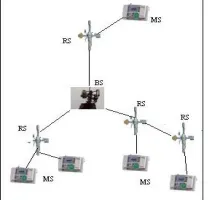
Relay location just forward traffic to/from mobile stop and create no traffic on its. Exchange station, base station, and cell stop all shares the spectrum, consequently no added equipment like another physical interface is needed. The consequent signaling change because of uplink queue status statement is trivial, and the matching uplink bandwidth usage is disregard able. After collecting relay station queue [figure1].
Volume 2, Issue 10, October 2013
Page 159
Queue info, base station programs the result to exchange station and cell station and operates the booking formula to have the downlink scheduling outcomes.As simultaneous transmission scenarios should be solved in a method, the input signal for the arranging algorithm. When adding a link nominee in to a parallel transmission scenario, it should be certain that adding this link won't reduce the absolute throughput of the scenario. But, it's not sensible to mix all potential links searching for coincident scenarios because of the non-linear improvement of links with regard to amount of RS.
The process is because of advice that wireless mobile networks are chiefly frame based, as well as the comparable scheduling algorithm should consider this variable under consideration. In each frame, this frame period must be shared by different simultaneous scenarios. Therefore appears the issue of a reasonable share of period resources between MS who reveal one framework, while still attaining the aim of the achieving maximum network throughput.
The next challenge would be to allow the arranging algorithm modulate for the real-time line size change in RS. The 6 different constraints are considered by the linear approach.
1: Derives the throughput for Mobile position node in the border, useful the simultaneous broadcast character of the multi hop cellular networks.
2: Indicates the file consciousness of the projected preparation algorithm by monitoring
3: The dynamic RS queue status, and this queue consciousness are not addressed by the connected work, the capacity restraint of a link in condition.
4: Applies Shannon’s Theorem to compute the higher bound of link data rate with the consideration of the interference caused by simultaneous transmissions.
5: States the time command of all simultaneous scenarios in a frame, redolent of the frame-based characteristic of this approach.
6: Transitive relative among BS and RS will be vigilant and this restraint power the real delay calculated at RS that associated directly to the BS
3.1 Detection of Concurrent Transmission Scenarios
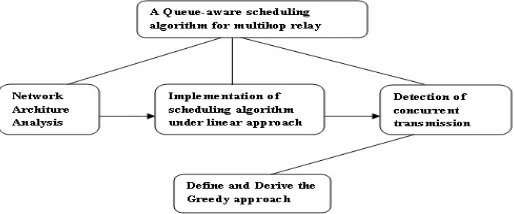
The amount of links grows nonlinearly with the number of nodes inside the network; it is improper to utilize a complete formula to look for all likely scenarios. We use a linear encoding approach validated to calculate the transmitting schedules for all coincident transmission scenarios, looking at increasing the throughput in every body. The transitive relationships to the transmission schedules between RS and BS.
Figure 2 Scheduling Algorithm under Linear Programming
3.2 Structure of Greedy effect
In this Greedy Strategy use the back force movement control system. This system says that to be able to make the most of the end to- end throughput in multi hop wireless network, the chosen coincident transmissions should have the ability to obtain the utmost out of the object function. We use a greedy algorithm to acquire a group of parallel transmission scenarios, together with the back force movement control system contained in the greedy approach and can be defined as. (1)
4.
IMPLEMENTATION METHODOLOGY AND RESULTS
Volume 2, Issue 10, October 2013
Page 160
Pause Times in m.secondsFigure 3 Throughput Comparison report
This illustrates the throughput between the transitivity, without transitivity and direct transmission.
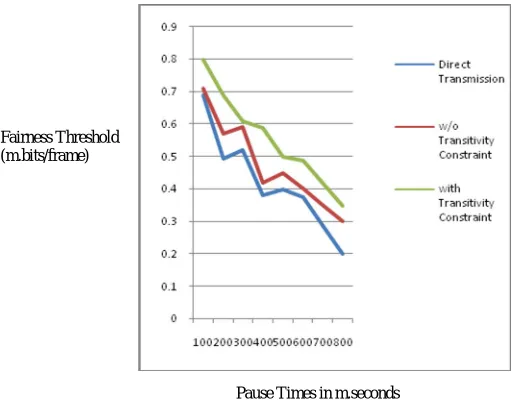
Figure 4 Fairness Comparison report
This illustrates the fairness between the transitivity, without transitivity and direct transmission
5.
CONCLUSION AND FUTURE WORK
A Transitive relation conscious scheduling formula for multi hop relay wireless mobile systems has been generated. Through the evaluation challenge that pursuing a focused strategy for creating cellular relay networks best displays the curiosity of the cellular networks Bandwidth guarantee between the base station and mobile station communication. This strategy indicates that cellular stations and relay stations don't form ad hoc sites and they've been under the management of bottom station. Yet another choice of building conveys cellular systems follows a comprise use in band spectrum of relay stations, not allow mobile stations as relay placement to supply, and associate centered preparation process. Within the preparation process, first a find of parallel transmission scenarios may be the outcome and it can be employed as feedback for a linear programming approach that determine the transmission schedules for the multi hop convey network. Simulations compute efficiency metrics for example throughput and equivalence of the suggested scheduling algorithm.
REFERENCES
[1] 3GPP TR25.924, “Opportunity driven multiple access,” 3GPP, ver. 1.0.0, Dec. 1999.
[2] TR 101 146, “UMTS; UTRA; Concept evaluation (UMTS 30.06),” ETSI, ver. 3.0.0, Dec. 1997.
[3] Stavros and A. Goldsmith, “Capacity regions for wireless ad hoc networks,” in Proc. IEEE ICC 2002, New York, Apr. 2002, pp. 3168–3173.
[4] M. Airy and K. Rohani, “Qos and fairness for CDMA packer data,” in Proc. IEEE Vehicular Technology Conf. 2000 Spring, Tokyo, Japan, May 2000, pp. 450–454.
[5] A. Fujiwara et al., “Area coverage and capacity enhancement by multi hop connection of CDMA cellular network,” in Proc. IEEE Vehicular Technology Conf. 2002 Fall, Vancouver, BC, Canada, Sept. 2002, pp. 2371–2374.
Avg.Throughtput (m.bits/frame)
Fairness Threshold (m.bits/frame)
Volume 2, Issue 10, October 2013
Page 161
[6] T. Rouse, I. Band, and S. McLaughlin, “Capacity and power investigation of opportunity driven multiple access (ODMA) networks in TDDCDMA based systems,” in Proc. IEEE ICC 2002, New York, Apr. 2002, pp. 3202–3206.
[7] B. Radunovic and A. Proutiere, “On Downlink Capacity of Cellular Data Networks with WLAN/WPAN Relays,” in Proc. 3rd IEEE RAWNET, 2007, pp. 1–7.
[8] J. Cho and Z. J. Hass, “On the Throughput Enhancement of the Downstream Channel in Cellular Radio Networks Through Multi hop Relaying,” IEEE J. Sel. Areas Communes., vol. 22, no. 7, pp. 1206–1219, Sept. 2004.
[9] Kokku,R.;Mahindra,R.;HonghaiZhang;Rangarajan, S., "NVS: A Substrate for Vitalizing Wireless Resources in Cellular Networks," Networking, IEEE/ACM Transactions on ,vol.20, no.5, pp.1333,1346,Oct.2012;doi:10.1109/TNET.2011.2179063