Vol.7 (2017) No. 5
ISSN: 2088-5334
A Study on Facial Expression Recognition Using Local Binary Pattern
Shahreen Kasim
#, Rohayanti Hassan
*, Nur Hadiana Zaini
*, Asraful Syifaa’ Ahmad
*, Azizul Azhar Ramli
#,
Rd Rohmat Saedudin
+#
Soft Computing and Data Mining Centre, Faculty of Computer Science and Information Technology, Universiti Tun Hussein Onn, Johor, Malaysia
*
Software Engineering Research Group, Faculty of Computing, Universiti Teknologi Malaysia, 81310 Skudai, Johor, Malaysia E-mail: [email protected]
+
School of Industrial Engineering, Telkom University, 40257 Bandung, West Java, Indonesia
Abstract— How to get the proper combination of feature extraction and classification is still crucial in facial expression recognition, and it has been addressed conducted over two decades. Hence, if inadequate features are used, even the best classifier could fail to achieve the accurate recognition. Therefore, Local Binary Pattern (LBP) is used as a feature extraction technique for facial expressions recognition where it is evaluated based on statistical local features. LBP is proven successful technique by the recent study due to its speed and discrimination performance aside of robust to low-resolution images. For the classification, Support Vector Machine is chosen, and the algorithm is implemented in MATLAB and tested on JAFFE (Japanese Female Facial Expressions) database in order to achieve the objectives and the goal of this research which is to obtain high accuracy in facial expressions and identify the seven basic facial expressions. The performance of feature extraction and classification is evaluated based on the recognition accuracy. The observation on results obtained in facial expressions recognition rate indicated the effectiveness of the proposed algorithm based on SVM-LBP features.
Keywords— facial expression recognition; feature extraction; local binary pattern; support vector machine; JAFFE
I. INTRODUCTION
Biometric is not foreign things in the technology of computer science which has been adapted for various applications. Basically, biometric is an authentication of behavioural characteristics and physical of individuals as a form of access control or identification. The well-known biometric authentication such iris recognition, fingerprint, DNA, palm print, hand geometry, face and voice recognition has become widespread in world applications, yet there are still have challenges to overcome. As compared to fingerprints and iris, face recognition has diverse advantages as it non-contact process. A numerous study has been conducted over two decades to address the problem of face recognition, especially in facial expression. Even though a lot of approaches had been discussed, expression recognition is difficult task to achieve the optimal pre-processing, feature extraction or selection and classification under a certain condition.
Nowadays, a study on the combination of face representation and classification is crucial in facial expression recognition. Moreover, the best classifier could fail to obtain accurate recognition if inadequate features are
used. Numerous studies have been made on recognizing facial expression with a high accuracy yet remains difficult due to subtlety, complexity, and variability of facial expressions. Furthermore, low-resolution images in real-world environments make real-life expression recognition much more difficult [1].
study that focused on facial expressions recognition issues in variance resolutions with six basic facial expressions.
Feature extraction technique is a key significance to the whole classification process [17], [18]. The process of feature extraction yields a prohibitively large number of features, and subsequently, a smaller subset of features needs to be selected according to some optimality criteria. The prominent characteristics on the faces must be extracted in order to recognize and identify human faces features like eyes, nose, and mouth by applying the geometry distribution and the shape of the face. There are two features used for extraction which is global and local features. Global features are often used as coarse representation and encoding the characteristics of the whole face whereas local features are often used as finer representation and encoding detailed variations within local areas in the face [7].
LBP has been found to be a powerful feature for texture classification which is a type of visual descriptor used for classification in computer vision. LBP is known as a method that combining multiple operators for multiresolution analysis. Also, joint distributions in LBP with orthogonal measures is a very powerful tool for rotation invariant texture analysis. As proposed by Ahonen [12], LBP is presented as a novel and efficient facial image representation based on texture features where the face image is divided into several regions from which the LBP feature distributions are extracted and concatenated into an enhanced feature vector to be used as a face descriptor. Furthermore, a lot of research on facial expression recognition had been experimented using LBP technique as LBP showing delightful results [9], [1].
Besides that, Rouhi et al. [8] have tested and analysed several other feature extraction methods namely Gabor Filter, and Elastic Bunch Graph Matching (EBGM). Rouhi et al. [8] found that 15-Gabor filter with fuzzy filter leads to a high rate of the feature extraction in the face recognition. Apart from that, multiple Gabor filter achieved high recognition rate and robust to facial expression variations [11] whereby Gabor filter able to reduce the space complexity of the system and reveal both transient and intransient facial features. However, Ou et al. [10] had applied Gabor filter and claimed that the Gabor filter is only showing an average result.
Meanwhile, EBGM is an extension to elastic graph matching for object classes with a common structure, such as faces in an identical pose. Tiwari [13] found that EBGM performed better than PCA which obtained highest accuracy rate of face recognition, but somehow it required long computational time. In other works, Senaratne et al. [14] has hybridized the EBGM with Particle Swarm Optimization and found it was more efficiency in face recognition.
This study has been motivated to analyze the seven basic facial expressions of emotion which are angry, sad, happy, fear, disgust, surprise and neutral by using Local Binary Pattern (LBP) as the feature extraction technique to obtain high accuracy recognition.
The remainder of this paper is organized as follows. In Section II, the material and methods used are discussed in detail. Section III presents the analysis and the discussion of the experimental results. Finally, Section IV summarizes the future work and conclusion.
II. MATERIAL AND METHOD
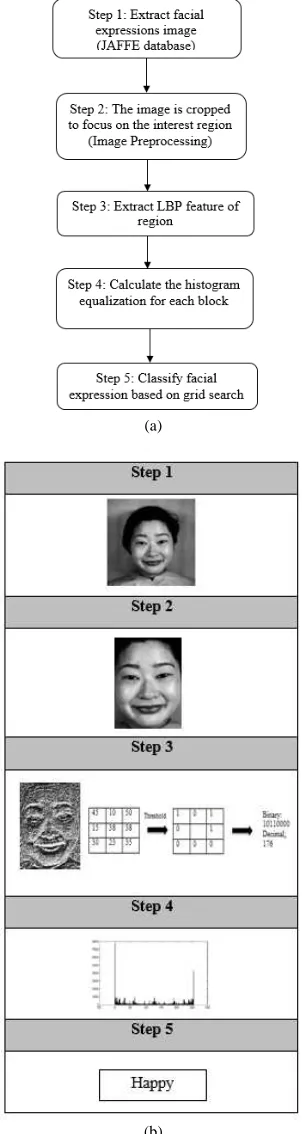
Based on Fig. 1, there are several stages involved in facial expression recognition which are data acquisition and preparation, image pre-processing, feature extraction technique and as well as the feature classification technique. In this study, Japanese Female Facial Expressions database (JAFFE) was used as a dataset. This database can be downloaded from http://www.kasrl.org/jaffe_info.html.
(a)
(b)
A. Data Acquisition and Preparation
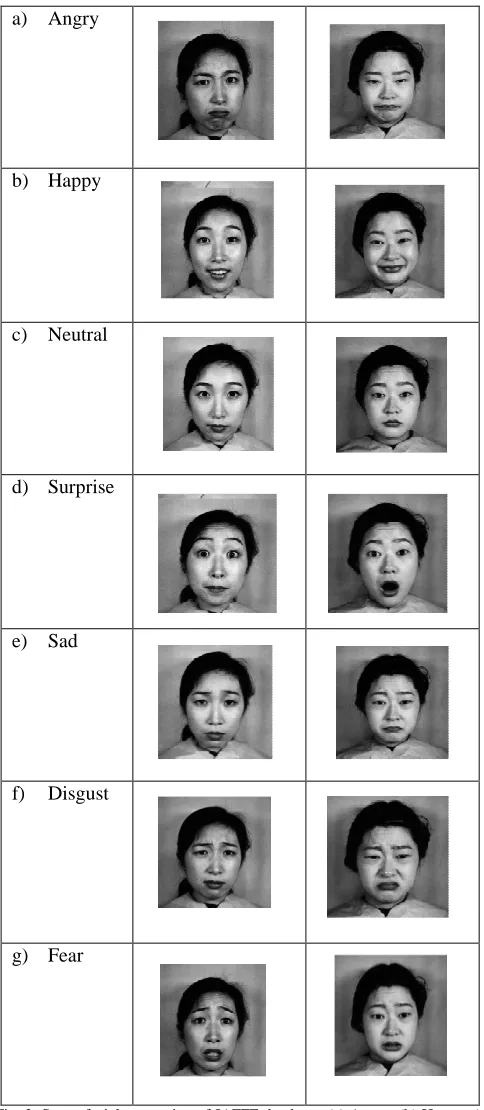
The JAFFE database contains 213 images of seven facial expressions: sad, angry, happy, fear, disgust, surprise and neutral. Ten models are posed three or four times of seven basic expressions. The sample of JAFFE database is shown in Fig. 2. There were seven facial expressions were selected, and 150 facial expression images sample were used in this study. The size of all pure facial images cut out from JAFFE database was normalized to 256 × 256 pixels.
a) Angry
b) Happy
c) Neutral
d) Surprise
e) Sad
f) Disgust
g) Fear
Fig. 2 Seven facial expression of JAFFE database; (a) Angry; (b) Happy; (c) Neutral; (d) Surprise; (e) Sad; (f) Disgust; (g) Fear
B. Image Processing
The image pre-processing procedure is very vital in the facial expressions recognition task. The aim of this phase is to retrieve sequences of images which have normalized intensity that was uniform in size and shape and depict only the face region. Thus, the effects of illumination and lighting should be eliminated in this stage as well as the noise and the normalization from the variation of pixel position [12]. In the pre-processing, the image will be cropped to eliminate the unnecessary part in the image and focused only on the interested region only as illustrated in Fig. 3.
Fig. 3 The example of image processing
C. Feature Extraction Technique Using LBP
An LBP description of a pixel is developed by thresholding the values of the matrix size 3 × 3 and result as in binary number. Based on the operator, LBP code is labeled for each pixel of an image. According to Feng et al. [19], we used texture descriptor as illustrated in Fig. 4, with 256-bin histogram of the labels, contains the density of each label.
Fig. 4 The basic LBP operator
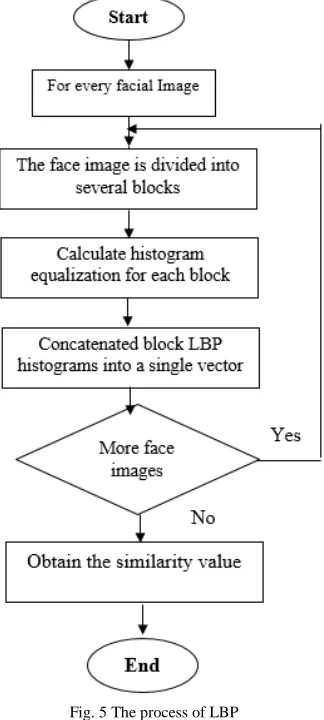
LBP method is implemented on images of the face in order to extract features which can be used to get a measure of the similarity between these images. Fig. 5 presents the process of LBP. Firstly, the face images were divided into several blocks. After that, the LBP histogram was calculated for each block. Then, the block LBP histograms were concatenated into a single vector. Histograms were then being compared between the images by measuring the distance similarity between the histograms. Moreover, every bin in histograms contains the number of its appearance in the region. Lastly, the feature vector was constructed by concatenating the regional histograms to one big histogram after every pixel is calculated [12].
D. Support Vector Machine (SVM)
the different classes [15]. The experiment was carried out using grid-search on the hyper-parameters in the 10-fold cross-validation. K-fold cross-validation has been applied using all expressions’ images of a person as the validation data, and the remaining images as the training data. In order to evaluate the performance of algorithm objectively, k-fold was done for ten times. Finally, the accuracy of recognition was calculated in order to determine the performance of LBP.
Fig. 5 The process of LBP
III.RESULTS AND DISCUSSION
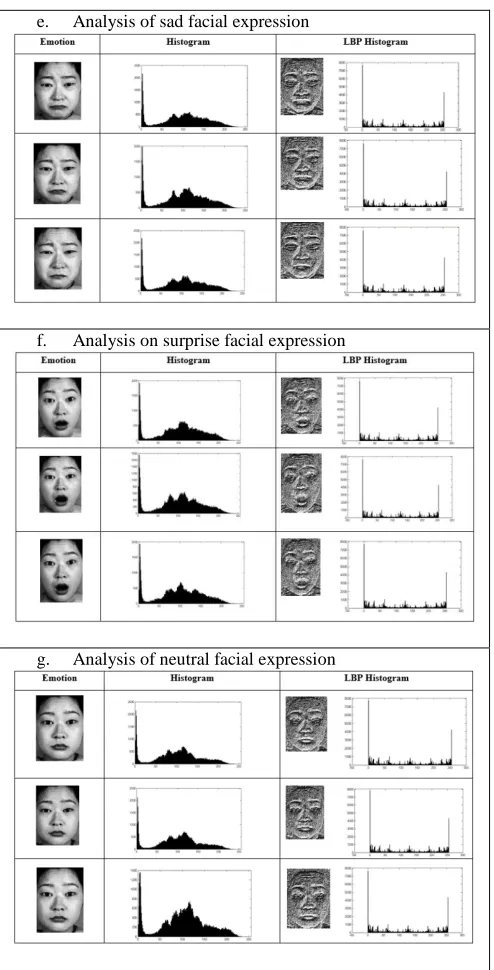
Table 1 demonstrates the analysis of facial expressions using the normal histogram and LBP histogram. The pixel’s intensity range in fear and angry emotion were very close because of the mouth region area was similar. The histogram equalization of happy emotion shows a gradual pattern in which the pixel’s intensity has no peak pixel compared to the surprise emotion. The mouth region was detected in a high dark part area that caused the peak pixel on the histogram. The Sad emotion of pixel’s intensity showed less dark spot on the mouth region hence no peak pixel on the histogram whereas disgust image showed there was three peaks pixel in every subregion and neutral images showed very low pixel in the histogram. The pixel’s intensity emotion was different for every image.
TABLEI
ANALYSIS OF FACIAL EXPRESSIONS IN HISTOGRAM AND LBPHISTOGRAM
a. Analysis of angry facial expression
b. Analysis of disgust facial expression
c. Analysis of fear facial expression
e. Analysis of sad facial expression
f. Analysis on surprise facial expression
g. Analysis of neutral facial expression
Table 2 presents the performance and evaluation on the accuracy of recognition which using LBP operator and without using LBP. We can see the recognition accuracy of seven facial expressions using LBP features achieved the average accuracy with 89% outperformed the average accuracy of without using LBP with 67%. This show on how important the feature extraction technique in achieving better accuracy of facial expression recognition process. Angry expressions succeed 100% in recognition of facial expressions accuracy whereas happy and surprise facial expressions using LBP achieved 95% accuracy. Sad and neutral expressions reported 90% accuracy, while fear expression reported 80% accuracy.
Some of the images experimented in JAFFE database look alike even though expressions stated is different could possibly affect the results achieved. The result was proven that by using LBP as a feature extraction technique gave a betterment result in recognition accuracy [6]. Furthermore, a
facial expression with using LBP can help to reduce the computation complexity which this scenario was shown in Table 1. The LBP histogram demonstrated a shorter pattern compared to the basic histogram. This led to a better detection ratio and eventually improved the recognition accuracy
TABLEII
ACCURACY OF SEVEN BASIC EXPRESSIONS WITH LBPFEATURES AND
WITHOUT LBPFEATURES
IV.CONCLUSIONS
This study had combined local binary pattern as a feature extraction technique with support vector machine in order to improve the accuracy of facial expression recognition. Seven facial expressions from JAFFE database have been used as a case study. The overall result showed that the average accuracy when using local binary pattern was 22% better from recognition process without using local binary pattern. However, the proposed combination have a limitation on generalization to other datasets. This limitation can be addressed in our future work. In future development, this research could be enhanced by referring to various other works available such as [21]-[29].
ACKNOWLEDGMENT
This research was funded by Research Contact Grant, Vot No: 4C907. Also many thanks to collaborative sponsor, GATES Scholars Foundation of GATES IT Solution Sdn. Bhd. and to RMC, UTM.
REFERENCES
[1] C. Shan, S. Gong, and P. W. McOwan, “Facial expression recognition based on Local Binary Patterns: A comprehensive study,” Image Vis. Comput., vol. 27, no. 6, pp. 803–816, 2009.
[2] P. L. B.-E. Ekman, “Facial expression and emotion,” Am. Psychol., vol. 48, no. 4, pp. 384–92, 1993.
[3] C. Chibelushi and F. Bourel, “Facial expression recognition: A brief tutorial overview,” On-Line Compend. Comput. Vis., 2003.
[4] C. Chan, J. Kittler, and K. Messer, “Multi-scale local binary pattern histograms for face recognition,” Adv. biometrics, 2007.
[5] H. Zhang, “Image Preprocessing Methods in Face Recognition,” in 2011 Symposium on Photonics and Optoelectronics (SOPO), 2011, pp. 1–4.
[6] S. Lajevardi and Z. Hussain, “Feature extraction for facial expression recognition based on hybrid face regions,” Adv. Electr. Comput., 2009.
[7] Y. Su, S. Shan, X. Chen, and W. Gao, “Hierarchical ensemble of global and local classifiers for face recognition,” IEEE Trans. Image, 2009.
[8] R. Rouhi, M. Amiri, and B. Irannejad, “A review on feature extraction techniques in face recognition,” Signal Image Process., 2012.
expression recognition,” Proc. 11th WSEAS Int. Conf. Electron. Hardware, Wirel. Opt. Commun. Proc. 11th WSEAS Int. Conf. Signal Process. Robot. Autom. Proc. 4th WSEA, pp. 138–142, 2012. [10] J. O. J. Ou, X.-B. B. X.-B. Bai, Y. P. Y. Pei, L. M. L. Ma, and W. L.
W. Liu, “Automatic Facial Expression Recognition Using Gabor Filter and Expression Analysis,” Second Int. Conf. Comput. Model. Simulation, 2010. ICCMS ’10, vol. 2, pp. 215–218, 2010.
[11] Q. Alshebani and P. Premaratne, “A hybrid feature extraction technique for face recognition,” Proc. Comput. …, 2014.
[12] T. Ahonen, A. Hadid, and M. Pietikäinen, “Face recognition with local binary patterns,” Comput. vision-eccv 2004, 2004.
[13] M. Tiwari, “Gabor Based Face Recognition Using EBGM and PCA,” ) Int. J. Comput. Sci. …, 2012.
[14] R. Senaratne, S. Halgamuge, and A. Hsu, “Face recognition by extending elastic bunch graph matching with particle swarm optimization.,” J. Multimed., 2009.
[15] M. Dumas, “Emotional expression recognition using support vector machines,” Proc. Int. Conf., 2001.
[17] S. Yuhandri, E. P. Madenda and W. Karmilasari, “Object Feature Extraction of Songket Image Using Chain Code Algorithm,” International Journal on Advanced Science, Engineering and Information Technology, vol 7, no. 1, pp. 235-241, 2017.
[18] I. E. W. Rachmawan, Y. Kiyoki and S. Sasaki, "An Automatic Feature Extraction Method of Satellite Multispectral Images for Interpreting Deforestation Effects in Soil Degradation" International Journal on Advanced Science, Engineering and Information Technology, vol 7, no 2, pp. 676-687, 2017.
[19] X. Feng, M. Pietikainen, and A. Hadid, "Facial expression recognition with local binary patterns and linear programming", Pattern Recognition And Image Analysis C/C of Raspoznavaniye Obrazov I Analiz Izobrazhenii, vol 15, no 2, pp. 546, 2005.
[20] S. Singh, A. Kaur, and A. Taqdir, “A Face Recognition Technique using Local Binary Pattern Method”, International Journal of Advanced Research in Computer and Communication Engineering, vol 4, no 3, 2015.
[21] U. K. Hassan, N. M. Nawi, and S. Kasim, “Classify a protein domain using sigmoid support vector machine,” in Information Science and Applications (ICISA), 2014 International Conference, IEEE, May. 2014. pp. 1-4.
[22] U. K. Hassan, N. M. Nawi, and S. Kasim, A. A, Ramli, M. F. M., Fudzee, and M. A. Salamat,”Classify a Protein Domain Using SVM Sigmoid Kernel”. In Recent Advances on Soft Computing and Data Mining, pp. 143-151, Springer, Cham.
[23] S., Ismail, R. M., Othman, S., Kasim, R., Hassan, H., Asmuni, and J., Taliba, “Pairwise protein substring alignment with latent semantic analysis and support vector machines to detect remote protein homology”, International Journal of Science and Bio-Technology, Volume 3, Issue 3, 2011, Pages 17-34.
[24] F. M., Abdullah, R. M., Othman, S., Kasim, R., Hashim, R., Hassan, H., Asmuni, and J., Taliba, “An Optimal Mesh Algorithm for Remote Protein Homology Detection”, Communications in Computer and Information Science, Volume 151 CCIS, Issue PART 2, 2011, Pages 471-497.
[25] S., Ismail, R. M., Othman, S., Kasim, R., Hassan, H., Asmuni, and J., Taliba, “Pairwise protein substring alignment with latent semantic analysis and support vector machines to detect remote protein homology” Communications in Computer and Information Science,Volume 151 CCIS, Issue PART 2, 2011, Pages 526-546. [26] F. M., Abdullah, R. M., Othman, S., Kasim, R., Hashim, R., Hassan,
H., Asmuni, and J., Taliba, “An Optimal Mesh Algorithm for Remote Protein Homology Detection”, International Journal of Bio-Science and Bio-Technology, Volume 3, Issue 2, June 2011, Pages 13-38. [27] S., Kasim, M. F. M., Fudzee, S., Deris, S., and R. M., Othman, “Gene
Function Prediction Using Improved Fuzzy c-Means Algorithm”, In Information Science and Applications (ICISA), 2014 International
Conference on (pp. 1-4). IEEE.
[28] S., Kasim, S., Deris, S., and R. M., Othman, “Multi-stage filtering for improving confidence level and determining dominant clusters in clustering algorithms of gene expression data”, Computers in biology
and medicine, 43(9), 1120-1133, 2013.
[29] S., Kasim, S., Deris, S., and R. M., Othman, “A new computational framework for gene expression clustering”, In International
Conference on Advanced Data Mining and Applications (pp.