Knowledge Management Strategy and Organizational Creative Performance Nexus: A
Developing Countries Perspective
Author’s Details: (1)
Syed Shahid Hussain (2) Dr. Wasif Ali Waseer (1)
University of Sargodha Lahore Campus, Pakistan Corresponding Author (2) Assistant Professor, at University of Management and Technology, Lahore, Pakistan.
Abstract:
The extant literature evidently emphasizes that knowledge is a strategic asset in this competitive landscape. This strategic asset can manage the organizations which have to make competitive business strategies. There are two schools of thought exist in the literature while making any knowledge management strategy; the first one is a system-oriented approach which is hardly examined empirically in the literature. This research paper nonetheless, is an effort to investigate the impact of system-oriented KM strategy on the organizational creativity and performance. The integrative research model was used to test hypothesis empirically. It is to be noted that cross-sectional survey was carried out. The total sample size was (N 116), and data have filled out through questionnaires from 30 privately-run business organizations. Several hypotheses are tested, and it is observed that system-oriented approach is equally effective in the developing countries. It was recommended that researchers replicate the same study in other sectors in developing countries.
Keywords: Knowledge Management, Knowledge Management Strategy, Organizational Creativity, Organizational Performance, Explicit-tacit knowledge
1.
INTRODUCTION
Knowledge is an essential factor of production in addition to the conventional factors; land, labor, and capital. It is now the leading factor of sustainable competitiveness for organizations (Camagni 2017; Omotayo, 2015;Jasimuddin, 2008; Drucker, 1992). The ancient underpinning of developed economies has now switched from natural resources to knowledgeable (intellectual) resources (Bergstrom and Randall, 2016; Lee and Choi, 2003). The researchers and management thinkers have declared that this is an era of knowledge management in which organizations are increasingly considering the knowledge as a valuable and strategic resource (Shahzad et al., 2016; Zaied et al., 2012; Choi et al., 2006; Bollinger and Smith, 2001; Zack, 1999; Teece, 2000). Nonaka et al., (2014) emphasize on the sustainable innovativeness in organizations to achieve sustainable competitiveness in the turbulent environment through the continuous creation of new knowledge and practical wisdom (Nonaka et al., 2014; Krogh et al., 2012; Nonaka and Takeuchi, 1995; Nonaka, 1994; 1991).
The management of this strategic asset, therefore, seems very complex matter. A researchers’ streams stresses on the management of knowledge through system-oriented approach which claims that the knowledge can be managed and created through acquisition strategy by using efficient KM systems like ICT and MIS (Kramer et al., 2016; Obeidat et al., 2015; Akgün, 2005; Corbonara, 2005; Alavi and Leidner, 2001).
Nonetheless, Choi et al., (2008), coined two types of KM strategies; KM focus strategy based on tacit-oriented and explicit-tacit-oriented and KM source strategies based on external-tacit-oriented and internal-tacit-oriented sources. Schulz and Jobe (2001) also asserted that KM focus strategies are more effective than others. Pan and Yang, (2010) and Choi et al., (2008) have studied the indirect relationship between KM strategies and organizational creativity leading to organizational performance in Korean and Chinese perspectives respectively. Donate, and Pablo, (2015), Jasimuddin (2008) and Zack (1999) have also posited the similar relationships.
models. Hardly, any empirical inquiries are found in the extant literature to observe the direct relationship between knowledge management strategies and organizational creativity and performance.
Synthesizing the previous studies, in line with the system approach and keeping in view the complexity of knowledge creation process in developing countries’ context, the fundamental goal of this study is to delineate the direct effect of KM focus strategy (defined by Choi et al., 2008) on organizational creativity and performance without considering the mediating role of knowledge creation process in the context of developing countries like Pakistan., The empirical results extracted through SPSS based on 216 responses of middle managers, collected from 30 privately run business organizations are very interesting and fully support the theoretical background of this study. This research paper, therefore, explores the new frontiers for future research to investigate the similar relationships in line with the system-oriented approach to facilitate the practitioners and managers while devising any KM strategy for the developing countries.
2.
LITERATURE REVIEW
The competitive landscape of the twenty-first-century challenges firms to continually change and adapting various external forms, like globalization, rapidly changing technologies, new rivals, and unpredictable and ever-changing political and economic conditions (Bretos and Marcuello, 2017). The challenge of the era is how to advance the internal organizational competencies to create sustainable effectiveness in this turbulent environment. The resource-based view (RBV) theory of firms has been dominated perspective around twenty years in this regard. According to RBV, firms create their competitive advantages based on their internal valuable, rare, inimitable and non-substitutable resources (Wernerfelt, 1984; Rumelt 1991; Barney, 1991). Gradually, the researchers and practitioners have come to the point that such resources reside in the human capital, i.e., experiences, skills, and knowledge of organizational members. It is consensus among the researchers that organizational members’ knowledge is a key strategic resource which has ability to make difference to compete in this chaotic environment (Wheelen and Hunger, 2017; Zaied et al., 2012; Choi et al., 2006; Bollinger and Smith, 2001; Zack, 1999; Teece, 1998; Grant, 1997).
Over the period both the academicians and experts emphasize the continuous creation of knowledge in organizations to be competitive in the rapid, ongoing changing environment (von Krough, 1998; Wiig, 1998). Nonaka and Takeuchi (1995), presented the concept of knowledge spiral based on four phased knowledge creation process; socialization, externalization, combination, and internalization (SECI). They further stressed that the knowledge is created by interplaying between two dimensions; epistemological comprising of tacit-explicit knowledge and ontological as knowledge is rooted in the minds of folks and flow towards groups, organization, and inter-organization. After that many researchers and authors of knowledge management introduced several knowledge creation models (Tyagi et l., 2015; Weick. 2012; Choo, 1998; Wiig, 1998) and most of them have constructed their models based on SECI model. The main objective of knowledge creation is to make organizations sustainable innovative in the turbulent environment (Nonaka et al., 2014). The innovation has two dimensions; generation of novel ideas and implementing the new ideas to enhance the organizational performance (McAdam, 2003; Titus, 2000). Thus, in the context of knowledge-intensive industries, organizational creativity leads organizational performance in terms of both non-financial and financial.
This research article circumference the KM focus strategies encompassing the system-oriented approach, organizational creativity, and organizational performance. Thus, in this section, the extant literature is reviewed around the main constructs of this study like knowledge management, KM strategies, organizational creativity and organizational performance. The literature review in this section presents a general idea and psychiatry of connected academic and empirical associations among all the constructs of this study as mentioned above.
skills, and competencies obsessed by organizational members; (ii) organizational capital encompasses the formal knowledge and organized (codified) experience residing in organization’s databanks, copyrights, trademarks, management processes and systems, culture, structures, etc. and (iii) social capital embraces the knowledge entrenched in relationships and interactions amongst individuals and its customers (Subramaniam and Youndt, 2005). Knowledge management prevents intellectual capital from crumbling, seeks opportunities to enhance decision-making capabilities for organizational initiatives. Therefore, organizations need to implement knowledge management in order to serve clienteles well, empowering employees, innovate and deliver on time high-quality products and enhance flexibility (Grey, 1996).
KM strategy is the intention and enabling conditions of knowledge creation for organizations (Nonaka and Takeuchi, 1995). According to Jasimuddin (2005a), the transfer of knowledge among organizational members is a crucial strategy to create values. Zack (1999), postulates that KM strategy helps an organization to develop a link between organizational environment (competitive forces) and internal competencies to establish a strategic competitive advantage. Jasimuddin (2008) posts on the hybrid KM strategies having both the soft and hard dimensions of knowledge transfer underpinning the tacit and explicit knowledge respectively which is also known as personalized and codified KM strategies respectively (Obeidat, 2014; Hansen et al., 1999). By soft mechanism, he means that the tacit knowledge is transferred socially person-to-person through direct communication, verbalization, language, training, story-telling and observation (Argote, 1999; Brown and Duguid, 1998).
Polyani (1966) posits the importance of knowledge by stating that either knowledge is tacit or it is embedded in the tacit knowledge. Nonetheless, the tacit knowledge exists in the brains of organizational members in the form of mental schemata and mental maps. Therefore, it is difficult to transfer or imitate. Thus, the main focus of practitioners, researchers and scholars are to make such KM strategies which assist the transfer and creation of tacit-oriented knowledge into the organizational memory. The extant literature increasingly draws the attention of the researchers towards using of effective KM strategies in organizations to achieve sustainable competitiveness (Lee and Choi, 2012; Choi et al., 2008; Zack, 1999). The literature repeatedly emphasizes on the tacit-oriented and explicit-oriented KM strategies like focus, codified, personalize, soft and hard mechanism and hybrid KM strategies (Jasimuddin, 2008; 2005a; Choi et al., 2008; Carbonara, 2005; Keskin, 2005).
Knowledge and creativity are the major driving forces for organizations to achieve competitiveness in the turbulent global environment (Eardley and Uden, 2010). Organizational creativity in the realm of knowledge management field has become very crucial component to understanding the organizational effectiveness as many prominent scholars consider it as an intermediate outcome (Nonaka et al., 2014; Lee et al., 2012; Lee and Choi, 2003). The prime objective of any business organization is to bring sustainable innovation in its processes; which is the vital source of competitive advantage (Nonaka, 2014; Krogh, 2012; Nanaka et al., 2008). The concept of creativity and innovation is commonly used interchangeably in the academic literature (Sarooghi et al., 2015; Msn, 2001). Organizational creativity is the generation and imagination of novel ideas (Woodman et al., 1993) while the innovation is the implementation of novel and imaginative ideas.
Organizational performance is the examination of its success or failure towards the achievement of its goals or purposes. The meticulous literature review reveals that organizations have to focus on continuous knowledge creation to make innovative sustainable performance (Nonaka et al., 2014). The sustainable innovation is dependent on organizational creativity which is closely associated with the imaginative and creative ideas of individuals. Nonaka and Takeuchi (1995), emphasizing the intertwined nature of knowledge reported that knowledge is created spirally by interplaying between tacit and explicit types of knowledge. The literature provokes the attention of researchers to develop an integrated model comprises diversified aspects of ever-growing and a complex stream of knowledge management (Lee and Choi, 2012; Choi et al., 2008; Choi et al., 2003). This study intends to develop and test an integrated model encompasses the components persistently highlighted in the literature; KM focus strategy, knowledge creation process (SECI), organizational creativity and organizational performance.
Based on the literature review a research model is hypothesized in this section. To investigate the relationships among different constructs and variables used in this research model a few hypotheses have also been formulated that will be analyzed and discussed through statistical analyses in the subsequent sections.
The hypothesized research model is graphically presented in Figure-2. Based on the research model, following hypotheses have been formulated in this research study.
Figure-1
H1: KM focuses strategy effects positively on the firm’s performance.
H2: Organizational Creativity has mediating effect between KM focus strategy and firm’s performance.
H3: KM focus strategy is positively associated with organizational creativity.
3.
RESEARCH METHODOLOGY
This is an empirical study therefore ontologically; the research paradigm is positivist. The theme of the study has been nurtured through deductive approach by narrowing down the concepts from broad and general perspective to the specific. For instance, the literature indicates many KM strategies, but the majority of researchers are found around the tacit-oriented and explicit-oriented strategies called KM focus strategy by Choi et al., (2008). Similarly, other constructs of the study: organizational creativity and firm’s performance (Richard et al., 2009) have been extracted from the literature in the same manner by using the deductive method. The data is collected by using survey method and analyzed through statistical tool SPSS.
All privately run businesses companies from all sectors (manufacturing, IT and service industries, etc.) of Pakistan are considered the population of this study. The size of the population used in the survey is limited to the middle managers (all the supervisors, assistant managers, deputy managers, floor managers and related technical, administrative and operational designations) of privately run business organizations. Since, the respondents of the survey are not common employees rather, they are a special group of employees, i.e., middle managers, therefore, keeping in view the exclusivity of the respondents, 30 privately run business organizations are selected for the survey which is a sufficient number to get the minimum desired level of responses.
Sampling Technique and Sample Size
The non-probability sampling technique comprises of convenience, quota, snowball and judgment sampling. Since the population is spread across the country, therefore, the convenience sampling is used to reach the respondents from the selected companies. According to Lucko and Rojas, (2010) the selection of sample size is critical with respect to statistical analyses. The sample size, however, is dependent on the type of the analysis which is decided by considering the research model. In this study, the rule of thumb coined by Hair and Bush, (2010) to decide about the sample size is adopted. According to this rule of thumb, the sample size should equal to the number of items in the questionnaire is multiplied by 5.
Statistical Analysis
The instrument used in this study encompasses four different latent variables (comprising of 4 to 5 observed items in each) is adopted from Choi (2002) and Lee and Choi (2003). It is fundamental to the quantitative research that the result of research instrument should be reliable (Bryman & Cramer, 2009). Instruments for the study demonstrating high-reliability scores have to be used (Deluga, 1991). Although the instrument used for this study is adopted from Choi (2002) and Lee and Choi (2003) developed for the Korean firms, but now it is being used in the Pakistani context. Therefore, its reliability is tested through Cronbach’s alpha result. According to Nunnally (1978), the acceptable range of Cronbach’s alpha is 0.7 or above. All Cronbach’s Alpha values of the constructs used in this survey instrument are calculated above 0.7. Therefore, the instrument is highly reliable. The tacit-oriented KMFS is the only construct which has 0.68 Cronbach’s Alpha value it may reflect weakness as given standard provided by Nunnally (1978). However, according to Heir (1995), Cronbach alpha score which falls close to 0.6 is also acceptable given the contextualization of the use of the instrument.
After testing the reliability of the instrument, initial data screening is done by evaluating missing value analysis, detection of outliers and test of normality. Descriptive statistical analysis including frequencies and percentages is used to show the break-up or main characteristics of the sample. The regression analysis is run by using SPSS to test the hypotheses. The four knowledge creation processes are based on four items each, the scores on the four items will be firstly averaged to yield a summary score reflecting the collective impact of knowledge creation processes on firm’s creativity. Four statistical tests, i.e., autocorrelation, multicollinearity, normality, and heteroscedasticity are run after each regression analyses tests to analyze and interpret the results of regression tests.
Data Analysis
SPSS (Statistical Package for Social Sciences) currently known as IBM Statistics is acquired for data analysis. Initially, collected data is entered into Microsoft Excel and screened out for missing values and illogical inputs. As the research model suggests to test; 1) the impact of Knowledge creation process as a moderator on the relationship of KM Focus Strategy and Organizational Creativity, and 2) the mediating effect of organizational creativity on the relationship of KM focuses strategy and firm’s performance. Assumptions of regression like normality, outliers, autocorrelation, and multicollinearity are found satisfied. Independent variable (KM Focus strategy), moderating variable (knowledge creation process), mediating variable (organizational creativity) are standardized to avoid high multicollinearity for the interaction terms in regression analysis.
Normality of Data
Mostly, Kolmogorov-Smirnov (KS) and Shapiro-Wilk (SW) tests are used to check the normality of the data. The Shapiro-Wilk test is more appropriate for small sample sizes, i.e., less than 50 responses, but it can also handle the sample sizes as large as 2000. Thus, Shapiro-Wilk test will be the numerical means of assessing normality in this study. Table-1 shows that the data is normal as Sig. value is 0.069 which is greater than 0.05.
Table – 1: Tests of Normality
Kolmogorov-Smirnova Shapiro-Wilk
Statistic Df Sig. Statistic df Sig.
Unstandardized Residual (X ON Y)
.059 216 .200* .985 165 .069
The Q-Q plot in fig-2 also supports the test of normality. Thus the condition of normality of data is fulfilled.
4.
RESULTS AND DISCUSSIONS
First HypothesisH1: KM focuses strategy effects positively on the firm’s performance.
Several regression analyses like simple linear regression analysis, multiple regression analysis, hierarchical regression analysis techniques are used to find the impact of one or more independent variables on the dependent variable. It also tells us which predictor is more important and which is less. In the present scenario, a simple linear regression model is run with KM Focus strategy as the independent variable and Organizational Performance as the dependent variable. The model summary in table-2 shows that total variation in Organizational Performance that is controlled by KM Focus strategy is 6.3%.
Table – 2: Model Summary
Model R
R Square
Adjusted R Square
Std. Error of the Estimate
1 .251a .063 .058 .97178771
a. Predictors: (Constant), KM Focus Strategy
When testing overall model, ANOVA table-3 suggests that all predictors are significant (P-value = 0). In this case, we have only one predictor (KM Focus strategy) which is significant.
Table – 3: ANOVA
Model
Sum of
Squares Df
Mean
Square F Sig.
1 Regression 13.539 1 13.539 14.337 .000b
Residual 202.095 214 .944
Total 215.635 215
a. Dependent Variable: Organizational Performance b. Predictors: (Constant), KM Focus Strategy
To know the direction of effect of KM Focus Strategy on Organizational Performance coefficients table-4 is presented. This table shows that regression weight is the positive showing positive impact of KM Focus Strategy on Organizational Performance as it was expected. This impact is also highly statistically significant as p-value = .000, so the hypothesis “KM focus strategy effects positively to the firm’s performance.” is accepted.
Table – 4:
Coefficients
Model
Unstandardized Coefficients
Standardized Coefficients
T Sig.
Correlations
B
Std.
Error Beta
Zero-order Partial Part 1 (Constant) -.005 .066 -.082 .934
KM Focus Strategy
.250 .066 .251 3.786 .000 .251 .251 .251
Second Hypothesis
H2: Organizational Creativity has mediating effect between KM focus strategy and firm’s performance.
A variable may be considered a mediator to the extent to which it carries the influence of a given independent variable (IV) to a given dependent variable (DV). The following four conditions have to be satisfied to check the Mediation in any statistical relationship:
1. The Independent Variable (IV) significantly affects the Mediator (M),
2. The IV significantly affects the Dependent Variable (DV) in the absence of the (M), 3. The mediator (M) has a significant unique effect on the DV, and
4. The effect of the IV on the DV shrinks upon the addition of the M to the model.
Sobel test is used to assess the effect of mediation (http://quantpsy.org/sobel/sobel.htm). By following this test, we get model-1 as X M
Condition – 1:
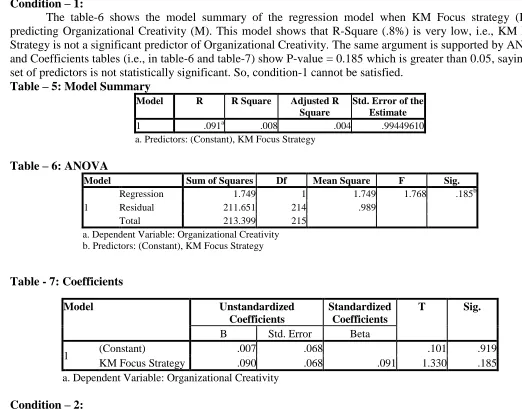
The table-6 shows the model summary of the regression model when KM Focus strategy (IV) is predicting Organizational Creativity (M). This model shows that R-Square (.8%) is very low, i.e., KM Focus Strategy is not a significant predictor of Organizational Creativity. The same argument is supported by ANOVA and Coefficients tables (i.e., in table-6 and table-7) show P-value = 0.185 which is greater than 0.05, saying that set of predictors is not statistically significant. So, condition-1 cannot be satisfied.
Table – 5: Model Summary
Model R R Square Adjusted R
Square
Std. Error of the Estimate
1 .091a .008 .004 .99449610
a. Predictors: (Constant), KM Focus Strategy
Table – 6: ANOVA
Model Sum of Squares Df Mean Square F Sig.
1
Regression 1.749 1 1.749 1.768 .185b
Residual 211.651 214 .989
Total 213.399 215
a. Dependent Variable: Organizational Creativity b. Predictors: (Constant), KM Focus Strategy
Table - 7: Coefficients
Model Unstandardized
Coefficients
Standardized Coefficients
T Sig.
B Std. Error Beta
1 (Constant) .007 .068 .101 .919
KM Focus Strategy .090 .068 .091 1.330 .185
a. Dependent Variable: Organizational Creativity
Condition – 2:
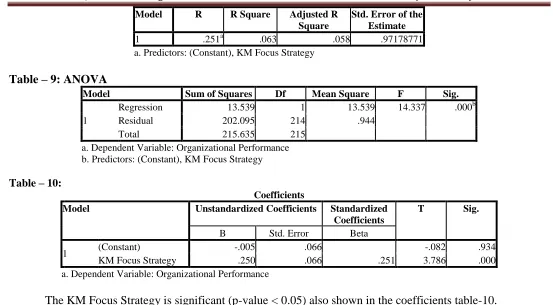
When Organizational performance (DV) is predicted with KM Focus Strategy (IV) directly, the following outputs are generated. This model summary shows in table-8 as better stats for R-Square (6.3%).
Model R R Square Adjusted R Square
Std. Error of the Estimate
1 .251a .063 .058 .97178771
a. Predictors: (Constant), KM Focus Strategy
Table – 9: ANOVA
Model Sum of Squares Df Mean Square F Sig.
1
Regression 13.539 1 13.539 14.337 .000b
Residual 202.095 214 .944
Total 215.635 215
a. Dependent Variable: Organizational Performance b. Predictors: (Constant), KM Focus Strategy
Table – 10:
Coefficients
Model Unstandardized Coefficients Standardized
Coefficients
T Sig.
B Std. Error Beta
1 (Constant) -.005 .066 -.082 .934
KM Focus Strategy .250 .066 .251 3.786 .000
a. Dependent Variable: Organizational Performance
The KM Focus Strategy is significant (p-value < 0.05) also shown in the coefficients table-10.
Condition – 3:
Now table-11 and table-12 below show the significance of mediating variable (Organization Creativity) when it predicts Organization Performance (dependent variable). R-Square is 16.9%, showing somewhat better results. The predictors are significant as shown in the ANOVA and Coefficients tables below (P-value = 0.000). Table – 11:
Model Summary
Model R R Square Adjusted R
Square
Std. Error of the Estimate
1 .411a .169 .165 .91491556
a. Predictors: (Constant), Organizational Creativity
Table – 12:
ANOVA
Model Sum of Squares Df Mean Square F Sig.
1
Regression 36.502 1 36.502 43.607 .000b
Residual 179.133 214 .837
Total 215.635 215
a. Dependent Variable: Organizational Performance b. Predictors: (Constant), Organizational Creativity
Table – 13:
Coefficients
Model Unstandardized Coefficients Standardized Coefficients
T Sig.
B Std. Error Beta
1 (Constant) -.008 .062 -.134 .894
Organizational Creativity .414 .063 .411 6.604 .000 a. Dependent Variable: Organizational Performance
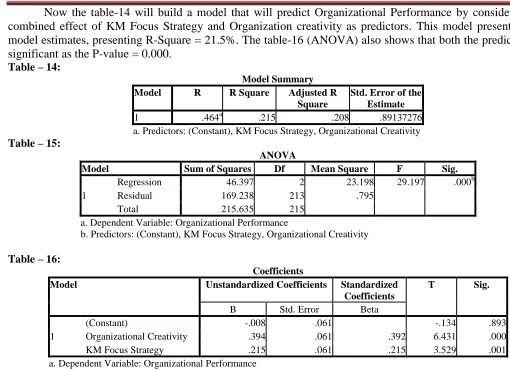
Now the table-14 will build a model that will predict Organizational Performance by considering the combined effect of KM Focus Strategy and Organization creativity as predictors. This model presents better model estimates, presenting R-Square = 21.5%. The table-16 (ANOVA) also shows that both the predictors are significant as the P-value = 0.000.
Table – 14:
Model Summary
Model R R Square Adjusted R
Square
Std. Error of the Estimate
1 .464a .215 .208 .89137276
a. Predictors: (Constant), KM Focus Strategy, Organizational Creativity Table – 15:
ANOVA
Model Sum of Squares Df Mean Square F Sig.
1
Regression 46.397 2 23.198 29.197 .000b
Residual 169.238 213 .795
Total 215.635 215
a. Dependent Variable: Organizational Performance
b. Predictors: (Constant), KM Focus Strategy, Organizational Creativity
Table – 16:
Coefficients
Model Unstandardized Coefficients Standardized
Coefficients
T Sig.
B Std. Error Beta
1
(Constant) -.008 .061 -.134 .893
Organizational Creativity .394 .061 .392 6.431 .000
KM Focus Strategy .215 .061 .215 3.529 .001
a. Dependent Variable: Organizational Performance
The coefficients table-16 also shows that both the predictors, i.e., Organizational Creativity and KM Focus Strategy are highly significant as P-values are 0.000 and 0.001 respectively.
From the above mentioned four conditions, three conditions attribute to the presence of statistical mediation of the organizational creativity in the model. The only condition, i.e., condition-1 is not fulfilled as the IV (KM Focus Strategy) does not significantly affect the mediator (Organizational Creativity).
Condition-2 requires that the independent variable significantly affects the dependent variable in the absence of mediator and it is noted that KM Focus Strategy (IV) is highly significant when regressed on Organizational Performance (p-value = 000). Condition-3 requires that the mediator significantly affects the dependent variable and it is noted that Organizational Creativity is highly significant when regressed on Organizational Performance (p-value = 000). Condition-4 requires that the effect of the IV on the DV shrinks upon the addition of the mediator to the model and we noted that regression weight of KM Focus Strategy is 0.251 and is shrunk to 0.215, giving us shrink of 0.035.
The mediating effect is also tested by using Sobel’s test. The formula used to calculate Sobel statistic is as under:
Sobel Statistic = a*b/SQRT (b2*sa2 + a2*sb2)
Where
a = raw (unstandardized) regression coefficient for the association between IV and mediator.
sa = standard error of a.
b = raw coefficient for the association between the mediator and the DV (when the IV is also a predictor of the DV).
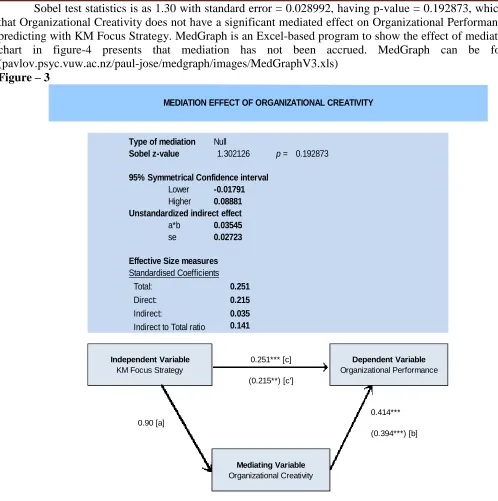
Sobel test statistics is as 1.30 with standard error = 0.028992, having p-value = 0.192873, which shows that Organizational Creativity does not have a significant mediated effect on Organizational Performance when predicting with KM Focus Strategy. MedGraph is an Excel-based program to show the effect of mediation. The chart in figure-4 presents that mediation has not been accrued. MedGraph can be found at (pavlov.psyc.vuw.ac.nz/paul-jose/medgraph/images/MedGraphV3.xls)
Figure – 3
Figure-3 indicate total effect size is computed as .251, the direct effect size is computed as 0.215, and indirect effect size is 0.035, and indirect to total effect is 0.414 which is significant, resulting in little or no mediation effect.
Baron and Kenny suggested eyeballing of any mediation effect when Sobel’s test results in Null mediation and partial mediation happens when Shrink (c-c’) > 0. In step 4 shrink in effect of KM, Focus Strategy is 0.035 which is positive providing evidence of partial mediation effect of Organizational Creativity on KM Focus Strategy when regressed on Organizational Performance. So, our hypothesis-2 did not support fully, but there exists partial indirect effect of organizational creativity when estimating Organizational Performance with KM Focus Strategy.
Third Hypothesis
Type of mediation Null
Sobel z-value 1.302126 p = 0.192873
95% Symmetrical Confidence interval
Lower -0.01791
Higher 0.08881 Unstandardized indirect effect
a*b 0.03545
se 0.02723
Effective Size measures
Standardised Coefficients
0.251 0.215 0.035 0.141
Total: Direct: Indirect:
Indirect to Total ratio
MEDIATION EFFECT OF ORGANIZATIONAL CREATIVITY
0.251*** [c]
(0.215**) [c']
0.414*** 0.90 [a]
(0.394***) [b]
Note: The numerical values in parentheses are beta weights taken from the second regresssion and the other values are zero order correlations.
Organizational Creativity
Independent Variable Dependent Variable
KM Focus Strategy Organizational Performance
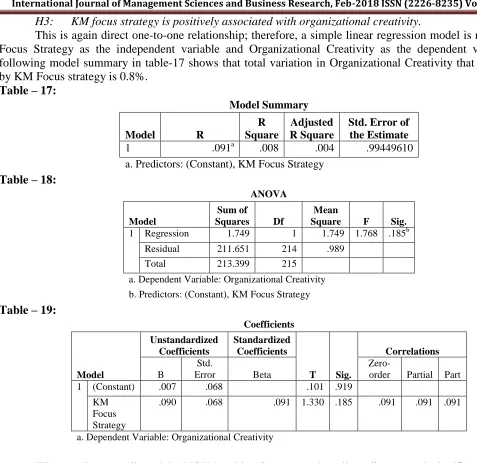
H3: KM focus strategy is positively associated with organizational creativity.
This is again direct one-to-one relationship; therefore, a simple linear regression model is run with KM Focus Strategy as the independent variable and Organizational Creativity as the dependent variable. The following model summary in table-17 shows that total variation in Organizational Creativity that is controlled by KM Focus strategy is 0.8%.
Table – 17:
Model Summary
Model R
R Square
Adjusted R Square
Std. Error of the Estimate
1 .091a .008 .004 .99449610
a. Predictors: (Constant), KM Focus Strategy
Table – 18:
ANOVA
Model
Sum of
Squares Df
Mean
Square F Sig.
1 Regression 1.749 1 1.749 1.768 .185b
Residual 211.651 214 .989
Total 213.399 215
a. Dependent Variable: Organizational Creativity
b. Predictors: (Constant), KM Focus Strategy
Table – 19:
Coefficients
Model
Unstandardized Coefficients
Standardized Coefficients
T Sig.
Correlations
B
Std.
Error Beta
Zero-order Partial Part
1 (Constant) .007 .068 .101 .919
KM Focus Strategy
.090 .068 .091 1.330 .185 .091 .091 .091
a. Dependent Variable: Organizational Creativity
When testing overall model ANOVA, table-18 suggests that all predictors are insignificant (p-value = 0.185). In this case, we have only one predictor (KM Focus strategy) which seems insignificant.
In order to have an idea of the direction of effect of KM Focus Strategy on Organizational Creativity, the table-19 (coefficients table) is presented. This table shows that regression weight is positive (.091) showing the positive impact of KM Focus Strategy on organizational Creativity as it was expected. This impact is statistically insignificant (p-value = 0.185), so our hypothesis “KM focus strategy has a direct positive relationship with organizational creativity” has been supported but this relationship is statistically insignificant.
5.
CONCLUSIONS AND IMPLICATIONS
positively on firm’s Performance which synthesizes the previous studies. The second direct relation is investigated between KM focus strategies and organizational creativity which is also supporting the argument that organizational creativity is a predictor of innovative performance (Pan and Yang, 2010; Choi et al., 2008). This means the system-oriented KM strategies in which knowledge can be acquired, created, stored, protected and utilized through effective systems like MIS and ICT, etc. are good predictors of today’s business organizations.
This is a cross-sectional study held in the Pakistani context and depicted the results which are different from other studies already carried out in different countries. Thus, the same study can be extended in other developing countries like India, Bangladesh, Afghanistan, Sri Lanka, etc. to see the difference of opinion of people working in different business organizations. The present research model can further be testified by measuring the “moderated mediation” effect by adding knowledge creation process (SECI) as a moderator between KM Focus Strategies and Organizational Creativity in this relationship in future. Furthermore, this study has also provided the new insights to the future researchers, practitioners, and strategists to replicate this research model in several other developing countries like India, Sri Lanka, Afghanistan, etc. It can also be applied on the basis of gender, industry, culture, etc. This study does not reject the previous findings but further, contribute that the creative environments are good enough for the establishment of an organization and competitive advantages can be achieved through strong KM systems such as ICT and MIS.
REFERENCES
i. Akgün, A. E., Byrne, J., Keskin, H., Lynn, G. S., & Imamoglu, S. Z. (2005). Knowledge
networks in new product development projects: A transactive memory
perspective. Information & management, 42(8), 1105-1120.
ii. Alavi, M., and Leidner, D. E. (2001). Review: Knowledge Management and Knowledge Management Systems: Conceptual Foundations and Research Issues. MIS quarterly, 107-136.
iii. Argote, L., (1999). Organizational Learning: Creating, Retaining, and Transferring Knowledge (Norwell, MA: Kluwer).
iv. Barney, J. (1991). Firm resources and sustained competitive advantage. Journal of management, 17(1), 99-120.
v. Bergstrom, J. C., & Randall, A. (2016). Resource economics: an economic approach to natural resource and environmental polic y. Edward Elgar Publishing.
vi. Bollinger, A. S. Smith, R. D. (2001). Managing organizational knowledge as a strategic asset. Journal of Knowledge Management, Vol. 5 (1), 8 – 18
vii. Bretos, I., & Marcuello, C. (2017). Revisiting Globalization Challenges and Oppor tunities in the Development of Cooperatives. Annals of Public and Cooperative Economics, 88(1), 47-73.
viii. Brown, J. S., & Duguid, P. (1998). Organizing knowledge. California management review, 40(3), 91.
ix. Bryman, A., & Cramer, D. (2009). Quantitative data analysis with SPSS 14, 15 and 16: A guide for social scientists. New York: Routledge.
x. Camagni, R. (2017). Regional competitiveness: towards a concept of territorial capital. In Seminal Studies in Regional and Urban Economics (pp. 115-131). Springer, Cham. xi. Carbonara, N. (2005). Information and communication technology and geographical
clusters: opportunities and spread. Technovation, 25(3), 213-222.
xii. Choi and Lee (2002). Knowledge Management Strategy and its Link to Knowledge Creation Process. Expert Systems with Applications, Vol 23, 173 -187.
Management Science, Omega 36, 235 -251.
xiv. Choo, C. W., Detlor, B., & Turnbull, D. (1998). A Behavioral Model of Information Seeking on the Web--Preliminary Results of a Study of How Managers and IT Specialists Use the Web.
xv. Deluga, R. J. (1991). The Relationship of Upward‐Influencing Behavior with Subordinate‐
Impression Management Characteristics1. Journal of Applied Social Psychology, 21(14), 1145-1160.
xvi. Donate, M. J., & de Pablo, J. D. S. (2015). The role of knowledge-oriented leadership in knowledge management practices and innovation. Journal of Business Research, 68(2), 360-370.
xvii. Drucker, P. (1992). The society of organizations. Harvard business review, 95-104.
xviii. Grant, R. M. (1997). The knowledge -based view of the firm: implications for management practice. Long range planning, 30(3), 450-454.
xix. Hair, J. F. (2010). Multivariate data analysis.
xx. Hansen, M.T., (1999). The Search -Transfer Problem: The Role of Weak Ties in Sharing Knowledge Across Organization Subunits. Administrative Science Quarterly. 44(1), 82 -111.
xxi. Jasimuddin S. M., (2008). A holistic View of Knowledge Management Strategy. Journal of Knowledge Management, Vol. 12, No. 2, pp. 57 -66.
xxii. Keskin, H. (2005). The relationships between explicit and tacit oriented KM strategy, and firm performance. Journal of American Academy of Business,7(1), 169 -175.
xxiii. Kramer, F., Klingner, S., Becker, M., & Friedrich, J. (2016). The state of SME knowledge management-a multiple case study analysis.
xxiv. Lee, H. and Choi, B. (2003). Knowledge Management Enablers, Processes, and Organizational Performance: An Integrative View and Empirica l Examination. Journal of Management Information System, 20( 1), 179 -22.
xxv. Lucko, G., & Rojas, E. M. (2010). Research validation in the construction domain: challenges and opportunities. J. Constr. Eng. Mgmt, 136(1), 127-135.
xxvi. McAdam, R., & Leonard, D. (2003) . Corporate social responsibility in a total quality management context: opportunities for sustainable growth. Corporate Governance: The international journal of business in society, 3(4), 36-45.
xxvii. Meihami, B., & Meihami, H. (2014). Knowledge Management a wa y to gain a competitive advantage in firms (evidence of manufacturing companies). International Letters of Social and Humanistic Sciences, 3, 80-91.
xxviii. Nahapiet, J., & Ghoshal, S. (1998). Social capital, intellectual capital, and the organizational advantage. Academy of management review, 23(2), 242-266.
xxix. Nonaka, K. I. (2007). Knowledge Creation and Management New Challenges for Managers.
xxx. Nonaka, I. (1994). A dynamic theory of organizational knowledge creation.Organization science, 5(1), 14-37.
xxxi. Nonaka, I., & Takeuchi, H. (1995). The knowledge-creating company: How Japanese companies create the dynamics of innovation. Oxford university press.
xxxii. Nonaka, I., Kodama, M., Hirose, A., & Kohlbacher, F. (2014). Dynamic fractal organizations for promoting knowledge -based transformation–A new paradigm for organizational theory. European Management Journal, 32(1), 137-146.
xxxiii. Nunnally, J. (1978). Psychometric methods.
xxxv. Obeidat, B. Y., Obeidat, B. Y., Al -Suradi, M. M., Al-Suradi, M. M., Masa’deh, R. E., Masa’deh, R. E., ... & Tarhini, A. (2016). The impact of knowledge management on innovation: An empirical study on Jordanian consultancy firms. Management Research Review, 39(10), 1214-1238.
xxxvi. Omotayo, F. O. (2015). Knowledge Management as an important tool in Organisational Management: A Review of Literature. Library Philosophy and Practice, 1.
xxxvii. Pan, S. J., & Yang, Q. (2010). A survey on transfer learning. Knowledge and Data Engineering, IEEE Transactions on, 22(10), 1345-1359.
xxxviii. Richard, P. J., Devinney, T. M., Yip, G. S., & Johnson, G. (2009). Measuring organizational performance: Towards methodological best practice. Journal of management.
xxxix. Polyani, M. (1966). The tacit dimension. University of Chicago press.
xl. Rumelt, R. P., Schendel, D., & Teece, D. J. (1991). Strategic management and economics. Strategic management journal, 12(S2), 5-29.
xli. Sarooghi, H., Libaers, D., & Burkemper, A. (2015). Examining the relationship between creativity and innovation: A meta -analysis of organizational, cultural, and environmental factors. Journal of business venturing, 30(5), 714-731.
xlii. Shahzad, K., Bajwa, S. U., Siddiqi, A. F. I., Ahmid, F., & Raza Sultani, A. (2016). Integrating knowledge management (KM) strategies and processes to enhance organizational creativity and performance: an empirical investigatio n. Journal of Modelling in Management, 11(1), 154-179.
xliii. Teece, D. J., (2000). Strategies for Managing Knowledge Assets: The Role of Firm Structure and Industrial Context. Long Range Planning, 33(4), 35 -54.
xliv. Tyagi, S., Cai, X., Yang, K., & Chambers, T. (2015). Lean tools and methods to support efficient knowledge creation. International Journal of Information Management, 35(2), 204-214.
xlv. Von Krogh, G., Haefliger, S., Spaeth, S., & Wallin, M. W. (2012). Carrots and rainbows:
Motivation and social practice in open source software development. MIS
quarterly, 36(2), 649-676.
xlvi. Weick, K. E. (2012). Making sense of the organization: Volume 2: The impermanent organization (Vol. 2). John Wiley & Sons.
xlvii. Wernerfelt, B. (1984). A resource -based view of the firm. Strategic management journal, 5(2), 171-180.
xlviii. Wheelen, T. L., & Hunger, J. D. (2017). Strategic management and business policy. pearson.
xlix. Woodman, R. W., Sawyer, J. E., & Griffin, R. W. (1993). Toward a theory of organizational creativity. Academy of management review, 18(2), 293-321.
l. Yang, X. S. (2010). Nature-inspired metaheuristic algorithms. Luniver press.
li. Zack, M. H. (1999). Managing codified knowledge. Sloan management review,40(4), 45 -58.