O R I G I N A L A R T I C L E
Open Access
It
’
s a match!? Appropriate item selection in
the Concealed Information Test
Linda Marjoleine Geven
1,2*, Gershon Ben-Shakhar
2, Merel Kindt
1and Bruno Verschuere
1Abstract
Background:While the Concealed Information Test (CIT) can determine whether examinees recognize critical details, it does not clarify the origin of the memory. Hence, when unknowledgeable suspects are contaminated with crime information through media channels or investigative interviews, the validity of the CIT can be compromised (i.e. false-positive outcomes). Yet, when the information was disclosed solely at the category level (e.g. the perpetrator escaped in a car), presenting specific items at the exemplar level (e.g. Citroën, Opel, or Volkswagen) might preclude this problem. However, diminished recollection for exemplar-level details could attenuate the CIT effect for knowledgeable suspects, thereby leading to false negatives. The appropriate item level for memory detection to reach an optimal balance between sensitivity and specificity remains elusive. As encoding, retention, and retrieval of information may influence memory performance and thereby memory detection, the current study investigated the validity of the CIT on both categorical and exemplar levels.
Results:Participants planned a mock robbery (n = 165), with information encoded at the category (e.g. car) or exemplar (e.g. Citroën) level. They were tested immediately or after a one-week-delay, with a response time-based CIT consisting of questions at the categorical or exemplar level. An interaction was found between encoding and testing, such that CIT validity based on reaction time was higher for “matching” (e.g. exemplar-exemplar) than for
“mismatching” (e.g. exemplar-categorical) items, while immediate versus one week delayed testing did not affect the outcome.
Conclusion: Critically, this indicates that what constitutes a good CIT item depends on the way the information was encoded. This provides a challenge for CIT examiners when selecting appropriate items.
Keywords:Memory detection, Deception, External validity, Leakage, Diagnosticity
Significance
The purpose of memory detection is to verify whether suspects are aware of critical information related to a crime by measuring psychophysiological or behavioral responses. The method requires that the examiner deter-mines a number of established facts from the investiga-tion to create a multiple-choice like test with several questions, for instance probing whether the murder weapon was a bomb, a firearm, or a knife. However, when factually innocent suspects are aware of the cor-rect answers through contamination in the interrogation or by the news media, they become at risk of being in-correctly classified as knowledgeable. The current study
investigated whether this important issue could be cir-cumvented by asking for more specific details, such as the specific type of knife that was used, and how this in-fluenced the rate at which suspects can be correctly clas-sified. Results indicated that what constitutes a good question for memory detection purposes strongly de-pends on the way the perpetrator remembered the detail. This provides a challenge for examiners when selecting appropriate items on a case-to-case basis.
Introduction
David Lykken introduced the Guilty Knowledge Test –
nowadays known as the Concealed Information Test
(CIT; Verschuere, Ben-Shakhar, & Meijer, 2011) – in
1959. The purpose of this alternative to traditional
poly-graph testing is to verify whether suspects show physio-logical or behavioral responses signaling recognition of
© The Author(s). 2019Open Access This article is distributed under the terms of the Creative Commons Attribution 4.0 International License (http://creativecommons.org/licenses/by/4.0/), which permits unrestricted use, distribution, and reproduction in any medium, provided you give appropriate credit to the original author(s) and the source, provide a link to the Creative Commons license, and indicate if changes were made.
* Correspondence:[email protected]
1Faculty of Social and Behavioural Sciences, Department of Clinical
Psychology, University of Amsterdam, Amsterdam, The Netherlands 2
critical knowledge about the crime under investigation. By demonstrating (lack of ) awareness of the critical in-formation, the CIT is expected to differentiate between knowledgeable and unknowledgeable suspects. Imagine the following case in which a robber enters a bank in his hometown, points a knife at the teller, and steals a pre-cious jewel from a safety deposit box, while his compan-ion waits outside in the car. The examiner creates a CIT in which, similar to a multiple-choice test with several answering options, critical information is probed while
measuring the suspects’ response to all presented
stim-uli. In this specific case, the examiner might draft a
question regarding the getaway vehicle, such as “How
did the perpetrator flee from the scene? a) by train, b) by
bike, c) by taxi, d) by car, or e) by bus.” A suspect who
committed this armed robbery, would recognize the cor-rect option and show enhanced responses to the word
“car”compared to the plausible alternatives. On the
con-trary, an innocent suspect with no means of knowing which alternative is correct is not expected to show any distinct responses to the correct, critical information.
Whereas in the past we had to wait for newspapers to receive the latest novelties, since the dawn of mass media, news spreads easier and faster than ever. When innocents
are“contaminated”with crime knowledge, they become at
risk of recognizing, and hence responding to, these crime details in the CIT. Indeed, several studies have shown that
knowledge in itself – irrespective of its origin – is
suffi-cient to elicit differential responses in the CIT (see a re-view by Bradley, Barefoot, & Arsenault,2011). Bradley and
Rettinger (1992) compared three groups of participants on
their recognition of critical information from a mock
crime in which the perpetrator“murdered and robbed”a
medical mannequin. As expected, participants who com-mitted the mock crime could be clearly distinguished from innocent participants who had been waiting in the laboratory. However, a third group of informed innocent participants who had merely been notified of details re-garding the murder also showed a distinct response upon the presentation of the critical detail. While the CIT is an established method to verify whether an individual pos-sesses critical knowledge, it does not pinpoint the source of this information.
In an attempt to solve this problem of information leakage, the Guilty Action Test (GAT; Bradley &
War-field,1984) was developed. While retaining the main
ele-ments of the CIT, rather than probing for passive knowledge about the crime (e.g. Which vehicle was used to flee from the crime scene?), questions in the GAT are
related to actions of the suspect (e.g. How did you flee
from the scene?). Contrary to the CIT, informed inno-cents recognizing the correct answer could now remain truthful while denying knowledge of the correct option.
Bradley, MacLaren, and Carle (1996) found that the
GAT revealed a lower false-positive rate when testing informed innocents than the CIT. However, a more recent direct comparison of the two methods to de-tect concealed information revealed that similar to the CIT, the GAT could not accurately distinguish be-tween participants who committed the mock crime and innocent participants who were informed about
its details (Gamer, 2010).
In Japan, where the CIT is applied in criminal
investiga-tions on a large scale (Osugi,2018), the leakage problem is
often tackled by formulating questions at the exemplar level. The crux is to ask for more specific information that is less likely to be leaked to the general public, such as the brand of the getaway vehicle. For instance, if the innocent knows that the perpetrators got away by car, it might not be known whether it was a Citroën, Opel, or Volkswagen. At the same time, asking such specific questions raises new challenges for the CIT regarding the balance between false-positive and false-negative outcomes.
A first challenge concerns (lack of ) memory for exem-plar details. Examiners have to estimate what the perpet-rator experienced during the robbery and choose specific details such that there is great likelihood that a guilty suspect would have noticed them, stored them in memory, and remembers it at the time of the CIT. Spe-cifically, when the interval between crime and memory detection test is large, perpetrators might forget specific
details of the crime (Nahari & Ben-Shakhar, 2011).
Re-search findings confirm that a time delay can diminish the detection efficiency of the CIT (Carmel, Dayan,
Naveh, Raveh, & Ben-Shakhar, 2003; Gamer, Kosiol, &
Vossel,2010; Nahari & Ben-Shakhar,2011; Peth, Vossel,
& Gamer,2012), particularly for peripheral details of the crime.
A second challenge concerns item distinguishability, referring to the fact that items at an exemplar level may be less discernable from the alternative fillers than items
at a broader category level (Osugi, 2018). Probing
exemplar-level critical details in a multiple-choice format requires homogeneously matched control alternatives in the CIT. Since items at the exemplar level are more similar than a set of words at the category level, because they share the same category, this may diminish the cap-acity of the critical detail to pop-out among the other
al-ternatives (Donchin,1981; Sokolov,1963).
Indeed, when the critical detail closely resembled the al-ternatives it was found that CIT validity decreased signifi-cantly (Ben-Shakhar & Gati,1987). In a recent experiment
in which the CIT was used to assess eyewitnesses’ face
memory, the CIT effect was nearly eliminated (Sauerland,
Wolfs, Crans, & Verschuere, 2017). As the perpetrator
pattern to the critical face. Hence, stimulus distinctiveness seems to be an important factor for successful memory detection.
Likewise, validity of memory detection is lowered when the items in the CIT slightly differ from the encoded infor-mation in modality, category or semantics. A linear rela-tionship was observed between physiological responsivity and the degree of match with the original stimulus, with an identical representation of the critical CIT item and
the examinees’memory revealing the highest detection
ef-ficiency (e.g. apple – apple; Ben-Shakhar & Gati, 1987;
Ben-Shakhar, Gati, & Salamon, 1995). Still, participants
did show a CIT effect upon the presentation of synonyms,
pictures of verbally encoded stimuli, or the critical items’
subordinate (e.g. apple–fruit; Ben-Shakhar, Frost, Gati, &
Kresh, 1996). Thus, while asking specific questions may
help to reduce the risk of false positives associated with the leakage of crime information, it may increase the risk of false negatives due to reduced memory and limited dis-tinguishability between the critical and control items, which may lead to decreased responsivity to the critical item.
In the present study, we further expand existing re-search on this issue that has both theoretical and practical implications, by investigating what would be the optimal question format for the CIT. While Ben-Shakhar et al.
(1996) examined generalization from exemplar level to
category level, the present study uses a full cross-over de-sign. Besides testing the optimal level of abstractness for CIT questioning, this allows to investigate whether the CIT detection efficiency depends on the level of abstract-ness during encoding.
Participant couples were involved in the planning phase of a mock robbery of a bank, with the critical items encoded either at the category (e.g. you will flee from the crime scene in a car) or exemplar (e.g. you will flee from the crime scene in a Citroën) level. One par-ticipant of the pair was asked to immediately participate in a deception detection test, while the other participant completed the test after a one-week-delay. In the CIT, half of the items were presented at the congruent ab-stractness level (either categorical or exemplar), whereas the other half were replaced by the corresponding test stimulus at the incongruent abstractness level, leading to a crossed design that investigates the optimal item selec-tion for memory detecselec-tion while maintaining both sensi-tivity and specificity.
Method
The study was approved by the ethical committee of the Department of Psychology of the University of Amsterdam (2017-CP-7836). The tasks scripts and data are available on https://osf.io/crw7f/, where the pre-registration for the hy-potheses, methods, and analyses can also be found.
Participants
A total of 165 participants (63.6% female) were recruited for this study through a university portal or through ad-vertisements on social media. Their average age was
24.23 years (SDage = 8.44, range 18–61 years).
Partici-pants received course credits or a monetary equivalent as compensation. All participants provided consent be-fore taking part in the study.
Seven participants did not complete the full study and were therefore excluded from data analyses. Twenty-two participants were excluded due to low target accuracy on the CIT (i.e. an error rate of 50% or more on target
items, see Kleinberg & Verschuere, 2015). This criterion
ensured that only those participants who understood the instructions and took the task seriously were included in the data analysis. All participants who completed the CIT had > 50% trials remaining after excluding errors and outliers (see the“Results”section below).
The final sample for analysis consisted therefore of 136
participants (64.7% female, Mage = 24.70, SDage = 9.01).
Seventy-one participants (64.8% female, Mage = 25.48,
SDage = 9.76) were randomly assigned to the immediate
CIT condition and 65 participants (64.6% female,Mage=
23.85, SDage = 8.11) were randomly assigned to the
de-layed CIT condition, completing the CIT after a one-week interval. There were no significant differences between the
immediate and the delayed condition in age,t(134) = 1.06,
p = 0.293, dbetween = 0.18 or gender, X2 (1) = 0.00,
p= 0.983,φc= 0.00.
Material
Crime scenario
Participants were told that they were going to plan a mock robbery and would work together as partners in crime. The crime scenario consisted of a coherent story based on eight critical details, of which four presented in their categorical form and four in their exemplar form: Participants encoded that they had met each other in the sports club (exemplar: volleyball club) and planned
to rob abank(exemplar:SNS bank) in their residence of
South-Holland(exemplar:Delft) inMay(exemplar:May
26th). Because they might not be able to flee the scene
without a fight, they would bring a knife (exemplar:
butterfly knife). The partners in crime plan to steal
ex-pensivejewelry (exemplar:ring) and hide it athome
(ex-emplar: attic). Lastly, they planned to flee the crime
scene by car (exemplar: Citroën; please see Additional
file1for all possible item combinations).
RT-CIT
During the CIT all participants were explicitly instructed to conceal their knowledge of the planned robbery. Par-ticipants were required to deny knowledge for trials
hence lying) while telling the truth to irrelevant items (i.e. respond“no”).
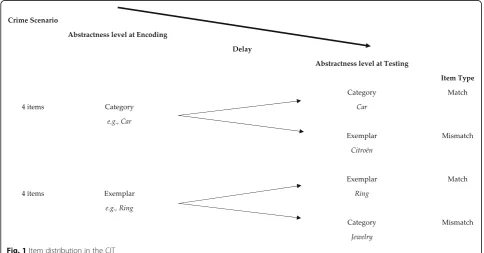
All eight critical items were presented at the categor-ical or exemplar level: two stimuli were encoded at the category level and were also presented at the category
level (e.g. encoded as car, tested as car, congruent with
encoding); two stimuli were encoded at the exemplar level and were also presented at the exemplar level (e.g.
encoded as Citroën, tested as Citroën, congruent with
encoding). In two other instances, the stimuli encoded at the category level were replaced by the corresponding
test stimulus in its exemplar form (e.g. encoded as car,
tested as Citroën; incongruent with encoding, as no
exemplar-level information was made available at encod-ing) and two of the stimuli encoded on the exemplar level were replaced by the corresponding test stimulus
in its category form (e.g. encoded as Citroën, tested as
car; incongruent with encoding, as only exemplar-level
information was made available at encoding; see also Fig.1). Lastly, target items (e.g.train) were added to en-sure that examinees pay attention to all items. These
items have to be answered “yes” and were learned just
before commencing the CIT. Targets were always pre-sented and tested at the same abstractness level as the critical items in the RT-CIT.
Follow-up questionnaire
Motivational states were reported in a questionnaire in-volving five questions that participants had to rate on a 5-point Likert scale (ranging from 1 = not at all to 5 = very much so). This questionnaire measured how well
participants were able to focus on the screen during the CIT, how involved they were in the study, how well their memory was for the items of the planned robbery and the learned target items, as well as how much they tried to avoid detection and appear innocent in the CIT.
Recall and recognition
To examine potential differences in memory perform-ance between the immediate and delayed CIT condition, memory for the critical items of the planned robbery were assessed with a free recall followed by a recognition test after the full procedure. Participants first had to freely recall the eight details from the encoding phase, in which they had planned the robbery. In the subsequent recognition test, participants had to pick the correct de-tails from a list of all eight critical items intermixed with irrelevant options (i.e. four irrelevant options per each critical detail, leading to 40 items).
For recall, the number of correctly recalled details were counted, leading to a total score between, this
rep-resents the possible range 0–8. For recognition, items
were scored as either correct (1) or incorrect (0) and
summed, leading to a total score between 0–8.
Procedure
Participants were invited to come to the laboratory in pairs and work as partners in crime while planning a
robbery. When only one participant showed up (n= 27),
the experimenter took the place of the partner in the planning phase of the mock crime. The experimenter ex-plained that it was important to remember the details
from the crime as well as possible and to visualize actu-ally committing the robbery. In order to prevent pos-sible detection, participants were asked to align their stories as much as possible and study the details extensively.
The experimenter first read the plan for the robbery out loud, with its eight critical details presented in either categorical or exemplar level. Participants had to encode all items by writing down the words, reading it out loud and probing each other for the information. During this encoding phase, the experimenter stayed in the room to assure that participants would not accidentally fill in an exemplar-level detail when aligning their story (e.g. inventing a specific date if they had to encode the month
May). During the encoding phase, the experimenter
asked the pair additional questions to stimulate richer encoding of the crime items and to contextualize the critical details (e.g. discuss how long you have known your partner in crime, and who will be driving the get-away vehicle). Then, the experimenter asked participants one by one to repeat the eight critical details from the robbery, until all items were recalled correctly. Lastly, participants filled in the missing details of the story on paper, followed by a free recall of the items. After this 10-min encoding phase, one participant of the pair was randomly assigned to the immediate testing condition, whereas the other participant was assigned to complete the CIT after a one-week delay (± 1 day). Participants were explicitly instructed not to discuss details of the ex-periment with each other in the one-week period be-tween the encoding phase and the second session.
In the second phase of the experiment, participants were asked to sit behind the computer for the CIT (pro-grammed in Inquisit 4.0). The experimenter explained that the police had received an anonymous tip about an upcoming robbery and that the participant was taken to the police station to undergo a lie detection test. The participant was instructed to try to convince the police of his innocence and beat the lie detector test by hiding all information about the crime. Upon successful con-cealment, the participant would receive an additional 0.5
course credit compensation.1
Then, participants were asked to encode eight target items to which they should respond affirmatively in the CIT, while denying all other information (i.e. both the critical details and irrelevant options). The eight targets were initially presented on the screen for 2 min and par-ticipants were asked to recall all items. Then, they saw the targets for an additional 1 min before recalling them again and continuing to the practice phases of the CIT.
For each of the eight critical details encoded in the crime scenario, the CIT included the correct answer, a target item and four incorrect answers serving as irrele-vant options (ratio 1:1:4). For instance, if May was the
critical stimulus, the target was July and the irrelevant stimuli were June, August, September, and October (cat-egorical Item Type); if May 26 was the critical stimulus, the target was May 30 and the irrelevant stimuli were May 8, May 12, May 17, and May 22 (exemplar Item Type). All eight critical items, eight target items, and 32 irrelevant items were displayed exactly 14 times, leading to a total of 672 trials in the test. These trials were di-vided over two blocks, each containing 336 trials, with a self-paced break in between. The sequence of the stimuli within the block was completely randomized, following a multiple-probe-protocol (see also Verschuere, Kleinberg, & Theocharidou,2015).
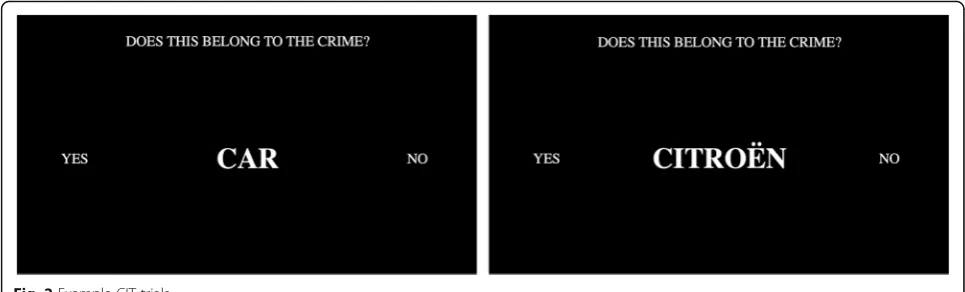
During the test, participants had to respond to the
question “Does this belong to the crime?” by pressing
ei-ther the left button (A-key) for YES, or the right button
(L-key) for NO on their keyboard (see Fig.2). The
ques-tion and the response keys remained on the screen dur-ing the entire test as a reminder. Participants were instructed to respond with YES only to the target items and NO to all other stimuli (i.e. both the correct details of the planned robbery and the irrelevant options). Each trial consisted of one answer (e.g. June) being displayed as a word in the middle of the screen for exactly 1500 ms. If the participant did not respond within the max-imum response deadline of 800 ms, the message TOO SLOW appeared in red above the stimulus for 200 ms. If
the participant’s response was incorrect, that is
respond-ing with NO for target items or with YES to critical or irrelevant items, the word WRONG appeared in red below the stimulus for 200 ms. Response latency was measured from the onset of the stimulus on the screen until one of the response keys was pressed. After key-press or after the 1500 ms presentation time, the
next stimulus appeared on the screen with an
inter-stimulus interval (ISI) of either 250, 500, or 750 ms to prevent response preparation.
stimulus presentation was added, so that the next trial would automatically appear upon key press or after 1500 ms. Again, feedback was given upon an erroneous response, but the TOO SLOW message was never pre-sented. Participants could only proceed to the next phase when their target accuracy was at least 50% and as an additional requirement, when their mean response la-tency was < 800 ms, otherwise this practice phase was repeated until their performance was satisfactory. The last practice phase was identical to the full test, includ-ing the WRONG and TOO SLOW feedback. Partici-pants could proceed to the actual test only when their target accuracy was at least 50% and when their mean response latency was < 800 ms.
After completing the full CIT procedure consisting of 672 trials, participants were presented with a question-naire designed to assess their attention to the tasks, in-volvement in the experiment, memory for the stimuli, and their motivation to avoid detection in the CIT on a 5-point Likert scale (ranging from 1 = not at all to 5 = very much so). Then, participants were told that the ex-periment was finished and they did not have to hide any information anymore. Finally, all participants completed the recall and recognition questionnaire assessing their
memory of the robbery’s details, before being debriefed
and compensated for participation with research credits.
Results
Trials with an incorrect response (i.e. pressing NO for tar-get items or pressing YES for either critical or irrelevant items)2 as well as trials with a RT < 150 ms or > 800 ms were excluded from analysis (see also Verschuere,
Crom-bez, Degrootte, & Rosseel, 2010). On average, 617 trials
(91.8%) per participant were included in the analyses (range 75.6–97.9%).
All analyses used an alpha level of 0.05. Effect sizes for
the ANOVA are reported using Cohen’sf. For follow-up
contrasts, Cohen’sdis used. As a rule of thumb, Cohen
(1992) proposed 0.20, 0.50, and 0.80 as thresholds for
“small,” “moderate,” and “large” effects, respectively, for
d values and 0.10, 0.25, and 0.40 as thresholds for
“small,” “moderate,” and “large” effects for f values. In addition, JZS Bayes factors were computed to further examine detection efficiency using JASP (JASP Team,
2018). Bayes factors are numerical values quantifying the
odds ratio between the null and the alternative
hypoth-esis given the data, with BF01 annotating how much
more likely the data are under the null as compared to
the alternative hypothesis and BF10 annotating how
much more likely the data are under the alternative as compared to the null hypothesis. For one-tailed testing, Bayes factors are reported as either predicting the null
(BF0+) or the alternative hypothesis (BF+ 0) in case of a
positive effect, and BF0−and BF−0for negative effects. A
default JZS prior with scaling factor r= 0.707 was used
for the alternative hypothesis (see Rouder, Speckman, Sun, Morey, & Iverson,2009). Using Jeffreys’(1961) cri-teria, a Bayes factor > 1, 3, 10, and 100 is taken as anec-dotal, substantial, strong, and decisive evidence for the respective hypothesis.
Confirmatory analyses: Concealed Information Test The main analysis consisted of a 2 (Delay: immediate CIT versus one-week-delayed CIT, between-participants) by 2 (Abstractness level at encoding: items encoded on category level versus items encoded on exemplar level, within-participants) by 2 (Abstractness level in the CIT: items tested on category level versus items tested on ex-emplar level, within-participants) mixed ANOVA on the CIT-effect, calculated as the reaction time difference (RTcritical items–RTirrelevant items) in milliseconds.
The mixed ANOVA revealed a significant main effect
of Abstractness level in the CIT, F (1, 134) = 6.24,
p= 0.014, f = 0.21, that subsumed under the significant
interaction between Abstractness level at encoding and
Abstractness level in the CIT, F (1, 134) = 65.85,
p< 0.001,f= 0.70 (i.e. larger RT difference when
encod-ing and testencod-ing were on a congruent level). No
signifi-cant main effect was found for Delay, F (1, 134) = 1.58,
There was no significant main effect of Abstractness
level at encoding, F (1, 134) = 0.79, p = 0.376, f = 0.08.
No significant interaction effect was found between
Ab-stractness level at encoding and Delay,F(1, 134) = 0.72,
p= 0.398,f= 0.07, or Abstractness level in the CIT and
Delay, F (1, 134) = 0.10, p = 0.757, f = 0.03. Lastly, the
three-way interaction did not reveal significant effects,F
(1, 134) = 1.58e-5,p= 0.997,f= 0.00.
To narrow down the predicted Abstractness level at encoding by Abstractness level in the CIT interaction, planned contrasts were conducted across the immediate and delayed condition with Item Type as fixed factors (i.e. Category-Category, Category-Exemplar,
Exemplar-Category, and Exemplar-Exemplar).3
A first planned contrast compared the RT difference between the Category-Exemplar Item Type with the three other Item Types to test the hypothesis that participants with categorical information only do not show recognition of the exemplar-level stimuli. The contrast revealed a significantly smaller CIT-effect in the Category-Exemplar Item Type compared to the three other Item Types in which knowledge existed, t (355.99) = 5.48, p < 0.001.4
A second planned contrast compared the RT difference of the Exemplar-Category Item Type with the two Item Types in which the abstractness level was the congruent for
Encoding and Testing (i.e. Category-Category and
Exemplar-Exemplar). The contrast revealed that the CIT-effect was significantly lower in the Exemplar-Category Item Type than for the other two Item Types, t (332.20) =
7.89, p < 0.001.5 Note that the Category-Exemplar Item
Type was not included in these contrasts, since participants are not expected to have a larger response latency to the critical compared to irrelevant items.
Following the preregistration, an additional compari-son was performed on the Category-Category versus Exemplar-Exemplar Item Types, to examine whether questions in the CIT are best asked on category or on the exemplar level when encoded in the congruent level.
The two-tailed paired-samples t-test revealed that the
CIT-effect for the Category-Category (M = 13.80, SD=
31.99) was smaller than that of the Exemplar-Exemplar
Item Type (M = 20.82, SD = 33.55), t (135) = 2.19,
p = 0.030, d = 0.19.6 However, an additional Bayesian
two-tailed paired-samplest-test revealed that this
differ-ence was not sufficiently supported by the data, as the Bayes factor for the CIT-effect difference between Category-Category and the Exemplar-Exemplar Item Types was close to 1 (BF= 1.04 in favor of H0).7
Moreover, as per preregistration, a one-tailed Bayesian
paired-samples t-test was performed on the
critical-ir-relevant contrast in each condition to investigate
whether detection efficiency was above chance. Table 1
shows the mean scores for each cell of the design. For
both the immediate and delayed CIT conditions, the re-sults revealed the expected CIT-effect for the Item Types Category-Category and Exemplar-Exemplar, reflected by strong to decisive evidence that recognition of the critical item results in larger RTs to the critical com-pared to the irrelevant items. For the Item Type Exemplar-Category there was no CIT-effect, reflected by strong evidence for the null showing no generalization from the exemplar to the category level. For the
two-tailed Category-Exemplar Item Type analysis,
Bayesian statistics revealed anecdotal to substantial evi-dence for the null hypothesis. Indeed, as participants encoded the critical information at the categorical level, they were not expected to distinguish the correct exem-plar from the irrelevant exemexem-plars in the CIT.
Exploratory analyses
For all questions in the follow-up questionnaire, an
independent-samples t-test was conducted to evaluate
whether the ratings of participants in the immediate
condition (n= 65) differed significantly from participants
who completed the CIT after a one-week delay (n= 68).
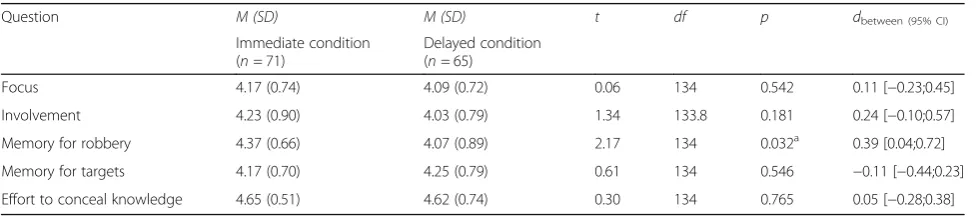
As predicted, participants in the immediate condition re-ported to have a better memory for details of the crime scenario than participants who were tested after a one-week delay. Participants in both conditions did not significantly differ in their focus, involvement, or effort
to hide the critical information. Table2 shows the mean
scores for each cell of the design.
For all memory data, one-tailed independent-samples
t-tests were conducted to evaluate whether the memory of
participants in the immediate CIT condition (n= 71) was
significantly higher than that for those tested after a
one-week delay (n= 65). For the free recall, the number of
correctly remembered details was counted (range 0–8).
For the recognition check the items were scored as either
incorrect (0) or correct (1) and summed (range 0–8).
While participants in the immediate condition recalled more items than participants in the delayed condition, no
differences emerged on recognition scores. Table3shows
the mean scores for each cell of the design.
Discussion
level, while the other four items were replaced by its antagonistic level of abstractness, leading to a crossed design. Results indicate an interaction between encod-ing and testencod-ing, such that CIT validity is highest when there is a match (i.e. congruency) between how infor-mation is encoded and tested. Delay between planning the crime and the memory detection test did not in-fluence these results.
Item selection in the Concealed Information Test
While the idea of using response latency to index
decep-tion is almost a century old (see Luria, 1932; Marston,
1920), current measurement equipment made it possible
to pick up on differences in milliseconds between truth-fully and falsely denying knowledge of a crime detail. Since then, the potential of RTs to support the notion that lying is more demanding than truth-telling, and hence takes more time, has been validated (Suchotzki, Verschuere, Van Bockstaele, Ben-Shakhar, & Crombez,
2017). The present findings are consistent with the
no-tion that lying is more demanding than truth-telling by showing enhanced RTs when denying recognition of pre-viously learned critical details. Importantly, this pattern did not arise when responding to unknown exemplar items after encoding items merely at the category level. Both these patterns affirm the validity of memory detec-tion using the RT measure to distinguish between knowledgeable and unknowledgeable individuals.
When general details from the crime are leaked to innocent suspects during interrogation or from the media, it could lead to a false indication of concealed information knowledge. Upon recognition of the crime details, the innocent suspect may show a distinct re-sponse pattern to the critical details relative to the
well-matched alternative options. While such
false-positive outcomes may be circumvented by prob-ing for more specific knowledge, this could result in false negatives, as the true culprit might not recall such specific information from the crime. The current results indicate no decreased detection efficiency when encoding and testing specific items in the CIT as compared to using broader categories. While a statisti-cally significant difference was found favoring the Exemplar-Exemplar Item Type over Categorical en-coding and testing, Bayesian analysis was inconclusive. Additional research will be required to reach firm con-clusions regarding the optimal balance between
sensi-tivity and specificity, especially since extensive
memory research has demonstrated that the categor-ical level is optimal for various cognitive functions, such as perception and most importantly, memory
(Rosch, Mervis, Gray, Johnson, & Boyes-Braem,1976).
Yet, given the risk associated with information contamin-ation, the current results suggest that the exemplar-level CIT could become a promising tool in the future when leakage is suspected.
Table 1Mean reaction times (in ms) for the immediate and delayed condition per Item Type
Item Type M (SD) dwithin (95% CI) BF M (SD) dwithin (95% CI) BF
Immediate CIT condition (n= 71) Delayed CIT condition (n= 65)
Category-Category Critical 500 (56) 0.47 [0.24;0.71] BF+ 0= 407.31 493 (51) 0.37 [0.12;0.62] BF+ 0= 12.67
Irrelevant 484 (43) 482 (49)
Exemplar-Exemplar Critical 503 (62) 0.55 [0.31;0.80] BF+ 0= 3368.63 497 (53) 0.69 [0.43;0.96] BF+ 0= 92,092.37
Irrelevant 482 (49) 477 (50)
Exemplar-Category Critical 474 (50) −0.23 [−0.46;0.01] BF0+= 19.62 473 (61) −0.27 [−0.51;-0.02] BF0+= 22.56
Irrelevant 480 (43) 480 (53)
Category-Exemplar Critical 471 (49) −0.06 [−0.28;0.16] BF01= 7.13 466 (53) −0.23 [−0.47;0.02] BF01= 1.12
Irrelevant 472 (48) 471 (52)
Table 2Mean scores on the follow-up questionnaire (5-point Likert scale)
Question M (SD) M (SD) t df p dbetween (95% CI)
Immediate condition (n= 71)
Delayed condition (n= 65)
Focus 4.17 (0.74) 4.09 (0.72) 0.06 134 0.542 0.11 [−0.23;0.45]
Involvement 4.23 (0.90) 4.03 (0.79) 1.34 133.8 0.181 0.24 [−0.10;0.57]
Memory for robbery 4.37 (0.66) 4.07 (0.89) 2.17 134 0.032a 0.39 [0.04;0.72]
Memory for targets 4.17 (0.70) 4.25 (0.79) 0.61 134 0.546 −0.11 [−0.44;0.23]
Effort to conceal knowledge 4.65 (0.51) 4.62 (0.74) 0.30 134 0.765 0.05 [−0.28;0.38]
Generalization
In the current study, no generalization occurred when
details were encoded in its’exemplar form (e.g. Citroën)
and the CIT-question asked about the categorical getaway vehicle (e.g. train, bike,taxi, car, orbus). Earlier CIT re-search has demonstrated the sensibility of the CIT to de-tect partial information, such as synonyms of the critical
detail. Moreover, Ben-Shakhar et al. (1996) showed a
mod-erate degree of physiological generalization from items
encoded at the exemplar level (e.g. apple) to its
super-ordinate category level (e.g. fruit). In the current study,
this effect was not replicated, neither in the immediate nor in the delayed condition.
We have speculated whether the absence of
generalization could have been a result of the fast and cognitively demanding character of the RT-CIT in which all eight details were flashed on the screen in random order, either in its categorical or exemplar form. Consequently, participants might have not rec-ognized the subordinate items as such, leading to un-changed behavior upon presentation of the critical
items. However, an additional pilot study (n = 75)
using the single-probe protocol of the RT-CIT (for
the procedure, see Verschuere et al., 2015), in which
all items belonging to a single question are presented sequentially before continuing to the next question, rather than presenting all items randomly intermixed, revealed similar results as the current study, including the lack of generalization.
Another possibility could lay in the fact that partici-pants in both the immediate condition as well as after a one-week delay had a high recall and recognition ability of the eight critical items. Interestingly, mem-ory research has indicated that especially over time, information is most likely retained at the basic
cat-egory level (Pansky & Koriat, 2004). Recollection of
specific details declines over time, while the gist of the event remains (Conway, Cohen, & Stanhope,
1991; Kintsch, Welsch, Schmalhofer, & Zimny, 1990).
More specifically, a slower forgetting curve was found
for basic level categorical information (e.g. bird),
whereas individuals could not anymore distinguish
be-tween exemplar-level items (e.g. sparrow or canary;
Dorfman & Mandler, 1994). It might be the case that
since the memory for the original information was
nearly perfect, the details were not yet converged to its categorical name, thereby explaining the lack of
generalization from Citroën to car.
Delay
In contrast to the present results, several studies (Carmel
et al., 2003; Gamer et al., 2010; Nahari & Ben-Shakhar,
2011) found an attenuated, yet significant CIT effect when
the test was administered after a one- or two-week delay, which was more pronounced for peripheral items as op-posed to details central to the crime. Although with a small sample, Hira, Sasaki, Matsuda, Furumitsu, and
Fur-edy (2001, 2002) found that participants guilty of a
mock-crime could be detected after a one-month and even a one-year delay. With the current results in mind, the categorical CIT might still be effective when adminis-tered sometime after the crime. Our findings showing no detrimental effect of delaying the CIT may be accounted for by our use of well-rehearsed items. However, as mem-ory research has demonstrated optimal memmem-ory retention for the categorical level, further studies investigating the level of abstractness on which details are encoded, stored, and retrieved by culprits, should give more insight in the expected effects of a highly detailed CIT with regard to false-negative outcomes. While the current results indi-cate positive effects for the exemplar-level CIT after a one-week time delay in preventing false positives, further research should confirm its validity.
Limitations and suggestions for future research
Questions can be raised about the success of the delay manipulation. While a statistically significant reduction in recall was revealed between participants who con-ducted the CIT immediately versus after a one-week delay, the size of the reduction was rather small, imply-ing negligible practical significance. Furthermore, for both conditions, a clear ceiling effect can be observed in the recognition memory test, with no differences due to time delay. As the CIT is a test of recognition, this might explain the absence of an effect of delay in the current paradigm. Further research should elongate the time interval between the planning of the robbery and the memory detection test, as this is common practice in the field of deception detection.
Table 3Mean scores (SDs in parentheses) on the memory questionnaires (range 0-8)
Question M (SD) M (SD) t df p dbetween (95% CI)
Immediate condition (n= 71)
Delayed condition (n= 65)
Recall 7.70 (0.52) 7.03 (1.22) 4.11 84.62 < 0.001 0.72 [0.35;1.06]
Moreover, the encoding phase was very exhaustive and might have caused the ceiling effect in memory perform-ance. This might be one possible reason why no generalization occurred from the exemplar to the cat-egory level. By studying the mock robbery on a more contextual level in future research, in contrast to the specific semantic setting of the current experiment, par-ticipants might also show increased responses to the
word “car,” as opposed to “Citroën.” A successful time
delay manipulation is expected to also influence the
de-tailedness of the culprit’s memory, as memory
perform-ance declines over time. While the perpetrator might still remember that he fled the crime scene with the
nearest parked Citroën, three months after the crime,
this memory might have changed to the word“car,”
un-less the specific information was highly salient (e.g. when the Citroën was specifically chosen because of its discrete color or strong engine, it is very likely that this item is central to the crime and will be better stored in memory).
To further examine the external validity of the CIT, fu-ture studies should include a less strong encoding ma-nipulation and/or a more realistic scenario, possibly presented in a visual or virtual-reality format. Moreover, as the current results based on RTs partially contradict previous results based on the electrodermal measure
(Ben-Shakhar et al., 1996), it will be important to
repli-cate the current experiment using psychophysiological measures. It should be noted that while the electroder-mal measure reflects orienting response (see also klein
Selle, Verschuere, Kindt, Meijer, & Ben-Shakhar, 2016,
2017), reaction time measures reflect different processes
(e.g. cognitive load, inhibition, and response conflict). Consequently, the two types of measures can also be af-fected by different factors.
Take home message
The current results indicate that what constitutes a good CIT question is very dependent on the encoding of the crime scene, thereby challenging examiners to formulate appropriate items to achieve an optimal balance between sensitivity and specificity.
Endnotes
1
Participants were given the bonus in research credits when their individual CIT score (dCIT= (MRT(critical items)
–MRT(irrelevant items)) / SDRT(irrelevant items)) was < 0.2 (see
also Noordraven & Verschuere,2013).
2
See online Additional file2for additional exploratory
analyses on error rates.
3
For sake of readability and correctness, as there was no significant influence of a time delay on CIT perform-ance, the reported contrasts were conducted across the immediate and delayed CIT condition. As this is a
deviation from the preregistration, the planned contrasts separately for each condition can be found in footnotes.
4
For the immediate CIT condition, the planned con-trast revealed that in the Category-Exemplar Item Type, in which no recognition was possible, there was a signifi-cantly smaller CIT-effect compared to the three other
levels,t(218.49) = 3.79,p< 0.001. For the delayed
con-dition, the planned contrast also revealed a significantly smaller CIT-effect in the Category-Exemplar Item Type
compared to the three other Item Types, t(256) = 3.50,
p= 0.001.
5
For the immediate CIT condition, the planned contrast revealed that the CIT-effect was significantly lower in the Exemplar-Category Item Type than for the other two Item Types,t(183.90) = 5.62,p< 0.001. For the delayed condi-tion, the planned contrast also revealed that the CIT-effect was significantly lower in the Exemplar-Category Item Type
than for the other two Item Types, t (256) = 5.60,
p< 0.001.
6
The two-tailed paired-samples t-test revealed for the
immediate condition that the CIT-effect for the
Category-Category (M= 16.63,SD= 33.99) was not
sig-nificantly different from the Exemplar-Exemplar Item
Type (M = 21.18, SD= 37.56),t (70) = 0.98, p= 0.332,
d = 0.12. For the delayed condition, the CIT-effect for
the Category-Category (M = 10.71,SD= 29.61) was
sig-nificantly smaller than that of the Exemplar-Exemplar
Item Type (M = 20.42, SD = 28.83), t (64) = 2.22,
p= 0.030,d= 0.27.
7
For the immediate CIT-condition, the Bayesian
two-tailed paired-samples t-test revealed substantial
evi-dence that there are no differences in the CIT-effect be-tween the Category-Category and the Exemplar-Exemplar
Item Types,BF= 4.85 in favor of H0. For the delayed
con-dition, the Bayesian two-tailed paired-samples t-test
re-vealed no conclusive result whether the CIT-effect for the Category-Category differed from the Exemplar-Exemplar Item Type,BF= 0.75 in favor of H0.
Additional files
Additional file 1:Item combinations in the crime scenario. (DOCX 21 kb)
Additional file 2:Exploratory analyses on error rates. (DOCX 24 kb)
Acknowledgements
We thank Elisa Cordesius, Wouter Dossche, and Jeannique Zimmerman for assistance in data collection.
Funding
This research was funded by a grant, no. 238/15, from the Israel Science Foundation to Gershon.
Ben-Shakhar and a grant from the University of Amsterdam to Bruno Verschuere.
Availability of data and materials
Authors’contributions
LG, GB-S, and BV contributed to developing the experiment. All authors approved the final design of the study. LG set up the experiment, performed the statistical analyses, and wrote the manuscript. All co-authors provided critical feedback on the manuscript and approved the final draft.
Ethics approval and consent to participate
The study was approved by the ethical committee of the Department of Psychology of the University of Amsterdam (2017-CP-7836). All participants provided consent before taking part in the study.
Consent for publication
Not applicable.
Competing interests
The authors declare that they have no competing interests.
Publisher’s Note
Springer Nature remains neutral with regard to jurisdictional claims in published maps and institutional affiliations.
Received: 31 August 2018 Accepted: 25 February 2019
References
Ben-Shakhar, G., Frost, R., Gati, I., & Kresh, Y. (1996). Is an apple a fruit? Semantic relatedness as reflected by psychophysiological responsivity.Psychophysiology,
33(6), 671–679.https://doi.org/10.1111/j.1469-8986.1996.tb02363.x.
Ben-Shakhar, G., & Gati, I. (1987). Common and distinctive features of verbal and pictorial stimuli as determinants of psychophysiological responsivity.Journal of Experimental Psychology: General,116(2), 91–105.https://doi.org/10.1037/ 0096-3445.116.2.91.
Ben-Shakhar, G., Gati, I., & Salamon, N. (1995). Generalization of the orienting response to significant stimuli: The roles of common and distinctive stimulus components.Psychophysiology,32(1), 36–42. https://doi.org/10.1111/j.1469-8986.1995.tb03403.x.
Bradley, M. T., Barefoot, C. A., & Arsenault, A. M. (2011). Leakage of information to innocent suspects. In B. Verschuere, G. Ben-Shakhar, & E. Meijer (Eds.),
Memory detection: Theory and application of the concealed information test, (pp. 187–199). Cambridge: Cambridge University Press.https://doi.org/10. 1017/CBO9780511975196.011.
Bradley, M. T., MacLaren, V. V., & Carle, S. B. (1996). Deception and nondeception in guilty knowledge and guilty actions polygraph tests.Journal of Applied Psychology,81(2), 153–160.https://doi.org/10.1037/0021-9010.81.2.153. Bradley, M. T., & Rettinger, J. (1992). Awareness of crime-relevant information and
the Guilty Knowledge Test.Journal of Applied Psychology,77(1), 55–59.
https://doi.org/10.1037/0021-9010.77.1.55.
Bradley, M. T., & Warfield, J. F. (1984). Innocence, information, and the guilty knowledge test in the detection of deception.Psychophysiology,21(6), 683– 689.https://doi.org/10.1111/j.1469-8986.1984.tb00257.x.
Carmel, D., Dayan, E., Naveh, A., Raveh, O., & Ben-Shakhar, G. (2003). Estimating the validity of the guilty knowledge test from simulated experiments: The external validity of mock crime studies.Journal of Experimental Psychology: Applied,9(4), 261–269.https://doi.org/10.1037/1076-898X.9.4.261. Cohen, J. (1992). Statistical power analysis.Current Directions in Psychological
Science,1(3), 98–101.https://doi.org/10.1111/1467-8721.ep10768783. Conway, M. A., Cohen, G., & Stanhope, N. (1991). On the very long-term retention
of knowledge acquired through formal education: Twelve years of cognitive psychology.Journal of Experimental Psychology: General,120(4), 395–409.
https://doi.org/10.1037/0096-3445.120.4.395.
Donchin, E. (1981). Surprise!...Surprise?Psychophysiology,18(5), 493–513.https:// doi.org/10.1111/j.1469-8986.1981.tb01815.x.
Dorfman, J., & Mandler, G. (1994). Implicit and explicit forgetting: When is gist remembered?The Quarterly Journal of Experimental Psychology Section A,
47(3), 651–672.https://doi.org/10.1080/14640749408401132.
Gamer, M. (2010). Does the Guilty Actions Test allow for differentiating guilty participants from informed innocents? A re-examination.International Journal of Psychophysiology,76(1), 19–24.https://doi.org/10.1016/j. ijpsycho.2010.01.009.
Gamer, M., Kosiol, D., & Vossel, G. (2010). Strength of memory encoding affects physiological responses in the Guilty Actions Test.Biological Psychology,83(2), 101–107.https://doi.org/10.1016/j.biopsycho.2009.11.005.
Hira, S., Sasaki, M., Matsuda, T., Furumitsu, I., & Furedy, J. J. (2001). Pz-recorded P300 is highly accurate and sensitive to a memorial manipulation in an objective laboratory guilty knowledge test.Psychophysiology,38, S50. Hira, S., Sasaki, M., Matsuda, T., Furumitsu, I., & Furedy, J. J. (2002). A year after the
commission of a mock crime, the P300 amplitudes, but not reaction time, are sensitive guilty knowledge test indicators.Psychophysiology,39, S42. JASP Team (2018). JASP (Version 0.9)[Computer software].
Jeffreys, H. (1961).Theory of probability, (3rd ed., ). Oxford: Oxford University Press. Kintsch, W., Welsch, D., Schmalhofer, F., & Zimny, S. (1990). Sentence memory: A
theoretical analysis.Journal of Memory and Language,29(2), 133–159.https:// doi.org/10.1016/0749-596X(90)90069-C.
klein Selle, N., Verschuere, B., Kindt, M., Meijer, E., & Ben-Shakhar, G. (2016). Orienting versus inhibition in the Concealed Information Test: Different cognitive processes drive different physiological measures.Psychophysiology,
53(4), 579–590.https://doi.org/10.1111/psyp.12583.
klein Selle, N., Verschuere, B., Kindt, M., Meijer, E., & Ben-Shakhar, G. (2017). Unraveling the roles of orienting and inhibition in the Concealed Information Test.
Psychophysiology,54(4), 628–639.https://doi.org/10.1111/psyp.12825. Kleinberg, B., & Verschuere, B. (2015). Memory detection 2.0:The first web-based
memory detection test memory.PLoS One,10(4), e0118715.https://doi.org/ 10.1371/journal.pone.0118715.
Luria, A. R. (1932).The nature of human conflicts. Oxford: Liveright. Lykken, D. T. (1959). The GSR in the detection of guilt.Journal of Applied
Psychology,43(6), 385–388.https://doi.org/10.1037/h0046060. Marston, W. M. (1920). Reaction-time symptoms of deception.Journal of
Experimental Psychology,3(1), 72–87.https://doi.org/10.1037/h0067963. Nahari, G., & Ben-Shakhar, G. (2011). Psychophysiological and behavioral measures
for detecting concealed information: The role of memory for crime details.
Psychophysiology,48(6), 733–744.https://doi.org/10.1111/j.1469-8986.2010.01148.x. Noordraven, E., & Verschuere, B. (2013). Predicting the sensitivity of the reaction
time-based Concealed Information Test.Applied Cognitive Psychology,27(3), 328–335.https://doi.org/10.1002/acp.2910.
Osugi, A. (2018). Field findings from the Concealed Information Test in Japan. In J. P. Rosenfeld (Ed.),Detecting Concealed Information and Deception: Recent Developments, (pp. 97–121). Cambridge: Academic Press.https://doi.org/10. 1016/B978-0-12-812729-2.00005-7.
Pansky, A., & Koriat, A. (2004). The basic-level convergence effect in memory distortions.Psychological Science,15(1), 52–59. https://doi.org/10.1111/j.0963-7214.2004.01501009.x.
Peth, J., Vossel, G., & Gamer, M. (2012). Emotional arousal modulates the encoding of crime-related details and corresponding physiological responses in the Concealed Information Test.Psychophysiology,49(3), 381–390.https:// doi.org/10.1111/j.1469-8986.2011.01313.x.
Rosch, E., Mervis, C. B., Gray, W. D., Johnson, D. M., & Boyes-Braem, P. (1976). Basic objects in natural categories.Cognitive Psychology,8(3), 382–439.https://doi. org/10.1016/0010-0285(76)90013-X.
Rouder, J. N., Speckman, P. L., Sun, D., Morey, R. D., & Iverson, G. (2009). Bayesian t tests for accepting and rejecting the null hypothesis.Psychonomic Bulletin and Review,16(2), 225–237.https://doi.org/10.3758/PBR.16.2.225.
Sauerland, M., Wolfs, A. C. F., Crans, S., & Verschuere, B. (2017). Testing a potential alternative to traditional identification procedures: Reaction time-based concealed information test does not work for lineups with cooperative witnesses.
Psychological Research, 1–13.https://doi.org/10.1007/s00426-017-0948-5. Sokolov, E. N. (1963).Perception and the conditioned reflex. New York: Macmillan. Suchotzki, K., Verschuere, B., Van Bockstaele, B., Ben-Shakhar, G., & Crombez, G.
(2017). Lying takes time: A meta-analysis on reaction time measures of deception.Psychological Bulletin,143(4), 428–453.https://doi.org/10.1037/ bul0000087.
Verschuere, B., Ben-Shakhar, G., & Meijer, E. (Eds.) (2011).Memory detection: Theory and application of the concealed information test. Cambridge: Cambridge University Press.https://doi.org/10.1017/CBO9780511975196.
Verschuere, B., Crombez, G., Degrootte, T., & Rosseel, Y. (2010). Detecting concealed information with reaction times: Validity and comparison with the polygraph.
Applied Cognitive Psychology,24(7), 991–1002.https://doi.org/10.1002/acp.1601. Verschuere, B., Kleinberg, B., & Theocharidou, K. (2015). RT-based memory
detection: Item saliency effects in the single-probe and the multiple-probe protocol.Journal of Applied Research in Memory and Cognition,4(1), 59–65.