P R O T O C O L
Open Access
A review protocol on research partnerships:
a Coordinated Multicenter Team approach
Femke Hoekstra
1,12*†, Kelly J. Mrklas
2,3†, Kathryn M. Sibley
4, Tram Nguyen
5,6, Mathew Vis-Dunbar
7,
Christine J. Neilson
8, Leah K. Crockett
4,9, Heather L. Gainforth
1,12*†and Ian D. Graham
10,11†Abstract
Background:Research partnership approaches, in which researchers and stakeholders work together collaboratively on a research project, are an important component of research, knowledge translation, and implementation. Despite their growing use, a comprehensive understanding of the principles, strategies, outcomes, and impacts of different types of research partnerships is lacking. Generating high-quality evidence in this area is challenging due to the breadth and diversity of relevant literature. We established a Coordinated Multicenter Team approach to identify and synthesize the partnership literature and better understand the evidence base. This review protocol outlines an innovative approach to locating, reviewing, and synthesizing the literature on research partnerships.
Methods:Five reviews pertaining to research partnerships are proposed. The Coordinated Multicenter Team developed a consensus-driven conceptual framework to guide the reviews. First, a review of reviews will comparatively describe and synthesize key domains (principles, strategies, outcomes, and impacts) for different research partnership approaches, within and beyond health (e.g., integrated knowledge translation, participatory action research). After identifying commonly used search terminology, three complementary scoping reviews will describe and synthesize these domains in the health research partnership literature. Finally, an umbrella review will amalgamate and reflect on the collective findings and identify research gaps and future directions. We will develop a collaborative review methodology, comprising search strategy efficiencies, terminology standardization, and the division of screening, extraction, and synthesis to optimize feasibility and literature capture. A series of synthesis and scoping manuscripts will emerge from this Coordinated Multicenter Team approach.
Discussion:Comprehensively describing and differentiating research partnership terminology and its domains will address well-documented gaps in the literature. These efforts will contribute to and improve the quality, conduct, and reporting of research partnership literature. The collaborative review methodology will help identify and establish common terms, leverage efficiencies (e.g., expertise, experience, search and protocol design, resources) and optimize research feasibility and quality. Our approach allows for enhanced scope and inclusivity of all research user groups and domains, thereby contributing uniquely to the literature. This multicenter, efficiency and quality-focused approach may serve to inspire researchers across the globe in addressing similar domain challenges, as exist in this rapidly expanding field.
Keywords:Knowledge synthesis, Multicenter study, Collaborative research partnerships, Integrated knowledge translation, Community-based participatory research, Stakeholder engagement, Research principles and strategies, Research outcomes and impact
* Correspondence:[email protected];[email protected] †Femke Hoekstra, Kelly J. Mrklas, Heather L. Gainforth and Ian D. Graham
contributed equally to this work.
1School of Health and Exercise Sciences, University of British Columbia
Okanagan, Kelowna, BC, Canada
Full list of author information is available at the end of the article
Background
Research partnership approaches, in which researchers and stakeholders work together collaboratively on a re-search project, are an important component of rere-search, knowledge translation, and implementation [1–4]. These approaches are becoming increasingly popular, as efforts to ensconce stakeholder engagement within health care research, implementation, and improvement work con-verge, and are prioritized by health care systems, re-search funders, government, and other organizations [4]. In particular, the active integration of patients and patient-identified priorities into the research process [5–
7] has become much more frequent and, in many cases, is now a mandated expectation of research teams [5, 8–
10]. Research partnership approaches align well with ef-forts to enhance participant empowerment [11], elevate disenfranchised voices [12], and engage in real-world so-lution finding [13] to improve research relevance and impact [14–17].
Over the last half of a century or more, research part-nership approaches have evolved within multiple re-search domains. A number of these approaches can be differentiated by important similarities and differences (e.g., integrated knowledge translation (IKT), participa-tory research, co-production, participaparticipa-tory action re-search (PAR), engaged scholarship, Mode 2 knowledge production) [14,15, 17–19]. This variability of approach and terminology presents considerable challenges for synthesis research in the field of research partnerships, particularly in the sub-field of IKT. The dispersion and variation of relevant literature is daunting, both scientif-ically and logistscientif-ically, and in many cases precludes at-tempts at more exhaustive reviews [3, 15, 20, 21]. Research partnership terminology [22–24] and defini-tions [15,25] vary significantly by discipline and are still actively evolving, making IKT and other research part-nership approaches difficult to capture conceptually [1–
3,21,25–33].
IKT1, in particular, has been compared and contrasted to other types of research partnership approaches. To il-lustrate, Salsberg and Merati [19], Salsberg [18], Jull and colleagues [15], and Bowen [34] highlight important comparisons between IKT and participatory health re-search: IKT and PAR, IKT and community-based partici-patory research (CBPR), and engaged scholarship and participatory research, respectively. However, syntheses conducted in this area to date highlight considerable limitations and challenges, such as the use of scope con-trol techniques and the amenability of reported data for extraction and synthesis [1,2,21,35–37].
In preparing this protocol, we were unable to identify a single synthesis that located, described, compared, or evaluated the literature pertaining to both IKT and re-lated partnership research approaches within the health
domain, or beyond. We identified a single review exam-ining empirically evaluated IKT studies [21], and several syntheses focused on individual types of partnerships and relevant domains [29, 37–39]. No synthesis that comparatively described principles, strategies, outcomes, and impacts in different types of research partnership approaches was identified. The implications of these findings are significant. The co-existence of multiple, po-tentially relevant evidence domains is well-recognized; yet, this evidence remains largely disconnected and is often viewed superficially, or within disciplines alone. We believe that extending the comparative analysis to other domains (principles, strategies, outcomes, impacts) may help researchers more deliberately apply and rigor-ously evaluate research partnership approaches in future. Comparative analytics examining how and why IKT and other research partnership approaches work, the key do-mains (principles, strategies, outcomes, impacts), and the contextual conditions under which these approaches function may allow more deliberate and efficient stake-holder engagement [1, 21] and would represent a major step forward in the design, conduct, assessment, and im-pact of IKT and other research partnership approaches, in real-world settings.
This protocol describes the work plan of a newly established Coordinated Multicenter Team, focused on optimizing the quality and efficiency of IKT and other research partnership syntheses. The team has a specific interest in IKT [20, 40, 41] and applied this lens in the design of the proposed studies. Using a collaborative ap-proach, we will build consensus strategies to address common challenges (e.g., terminology, definitions, con-ceptual similarities/differences, evidence volume and dis-persion, logistics/resource and feasibility issues) faced by researchers attempting to synthesize the research part-nership literature, including the sub-field of IKT. The three main aims of this study are to:
1. Systematically scope the literature and
comparatively describe and synthesize principles, strategies, outcomes, and impacts reported in different types of research partnership approaches within and beyond health;
2. Describe and synthesize the principles, strategies, outcomes, and impacts and the accompanying research methods and tools reported in different types of health research partnership studies; and 3. Amalgamate and reflect on the collective findings
and identify research gaps and future directions.
Methods
approaches. This work will contribute to broadening and deepening the the evidence base for research partner-ships and practice.
Coordinated Multicenter Team
A Coordinated Multicenter Team approach to plan, exe-cute, assess, and report the proposed research syntheses will be used. The team is spread geographically and comprises clustered, multicenter teams working on com-plementary themes and projects. This approach will cre-ate resource and time efficiency, high productivity, and effectiveness and enhance methodological, logistical, and reporting quality within this area of the research litera-ture. The Coordinated Multicenter Team comprises cur-rently nine individuals (KJM, FH, KMS, TN, MVD, CJN, LKC, IDG, HG) across six academic and healthcare cen-ters (University of Calgary, Alberta Health Services, Uni-versity of British Columbia Okanagan, UniUni-versity of Manitoba, Ottawa Hospital Research Institute, Univer-sity of Ottawa). Our work is embedded within an inter-national integrated knowledge translation research network [42] established to systematically study and ad-vance what is known and documented about IKT.
Engagement of stakeholders in the proposed studies Our Coordinated Multicenter Team will both study and employ an IKT approach in the proposed re-search [43]. Team members work with several stake-holder groups who have a vested interest in improving the science of IKT, including patients, in particular. A steering committee, consisting of a di-verse representation of stakeholders (e.g., patients, policy and decision-makers, healthcare professionals, researchers), will be established for each individual re-view (see Appendix 1). Committee members will be actively involved in reviews according to their needs and preferences and according to the specific needs of each review [44–46]. At a minimum, the Coordi-nated Multicenter Team will engage its stakeholders in the following research phases:
– Conceptual design and formulation of the research questions
– Before starting data extraction
– Data analysis, interpretation, and dissemination of results
Study design
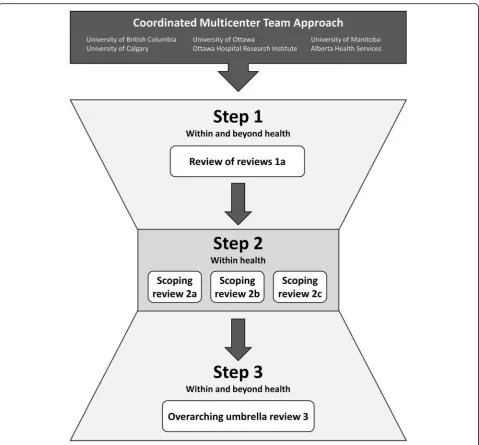
Scoping practices outlined by Arksey, O’Malley, and other colleagues [47–51] guide our work to identify and describe the research questions, identify and se-lect studies, abstract, collate, synthesize, and validate findings. Given the diversity of terminology and the dispersion of this literature, we will synthesize in
three steps (Fig. 1). First, we will start broadly by conducting a review of reviews to comparatively de-scribe and synthesize key domains (principles, strat-egies, outcomes, and impacts) for different research partnership approaches, within and beyond health (step 1). In this first step, we will identify the re-search partnership terminology and rere-search scope in different practice domains in order to optimize our search strategies for subsequent steps. Secondly, using a more refined set of search strategy terms informed by the review of reviews, we will conduct several scoping reviews to describe and synthesize each key domain further in the health research partnership lit-erature (step 2). Finally, we will amalgamate and re-flect on the findings of all reviews conducted in the previous steps, using an umbrella review, to draw overarching conclusions, describe our collaborative approach and future directions, and contribute to the research agenda (step 3). A series of scoping and syn-thesis manuscripts will emerge a review of reviews (1a), three scoping reviews (2a–c), and one overarch-ing umbrella review (3a).
The planning, execution, evaluation, and reporting of all reviews and findings will be guided by the Cochrane Collaboration Handbook of Systematic Reviews [52], the Preferred Reporting Items for Systematic Review and Meta-Analysis Protocols (PRISMA-P) [53], Preferred Reporting Items for Systematic Review and Meta-Analysis Equity (PRISMA-E) [54], and the emer-gent PRISMA-ScR for Scoping Reviews [55], and recent guidance from Pollock and colleagues for the conduct of overviews of reviews [56]. Details about the compliance with the PRISMA-P guidelines are described in Additional file1.
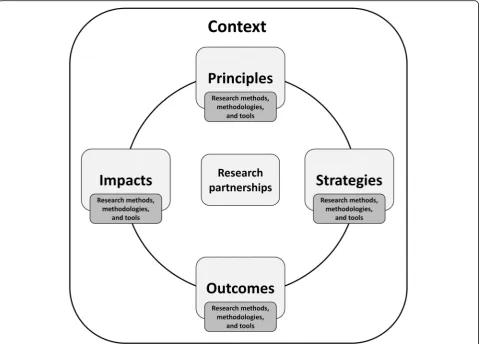
Guiding conceptual framework
that the nature of each of the proposed domains will be heavily influenced bycontext.
For the purpose of this review, we will use the follow-ing operational terms and definitions:
– Research partnerships:“individuals, groups, or
organizations engaged in collaborative research activity involving at least one researcher (e.g., individual affiliated with an academic institution) and any stakeholder actively engaged in any part of the research process (e.g., decision or policy maker, health care administrator or leader, community agency, charities, network, patients etc.)”[1,57]. Examples of research partnership approaches
include, but are not limited to, IKT, participatory research, and participatory action research.
– Principles:“fundamental norms, rules, or values that
represent what is desirable and positive for a person, group, organization, or community and help it in determining the rightfulness or wrongfulness of its actions. Principles are more basic than policy and objectives and are meant to govern both”[58].
– Strategies:“observable actions designed to achieve an
outcome”[59].
– Outcomes:“a planned,a prioriassessment described
in the study methods that is used to determine a change in status as a result of interventions, can be measured or assessed as a component of the study,
and is not something of futuristic benefit”. (Adapted from the University of Waterloo Research
Ethics—Definition of Outcome) [60].
– Impact:“identifiable benefit to, or positive influence
on, the economy, society, public services, health, the environment, quality of life, or academia”[61].
– Method:“the techniques or procedures used to
gather and analyze data related to some research question or hypothesis”[62].
– Methodology:“the strategy, plan of action, process,
or design underlying behind the choice and use of particular methods and the choice and use of methods to the desired outcomes”[62].
– Tools:“an instrument (e.g., survey, measures,
assessments, questionnaire, inventory, checklist, metrics, indicators, list of factors, subscales, or similar) that can be used to assess/evaluate the elements or domains of an IKT or health research partnership”[57].
– Context: defined as“the physical, organizational,
institutional, and legislative structures that enable
and constrain, and resource and realize, people and procedures”[63].
– Facilitators:“single or multilevel factors that are
positively associated with or enhance IKT or research partnership and/or its definition,
conceptualization, establishment, or conduct, design, assessment, or impact”[57]
– Barriers:“single or multilevel factors that are
negatively associated with or hinder IKT or research partnership and/or its definition, conceptualization, establishment, or conduct, design, assessment, or impact”[57].
Research questions
Several groups of research questions will guide our re-search (see Tables 1and 2). The primary research ques-tion for the review of reviews 1a is as follows:
1a) What differences and similarities can be identified in reported principles, strategies, outcomes, and impacts among different health and non-health research partner-ship approaches?
Table 1Primary research questions and PICOS elements for the review of reviews (step 1)
Review of reviews 1a
Framework domains Principles, strategies, outcomes, and impacts
Research question What differences and similarities can be identified in reported principles, strategies, outcomes, and impacts among different health and non-health research partnership approaches?
Population Researchers, clinician scientists, trainees, policy and decision-makers, funders, patients, and other stakeholders
Intervention Any type of research partnership approach
Comparators Different types of research partnership approaches
Outcomes Primary: principles, strategies, outcomes, impacts,
Secondary: partnership definitions, guiding theories/models/frameworks
Study design Any kind of literature review
Databases and time span
MEDLINE, Embase, CINAHL, PsycINFO, ERIC, Education Source, Social Services Abstracts, Sociological Abstracts, Sociology Database, Applied Social Sciences Index and Abstracts, Web of Science Core Collection, and JSTOR
Other criteria Inclusion criteria:
- Articles that describe a literature overview of research partnerships according to our definition - Articles that describe a systematic search of the literature including search terms and databases
- Articles that describe a literature review on how research partnerships work (i.e., principles or strategies)ordescribe a literature review on outcomes or impacts of research partnerships
- Are published in the English language. Exclusion criteria are:
- Articles that do not meet our definition of research partnership
- Articles that describe a review of a method or tool instead of a literature overview
- Articles that describe a literature overview of assessment tools for research partnerships as the primary study aim - Articles that describe a literature review on knowledge translation and/or knowledge mobilization without a primary focus
on research partnership.
PICOSpopulation, intervention, comparators, outcomes, study design
Table 2Research questions and PICOS elements of three scoping reviews (step 2)
Scoping review 2a Scoping review 2b Scoping review 2c
Framework domains
Principles and strategies Outcomes, impacts, and tools Research methodologies and methods
Primary research question(s)
What principles and strategies are used to guide the different types of health research partnerships?
- What are the reported outcomes and impacts of the different types of health research partnerships?
- What are the available measurement tools for assessing the outcomes and impact of the different types of health research partnerships?
What research methodologies and methods have been used to explicitly study or evaluate the partnering process underpinning health research partnership?
Population* Researchers, clinician scientists, trainees, policy and decision-makers, funders, patients, and other stakeholders
Intervention Different types of health research partnerships
Different types of health research partnerships Any study design that includes a description of the methodology and/or methods used to explicitly study or evaluate the different types of health research partnership processes
Comparators Not Applicable Not Applicable No evaluation/assessment of health research
partnerships
Primary outcomes
Principles and strategies Outcomes, impacts and their characteristics, tools, tool properties
Research methodologies and methods
Secondary outcomes*
General descriptive study characteristics and partnership characteristics**
Other criteria
Decisions regarding other inclusion and exclusion criteria, such as time span, databases, study designs, will be contingent on the terminology findings arising in Study 1a—Review of Reviews.
The primary research questions for scoping reviews 2a–c are as follows:
2a) What principles and strategies are used to guide the different types of health research partnerships?
2b) What are the reported outcomes and impacts of the different types of health research partnerships, and what are the available measurement tools for assessing theoutcomesandimpact?
2c) What research methodologies and methods have been used to explicitly study or evaluate the partnering process underpinning health research partnership?
The primary research questions for the overarching umbrella review 3 are as follows:
3a) What do we currently know aboutprinciples, strat-egies, outcomes, and impacts in the context of research partnership approaches? What are the research gaps in the literature on research partnership approaches? What are the next steps that should be taken in the field of re-search partnerships?
Secondary research questions for each individual scop-ing review are described inAppendix 2.
Step 1: Review of reviews Search strategy
In consultation with our collaborating academic librar-ians (MVD, CJN), the Coordinated Multicenter Team developed a search strategy centered on capturing the following key concepts: partnership research, participa-tory research, knowledge translation, and knowledge transfer. We opted not to use controlled vocabularies given that preliminary inquiries confirmed poor capture of this literature by traditional health indexing. Con-trolled vocabulary would adversely impact precision and inflate recall [22,23,64].
There is great diversity in the terminologies used to express concepts associated with different types of re-search partnership. However, we will work on the as-sumption that review papers, as they synthesize existing knowledge, will use standardized terminology in their ti-tles, abstracts, and keywords, allowing for a less com-plex, but still comprehensive strategy. The search will be piloted in four health databases (MEDLINE, Embase, CINAHL, and PsycINFO) to evaluate scope and feasibil-ity.Appendix 3describes an example of the search strat-egy in MEDLINE. Further refinement of this stratstrat-egy will be based on our findings during an initial screening process. The refined search strategy will then be used to search a wider range of disciplines. Ultimately, the re-view will describe the terminology required for our sub-sequent reviews and allow us to identify a list of “gold standard” articles, ensuring scoping review search strat-egies are effective. The final search stratstrat-egies for all indi-vidual databases will be available via the Open Science Framework [65,66].
Electronic data sources
We will search for review papers within and beyond the health domain using the following electronic databases: MEDLINE, Embase, CINAHL, PsycINFO, ERIC, Educa-tion Source, Social Services Abstracts, Sociological Ab-stracts, Sociology Database, Applied Social Sciences Index and Abstracts, Web of Science Core Collection, and JSTOR.
Screening process and data extraction
The search will be executed by our academic librarian (MVD), and the results managed using Endnote™ X.7.5.3. De-duplication of search findings will be done according to Bramer’s method [67]. De-duplicated re-sults will be imported into Rayyan, a web-based tool de-signed to facilitate the screening process of literature reviews [68]. Prior to the actual screening process, we will choose a random sample (5%) of citations to con-duct calibration screening. Two members of the Coordi-nated Multicenter Team (FH, KJM) will take part and review the same set of citations independently. We will calculate inter-rater agreement using the kappa statistic and start the screening process once a kappa ≥0.6 is achieved. Where discrepancies arise, these will be dis-cussed and resolved by consensus or failing agreement, referred to a third team member for a final decision.
research questions (see Table1andAppendix 2for more details). Once a final set of eligible review papers is gen-erated, data extraction from full-text review papers will proceed, independently, and in duplicate, using a pre-tested data extraction tool in MS Excel. The extract-able data (e.g., principles, strategies, outcomes, impacts) will be summarized for different types of research part-nership approaches (e.g., IKT, CBPR, PAR). Strategies to determine the risk of bias and the methodological qual-ity of the included review papers will be developed using published guidance [56,69,70].
Step 2: Scoping reviews Search strategy
Building on the findings from the review of reviews (step 1), the Coordinated Multicenter Team will refine the health research partnership search strategy. The review of reviews will be used to identify relevant terminology and definitions used in different types of health research partnership, allowing for the development of a high-quality, evidence-informed search strategy for each scoping review. The review of reviews will also supple-ment the creation of a“gold standard” list of articles to test subsequent searches against. This approach will re-quire intense collaborative effort and multiple strategy alignments; we anticipate the output will generate a comprehensive, well-defined body of literature amenable to multiple reviews that are focused on specific aspects of different types of health research partnerships. The search process will be facilitated by the team’s academic librarian (MVD). For each scoping review (step 2, re-views 2a–c), three individual search strategies will be de-veloped, to ensure reproducibility and feasibility. Search strategies will consist of two parts: (1) an overarching segment to identify different types of health research partnerships and (2) protocol-specific part(s) identifying and/or modifying the focus of each scoping review as per domains of the guiding framework (e.g., principles, strategies, outcomes, impacts). The first part of each search strategy will be the same for every scoping review (identification of research partnerships search terms), and the second part will be customized to match review-specific research questions. Strategies will be piloted in MEDLINE to determine scope and feasibility limitations and anticipate resource requirements. To optimize search quality and comprehensiveness and to refine the balance between search sensitivity and scope feasibility, draft search strategies will be scrutinized by a second academic librarian using the Peer Review of Elec-tronic Search Strategies (PRESS) checklist [71, 72]. The team will review and consider the suggestions and make final edits to the strategy as necessary. All final search strategies for the individual databases will be available through Open Science Framework [66].
Electronic data sources
All scoping reviews will search for articles by using the following four electronic health databases: MEDLINE, Embase, CIHNAL, and PsycINFO. Decisions regarding additional refinements to data sources (e.g., time span, grey literature) will be specific to each scoping review and informed by the review of reviews findings.
Screening process
The Coordinated Multicenter Team search will be exe-cuted by an academic librarian (MVD), and results man-aged and de-duplicated using Endnote™ X.7.5.3, as described previously. Title and abstract screening will be performed for each scoping review separately using a pre-tested MS Excel screening tool. Screening calibra-tion will be undertaken in two stages, by title and ab-stract, and then in full text, using the methods described previously (step 1), and will be carried out independently and in duplicate by two team members. Discrepancies will be discussed and resolved by screener consensus or referred to a third investigator for final resolution.
To maximize quality and ensure comparability within a very large volume of literature, we formulated general eligibility criteria for all scoping reviews for use with title and abstract level screening. We will combine these gen-eral eligibility criteria with review-specific criteria. We will include citations that involve research partnerships in the health domain. We will exclude articles that do not meet the definition of research partnership. For all excluded studies, we will track primary reasons for ex-clusion. After title and abstract screening, each scoping review team will proceed with the full-text screening process. Once a final set of eligible papers is generated, data extraction from full-text papers will proceed.
Screening calibration within each scoping review will be undertaken at each screening level as described previ-ously.A prioriagreement on common terms and defini-tions was achieved and will be applied during all study levels.
Aspects related to study records (risk of bias) and data (synthesis, meta-bias, confidence in cumulative evi-dence) will be tailored to each individual scoping review paper. Details about these aspects will be described in the individual review papers.
Step 3: Overarching umbrella review
Discussion
This review protocol outlines our Coordinated Multicen-ter Team approach to reviewing and synthesizing re-search partnerships using an innovative and collaborative review methodology. Our approach will re-sult in a series of review manuscripts describing specific aspects of different types of research partnerships and attempt to address the documented gaps, with a specific focus and interest in IKT [20, 40, 41]. By documenting our Coordinated Multicenter Team approach, we hope to provide guidance to and inspire researchers in the same or other fields to tackle evidence bases that are challenged by scope, terminology, dispersion, and volume.
Our Coordinated Multicenter Team approach is cen-tralized around three key aspects. First, we willoptimize research quality by sharing knowledge and expertise among all team members. Our team currently consists of nine individuals with different backgrounds and ex-pertise (e.g., KT, implementation, IKT, behavioral sci-ence, research partnerships, knowledge synthesis), working in six different organizations across Canada. This provides a unique opportunity to learn in collabor-ation and raise the quality and integrity of multiple re-views. All papers published by the Coordinated Multicenter Team will use common terms and language based on our consensus-driven and literature-based guiding framework and related terms and definitions and reporting criteria [21], unless otherwise noted (Fig. 2). The Coordinated Multicenter Team papers may be used as a template for future research to conduct studies and report on different types of research partner-ship (e.g., we know of at least two similarly structured systematic reviews that will cascade from this first pro-posed set of reviews). Our search strategies will be pub-licly available [65, 66], giving other researchers the opportunity to use our searches and build upon our work in refining terms and in locating and describing the nature of the evidence base for IKT and other types of research partnership approaches. In this way, we hope that our work will enhance research quality and trans-parency in the field of IKT and other research partner-ship approaches by creating a common language for reporting and planning.
Second, we will increase capacity by maximizing syn-thesis team efficiencyin all stages of the review processes (e.g., search strategy development, screening process, procedural alignments for screening, extraction, dissem-ination). For example, we will use our findings from the review of reviews to develop an overarching research partnership-focused search strategy that will be applied in all our scoping reviews. We expect that a search strat-egy built upon terms and definitions comprising the breadth of the literature pertaining to research
partnership will result in more focused results and will improve feasibility with well-justified search strategy controls. Syntheses can pose significant time, resource, and volume challenges [75] in fields where there is a high diversity of terminology, procedures, and literature dispersion. Our efficiency- and quality-focused collab-orative review methodology offers potential strategies to overcome these challenges and may therefore contribute to the literature on review methodologies addressing ef-ficiency and quality improvement [76–78]. Moreover, this approach allows for an enhanced scope for each re-view and enhances inclusivity of all research user groups and domains, thus contributing uniquely to the literature and reducing the potential for duplication of efforts.
Third, we hopeto maximize the impactof our work by ensuring that our projects are relevant and usable to a broad audience by using an IKT approach tailored to each individual review project [43–46]. We will establish steer-ing committees consiststeer-ing of a diverse group of stake-holders for each individual review and engage them throughout the review processes (Appendix 1). Moreover, we will reflect on our own IKT approach and will share the lessons learned in the overarching umbrella review. Our Coordinated Multicenter Team approach will, there-fore, meet the needs of our partners and ensure that both researchers and stakeholders can benefit from our work.
In summary, our protocol paper provides a methodo-logical design template for future researchers to con-struct their own reviews or research. It contributes to the methodological refinement of review processes using multi-site collaborative teams, in which design, work-flow, scientific and logistical strategy, and other efficien-cies are leveraged to optimize research quality. Ultimately, we hope our efforts will contribute to and improve the quality, conduct, and reporting of the re-search partnership literature. Our Coordinated Multi-center Team approach may serve to inspire researchers across the globe in addressing similar domain challenges, as exist in this rapidly expanding field.
Endnotes 1
Additional file
Additional file 1PRISMA-P Checklist (DOCX 22 kb)
Appendix 1—Steering committees
A steering committee, consisting of a diverse representa-tion of stakeholders (e.g., patients, policy and decision-makers, healthcare professionals, researchers), will be established for each individual review. This ap-pendix provides an overview of the stakeholders who will be a member of one of the steering committees.
The following partners will take part in one of the steering committees:
– Spinal Cord Injury Ontario
– Spinal Cord Injury BC
– Ontario SCI Solutions Alliance
– Northern American Spinal Cord Injury Consumer Consortium
– Miami Project
– Rick Hansen Institute
– Research Manitoba
– International Collaboration on Repair Discoveries
– Spinal Cord Injury Canada
– Michael Smith Foundation for Health Research
– Mrklas, KJ—PhD Supervisory Committee, Department of Community Health Sciences, Cumming School of Medicine, University of Calgary
– Clinicians from Hamilton Health Sciences, Toronto Rehabilitation Institute—University Health Network, Seine River Physiotherapy
– Patient research partners from the BC SUPPORT Unit, University of Calgary
Appendix 2—Compendium of Review Protocols
Review of reviews 1a—Comparing and synthesizing re-search partnership approaches
Aim
This review of reviews aims to identify differences and similarities in principles, strategies, outcomes, and impacts reported in different health and non-health research partnership approaches in order to improve the differentiation among different re-search partnership approaches.
Primary research question
– Whatdifferences and similaritiescan be identified in
reported principles, strategies, outcomes, and impacts among different health and non-health re-search partnership approaches?
Secondary research questions
– What kind of health and non-health research part-nership approaches can be distinguished?
– What definitions are used for research partnerships?
– What principles, strategies, outcomes, and impacts are reported in different health and non-health research partnership approaches?
– What are the differences and similarities between research partnership within and beyond the health domain?
– What theories, models, and frameworks are used to guide review papers on health and non-health re-search partnership approaches?
Scoping review 2a—Principles and strategies Aim
This scoping review aims to identify keyprinciplesand strategiesfor different health research partnerships.
Primary research question
– Whatprinciplesandstrategiesare used to guide the
different types of health research partnerships?
Secondary research questions
– How can the identifiedstrategiesbe linked to the identifiedprinciples?
– What theories, models, and frameworks are used to guide the different types of health research partnerships? How do they relate to the guiding principles and strategies?
– How do the guiding principles and strategies differ between stages in the research process (e.g., data collection, data analysis, interpretation of findings, disseminating of findings)?
– How do the guiding principles and strategies differ betweensettings?
– How do the guiding principles and strategies differ betweenpopulations?
– How do the guiding principles and strategies differ betweengroups of research users(e.g., patients, practitioners, decision-makers, health
organizations)?
– Whatfacilitatorsandbarriersare associated with
the guiding principles and strategies?
Scoping review 2b—Outcomes, impacts, and tools Aim
This scoping review aims to establish the scope, na-ture, and location of the global literature pertaining to the reported outcomes and impacts of different health research partnerships and outcomes or impact assessment tools.
– What are the reportedoutcomesandimpactsof the different types of health research partnerships?
– What are the available measurement tools for assessing theoutcomesandimpactsof the different types of health research partnerships?
Secondary research questions
– How are the different health research partnership outcomes or impact (and/or related concepts) defined and described?
– What are the key characteristics and constructs of the different health research partnership outcomes or impact assessment tools?
– What are the documented barriers, facilitators, and/ or other documented influences on the
development, assessment, or use of the different health research partnership outcome or impact assessment tools?
– What emergent gaps exist in health research partnership outcome or impact assessment?
– To what extent is the nature and scope of the evidence base in this area amenable to systematic review?
– What future research questions arise in the literature on health research partnership outcomes or impact assessment?
Scoping review 2c—Research methodologies and methods
Aim
This scoping review aims to describe the research methodologies and methods used to study or evaluate the partnering process underpinning health research partnership.
Primary research question
– What research methodologies and methods have been used to explicitly study or evaluate the partnering process underpinning health research partnership?
Secondary research questions
– How is IKT defined in studies?
– To what extent has the IKT approach been explicitly studied/evaluated in published literature?
– In what contexts has the IKT approach been explicitly studied/evaluated?
Review 3—Overarching umbrella review Aim
The final paper aims to synthesize the findings from the four reviews in terms of the guiding conceptual framework.
Primary research questions
– What do we currently know aboutprinciples,
strategies,outcomes, andimpactsin the context of
research partnership approaches? What are the research gaps in literature on research partnership approaches? What are the next steps that should be taken in the field of research partnerships?
Appendix 3—Search strategy
The example search strategy for the review of reviews in MEDLINE.
Line Search Hits
1 (((partnership or participatory) adj2 research) or ((transfer or translation) adj knowledge) or ((“mode 2”or“mode two”or“mode II”) adj2 (knowledge or research)) or“linkage and exchange”).ti,ab,kw,kf.
4715
2 (partnership? or“community-based”).ti. and (research or assessment or measurement or outcomes or tools).ab,ti.
7484
3 review.pt. or (“scoping review*1”or“systematic review*1”or“review of the literature”or“literature review*1”or“umbrella review*1”or“review of reviews”or“mapping review*1”or“realist review*1” or“rapid review*1”).ab,ti.
2,447,648
4 1 or 2 11,025
5 3 and 4 983
The search was run on January 29, 2018
Abbreviations
CBPR:Community-based participatory research; IKT: Integrated knowledge translation; PAR: Participatory action research
Acknowledgements None.
Funding
This research is supported in part by the IKTR Network (Canadian Institutes of Health Research Foundation Grant (FDN #143237), a Canadian Institutes of Health Research Project Grant (iKT Project grant: 156372), a Michael Smith Foundation for Health Research Scholar Award (Scholar Award #16910), and by the International Collaboration on Repair Discoveries (F17-01540). KMS is supported by a Canada Research Chair in Integrated Knowledge Translation in Rehabilitation Sciences. TN holds a Postdoctoral Fellowship from the Canadian Institutes of Health Research (2016–2019). This manuscript is an amalgamation of research proposals funded by different funding bodies. None of the funding bodies had a role in writing this manuscript or will have a role in the collection, analysis, or interpretation of the data.
Availability of data and materials
Not applicable. However, the final search strategies for the individual databases that will be executed for each individual review will be available through the Open Science Framework. Other relevant information about the data screening and data extraction processes will be published as a supplementary material to future publications and/or will be available through the Open Science Framework.
Authors’contributions
framework. KS was involved with the protocol conceptualization, provided critical input into the study design and manuscript drafts, and participated in obtaining funding for the study. TN was involved with the protocol conceptualization and provided critical input into the study design and manuscript drafts. MVD was involved with the study and conceptual design of the search strategies and provided critical input into the study design and manuscript drafts. CJN was involved with the conceptual design of the search strategies, provided advice in the early protocol design stages, and provided input into manuscript drafts. LC provided feedback on protocol concepts and manuscript drafts. HG oversaw the protocol conceptualization and the study design, provided critical input into the study design and manuscript drafts and the development of the conceptual framework, and participated in obtaining funding for the study. IDG oversaw the protocol conceptualization, provided feedback on the study design and manuscript drafts, and participated in obtaining funding for the study. All authors have read and approved the final manuscript.
Ethics approval and consent to participate Not applicable.
Consent for publication Not applicable.
Competing interests
The authors declare that they have no competing interests.
Publisher’s Note
Springer Nature remains neutral with regard to jurisdictional claims in published maps and institutional affiliations.
Author details
1School of Health and Exercise Sciences, University of British Columbia
Okanagan, Kelowna, BC, Canada.2Strategic Clinical Networks™, System
Innovation and Programs, Alberta Health Services, Calgary, AB, Canada.
3
Department of Community Health Sciences, Cumming School of Medicine, University of Calgary, Calgary, AB, Canada.4Department of Community
Health Sciences, Max Rady College of Medicine, University of Manitoba, Winnipeg, Manitoba, Canada.5School of Epidemiology and Public Health,
Faculty of Medicine, University of Ottawa, Ottawa, ON, Canada.6CanChild Centre for Childhood Disability Research, Faculty of Health Sciences, McMaster University, Hamilton, ON, Canada.7Library, University of British
Columbia Okanagan, Kelowna, BC, Canada.8University of Manitoba,
Winnipeg, MB, Canada.9George and Fay Yee Centre for Healthcare Innovation, University of Manitoba, Winnipeg, Manitoba, Canada.10Clinical
Epidemiology Program, Ottawa Hospital Research Institute, Ottawa, Ontario, Canada.11School of Epidemiology and Public Health, University of Ottawa,
Ottawa, ON, Canada.12International Collaboration on Repair Discoveries (ICORD, University of British Columbia, Vancouver, ON, Canada.
Received: 19 June 2018 Accepted: 7 November 2018
References
1. Drahota A, Meza RD, Brikho B, Naaf M, Estabillo JA, Gomez ED, Vejnoska SF, Dufek S, Stahmer AC, Aarons GA. Community-academic partnerships: a systematic review of the state of the literature and recommendations for future research. Milbank Q. 2016;94:163–214.
2. Camden C, Shikako-Thomas K, Nguyen T, Graham E, Thomas A, Sprung J, Morris C, Russell DJ. Engaging stakeholders in rehabilitation research: a scoping review of strategies used in partnerships and evaluation of impacts. Disability & Rehabilitation. 2015;37:1390–400.https://doi.org/10.3109/ 09638288.2014.963705.
3. Jagosh J, Macaulay AC, Pluye P, Salsbert J, Bush PL, Henderson J, Greenhalgh T. Uncovering the benefits of participatory research: implications of a realist review for health research and practice. Millbank Quarterly. 2012;90:311–46.
4. Goodman MS, Sanders Thompson VL. The science of stakeholder engagement in research: classification, implementation and evaluation. Translational Behavioral Medicine. 2017;7:486–91.https://doi.org/10.1007/ s13142-017-0495-z.
5. Canadian Institute for Health Research. Strategy for Patient Oriented Research (SPOR). Ottawa: Canadian Institutes for Health Research; 2018. cited 2018 March 7]. Available from:http://www.cihr-irsc.gc.ca/e/41204.html
6. Sofolahan-Oladeinde Y, Mullins CD, Baquet CR. Using community-based participatory research in patent-centered outcomes research to address health disparities in under-represented communities. Journal of Comparative Effectiveness Research. 2015;4:515.
7. World Health Organization. World Health Organization Alma Ata Declaration. Geneva: World Health Organization; 1978.
8. Patient-Centered Outcomes Research Institute (PCORI). Engagement: influencing the culture of research. Washington: PCORI; 2018 [March 21, 2018]. Available from:https://www.pcori.org/engagement.
9. Alberta Innovates Health Solutions (AIHS). Funding opportunities and programs. Edmonton: Alberta Innovates Health Solutions; 2018 [cited 2018 March 20, 2018]. Available from:http://www.aihealthsolutions.ca/funding/ health-research-funding/.
10. Auckland S. BRC Guidance: involving users in research. London: Guy's and Thomas' NHS Foundation Trust; 2010.
11. World Health Organization. Ninth futures forum on health systems governance and public participation. Copenhagen: World Health Organization; 2006.
12. O'Mara-Eves A, Brunton G, McDaid D, Oliver S, Kavanaugh J, Jamal F, Matosevic T, Harden A, Thomas J. Community engagement to reduce inequalities in health: a systematic review, meta-analysis and economic analysis. Public Health Research. 2013;1:4.https://doi.org/10.3310/phr01040. 13. Mockford C, Staniszewska S, Griffiths F, Herron-Marx S. The impact of patient
and public involvement on UK NHS health care: a systematic review. International Journal of Quality in Health Care. 2012;24:28–38. 14. Bowen S, Graham ID. Backwards design or looking sideways? Knowledge
translation in the real world: comment on“a call for a backward design to knowledge translation”. International Journal of Health Policy and Management. 2015;4:545–7.
15. Jull J, Giles A, Graham ID. Community-based participatory research and integrated knowledge translation: advancing the co-creation of knowledge. Implement Sci. 2017;12:1–9.
16. Brett J, Staniszewska S, Mockford C, Herron-Marx S, Hughes J, Tysall C, Suleman R. Mapping the impact of patient and public involvement on health and social care research: a systematic review. Health Expect. 2012;17:637–50.
17. Rycroft-Malone J, Burton CR, Bucknall T, Graham ID, Hutchinson AM, Stacey D. Collaboration and co-production of knowledge in healthcare: opportunities and challenges. International Journal of Health Policy and Management. 2016;5:221–3.
18. Salsberg J, Maccaulay AC, Parry D. Chapter 2: guide to integrated knowledge translation research: researcher and knowledge-user collaboration in health research. In: Graham JMT ID, Pearson A, editors. Turning knowledge into action: practical guidance on how to do integrated knowledge translation research. Lippincott-Joanna Briggs Institute Synthesis Science in Healthcare Series: Book 21. Philadelphia: Lippincott Williams & Wilkins; 2014.
19. Salsberg J, Merati N. Participatory Health Research in North America: from community engagement to evidence-informed practice. In: Kongats K, Michael TW, editors. Participatory Health Research: voices from around the world (in press). San Fransisco: Springer; 2018.
20. Gagliardi AR, Kothari A, Graham ID. Research agenda for integrated knowledge translation (IKT) in healthcare: what we know and do not yet know. J Epidemiol Community Health. 2017;71:105–6.https://doi.org/10. 1136/jech-2016-207743.
21. Gagliardi A, Berta W, Kothari A, Boyko J, Urquhart R. Integrated knowledge translation (iKT) in health care: a scoping review. Implement Sci. 2016;11:1–12.
https://doi.org/10.1186/s13012-016-0399-1.
22. McKibbon KA, Lokker C, Wilczynski NL, Ciliska D, Dobbins M, Davis DA, Straus SE. A cross-sectional study of the number and frequency of terms used to refer to knowledge translation in a body of literature in 2006: a tower of babel? Implement Sci. 2010;5:16.https://doi.org/10.1186/1748-5908-5-16.
23. McKibbon KA, Lokker C, Wilczynski NL, Haynes RB, Ciliska D, Dobbins M, Davis DA, Straus SE. Search filters can find some but not all knowledge translation articles in MEDLINE: an analytic survey. J Clin Epidemiol. 2012;65:651–9. 24. Graham ID, Tetroe, JM., Robinson, N., Grimshaw, J., and the International
25. Granner ML, Sharpe PA. Evaluating community coalition characteristics and functioning: a summary of measurement tools. Health Education Research -Theory and Practice. 2004;19:514–32.
26. Israel BA, Schulz AJ, Parker EA, Becker AB. Review of community-based research: assessing partnership approaches to improve public heath. Annu Rev Public Health. 1998;19:173–202.
27. Zakocs RE, Edwards EM. What explains community coalition effectiveness? A review of the literature. Am J Prev Med. 2006;30:351–61.
28. Seaton CL, Holm N, Bottorff JL, Jones-Bricker M, Errey S, Caperchione CM, Lamont S, Johnson ST, Healy T. Factors that impact the success of interorganizational health promotion collaborations: a scoping review. Am J Health Promot. 2017:1–15.
29. Voorberg WH, Bekkers VJ, Tummers LG. A systematic review of co-creation and co-production: embarking on the social innovation journey. Public Management Review. 2015;17:1333–57.
30. Walters SJ, Stern C, Robertson-Malt S. The measurement of collaboration within healthcare settings: a systematic review of measurement properties of instruments. JBI Database of Systematic Reviews and Implementation Reports. 2016:138–97.https://doi.org/10.11124/JBISRIR-2016-2159. 31. LeClercq T, Hammedi W, Poncin I. Ten years of value cocreation: an
integrative review. Rech Appl Mark. 2016;31:26–60.
32. Stolp S, Bottorff JL, Seaton CL, Jones-Bricker M, Oliffe JL, Johnson ST, Errey S, Medhurst K, Lamont S. Measurement and evluation practices of factors that contribute to effective health promotion collaboration functioning: a scoping review. Evaluation and Program Planning. 2016;61:38–44. 33. Gradinger G, Britten N, Wyatt K, Froggatt K, Gibson A, Jacoby A, Lobban F,
Mayes D, Snape D, Rawcliffe T, Popay J. Values associated with public involvement in health and social care research: a narrative review. Health Expect. 2013;18:661–75.
34. Bowen S. The relationship between engaged scholarship, knowledge translation and participatory research. In: Liamputtong GHAP, editor. Participatory qualitative research methodologies in health. Los Angeles: SAGE; 2015. p. 183–99.
35. Greenhalgh T, Jackson C, Shaw S, Janamian T. Achieving research impact through co-creation in community-based health services: literature review and case study. Milbank Q. 2016;94:392–429.
36. Smith KE, Bambra C, Joyce KE, Perkins N, Hunter DJ, Blenkinsopp EA. Partners in health? A systematic review of the impact of organizational partnerships on public health outcomes in England between 1997-2008. J Public Health. 2009;31:210–21.
37. Roussos ST, Fawcett SB. A review of collaborative partnerships as a strategy for improving community health. Annu Rev Public Health. 2000;21:369–402. 38. Varda D, Shoup J, Miller S. A systematic review of collaboration and network
research in the public affairs literature: implications for public health practice and research. Research and Practice. 2012;102:564–71. 39. Rycroft-Malone J, Burton C, Wilkinson J, Harvey G, McCormack B, Baker R,
Dopson S, Graham I, Staniszewska S, Thompson C, Ariss S, Melville-Richards L, Williams L. Collective action for knowledge mobilisation: a realist evaluation of the Collaborations for Leadership in Applied Health Research and Care. NIHR Journals Library: Southhampton; 2015.
40. Kothari A, McCutcheon C, Graham ID, for the iKT Research Network. Defining integrated knowledge translation and moving forward: a reponse to recent commentaries. International Journal of Health Policy and Management. 2017;6:1–2.
41. Graham ID, Kothari A, McCutcheon C, and the Integrated Knowledge Translation Research Network Project Leads. Moving knowledge into action for more effective practice, programmes and policy: protocol for a research programme on integrated knowledge translation. Implementation Science. 2018;13.https://doi.org/10.1186/s13012-017-0700-y.
42. Graham ID. Moving knowledge into action for more effective practice, programs and policy: A research program focusing on integrated knowledge translation (Foundation Scheme: 2014 1st Live Pilot). [Grant Application]. In press 2015.
43. Canadian Institutes of Health Research (CIHR). Guide to knowledge translation planning at CIHR: integrated and end-of-grant approaches. Ottawa: Her Majesty the Queen In Right of Canada; 2012.
44. Domecq JP, Prutsky, G., Elriayah, T., Wang, Z., Habhan, M., Shippee, N., Brito, J.P., Boehmer, K., Hasan, R., Firwana, B., Erwin, P., Eton, D., Sloan, J., Montori, V., Asi, N., Abu Dabrh, AM., Hassan Murad, M. Patient engagement in research: a systematic review. BMC Health Serv Res 2014;14:1–9. doi:https:// doi.org/10.1186/1472-6963-14-89.
45. Hyde C, Dunn KM, Higginbottom A, Chew-Graham CA. Process and impact of patient involvement in a systematic review of shared decision making in primary care consultations. Health Expect. 2017;20:298–308.https://doi.org/ 10.1111/hex.12458.
46. Harris J, Croot L, Thompson J, Springett J. How stakeholder participation can contribute to systematic reviews of complex interventions. J Epidemiol Community Health. 2015;70:207–14.https:// doi.org/10.1136/jech-2015-205701.
47. Arksey H, O'Malley L. Scoping studies: towards a methodological framework. International Journal of Social Research Methodology: Theory and Practice. 2005;8:19–32.
48. Daudt HM, van Mossel C, Scott SJ. Enhancing the scoping study methodology: a large, inter-professional team's experience with Arksey and O'Malley's framework. BMC Med Res Methodol. 2013;13:1–9.
49. Levac D, Colquhoun H, O’Brien KK. Scoping studies: advancing the methodology. Implement Sci. 2010;5:1–9.
50. Colquhoun HI, Levac D, O'Brien KK, Straus S, Tricco AC, Perrier L, Kastner M, Moher D. Scoping reviews: time for clarity in defintion, methods and reporting. J Clin Epidemiol. 2014;67:1291–4.https://doi.org/10.1016/j.jclinepi. 2014.03.013.
51. Tricco AC, Lillie E, Zarin W, O'Brien K, Colquhoun H, Kastner M, Levac D, Ng C, Pearson Sharpe J, Wilson K, Kenny M, Warren R, Wilson C, Stelfox HT, Straus SE. A scoping review on the conduct and reporting of scoping reviews. BMC Med Res Methodol. 2016;16:1–10.https://doi.org/10.1186/ s12874-016-0116-4.
52. Higgins JP, & Green, S. Cochrane handbook for systematic reviews of interventions. 2011 [updated march 2011; cited 2015 November 5]. Available from:http://handbook.cochrane.org.
53. Moher D, Shamseer L, Clarke M, Ghersi D, Liberati A, Petticrew M, Shekelle P, Stewart LA, and PRISMA-P Group. Preferred Reporting Items for Systematic Review and Meta-Analysis Protocols (PRISMA-P) 2015 Statement. Systematic Reviews. 2015;4:1–9.https://doi.org/10.1186/2046-4053-4-1.
54. Welch V, Petticrew M, Tugwell P, Moher D, O'Neill J, Waters E, White H, and the PRISMA-Equity Bellagio group. PRISMA-Equity 2012 extention: reporting guidelines for systematic reviews with a focus on health equity. PLOS Medicine. 2012;9:e1001333.https://doi.org/10.1371/journal.pmed.1001333. 55. Tricco AC. Preferred Reporting Items for Systematic Reviews and
Meta-Anaysis extension for Scoping Reviews (PRISMA-ScR) Toronto, Canada2015 [cited 2015 September 11, 215]. Available from: http://www.prisma-statement.org/Extensions/InDevelopment.aspx.
56. Pollock M, Fernandes RM, Becker LA, Featherstone R, Hartling L. What guidance is available for researchers conducting overviews of reviews of healthcare interventions? A scoping review and qualitative metasummary. Systematic Reviews. 2016;5:1–15.
57. Mrklas KJ. A scoping review of available tools for assessing integrated knowledge translation research or health research partnership impact. [PhD Dissertation]: University of Calgary; 2017.
58. Business Dictionary. Definition of principles: business dictionary; 2017 [cited 2017 retrieved December 5, 2017]. Available from:http://www.
businessdictionary.com/definition/principles.html. 59. Oxford Dictionary. 2018. Definition for "strategies".
60. University of Waterloo. Research ethics: definition of a health outcome. Waterloo, ON: University of Waterloo; 2018 [cited 2018 March 7]. Available from: https://uwaterloo.ca/research/office-research-ethics/research-human- participants/pre-submission-and-training/human-research-guidelines-and-policies-alphabetical-list/definition-health-outcome.
61. Higher Education Funding Council for England: Research Excellence Framework 2014. Assessment framework and guidance on submissions 2011. Bristol, UK2014 [cited 14 Nov 2017]. Available from:http://www.ref.ac.uk/2014/ media/ref/content/pub/assessmentframeworkandguidanceonsubmissions/ GOS%20including%20addendum.pdf.
62. Crotty M. Introduction: the research process. In: (Ed). MC, editor. The foundations of social research: meaning and perspective in the research process. London: Sage; 1998. p. 1–17.
63. May C, Finch T, Mair F, Ballini L, Dowrick C, Eccles M, Gask L, MacFarlane A, Murray E, Rapley T, Rogers A, Treweek S, Wallace P, Anderson G, Burns J, Heaven B. Understanding the implementation of complex interventions in health care: the normalization process model. BMC Health Serv Res. 2007;7:1–7. 64. Lokker C, McKibbon KA, Wilczynski NI, Haynes RB, Ciliska D, Dobbins M,
65. Foster ED, Deardorff A. Open Science Framework (OSF). Journal of the Medical Library Association (JMLA). 2017;105:203–6.https://www.ncbi.nlm. nih.gov/pmc/articles/PMC5370619/pdf/jmla-105-203.pdf.
66. Hoekstra F, Mrklas KJ, Sibley K, Nguyen T, Vis-Dunbar M, Neilson C, Crockett L, Gainforth H, Graham ID. Understanding collaborative approaches to research: a synthesis of the research partnership literature; 2018.https://doi. org/10.17605/OSF.IO/GVR7Y.
67. Bramer WM, Giustini D, de Jonge GB, Holland L, Bekhuis T. De-duplication of database search results for systematic reviews in endnote. Journal of the Medical Library Association (JMLA). 2016;104:240–3.https://doi.org/10.3163/ 1536-5050.104.3.014.
68. Ouzzani M, Hammady H, Fedorowicz Z, Elmagarmid A. Rayyan - a web and mobile app for systematic reviews. Systematic Reviews. 2016;5.https://doi. org/10.1186/s13643-016-0384-4.
69. Ballard M, Montgomery P. Risk of bias in overviews of reviews: a scoping review of methodological guidance and four-item checklist. Res Synth Methods. 2017;8:92–108.https://doi.org/10.1002/jrsm.1229.
70. Pollock A, Campbell P, Brunton G, Hunt H, Estcourt L. Selecting and implementing overview methods: implications from five exemplar overviews. Systematic Reviews. 2017;6:145.https://doi.org/10.1186/s13643-017-0534-3. 71. McGowan J, Sampson M, Lefebvre C. An evidence based checklist for the peer
review of electronic search strategies (PRESS EBC). Evidence Based Library and Information Practice. 2010;5:149–54.https://doi.org/10.18438/B8SG8R. 72. McGowan J, Sampson M, Salzwedel D, Cogo E, Foerster V, Lefebvre C.
Guideline statement: PRESS peer review of electronic search strategies 2015 guideline statement. J Clin Epidemiol. 2016;75:40–6.
73. Aromataris E, Fernandez R, Godfrey CM, Holly C, Khalil K, Tungpunkom P. Summarizing systematic reviews: methodological development, conduct and reporting of an umbrella review approach. International Journal of Evidence-Based Healthcare. 2015;13:132–40.https://doi.org/10.1097/XEB. 0000000000000055.
74. Grant M, Booth J. A typology of reviews: an analysis of 14 review types and associated methodologies. Health Inf Libr J. 2009;26:91–108.https://doi.org/ 10.1111/j.1471-1842.2009.00848.x.
75. Petticrew M, Roberts H. Systematic reviews in the social sciences: a practical guide. Malden: Blackwell Publishing Co.; 2006.
76. Petticrew M. Time to rethink the systematic review catechism? Moving from 'what works' to 'what happens'. Systematic Reviews. 2015;4:1–6.https://doi. org/10.1186/s13643-015-0027-1.
77. Uttley L, Montgomery P. The influence of the team in conducting a systematic review. Systematic Reviews. 2017;6:1–4.https://doi.org/10.1186/ s13643-017-0548-x.
78. Tsertsvadze A, Chen Y, Moher D, Sutcliffe P, McCarthy N. How to conduct systematic reviews more expeditiously? Systematic Reviews. 2015;4:1–6.
https://doi.org/10.1186/s13643-015-0147-7.
79. Canadian Institutes of Health Research. Knowledge translation at the CIHR. Ottawa: Canadian Institutes of Health Research; 2000 [cited 2018 March 8]. Available from:http://www.cihr-irsc.gc.ca/e/29418.html#2.