M E T H O D O L O G Y
Open Access
Neutral models of short-term microbiome
dynamics with host subpopulation
structure and migration limitation
Qinglong Zeng
1,2*and Allen Rodrigo
2Abstract
Background:Most empirical studies tend to focus on microbiome dynamics within hosts or microbiome compositional differences between hosts over short periods. However, there is still a dearth of formal models that allow us to investigate the observed short-term dynamics of microbiomes under a unified ecological and evolutionary framework. In our previous study, we developed a computational agent-based neutral framework that simulates microbiome dynamics spanning many host generations with the added dimension of a genealogy of hosts. Although this long-term framework revealed interesting microbial diversity patterns under a simple but plausible evolutionary process and provided a platform for future elaboration of more complex systems, it does not allow us to explore microbiome dynamics within a single host generation.
Methods:In this paper, we developed a computational, agent-based, forward-time framework of microbiome dynamics within a single host generation. As we have done under our neutral long-term models, we incorporate neutral processes of environmental microbiome assembly and microbe acquisition from parents and environment. We also incorporate a Moran genealogical model of hosts, so that the dynamics of microbiome evolution can be studied within a single host generation. Furthermore, we allow host subpopulation structure and host migration to affect microbiome recruitment.
Results:We show that microbiome diversity within hosts increases monotonically with increases in environmental contribution, while microbiome diversity between hosts increases with increasing parental inheritance. Host population division and dispersal limitation under high host contribution further shaped the patterns by elevating microbiome differences between hosts and depressing microbial diversity within hosts. Microbiome diversity within the whole population showed strong temporal stability regardless of the modes of microbiome acquisition and subpopulation structures.
Conclusions:We present a computational framework that integrates various processes including host genealogy, microbe recruitment, and host dispersal limitation acting on the short-term dynamics of microbiomes. Our framework demonstrates that the neutral dynamics of microbiomes within a population of hosts is strongly influenced by transmission mode and shared environment.
Keywords:Microbiome, Diversity, Temporal dynamics, Metacommunity, Dispersal limitation
* Correspondence:[email protected]
1Department of Biology, Duke University, Durham, NC, USA
2Research School of Biology, The Australian National University, Canberra, ACT, Australia
Background
We previously developed a computational framework to model microbiome evolution spanning many host gener-ations with the added dimension of a genealogy of hosts [1]. The framework allows us to investigate the effects of different ecological processes on microbiome diversity patterns over an evolutionary timescale measured on several thousand host generations. However, this long-term framework does not apply easily to most empirical studies, because these studies tend to focus on micro-biome dynamics within hosts over short periods [2–4] or microbiome diversities within and between hosts [5,
6]. Many of these studies focus on microbial community establishment and succession within hosts [7–10], and responses to a variety of perturbations, including the ad-ministration of antibiotics [11–13], and changes in diet [14–16], lifestyle [17, 18], or environments [19, 20]. For host-associated microbial communities, therefore, it may be argued that the appropriate timescale for investigat-ing microbiome dynamics is the lifespan of a host, or if we consider a population of hosts, a host generation. Over this period, microbes colonize and then proceed through several successional stages, frequently establish-ing a steady-state community (or, in ecological terms, a
“climax” community) within the host, albeit one which can be altered if the host environment is disturbed [4,
21, 22]. In this paper, we develop a computational, agent-based, forward-time framework of microbiome dy-namics within a single host generation to explore how microbial community composition responds under dif-ferent conditions that affect recruitment and succession.
As we have done with the neutral models that we devel-oped previously [1], we assume that microbial OTUs are functionally equivalent, and thus, do not differ in their fit-ness to survive in the host or environment. Nor do they confer any benefit to the fitness of their hosts. In other words, our models are selectively neutral. Unsurprisingly, this assumption of neutrality is often questioned. The as-sociation between host genetics and their microbiomes has been identified experimentally and statistically in sev-eral human and mouse studies [23–25]. Jerald et al. [26] also show that the evolutionary patterns in genomic data of gastrointestinal microbiomes can only be explained by niche processes despite the fact that empirical species abundance distributions fit the predictions of both neutral and non-neutral theories. Ley et al. argued that microbial diversity of host-associated microbiota is the result of entangled evolutionary forces on both microbe and host levels [27]. However, neutral models are commonly ap-plied in model building: by constructing our models using simple assumptions, we are able to discern what patterns emerge in the absence of more complex processes, and thus compare these to real-world observations. We emphasize that we do not believe that host-microbe
systems are as simple as our models, but only that it is more parsimonious to start with simple processes.
Thus, in the models presented in this paper, we also view recruitment either from the parent or from environ-ment as a stochastic process that is influenced only by the relative abundance of each OTU at the source. Addition-ally, we allow microbial recruitment to be limited by sub-population structure. With subsub-population structure, there is restricted exchange of hosts and microbes between sub-populations. Dispersal limitation of microbes under such conditions is a key component of metacommunity theory and is widely believed to be one of the most important ecological mechanisms that affect the assembly of micro-bial communities. Martiny et al. [28] suggest that geographic barriers and environmental heterogeneity are significant drivers of spatial variation in microbial diver-sity. Observations on free-living microbial communities [29–31] strengthen the claim that availability of microbes is often restricted by local environmental structures. Costello et al. [32] made a similar argument with respect to host-associated microbial communities by highlighting the role of dispersal limitation in mediating the diversity of human microbiota. Mihaljevic and others [33,34] sum-marized the advantages and applications of linking a metacommunity model to symbiont communities. Other model-fitting studies utilized neutral metacommunity the-ory to explore the structuring mechanisms of human lung and parasitic helminth communities [35,36].
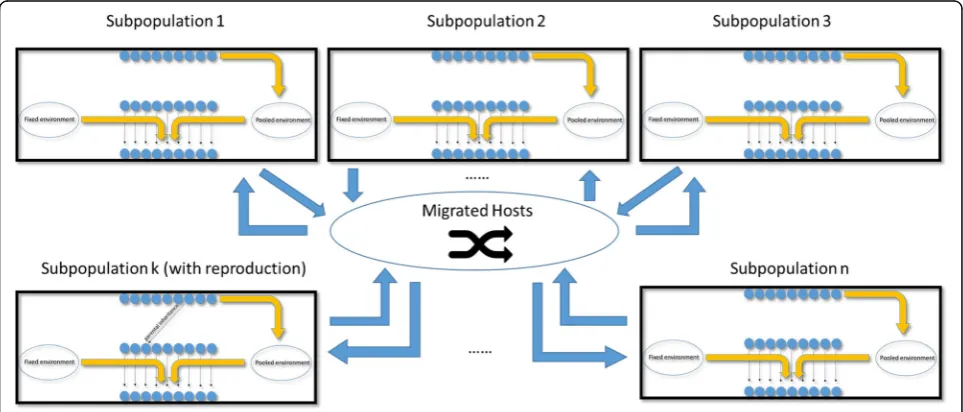
By taking account of metacommunity structure and dispersal limitation, our framework views a host popula-tion as a collecpopula-tion of host subcommunities and their as-sociated microbial communities, with exchanges of hosts and microbes that depend on the rates of host migration among communities: as hosts move between subpopula-tions, they carry their microbes with them and are able to pass these microbes on to offspring or the environ-ment within their new subpopulation.
Our results indicate that in the absence of any subpop-ulation structure, parental contribution to microbial availability suppresses microbial diversity within individ-ual hosts but increases the heterogeneity between hosts. We see the same pattern with our long-term models of neutral microbiome evolution [1]. In contrast, more complicated patterns of diversity are generated in the presence of host population substructure and migration. In particular, subdivided host populations promote local extinction of microbial taxa and inter-host differences in microbiome composition, although these effects are ameliorated by frequent host migrations.
Models
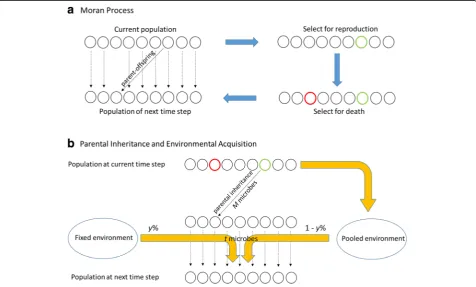
the basic framework to simulate the stochastic changes in a host population of constant size with overlapping genera-tions. A Moran model with host population sizeNhasN
time steps for one host generation and allows one random host reproduction and one random host death at each time step (Fig.1a). As is described in Fig.1b, this Moran genea-logical process is included into the overall framework in a similar way as the Wright-Fisher process was incorporated under our previously proposed long-term neutral models of microbiome evolution, which allows us to model offspring microbiome acquisition and environmental microbiome as-sembly similarly as well (Fig.1b).
We define the direct parental microbial contribution as the expected average percentage of microbes from the parent to its offspring over one host generation (i.e., over theNtime steps). In our models, the single offspring that is produced at each time step obtains its microbiome by sampling exclusively from the microbiome of the parent. At each subsequent time step, some proportion of a host’s microbiome is sampled from the environment, and the
rest is sampled from that individual’s“previous self” (i.e., that same individual’s microbiome in the preceding time step). In this way, a host’s microbiome is acquired as a mixture of parent and environmental microbial communi-ties. We refer to this as a“mixed acquisition”process, in-dicated by MAx, where x% is the percentage of the
microbiome recovered from the parent.
As with microbial acquisition, a mixture of processes determine the composition of the pool of microbes avail-able from environment:
A“fixed”environmental component (FE), whereby all microbial OTUs are available to hosts at every time step at an unchanging relative abundance. A“pooled”environmental component (PE), in which
the microbial composition is determined by the relative abundance of OTUs in the total microbial pool from all hosts in the previous time step. A“mixed”environmental source (MEy) that contains
a percentage, y%, from the parental pool of
Fig. 1Microbiome parental inheritance and environmental acquisition under Moran process. (a) The diagram shows a population of hosts evolving under a standard Moran process, where the green circle indicates a dying host and the red circle indicates a reproducing host. The reproduced offspring will replace the dead one.N(whereNis the population size) time steps of the abovementioned events are equivalent to one host generation. (b) The yellow arrows signify the flow of microbes from hosts to environment (pooled environment is a collection of microbes available in the current host population) and from environment to hosts (both fixed environment and pooled environment contribute to host microbiomes at next time step and the ratio ofy% and 1-y% is determined by the environment assembly mode MEy). Parental inheritance of
microbes only exists for newly reproduced offspring:M(the total number of microbes per host) microbes are inherited from parents at birth. All the hosts acquiretmicrobes from local environments at each time step:t¼aMN, whereMis the total number of microbes per host,Nis the host population size,asatisfiesx¼1−e−a
a , andxis the expected percentage of parental microbes over one host generation determined by MAx
microbes, and (100-y)% of microbes from the fixed environment.
The acquisition and assembly of microbes in each host’s microbiome, and in the environmental pools, are driven by stochastic sampling under the assumption of ecological equivalence of hosts and microbes. The proportion of microbiome recruited from the host’s pre-vious self is calculated as a function of parental contri-bution, so that over N time steps, the contribution at each time step will integrate to a total that is equal to the percent parental contribution per generation, x%. Unlike the direct contribution of a host to itself from one time step to the next, there is no need to integrate over all time steps for the hosts’contribution to the en-vironmental pool. This is because contributions from the host population in any given time step to the envir-onment completely replace all previous contributions by hosts; thus, using a host contribution ofy% to the envir-onmental pool at each time step equates toy% host con-tribution over allNtime steps.
Host population structure and dispersal limitation are in-corporated after the basic platform is built (Fig. 2). With host population substructure, we allow a host population to be subdivided into several small subpopulations (often called“demes”; we use the two words interchangeably) with each subpopulation sharing a local environmental microbial community. Each local environment still consists of two parts: a fixed environmental (FE) component, which is a large multinomial sample from a common environmental microbiome, and a pooled environmental (PE) component,
which is constituted by the microbiomes of hosts resident in a given subpopulation. The subpopulations may be com-pletely isolated if no host migration is allowed; alternatively, with a non-zero host dispersal rate, a certain proportion of hosts in a subpopulation become “migrants.” All migrants are aggregated into a common pool, and then assigned ran-domly to each of the subpopulations. It is possible therefore that a “migrant” from a particular subpopulation is reas-signed to that same population, although this probability decreases as the number of subpopulations increases.
The initial subpopulations of hosts (and their associ-ated microbiomes) are constructed by performing pro-gressive bifurcations of the host population, followed by independent resampling of microbiomes at each bifur-cating node to generate independent instances of micro-biomes for each subpopulation.
The Moran process allows us to model microbial flux within the host at a relative fine-grained timescale. For instance, in our simulations, we assume a metapopula-tion of 4096 hosts. Each generametapopula-tion is divided into 4096 time steps. If we apply our framework to a human popu-lation with an expected generation time of 30 years [38], then each time step corresponds to 64 h. In other words, our framework would allow hosts to recruit and ex-change new microbes about every two-and-half days.
Results
Microbiome diversity dynamics in absence of subpopulation structure
At each time step of our simulations, we measured microbiome diversities within hosts (α-diversity) and
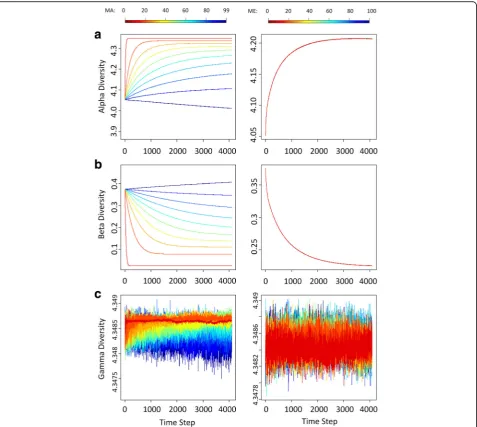
within the whole population of hosts (γ-diversity) with the Shannon-Wiener Index and measured microbiome diversity between hosts (β-diversity) with the Bray-Curtis dissimilarity measure. In the absence of any population structure, our short-term simulations indicate that if there is high parental inheritance of microbiomes, hosts are apt to lose microbial species stochastically over time, resulting in low species diversity within hosts (α-diversity) and high differences between hosts (β-diversity) (Fig.3b). In contrast, if microbiomes are obtained largely from the environment, a common environmental pool exerts a homogenizing effect, decreasing the difference between hosts (β-diversity) but enhancing the species richness and evenness within hosts (α-diversity) (Fig. 3a). Diversity
across the whole population of hosts,γ-diversity, does not vary markedly over a single host generation regardless of how hosts acquire their microbes (Fig. 3c). Interestingly, the differences in parental contribution to a pooled envir-onmental do not lead to significantly different values ofα -and β-diversities in the absence of population structure (Fig.3a, b).
Whereas the patterns of α-diversity obtained with our single-generation and long-term models are similar, the two models differ in the patterns obtained forγ-diversity and β-diversity [1]. In our long-term simulations [1],
γ-diversity gradually declines instead of staying or fluctu-ating at the initial level, and β-diversity grows only for the first few generations and then declines under direct
Fig. 3Diversity trace plots over time under different MAxand MEyin absence of population division. Each row labeled with (a), (b), or (c) represents
or indirect (via contributions to the environment) paren-tal transmission. We think these differences between our short-term and long-term simulations result from the augmented ecological drifts at the level of the host population: the persistence and extinction of host line-ages tend to intensify the demographic stochasticity in microbiomes over time and leads to the long-term de-pressive effects onγ- andβ- diversities. This can only be captured by our long-term simulations, since it takes many host generations for a host population to lose a substantial number of lineages.
Microbiome diversity patterns with subpopulation structure and host migration
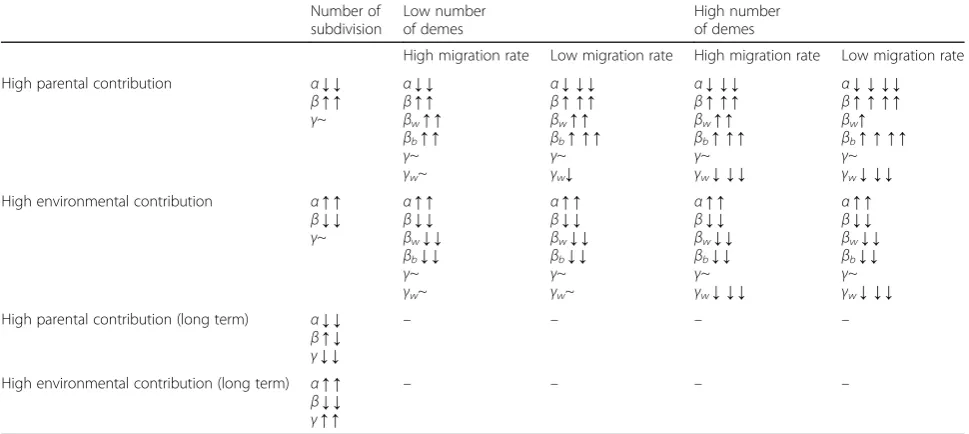
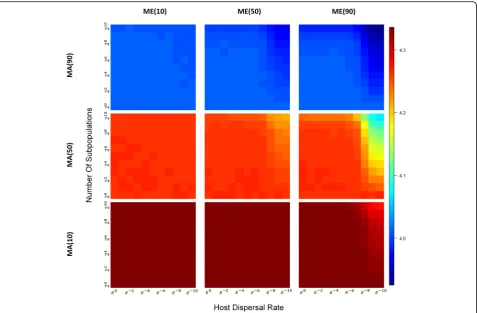
With population subdivision, different patterns ofα-,β-, and γ-diversities are obtained depending on the extent to which hosts contribute indirectly to the environment or directly to offspring, host migration rates, and the number of demes in the population (Table 1). When microbiomes are largely acquired from the environment (Fig.4, bottom row), the number of demes and dispersal limitation show little effect onα-diversity, except at very low host migration rates. However, as parental contribu-tion increases, either directly to offspring or indirectly through a contribution to the environment, we see that
α-diversity decreases (Fig. 4), as the number of demes increase and the migration rate decreases.
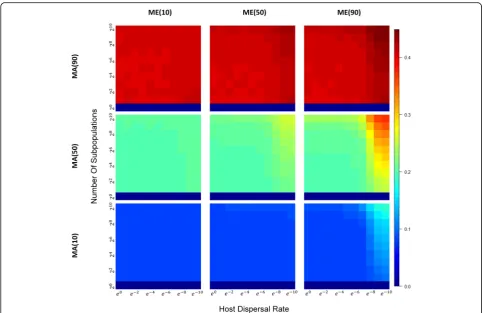
We see the converse with between-host diversity, both for hosts between demes (i.e., βb-diversity; Fig. 5), and
within demes (βw-diversity; Fig.6): when direct or
indir-ect parental contribution is low and between-host diver-sity is low. Interestingly, if we compare βb-diversity to
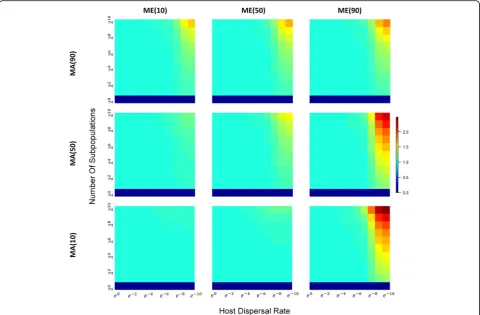
βw-diversity (Fig.7), we see that as the number of demes
increase, and host migrations decrease, differences between hosts in different demes is greater than the dif-ferences between hosts in the same deme. This makes sense, of course, because a highly divided population under limited host migration is equivalent to having many “islands” of small isolated subpopulations. βw
-diversity tend to decrease as small subpopulations are more apt to be homogenized by a shared environ-ment; βb-diversity tend to be elevated because
subpopulation structure and isolation allow each sub-population to evolve with greater independence and stochastic differences between subpopulations grad-ually accumulate over time.
What about microbial γ-diversity of the collection of hosts across all subpopulations, i.e., the host metapopu-lation? As opposed to changes that may occur in the environmental microbial component within demes,
γ-diversity across the metapopulation is not affected by population subdivision (Additional file 1: Figure S1). In retrospect, perhaps this is unsurprising: under a neutral model of microbiome dynamics, a single host gener-ation does not appear to be able to alter microbial di-versity across the entire population. However, as the number of demes increases, and migration rates de-crease, within-deme γw-diversity decreases (Additional
file2: Figure S2). This is because microbial species car-ried by migrants diversify local communities and indi-vidual microbiomes. As the numbers of migrants decrease, there is less opportunity to homogenize the microbial composition in different demes, although metapopulation microbial diversity is maintained. Therefore, it is possible to see microbial γ-diversity of
Table 1Summary ofα-,β-, andγ-diversity patterns under different scenariosa
Number of subdivision Low number of demes High number of demes
High migration rate Low migration rate High migration rate Low migration rate
High parental contribution α↓ ↓
β↑ ↑ γ~
α↓ ↓ β↑ ↑ βw↑ ↑ βb↑ ↑ γ~
γw~
α↓ ↓ ↓ β↑ ↑ ↑ βw↑ ↑ βb↑ ↑ ↑ γ~
γw↓
α↓ ↓ ↓ β↑ ↑ ↑ βw↑ ↑ βb↑ ↑ ↑ γ~
γw↓ ↓ ↓
α↓ ↓ ↓ ↓ β↑ ↑ ↑ ↑ βw↑ βb↑ ↑ ↑ ↑ γ~
γw↓ ↓ ↓ High environmental contribution α↑ ↑
β↓ ↓ γ~
α↑ ↑ β↓ ↓ βw↓ ↓ βb↓ ↓ γ~
γw~
α↑ ↑ β↓ ↓ βw↓ ↓ βb↓ ↓ γ~
γw~
α↑ ↑ β↓ ↓ βw↓ ↓ βb↓ ↓ γ~
γw↓ ↓ ↓
α↑ ↑ β↓ ↓ βw↓ ↓ βb↓ ↓ γ~
γw↓ ↓ ↓ High parental contribution (long term) α↓ ↓
β↑ ↓ γ↓ ↓
– – – –
High environmental contribution (long term) α↑ ↑
β↓ ↓ γ↑ ↑
– – – –
a
the metacommunity of hosts remaining relatively stable for different degrees of population fragmentation but decreasing within each subpopulation.
Discussion
In this paper, we introduce an agent-based computa-tional framework that implements short-term neutral models of microbiome dynamics using a Moran process. The framework presented here has many points of simi-larity with the long-term computational framework de-veloped earlier [1], including the application of different acquisition and environmental assembly modes. How-ever, unlike the Wright-Fisher process that was used in our long-term framework, the Moran process allows us to investigate the temporal dynamics and diversity pat-terns of microbiomes within a single host generation. We have included host dispersal and subpopulation structure in our short-term models to help us explore the effects of dispersal limitation on microbiome diver-sities. Empirically, these subpopulations may correspond to different host communities, locales, or family groups. Although our short-term models do not include
non-random shifts in microbial composition and/or host dynamics caused by dietary or environmental changes, illness, antimicrobial therapies, etc., it is theoretically easy to incorporate these types of events into the Moran model, because we are able to perturb the dynamics of the system at discrete time steps. Adding these exten-sions to our framework is an obvious next step.
Under our short-term framework, each host’s first microbes are acquired from parents at birth (vertical transmission). The seeding effects of early exposure to maternal environments on initial microbial communities have been studied for humans and other mammals [39– 41]. Postnatal microbial succession is abstracted in our models via a constant process of microbial recruitment from a host’s previous self (i.e., the same host in the pre-vious time step) and the environment (horizontal trans-mission). In fact, as hosts age, both human and plant examples [4, 42, 43] show a successional trend in indi-vidual microbiomes from low diversity to high diversity gradually reaching a steady state, most likely a conse-quence of persistent microbial colonization from the en-vironment. Our simulations here also recover the same
Fig. 4Heatmaps ofα-diversity across a range of subpopulation sizes and host dispersal rate under different combinations of MAxand MEy.Each
heatmap corresponds to a combination of MAxand MEyboth of which has three levels (10%, 50%, and 90%). For each heatmap, horizontal and
trend (Additional file 3: Figure S3). Varying the propor-tion of parental contribupropor-tion and environmental contri-bution under the short-term models has similar impacts on α- and β-diversities as they do with our the long-term models (Table 1) [1], although population subdiv-ision appears to intensify these effects. Similar patterns were also observed in some natural communities; for in-stance, cnidarian hosts that acquire their algal symbionts horizontally appear to harbor more diverse communities than hosts that acquire their symbionts vertically [44].
A point of contrast between our short-term and long-term models was observed with γ-diversity, with the long-term models having lower levels of whole-population diversity relative to our short-term models. We believe that this is a consequence of imposing a Wright-Fisher genealogical model on our long-term sim-ulations. Under such a genealogy, we expect that after a sufficient number of generations have elapsed (on aver-age 2 N generations, for haploid hosts, or 4N, for dip-loid hosts), all individuals will be descended from a common ancestor. Depending on the rates of parental contribution to the environment, we are likely to see
greater loss of whole-population microbial diversity in long-term models, relative to our short-term models.
Our short-term models also include the effects of dis-persal limitation in a structured host population, and they allow us to recover the patterns of diversity shaped by shared environments that we see in real-world situa-tions. For example, a comparative study on the human gut microbiome indicated significant species diversity differences between a farming group and an urban con-trol group as well as between males and females in the farming group [45]. The uncommon sexual differenti-ation of gut microbiomes in Hadza is believed to be as-sociated with the sexual division of labor and diet in this special hunter-gatherer community. This marked hetero-geneity between different social groups provides empir-ical evidence for the predictions of our models about population division and shared environment onβ -diver-sity. Similarly, more skin and oral microbiota were found to be shared between cohabiting adults than with other individuals regardless of host genetic relatedness [46– 48]. These interesting observations are consistent with our predictions of increased microbiome similarity
Fig. 5Heatmaps ofβb-diversity across a range of subpopulation sizes and host dispersal rates under different combinations of MAxand MEy.With
within-host subpopulations and decreased microbiome similarity between host subpopulations (Figs.5,6, and7) and highlight the dominant role of shared environments in determining microbiome compositions that contrast with the effects of selective factors from host genetics.
To summarize, in this paper, we present a computa-tional framework to model the host-microbe dynamics with and without population subdivision, over a single host generation. As with our previously proposed long-term framework [1], we model microbiome dynamics within a host population and consider a shared evolution-ary history between hosts and microbes by simulating host genealogy. Our results confirm what theory tells us to ex-pect: as we increase the number of subpopulations and decrease the rate of host exchanges between the subpopu-lations, we see decreasing levels of within-host diversity and increasing levels of between-host diversity [49]. Both are likely consequences of the increasing effects of eco-logical drift acting on microbial communities from local environmental and/or host communities. The incorpor-ation of host subpopulincorpor-ation structure and dispersal limita-tion also highlights the significant effects of shared environment in shaping core microbiome within subpop-ulations in the absence of selection.
But if our models confirm what community microbial theory predicts, what value do these models have? We believe that the value of our computational models re-sides in the assumptions and processes that underlie the models’ framework. By stating explicitly what these as-sumptions and processes are, our models can be exam-ined and modified. In effect, our models, and others like them, serve as computational“proofs” of microbial eco-logical theory. And by making our models as simple as possible, they also serve as “null hypotheses” for statis-tical tests, allowing researchers to perform forward neu-tral simulations using their own empirical microbiome data as the initial microbiomes to forecast short-term dynamics under custom settings of parental/environ-ment contribution and host population structures.
The Moran model used here is also particularly flexible, allowing users to intercept simulated populations at any time step to accommodate transient or sustained changes in hosts, microbes, and environments. It is also possible to extend the framework to include the effects of selection acting on hosts and/or microbes, as we have done recently [50]. As we noted above, the important role of non-neutral effects in microbiome assembly has been investi-gated and demonstrated by others [25,27,51]. We expect
Fig. 6Heatmaps ofβw-diversity across a range of subpopulation sizes and host dispersal rates under different combinations of MAxand MEy.
the incorporation of selection into our current framework may further drive the differentiation of microbiomes be-tween host subpopulations and facilitate the establishment of core microbiomes within each deme.
Conclusions
Previous empirical studies suggest a need for ecological and evolutionary frameworks to investigate short-term dy-namics of microbiomes. Here we present a computational framework that incorporates models that take account of multiple ecological or evolutionary processes including host genealogy, microbe acquisition, environmental microbiome assembly, host subpopulation structures, and migration to model microbiome dynamics within a single host generation. Our simulated results indicate that high parental inheritance raised microbiome differences between hosts, while high environmental contribution in-creased microbiome diversity within hosts. Our frame-work also shows that host subpopulation structure and dispersal limitation can further reshape the diversity pat-terns when host contribution to offspring microbiome is high. Highly fragmented host population with limited dis-persal rate increases the overallβ-diversity andβ-diversity
between subpopulations and decreases β-diversity within subpopulations andα-diversity.
Methods
As mentioned before, we implemented our short-term simulations in a similar way as we did for our long-term neutral framework. The simulated host population has a constant size ofNhosts (N= 4096). Each host is allocated a virtual microbiome with capacity of M microbes (M= 107). In order to initialize the simulations, we obtained empirical human microbiome data at the genus level from HMP website (https://www.hmpdacc.org/
HMSMCP/). The initial microbiomes are resampled from
a truncated and rescaled multivariate normal distribution (trMVN) which is fitted to the empirical microbiome data from human stool samples [52]. A Kolmogorov-Smirnov test demonstrates that the resampled microbiome data still maintains the same microbial abundance and diversity distributions of empirical data.
For the sake of simplicity, we have the same number of hosts in each subpopulation (the methods can be modified to allow different subpopulation sizes to be simulated). As noted above, the total number of hosts is
Fig. 7Heatmaps of ratio ofβb-diversity toβw-diversity across a range subpopulation sizes and host dispersal rates under different combinations
of MAxand MEy.With a similar layout, all heatmaps are also plotted in the same way as those in Fig.4except thatβ-diversity ratio instead ofα
4096 = 212. To construct ksubpopulations, we construct a complete binary tree withklevels. For example, when
k= 1, there is a root node on the tree, and two terminal nodes, representing the two host subpopulations. The microbiome at the root node is described by the trMVN fitted with empirical data. The microbiomes at any node that represents a subpopulation are also described by a trMVN drawn from the trMVN of its parental node. The hosts within each subpopulation represent random draws from the microbiome of the subpopulation. In this way, we are able to generate host microbiomes in 2k equally sized subpopulations, wherek∈[ℤ; 0,d].
The fixed environmental microbiome was simulated by pooling all empirical human stool microbiome data. Thus, the total number of OTUs we simulated is the total num-ber of genera contained in this empirical human micro-biome dataset (g= 129). Of course, simulating less or more OTUs at higher or lower taxonomical ranks is also possible. It is plausible to conjecture that increasing the total number of OTUs will be expected to reduce the aver-age population size per microbial taxon and thus increase the sensitivity of microbiomes to the effect of ecological drifts since rare OTUs are more likely to be affected by demographic stochasticity [53–55]. Therefore, under high host contribution with/without subpopulation structures,
α-diversity may decrease further and β-diversity may in-crease further. We do not believe that this will alter the qualitative results that we have obtained.
Under the scenario of MEy, environmental
micro-biomes !e are updated at each time step by mixing two environmental components as follows:
e
! ¼ð1−yÞ!f þyp;!
where !f and !p represent the fixed environment and pooled environment, respectively. As noted above, the pooled environmental microbiomes !p are constructed by pooling all the microbes in the current host popula-tions if no host population structure is simulated, or in the corresponding host subpopulations when the host population is segmented:
p
! ¼1
n Xn i¼1 a ! i;
where!airepresent the microbiome composition of host iin current subpopulation/population of sizen.
Under the scenario of MAx, the newborn offspring
always inherits their initial microbiome (107 microbes) from the parent and then continues to acquire microbes at a constant rate (v microbes per time step) from the environment. Let T be the total number of microbes acquired from the environment within one host generation; at each time step, one
host receives t=T/N microbes from the environment. Let M denote the total number of microbes in one microbiome. The expected average percentage of parental microbes over one host generation, x, can be written as follows:
x¼ 1
N X N−1
i¼0 M
Mþt
i
≈ lim
N→∞
1
N XN−1
i¼0 M
Mþt
i
¼1−e−a
a ;
where a¼MT¼NtM . By solving the abovementioned equation, we can find out the value of a correspond-ing to any parental contribution; this gives us the number of microbes each host acquires from the en-vironment at one time step for the implementation of simulations. Since our long-term models also interpret parental contribution as the expected percentage of parental microbes over one host generation, the par-ental contribution x defined above is equivalent with the parental contribution parameter defined under our long-term models.
As is mentioned before, the initial host population structure is formed by performing progressive bifur-cation of the host population and hierarchical clustering of the initial microbiomes. Each cluster of host micro-biomes represents an initial host subpopulation. At each time step, we randomly select one host subpopulation for the event of host reproduction and death. Then, we draw zj hosts from host subpopulation j as migrating
hosts with zj~Bin(nj,q). Bin(nj,q) represents a binomial
distribution, where nj is the size of subpopulationjand q is the host dispersal rate. We shuffle all the migrating hosts from the whole population and randomly reassign them back to their new subpopulations.
Additional files
Additional file 1:Figure S1.Heatmaps ofγ-diversity across a range subpopulation sizes and host dispersal rates under different combinations of MAxand MEy.With a similar layout, all heatmaps are also plotted in the same way as those in Fig.4except thatγ-diversity instead ofα -diversity is measured. (TIF 3353 kb)
Additional file 2:Figure S2.Heatmaps of averageγw-diversity across a range subpopulation sizes and host dispersal rates under different combinations of MAxand MEy.With a similar layout, all heatmaps are also plotted in the same way as those in Fig.4except thatγw-diversity within subpopulations instead ofα-diversity is measured. (TIF 1286 kb)
Additional file 3:Figure S3.α-diversity trace plots of individual microbiomes over host lifespan. Individual within-host diversity plots show under both structured population (1024 demes and host migration rate =e−10) and unstructured population, individualα-diversity increases along time after birth. The blue lines represent hosts who are still alive before our simulation ends. The red lines represent hosts whose death events are observed by the end of our simulation. (TIF 5367 kb)
Abbreviations
MAx:Mixed acquisition withx% from parental inheritance and (1-x)% from environment; MEy: Mixed environmental microbiome withy% from pooled environment and (1-y)% from fixed environment
Acknowledgments
We have benefited from discussions with Yuantong Ding, Louis Ranjard, Thomas Wong, and Steven Wu. We thank two reviewers and the Associate Editor for comments that helped us improve the manuscript substantially.
Funding
This research was supported by funds to QZ and AR from Duke University.
Availability of data and materials
All data generated or analyzed during this study can be easily simulated from the source code we provide on githubhttps://github.com/qz28/MetaSTM.git.
Authors’contributions
QZ did most of the coding work, implemented all the computational experiments, and analyzed all the simulated data. AR supervised the whole project and interpreted the results. Both QZ and AR were major contributors in writing the manuscript. All authors read and approved the final manuscript.
Ethics approval and consent to participate
Not applicable.
Competing interests
The authors declare that they have no competing interests.
Publisher’s Note
Springer Nature remains neutral with regard to jurisdictional claims in published maps and institutional affiliations.
Received: 22 February 2018 Accepted: 19 April 2018
References
1. Zeng Q, Sukumaran J, Wu S, Rodrigo A. Neutral models of microbiome evolution. PLoS Comput Biol. 2015;11:e1004365.
2. Gajer P, Brotman RM, Bai G, Sakamoto J, Schutte UM, Zhong X, Koenig SS, Fu L, Ma ZS, Zhou X, et al. Temporal dynamics of the human vaginal microbiota. Sci Transl Med. 2012;4:132ra152.
3. Grice EA, Kong HH, Conlan S, Deming CB, Davis J, Young AC, Program NCS, Bouffard GG, Blakesley RW, Murray PR, et al. Topographical and temporal diversity of the human skin microbiome. Science. 2009;324:1190–2. 4. Koenig JE, Spor A, Scalfone N, Fricker AD, Stombaugh J, Knight R, Angenent
LT, Ley RE. Succession of microbial consortia in the developing infant gut microbiome. Proc Natl Acad Sci U S A. 2011;108(Suppl 1):4578–85.
5. Claus SP, Tsang TM, Wang Y, Cloarec O, Skordi E, Martin FP, Rezzi S, Ross A, Kochhar S, Holmes E, Nicholson JK. Systemic multicompartmental effects of the gut microbiome on mouse metabolic phenotypes. Mol Syst Biol. 2008;4:219. 6. Turnbaugh PJ, Ley RE, Mahowald MA, Magrini V, Mardis ER, Gordon JI. An
obesity-associated gut microbiome with increased capacity for energy harvest. Nature. 2006;444:1027–31.
7. Backhed F, Roswall J, Peng Y, Feng Q, Jia H, Kovatcheva-Datchary P, Li Y, Xia Y, Xie H, Zhong H, et al. Dynamics and stabilization of the human gut microbiome during the first year of life. Cell Host Microbe. 2015;17:852. 8. Duguma D, Hall MW, Rugman-Jones P, Stouthamer R, Terenius O, Neufeld
JD, Walton WE. Developmental succession of the microbiome of Culex mosquitoes. BMC Microbiol. 2015;15:140.
9. McKenney EA, Rodrigo A, Yoder AD. Patterns of gut bacterial colonization in three primate species. PLoS One. 2015;10:e0124618.
10. Newburg DS, Morelli L. Human milk and infant intestinal mucosal glycans guide succession of the neonatal intestinal microbiota. Pediatr Res. 2015;77:115–20. 11. Cho I, Yamanishi S, Cox L, Methe BA, Zavadil J, Li K, Gao Z, Mahana D, Raju
K, Teitler I, et al. Antibiotics in early life alter the murine colonic microbiome and adiposity. Nature. 2012;488:621–6.
12. Jakobsson HE, Jernberg C, Andersson AF, Sjolund-Karlsson M, Jansson JK, Engstrand L. Short-term antibiotic treatment has differing long-term impacts on the human throat and gut microbiome. PLoS One. 2010;5:e9836. 13. Langdon A, Crook N, Dantas G. The effects of antibiotics on the
microbiome throughout development and alternative approaches for therapeutic modulation. Genome Med. 2016;8:39.
14. David LA, Maurice CF, Carmody RN, Gootenberg DB, Button JE, Wolfe BE, Ling AV, Devlin AS, Varma Y, Fischbach MA, et al. Diet rapidly and reproducibly alters the human gut microbiome. Nature. 2014;505:559–63. 15. Muegge BD, Kuczynski J, Knights D, Clemente JC, Gonzalez A, Fontana L, Henrissat
B, Knight R, Gordon JI. Diet drives convergence in gut microbiome functions across mammalian phylogeny and within humans. Science. 2011;332:970–4. 16. Turnbaugh PJ, Ridaura VK, Faith JJ, Rey FE, Knight R, Gordon JI. The effect of
diet on the human gut microbiome: a metagenomic analysis in humanized gnotobiotic mice. Sci Transl Med. 2009;1:6ra14.
17. Matsumoto M, Inoue R, Tsukahara T, Ushida K, Chiji H, Matsubara N, Hara H. Voluntary running exercise alters microbiota composition and increases n-butyrate concentration in the rat cecum. Biosci Biotechnol Biochem. 2008;72:572–6. 18. Santacruz A, Marcos A, Warnberg J, Marti A, Martin-Matillas M, Campoy C,
Moreno LA, Veiga O, Redondo-Figuero C, Garagorri JM, et al. Interplay between weight loss and gut microbiota composition in overweight adolescents. Obesity (Silver Spring). 2009;17:1906–15.
19. Dethlefsen L, Relman DA. Incomplete recovery and individualized responses of the human distal gut microbiota to repeated antibiotic perturbation. Proc Natl Acad Sci U S A. 2011;108(Suppl 1):4554–61.
20. Lozupone CA, Stombaugh JI, Gordon JI, Jansson JK, Knight R. Diversity, stability and resilience of the human gut microbiota. Nature. 2012;489:220–30. 21. Gillilland MG 3rd, Erb-Downward JR, Bassis CM, Shen MC, Toews GB, Young VB,
Huffnagle GB. Ecological succession of bacterial communities during conventionalization of germ-free mice. Appl Environ Microbiol. 2012;78:2359–66. 22. Peterfreund GL, Vandivier LE, Sinha R, Marozsan AJ, Olson WC, Zhu J,
Bushman FD. Succession in the gut microbiome following antibiotic and antibody therapies for Clostridium difficile. PLoS One. 2012;7:e46966. 23. Parks BW, Nam E, Org E, Kostem E, Norheim F, Hui ST, Pan C, Civelek M, Rau
CD, Bennett BJ, et al. Genetic control of obesity and gut microbiota composition in response to high-fat, high-sucrose diet in mice. Cell Metab. 2013;17:141–52.
24. Srinivas G, Moller S, Wang J, Kunzel S, Zillikens D, Baines JF, Ibrahim SM. Genome-wide mapping of gene-microbiota interactions in susceptibility to autoimmune skin blistering. Nat Commun. 2013;4:2462.
25. Bonder MJ, Kurilshikov A, Tigchelaar EF, Mujagic Z, Imhann F, Vila AV, Deelen P, Vatanen T, Schirmer M, Smeekens SP. The effect of host genetics on the gut microbiome. Nat Genet. 2016;48:1407.
26. Jeraldo P, Sipos M, Chia N, Brulc JM, Dhillon AS, Konkel ME, Larson CL, Nelson KE, Qu A, Schook LB, et al. Quantification of the relative roles of niche and neutral processes in structuring gastrointestinal microbiomes. Proc Natl Acad Sci U S A. 2012;109:9692–8.
27. Ley RE, Peterson DA, Gordon JI. Ecological and evolutionary forces shaping microbial diversity in the human intestine. Cell. 2006;124:837–48. 28. Martiny JB, Bohannan BJ, Brown JH, Colwell RK, Fuhrman JA, Green JL,
29. Adams RI, Miletto M, Taylor JW, Bruns TD. Dispersal in microbes: fungi in indoor air are dominated by outdoor air and show dispersal limitation at short distances. ISME J. 2013;7:1262–73.
30. Ofiteru ID, Lunn M, Curtis TP, Wells GF, Criddle CS, Francis CA, Sloan WT. Combined niche and neutral effects in a microbial wastewater treatment community. Proc Natl Acad Sci U S A. 2010;107:15345–50.
31. Peay KG, Garbelotto M, Bruns TD. Evidence of dispersal limitation in soil microorganisms: isolation reduces species richness on mycorrhizal tree islands. Ecology. 2010;91:3631–40.
32. Costello EK, Stagaman K, Dethlefsen L, Bohannan BJ, Relman DA. The application of ecological theory toward an understanding of the human microbiome. Science. 2012;336:1255–62.
33. Christian N, Whitaker BK, Clay K. Microbiomes: unifying animal and plant systems through the lens of community ecology theory. Front Microbiol. 2015;6:869. 34. Mihaljevic JR. Linking metacommunity theory and symbiont evolutionary
ecology. Trends Ecol Evol. 2012;27:323–9.
35. Poulin R. Parasites and the neutral theory of biodiversity. Ecography. 2004; 27:119–23.
36. Sloan WT, Lunn M, Woodcock S, Head IM, Nee S, Curtis TP. Quantifying the roles of immigration and chance in shaping prokaryote community structure. Environ Microbiol. 2006;8:732–40.
37. Moran PAP. Random processes in genetics. Math Proc Camb Philos Soc. Cambridge University Press. 1958;54(1):60–71.
38. Tremblay M, Vezina H. New estimates of intergenerational time intervals for the calculation of age and origins of mutations. Am J Hum Genet. 2000;66:651–8.
39. Dominguez-Bello MG, Costello EK, Contreras M, Magris M, Hidalgo G, Fierer N, Knight R. Delivery mode shapes the acquisition and structure of the initial microbiota across multiple body habitats in newborns. Proc Natl Acad Sci U S A. 2010;107:11971–5.
40. Mueller NT, Bakacs E, Combellick J, Grigoryan Z, Dominguez-Bello MG. The infant microbiome development: mom matters. Trends Mol Med. 2015;21:109–17. 41. Ottman N, Smidt H, de Vos WM, Belzer C. The function of our microbiota: who
is out there and what do they do? Front Cell Infect Microbiol. 2012;2:104. 42. Arnold AE, Herre EA. Canopy cover and leaf age affect colonization by
tropical fungal endophytes: ecological pattern and process in Theobroma cacao (Malvaceae). Mycologia. 2003;95:388–98.
43. Voriskova J, Baldrian P. Fungal community on decomposing leaf litter undergoes rapid successional changes. ISME J. 2013;7:477–86. 44. Barneah O, Weis V, Perez S, Benayahu Y. Diversity of dinoflagellate
symbionts in Red Sea soft corals: mode of symbiont acquisition matters. Mar Ecol Prog Ser. 2004;275:89–95.
45. Schnorr SL, Candela M, Rampelli S, Centanni M, Consolandi C, Basaglia G, Turroni S, Biagi E, Peano C, Severgnini M, et al. Gut microbiome of the Hadza hunter-gatherers. Nat Commun. 2014;5:3654.
46. Song SJ, Lauber C, Costello EK, Lozupone CA, Humphrey G, Berg-Lyons D, Caporaso JG, Knights D, Clemente JC, Nakielny S, et al. Cohabiting family members share microbiota with one another and with their dogs. elife. 2013;2:e00458. 47. Shaw L, Ribeiro AL, Levine AP, Pontikos N, Balloux F, Segal AW, Roberts AP,
Smith AM. The human salivary microbiome is shaped by shared environment rather than genetics: evidence from a large family of closely related individuals. MBio. 2017;8:e01237–17.
48. Stahringer SS, Clemente JC, Corley RP, Hewitt J, Knights D, Walters WA, Knight R, Krauter KS. Nurture trumps nature in a longitudinal survey of salivary bacterial communities in twins from early adolescence to early adulthood. Genome Res. 2012;22:2146–52.
49. Economo EP, Keitt TH. Species diversity in neutral metacommunities: a network approach. Ecol Lett. 2008;11:52–62.
50. Zeng Q, Wu S, Sukumaran J, Rodrigo A. Models of microbiome evolution incorporating host and microbial selection. Microbiome. 2017;5:127. 51. Bonder MJ, Tigchelaar EF, Cai X, Trynka G, Cenit MC, Hrdlickova B, Zhong H,
Vatanen T, Gevers D, Wijmenga C. The influence of a short-term gluten-free diet on the human gut microbiome. Genome Med. 2016;8:45.
52. McArdle BH, Anderson MJ. Fitting multivariate models to community data: a comment on distance-based redundancy analysis. Ecology. 2001;82:290–7. 53. Bartlett M. The critical community size for measles in the United States. J R
Stat Soc Ser A (General). 1960;123(1):37–44.
54. Lande R, Engen S, Saether B-E. Stochastic population dynamics in ecology and conservation. Oxford: Oxford University Press on Demand; 2003. 55. Melbourne BA, Hastings A. Extinction risk depends strongly on factors